
Direct to Consumer Microbiome Analyzing Market Size, Growth & Trends by 2034
Coverage: By Product (Gut Microbiome Testing Kits, Health Sample Kits, Other Microbiome Testing Kits); Application (Infections, Gut Conditions, Metabolic Disorders, Cardiovascular Diseases, Others); End-user (Hospitals, Clinics, Diagnostics Centers, Others), and Geography (North America, Europe, Asia Pacific, and South and Central America)
- Status : Data Released
- Report Code : TIPRE00014214
- Category : Life Sciences
- No. of Pages : 150
- Available Report Formats :


- Last update date : July 03, 2026


2025 Market Size
US$ 1.41 Bn
Base year value
2034 Forecast
US$ 5.68 Bn
Projected by 2034
CAGR 2026-2034
16.72 %
Growth rate
Addressable Market
US$ 29.73 Bn
(2026-2034)
The Direct To Consumer Microbiome Analyzing Market was valued at US$ 1.41 Billion in 2025 and is projected to reach US$ 5.68 Billion by 2034, expanding at a CAGR of 16.72% during 2026–2034. Growth is anchored in rising consumer demand for personalized nutrition insights, expanding stool-based sequencing platforms, and increasing integration of microbiome analytics into preventive healthcare models. Continuous improvements in next-generation sequencing and AI-driven interpretation tools are accelerating commercial scalability across global consumer health ecosystems.
North America maintains a structurally advanced position in the Direct To Consumer Microbiome Analyzing market, supported by a CAGR range of 15.8–17.2%. Strong adoption of subscription-based gut health testing, high awareness of preventive diagnostics, and strong presence of leading biotechnology firms strengthen regional momentum. Expansion of digital health ecosystems and integration of microbiome data into wellness platforms further reinforce sustained demand across consumer and clinical-adjacent applications.
Direct to Consumer Microbiome Analyzing Market Assessment and Insights
- North America: North America accounted for 38–42% share of the Direct To Consumer Microbiome Analyzing market share in 2025 and is projected to expand at a CAGR of 15.8%–17.2% during 2026–2034. Growth is driven by strong digital health penetration and increasing adoption of personalized nutrition solutions, which continue to accelerate demand across preventive wellness platforms.
- U.S.: The U.S. represented 78–82% of the North American Direct To Consumer Microbiome Analyzing market size in 2025 and is anticipated to register a CAGR of 16.0%–17.5% during 2026–2034, supported by widespread consumer awareness of gut health, robust digital wellness adoption, and expanding availability of at-home microbiome testing solutions.
- Europe: Europe held 25–29% share of the market in 2025 and is expected to grow at a CAGR of 14.5%–16.0% during 2026–2034. The United Kingdom, Germany, and France remain key contributors, driven by increasing clinical adoption and growing consumer interest in microbiome-based health monitoring.
- Asia Pacific: Asia Pacific accounted for 28–32% share of the market in 2025 and is forecast to expand at a CAGR of 17.0%–18.5% during 2026–2034. China, Japan, and India lead regional growth through rapid expansion of digital wellness ecosystems and increasing biotech investments.
- Largest Segment – Gut Microbiome Testing Kits: Gut microbiome testing kits represented the largest segment and are expected to grow at a CAGR of 16.5%–17.5% during 2026–2034 in the Direct To Consumer Microbiome Analyzing market, driven by strong consumer preference for digestive health monitoring and preventive health screening.
- High Growth Segment – Metabolic Disorders: The metabolic disorders segment is projected to register the fastest growth with a CAGR of 18.0%–19.0% during 2026–2034, supported by increasing linkage of microbiome profiles with metabolic disease risk prediction and management.
- Key companies analyzed in detail: Atlas Biomed Group Limited; Viome Life Sciences, Inc.; 23andMe Holding Co.; Carbiotix AB; BIOMES NGS GmbH; Quantbiome, Inc.; Zymo Research Corporation; Microba Life Sciences Limited; BiomeBank Pty Ltd; TÜBİTAK Marmara Research Center (MAM)
Source: The Insight Partners' analysis based on proprietary research, government publications, company annual reports, investor presentations, industry databases, and expert interviews.
The Direct To Consumer Microbiome Analyzing market report shifted from laboratory-focused microbiology diagnostics to commercially available sequencing tools due to falling prices for genome sequencing. Early products concentrated mainly on providing academic-level microbiome profiling; meanwhile, modern products include AI analysis levels, mobile apps, and health monitoring over time. The shift was driven by companies like Viome Life Sciences, Inc. and 23andMe Holding Co. as they combined genetic and microbiome data into useful consumer information.
Future development is influenced by the merger of preventive healthcare, nutritional science, and digital therapeutics domains. Funding is becoming more concentrated on cloud-based microbiome analytics systems and regional microbiota repositories. There is also growing regulatory harmonization in Europe and Asia Pacific, which facilitates commercial opportunities in both wellness and early disease detection areas.
Direct to Consumer Microbiome Analyzing Market Report Scope
| Report Attribute | Details |
|---|---|
| Market size in 2025 | US$ 1.41 Billion |
| Market Size by 2034 | US$ 5.68 Billion |
| Global CAGR (2026 - 2034) | 16.72% |
| Historical Data | 2021-2024 |
| Forecast period | 2026-2034 |
Direct to Consumer Microbiome Analyzing Market Analysis
The Direct To Consumer Microbiome Analyzing market is heavily affected by growing consumer knowledge about the links between gut-brain axis connections and chronic disease prevention techniques. The growth of demand is fueled by reduced cost of sequencing and faster turnaround time from sample to insights. The ecosystem creation involves collaboration of sequencing providers, cloud-based analysis solutions, and app developers for wellness. Firms like Microba Life Sciences Limited and BIOMES NGS GmbH are developing better bioinformatics skills to make consumer-scale engagement possible.
The growth on the supply side is driven by automation of sequencing processes and the incorporation of artificial intelligence systems for microbial identification. The competitive pressure is building up due to diversification into subscriptions and multi-sample testing solutions. Inter-industry collaborations of diagnostics firms and nutritional science organi
The market is fairly consolidated, with clear differentiation based on the depth of data analysis, database volume, and customer interaction tools. Viome Life Sciences, Inc., and Atlas Biomed Group Limited focus on the application of artificial intelligence to personalized dietary suggestions, whereas 23andMe Holding Co. uses genetic ancestry knowledge to improve the microbiome context. Financial investments are made into platform scaling, clinical testing, and emerging Asian wellness markets.
Positioning strategies are more and more dependent on the availability of microbial reference databases and integrations with health wearable ecosystems. The companies invest in the development of multi-omics platforms using microbiome, metabolome, and genome datasets.
● REPORT CUSTOMIZATION
Tailor This Report To Align With Your Specific Business Requirements
This report can be customized to align precisely with your business objectives, scope, and target markets. Customization options include tailored segmentation, geography, competitive analysis, and strategic insights to support informed decision-making.
Customize This Report →WHAT YOU CAN ADJUST
- ● Segmentations
- ● Geography
- ● Competitive Analysis
- ● Language Preferences
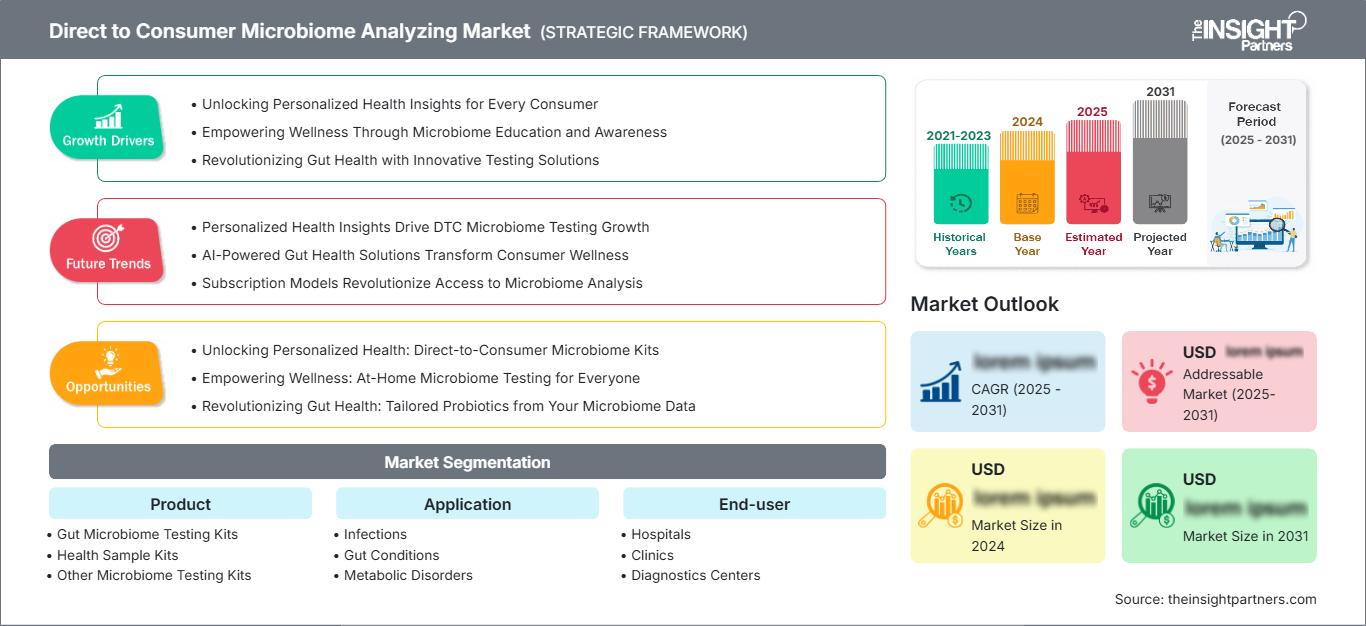
Direct to Consumer Microbiome Analyzing Market: Strategic Insights
Regional Insights
North America Direct To Consumer Microbiome Analyzing Market
North America accounts for a leading share of 38–42% in 2025, supported by a CAGR range of 15.8–17.2%. High consumer willingness to adopt preventive health tools and strong venture capital inflows into biotechnology startups support sustained expansion. The region benefits from mature digital health infrastructure and widespread integration of microbiome insights into wellness platforms.
US Direct To Consumer Microbiome Analyzing Market
The United States dominates regional demand with strong participation from subscription-based testing providers. Increasing use of microbiome data in personalized nutrition planning and chronic disease risk management strengthens the Direct To Consumer Microbiome Analyzing market penetration. Canada contributes through academic-industry collaborations and growing adoption of precision nutrition programs across urban populations.
The U.S. holds 78–82% share within North America and records a CAGR of 16.0–17.5%. Strong consumer demand for gut health optimization and preventive diagnostics drives widespread adoption of at-home microbiome kits. Companies such as Viome Life Sciences, Inc. and 23andMe Holding Co. maintain significant presence through subscription-based analytics ecosystems.
Application trends show rising integration of microbiome insights into metabolic health tracking and dietary personalization platforms. Growth is further reinforced by partnerships between wellness brands and sequencing providers, expanding consumer access to continuous microbiome monitoring services.
Europe Direct To Consumer Microbiome Analyzing Market
Europe contributes 25–29% share in 2025, with a CAGR of 14.5–16.0%. Regulatory clarity around genetic and microbiome data usage enhances consumer confidence. The United Kingdom leads adoption due to strong digital health integration, followed by Germany and France, where clinical research institutions actively validate microbiome-based health models.
There is increased demand for preventive healthcare products in the UK, and for the incorporation of microbiome analysis into nutrition coaching apps. The clinical-grade microbiome analysis, facilitated by biotech companies like BIOMES NGS GmbH, is important in Germany. The use of microbiome analysis in wellness-related consumer health applications is gaining traction in France, Italy, and Spain.
APAC Direct To Consumer Microbiome Analyzing Market
Asia Pacific accounts for 28–32% share and records the highest regional CAGR of 17.0–18.5% in the Direct To Consumer Microbiome Analyzing market. The high rate of urbanization and rising middle-class spending on health care and digital wellness drive demand. China dominates in adopting large-scale consumer tests, whereas Japan emphasizes incorporating advanced research on the microbiome. India is experiencing high growth through telemedicine and preventive nutrition systems.
South Korea and Australia have contributed to regional growth via biotechnology and precision health systems. The growth in Asia Pacific is also supported by government-funded research and increasing investments in microbiome studies. APAC growth is further reinforced by mobile-first health ecosystems and rising consumer interest in personalized diet optimization tools.
Middle East & Africa Direct To Consumer Microbiome Analyzing Market
The region accounts for 5–7% share with a CAGR of 13–15.5%. Growth is driven by rising healthcare modernization initiatives and increasing awareness of preventive wellness solutions. Saudi Arabia and the UAE lead adoption through digital health transformation programs and investments in precision medicine infrastructure.
South Africa demonstrates emerging demand supported by private healthcare expansion and diagnostic awareness campaigns. The Direct To Consumer Microbiome Analyzing market in the Rest of MEA is gradually integrating microbiome testing through wellness clinics and international telehealth partnerships, with infrastructure development shaping long-term adoption potential.
Segmentation Analysis
Gut Microbiome Testing Kits dominate the Direct To Consumer Microbiome Analyzing market, supported by a CAGR of 16.5–17.5%, driven by strong consumer demand for digestive health insights and preventive screening solutions. These kits remain central to direct-to-consumer offerings due to accessibility and clinical relevance.
Health Sample Kits demonstrate the fastest expansion with a CAGR of 17.5–18.8%, supported by multi-sample integration capabilities and growing interest in holistic biological profiling. Other microbiome testing kits maintain moderate growth, serving niche applications in specialized research and wellness programs.
- Gut Microbiome Testing Kits: structured around digestive health profiling and preventive diagnostics, widely adopted in subscription models across developed markets
- Health Sample Kits: include multi-sample biological testing formats enabling broader health insights beyond gut microbiota composition
- Other Microbiome Testing Kits: specialized tools used in targeted wellness assessments and emerging research applications
Gut Conditions represent a core application with a CAGR of 17.0–18.0%, driven by high prevalence of digestive disorders and strong consumer focus on gut health optimization. Increasing correlation between microbiome imbalance and chronic gastrointestinal diseases reinforces demand.
Metabolic Disorders exhibit the highest growth at 18.0–19.0%, supported by rising obesity and diabetes prevalence. Infections applications maintain steady adoption, while cardiovascular disease applications grow through emerging research linking microbiome diversity with heart health risk indicators.
- Infections: applied in microbial imbalance detection and immune response analysis across preventive healthcare models
- Gut Conditions: focus on IBS, inflammation, and digestive health management through microbiome profiling
- Metabolic Disorders: used for obesity and diabetes risk prediction through gut flora composition analysis
- Cardiovascular Diseases: emerging application linking microbiome biomarkers with cardiovascular risk assessment
Hospitals remain the primary end-user segment with moderate growth of 15.5–16.8%, integrating microbiome diagnostics into preventive care frameworks. Clinics demonstrate higher adoption due to flexible testing integration and patient engagement models.
Diagnostics Centers represent the fastest-growing end-user group at 17.0–18.5%, driven by automation and high-throughput sequencing capabilities. Increasing outsourcing of microbiome analysis services further strengthens their role in the ecosystem.
- Hospitals: incorporate microbiome testing into preventive screening and chronic disease management pathways
- Clinics: utilize consumer-friendly testing models to enhance personalized patient care and nutrition planning
- Diagnostics Centers: provide high-volume sequencing and advanced bioinformatics processing services
Opportunity Snapshot
| End User | Revenue Contribution | Trend Tag | Adoption Stage |
| Hospitals | High | Preventive Care | Mature |
| Clinics | Medium | Personalization | Scaling |
| Diagnostics Centers | High | Sequencing Scale | Scaling |
Direct to Consumer Microbiome Analyzing Market Growth Drivers and Impact Analysis
Rising Consumer Shift Toward Preventive Health Optimization
The rising global emphasis on preventive healthcare is leading to a substantial transformation in demand dynamics in the Direct To Consumer Microbiome Analyzing market. Consumers have been progressing from reactive healthcare approaches to a proactive health-monitoring model that aims to identify risks and optimize lifestyle choices. As microbiome analyzing offers useful information about digestive, immune, and metabolic health, it represents a crucial element of personalized health ecosystems. The development of subscription-based health services and the integration of microbiome analysis results into mobile health apps will continue driving adoption in both developed and developing countries. Companies are relying on behavioral health data and nutrition information to drive engagement, and microbiome analysis is becoming a valuable diagnostic tool for healthcare professionals.
Advancements in Sequencing Technologies and Bioinformatics
Next-gen sequencing technologies, along with cloud bioinformatics platforms, are making significant advances in terms of accuracy, cost-effectiveness, and scalability of microbiome analysis. The decreasing cost of sequencing has paved the way for at-home microbiome tests to launch commercially, while the use of AI to interpret test results helps make them more usable for consumers outside the clinical setting. Such developments are facilitating not only faster testing times but also higher accuracy in terms of microbial taxonomic classification. With machine learning algorithms, it is now possible to use microbiomes as a predictive factor in health modeling, including for metabolic and cardiovascular risks. The growing interoperability between sequencing platforms and digital health ecosystems is further strengthening the Direct To Consumer Microbiome Analyzing market infrastructure. As technology continues to mature, improvements in accessibility and precision are expected to expand consumer adoption in both developed and emerging economies.
Expansion of Digital Health Ecosystems and Subscription Models
The emergence of digital health ecosystems is transforming the distribution and monetization dynamics in microbiome testing. Instead of single-shot diagnostic products, companies are offering subscription services that enable continuous microbiome monitoring, thereby generating sustainable revenue streams for market players. The integration of products into wearables, nutritional apps, and telehealth portals increases the value proposition through closed-loop systems. Firms are building partnerships within ecosystems to increase customer loyalty and personalization capacities. All these trends, combined, enable the development of more integrated health solutions. The growth of ecosystems is especially rapid in North America and Asia Pacific, where the adoption of digital health platforms is high and rising.
Direct to Consumer Microbiome Analyzing Market Future Trends
Multi-Omics Integration for Holistic Health Profiling
The integration of microbiome information with genomics, metabolomics, and proteomics is emerging as a transformative development aligned with key direct to consumer microbiome analyzing market trends. Multi-omics provides a holistic perspective on health by linking microbial activity to genetic predispositions and metabolic products. Platforms capable of merging all kinds of information into consumer dashboards are now being developed. In addition, advances in computational biology and AI-powered analysis contribute to the interpretation of multi-level datasets. This trend is attracting significant investment from the biotechnology industry as companies try to differentiate themselves through superior data insights. In the long run, multi-omics technology is poised to transform industry dynamics by valuing data quality and complexity.
Expansion of AI-Driven Personalized Nutrition Platforms
AI-based technologies are an increasingly important part of the development of personalized nutrition systems in the microbiome testing industry. With the help of AI-based solutions, consumers receive personalized recommendations on which foods to eat, which supplements to use, and which lifestyle changes to make, based on data on microbial composition. With each new piece of information the platform receives, its algorithms improve through constant learning. To make the recommendation engine even better, companies create new tools such as behavioral analytics, wearables, and food journals. All these trends are paving the way for the creation of platforms that will serve as personalized health optimization solutions and evolve alongside consumers’ behavior.
Direct to Consumer Microbiome Analyzing Market Opportunities
Expansion into Clinical-Grade Preventive Diagnostics
The transition of microbiome testing from wellness-focused applications to clinically validated diagnostic solutions presents a significant growth opportunity, supporting the broader direct to consumer microbiome analyzing market forecast. As regulatory approaches change, more and more companies are conducting clinical studies of microbiome biomarkers to demonstrate their utility in diagnosing and predicting disease. This will enable the incorporation of the technology into hospital processes and into preventive care plans designed by physicians. Clinical-level validation will increase trust among healthcare practitioners and improve the chances of reimbursement in certain markets. This is especially relevant in cardiovascular and metabolic diseases.
Growth in Emerging Economies Through Digital Health Penetration
Emerging markets represent substantial opportunities for growth owing to the rising adoption of digital health solutions and increased awareness of health matters. Rapid deployment of microbiome testing services is being enabled by mobile-first health ecosystems across the Asia Pacific region, Latin America, and parts of the Middle East. Affordable and accessible sequencing services, coupled with localized distribution channels, are contributing to the achievement of the objective. Collaboration between telemedicine firms and pharmacy networks is making it easier to penetrate the market more deeply. With rising disposable incomes and greater awareness of preventive healthcare measures, these markets are poised to be major growth engines.
Recent Developments
- March 2026: Viome Life Sciences, Inc. expanded its AI-driven microbiome interpretation platform, enhancing integration with personalized nutrition recommendations and strengthening its subscription-based consumer health ecosystem.
- November 2025: 23andMe Holding Co. advanced its consumer health analytics offering by expanding microbiome-linked wellness reports within its digital platform, reinforcing multi-omics integration capabilities.
- July 2025: Zymo Research Corporation introduced enhanced sequencing workflows supporting higher-resolution microbiome profiling for research and consumer testing applications, improving turnaround efficiency.
Frequently Asked Questions

- Comprehensive Market Sizing and Forecast Analysis
- Detailed Segmentation Analysis
- In-Depth Market Dynamics Assessment
- Regional and Country-Level Insights
- Competitive Landscape and Company Benchmarking
- Strategic Business Intelligence
Recent Reports
Testimonials

The Insight Partners' SCADA System Market report is comprehensive, with valuable insights on current trends and future forecasts. The team was highly professional, responsive, and supportive throughout. We are very satisfied and highly recommend their services.
RAN KEDEM Partner, Reali Technologies LTDs
I requested a report on a very specific software market and the team produced the report in a few days. The information was very relevant and well presented. I then requested some changes and additions to the report. The team was again very responsive and I got the final report in less than a week.
JEAN-HERVE JENN Chairman, Future Analytica
We worked with The Insight Partners for an important market study and forecast. They gave us clear insights into opportunities and risks, which helped shape our plans. Their research was easy to use and based on solid data. It helped us make smart, confident decisions. We highly recommend them.
PIYUSH NAGPAL Sr. Vice President, High Beam Global
The Insight Partners delivered insightful, well-structured market research with strong domain expertise. Their team was professional and responsive throughout. The user-friendly website made accessing industry reports seamless. We highly recommend them for reliable, high-quality research services
YUKIHIKO ADACHI CEO, Deep Blue, LLC.
This is the first time I have purchased a market report from The Insight Partners.While I was unsure at first, I visited their web site and felt more comfortable to take the risk and purchase a market report.I am completely satisfied with the quality of the report and customer service. I had several questions and comments with the initial report, but after a couple of dialogs over email with their analyst I believe I have a report that I can use as input to our strategic planning process.Thank you so much for taking the extra time and making this a positive experience.I will definitely recommend your service to others and you will be my first call when we need further market data.
JOHN SUZUKI President and Chief Executive Officer, Board Director, BK Technologies
I wish to appreciate your support and the professionalism you displayed in the course of attending to my request for information regarding to infectious disease IVD market in Nigeria. I appreciate your patience, your guidance, and the fact that you were willing to offer a discount, which eventually made it possible for us to close a deal. I look forward to engaging The Insight Partners in the future, all thanks to the impression you have created in me as a result of this first encounter.
DR CHIJIOKE ONYIA MANAGING DIRECTOR, PineCrest Healthcare Ltd.Reason to Buy
- Informed Decision-Making
- Understanding Market Dynamics
- Competitive Analysis
- Identifying Emerging Markets
- Customer Insights
- Market Forecasts
- Risk Mitigation
- Boosting Operational Efficiency
- Strategic Planning
- Investment Justification
- Tracking Industry Innovations
- Aligning with Regulatory Trends





 Get Free Sample for