
DNA Analysis in the Government Sector Market Growth, Size & Forecast by 2034
Coverage: By Type (Restriction Fragment Length Polymorphism (RFLP), Short Tandem Repeat (STR) Analysis, Single Nucleotide Polymorphism (SNP) Analysis, Others); Application (Forensics, Law Enforcement); End User (Homeland Security, Defense Sector) , and Geography (North America, Europe, Asia Pacific, and South and Central America)
- Status : Data Released
- Report Code : TIPRE00018771
- Category : Life Sciences
- No. of Pages : 150
- Available Report Formats :


- Last update date : July 08, 2026


2025 Market Size
US$ 2.39 Bn
Base year value
2034 Forecast
US$ 5.54 Bn
Projected by 2034
CAGR 2026-2034
9.79 %
Growth rate
Addressable Market
US$ 35.32 Bn
(2026-2034)
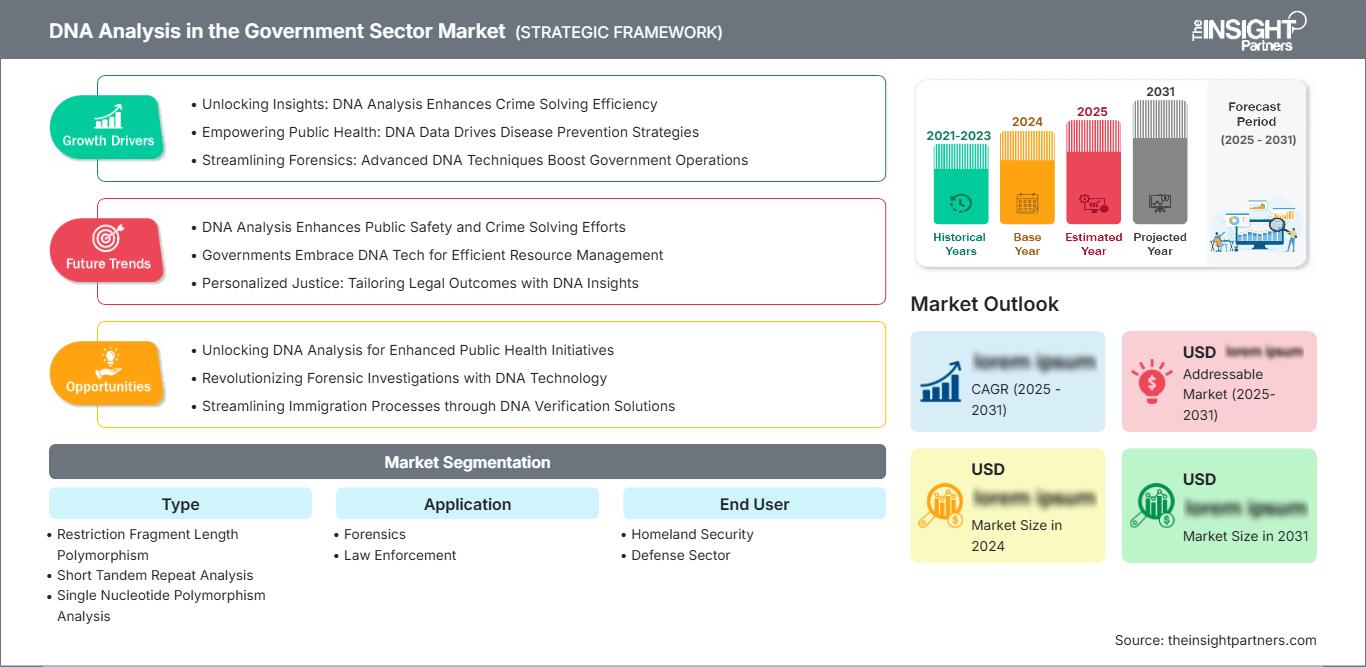
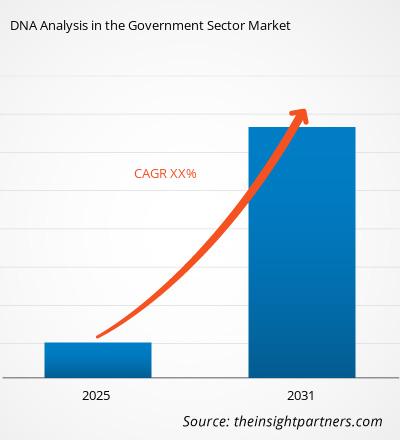
The global DNA Analysis in the Government Sector market was valued at US$ 2.39 billion in 2025 and is expected to reach US$ 5.54 billion by 2034; it is estimated to record a CAGR of 9.79% during 2026-2034.
DNA Analysis in the Government Sector Market Assessment and Insights
- North America: North America accounted for 39–42% share in 2025 and is anticipated to expand at a CAGR of 10.6%–11.4% during 2026–2034. Strong federal funding, established CODIS-linked workflows, and increasing deployment of rapid DNA technologies continue to support regional market leadership.
- U.S.: The U.S. represented 82–86% of the North American market in 2025 and is projected to register a CAGR of 10.8%–11.5% during 2026–2034, supported by widespread forensic DNA adoption, expanding public safety initiatives, and continued investments in forensic laboratory infrastructure.
- Europe: Europe held 26–29% DNA Analysis in the Government Sector market share in 2025 and is expected to grow at a CAGR of 9.8%–10.6% during 2026–2034. The United Kingdom and Germany remain the leading regional markets due to cross-border policing initiatives, migration management programs, and increasing laboratory automation.
- Asia Pacific: Asia Pacific accounted for 21–24% share in 2025 and is forecast to expand at a CAGR of 12.4%–13.2% during 2026–2034. China, Japan, South Korea, and India continue to drive regional growth through digital policing initiatives, disaster victim identification programs, and government-backed biometric modernization.
- Largest Segment: Technology – Short Tandem Repeat Analysis represented the largest market segment and is expected to record a CAGR of 10.8%–11.4% during 2026–2034, reflecting its established role in offender databases, standardized forensic workflows, and court-recognized evidentiary reliability.
- Largest Segment: Application – Forensics represented the largest application segment and is expected to record a CAGR of 10.9%–11.6% during 2026–2034, supported by continued government investment in crime-scene investigation, cold-case resolution, and missing-person identification programs.
- Largest Segment: End User – Homeland Security represented the largest end-user segment and is expected to record a CAGR of 11.0%–11.7% during 2026–2034, driven by expanding border security screening, detention intake processing, and identity verification initiatives.
- High Growth Segment: Technology – Single Nucleotide Polymorphism Analysis is projected to grow at a CAGR of 12.8%–13.7% during 2026–2034, driven by increasing adoption of next-generation sequencing, ancestry inference, and forensic genetic genealogy applications.
- High Growth Segment: Application – Law Enforcement is projected to grow at a CAGR of 11.4%–12.1% during 2026–2034, supported by expanding integration of rapid DNA technologies, investigative lead generation, and biometric identification systems within policing workflows.
- High Growth Segment: End User – Defense Sector is projected to grow at a CAGR of 11.5%–12.3% during 2026–2034, driven by increasing investments in force protection, human remains identification, battlefield forensics, and secure identity management programs.
- Key companies analyzed in detail: Lockheed Martin Corporation; NEC Corporation; M2SYS LLC; IDEMIA Public Security USA LLC; ANDE Corporation; QIAGEN N.V.; Thermo Fisher Scientific Inc.; Verogen, Inc.; Promega Corporation; Bode Cellmark Forensics, Inc. d/b/a Bode Technology.
Source: The Insight Partners' analysis based on proprietary research, government publications, company annual reports, investor presentations, industry databases, and expert interviews.
The DNA Analysis in the Government Sector Market has evolved from conventional laboratory-based forensic testing toward integrated digital forensic ecosystems capable of processing large genetic datasets. Government agencies increasingly utilize DNA technologies not only for criminal investigations but also for disaster victim identification, border security, missing-person programs, and counterterrorism initiatives. Continuous improvements in sequencing accuracy and database interoperability have broadened operational applications.
The DNA Analysis in the Government Sector Market Forecast indicates that market expansion will be driven by rapid DNA technologies, automated evidence processing, and stronger collaboration among forensic laboratories, defense agencies, and security organizations. Governments are increasing investments in advanced identification systems that deliver faster and more reliable results. As genetic intelligence assumes a greater role in public safety strategies, procurement activities, and technology modernization initiatives are expected to accelerate across multiple jurisdictions.
DNA Analysis in the Government Sector Market Report Scope
| Report Attribute | Details |
|---|---|
| Market size in 2025 | US$ 2.39 Billion |
| Market Size by 2034 | US$ 5.54 Billion |
| Global CAGR (2026 - 2034) | 9.79% |
| Historical Data | 2021-2024 |
| Forecast period | 2026-2034 |
DNA Analysis in the Government Sector Market Analysis
The DNA Analysis in the Government Sector Market is being influenced by rising security concerns, increasing crime complexity, and the growing need for scientifically validated evidence in judicial processes. Governments are investing in advanced DNA profiling systems to improve case resolution rates and accelerate forensic workflows. The expanding volume of genetic information generated through forensic investigations is encouraging agencies to modernize laboratory infrastructure and adopt automated analytical solutions.
The DNA Analysis in the Government Sector market report involves technology developers, forensic laboratories, law enforcement agencies, homeland security departments, defense organizations, database management providers, and software analytics firms. Integration across these stakeholders has become increasingly important as governments seek comprehensive identity verification and investigative capabilities supported by genomic technologies.
Competitive activity in the DNA Analysis in the Government Sector Market is characterized by technology innovation, strategic government partnerships, and investments in biometric and forensic intelligence platforms. Companies including Lockheed Martin Corporation, NEC Corporation, M2SYS Technology, MorphoTrust USA, Ultra Electronics Forensic Technology, NetBio, Inc., EyeLock LLC, 3M Company, A-T Solutions, Inc., and Stanley Black and Decker, Inc. continue to strengthen their presence through specialized security and identification solutions.
The investment trend is now moving towards fast DNA testing kits, cloud-based forensic databases, AI-assisted evidential analysis, and biometrics that incorporate all modalities. Participants in the market are emphasizing factors such as interoperability, cybersecurity, and deployment scalability to meet the demands of government procurement programs.
● REPORT CUSTOMIZATION
Tailor This Report To Align With Your Specific Business Requirements
This report can be customized to align precisely with your business objectives, scope, and target markets. Customization options include tailored segmentation, geography, competitive analysis, and strategic insights to support informed decision-making.
Customize This Report →WHAT YOU CAN ADJUST
- ● Segmentations
- ● Geography
- ● Competitive Analysis
- ● Language Preferences
DNA Analysis in the Government Sector Market: Strategic Insights
Regional Insights
North America DNA Analysis in the Government Sector Market
North America accounts for the largest share of the DNA Analysis in the Government Sector Market due to mature forensic infrastructure, extensive DNA databases, and strong governmental support for public safety technologies. The region is expected to maintain a CAGR of approximately 10.4% through the forecast period. Ongoing modernization of criminal justice systems and forensic laboratories continues to stimulate technology adoption.
There have been more instances of federal and state government agencies adopting sophisticated DNA identification systems to improve investigative efficiency and enhance national security. Additional impetus for demand has come from increased spending on border control, disaster response, and forensic digitization. These factors make North America the dominant regional market.
U.S. DNA Analysis in the Government Sector Market
The United States represents the dominant DNA Analysis in the Government Sector market within North America, accounting for an estimated 72–76% of regional revenue. The U.S. market is projected to expand at a CAGR of approximately 10.5% through 2034. Extensive utilization of DNA evidence across federal, state, and local law enforcement agencies supports continued market expansion.
With major companies offering technology and forensic labs equipped with advanced technologies, there is a conducive environment for innovation. The use of DNA testing in homeland security initiatives is increasingly being combined with biometric recognition, intelligence operations, and border control procedures. The increased use of rapid DNA testing processes is enhancing efficiency in investigations.
Europe DNA Analysis in the Government Sector Market
Europe accounts for approximately 24–29% of global DNA Analysis in the Government Sector market revenue and is expected to register a CAGR of around 10.2% during the forecast period. Regional growth is supported by stringent legal frameworks governing forensic evidence and continued investments in criminal justice modernization. Germany remains the leading national market due to its advanced forensic capabilities and strong public-sector technology spending.
Investments in forensic science modernization and DNA management databases further enhance DNA forensics in the UK, which in turn boosts demand in the wake of increased cold cases investigations and public security programs.
Highly advanced forensic laboratories and strong collaboration among research facilities and security services make Germany one of the markets that drive the adoption of DNA forensics thanks to demands for criminal investigations and border protection and digitalization of public security agencies.
France, Italy, and Spain altogether form a group of countries that provide many growth prospects in view of investments in forensic infrastructures and DNA forensics for judicial processes.
APAC DNA Analysis in the Government Sector Market
Asia Pacific is projected to be the fastest-growing regional market, with a CAGR approaching 12.4% through 2034. The region currently represents approximately 22–27% of global revenue and benefits from expanding government investments in forensic modernization and public security enhancement programs. China leads the regional market owing to large-scale security infrastructure initiatives.
China continues to strengthen forensic and biometric identification capabilities through investments in advanced analytical platforms and digital public security systems. Government-led modernization efforts are accelerating adoption of sophisticated DNA technologies across law enforcement and homeland security agencies.
Japan, South Korea, India, and Australia are increasingly adopting DNA-based identification technologies to improve criminal investigations, disaster victim identification, and border management capabilities. Policy support for forensic modernization, coupled with rising security requirements, is contributing to sustained market expansion throughout the region.
Middle East & Africa DNA Analysis in the Government Sector Market
The Middle East & Africa DNA Analysis in the Government Sector market is witnessing steady development and is anticipated to register a CAGR of approximately 9.8% through 2034. Government initiatives aimed at strengthening national security and modernizing law enforcement infrastructure are creating favorable conditions for DNA technology adoption. Saudi Arabia currently leads the regional market.
Saudi Arabia and the United Arab Emirates continue investing in advanced forensic laboratories and digital security infrastructure as part of broader national transformation programs. These initiatives are supporting the integration of genomic identification technologies into criminal investigation and homeland security operations.
South Africa and the broader MEA region are gradually expanding forensic capabilities to address evolving security challenges. Infrastructure modernization, public-sector digitization, and increasing emphasis on evidence-based investigations are expected to generate new opportunities for technology providers operating in the region.
Segmentation Analysis
Type
- Restriction Fragment Length Polymorphism remains relevant in specialized forensic applications requiring detailed genetic differentiation, particularly in legacy databases and complex investigations where historical compatibility and validation standards are essential.
- Short Tandem Repeat Analysis represents the leading segment due to widespread acceptance in forensic laboratories, strong legal admissibility, high identification accuracy, and compatibility with national criminal DNA databases.
- Single Nucleotide Polymorphism Analysis is gaining importance as governments seek advanced genetic intelligence capabilities, ancestry assessment tools, and improved identification performance when analyzing degraded biological samples.
Application
- Forensics constitutes the primary application area, supporting criminal investigations, victim identification, cold-case reviews, disaster response operations, and evidence validation within judicial proceedings.
- Law Enforcement continues expanding through the integration of DNA analytics into investigative workflows, suspect identification programs, border management operations, and intelligence-driven public safety initiatives.
End User
- Homeland Security agencies increasingly deploy DNA analysis technologies for border screening, identity verification, counterterrorism activities, and national security investigations requiring reliable biometric intelligence.
- Defense Sector organizations utilize DNA technologies for personnel identification, battlefield forensics, intelligence support, disaster response operations, and strategic security preparedness programs.
Opportunity Snapshot
| End User | Revenue Contribution | Trend Tag | Adoption Stage |
| Homeland Security | High | Border Security | Mature |
| Defense Sector | Medium | Tactical Forensics | Scaling |
DNA Analysis in the Government Sector Market Growth Drivers and Impact Analysis
Expansion of National DNA Databases and Criminal Identification Programs
Government agencies worldwide are expanding DNA repositories to strengthen criminal investigations and improve identification accuracy. Growing emphasis on solving complex crimes, reducing investigative timelines, and enhancing judicial outcomes has increased investment in DNA database infrastructure. Many countries are implementing legislation that supports broader collection and retention of forensic genetic information while maintaining privacy safeguards.
The impact on the DNA Analysis in the Government Sector market is substantial because larger databases require advanced analytical tools, data management systems, and interoperable platforms. Technology providers benefit from sustained procurement activity related to laboratory modernization, evidence processing automation, and secure database management. As DNA repositories become increasingly comprehensive, demand for scalable analytical solutions continues to rise across government agencies.
Rising Adoption of Rapid DNA Technologies in Public Security Operations
Rapid DNA platforms are transforming how government agencies conduct identification and investigative activities. These systems significantly reduce processing times compared with traditional laboratory workflows, enabling faster decision-making in law enforcement and security environments. The technology is particularly valuable in border management, disaster response, and time-sensitive criminal investigations.
The resulting market impact extends beyond equipment procurement. Governments increasingly invest in training, software integration, and supporting infrastructure required for rapid DNA deployment. This creates opportunities for technology vendors offering comprehensive solutions capable of delivering operational efficiency while maintaining forensic accuracy and regulatory compliance.
Growing Focus on Counterterrorism and Border Security Intelligence
Increasing geopolitical uncertainties and transnational security threats have heightened interest in advanced identification technologies. DNA analysis is becoming an important component of broader biometric intelligence strategies designed to strengthen border control, counterterrorism operations, and national security investigations.
This driver encourages governments to integrate DNA capabilities with facial recognition, fingerprint systems, and intelligence databases. The resulting convergence of forensic and biometric technologies is stimulating innovation and creating new procurement opportunities for vendors capable of delivering integrated security solutions tailored to government requirements.
DNA Analysis in the Government Sector Market Future Trends
Convergence of DNA Analytics with Artificial Intelligence Platforms
There are attempts to apply artificial intelligence in forensics for a better understanding of evidence, automation of data processing, and recognition of complicated genetic relations. It appears that government entities search for such AI solutions that would allow conducting faster investigations in a scientifically and legally sound way.
AI-based analysis of DNA is expected to facilitate predictive investigation, better pattern recognition, and case management efficiency in the future. Suppliers with expertise in the integration of genomics and machine learning technologies are likely to benefit from increased demand on the part of governmental organizations.
Development of Integrated Multimodal Biometric Security Ecosystems
The DNA Analysis in the Government Sector Market Trends highlight the growing integration of DNA analysis with fingerprint, iris, facial recognition, and digital identity technologies to establish comprehensive security frameworks. Governments are advancing unified identity management systems that support law enforcement, border control, and homeland security through interconnected biometric data sources. Looking ahead, adoption is expected to accelerate as interoperability standards improve and agencies prioritize integrated identity verification solutions. This evolution is likely to foster greater collaboration among forensic technology providers, cybersecurity firms, and biometrics solution companies, strengthening the overall government security ecosystem.
DNA Analysis in the Government Sector Market Opportunities
Modernization of Forensic Infrastructure in Emerging Economies
A large number of developing countries are currently taking steps to improve their forensics laboratories and public security infrastructures in order to meet emerging challenges in the areas of crime and security. This is creating ample opportunities for the vendors of DNA testing devices, laboratory automation tools, and forensic software solutions.
There are plenty of opportunities for investors and technology vendors to take advantage of by partnering with government agencies and creating deployment solutions according to the specific needs of the region. This makes for especially lucrative long-term opportunities in those regions that have adopted widespread public sector digital transformation plans.
Expansion of Cross-Border Security and Intelligence Collaboration
Cooperation on security matters is rising across the world since nations now face threats like transnational crime, terrorism, and migration. The use of DNA technology has become more common in facilitating cooperative efforts in terms of investigation, identity verification, and intelligence. The need for interoperability increases the need for standard analysis tools and safe means of exchanging information.
Businesses that have created solutions for such multinational cooperation efforts are poised to benefit from the opportunities. Investing in cybersecurity, cloud-based forensics, and interoperable databases can enable companies to meet future government needs and promote international security cooperation.
Recent Developments
- May 2026: NIMS Hyderabad launched Telangana’s first government-sector Next Generation Sequencing cancer testing facility. Established under the DIAMOnDS project, the centre offers advanced molecular diagnostic services free of cost and has already benefited more than 1,400 cancer patients.
- January 2026: Lucid Diagnostics Inc. announced that it has been awarded a contract by the U.S. Department of Veterans Affairs (VA) for its EsoGuard Esophageal DNA Test, expanding access to esophageal precancer testing across the nation's largest integrated healthcare system, which serves more than nine million enrolled veterans annually.
- May 2025: Internationally acclaimed expert on DNA analysis collaborates with the Government Analyst Department to improve effective response to victims of SGBV. The Government of Canada and UNDP support the strengthening of the DNA laboratory and capacity building of the Government Analyst Department of Sri Lanka.
Frequently Asked Questions

- Comprehensive Market Sizing and Forecast Analysis
- Detailed Segmentation Analysis
- In-Depth Market Dynamics Assessment
- Regional and Country-Level Insights
- Competitive Landscape and Company Benchmarking
- Strategic Business Intelligence
Recent Reports
Testimonials

The Insight Partners provided valuable market intelligence that supported our global go-to-market strategy. Their team was professional, responsive, and attentive to our feedback, providing thoughtful analysis and helpful methodological clarifications throughout the project.
Junmo Kim Chief Financial Officer (CFO), Enertech Co., Ltd.
The Insight Partners' SCADA System Market report is comprehensive, with valuable insights on current trends and future forecasts. The team was highly professional, responsive, and supportive throughout. We are very satisfied and highly recommend their services.
RAN KEDEM Partner, Reali Technologies LTDs
I requested a report on a very specific software market and the team produced the report in a few days. The information was very relevant and well presented. I then requested some changes and additions to the report. The team was again very responsive and I got the final report in less than a week.
JEAN-HERVE JENN Chairman, Future Analytica
We worked with The Insight Partners for an important market study and forecast. They gave us clear insights into opportunities and risks, which helped shape our plans. Their research was easy to use and based on solid data. It helped us make smart, confident decisions. We highly recommend them.
PIYUSH NAGPAL Sr. Vice President, High Beam Global
The Insight Partners delivered insightful, well-structured market research with strong domain expertise. Their team was professional and responsive throughout. The user-friendly website made accessing industry reports seamless. We highly recommend them for reliable, high-quality research services
YUKIHIKO ADACHI CEO, Deep Blue, LLC.
This is the first time I have purchased a market report from The Insight Partners.While I was unsure at first, I visited their web site and felt more comfortable to take the risk and purchase a market report.I am completely satisfied with the quality of the report and customer service. I had several questions and comments with the initial report, but after a couple of dialogs over email with their analyst I believe I have a report that I can use as input to our strategic planning process.Thank you so much for taking the extra time and making this a positive experience.I will definitely recommend your service to others and you will be my first call when we need further market data.
JOHN SUZUKI President and Chief Executive Officer, Board Director, BK Technologies
I wish to appreciate your support and the professionalism you displayed in the course of attending to my request for information regarding to infectious disease IVD market in Nigeria. I appreciate your patience, your guidance, and the fact that you were willing to offer a discount, which eventually made it possible for us to close a deal. I look forward to engaging The Insight Partners in the future, all thanks to the impression you have created in me as a result of this first encounter.
DR CHIJIOKE ONYIA MANAGING DIRECTOR, PineCrest Healthcare Ltd.Reason to Buy
- Informed Decision-Making
- Understanding Market Dynamics
- Competitive Analysis
- Identifying Emerging Markets
- Customer Insights
- Market Forecasts
- Risk Mitigation
- Boosting Operational Efficiency
- Strategic Planning
- Investment Justification
- Tracking Industry Innovations
- Aligning with Regulatory Trends





 Get Free Sample for