
DNA Extractor Market Size, Trends & Growth by 2034
Coverage: By Type (Automated, Semi-automatic); Application (Pharmaceutical and Biotechnology Companies, Academic and Research Institutes, Other) , and Geography (North America, Europe, Asia Pacific, and South and Central America)
- Status : Data Released
- Report Code : TIPRE00018010
- Category : Life Sciences
- No. of Pages : 150
- Available Report Formats :


- Last update date : July 08, 2026


2025 Market Size
US$ 2.68 Bn
Base year value
2034 Forecast
US$ 4.87 Bn
Projected by 2034
CAGR 2026-2034
6.88 %
Growth rate
Addressable Market
US$ 34.14 Bn
(2026-2034)
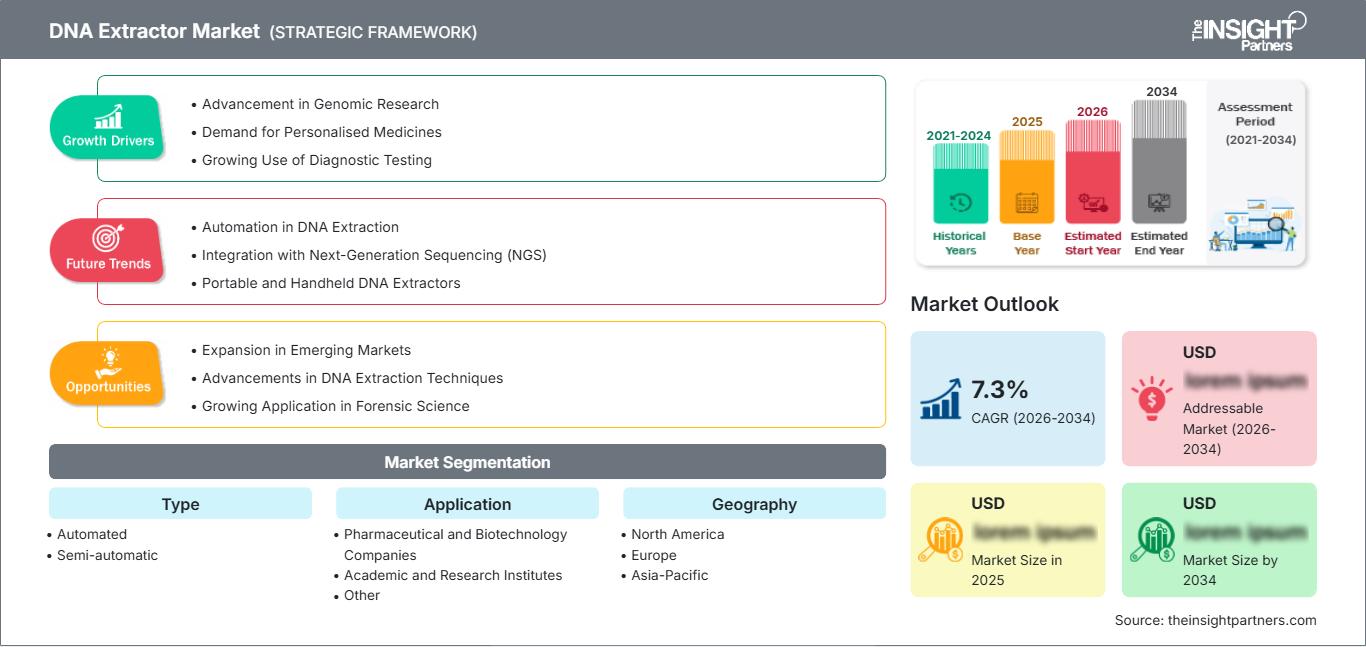
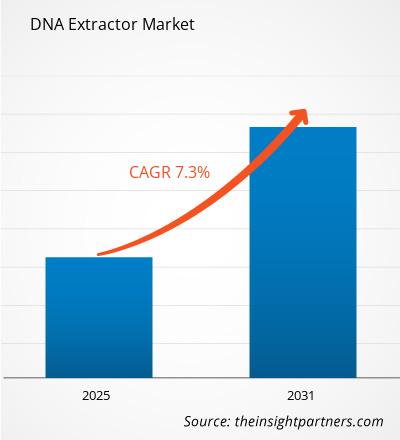
The DNA Extractor Market size is valued at US$ 2.68 billion in 2025 and is projected to reach US$ 4.87 billion by 2034, expanding at a CAGR of 6.88% during 2026–2034. The market is gaining momentum as genomic research, molecular diagnostics, forensic testing, and precision medicine programs increasingly rely on efficient DNA isolation workflows. Growing laboratory automation requirements and the rising volume of genetic testing are reinforcing demand for advanced extraction platforms capable of delivering reproducible and high-purity nucleic acid samples.
Robust investments in biotechnology research, the growing adoption of molecular diagnostic solutions, and the strong presence of prominent life science organizations are driving regional market growth. According to the DNA extractor market forecast, rising deployment of automated laboratory platforms and increasing genomic sequencing activities across healthcare and research facilities are expected to further enhance demand for advanced DNA extraction technologies.
DNA Extractor Market Assessment and Insights
- North America: North America accounted for 34–38% DNA extractor market share in 2025 and is anticipated to expand at a CAGR of 6.4%–6.8% during 2026–2034. Strong molecular testing adoption, intensive genomics research activities, and ongoing laboratory automation continue to support regional market leadership.
- U.S.: The U.S. represented 78–82% of the North American DNA extractor market in 2025 and is projected to register a CAGR of 6.5%–6.9% during 2026–2034, supported by expanding molecular diagnostics, increasing genomics research, and automation upgrades across clinical and biopharmaceutical laboratories.
- Europe: Europe held 25–29% DNA extractor market share in 2025 and is expected to grow at a CAGR of 6.0%–6.4% during 2026–2034. Germany, the United Kingdom, and France remain the leading regional markets due to strong translational research infrastructure, public genomics initiatives, and continued procurement of standardized sample preparation platforms.
- Asia Pacific: Asia Pacific accounted for 24–28% DNA extractor market share in 2025 and is forecast to expand at a CAGR of 7.6%–8.0% during 2026–2034. China, Japan, and India continue to drive regional growth through expanding hospital laboratory capacity, strengthening public health networks, and increasing investments in biotechnology research and automated DNA extraction technologies.
- Largest Segment: Type – Automated DNA Extractors represented the largest market segment and is expected to record a CAGR of 7.2%–7.6% during 2026–2034, reflecting increasing demand for hands-free processing, reduced contamination risk, improved reproducibility, and seamless integration with medium- and high-throughput molecular workflows.
- High Growth Segment: Application – Pharmaceutical and Biotechnology Companies is projected to grow at a CAGR of 7.4%–7.8% during 2026–2034, driven by expanding biomarker discovery programs, increasing cell and gene therapy research, and growing adoption of next-generation sequencing in drug development.
- Key companies analyzed in detail: AutoGen, Inc.; Bee Robotics Ltd.; BioSan SIA; Promega Corporation; Analytik Jena GmbH+Co. KG; Seegene Inc.; Revvity, Inc.; BioChain Institute, Inc.; QIAGEN N.V.; F. Hoffmann-La Roche Ltd.
Source: The Insight Partners' analysis based on proprietary research, government publications, company annual reports, investor presentations, industry databases, and expert interviews.
The DNA Extractor Market has evolved from a laboratory-support segment into a strategic component of molecular biology workflows. Advances in genomics, personalized medicine, infectious disease surveillance, and forensic science have elevated the importance of reliable DNA extraction systems. Laboratories increasingly prioritize throughput, contamination control, and workflow standardization, creating favorable conditions for automated extraction technologies.
Future market development will be shaped by the convergence of automation, artificial intelligence-assisted laboratory management, and high-throughput genomic applications. Expanding sequencing activities, population genomics initiatives, and increasing clinical adoption of molecular diagnostics are expected to broaden the role of DNA extraction systems across both research and healthcare environments.
DNA Extractor Market Report Scope
| Report Attribute | Details |
|---|---|
| Market size in 2025 | US$ 2.68 Billion |
| Market Size by 2034 | US$ 4.87 Billion |
| Global CAGR (2026 - 2034) | 6.88% |
| Historical Data | 2021-2024 |
| Forecast period | 2026-2034 |
DNA Extractor Market Analysis
DNA extraction represents the foundational step in numerous molecular testing procedures. Demand is being supported by increasing utilization of PCR-based diagnostics, next-generation sequencing, biomarker discovery programs, and forensic investigations. Laboratories require extraction systems capable of handling diverse sample types while maintaining high recovery rates and reproducibility. These operational requirements are encouraging migration toward automated and semi-automated platforms.
The DNA extractor market report includes instrument manufacturers, reagent suppliers, software providers, research laboratories, diagnostic centers, and biotechnology organizations. Continuous innovation in extraction chemistries and workflow integration is enhancing operational efficiency. Growing emphasis on sample quality in downstream applications further strengthens the importance of advanced DNA extraction technologies throughout the value chain.
The competitive landscape is driven by technologies that differentiate, integrate processes, and have an effective distribution network across the globe. Companies like QIAGEN, Roche Holding AG, Promega Corporation, PerkinElmer, Analytik Jena, and SEEGENE are striving to enhance their automation technology and extraction technology performance.
More and more investments are being made in the area of laboratory automation, genomics technologies, and precision medicine platforms. Collaborations between companies providing extraction technologies and sequencing platforms are on the rise. Companies which provide an end-to-end molecular workflow integrating extraction, analysis, and data management are expected to gain a competitive edge over the forecast period.
● REPORT CUSTOMIZATION
Tailor This Report To Align With Your Specific Business Requirements
This report can be customized to align precisely with your business objectives, scope, and target markets. Customization options include tailored segmentation, geography, competitive analysis, and strategic insights to support informed decision-making.
Customize This Report →WHAT YOU CAN ADJUST
- ● Segmentations
- ● Geography
- ● Competitive Analysis
- ● Language Preferences
DNA Extractor Market: Strategic Insights
Regional Insights
North America DNA Extractor Market
North America accounts for the largest share of the DNA Extractor Market and is projected to expand at approximately 6.5% CAGR through 2034. The region benefits from a mature biotechnology industry, strong research funding, and widespread adoption of molecular diagnostics. Academic institutions, pharmaceutical companies, and healthcare laboratories continue investing in automated genomic workflows.
Additionally, the leadership within the region benefits from a well-equipped laboratory setup, as well as active precision medicine programs. The increased use of sequencing technologies, high demand for companion diagnostics, and numerous genomic research studies have contributed to the steady use of DNA extraction systems.
U.S. DNA Extractor Market
The U.S. represents approximately 70–75% of the North American DNA Extractor Market and is expected to grow at a CAGR of around 6.6% during the forecast period. Strong federal research funding, extensive genomics programs, and a concentration of biotechnology innovators contribute to market leadership.
Some of the key players operating in the country include QIAGEN, Promega Corporation, PerkinElmer, and Roche Holding AG. More pharmaceutical and biotech organizations are using automation tools for DNA isolation in sequencing and drug discovery. The increased use of molecular diagnostics for cancer, infectious diseases, and inherited diseases contributes to market growth.
Europe DNA Extractor Market
Europe accounts for an estimated 25–30% share of the global DNA Extractor Market and is forecast to expand at approximately 6.3% CAGR through 2034. Strong government support for life science research, increasing genomic healthcare initiatives, and advanced laboratory networks continue to stimulate demand. Germany remains the leading national market due to its extensive biotechnology and diagnostic infrastructure.
The UK benefits from ongoing investments in genomics-based healthcare and translational research. National sequencing initiatives and expanding molecular testing capabilities are supporting demand for high-throughput extraction systems. Research organizations increasingly prioritize workflow automation to improve efficiency and reproducibility.
Germany maintains a strong position owing to its advanced industrial biotechnology sector, robust research ecosystem, and significant laboratory automation adoption. Meanwhile, France, Italy, and Spain are witnessing growing implementation of molecular diagnostic technologies, creating opportunities for both automated and semi-automatic extraction solutions across healthcare and academic institutions.
APAC DNA Extractor Market
Asia Pacific is expected to be the fastest-growing regional DNA Extractor market, recording a CAGR of approximately 8.0% through 2034 while accounting for around 22–27% of global revenue. Expanding biotechnology industries, increasing healthcare investments, and supportive government genomics programs are accelerating market growth. China currently leads regional demand.
China continues strengthening its genomics capabilities through substantial investments in research infrastructure, sequencing capacity, and biotechnology innovation. Growing pharmaceutical research activities and precision medicine initiatives are increasing demand for automated DNA extraction technologies.
Japan and South Korea benefit from advanced diagnostic ecosystems and high technology adoption rates. India is emerging as a significant growth market due to expanding biotechnology research and increasing molecular testing requirements. Australia supports regional growth through strong academic research capabilities and government-backed genomic medicine programs.
Middle East & Africa DNA Extractor Market
The Middle East & Africa DNA Extractor Market is experiencing gradual expansion with a projected CAGR of approximately 6.0% through 2034. Growing investments in healthcare modernization, diagnostic infrastructure, and biotechnology research are creating favorable conditions for market development. Saudi Arabia currently represents the leading country within the region.
Saudi Arabia and the UAE are investing heavily in healthcare transformation programs and genomic medicine initiatives. These efforts are encouraging adoption of advanced laboratory technologies, including automated DNA extraction platforms used in research and diagnostic settings.
South Africa remains an important biotechnology and research hub within Africa. Across the broader MEA region, improving laboratory infrastructure and increasing demand for molecular diagnostics are supporting market opportunities. Investments linked to economic diversification and scientific research capacity continue to strengthen long-term growth prospects.
Segmentation Analysis
Type
- Automated: Automated DNA extractors dominate market demand due to superior throughput, reduced contamination risk, standardized workflows, and compatibility with high-volume genomic, diagnostic, and pharmaceutical research applications requiring reproducible sample preparation.
- Semi-automatic: Semi-automatic systems remain relevant among cost-conscious laboratories seeking improved efficiency without full automation investment. These platforms provide operational flexibility for medium-throughput workflows and diverse research applications.
Application
- Pharmaceutical and Biotechnology Companies: This segment generates substantial demand as organizations require high-quality DNA extraction for drug discovery, biomarker identification, clinical research, and genomic analysis supporting precision medicine development.
- Academic and Research Institutes: Universities and research centers increasingly adopt DNA extraction systems for genomics, molecular biology, agricultural biotechnology, and disease research programs requiring reliable sample preparation workflows.
Opportunity Snapshot
| Application | Revenue Contribution | Trend Tag | Adoption Stage |
| Pharmaceutical and Biotechnology Companies | High | Precision Medicine | Mature |
| Academic and Research Institutes | Medium | Genomics Research | Scaling |
| Other | Low | Forensics Testing | Emerging |
DNA Extractor Market Growth Drivers and Impact Analysis
Expansion of Genomic Research and Sequencing Activities
The rapid growth of genomic research is significantly influencing demand for DNA extraction technologies. Research institutions, healthcare organizations, and biotechnology companies increasingly depend on high-quality nucleic acid samples for sequencing, gene expression analysis, and molecular characterization studies. The rising accessibility of next-generation sequencing has expanded the number of laboratories conducting genomic investigations, thereby increasing extraction requirements. Population genomics programs, cancer research initiatives, and rare disease investigations are creating sustained demand for efficient sample preparation solutions.
The impact extends beyond laboratory research as the clinical sector continues to adopt genomic testing into its diagnoses, thus necessitating the need for standard extraction processes that can meet regulatory and quality standards. Firms that offer scalable systems applicable to various uses are benefiting from growing market prospects within the health care and life sciences industries.
Growing Adoption of Laboratory Automation
Laboratories find themselves under growing pressure to enhance efficiencies in spite of an increase in sample size. The role of automation comes from the need to decrease manual input, eliminate variability, and ensure higher throughput. Automated DNA extraction systems allow laboratories to handle numerous samples efficiently, and therefore become appealing for diagnostics and research laboratories.
This trend towards automation changes purchasing priorities. Companies tend to choose extraction systems not based only on their ability to extract but also considering integration into the workflow, connectivity, and scalability of the system. This demand drives innovation in robotic handling, software integration, and automation of quality control processes.
Increasing Use of Molecular Diagnostics in Healthcare
Molecular diagnostic testing has become an essential component of modern healthcare. Applications in oncology, infectious disease detection, inherited disorder screening, and companion diagnostics require reliable DNA extraction as a critical preparatory step. As healthcare providers expand molecular testing capabilities, demand for extraction technologies continues to rise.
This effect is especially apparent in clinical laboratories where there is a need for systems that provide fast processing and reproducibility of results. The increased use of the precision medicine strategy adds to the significance of the good isolation of DNA. This trend drives the continual product development and investment in the extraction technology process.
DNA Extractor Market Future Trends
Integration of Extraction Systems with End-to-End Molecular Workflows
DNA extraction methods are becoming more and more part of the overall molecular diagnostics ecosystem. Labs strive to have seamless workflow solutions that unite the process of extraction, amplification, sequencing, and data analysis. Such trends lead manufacturers to create integrated platforms that will help to simplify workflows and increase laboratory productivity.
The future systems will have the ability to have software tools, remote monitoring capabilities, and workflow optimization. The integration with the laboratory information management system will increase effectiveness even more. With the growth in the number of genomic tests, there is a growing need for such platforms.
Development of Compact and Flexible Extraction Platforms
The DNA extractor market trends indicate a growing demand for extraction systems that combine automation with operational adaptability. Compact platforms tailored for low- and medium-throughput applications are gaining traction among research organizations, specialized diagnostic laboratories, and developing biotechnology firms. These systems address space constraints while enabling laboratories to expand their molecular testing capabilities. Future product innovations are expected to focus on modular configurations, streamlined workflows, and broader sample compatibility, creating opportunities for smaller laboratories seeking advanced extraction solutions without significant capital investments.
DNA Extractor Market Opportunities
Emerging Precision Medicine Programs in Developing Economies
Countries that are underdeveloped have increased their interest in genomic medicine, offering promising prospects for companies providing DNA extraction services. Healthcare reform processes and the growth of the biotechnology industries in the region will foster the use of molecular diagnosis methods, leading to the need for scalable technologies for extraction.
Firms that build local ties, offer educational programs, and develop affordable automation solutions can enjoy a considerable competitive edge. Development of regional manufacturing, logistics, and services facilities can prove useful in capturing and meeting growing needs.
Expansion of Forensic and Public Health Testing Infrastructure
Forensic laboratories and public health agencies are increasing their reliance on molecular analysis techniques. DNA extraction systems play a critical role in evidence processing, epidemiological surveillance, and outbreak investigations. Continued investment in laboratory modernization creates favorable conditions for market growth.
Technology suppliers have room for developing extraction systems that are suited for difficult samples and regulatory requirements. Effective collaboration with the government and public health institutions can result in the opening up of revenue sources while improving their position in novel application fields.
Recent Developments
- February 2026: Thermo Fisher Scientific has introduced the Thermo Scientific Sequential Protein/DNA/RNA Extraction Kit, a sample preparation solution that enables sequential extraction of protein, DNA, and RNA from a single sample. The kit is designed to address challenges in cancer and disease research where samples are often limited and difficult to replace.
- February 2026: New England Biolabs (NEB®) announced the release of the Monarch Mag Cell-free DNA (cfDNA) Extraction Kit, which enables consistent, scalable extraction of low-abundance, circulating cell-free DNA (cfDNA) for downstream applications including biomarker discovery and diagnostics development. The magnetic, bead-based workflow is compatible with biofluids including plasma, serum, urine, and cerebrospinal fluid across variable input volumes from mL to 4 mL.
- September 2025: Xpedite Diagnostics GmbH, a pioneer in rapid nucleic acid extraction technologies, announced the CE-IVD certification and launch of SwiftX Virus, a breakthrough one-step DNA/RNA extraction kit for human serum and plasma. SwiftX™ Virus empowers laboratories, hospitals, and field settings with a fast, reliable, and contamination-minimized workflow ideal for point-of-care testing.
Frequently Asked Questions

- Comprehensive Market Sizing and Forecast Analysis
- Detailed Segmentation Analysis
- In-Depth Market Dynamics Assessment
- Regional and Country-Level Insights
- Competitive Landscape and Company Benchmarking
- Strategic Business Intelligence
Recent Reports
Testimonials

The Insight Partners' SCADA System Market report is comprehensive, with valuable insights on current trends and future forecasts. The team was highly professional, responsive, and supportive throughout. We are very satisfied and highly recommend their services.
RAN KEDEM Partner, Reali Technologies LTDs
I requested a report on a very specific software market and the team produced the report in a few days. The information was very relevant and well presented. I then requested some changes and additions to the report. The team was again very responsive and I got the final report in less than a week.
JEAN-HERVE JENN Chairman, Future Analytica
We worked with The Insight Partners for an important market study and forecast. They gave us clear insights into opportunities and risks, which helped shape our plans. Their research was easy to use and based on solid data. It helped us make smart, confident decisions. We highly recommend them.
PIYUSH NAGPAL Sr. Vice President, High Beam Global
The Insight Partners delivered insightful, well-structured market research with strong domain expertise. Their team was professional and responsive throughout. The user-friendly website made accessing industry reports seamless. We highly recommend them for reliable, high-quality research services
YUKIHIKO ADACHI CEO, Deep Blue, LLC.
This is the first time I have purchased a market report from The Insight Partners.While I was unsure at first, I visited their web site and felt more comfortable to take the risk and purchase a market report.I am completely satisfied with the quality of the report and customer service. I had several questions and comments with the initial report, but after a couple of dialogs over email with their analyst I believe I have a report that I can use as input to our strategic planning process.Thank you so much for taking the extra time and making this a positive experience.I will definitely recommend your service to others and you will be my first call when we need further market data.
JOHN SUZUKI President and Chief Executive Officer, Board Director, BK Technologies
I wish to appreciate your support and the professionalism you displayed in the course of attending to my request for information regarding to infectious disease IVD market in Nigeria. I appreciate your patience, your guidance, and the fact that you were willing to offer a discount, which eventually made it possible for us to close a deal. I look forward to engaging The Insight Partners in the future, all thanks to the impression you have created in me as a result of this first encounter.
DR CHIJIOKE ONYIA MANAGING DIRECTOR, PineCrest Healthcare Ltd.Reason to Buy
- Informed Decision-Making
- Understanding Market Dynamics
- Competitive Analysis
- Identifying Emerging Markets
- Customer Insights
- Market Forecasts
- Risk Mitigation
- Boosting Operational Efficiency
- Strategic Planning
- Investment Justification
- Tracking Industry Innovations
- Aligning with Regulatory Trends





 Get Free Sample for