
Dry Ramming Mass Market Size, Share & Demand by 2034
Dry Ramming Mass Market Size and Forecasts (2021 - 2034), Global and Regional Share, Trends, and Growth Opportunity Analysis Report Coverage : by Type (Alumina ramming mass, Silica ramming mass, Magnesia based ramming mass); Function (Lining, Repairing, Patching); Application (Foundries, Blast furnace, Electric arc furnace, Steel, Non steel); and Geography (North America, Europe, Asia Pacific, and South and Central America)
- Status : Data Released
- Report Code : TIPRE00040266
- Category : Chemicals and Materials
- No. of Pages : 150
- Available Report Formats :


- Last update date : August 04, 2026


2025 Market Size
US$ 2.83 Bn
Base year value
2034 Forecast
US$ 5.42 Bn
Projected by 2034
CAGR 2026-2034
7.49 %
Growth rate
Addressable Market
US$ 37.19 Bn
(2026-2034)
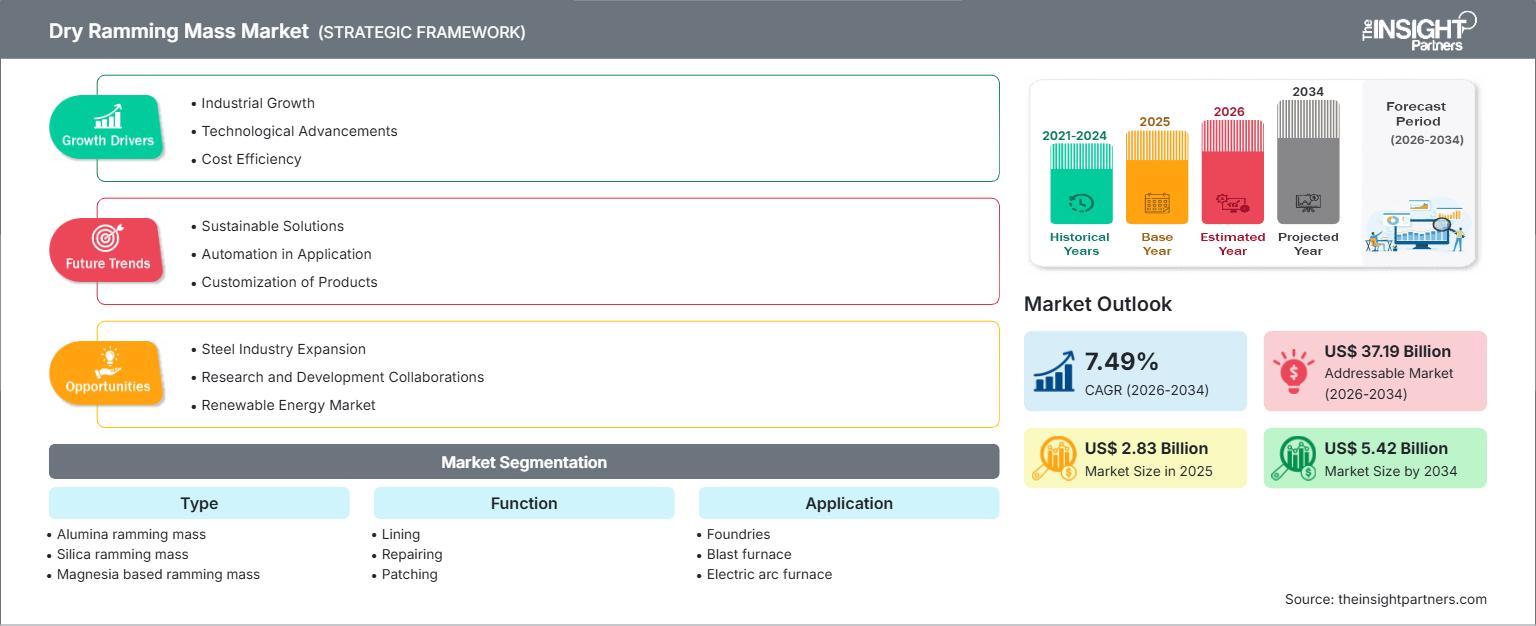
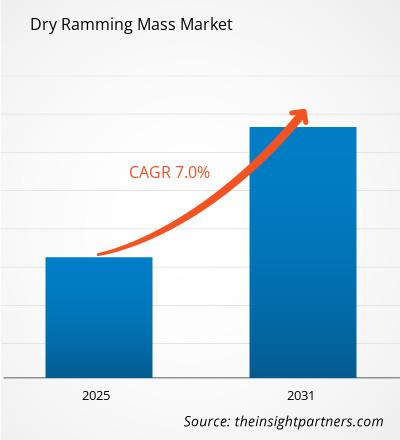
The Dry Ramming Mass Market was valued at US$ 2.83 Billion in 2025 and is projected to reach US$ 5.42 Billion by 2034, registering a CAGR of 7.49% during 2026–2034. Growth is supported by higher refractory consumption in steelmaking, foundries, electric arc furnaces, blast furnaces, and non-steel metallurgical operations requiring reliable furnace linings, fast installation, and improved thermal stability.
North America is expected to advance at a 6.4–7.2% CAGR as steel recycling, foundry modernization, and electric furnace investments increase demand for pre-mixed refractory linings. The Dry Ramming Mass Market size outlook in the region is shaped by furnace relining cycles, tighter productivity targets, and preference for materials that reduce shutdown time while improving lining life.
Dry Ramming Mass Market Assessment and Insights
- North America: Share in 2025 of 18–22% and CAGR between 6.4–7.2%. Regional demand is supported by electric arc furnace capacity, steel recycling, and foundry upgrades.
- US: Share in 2025 of 74–78% of North America and CAGR between 6.5–7.3%. Refractory replacement cycles remain linked to steel, iron casting, and non-ferrous melting.
- Europe: Share in 2025 of 20–24% and CAGR between 6.2–7.0%. Germany, Italy, France, Spain, and the UK lead demand through steel decarbonization, foundries, and industrial maintenance.
- Asia Pacific: Share in 2025 of 46–50% and CAGR between 8.0–8.8%. China, India, Japan, and South Korea dominate consumption because of steel output and induction furnace density.
- Largest Segment: Silica ramming mass with market share of 48–52% in 2025 and CAGR of 7.0–7.8% during 2026–2034.
- High Growth Segment: Electric arc furnace with market share of 18–22% in 2025 and CAGR of 8.4–9.2% during 2026–2034.
- Key companies analyzed in detail: RHI Magnesita N.V., Compagnie de Saint-Gobain S.A., Calderys, Dense Refractories Co., Ltd., Gita Refractories Private Limited, Henan Xinmi Changxing Refractory Material Co., Ltd., Imperial World Trade Private Limited, Refcast Corporation, Shenghe Refractories, Vishva Vishal Refractories Limited.
Source: The Insight Partners' analysis based on proprietary research, government publications, company annual reports, investor presentations, industry databases, and expert interviews.
Material requirements are evolving as steel producers and foundries seek denser linings, lower impurity profiles, and shorter repair cycles. Suppliers are improving particle-size distribution, binder systems, and mineral purity to extend campaign life in induction furnaces and electric arc furnaces. The Dry Ramming Mass Market is therefore moving from commodity refractory supply toward performance-led formulations that support higher productivity, better metal quality, and reduced unplanned downtime.
Future demand will be shaped by secondary steelmaking, non-ferrous casting, and infrastructure-linked metal consumption. Investment is shifting toward Asia Pacific and selected Middle Eastern projects, while mature markets focus on furnace efficiency and compliance. The market will benefit from regulatory pressure for energy-efficient metallurgical operations, provided suppliers can secure silica, alumina, and magnesia inputs at competitive and consistent quality levels.
Dry Ramming Mass Market Report Scope
| Report Attribute | Details |
|---|---|
| Market size in 2025 | US$ 2.83 Billion |
| Market Size by 2034 | US$ 5.42 Billion |
| Global CAGR (2026 - 2034) | 7.49% |
| Historical Data | 2021-2024 |
| Forecast period | 2026-2034 |
Dry Ramming Mass Market Analysis
The Dry Ramming Mass Market growth profile is closely tied to furnace utilization in steel, foundry, and alloy production. World steel production remains concentrated in Asia, while electric furnace investment is expanding in North America, Europe, India, and the Middle East as producers pursue lower-emission steel routes. These shifts raise demand for refractory linings that resist corrosion, thermal shock, and mechanical wear during repeated melting cycles.
Across the value chain, raw mineral quality, grain sizing, pre-mixing consistency, and reliable logistics determine customer retention. Furnace operators increasingly evaluate total lining cost rather than purchase price alone, because relining frequency affects output, power consumption, and labor scheduling. The market therefore rewards suppliers that combine stable raw material sourcing with application support and technical service.
Competitive positioning in the Dry Ramming Mass Market analysis depends on specialization, local availability, and ability to serve high-temperature users with consistent batches. RHI Magnesita N.V., Compagnie de Saint-Gobain S.A., and Calderys compete through broad refractory portfolios and global technical networks, while Gita Refractories Private Limited, Dense Refractories Co., Ltd., and regional specialists compete on responsiveness and customized formulations.
Investment trends are centered on recycling, digital production controls, and capacity additions near steelmaking clusters. RHI Magnesita has highlighted refractory recycling and digitalized production initiatives, while Calderys has pursued India-focused refractory expansion. The market remains fragmented, but customers increasingly favor suppliers that can document performance, reduce furnace interruptions, and support decarbonizing metallurgical operations.
Additional supplier differentiation is likely to come from application engineering, not only mineral composition. Furnace operators increasingly expect refractory partners to advise on lining preparation, ramming density, sintering practice, and post-installation inspection. This service-led approach can reduce avoidable failures and strengthen renewal orders. For the market, such technical collaboration is especially relevant in smaller foundries and secondary steel plants where in-house refractory expertise may be limited, but operating losses from furnace downtime remain significant.
● REPORT CUSTOMIZATION
Tailor This Report To Align With Your Specific Business Requirements
This report can be customized to align precisely with your business objectives, scope, and target markets. Customization options include tailored segmentation, geography, competitive analysis, and strategic insights to support informed decision-making.
Customize This Report →WHAT YOU CAN ADJUST
- ● Segmentations
- ● Geography
- ● Competitive Analysis
- ● Language Preferences
Dry Ramming Mass Market: Strategic Insights
Regional Insights
North America Dry Ramming Mass Market
North America held 18–22% share in 2025 and is forecast to grow at a 6.4–7.2% CAGR. The region benefits from electric arc furnace-based steelmaking, established foundry capacity, and steady demand for repair linings. Dry Ramming Mass Market share is supported by recurring maintenance cycles in steel mini-mills and non-ferrous casting operations.
Refractory demand also reflects a preference for materials that reduce furnace downtime and improve lining predictability. U.S. steel recycling, automotive casting, aerospace components, and machinery production create recurring consumption. Canada and Mexico contribute through metal fabrication and manufacturing supply chains, while suppliers focus on technical service, inventory proximity, and performance validation.
U.S. Dry Ramming Mass Market
The U.S. represents 74% to 78% of the North American market, with a predicted CAGR of 6.5% to 7.3%. High demand comes from steel mills, iron foundries, aluminum casting, and repair activities, where furnace downtime affects operating margins. Customers in the domestic market insist on using high-purity silica-alumina mixes.
The presence of companies is influenced by global refractories communities, importers, and distributors who serve mini-mills and foundries. Investment in electric furnaces boosts demand for hearth and lining refractories, while non-steel applications require thermal stability for processing copper, aluminum, and alloys. Purchasing teams emphasize the importance of proven campaign life and suppliers’ response.
Europe Dry Ramming Mass Market
Europe has a 20-24% share in 2025 and is expected to grow at a 6.2-7.0% CAGR. Germany holds the dominant position due to automotive foundries, machinery manufacturing, and steel revitalization. The UK relies on specialty metals and repairs, while Italy profits from the electric furnace steel industry and casting industrial clusters.
France, Spain, and the Central European countries also contribute to the market through foundries, non-ferrous metals, and maintenance of high-temperature materials. High energy prices and carbon legislation push manufacturers to improve furnace performance, making it critical to ensure reliable refractory lining performance. European purchasers expect waste-saving installations and reliable technical documentation from suppliers.
APAC Dry Ramming Mass Market
Asia Pacific accounted for around 46%-50% of the market share in 2025 and is projected to record a CAGR of 8.0%-8.8%. China continues to be a major country due to extensive steel capacity, foundry operations, and refractories production. India is fast-moving ahead owing to infrastructure, induction furnaces, and secondary steel production.
Demand from Japan and South Korea continues, supported by advanced steel, automotive, and electronics-related metal processing, while Australia contributes through mining machinery and non-ferrous applications. Favorable government policies for infrastructure, domestic manufacturing, and emissions-friendly steel manufacturing processes help drive market adoption in this region.
Middle East & Africa Dry Ramming Mass Market
Middle East & Africa is forecasted to experience a 6.8%-7.6% CAGR growth rate. Saudi Arabia dominates as infrastructural, construction, and industrial developments improve furnace usage. UAE boosts demand via aluminum, fabrication, and industrial maintenance, while South Africa provides demand through mining, metallurgy, and foundries.
Rest of MEA demand will depend on demand from cement, steel, and non-ferrous processing plants. The availability of energy and infrastructure investments makes the field attractive to players in the refractory industry, though logistics and technical services play a crucial role in this business. Customers prefer dry mixes, which ensure quick repairs and stable performance under high-temperature operating conditions.
Segmentation Analysis
Type
Type will be projected to experience a CAGR of 7.1-7.9%. The Dry Ramming Mass Market scope, based on materials used, depends on furnace chemistry, operating temperatures, slag properties, and lining life expectancy. Silica grades are common in induction furnace applications; alumina grades are used for high temperatures; and magnesia-based mixes are used in basic slags.
- Alumina ramming mass: Demand is supported by high-temperature applications requiring strength, thermal stability, and resistance to wear. It remains important where metallurgical quality and furnace reliability outweigh basic material cost.
- Silica ramming mass: This category holds the largest position because induction furnaces widely use silica linings for iron and steel melting. Its availability, cost efficiency, and performance familiarity sustain broad adoption.
- Magnesia based ramming mass: Magnesia-based mixes are strategically important in basic refractory environments, especially where slag chemistry requires higher corrosion resistance. Adoption increases with demanding steel and alloy processing conditions.
Function
The function segment is expected to witness a CAGR between 7.0% and 7.8%. Lining remains the fundamental application, as furnace campaigns require a dense, stable, and well-placed refractory lining. Maintenance and repair become important as operators desire faster maintenance, shorter shutdown times, and efficient use of expensive melting machines.
- Lining: Lining applications account for the principal demand base because they protect furnace shells from heat, metal penetration, and chemical attack. Performance consistency directly affects campaign length and production continuity.
- Repairing: Repairing demand increases when operators extend refractory life through scheduled maintenance rather than full replacement. It supports cost control, faster restart, and improved asset utilization in steel and foundry plants.
- Patching: Patching is used for localized wear, cracks, and erosion zones. It is strategically valuable for reducing emergency downtime and maintaining furnace safety between planned shutdown cycles.
Application
The application is forecasted to grow at a CAGR of 7.4% to 8.2%. Steel and foundries will continue to dominate end-user segments, while electric arc furnaces offer maximum potential, driven by decarbonization policies that favor scrap-based steelmaking. Blast furnaces will continue to use refractories for maintenance applications, diversifying demand.
- Foundries: Foundries require reliable ramming materials for casting iron, steel, aluminum, and alloys. Demand reflects production cycles in automotive, machinery, rail, energy, and engineering components.
- Blast furnace: Applications depend on high-performance refractory maintenance in harsh thermal and chemical environments. Demand is steady, with integrated steel plants continuing to operate and upgrade ironmaking assets.
- Electric arc furnace: Applications are growing fastest as steelmakers increase scrap-based production. High thermal load, slag attack, and rapid operating cycles drive demand for durable ramming mixes.
- Steel: Steel applications span a broad range of induction furnaces, ladles, repair zones, and melting units. Consumption depends on output volumes, relining frequency, and productivity targets.
- Non steel: Non-steel use includes aluminum, copper, alloys, cement, glass, and petrochemical operations. These applications diversify demand and require tailored refractory behavior for different melt chemistries.
Opportunity Snapshot
| Segment Name | Revenue Contribution | Trend Tag | Adoption Stage |
| Foundries | High | Casting Efficiency | Mature |
| Blast furnace | Medium | Ironmaking Repair | Mature |
| Electric arc furnace | High | Scrap Steel | Scaling |
| Steel | High | Furnace Uptime | Mature |
| Non steel | Medium | Alloy Processing | Scaling |
Dry Ramming Mass Market Growth Drivers and Impact Analysis
Expansion of Electric Furnace Steelmaking
The capacity of electric arc and induction furnaces is growing due to efforts by steel producers to reduce emissions, greater versatility in scrap usage, and more efficient production cycles. These trends directly increase demand for refractories, as they lead to greater wear from frequent melting, slag erosion, and thermal shock. Dry mixes should be preferred where fast installation and uniform sintering are needed. The industry will benefit from refractory manufacturers linking material selection to furnace performance. Refractory companies that can offer high-quality formulations can earn money from improvements in the melting process.
Foundry Modernization and Casting Quality Requirements
Foundries for automotive, machinery, construction equipment, rail, and energy components are upgrading their melting-process equipment to enhance yield, dimensional tolerance, and metallurgy. Lining integrity is key in such efforts as it prevents contamination of metal melts, disruption of casting operations, and increases maintenance expenses. Dry ramming mass is an attractive solution due to its high lining density, corrosion resistance, and shorter repair cycle times. With customers increasingly demanding higher-quality assurance and shorter lead times, foundries are expected to upgrade to more reliable refractories. This creates recurring demand for performance-oriented products and technical support.
Operational Focus on Downtime Reduction
High-temperature sectors are now gauging the value of refractories by furnace availability rather than just the cost of materials. Each unexpected shutdown affects electricity, staffing, production, and obligations to customers. Dry ramming mass allows for less downtime because it can be installed more easily and returned to operation than many traditional options. Manufacturers are now responding with pre-mixed, moisture-adjusted, and grain-conditioned options that increase installation efficiency. The effect on the industry is the trend toward high-quality grades with application engineering.
Dry Ramming Mass Market Future Trends
Lower-Impurity and Energy-Efficient Formulations
Future Dry Ramming Mass Market trends will involve low impurity content, precise particle distribution, and energy-saving furnace formulations. It is expected that steel and foundry producers will look for materials with predictable performance in terms of sintering resistance, non-permeability to metals, and stable lining. The furnace's wear will be considered when deciding what to buy, since refractory performance depends on operational parameters. Firms dealing in the production of high-purity materials, together with diagnostics, will stand out in the market where users measure costs per heat rather than per material price.
Recycling and Circular Refractory Supply Chains
Refractory recycling is going to shift from a sustainability message to procurement requirements as steel and industrial clients cut down on waste and greenhouse gas emissions. Use of reclaimed refractory material, control of mineral processing, and logistics in a closed loop will help decrease dependence on natural materials and increase supply security. Rigorous quality control will be necessary, as recycled material with inconsistent properties can affect lining performance. Big companies with mineral processing facilities and tracing systems will be the driving force in this process.
Dry Ramming Mass Market Opportunities
Asia Pacific Capacity Expansion
Asia-Pacific is considered the most promising investment destination due to continued high demand for steel production, high induction furnace density, and infrastructure-linked metal demand. Countries such as India and Southeast Asia are especially promising, as there is growth in the number of secondary steel producers and in the modernization of foundry machinery. The Dry Ramming Mass Market Forecasts opportunity includes localized production facilities, technical service centers, and an affordable, high-purity silica supply. Companies that establish reliable distribution near industrial clusters can reduce lead times and improve customer retention. Partnerships with furnace installers and steel associations may further strengthen market access.
Specialized Products for Non-Steel Metallurgy
Opportunities in non-steel metallurgy lie in producing differentiated products that support the processing of aluminum, copper, ferroalloys, glass, cement, and petrochemicals. The processing of all these products requires different refractories, depending on their chemistry, operating temperatures, and corrosion risk. There is a possibility for suppliers to earn margins by offering application-specific blends of alumina and magnesia with known advantages. This will occur when industrial diversification schemes promote the local processing of minerals and metals. Technical consultation, rapid troubleshooting, and customized packaging will be important commercial levers in this opportunity area.
Recent Developments
- July 2026: ArcelorMittal has engaged Lloyd’s Register to create a unified operating model for its global dry bulk terminal network, aiming to standardize safety, governance, and performance practices. This model will address inconsistencies across varying regulatory environments and asset maturities, enhancing reliability and visibility in ArcelorMittal's international port operations. Lloyd’s Register will develop a controlled operations manual, standard operating procedures, checklist controls, and self-audit tools, focusing on shift execution, evidence capture, compliance, and continuous improvement.
- April 2026: Gravis has expanded its North American presence by acquiring Western Packaging Solutions, a Montreal distributor of flexible intermediate bulk containers and woven bags. This acquisition enhances Gravis's bulk packaging capabilities and solidifies its position in the bulk transportation packaging industry. Headquartered in Rolling Meadows, IL, Gravis provides various packaging products including plastic pallets and stretch film.
Frequently Asked Questions

- Comprehensive Market Sizing and Forecast Analysis
- Detailed Segmentation Analysis
- In-Depth Market Dynamics Assessment
- Regional and Country-Level Insights
- Competitive Landscape and Company Benchmarking
- Strategic Business Intelligence
Recent Reports
Testimonials

The Insight Partners' SCADA System Market report is comprehensive, with valuable insights on current trends and future forecasts. The team was highly professional, responsive, and supportive throughout. We are very satisfied and highly recommend their services.
RAN KEDEM Partner, Reali Technologies LTDs
I requested a report on a very specific software market and the team produced the report in a few days. The information was very relevant and well presented. I then requested some changes and additions to the report. The team was again very responsive and I got the final report in less than a week.
JEAN-HERVE JENN Chairman, Future Analytica
We worked with The Insight Partners for an important market study and forecast. They gave us clear insights into opportunities and risks, which helped shape our plans. Their research was easy to use and based on solid data. It helped us make smart, confident decisions. We highly recommend them.
PIYUSH NAGPAL Sr. Vice President, High Beam Global
The Insight Partners delivered insightful, well-structured market research with strong domain expertise. Their team was professional and responsive throughout. The user-friendly website made accessing industry reports seamless. We highly recommend them for reliable, high-quality research services
YUKIHIKO ADACHI CEO, Deep Blue, LLC.
This is the first time I have purchased a market report from The Insight Partners.While I was unsure at first, I visited their web site and felt more comfortable to take the risk and purchase a market report.I am completely satisfied with the quality of the report and customer service. I had several questions and comments with the initial report, but after a couple of dialogs over email with their analyst I believe I have a report that I can use as input to our strategic planning process.Thank you so much for taking the extra time and making this a positive experience.I will definitely recommend your service to others and you will be my first call when we need further market data.
JOHN SUZUKI President and Chief Executive Officer, Board Director, BK Technologies
I wish to appreciate your support and the professionalism you displayed in the course of attending to my request for information regarding to infectious disease IVD market in Nigeria. I appreciate your patience, your guidance, and the fact that you were willing to offer a discount, which eventually made it possible for us to close a deal. I look forward to engaging The Insight Partners in the future, all thanks to the impression you have created in me as a result of this first encounter.
DR CHIJIOKE ONYIA MANAGING DIRECTOR, PineCrest Healthcare Ltd.Reason to Buy
- Informed Decision-Making
- Understanding Market Dynamics
- Competitive Analysis
- Identifying Emerging Markets
- Customer Insights
- Market Forecasts
- Risk Mitigation
- Boosting Operational Efficiency
- Strategic Planning
- Investment Justification
- Tracking Industry Innovations
- Aligning with Regulatory Trends





 Get Free Sample for