
Drylab Photo Printing Market Trends, Share & Demand by 2034
Drylab Photo Printing Market Size and Forecasts (2021–2034), Global and Regional Share, Trends, and Growth Opportunity Analysis Report Coverage : By Technology (Silver Halide, Dye Sublimation, Inkjet, Thermal), Application (Portrait Photography, Landscape Photography, Event Photography, Commercial Printing), Format (Prints, Albums, Canvas, Photo Books), End User (Professional Photographers, Consumers, Businesses)
- Status : Data Released
- Report Code : TIPRE00039822
- Category : Electronics and Semiconductor
- No. of Pages : 150
- Available Report Formats :


- Last update date : August 10, 2026


2025 Market Size
US$ 325.44 Mn
Base year value
2034 Forecast
US$ 527.67 Mn
Projected by 2034
CAGR 2026-2034
5.52 %
Growth rate
Addressable Market
US$ 3,868.64 Mn
(2026-2034)
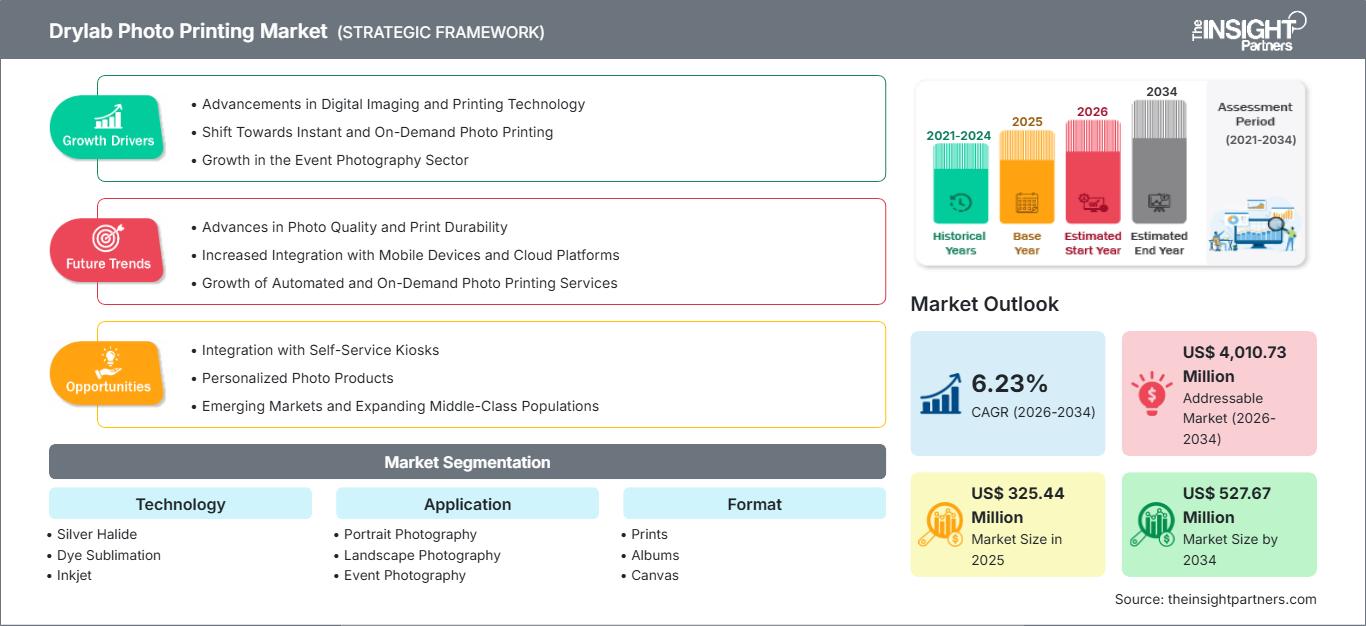
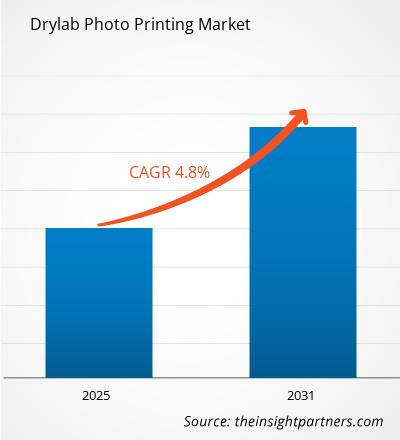
The Drylab Photo Printing market was valued at US$ 325.44 million in 2025 and is expected to reach US$ 527.67 million by 2034; it is estimated to record a CAGR of 5.52% during 2026-2034.
Drylab Photo Printing Market Assessment and Insights
- North America accounted for 31–34% share in 2025 and is expected to grow at a CAGR of 5.8–6.4% during 2026–2034, supported by premium photo products, studio modernization, and dense retail fulfillment networks.
- US represented 78–82% of North American revenue in 2025 and is projected to expand at a CAGR of 5.9–6.5% through 2034.
- Europe held 25–28% share in 2025 and is forecast to grow at a CAGR of 5.4–6.0%, led by Germany, the UK, France, Italy, and Spain.
- Asia Pacific captured 34–38% share in 2025 and is expected to post a CAGR of 6.8–7.5%, with China, Japan, South Korea, India, and Australia leading adoption.
- Largest Segment Inkjet held 49–54% market share in 2025 and is projected to grow at a CAGR of 6.5–7.1% during 2026–2034.
- High Growth Segment Photo Books accounted for 18–22% market share in 2025 and is forecast to expand at a CAGR of 7.2–8.0% through 2034.
- Key companies analyzed in detail: Konica Minolta, Inc., Brother Industries, Ltd., Sony Group Corporation, Mitsubishi Electric Corporation, Panasonic Holdings Corporation, Noritsu Precision Co., Ltd., Seiko Epson Corporation, Samsung Electronics Co., Ltd., Canon Inc., FUJIFILM Corporation, and Eastman Kodak Company.
Source: The Insight Partners' analysis based on proprietary research, government publications, company annual reports, investor presentations, industry databases, and expert interviews.
The transition of the printing process has evolved from large wet labs to compact dry printing technology utilizing ink jet, dye sublimation, thermal transfer, and workflow application for digital printing. The improvement of nozzle reliability, the range of colors, automatic calibration, and duplex media path has improved consistency because the amount of water, chemistry, ventilation, and footprint has decreased. The competitive factors have become throughputs, efficiency of consumables, media range, and uptime. Therefore, laboratories may plan personalized print jobs together with standard batch jobs utilizing prints, albums, canvas, and books without separate chemical processes.
In addition, investments will be done in Asia Pacific cities, secondary North American markets, and digitally connected studio environments providing services related to weddings, tourism, education institutions, and corporate events until 2034. The systems characterized by the absence of capital expenditure and cloud-based ordering will allow entrepreneurs to enter the market because of environmental regulations promoting less use of chemicals. The hardware in combination with color management, remote monitoring, and consumables will increase resilience of firms. Moreover, the expansion will involve availability of local media, technicians' network, financing, and integration of software.
Drylab Photo Printing Market Report Scope
| Report Attribute | Details |
|---|---|
| Market size in 2025 | US$ 325.44 Million |
| Market Size by 2034 | US$ 527.67 Million |
| Global CAGR (2026 - 2034) | 5.52% |
| Historical Data | 2021-2024 |
| Forecast period | 2026-2034 |
Drylab Photo Printing Market Analysis
Market Growth depends on the ongoing demand for high-quality physical mementos despite the proliferation of digital transactions. The cycles of demand depend on weddings, educational, tourist, identification, and business events, while customization leads to higher order volume. Printhead, ink, ribbon, paper, software, finishing, distribution, and maintenance providers are part of the value chain. Nowadays, customers evaluate the price of a good print, not the machine, which is determined by uptime, waste reduction, and color durability.
The market supply situation favors suppliers that integrate consumables, provide regional service, and have workflow integration. Inkjet technologies are used for variable and larger-format printing, while dye-sublimation and thermal technologies cover fast and standardized printing. Availability of media and vulnerability to shipping are the two operational limitations that require laboratories to stock multiple types of paper. Order consolidation using cloud ordering increases efficiency through combining the orders from retailers, studios, and mobile apps into fewer printing locations.
Drylab Photo Printing market report shows a fragmented industry consisting of varied electronics companies and imaging companies. Competition within the industry is through the ability of firms such as Canon Inc., Seiko Epson Corporation, FUJIFILM Corporation, Noritsu Precision Co., Ltd., and Eastman Kodak Company in color science, sales, and workflow processes. Firms such as Brother Industries, Ltd., Sony Group Corporation, Mitsubishi Electric Corporation, Panasonic Holdings Corporation, Samsung Electronics Co., Ltd., and Konica Minolta, Inc. have related imaging and printing technologies.
In recent times, the focus for investment is moving towards scalable solutions with automation and software minimizing human intervention. Positioning of the companies involves offering application packages rather than just equipment alone. The vendors may protect margins using certified media, service agreements, templates, and fleet management while distributors may distinguish themselves through installation and training services. The operators prefer solutions which can cater to seasonal events along with year-round commercial applications without compromising on color accuracy and chemistry processing expertise.
● REPORT CUSTOMIZATION
Tailor This Report To Align With Your Specific Business Requirements
This report can be customized to align precisely with your business objectives, scope, and target markets. Customization options include tailored segmentation, geography, competitive analysis, and strategic insights to support informed decision-making.
Customize This Report →WHAT YOU CAN ADJUST
- ● Segmentations
- ● Geography
- ● Competitive Analysis
- ● Language Preferences
Drylab Photo Printing Market: Strategic Insights
Regional Insights
North America Drylab Photo Printing Market
North America commanded 31–34% of the Drylab Photo Printing Market share in 2025 and is anticipated to expand by 5.8–6.4% up until 2034. North America features a high spend on personal photography in households, traditional schools and wedding photography avenues, along with availability of professional imaging solutions resellers. Wet labs are shifting to compact networked printers which have decreased chemical handling, space needs, and operator training, along with fast picking up and shipping.
Among the most sought-after services are premium albums, events bundles, passport photography, printing on canvas, and small-format commercial printing. The retailers have consolidated their production but retained the orders made via their distributed kiosks and mobile applications. Fleet standardization, remote monitoring, and consumption predictability are just a few examples of the aspects that influence purchase decisions. Professional portraiture and tourism in Canada, and events and retail in Mexico, can be other examples of market segments.
U.S. Drylab Photo Printing Market
In 2025, the US market held 78-82% of North America revenues and is estimated to grow at 5.9-6.5% till 2034. Dense channel networks consisting of photographers, specialty stores, school photography operators, and event organizers support recurring business volumes. Canon Inc., Seiko Epson Corporation, FUJIFILM Corporation, Noritsu Precision Co., Ltd., and Eastman Kodak Company have high levels of channel presence via professional imaging product lines, supplies, distribution, and service operations.
The services are evolving from commoditized snapshots to more lucrative photo albums, framed photos, canvas printing, graduation packages, and photos for events. Critical needs for the operators include fast turnaround, borderless printing, accurate reproduction of skin colors, and minimal maintenance. Integration with e-commerce enables regional laboratories to consolidate orders and be efficient, but the cost of logistics encourages local production if there is a deadline problem. Individual studios usually employ small devices.
Europe Drylab Photo Printing Market
The European region generated 25%–28% of the revenue in 2025 and is estimated to grow at 5.4%–6.0% through 2034. Germany has the strongest performance based on its sizable professional imaging presence, color management culture, and demand from portrait, retail, and commercial printing labs. British laboratories favor online orders, customized gifts, and wedding photo books; with their small dry system footprint that allows distributed order processing and reduced chemical treatment requirements.
France, Italy, and Spain derive revenue through tourism photography, event-based photography, school photography, and interior-decorating applications. In Europe, considerations of energy efficiency, minimizing waste, ease of repair, and consumables traceability play increasing role in tender and replacement selection criteria. Manufacturers offering multilingual workflow software and reliable support engineer access have a competitive edge. Growth in the market is consistent but not fast since digital alternatives are well-established, however, luxury physical prints and services keep it resilient.
APAC Drylab Photo Printing Market
In 2025, Asia Pacific was responsible for 34-38% market share and expected to witness a 6.8-7.5% CAGR till 2034. China is dominant owing to its scale while Japan offers expertise in minilabs combined with high-quality expectations. South Korea enables connected retail imaging while India benefits from increasing weddings, school, and studio photography.
Professional portraitures and events are advantageous for Australia. Urbanization, large number of creative companies, electronics manufacturing industry in the country, and digital money transactions make the distributed printing approach favorable. The production of clean products as emphasized in the policy will also be beneficial for shifting from chemical processes due to its cost issues.
Middle East & Africa Drylab Photo Printing Market
The Middle East & Africa segment is projected to grow at 5.6%-6.3% till 2034. The UAE takes the lead in terms of regional penetration through tourism, events, luxury retail, and connectivity of the service infrastructure. Saudi Arabia contributes additional demand in weddings, entertainment, and commercial print, along with increased investments in venues and hospitality.
South Africa dominates the professional photography and retail laboratory market segment, whereas the Rest of MEA has a distributor-driven market. Dry equipment that fits into a compact space is suitable for areas that have limitations in water supply, chemistry disposal, and technical support.
Segmentation Analysis
Technology
The Technology segment is projected to grow at 6.1–6.8% during 2026–2034. The Drylab Photo Printing Market scope spans legacy-quality silver-halide output and increasingly dominant digital dry processes. Buyers balance color permanence, throughput, media flexibility, maintenance intensity, and consumable cost. Inkjet gains in mixed-format laboratories, while dye-sublimation and thermal platforms remain important where speed, compactness, and predictable standardized output outweigh broader substrate requirements.
- Silver Halide retains relevance where laboratories prioritize familiar photographic appearance, continuous tone, and established premium finishing, but chemical handling and infrastructure requirements constrain new installations.
- Dye Sublimation supports event, kiosk, and instant-output workflows through rapid drying, durable surfaces, compact devices, and predictable per-print consumables suited to standardized sizes.
- Inkjet leads mixed-format production because scalable print widths, expanding color sets, variable media handling, and efficient short runs support studios, laboratories, and décor specialists.
- Thermal serves portable and transaction-oriented applications where simple operation, low maintenance, fast output, and reliable small-format production matter more than extensive media choice.
Application
The Application segment is expected to expand at 6.0–6.7% through 2034. Demand varies by image volume, turnaround, color expectations, and finishing complexity. Portrait and event workflows favor accurate skin tones and rapid batching, landscape photography requires wide gamut and detail, and commercial printing values repeatability. Software templates, automated cropping, and integrated ordering increasingly determine productivity across all applications.
- Portrait Photography remains a dependable volume base across studios, schools, graduations, and identity services, requiring consistent skin tones, repeatable calibration, and flexible package creation.
- Landscape Photography emphasizes tonal range, fine detail, archival media, and larger formats, making color management and premium inkjet output strategically important for galleries and creators.
- Event Photography rewards speed, portability, and immediate fulfillment at weddings, sports, conferences, and attractions, supporting compact dye-sublimation and thermal systems with standardized consumables.
- Commercial Printing broadens asset utilization through branded décor, proofs, promotional images, and short-run collateral, favoring automated workflows, media versatility, and dependable color across repeat orders.
Format
The Format segment is forecast to advance at 6.3–7.0% during 2026–2034. Standard prints sustain volume, while albums, canvas, and photo books increase ticket value through personalization and finishing. Laboratories seek systems that minimize changeover between media and sizes. Workflow software connecting page design, imposition, duplex production, and finishing is becoming as important as engine speed for profitable product diversification.
- Prints provide the largest recurring order base for portraits, events, identification, and retail pickup, with demand centered on speed, color consistency, and economical small batches.
- Albums remain central to wedding and milestone photography, combining premium papers, lay-flat binding, and curated storytelling that supports higher margins and differentiated studio packages.
- Canvas connects photography with home and commercial décor, requiring durable inks, broad media compatibility, accurate stretching allowances, and dependable larger-format color reproduction.
- Photo Books represent the high-growth format as mobile ordering, automated layouts, duplex printing, and personalized gifting make professionally finished books accessible to consumers and businesses.
End User
The End User segment is projected to grow at 5.9–6.6% through 2034. Professional photographers prioritize control, turnaround, and premium finishes; consumers value convenience and personalization; businesses require repeatability and brand consistency. Adoption increasingly follows a hybrid model in which order capture occurs online or on mobile devices, while production is routed to studios, regional laboratories, retailers, or in-house commercial facilities.
- Professional Photographers are the most strategically influential buyers, using print quality, media breadth, workflow control, and rapid fulfillment to differentiate portrait, wedding, event, and fine-art services.
- Consumers purchase episodically around holidays, travel, family milestones, and gifting, favoring intuitive mobile ordering, transparent pricing, convenient pickup, and personalized formats beyond standard prints.
- Businesses use photographic output for hospitality décor, branded events, retail displays, corporate gifting, proofs, and localized campaigns, emphasizing consistency, rights management, and reliable turnaround.
Opportunity Snapshot
| End Users | Revenue Contribution | Trend Tag | Adoption Stage |
| Professional Photographers | High | Studio Control | Mature |
| Consumers | Medium | Mobile Gifting | Scaling |
| Businesses | Medium | Branded Décor | Scaling |
Drylab Photo Printing Market Growth Drivers and Impact Analysis
Migration from Wet Chemistry to Compact Dry Production
Laboratories are replacing wet processors where water use, chemical storage, ventilation, technician skills, and floor space create disproportionate cost. Dry inkjet and dye-sublimation systems enable cleaner installation in studios, retail counters, schools, and event venues while reducing startup complexity. The operational impact extends beyond environmental considerations: faster warm-up, simpler maintenance, and digital job routing allow operators to match capacity with variable demand. This encourages smaller businesses to internalize production and larger networks to distribute output closer to customers. Suppliers benefit through equipment replacement, service, media, and software revenue, while buyers gain shorter turnaround and fewer process steps. The strongest adoption occurs where premium output and local fulfillment justify consumable costs.
Premium Personalization Raises Value per Printed Image
Consumers may print fewer routine snapshots, but they increasingly purchase curated products linked to weddings, graduations, travel, anniversaries, memorials, and gifting. Albums, canvas, and photo books convert digital archives into higher-value physical objects, supporting margins that commodity prints cannot deliver. Automated layouts, templates, facial grouping, and mobile uploads reduce the labor needed to produce individualized orders. For professional photographers, print packages strengthen service differentiation and create revenue beyond image files. Retailers and laboratories can use the same engines across multiple formats, improving utilization and cross-selling. Market impact therefore comes from mix improvement as much as unit growth, encouraging investment in versatile media handling, precise color, duplex capability, and finishing partnerships.
Connected Workflows Improve Utilization and Turnaround
Cloud ordering, kiosk integration, mobile applications, and centralized production management are reshaping how jobs reach drylab equipment. A laboratory can aggregate orders from several storefronts and photographers, assign production by format or deadline, and return finished products through pickup or shipment. This raises engine utilization, reduces manual file handling, and lowers error rates through standardized cropping, color treatment, and templates. Remote diagnostics and consumable monitoring further improve uptime, particularly for distributed fleets. The commercial effect is significant for event and retail operators facing short delivery windows and seasonal peaks. Vendors that integrate hardware, workflow software, and support can deepen recurring relationships, while open interfaces remain important for customers combining capture, commerce, printing, and finishing platforms.
Drylab Photo Printing Market Future Trends
AI-Assisted Image Preparation Moves into Production Workflows
Drylab Photo Printing Market trends will increasingly reflect automated image preparation rather than engine-only innovation. Software will assess resolution, crop suitability, color balance, skin-tone consistency, and layout quality before a job reaches production. These capabilities can make previously marginal smartphone files printable, reduce operator intervention, and support rapid personalization at scale. Vendors are likely to embed assistance within kiosks, web storefronts, and fleet software, with human review retained for premium work. Competitive advantage will shift toward systems that document corrections, preserve creator intent, and apply consistent rules across devices. Laboratories should evaluate interoperability, data governance, and measurable reductions in rework.
Distributed Micro-Labs Support Local and Event Fulfillment
Compact, connected equipment will enable micro-labs inside studios, hotels, attractions, campuses, and event venues. Instead of moving every job to a centralized plant, operators can route urgent or high-margin orders locally and consolidate less time-sensitive work regionally. The model shortens delivery, reduces shipping exposure, and supports immediate upselling after image capture. Standardized color profiles, remote support, and common consumables will be essential for consistent output across locations. Equipment suppliers can respond with subscription financing, modular capacity, and simplified maintenance. Adoption will expand where local demand is seasonal but valuable, making flexible deployment and redeployment important purchasing criteria.
Drylab Photo Printing Market Opportunities
Build Vertical Solutions for Wedding and Event Ecosystems
Suppliers can capture more value by packaging printers with capture-to-order software, event templates, portable finishing, service response, and calibrated consumables. The opportunity is strongest in wedding, sports, school, and attraction photography, where immediate proofing and short delivery windows influence purchase conversion. Drylab Photo Printing Market Forecasts support investment in systems that scale from a single venue to coordinated fleets. Vendors should partner with event platforms and photographers, offer seasonal financing, and design training around complete workflows rather than device operation. Success metrics should include sellable prints per hour, reprint rates, consumable availability, and revenue per attendee, enabling buyers to justify deployment economically.
Expand Premium Photo Books and Décor through Retail Networks
Retailers, laboratories, and printer manufacturers can develop differentiated photo-book, canvas, and framed-print programs using localized templates, curated media, and predictable fulfillment. The opportunity is not limited to consumer gifting: hospitality, corporate events, property marketing, and branded interiors require short-run visual products with consistent color. Investment should prioritize duplex workflows, media profiling, automated layout tools, and finishing partnerships that reduce manual touches. Regional production nodes can balance speed with utilization, while online storefronts broaden reach. Providers should test bundles, seasonal campaigns, and creator partnerships, then use order data to refine format ranges, inventory, and capacity before expanding geographically.
Recent Developments
- October 2023: Kodak Moments has launched its Retail Software version 23.2, introducing 60 new features and upgrades to help retailers enhance photo services and increase revenue. The updated platform enables same-day creation of premium products such as photo mugs, custom journals, and coin banks. It also improves order management, supports mobile photo printing, and adds energy-saving features for Kodak kiosks and printing systems.
- January 2026: FUJIFILM India showcased its advanced digital printing portfolio at PAMEX 2026 in Mumbai, featuring the Revoria Press and Apeos series. The company highlighted solutions for commercial printing, enterprises, packaging, photo markets, and on-demand production. Key products included the Revoria PC1120s, EC2100S, SC285S, and Apeos Pro C650, offering high-speed output, enhanced color quality, workflow efficiency, and versatile media support.
- April 2025: Seiko Epson Corporation Epson launched the 24-inch SureColor P7370 and 44-inch SureColor P9370 for professional photography, fine art, and graphic design, citing expanded color gamut, improved usability, and speeds exceeding twice those of the prior generation.
Frequently Asked Questions

- Comprehensive Market Sizing and Forecast Analysis
- Detailed Segmentation Analysis
- In-Depth Market Dynamics Assessment
- Regional and Country-Level Insights
- Competitive Landscape and Company Benchmarking
- Strategic Business Intelligence
Recent Reports
Testimonials

The Insight Partners' SCADA System Market report is comprehensive, with valuable insights on current trends and future forecasts. The team was highly professional, responsive, and supportive throughout. We are very satisfied and highly recommend their services.
RAN KEDEM Partner, Reali Technologies LTDs
I requested a report on a very specific software market and the team produced the report in a few days. The information was very relevant and well presented. I then requested some changes and additions to the report. The team was again very responsive and I got the final report in less than a week.
JEAN-HERVE JENN Chairman, Future Analytica
We worked with The Insight Partners for an important market study and forecast. They gave us clear insights into opportunities and risks, which helped shape our plans. Their research was easy to use and based on solid data. It helped us make smart, confident decisions. We highly recommend them.
PIYUSH NAGPAL Sr. Vice President, High Beam Global
The Insight Partners delivered insightful, well-structured market research with strong domain expertise. Their team was professional and responsive throughout. The user-friendly website made accessing industry reports seamless. We highly recommend them for reliable, high-quality research services
YUKIHIKO ADACHI CEO, Deep Blue, LLC.
This is the first time I have purchased a market report from The Insight Partners.While I was unsure at first, I visited their web site and felt more comfortable to take the risk and purchase a market report.I am completely satisfied with the quality of the report and customer service. I had several questions and comments with the initial report, but after a couple of dialogs over email with their analyst I believe I have a report that I can use as input to our strategic planning process.Thank you so much for taking the extra time and making this a positive experience.I will definitely recommend your service to others and you will be my first call when we need further market data.
JOHN SUZUKI President and Chief Executive Officer, Board Director, BK Technologies
I wish to appreciate your support and the professionalism you displayed in the course of attending to my request for information regarding to infectious disease IVD market in Nigeria. I appreciate your patience, your guidance, and the fact that you were willing to offer a discount, which eventually made it possible for us to close a deal. I look forward to engaging The Insight Partners in the future, all thanks to the impression you have created in me as a result of this first encounter.
DR CHIJIOKE ONYIA MANAGING DIRECTOR, PineCrest Healthcare Ltd.Reason to Buy
- Informed Decision-Making
- Understanding Market Dynamics
- Competitive Analysis
- Identifying Emerging Markets
- Customer Insights
- Market Forecasts
- Risk Mitigation
- Boosting Operational Efficiency
- Strategic Planning
- Investment Justification
- Tracking Industry Innovations
- Aligning with Regulatory Trends





 Get Free Sample for