
Dyslexia Treatments Market Growth, Share & Trends by 2034
Coverage: by Drug Type (Cyclizine, Meclizine, Methylphenidate, Dimenhydrinate); Distribution Channel (Hospital Pharmacies, Retail Pharmacies, Online Pharmacies), and Geography (North America, Europe, Asia Pacific, and South and Central America)
- Status : Data Released
- Report Code : TIPRE00007747
- Category : Life Sciences
- No. of Pages : 151
- Available Report Formats :


- Last update date : June 22, 2026


2025 Market Size
US$ 5.02 Bn
Base year value
2034 Forecast
US$ 8.34 Bn
Projected by 2034
CAGR 2026-2034
5.80 %
Growth rate
Addressable Market
US$ 60.53 Bn
(2026-2034)
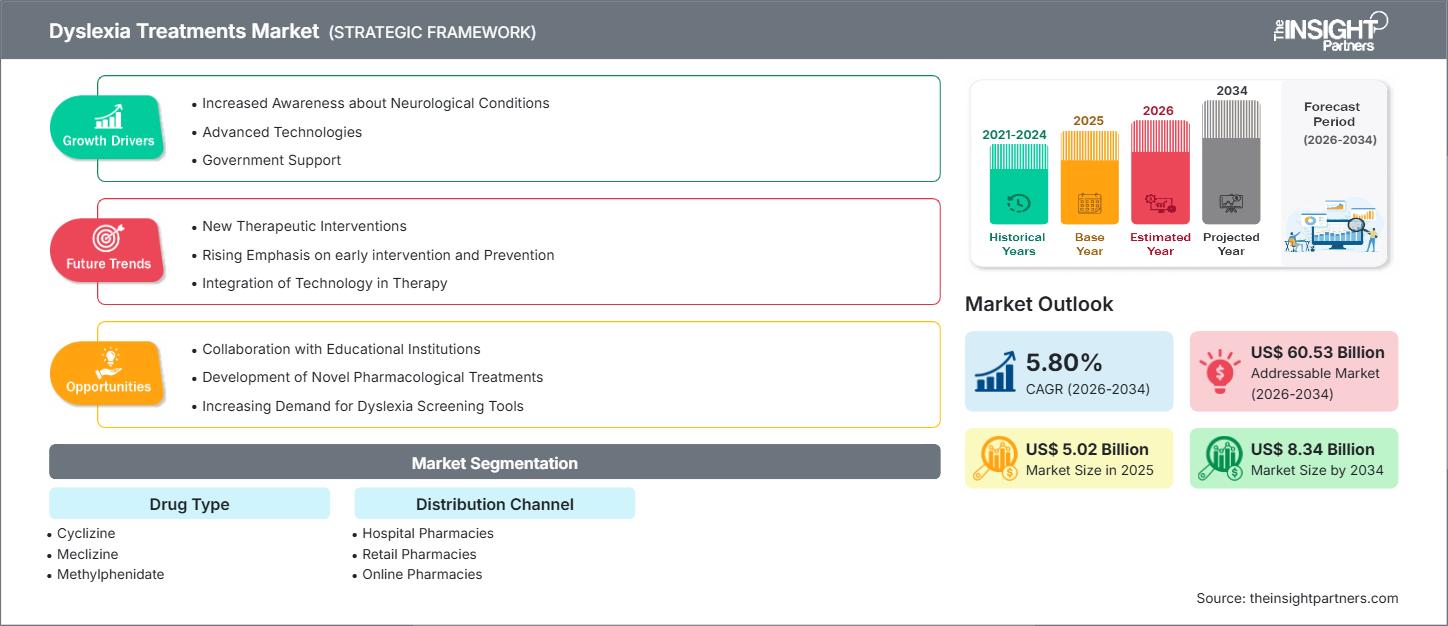
The global dyslexia treatments market size is projected to reach US$ 8.34 billion by 2034 from US$ 5.02 billion in 2025. The market is anticipated to register a CAGR of 5.80% during the forecast period 2026–2034.
Key market dynamics include a heightening global focus on neurodiversity, rising diagnostic rates facilitated by AI-driven screening tools, and a significant shift toward integrated pharmacological and behavioral therapy models. Additionally, the market is expected to benefit from the increasing prevalence of co-morbid conditions such as ADHD, expansion in specialized pediatric care infrastructure across emerging economies, and the rising inclusion of cognitive enhancers in personalized treatment regimens.
Dyslexia Treatments Market Analysis
The dyslexia treatments market analysis shows a strategic pivot toward addressing the sensory and neurological foundations of learning disabilities. Modern procurement trends indicate a growing reliance on medications that stabilize vestibular functions and enhance neurotransmitter activity to improve reading fluency. Unlike traditional models that focused solely on academic remediation, today’s market is increasingly shaped by neuro-rehabilitation protocols that combine pharmaceutical intervention with cognitive training. Strategic opportunities are emerging in the development of pediatric-friendly drug delivery systems, such as extended-release liquids and transdermal patches, which cater to the long-term nature of dyslexia management. The analysis also suggests that market expansion is highly correlated with the integration of digital health records, allowing clinicians to monitor the efficacy of drugs like methylphenidate alongside educational progress. Competitive differentiation now hinges on the ability of providers to offer evidence-based, data-driven outcomes that justify the cost of multidisciplinary care.
Dyslexia Treatments Market Overview
Dyslexia treatments have transitioned from specialized tutoring services into a comprehensive clinical ecosystem encompassing pharmacology, digital therapeutics, and specialized retail. The sector now involves the strategic use of CNS stimulants and anti-motion sickness agents to manage symptoms of inattention and visual tracking difficulties. Both global pharmaceutical innovators and regional generic manufacturers compete in this landscape, leveraging high-demand molecules like meclizine and cyclizine. Growing demand for accessible, private treatment options among families in urbanized regions has fueled a surge in the popularity of online pharmaceutical services and home-based clinical monitoring. The US market is increasingly defined by the widespread availability of generic central nervous system stimulants and vestibular stabilizers. As key patents expire, healthcare providers are shifting toward cost-effective generic alternatives to manage dyslexia-related comorbidities, significantly enhancing patient accessibility and long-term adherence within established insurance frameworks.
Market Research Highlights
- Global market for Dyslexia Treatments was valued at US$ 5.02 Billion in 2025
- Annual market size is expected to reach US$ 8.34 Billion by 2034
- Total addressable market (TAM) during 2026-2034 is projected to reach approximately US$ 60.53 Billion
- Market is anticipated to register a CAGR of 5.8% during the forecast period
- The United States represents a key market, supported by Increased Awareness about Neurological Conditions, Advanced Technologies in Drugs Manufacturing, Government Support, as well as evolving industry dynamics
- Market analysis covers North America, Europe, Asia-Pacific, South and Central America, Middle East and Africa, with growth evaluated across the forecast period
- Market opportunities such as Collaboration with Educational Institutions, Development of Novel Pharmacological Treatments, Increasing Demand for Dyslexia Screening Tools are expected to influence market dynamics and addressable market
- Report profiles industry participants, including Gangwal Chemicals Pvt. Ltd, GlaxoSmithKline, Jubilant Cadista, Micro Labs, Novartis AG, Pfizer Inc., Purdue Pharma, RPG Life Sciences Ltd, Srikem Labs, Wallace Pharmaceuticals Ltd., while analyzing competitive strategies and innovation developments
-
Source: The Insight Partners' analysis based on proprietary research, government publications, company annual reports, investor presentations, industry databases, and expert interviews.
● REPORT CUSTOMIZATION
Tailor This Report To Align With Your Specific Business Requirements
This report can be customized to align precisely with your business objectives, scope, and target markets. Customization options include tailored segmentation, geography, competitive analysis, and strategic insights to support informed decision-making.
Customize This Report →WHAT YOU CAN ADJUST
- ● Segmentations
- ● Geography
- ● Competitive Analysis
- ● Language Preferences
Dyslexia Treatments Market: Strategic Insights
-
Get Top Key Market Trends of this report.This FREE sample will include data analysis, ranging from market trends to estimates and forecasts.
Dyslexia Treatments Market Drivers and Opportunities
Market Drivers:
- Increasing Prevalence of Co-morbid ADHD and Dyslexia: A high overlap between learning disorders and attention deficits is driving the use of stimulants to improve working memory and executive function during literacy tasks.
- Advancements in Neuro-Pharmacology: Emerging research into the role of the vestibular system in reading is sustaining high demand for antihistamines used off-label to improve coordination and visual tracking.
- Supportive Government Mandates for Screening: New regulations in developed and emerging markets requiring early screening in schools have removed traditional barriers for niche dyslexia medications.
Market Opportunities:
- Expansion of Online Pharmacy Networks: Forming strategic partnerships between telehealth providers and online pharmacies may facilitate access to high-margin treatment segments in underserved rural areas.
- Growth in Specialized Pediatric Formulations: Beyond standard tablets, there is a significant opportunity for the development of patient-friendly delivery systems like patches or fast-dissolving films to improve adherence in children.
- Diversification into Integrated Clinical Platforms: There is a growing opportunity for producers to target clinics by bundling drug therapies with digital monitoring software to track patient progress in real-time.
Dyslexia Treatments Market Report Segmentation Analysis
The Dyslexia Treatments Market share is analyzed across various segments to provide a clearer understanding of its structure, growth potential, and emerging trends. Below is the standard segmentation approach used in most industry reports:
By Drug Type:
- Methylphenidate: The dominant volume driver within the clinical segment, primarily prescribed when dyslexia co-occurs with attention-deficit symptoms to improve cognitive focus.
- Meclizine: A fast-growing niche utilized for its potential to address vestibular-related visual processing issues, increasingly adopted in holistic neuro-rehabilitation programs.
- Cyclizine: Gains traction in specialized clinical settings for managing sensory-induced nausea or dizziness that can accompany intensive visual therapy.
- Dimenhydrinate: Often used in adjunct therapy to manage the motion-sensitivity symptoms frequently reported by individuals with specific subtypes of dyslexia.
By Distribution Channel:
- Hospital Pharmacies: Remains the primary channel for initial prescriptions following a formal diagnosis at specialized pediatric or neurological centers.
- Retail Pharmacies: The fastest-rising physical channel, benefiting from the mainstreaming of dyslexia medications and the expansion of community-based healthcare.
- Online Pharmacies: Offers a select but growing range of shelf-stable medications and recurring prescription refills, enabling convenient home-based treatment management.
By Geography:
- North America
- Europe
- Asia Pacific
- South & Central America
- Middle East & Africa
Dyslexia Treatments Market Report Scope
| Report Attribute | Details |
|---|---|
| Market size in 2025 | US$ 5.02 Billion |
| Market Size by 2034 | US$ 8.34 Billion |
| Global CAGR (2026 - 2034) | 5.80% |
| Historical Data | 2021-2024 |
| Forecast period | 2026-2034 |
| Segments Covered |
By Drug Type
|
| Regions and Countries Covered |
North America
|
| Market leaders and key company profiles |
|
Dyslexia Treatments Market Players Density: Understanding Its Impact on Business Dynamics
The Dyslexia Treatments Market is growing rapidly, driven by increasing end-user demand due to factors such as evolving consumer preferences, technological advancements, and greater awareness of the product's benefits. As demand rises, businesses are expanding their offerings, innovating to meet consumer needs, and capitalizing on emerging trends, which further fuels market growth.
Dyslexia Treatments Market Share Analysis by Geography
Asia-Pacific is expected to grow fastest in the coming years. Emerging markets in South & Central America, the Middle East, and Africa also have many untapped opportunities for diagnostic developers and pharmaceutical manufacturers to expand.
The dyslexia treatments market is undergoing a significant transformation, moving from a traditional remedial education model to a clinical high-value intervention sector. Growth is driven by the rising prevalence of learning disabilities, a surge in comorbid ADHD diagnoses, and the expansion of the digital therapeutics sector. Below is a summary of market share and trends by region:
North America
- Market Share: Holds the largest share globally, driven by advanced healthcare infrastructure and strong regulatory support like the Individuals with Disabilities Education Act (IDEA).
- Key Drivers:
- Well-established diagnostic centers and a high volume of pediatric prescriptions for Central Nervous System (CNS) stimulants.
- High consumer awareness leading to early pharmaceutical intervention and specialized clinical care.
- Robust presence of industry leaders and major retail pharmacy chains.
- Trends: Scaling of telehealth for medication management and the rapid integration of AI-driven reading assistants into clinical treatment plans.
Europe
- Market Share: Holds the second-largest share, anchored by comprehensive state-funded special education frameworks and clinical research in the UK, Germany, and France.
- Key Drivers:
- Increasing adoption of antihistamines and stimulants as adjuncts to intensive speech and occupational therapy.
- Government mandates for universal early-childhood screening in primary schools.
- Strong healthcare reimbursement systems for neurodevelopmental diagnosis.
- Trends: A strategic focus on standardized clinical pathways and the rising use of online pharmacies for long-term prescription fulfillment of learning-support medications.
Asia-Pacific
- Market Share: The fastest-growing region, with high-growth markets in China and India expanding their healthcare and educational budgets.
- Key Drivers:
- Massive pediatric population and rising middle-class disposable income favoring premium private treatments.
- Growing government initiatives to improve literacy and identify learning disorders in rural and urban areas.
- Rapid expansion of the retail pharmacy sector and digital health infrastructure.
- Trends: Heavy reliance on e-commerce platforms for therapeutic aids and an increasing trend of B2B contracts between pharmaceutical distributors and international schools.
South and Central America
- Market Share: Emerging market with a growing private clinic sector in countries like Brazil and Chile.
- Key Drivers:
- Increasing awareness of dyslexia as a clinical condition rather than a general learning difficulty.
- Modernization of community pharmacies to provide specialized pediatric medications.
- Rising influence of North American treatment protocols among healthcare professionals.
- Trends: Growth of boutique specialty centers and the introduction of localized digital screening tools to differentiate from basic school-level assessments.
Middle East and Africa
- Market Share: Developing market transitioning toward formalized commercial healthcare and specialized education centers.
- Key Drivers:
- Traditional presence of specialized learning support transitioning into formalized clinical medicine.
- High demand for shelf-stable pediatric formulations in diverse climates.
- Trends: Implementation of national disability certification systems and the formalization of hospital-based pharmacies to ensure a reliable supply of CNS drugs.
High Market Density and Competition
Competition is intensifying due to the presence of established leaders such as Pfizer Inc., Novartis AG, and Teva Pharmaceutical Industries Ltd. Regional experts and niche players like Cian Healthcare Pvt. Ltd. (India) and Wallace Pharmaceuticals (India), alongside specialized providers such as Jubilant Pharma Limited, also contribute to a diverse and rapidly expanding market landscape.
This competitive environment pushes vendors to differentiate through:
- Functional Branding: Positioning medications as part of a total cognitive wellness package that includes both pharmaceutical and digital therapy.
- Supply Chain Integrity: Ensuring transparency from raw material sourcing to final retail distribution to meet ethical healthcare standards.
- Technological Integration: Using data from eye-tracking devices and reading software to adjust drug dosages and therapeutic schedules for better outcomes.
Opportunities and Strategic Moves
- Partner with digital health platforms and e-commerce pharmacies to tap into the surging demand for convenient, home-based management of chronic learning disabilities in the Asia-Pacific and North American markets.
- Incorporate data-driven monitoring tools and parent-focused apps to appeal to tech-savvy parents seeking evidence-based outcomes and real-time tracking of their child's therapeutic progress.
Major Companies operating in the Dyslexia Treatments Market:
- Gangwal Chemicals Pvt. Ltd
- GlaxoSmithKline
- Jubilant Cadista
- Micro Labs
- Novartis AG
- Pfizer Inc.
- Purdue Pharma
- RPG Life Sciences Ltd
- Srikem Labs
- Wallace Pharmaceuticals Ltd.
Disclaimer: The companies listed above are not ranked in any particular order.
Dyslexia Treatments Market News and Recent Developments
- In September 2025, the Madras Dyslexia Association (MDA) launched a new remedial toolkit to assist children with learning difficulties in mathematics. The toolkit, named ‘Count on Me’, has been designed to support students with developmental dyscalculia and other math-related challenges, a press release said. Currently, 50 schools across Chennai are using this resource, which is also proving beneficial for all students by making mathematics accessible and engaging.
- In February 2025, Promova launched Dyslexia Mode 2.0, designed specifically to support learners with dyslexia in their language acquisition. This innovative feature embodies the principles Darren advocates for in inclusive design.
Dyslexia Treatments Market Report Coverage and Deliverables
The Dyslexia Treatments Market Size and Forecast (2021–2034) report provides a detailed analysis of the market covering below areas:
- Dyslexia Treatments Market size and forecast at global, regional, and country levels for all the key market segments covered under the scope
- Dyslexia Treatments Market trends, as well as market dynamics such as drivers, restraints, and key opportunities
- Detailed PEST and SWOT analysis
- Dyslexia Treatments Market analysis covering key market trends, global and regional framework, major players, regulations, and recent market developments
- Industry landscape and competition analysis covering market concentration, heat map analysis, prominent players, and recent developments in the Dyslexia Treatments Market.
- Detailed company profiles
Frequently Asked Questions

- Comprehensive Market Sizing and Forecast Analysis
- Detailed Segmentation Analysis
- In-Depth Market Dynamics Assessment
- Regional and Country-Level Insights
- Competitive Landscape and Company Benchmarking
- Strategic Business Intelligence
Recent Reports
Testimonials

The Insight Partners' SCADA System Market report is comprehensive, with valuable insights on current trends and future forecasts. The team was highly professional, responsive, and supportive throughout. We are very satisfied and highly recommend their services.
RAN KEDEM Partner, Reali Technologies LTDs
I requested a report on a very specific software market and the team produced the report in a few days. The information was very relevant and well presented. I then requested some changes and additions to the report. The team was again very responsive and I got the final report in less than a week.
JEAN-HERVE JENN Chairman, Future Analytica
We worked with The Insight Partners for an important market study and forecast. They gave us clear insights into opportunities and risks, which helped shape our plans. Their research was easy to use and based on solid data. It helped us make smart, confident decisions. We highly recommend them.
PIYUSH NAGPAL Sr. Vice President, High Beam Global
The Insight Partners delivered insightful, well-structured market research with strong domain expertise. Their team was professional and responsive throughout. The user-friendly website made accessing industry reports seamless. We highly recommend them for reliable, high-quality research services
YUKIHIKO ADACHI CEO, Deep Blue, LLC.
This is the first time I have purchased a market report from The Insight Partners.While I was unsure at first, I visited their web site and felt more comfortable to take the risk and purchase a market report.I am completely satisfied with the quality of the report and customer service. I had several questions and comments with the initial report, but after a couple of dialogs over email with their analyst I believe I have a report that I can use as input to our strategic planning process.Thank you so much for taking the extra time and making this a positive experience.I will definitely recommend your service to others and you will be my first call when we need further market data.
JOHN SUZUKI President and Chief Executive Officer, Board Director, BK Technologies
I wish to appreciate your support and the professionalism you displayed in the course of attending to my request for information regarding to infectious disease IVD market in Nigeria. I appreciate your patience, your guidance, and the fact that you were willing to offer a discount, which eventually made it possible for us to close a deal. I look forward to engaging The Insight Partners in the future, all thanks to the impression you have created in me as a result of this first encounter.
DR CHIJIOKE ONYIA MANAGING DIRECTOR, PineCrest Healthcare Ltd.Reason to Buy
- Informed Decision-Making
- Understanding Market Dynamics
- Competitive Analysis
- Identifying Emerging Markets
- Customer Insights
- Market Forecasts
- Risk Mitigation
- Boosting Operational Efficiency
- Strategic Planning
- Investment Justification
- Tracking Industry Innovations
- Aligning with Regulatory Trends





 Get Free Sample for