
E-commerce Market Share, Growth & Demand by 2034
Coverage: By Distribution Channel (B2B, B2C); Industry (Consumer Electronics, Apparels, Auto and Parts, Health, Personal Care and Beauty, Food and Beverages, Others), and Geography (North America, Europe, Asia Pacific, and South and Central America)
- Status : Data Released
- Report Code : TIPRE00018590
- Category : Technology, Media and Telecommunications
- No. of Pages : 150
- Available Report Formats :


- Last update date : March 23, 2026


2025 Market Size
US$ 6015.6 Bn
Base year value
2034 Forecast
US$ 13814.2 Bn
Projected by 2034
CAGR 2026-2034
9.68 %
Growth rate
Addressable Market
US$ 88,398.76 Bn
(2026-2034)
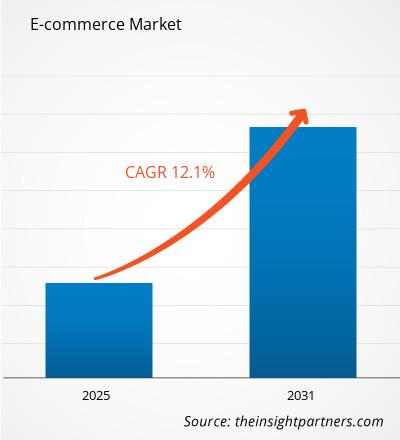
The global E-commerce market was valued at US$ 6015.6 billion in 2025 and is expected to reach US$ 13814.2 billion by 2034; it is estimated to record a CAGR of 9.68% during 2026-2034.
Key market dynamics include the exponential rise in smartphone penetration, the widespread adoption of 5G technology, enhancing mobile shopping experiences, and a significant shift in consumer behavior toward digital-first retail. Additionally, the market is expected to benefit from the rapid expansion of digital payment ecosystems, the integration of Artificial Intelligence (AI) for hyper-personalized shopping journeys, and the growing prominence of cross-border trade facilitated by streamlined global logistics.
E-Commerce Market Analysis
The e-commerce market analysis indicates a strategic pivot toward experience-driven commerce, where businesses are moving beyond simple transactional platforms to immersive, AI-powered ecosystems. As competition intensifies, companies are increasingly investing in predictive analytics to anticipate consumer demand and optimize supply chain efficiency. Strategic opportunities are emerging in Social Commerce and Quick Commerce, where the fusion of entertainment, social media, and ultra-fast delivery (under 30 minutes) is redefining the retail boundary. The analysis also highlights that market success now hinges on the seamless integration of omnichannel strategies, ensuring that the digital and physical brand experience is consistent. Competitive differentiation is increasingly defined by sustainable practices, such as carbon-neutral shipping and eco-friendly packaging, as well as the implementation of robust cybersecurity frameworks to protect consumer data in an era of escalating digital threats.
E-Commerce Market Overview
E-Commerce has transitioned from a supplementary retail channel to the primary engine of global economic growth. Historically dominated by desktop-based transactions for electronics and apparel, the industry has evolved into a mobile-centric landscape encompassing everything from groceries to high-value industrial equipment. The ecosystem is characterized by the coexistence of massive horizontal marketplaces and a booming Direct-to-Consumer (D2C) industry that allows brands to own the entire customer relationship. Technological advancements in augmented reality (AR) for virtual try-ons and the rise of Buy Now, Pay Later (BNPL) financial models have significantly lowered the barriers to purchase. While established markets in Asia and North America continue to lead in volume, emerging economies in Southeast Asia, Latin America, and Africa are experiencing the fastest growth rates as infrastructure matures. For instance, the market in the US remains a global cornerstone of innovation, characterized by a highly mature digital infrastructure and a tech-savvy consumer base. Growth is currently propelled by the Mainstreaming of grocery e-commerce and a surge in retail-media spending. The landscape features intense competition between established retail giants and emerging social-driven shopping platforms.
Market Research Highlights
- Global market for E-commerce was valued at US$ 6,015.60 Billion in 6015
- Annual market size is expected to reach US$ 13,814.20 Billion by 2034
- Total addressable market (TAM) during 2026-2034 is projected to reach approximately US$ XX
- Market is anticipated to register a CAGR of 10.38% during the forecast period
- The United States represents a key market, supported by Technological Advancements, Changing Consumer Behavior, as well as evolving industry dynamics
- Market analysis covers North America, Europe, Asia-Pacific, South and Central America, Middle East and Africa, with growth evaluated across the forecast period
- Market opportunities such as Global Internet Penetration, Cross-Border E-commerce are expected to influence market dynamics and addressable market
- Report profiles industry participants, including Amazon.com, Inc., Alibaba Group Holding Limited, Best Buy, eBay, Flipkart Private Limited, JD.com, Inc., The Home Depot, The Kroger Co., Target, Walmart, while analyzing competitive strategies and innovation developments
-
Source: The Insight Partners' analysis based on proprietary research, government publications, company annual reports, investor presentations, industry databases, and expert interviews.
● REPORT CUSTOMIZATION
Tailor This Report To Align With Your Specific Business Requirements
This report can be customized to align precisely with your business objectives, scope, and target markets. Customization options include tailored segmentation, geography, competitive analysis, and strategic insights to support informed decision-making.
Customize This Report →WHAT YOU CAN ADJUST
- ● Segmentations
- ● Geography
- ● Competitive Analysis
- ● Language Preferences
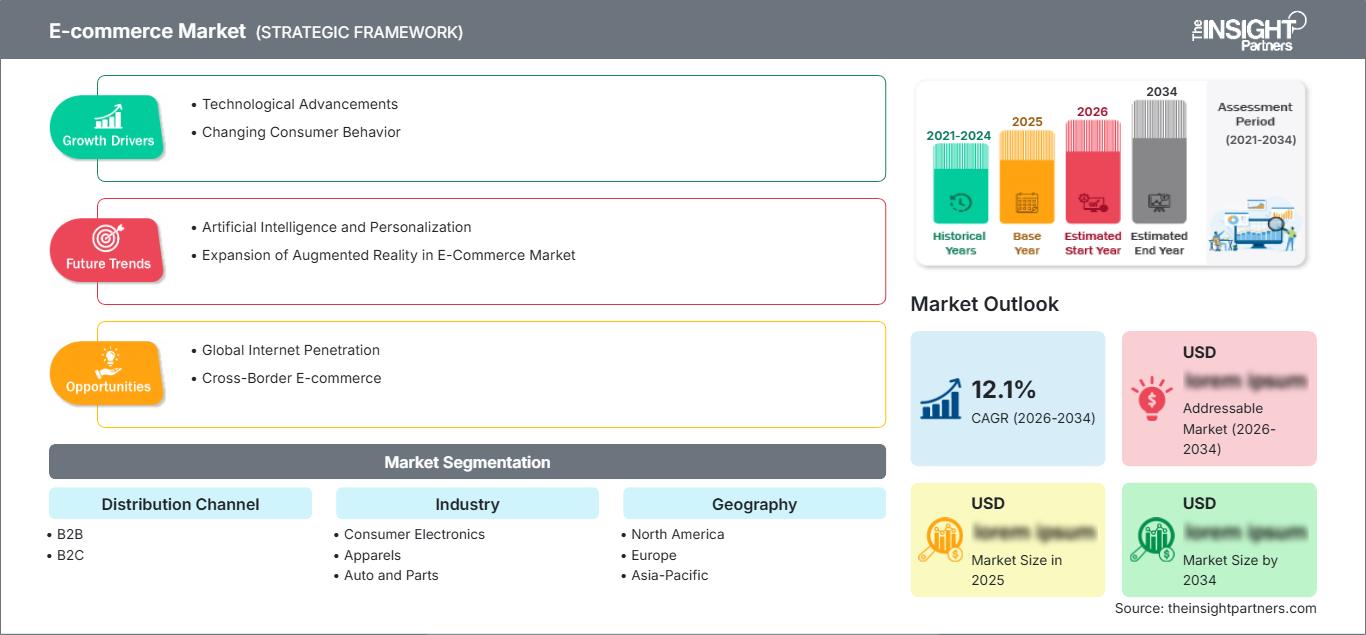
E-commerce Market: Strategic Insights
-
Get Top Key Market Trends of this report.This FREE sample will include data analysis, ranging from market trends to estimates and forecasts.
E-Commerce Market Drivers and Opportunities
Market Drivers:
- Accelerating Mobile and 5G Penetration: The global rollout of 5G networks is enabling faster, more immersive mobile shopping experiences. With smartphones becoming the primary device for internet access in emerging markets, mobile-first commerce is driving unprecedented transaction volumes.
- Evolution of Digital Payment Ecosystems: The proliferation of secure digital wallets, instant payment interfaces (like UPI), and embedded finance options has simplified the checkout process. These innovations reduce cart abandonment and foster consumer trust in digital transactions.
- AI-Driven Personalization and Operational Efficiency: Artificial Intelligence is revolutionizing the market by providing highly tailored product recommendations and optimizing logistics. Predictive algorithms help businesses manage inventory levels more effectively, reducing costs and improving delivery speeds.
Market Opportunities:
- Expansion of Social and Live Commerce: Integrating shopping directly into social media platforms and live-streaming events presents a multi-billion dollar opportunity to capture younger demographics who prefer interactive and community-driven buying experiences.
- Growth in B2B E-Commerce Digitization: The B2B sector is currently undergoing a massive digital transformation. Developing specialized platforms that mirror the ease of B2C shopping for industrial and wholesale procurement offers significant untapped revenue potential.
- Sustainability and Green Logistics: As environmental concerns influence purchasing decisions, there is a growing opportunity for Eco-Commerce. Implementing circular economy models and transparent, green supply chains can serve as a powerful differentiator for premium brands.
E-Commerce Market Report Segmentation Analysis
The E-Commerce Market share is analyzed across various segments to provide a clearer understanding of its structure, growth potential, and emerging trends. Below is the standard segmentation approach used in most industry reports:
By Distribution Channel:
- B2C (Business-to-Consumer): This remains the most visible and high-volume segment, driven by the mass adoption of online retail, home delivery services, and the convenience of shopping for daily essentials and luxury goods.
- B2B (Business-to-Business): A rapidly expanding segment that involves the digital exchange of goods and services between companies. It is benefiting from the modernization of supply chains and the shift away from traditional manual procurement.
By Industry:
- Consumer Electronics: Historically, the leading category, fueled by frequent product cycles, high-value transactions, and the tech-savvy nature of early e-commerce adopters.
- Apparel: A dominant segment characterized by high consumer engagement, the rise of fast-fashion digital brands, and the successful implementation of virtual fitting technologies.
- Auto and Parts: An emerging niche that has seen growth through the digitization of the aftermarket parts industry and the increasing consumer comfort with purchasing vehicles online.
- Health, Personal Care, and Beauty: One of the fastest-growing categories, driven by subscription models, social media influencer marketing, and the shift toward online pharmacy services.
- Food and Beverages: A market that witnessed a permanent shift during the pandemic, with a focus on grocery delivery, gourmet food kits, and Quick Commerce for immediate needs.
- Others: Includes home and furniture, toys, media, and specialized DIY equipment.
By Geography:
- North America
- Europe
- Asia Pacific
- South & Central America
- Middle East & Africa
E-commerce Market Report Scope
| Report Attribute | Details |
|---|---|
| Market size in 2025 | US$ 6015.6 Billion |
| Market Size by 2034 | US$ 13814.2 Billion |
| Global CAGR (2026 - 2034) | 9.68% |
| Historical Data | 2021-2024 |
| Forecast period | 2026-2034 |
| Segments Covered |
By Distribution Channel
|
| Regions and Countries Covered |
North America
|
| Market leaders and key company profiles |
|
E-commerce Market Players Density: Understanding Its Impact on Business Dynamics
The E-commerce Market is growing rapidly, driven by increasing end-user demand due to factors such as evolving consumer preferences, technological advancements, and greater awareness of the product's benefits. As demand rises, businesses are expanding their offerings, innovating to meet consumer needs, and capitalizing on emerging trends, which further fuels market growth.
E-Commerce Market Share Analysis by Geography
Asia-Pacific is expected to grow fastest in the coming years, maintaining its position as the world's largest e-commerce market. Emerging markets in South & Central America, the Middle East, and Africa also have many untapped opportunities for digital platforms and fintech providers to expand as internet accessibility improves.
The e-commerce market is undergoing a significant transformation, moving from a convenience-based alternative to the foundational pillar of modern retail. Growth is driven by the global middle-class expansion, the Quick Commerce boom, and the integration of financial services into shopping platforms. Below is a summary of market share and trends by region:
North America
- Market Share: A mature and highly influential segment, characterized by high average order values and the world's most advanced logistics networks.
- Key Drivers:
- Widespread consumer reliance on subscription-based loyalty programs (e.g., Amazon Prime).
- The rapid growth of Retail Media Networks allows brands to target consumers at the point of purchase.
- Strong domestic presence of global e-commerce pioneers and technology innovators.
- Trends: A significant shift toward Direct-to-Consumer (D2C) brands bypassing traditional retailers and a rising focus on Same-Day delivery infrastructure.
Europe
- Market Share: A robust market with a strong emphasis on cross-border trade and stringent data privacy regulations (GDPR) shaping consumer trust.
- Key Drivers:
- High internet penetration and a well-integrated regional transport network facilitate international sales.
- Growing consumer preference for sustainable and ethical e-commerce brands.
- Strong government support for the digitization of Small and Medium Enterprises (SMEs).
- Trends: The implementation of the Digital Services Act to ensure fair competition and the rapid growth of Click and Collect models in urban centers.
Asia-Pacific
- Market Share: The largest and most dynamic region, home to the world's biggest e-commerce shopping festivals and a mobile-first population.
- Key Drivers:
- Massive consumer bases in China and India are adopting digital payments at an unprecedented scale.
- Government-led Digital India and Smart City initiatives are expanding internet access to rural areas.
- The dominance of Super-Apps that integrate social media, payments, and shopping into a single ecosystem.
- Trends: The explosion of Live Commerce (selling via live video) and the rise of Hyper-Value platforms targeting value-conscious consumers in Tier-2 and Tier-3 cities.
South and Central America
- Market Share: A high-growth emerging market led by Brazil and Argentina.
- Key Drivers:
- Rapid improvement in financial inclusion through the rise of regional fintech and digital-only banks.
- Increasing investment from global marketplaces looking to capture the next billion shoppers.
- Modernization of local postal and courier services to handle increasing parcel volumes.
- Trends: The rapid adoption of Marketplace models by traditional department stores and the growth of mobile-centric shopping apps.
Middle East and Africa
- Market Share: A developing market with immense potential, transitioning from traditional cash-based economies to digital-first societies.
- Key Drivers:
- A young, tech-savvy population and high smartphone ownership in markets like the UAE, Saudi Arabia, and Nigeria.
- Strategic investments in Smart Logistics and localized fulfillment centers to overcome geographical challenges.
- The arrival of global e-commerce giants fuels increasing trust in online shopping.
- Trends: Transitioning from Cash on Delivery to digital payments and a focus on developing specialized B2B marketplaces for the oil, gas, and construction sectors.
High Market Density and Competition
Competition is intensifying due to the presence of established leaders such as Amazon.com Inc., Alibaba Group, and Walmart Inc. Regional powerhouses like Mercado Libre (South America), Flipkart (India), and Shopee (Southeast Asia) also contribute to a diverse and rapidly expanding market landscape.
This competitive environment pushes vendors to differentiate through:
- Hyper-Personalization: Utilizing Generative AI to create unique shopping interfaces, personalized style guides, and individualized promotional offers for every user.
- Logistics Innovation: Developing proprietary delivery networks, drone technology, and Dark Stores to enable ultra-fast fulfillment and reduce dependency on third-party carriers.
- Ecosystem Locking: Creating integrated service bundles, such as streaming, cloud storage, and exclusive discounts, to increase customer lifetime value and brand loyalty.
- Trust and Security: Implementing blockchain for supply chain transparency and advanced biometric authentication for secure, frictionless payments.
Opportunities and Strategic Moves
- Partner with Fintech Providers: E-commerce platforms are increasingly integrating Buy Now, Pay Later and micro-insurance products to make high-value purchases more accessible to a broader audience.
- Invest in Phygital Retail: Leveraging Augmented Reality (AR) and Internet of Things (IoT) to bridge the gap between online browsing and physical store experiences, such as smart mirrors and automated returns.
Major Companies operating in the E-Commerce Market are:
- Amazon.com, Inc.
- Alibaba Group Holding Limited
- Best Buy
- eBay
- Flipkart Private Limited
- JD.com, Inc.
- The Home Depot
- The Kroger Co.
- Target
- Walmart
Disclaimer: The companies listed above are not ranked in any particular order.
E-Commerce Market News and Recent Developments
- In September 2025, Amazon finalized its acquisition of Axio (formerly known as Capital Float), a prominent digital lending and checkout finance provider in India. The completion of the deal followed the receipt of formal regulatory approval from the Reserve Bank of India (RBI). As one of the largest acquisitions ever conducted by the company in the region, the transaction successfully integrated the global reach of the E-Commerce leader with Axio's specialized digital lending expertise to expand credit accessibility across the Indian market significantly.
- In February 2024, Wix.com Ltd., a leading SaaS website builder platform, announced a strategic partnership with Global-e Online Ltd. to provide merchants with an advanced international cross-border selling solution. This collaboration significantly bolstered Wix's existing E-Commerce capabilities by integrating industry-leading functionalities that empowered sellers to enter and navigate new global markets effortlessly. By leveraging this partnership, merchants gained the ability to scale their businesses globally, utilizing Global-e's specialized tools to manage the complexities of international trade within the broader E-Commerce ecosystem.
E-Commerce Market Report Coverage and Deliverables
The E-Commerce Market Size and Forecast (2021–2034) report provides a detailed analysis of the market covering below areas:
- Market size and forecast at global, regional, and country levels for all the key market segments covered under the scope
- Market trends, as well as market dynamics such as drivers, restraints, and key opportunities
- Detailed PEST and SWOT analysis
- Market analysis covering key market trends, global and regional framework, major players, regulations, and recent market developments
- Industry landscape and competition analysis covering market concentration, heat map analysis, prominent players, and recent developments in the E-Commerce Market.
- Detailed company profiles
Frequently Asked Questions

- Comprehensive Market Sizing and Forecast Analysis
- Detailed Segmentation Analysis
- In-Depth Market Dynamics Assessment
- Regional and Country-Level Insights
- Competitive Landscape and Company Benchmarking
- Strategic Business Intelligence
Recent Reports
Testimonials

The Insight Partners' SCADA System Market report is comprehensive, with valuable insights on current trends and future forecasts. The team was highly professional, responsive, and supportive throughout. We are very satisfied and highly recommend their services.
RAN KEDEM Partner, Reali Technologies LTDs
I requested a report on a very specific software market and the team produced the report in a few days. The information was very relevant and well presented. I then requested some changes and additions to the report. The team was again very responsive and I got the final report in less than a week.
JEAN-HERVE JENN Chairman, Future Analytica
We worked with The Insight Partners for an important market study and forecast. They gave us clear insights into opportunities and risks, which helped shape our plans. Their research was easy to use and based on solid data. It helped us make smart, confident decisions. We highly recommend them.
PIYUSH NAGPAL Sr. Vice President, High Beam Global
The Insight Partners delivered insightful, well-structured market research with strong domain expertise. Their team was professional and responsive throughout. The user-friendly website made accessing industry reports seamless. We highly recommend them for reliable, high-quality research services
YUKIHIKO ADACHI CEO, Deep Blue, LLC.
This is the first time I have purchased a market report from The Insight Partners.While I was unsure at first, I visited their web site and felt more comfortable to take the risk and purchase a market report.I am completely satisfied with the quality of the report and customer service. I had several questions and comments with the initial report, but after a couple of dialogs over email with their analyst I believe I have a report that I can use as input to our strategic planning process.Thank you so much for taking the extra time and making this a positive experience.I will definitely recommend your service to others and you will be my first call when we need further market data.
JOHN SUZUKI President and Chief Executive Officer, Board Director, BK Technologies
I wish to appreciate your support and the professionalism you displayed in the course of attending to my request for information regarding to infectious disease IVD market in Nigeria. I appreciate your patience, your guidance, and the fact that you were willing to offer a discount, which eventually made it possible for us to close a deal. I look forward to engaging The Insight Partners in the future, all thanks to the impression you have created in me as a result of this first encounter.
DR CHIJIOKE ONYIA MANAGING DIRECTOR, PineCrest Healthcare Ltd.Reason to Buy
- Informed Decision-Making
- Understanding Market Dynamics
- Competitive Analysis
- Identifying Emerging Markets
- Customer Insights
- Market Forecasts
- Risk Mitigation
- Boosting Operational Efficiency
- Strategic Planning
- Investment Justification
- Tracking Industry Innovations
- Aligning with Regulatory Trends





 Get Free Sample for