
E-Commerce Packaging Market Growth, Demand & Size by 2034
Coverage: by Material (Plastic, Corrugated Board, Paper, Other Materials); End-user Vertical (Fashion and Apparel, Consumer Electronics, Food and Beverages, Personal Care Products, Other End-user Verticals) , and Geography (North America, Europe, Asia Pacific, and South and Central America)
- Status : Data Released
- Report Code : TIPRE00007986
- Category : Chemicals and Materials
- No. of Pages : 150
- Available Report Formats :


- Last update date : July 27, 2026


2025 Market Size
US$ 111.07 Bn
Base year value
2034 Forecast
US$ 471.76 Bn
Projected by 2034
CAGR 2026-2034
17.43 %
Growth rate
Addressable Market
US$ 2,429.23 Bn
(2026-2034)
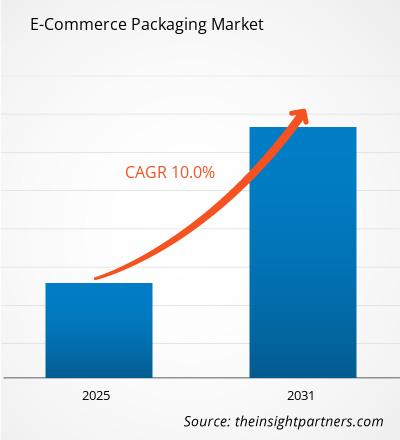
The E-commerce Packaging Market size was US$ 111.07 billion in 2025 and is estimated to be US$ 471.76 billion in 2034 with a CAGR of 17.43% during the period of 2026-2034, which will be driven by growth in digital retail, increasing parcel volumes, demand for non-breakage packagings, and movement towards lightweight and recyclable packaging.
North America continues to be one of the high-value demand areas because of advances in parcel logistics, omnichannel retailing, and retailers' investments in automated packing operations. North America is forecast to grow at a CAGR of 15.8%-17.2% between 2026-2034 on account of right-sizing technologies, curb-side recyclable fiber packagings, and protection of electronics, cosmetics, clothing, grocery, and household items.
E-Commerce Packaging Market Assessment and Insights
- North America: Share in 2025 of 28–32% and CAGR between 15.8–17.2%. Retailer automation, parcel carrier density, and recyclable corrugated adoption support resilient demand.
- US: Share in 2025 of 82–86% of North America and CAGR between 16.0–17.5%. Marketplace fulfillment, returns management, and protective packaging standards sustain growth.
- Europe: Share in 2025 of 20–24% and CAGR between 14.5–16.2%. Germany, the UK, France, Italy, and Spain lead adoption through PPWR-led circular packaging transition.
- Asia Pacific: Share in 2025 of 39–43% and CAGR between 18.4–20.1%. China, India, Japan, South Korea, and Australia benefit from mobile commerce and logistics scale.
- Largest Segment: Paper and Paperboard held 61–65% market share in 2025 and CAGR of 16.8–18.2% during 2026–2034.
- High Growth Segment: Bags and Pouches held 24–28% market share in 2025 and CAGR of 18.8–20.5% during 2026–2034.
- Key companies analyzed in detail: Amcor plc, Billerud AB, DS Smith Plc, Georgia-Pacific LLC, International Paper Company, Mondi plc, Orora Packaging Australia Pty Ltd., Sealed Air Corporation, Smurfit Westrock plc, WestRock Company.
Source: The Insight Partners' analysis based on proprietary research, government publications, company annual reports, investor presentations, industry databases, and expert interviews.
Online shopping packaging has evolved from simple shipping packaging to an engineered logistics resource. The E-commerce Packaging Market share is being impacted by automated fulfillment systems, dimensional weight rates, increased cost of damage visibility, and customer demand for recyclable packages. Fiber boxes continue to play a major role as flexible mailers, paper padding, tamper proof labels, and smart packaging become more prevalent as retailers try to minimize material usage without affecting delivery security.
During the forecast period, the focus would be on building Asian-Pacific fulfillment capabilities, automating North American operations, and redesigning processes in line with European regulations. The market would also see a positive impact due to regulatory pressures on packaging waste, retailers' desire to use less void-fill material, and consumers' desire for curbside-recyclable packaging. Companies that integrate paper, converting, designing, testing and recycling of materials would be in a better position to take advantage of opportunities.
E-Commerce Packaging Market Report Scope
| Report Attribute | Details |
|---|---|
| Market size in 2025 | US$ 111.07 Billion |
| Market Size by 2034 | US$ 471.76 Billion |
| Global CAGR (2026 - 2034) | 17.43% |
| Historical Data | 2021-2024 |
| Forecast period | 2026-2034 |
E-Commerce Packaging Market Analysis
Growth drivers include retail parcelization, fast grocery delivery, fashion returns, and shipping of consumer electronics requiring higher protection. E-commerce companies are opting for customized cartons to help reduce air transportation costs and breakage. Growth is also driven by the demand for packaging solutions that pass tests based on automated sorting, long-distance transportation, and increased last-mile activities.
Supply trends are determined by availability of containerboard, recycled fibers, resins prices, and proximity of converters to fulfillment centers. The need by retailers for packaging solutions providers who can provide services like design laboratories, printing, sustainability, and testing of packaging effectiveness is increasing. Therefore, the supply chain is favoring those packaging solutions providers who have access to raw materials and ability to prototype and automate their processes.
The Competitive Analysis of the Present E-commerce Packaging Market reveals a growing focus on fiber innovations, light weighting, protection, and circularity claims. Amcor plc and Sealed Air Corporation increase their emphasis on flexible and protective solutions, whereas International Paper Company, DS Smith Plc, Smurfit Westrock plc, WestRock Company, Mondi plc, Billerud AB, Georgia-Pacific LLC, and Orora Packaging Australia Pty Ltd compete using corrugated, paperboard, design, and regional logistics capabilities.
Investments will go into packing lines automation, recyclable coatings, reusable shipper trials, paper mailers, and packaging optimization in fulfillment centers. The importance of strategic positioning becomes higher and consists in the ability to assist customers in achieving their sustainability goals, controlling the cost per shipment. Paper-based packaging suppliers become more consolidated, which provides them with greater scale, wider geographic reach, and higher purchasing power.
● REPORT CUSTOMIZATION
Tailor This Report To Align With Your Specific Business Requirements
This report can be customized to align precisely with your business objectives, scope, and target markets. Customization options include tailored segmentation, geography, competitive analysis, and strategic insights to support informed decision-making.
Customize This Report →WHAT YOU CAN ADJUST
- ● Segmentations
- ● Geography
- ● Competitive Analysis
- ● Language Preferences
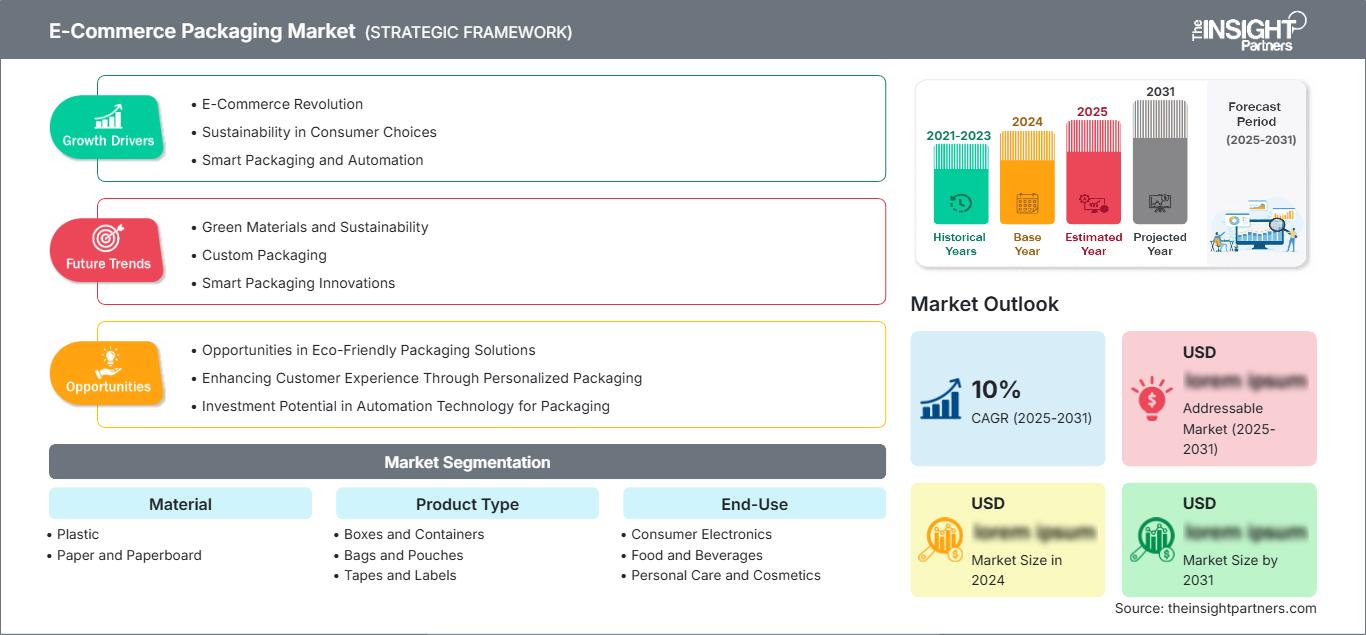
E-Commerce Packaging Market: Strategic Insights
Regional Insights
North America E-commerce Packaging Market
North America was estimated to account for 28-32% of total market revenue in 2025 and is expected to grow at a 15.8-17.2% CAGR from 2026-2034. North America holds an advantage due to its denser parcel network, automation in fulfillment, and retailers' investment in packaging to lower their dimensional weight.
Growing regulations and corporate sustainability drives the paper-based material and recycled content. Fit-to-product packaging, void-fill paper, and flexible mailers have been used by retailers to minimize waste and lower fulfillment costs. The significance of packaging companies having a regional converting facility and ISTA-compatible testing capability is becoming more apparent as retailers want consistent protection from automated sorting, cross-border shipments, and peak-season demand.
U.S. E-commerce Packaging Market
In 2025, the U.S. held 82–86% share of revenues from North America, and is expected to have a 16.0–17.5% CAGR. Marketplace giants, direct-to-consumer firms, and omnichannel operators are among the main drivers of demand for corrugated boxes, padded mailers, labels, tapes, and protective packs. Better ROI in fashion and electronics requires sturdier, resealable, and branded packaging solutions.
Domestic companies dominate fiber-based, protective, and flexible packaging markets. International Paper Company, Georgia-Pacific LLC, Sealed Air Corporation, Smurfit Westrock plc, and WestRock Company enable national conversion and distribution of packaging products. Current application trends include ship-in-own-container certification, paper cushioning, box erection automation, and printing of packaging products for subscription, beauty, home, and consumer electronics companies.
Europe E-commerce Packaging Market
Europe captured 20–24% share of global revenues in 2025 and is expected to grow at a CAGR of 14.5–16.2%. Germany is at the forefront on account of advanced manufacturing processes, efficient parcel logistics operations, and high levels of sustainability compliance. The UK shows rapid adoption of fiber mailers and returnable formats, whereas France emphasizes packaging recycling for beauty, food, and luxury goods.
Fashion, cosmetic, and gourmet food online shopping from Italy and Spain drive additional demand. The EU Packaging and Packaging Waste Regulation is pressuring retailers to minimize the use of packaging materials, recycle them, and reuse them. DS Smith Plc, Mondi plc, Billerud AB, and Smurfit Westrock plc are well positioned as brands redesign their packaging for fiber, lightweighting, and circular procurement.
APAC E-commerce Packaging Market
Asia-Pacific represented 39-43% of the global market in 2025 and is expected to expand at a CAGR of 18.4-20.1%. The dominant market leader in this region is China due to high volume of parcels, platform shopping, and well-developed fulfillment network. India provides additional growth impetus via mobile commerce, digital payments, and last-mile logistics capabilities.
Small and high-quality packaging solutions for electronics, cosmetics, and convenience deliveries are sought in Japan and South Korea, while Australia drives demand in grocery, apparel, and household categories. Policies aimed at reducing plastic waste and increased recycling rates favor paperboards and mono-material flexible packaging as well as appropriate sizing.
Middle East & Africa E-commerce Packaging Market
The Middle East & Africa is projected to experience a 16.2%–18.0% CAGR through 2034. The region’s market leader is Saudi Arabia, where logistics infrastructure, digitized retail sales, and tourism-related consumption drive parcel demand growth. The UAE profits from cross-border fulfillment, luxury retail, and express delivery in the electronics, beauty, and fashion segments.
South Africa continues to be a significant source of demand for groceries and other delivery services, as well as for apparel delivery, while the remaining MEA countries are developing their payment solutions and investing in urban logistics. Investments in energy and infrastructure contribute to the development of warehouse, logistics, and packaging capacities.
Segmentation Analysis
Material
The Material segment is forecast to grow at a 17.0–18.5% CAGR during 2026–2034. The E-commerce Packaging Market scope is widening as retailers balance protection, sustainability, machinability, and consumer disposal expectations. Paper-based formats dominate high-volume shipments, while plastics remain relevant where moisture resistance, flexibility, and lightweight protection are operationally important.
- Plastic: Plastic formats remain important for flexible mailers, pouches, protective films, and moisture-sensitive deliveries where low weight, puncture resistance, and cost efficiency support operational performance.
- Paper and Paperboard: Paper and paperboard hold the leading position because corrugated boxes, kraft mailers, and paper cushioning align with recyclability targets and established collection infrastructure.
Product Type
The Product Type segment is projected to expand at a 17.3–18.9% CAGR through 2034. Demand is shaped by product fragility, fulfillment automation, shipping economics, and return behavior. Boxes and containers remain essential for protection and stacking, while bags, pouches, tapes, and labels gain relevance as retailers pursue lighter and more efficient parcel formats.
- Boxes and Containers: Boxes and containers remain the core format for electronics, household products, food shipments, and mixed baskets requiring crush resistance, stacking strength, and standardized carrier handling.
- Bags and Pouches: Bags and pouches are scaling rapidly in apparel, personal care, and soft goods because they reduce material usage, shipping weight, storage space, and packing time.
- Tapes and Labels: Tapes and labels support security, routing, branding, traceability, and returns management, making them critical consumables across high-volume fulfillment and last-mile delivery operations.
End-Use
The End-Use segment is expected to grow at a 17.2–18.8% CAGR during 2026–2034. Demand varies by fragility, basket size, temperature sensitivity, and return intensity. Consumer electronics need protective structures, food and beverages require secure transit, personal care emphasizes brand presentation, textiles depend on lightweight mailers, and household products require durable formats for bulky shipments.
- Consumer Electronics: Consumer electronics require cushioning, tamper evidence, antistatic considerations, and strong outer protection because product damage directly affects returns, warranty costs, and customer trust.
- Food and Beverages: Food and beverages rely on secure, leak-resistant, and often temperature-compatible packaging that protects freshness, prevents contamination, and supports rapid grocery and specialty food delivery.
- Personal Care and Cosmetics: Personal care and cosmetics use compact, premium, and protective packaging to reduce breakage, preserve brand experience, and support subscription and direct-to-consumer models.
- Textile and Apparels: Textile and apparels favor lightweight mailers, resealable pouches, and return-friendly formats due to high order frequency, size variability, and elevated exchange rates.
- Household Products: Household products require robust boxes, tapes, and labels for bulky or mixed shipments, where pack strength and clear handling instructions reduce transit damage.
Opportunity Snapshot
| Segment Name | Revenue Contribution | Trend Tag | Adoption Stage |
| Consumer Electronics | High | Shock Safe | Mature |
| Food and Beverages | High | Grocery Packs | Scaling |
| Personal Care and Cosmetics | Medium | Premium Unboxing | Scaling |
| Textile and Apparels | High | Return Mailers | Mature |
| Household Products | Medium | Bulky Parcels | Scaling |
E-Commerce Packaging Market Growth Drivers and Impact Analysis
Parcel Volume Expansion Across Digital Retail Channels
E-commerce packaging shifts in-store inventory into package deliveries, increasing the number of packages needed per unit of consumer demand. The categories of clothing, electronic products, personal care items, groceries, and household goods each have unique requirements for protection and labeling. The packaging market will see the greatest effect in regions where marketplaces and omnichannel retailers have regional fulfillment centers processing large numbers of orders. For suppliers, packaging can be advantageous where the packaging can be standardized, made less complex, and able to run through automated processes. Packaging becomes more important as parcel volumes grow in the E-commerce Packaging Market.
Sustainability Regulation and Retailer Waste-Reduction Goals
Regulations on packaging are becoming increasingly stringent, especially in Europe, where regulations regarding packaging dictate that the packaging should be reusable, recyclable, and minimal. The large companies are having their own goals on reducing virgin plastics, eliminating unnecessary void filling, and including higher levels of recycled/renewable materials. The challenges are forcing companies to adopt paperboard, recyclable mailers, monomaterial film, and fit-for-product packaging. The effect on the industry is practical and not symbolic because compliance influences procurement processes, qualification of suppliers, and the launch of products. Suppliers with knowledge of material science, life cycle assessment, and recycling can transition from being commodity suppliers to packaging consultants.
Automation and Right-Sizing in Fulfillment Operations
Fulfillment centers have started using automated solutions for their box-making, labeling, sealing, and void-filling needs due to labor shortages and inconsistencies in shipments. Right sizing helps reduce dimensional weights and minimize air shipping, and optimize trailer loading. All such technologies depend on suitable grades of corrugates, tapes, labels, bags, and pouches which work at fast speeds. Packaging vendors who offer products that work well with the machines can get themselves ingrained in the retail company's processes, and enjoy higher switching costs. Some other benefits include lower damages, faster throughput, less material waste, and predictable freight charges.
E-Commerce Packaging Market Future Trends
Reusable and Return-Optimized Packaging Networks
Future E-commerce Packaging Market trends will increasingly include reusable shippers, resealable mailers, and packaging designed for simplified returns. Apparel, footwear, cosmetics, and electronics retailers are likely to adopt formats that protect products through both outbound delivery and reverse logistics. Reuse systems will need tracking, cleaning, inspection, and consumer participation models, so adoption will be selective at first. However, regulation and retailer sustainability commitments may accelerate pilots in dense urban markets. Suppliers that combine durable materials, closure systems, data capture, and reverse-logistics partnerships can create differentiated offerings with recurring service revenue rather than one-time packaging sales.
Data-Enabled Packaging for Traceability and Consumer Interaction
Smart labels, printed codes, and connected packaging features will become more relevant as retailers seek better shipment visibility, authentication, returns processing, and post-purchase engagement. These tools can help verify delivery condition, guide recycling behavior, provide product instructions, and support loyalty programs. Adoption will be strongest in higher-value categories where fraud prevention, brand experience, and traceability justify incremental cost. Packaging converters that integrate print, data management, and security features may gain stronger relationships with brands. Over time, connected packaging can transform shipping materials into measurable communication and operations assets.
E-Commerce Packaging Market Opportunities
Paper-Based Substitution in Apparel and Personal Care Shipments
Apparel and personal care brands are under pressure to reduce plastic mailers while preserving low-cost, lightweight delivery. This creates an opportunity for kraft mailers, paper padded envelopes, recyclable wraps, and molded fiber inserts. Investment aligned with E-commerce Packaging Market Forecasts should prioritize converting capacity, barrier coatings, resealable paper closures, and print capabilities for branded unboxing. Suppliers can also support retailers with testing protocols that prove paper-based options withstand sorting, moisture exposure, and return cycles. The opportunity is commercially attractive because these categories ship frequently, use high volumes of flexible packaging, and value consumer-facing sustainability signals.
Protective Packaging for Electronics and Premium Goods
Electronics, beauty devices, small appliances, and premium household goods require packaging that prevents shock, vibration, abrasion, and tampering. Suppliers can target this opportunity through molded pulp, engineered corrugated inserts, inflatable cushions, paper cushioning, and tamper-evident closures. The investment case is supported by the high cost of product damage, customer complaints, and reverse logistics. Brands are likely to pay for packaging that reduces returns while maintaining sustainability and presentation standards. Companies offering design simulation, drop testing, and rapid customization can capture higher-margin projects and strengthen relationships with direct-to-consumer and marketplace sellers.
Recent Developments
- July 2026: Rev-O-Box has launched a reversible packaging platform that converts a standard shipping box into a premium gift box in seconds. This innovation enhances customer experience, supports sustainability, and provides gift-ready packaging for e-commerce and retail.
- January 2026: UCanPack, a US provider of packaging and shipping supplies, has launched a new line of engineered tall boxes aimed at e-commerce shippers. These boxes prioritize impact resistance, crush protection, and optimal geometry, catering to elongated and narrow products like lamps and sports gear. Available online, the solution aims to minimize transit damage and enhance packaging efficiency.
Frequently Asked Questions

- Comprehensive Market Sizing and Forecast Analysis
- Detailed Segmentation Analysis
- In-Depth Market Dynamics Assessment
- Regional and Country-Level Insights
- Competitive Landscape and Company Benchmarking
- Strategic Business Intelligence
Recent Reports
Testimonials

The Insight Partners' SCADA System Market report is comprehensive, with valuable insights on current trends and future forecasts. The team was highly professional, responsive, and supportive throughout. We are very satisfied and highly recommend their services.
RAN KEDEM Partner, Reali Technologies LTDs
I requested a report on a very specific software market and the team produced the report in a few days. The information was very relevant and well presented. I then requested some changes and additions to the report. The team was again very responsive and I got the final report in less than a week.
JEAN-HERVE JENN Chairman, Future Analytica
We worked with The Insight Partners for an important market study and forecast. They gave us clear insights into opportunities and risks, which helped shape our plans. Their research was easy to use and based on solid data. It helped us make smart, confident decisions. We highly recommend them.
PIYUSH NAGPAL Sr. Vice President, High Beam Global
The Insight Partners delivered insightful, well-structured market research with strong domain expertise. Their team was professional and responsive throughout. The user-friendly website made accessing industry reports seamless. We highly recommend them for reliable, high-quality research services
YUKIHIKO ADACHI CEO, Deep Blue, LLC.
This is the first time I have purchased a market report from The Insight Partners.While I was unsure at first, I visited their web site and felt more comfortable to take the risk and purchase a market report.I am completely satisfied with the quality of the report and customer service. I had several questions and comments with the initial report, but after a couple of dialogs over email with their analyst I believe I have a report that I can use as input to our strategic planning process.Thank you so much for taking the extra time and making this a positive experience.I will definitely recommend your service to others and you will be my first call when we need further market data.
JOHN SUZUKI President and Chief Executive Officer, Board Director, BK Technologies
I wish to appreciate your support and the professionalism you displayed in the course of attending to my request for information regarding to infectious disease IVD market in Nigeria. I appreciate your patience, your guidance, and the fact that you were willing to offer a discount, which eventually made it possible for us to close a deal. I look forward to engaging The Insight Partners in the future, all thanks to the impression you have created in me as a result of this first encounter.
DR CHIJIOKE ONYIA MANAGING DIRECTOR, PineCrest Healthcare Ltd.Reason to Buy
- Informed Decision-Making
- Understanding Market Dynamics
- Competitive Analysis
- Identifying Emerging Markets
- Customer Insights
- Market Forecasts
- Risk Mitigation
- Boosting Operational Efficiency
- Strategic Planning
- Investment Justification
- Tracking Industry Innovations
- Aligning with Regulatory Trends





 Get Free Sample for