
Electromyography Electrode Market Size, Trends & Demand by 2034
Coverage: by Product (Metal Electrode, Others); Applications (Hospital, Medical Center), and Geography (North America, Europe, Asia Pacific, and South and Central America)
- Status : Data Released
- Report Code : TIPRE00011091
- Category : Life Sciences
- No. of Pages : 150
- Available Report Formats :


- Last update date : July 08, 2026


2025 Market Size
US$ 1,004.5 Mn
Base year value
2034 Forecast
US$ 1,445.25 Mn
Projected by 2034
CAGR 2026-2034
4.65 %
Growth rate
Addressable Market
US$ 11,425.49 Mn
(2026-2034)
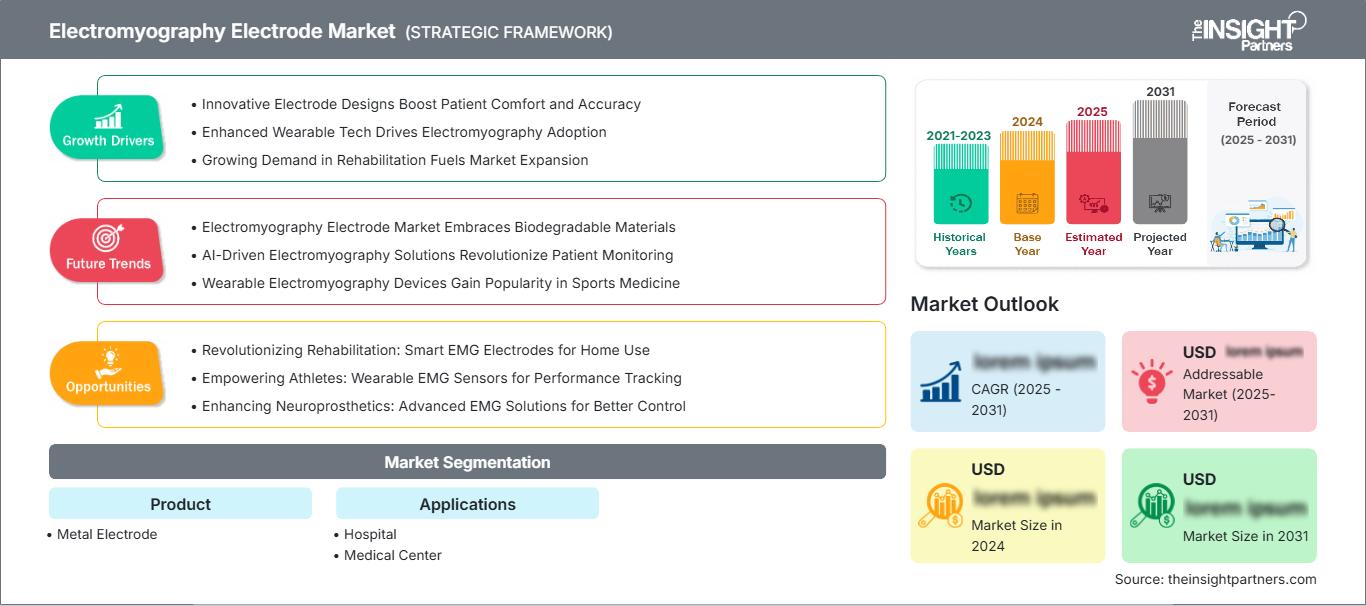
The electromyography electrode market size generated US$ 1,004.5 Million in 2025 and is projected to reach US$ 1,445.25 Million by 2034, reflecting a 4.65% CAGR during 2026–2034. The market covers electrodes used to record muscle electrical activity in diagnostic, rehabilitation, intraoperative, urodynamic, and biomechanics settings, with demand tied to neuromuscular testing, hospital workflow standardization, and the clinical need for reliable signal acquisition.
North America is expected to grow at a 4.4–5.0% CAGR as hospitals, neurodiagnostic labs, and rehabilitation providers expand access to EMG testing. Structural demand is supported by high neurology referral volumes and broad adoption of disposable surface and needle electrodes. The electromyography electrode market forecast suggests that U.S. hospital networks are increasingly prioritizing standardized electrode procurement strategies to minimize testing variability and improve consistency across neurology, orthopedics, urology, and intraoperative monitoring departments.
Electromyography Electrode Market Assessment and Insights
- North America: Holds 36–40% share in 2025, growing at a CAGR of 4.4–5.0% during 2026–2034, driven by expanding access to neurology services, hospital standardization initiatives, and increasing demand for electromyography (EMG) diagnostics.
- US: Accounts for 84–88% of the North American electromyography electrode market in 2025, expanding at a 4.5–5.1% CAGR due to advanced neurodiagnostic infrastructure, rising EMG procedure volumes, and continued adoption of standardized hospital diagnostic protocols.
- Europe: Represents 27–31% share in 2025, growing at a 3.9–4.5% CAGR, led by Germany, the UK, and France through aging neurology patient populations, established reimbursement systems, and increasing demand for neurophysiology diagnostics.
- Asia Pacific: Holds 22–26% share in 2025, expanding at a 5.4–6.0% CAGR, led by China, Japan, and India with expanding hospital infrastructure, strengthening local medical device distribution, and improving access to neurological diagnostics.
- Largest Segment: Product holds the largest electromyography electrode market share in 2025, growing at a 4.3–4.9% CAGR due to the widespread use of reusable and needle-based metal electrodes that provide high-fidelity EMG recording.
- High Growth Segment: Applications are projected to register the fastest growth at a CAGR of 4.8–5.4% during 2026–2034, driven by expanding EMG utilization in rehabilitation, urology, and movement assessment across medical centers.
- Key companies analyzed in detail: Albyn Medical S.L.; ANDROMEDA Medizinische Systeme GmbH; CooperSurgical, Inc.; Medtronic plc; Danlee Medical Products, Inc.; Laborie Medical Technologies Corp.; Natus Medical Incorporated; Nihon Kohden Corporation; Noraxon U.S.A. Inc.; SparkFun Electronics, Inc.; Ambu A/S; Rhythmlink International, LLC.
Source: The Insight Partners' analysis based on proprietary research, government publications, company annual reports, investor presentations, industry databases, and expert interviews.
The electromyography electrode market report highlights the significant evolution of electrode-based electromyography devices from conventional reusable electrode contacts to advanced solutions such as disposable adhesive electrodes, concentric needle electrodes, monopolar electrodes, and specialized surface electrodes. Ongoing research and development activities are focused on reducing impedance, improving signal quality, enhancing adhesion performance, and strengthening compatibility with EMG and nerve conduction study (NCS) systems. Additionally, manufacturing advancements are emphasizing rigorous quality control, sterile packaging standards, and a wider selection of electrode gauges and lead configurations to meet the requirements of neurology, rehabilitation, pelvic floor diagnostics, and intraoperative monitoring applications.
Future developments in the electromyography electrode market will be driven by increased screening for neuromuscular diseases, growing rehabilitation facilities, and development of neurodiagnostic capabilities in the Asia Pacific, Middle East, and selected European regions. Favorable regulations will support single-use electrodes, packaged traceability, and stable electrical characteristics. Companies providing electrode supplies along with software EMG instruments and other services are expected to see recurring revenues increase.
Electromyography Electrode Market Report Scope
| Report Attribute | Details |
|---|---|
| Market size in 2025 | US$ 1,004.5 Million |
| Market Size by 2034 | US$ 1,445.25 Million |
| Global CAGR (2026 - 2034) | 4.65% |
| Historical Data | 2021-2024 |
| Forecast period | 2026-2034 |
Electromyography Electrode Market Analysis
Demand for Electromyography Electrode Products correlates with the clinical assessment of nerve and muscle diseases such as radiculopathy, neuropathy, motor neuron disease, myopathy, pelvic floor disorder, and perioperative neuromuscular monitoring. Hospitals and health clinics need dependable electrodes since they impact the quality of the signal. Value chain components include conductive metals, needle manufacturing, hydrogel composition, cable assembly, packaging, and compatibility validation of electrodes in EMG systems.
Supply factors in the electromyography electrode market vary by electrode type. Adhesive electrodes depend on large-scale conversion and hydrogel acquisition, while needle electrodes depend on metal processing and sterilization process validation. End users now consider the entire process reliability, not only the product cost. This provides a competitive advantage to suppliers that deliver reliable accessories, training programs, and supply replenishment programs in different medical specialties.
The electromyography electrode market encompasses neurodiagnostic platform companies, urodynamics players, and biomechanics providers. The rivalry is conducted by Natus Medical Incorporated, Nihon Kohden Corporation, and Laborie Medical Technologies Corp., while Noraxon U.S.A. Inc. focuses on movement science and rehabilitation solutions. Albyn Medical S.L. and ANDROMEDA Medizinische Systeme GmbH retain their positions in the field of urodynamic EMG application, whereas Ambu A/S, Rhythmlink International, LLC, and Danlee Medical Products, Inc. add to the range of electrode manufacturers.
Trends in investment activities point at a larger consumables range, single-use products, and software-integrated diagnostics ecosystems. Positioning strategies will be built increasingly on the basis of channel depth, hospital contracting capacity, and education initiatives. It is advantageous to position oneself as the supplier of electrodes that can be applied along with EMG platforms, intraoperative monitoring, pelvic floor testing, and rehabilitation analysis systems. Strategic investment in the electromyography electrode market is also influenced by how hospitals evaluate electrode suppliers within broader neurodiagnostic contracts. Purchasing teams increasingly prefer vendors that can document traceability, packaging integrity, shelf-life consistency, and compatibility across multiple EMG systems. This shifts competition away from isolated product availability and toward service-backed supply assurance, especially in regions where distributor performance determines procedure continuity.
● REPORT CUSTOMIZATION
Tailor This Report To Align With Your Specific Business Requirements
This report can be customized to align precisely with your business objectives, scope, and target markets. Customization options include tailored segmentation, geography, competitive analysis, and strategic insights to support informed decision-making.
Customize This Report →WHAT YOU CAN ADJUST
- ● Segmentations
- ● Geography
- ● Competitive Analysis
- ● Language Preferences
Electromyography Electrode Market: Strategic Insights
Regional Insights
North America Electromyography Electrode
North America held 36–40% electromyography electrode market share in 2025 and is expected to grow at a 4.4–5.0% CAGR through 2034. The region benefits from high neurologist density, advanced hospital-based EMG laboratories, and regular use of needle and surface electrodes in neuromuscular diagnosis.
The factors contributing to procurement include the standardization associated with integrated delivery networks and the demand for certified disposable electrodes that minimize cross-contamination. Gait analysis, pelvic floor testing, and intraoperative monitoring programs are also increasing adoption in rehabilitation facilities and academic medical centers.
One other structural element is the preponderance of teaching hospitals and specialty referral centers in the region. Multiple electrode types are needed for training and complicated case studies. The standardization of procedure documentation is leading to a preference among procurement specialists for electrode batches that ensure consistent impedance results and minimize testing from lack of signal acquisition.
U.S. Electromyography Electrode Market
The U.S. represented 84–88% of North American electromyography electrode market in 2025 and is projected to grow at a 4.5–5.1% CAGR. Large hospital systems, private neurology groups, orthopedic practices, and rehabilitation networks create steady consumption of disposable adhesive, monopolar, and concentric needle electrodes.
Company presence is strong, with Natus Medical Incorporated, Noraxon U.S.A. Inc., Rhythmlink International, LLC, and Danlee Medical Products, Inc. serving clinical and research users. Applications are expanding in intraoperative monitoring, sports biomechanics, pelvic floor therapy, and outpatient electrodiagnostic testing.
Furthermore, the expansion of outpatient services in the U.S. affects packaging and distribution of electrodes. Small clinics need smaller minimum orders, compatibility information, and procedure-ready packages. There is a space left for those suppliers who will be able to work on the national hospital contract and small ambulatory practices without losing quality and efficiency.
Europe Electromyography Electrode Market
In 2025, Europe accounted for 27–31% of the electromyography electrode market with a 3.9–4.5% CAGR forecasted due to well-developed neurophysiology departments, rehabilitation clinics, and routine use of EMG in orthopedic and neuromuscular pathways.
The UK market is still relevant since its neurophysiology services and private clinics need standardized surface and needle electrodes for referral-based tests. In Germany, the demand will be higher in more complex applications like advanced neurodiagnostics and movement evaluation since good signal capture facilitates documentation and further therapy.
There will be considerable contributions from France, Italy, and Spain through hospital neurology, urology, rehabilitation, and anesthesia departments. The country CAGRs are estimated at UK 3.8–4.4%, Germany 4.0–4.6%, France 3.9–4.5%, Italy 3.7–4.3%, and Spain 3.9–4.5%.
Although Europe is still driven by cost management considerations, the quality demands will be high since EMG test results affect clinical decision making, referrals, and disability determination. Distributors with good market coverage and multilingual technical documents along with compliant product files can better serve hospitals with cost and quality considerations.
APAC Electromyography Electrode Market
In 2025, APAC had 22-26% electromyography electrode market share and is predicted to grow at 5.4-6.0% CAGR on account of rising electrode use within the context of hospital upgrades, growing insurance penetration, and improved neurological patient referrals.
The major APAC markets include China as a result of an expansion in electrodiagnostic facilities in tertiary hospitals, and good availability of compatible consumable products from local distributors, Japan, owing to aging population and well-established practices of neurophysiology, and South Korea with support from advanced rehabilitation and sports medicine facilities.
India exhibits the highest growth rate due to new EMG services and rehabilitation programs in private medical centers. Australia is smaller but standards-driven, with preference for validated disposable electrodes. CAGR by country includes China 5.8-6.4%, Japan 4.2-4.8%, South Korea 5.1-5.7%, India 6.2-6.8%, and Australia 4.5-5.1%.
Within APAC, demand for electrodes is also impacted by healthcare education and training. The emergence of new EMG labs necessitates advice in choosing appropriate electrodes, their placement, storage, and troubleshooting. Companies providing both consumables and application expertise can expedite the adoption process since clinicians need to be assured that their choice of electrode will not affect diagnosis.
Middle East & Africa Electromyography Electrode Market
The Middle East & Africa is projected to grow at a 4.9–5.5% CAGR through 2034. Saudi Arabia is the leading country as public hospitals, specialty centers, and rehabilitation programs expand neurodiagnostic capacity alongside broader healthcare infrastructure investment.
The UAE is benefited by private hospital development, medical tourism and demand for neurology and orthopedic assessment. South Africa is the center for sub-Saharan demand through private healthcare networks and academic hospitals, whereas the other MEA countries remain import dependent with growing diagnostic consumables access.
Fiscal capability in the electromyography electrode market is generated due to energy being favorable for infrastructure expenditure in the Gulf region, but the procurement process is still sensitive to distributor performance and documentation. The estimated country CAGRs include Saudi Arabia 5.2–5.8%, UAE 5.0–5.6% and South Africa 4.2–4.8%.
In MEA, the future demand is related to the transformation of the capital expenditures to actual diagnostics use. The hospitals can buy EMG devices before developing regular diagnostics consumables procurement processes. Companies with regional stock, distributors' training and biomedical engineering assistance can minimize downtime and ensure high utilization of installed neurodiagnostics devices.
Segmentation Analysis
Product
Product demand in the electromyography electrode market is led by metal electrodes, projected to expand at a 4.3–4.9% CAGR during 2026–2034. Their importance reflects use in needle EMG, reusable surface contacts, stimulation electrodes, and high-fidelity diagnostic applications where conductivity, durability, and signal stability remain critical purchasing criteria.
Metal electrode suppliers can strengthen positioning by offering precise gauge options, ergonomic connector designs, and packaging that supports fast procedure-room setup. In high-volume environments, small improvements in handling, labeling, and signal stability can reduce technician burden. These practical advantages are increasingly important as hospitals seek productivity gains without compromising diagnostic reliability.
- Metal Electrode: Includes concentric needle, monopolar needle, reusable disc, bar, and stimulation electrodes used where clean signal capture, low resistance, and durability are required across diagnostic and monitoring workflows.
Applications
Application demand in the electromyography electrode market is projected to grow at a 4.8–5.4% CAGR during 2026–2034. Hospitals remain the largest users, while medical centers gain momentum as outpatient neurology, rehabilitation, pelvic floor, and movement-assessment services expand outside traditional inpatient diagnostic departments.
Application-led growth also encourages suppliers to tailor education by care setting. Hospitals prioritize diagnostic consistency and sterile workflows, while medical centers emphasize ease of use, compact inventory, and flexible scheduling. Vendors that map product bundles to each setting can improve adoption and reduce confusion among clinicians, technicians, and procurement teams.
- Hospital: Hospitals use EMG electrodes across neurology laboratories, operating rooms, urology departments, and rehabilitation units, making procurement volume high and specification requirements more formalized.
- Medical Center: Medical centers are expanding outpatient EMG testing, pelvic floor therapy, sports rehabilitation, and movement analysis services, creating demand for flexible electrode formats and reliable replenishment.
Opportunity Snapshot
| Applications | Revenue Contribution | Trend Tag | Adoption Stage |
| Hospital | High | Neurodiagnostic Kits | Mature |
| Medical Center | Medium | Outpatient EMG | Scaling |
Electromyography Electrode Market Growth Drivers and Impact Analysis
Rising neuromuscular disease diagnosis and referral volumes
There is a rising focus by clinicians on neuropathy, radiculopathy, myopathy, carpal tunnel syndrome, and motor neuron disease, resulting in a greater demand for EMG tests as well as electrodes. Electromyography is still a crucial tool when doctors seek proof of neurological and muscular impairment through functional means other than imaging or lab work. High referral rates equate to ongoing usage of the electrodes, particularly disposable needle and adhesive ones. This effect is most pronounced at hospitals and clinics with electrodiagnostics facilities conducting high volumes of tests.
Shift toward disposable, standardized electrode workflows
There is a growing trend among healthcare professionals in adopting disposables for the reason that it decreases the burden of reprocessing procedures, addresses infection control considerations, and eases multi-site procurement. Standardized electrode kits also help to standardize work performed by different technologists across multiple sites especially when EMG services are offered in hospitals, outpatient clinics, and rehabilitation centers. The implication of this driver is a shift from a one-off purchase of accessories to procurement of a product on a contract basis.
The impact of this driver is more noticeable in hospital groups offering EMG services in multiple locations where the procurement committees assess the benefits in terms of infection control measures, ease of use by the technologist, and cost savings in procedures.
Expansion of rehabilitation, urology, and movement science applications
EMG electrodes are no longer limited to conventional neurology laboratories. Rehabilitation providers use surface EMG for muscle activation assessment and biofeedback, urology practices use electrodes in pelvic floor and urodynamic evaluation, and biomechanics labs apply surface EMG to gait, sports, and ergonomic studies. This broadening application base expands addressable demand beyond hospital neurology. The market impact is a more diverse buying audience, requiring electrode suppliers to support different lead lengths, attachment methods, software environments, and training needs.
For electrode manufacturers, this application expansion requires more than broad catalog coverage. Rehabilitation and urology users often need training materials, placement guidance, and product formats that fit non-neurology workflows. Companies that adapt sales support to these clinical audiences can convert occasional use into consistent purchasing programs across outpatient and specialty facilities.
Electromyography Electrode Market Future Trends
Integrated EMG consumables with digital diagnostic platforms
A major electromyography electrode market trend is the tighter integration of electrodes, acquisition hardware, software, and clinical reporting. EMG systems are increasingly designed to support automated workflows, reference values, electronic medical record connectivity, and combined neuromuscular ultrasound interpretation. Electrodes that are validated for these ecosystems can become part of a broader diagnostic package rather than interchangeable accessories. Over time, vendors may use consumables compatibility, training content, and software updates to reinforce platform loyalty and create more predictable recurring revenue streams.
This trend may also support differentiated pricing because validated consumables can reduce troubleshooting time and protect diagnostic confidence. Hospitals that standardize on integrated platforms may prefer electrodes supported by the same vendor or an approved accessory partner. That preference could make compatibility documentation and service response as important as electrode material characteristics.
Wearable and dry-electrode formats for functional assessment
Wearable surface EMG and dry-electrode formats are expected to gain attention in rehabilitation, sports science, ergonomics, and remote functional assessment. These formats reduce setup time, improve mobility during testing, and allow muscle activity to be monitored during real-world movement rather than static clinical examination alone. Adoption will remain selective because medical diagnostic EMG still requires high signal confidence and regulatory discipline. However, the trend should expand demand for specialized electrode interfaces in medical centers, research labs, and performance clinics.
Commercial success in the electromyography electrode market will depend on balancing convenience with evidence. Wearable and dry-electrode products must demonstrate stable signal acquisition during movement, sweat exposure, and repeated sessions. Suppliers that build credibility through validation studies, clinician training, and software integration can expand beyond research settings into structured rehabilitation and performance-monitoring programs.
Electromyography Electrode Market Opportunities
Procedure-ready electrode kits for outpatient EMG services
Outpatient neurology and medical centers need compact, procedure-ready electrode kits that reduce setup time and simplify inventory management. Suppliers can create value by bundling disposable adhesive electrodes, needle electrodes, ground electrodes, skin-preparation accessories, and compatible lead sets around common EMG protocols. This opportunity is attractive because smaller sites often lack the procurement depth of hospitals but still require dependable clinical quality. Kit-based models can improve ordering discipline, reduce stockouts, and help providers scale testing capacity without expanding administrative workload.
Commercially, kit models can also improve forecasting for suppliers and buyers. When electrode components are aligned to defined procedures, reorder cycles become easier to estimate and stock rotation improves. This is especially valuable for outpatient sites that cannot maintain large inventories but need predictable access to sterile, compatible components.
Emerging-market distributor partnerships and clinical education
Emerging markets offer a clear opportunity for companies that combine electrode supply with distributor training, platform compatibility guidance, and clinician education. Many hospitals in India, China, the Gulf, and Southeast Asia are adding EMG capacity but need support in electrode selection, storage, and workflow design. Suppliers that build regional distributor networks and provide application-specific training can reduce adoption friction. This approach can also support premium positioning because clinical confidence and dependable availability matter more than lowest-price sourcing in new diagnostic programs.
Partnership execution should be selective rather than purely volume-driven. The most attractive distributors will have relationships with neurology, rehabilitation, urology, and biomedical engineering stakeholders. They should also be able to manage documentation, training requests, and after-sales support, because weak local execution can undermine technically sound electrode products.
Recent Developments
- May 2025: Delsys announced updated integrations for its Trigno wireless EMG platform, expanding compatibility with motion capture systems to support advanced biomechanics and neurophysiology research. The update enhances the functionality of the company's wireless EMG sensors and electrodes in multi-modal data acquisition environments, strengthening its position in the surface EMG market.
- December 2024: Delsys highlighted the commercial rollout of its Trigno Centro EMG system as one of its major 2024 milestones. The platform introduced enhanced wireless range, increased sensor capacity, and improved data handling capabilities, expanding applications for the company's wireless surface EMG electrodes across research and clinical settings.
- October 2024: Delsys launched the Matching Contribution Program for the Trigno EMG and Movement Sensors Starter Kit, providing researchers with expanded access to its wireless EMG sensors and electrode technology. The initiative was designed to accelerate adoption of advanced EMG measurement solutions in engineering, rehabilitation, and sports science research.
Frequently Asked Questions

- Comprehensive Market Sizing and Forecast Analysis
- Detailed Segmentation Analysis
- In-Depth Market Dynamics Assessment
- Regional and Country-Level Insights
- Competitive Landscape and Company Benchmarking
- Strategic Business Intelligence
Recent Reports
Testimonials

The Insight Partners' SCADA System Market report is comprehensive, with valuable insights on current trends and future forecasts. The team was highly professional, responsive, and supportive throughout. We are very satisfied and highly recommend their services.
RAN KEDEM Partner, Reali Technologies LTDs
I requested a report on a very specific software market and the team produced the report in a few days. The information was very relevant and well presented. I then requested some changes and additions to the report. The team was again very responsive and I got the final report in less than a week.
JEAN-HERVE JENN Chairman, Future Analytica
We worked with The Insight Partners for an important market study and forecast. They gave us clear insights into opportunities and risks, which helped shape our plans. Their research was easy to use and based on solid data. It helped us make smart, confident decisions. We highly recommend them.
PIYUSH NAGPAL Sr. Vice President, High Beam Global
The Insight Partners delivered insightful, well-structured market research with strong domain expertise. Their team was professional and responsive throughout. The user-friendly website made accessing industry reports seamless. We highly recommend them for reliable, high-quality research services
YUKIHIKO ADACHI CEO, Deep Blue, LLC.
This is the first time I have purchased a market report from The Insight Partners.While I was unsure at first, I visited their web site and felt more comfortable to take the risk and purchase a market report.I am completely satisfied with the quality of the report and customer service. I had several questions and comments with the initial report, but after a couple of dialogs over email with their analyst I believe I have a report that I can use as input to our strategic planning process.Thank you so much for taking the extra time and making this a positive experience.I will definitely recommend your service to others and you will be my first call when we need further market data.
JOHN SUZUKI President and Chief Executive Officer, Board Director, BK Technologies
I wish to appreciate your support and the professionalism you displayed in the course of attending to my request for information regarding to infectious disease IVD market in Nigeria. I appreciate your patience, your guidance, and the fact that you were willing to offer a discount, which eventually made it possible for us to close a deal. I look forward to engaging The Insight Partners in the future, all thanks to the impression you have created in me as a result of this first encounter.
DR CHIJIOKE ONYIA MANAGING DIRECTOR, PineCrest Healthcare Ltd.Reason to Buy
- Informed Decision-Making
- Understanding Market Dynamics
- Competitive Analysis
- Identifying Emerging Markets
- Customer Insights
- Market Forecasts
- Risk Mitigation
- Boosting Operational Efficiency
- Strategic Planning
- Investment Justification
- Tracking Industry Innovations
- Aligning with Regulatory Trends





 Get Free Sample for