
Elevator Wire Rope Market Demand, Share & Growth by 2034
Coverage: by Type (Steel Core, Fiber Core); Application (Traction Elevators, Hydraulic Elevators) , and Geography (North America, Europe, Asia Pacific, and South and Central America)
- Status : Data Released
- Report Code : TIPRE00012841
- Category : Chemicals and Materials
- No. of Pages : 150
- Available Report Formats :


- Last update date : August 19, 2026


2025 Market Size
US$ 3.74 Bn
Base year value
2034 Forecast
US$ 5.15 Bn
Projected by 2034
CAGR 2026-2034
3.63 %
Growth rate
Addressable Market
US$ 40.40 Bn
(2026-2034)
The Global Elevator Wire Rope Market size was valued at US$ 3.74 billion in 2025 and estimated to grow to US$ 5.15 billion by 2034, growing at a CAGR of 3.63% between 2026 and 2034. The market is driven by the growth in elevator installations, modernization of elevators, replacements, and the need for ropes in traction systems. In the development of wire ropes, there is an emphasis on fatigue resistance, dimensional stability, elongation control, and machine-room-less elevator systems compatibility.
The North American region is anticipated to register a CAGR of 3.2–3.8% between 2026 and 2034, driven by the modernization of the aging elevator fleet and increased safety expectations. The demand for replacements is essential due to the existing commercial structures that will need the replacement of ropes at intervals.
Elevator Wire Rope Market Assessment and Insights
- North America: The region is expected to hold a 9–11% Elevator Wire Rope Market share in 2025 and expand at a 3.2–3.8% CAGR between 2026–2034, supported by modernization, replacement demand, and elevator safety requirements.
- US: The US accounts for 77–80% of North America's 2025 market, with growth of 3.1–3.7% CAGR between 2026–2034, led by modernization and replacement activity.
- Europe: Europe represents 16–19% share in 2025 and is expected to grow at 2.8–3.4% CAGR between 2026–2034, with Germany, Italy, France, the UK, and Spain forming key demand centers.
- Asia Pacific: Asia Pacific holds the largest regional position at 62–66% share in 2025 and is projected to expand at 4.0–4.6% CAGR between 2026–2034, led by China, Japan, South Korea, and India.
- Largest Segment: Traction Elevators represent a 55–58% market share in 2025 and are projected to grow at a 3.8–4.1% CAGR between 2026–2034, supported by high-rise and commercial installations.
- High Growth Segment: Steel Core represents a 42–46% market share in 2025 and is projected to record a 4.1–4.5% CAGR between 2026–2034, driven by high-load and high-speed applications.
- Key companies analyzed in detail: ALPS Wire Rope Corporation, Bharat Wire Ropes Limited, Gustav Wolf GmbH, Tokyo Rope Manufacturing Co., Ltd., Usha Martin Limited, WireCo WorldGroup Inc., Kiswire Ltd., BRUGG Lifting AG, PFEIFER Drako Drahtseilwerk GmbH, Teufelberger Seil GmbH.
Source: The Insight Partners' analysis based on proprietary research, government publications, company annual reports, investor presentations, industry databases, and expert interviews.
The Elevator Wire Rope Market is trending towards greater strengths, smaller dimensional variations, and improved fatigue resistance. Optimizations of strand design, lubrication retention, core design, and pre-stretching are being utilized by manufacturers to increase the frequency of maintenance intervals. Increased automation of production processes is also taking place in order to ensure greater consistency in diameter, tensile strength, and elongation. This development is especially pertinent to high rise and machine room less elevators in which the installation space and bending cycles increase performance demands.
According to the Elevator Wire Rope Market report, growth will be increasingly dependent on renovation markets and developing economies. Manufacturing and distribution investment opportunities have been identified in India and Southeast Asia, while matured European and North American markets rely on replacements and compliance. The regulatory focus on elevator safety, inspection, accessibility, and energy efficiency would continue to drive demand for technical specifications of ropes. Thus, production facilities are becoming more customer-oriented and are increasing engineering support, inspection services, and rope designs.
Elevator Wire Rope Market Report Scope
| Report Attribute | Details |
|---|---|
| Market size in 2025 | US$ 3.74 Billion |
| Market Size by 2034 | US$ 5.15 Billion |
| Global CAGR (2026 - 2034) | 3.63% |
| Historical Data | 2021-2024 |
| Forecast period | 2026-2034 |
Elevator Wire Rope Market Analysis
The Elevator Wire Rope Market exists in an ecosystem where the participants are specialty steel makers, wire drawing plants, rope making plants, elevator OEMs, installers, maintenance contractors, distributors, and building owners. The demand starts from new elevator installations and extends through replacement and modernization programs. High carbon steel wire, lubricants, fibers, and steel core are the key upstream inputs, and the construction and manufacturing processes are the key downstream determinants.
The supply factors include steel prices, energy prices, production capacity, and certification issues. For the large manufacturers, the integrated wire drawing and stranding operations are significant advantages, but for the specialized manufacturers, the engineering of the construction and the applications knowledge make their key competitive advantages. The purchase of the elevator wire ropes is highly influenced by the specification from elevator OEMs due to technical compatibility reasons.
According to Elevator Wire Rope Market forecasts, positioning is becoming more and more focused on economies of scale. Companies such as Gustav Wolf GmbH, BRUGG Lifting AG, PFEIFER Drako Drahtseilwerk GmbH and Tokyo Rope Manufacturing Co., Ltd., have competitive positions in terms of application-oriented portfolios and international clients. Meanwhile, Usha Martin Limited benefits from integrated production and international distribution of its products, and Kiswire Ltd. focuses on precise rope engineering and specific elevator products.
The Elevator Wire Rope Market trends indicate that investments are being made into capacity, automation and geographical proximity as well. BRUGG Lifting AG increases production capacities, and Usha Martin Limited develops its specialized production of ropes. Bharat Wire Ropes Limited, WireCo WorldGroup Inc., Teufelberger Seil GmbH and ALPS Wire Rope Corporation compete in terms of product specialization and distribution network. The basis for differentiation will be fatigue life, safety documentation, customization, engineering services and compliance with elevator OEM specifications.
● REPORT CUSTOMIZATION
Tailor This Report To Align With Your Specific Business Requirements
This report can be customized to align precisely with your business objectives, scope, and target markets. Customization options include tailored segmentation, geography, competitive analysis, and strategic insights to support informed decision-making.
Customize This Report →WHAT YOU CAN ADJUST
- ● Segmentations
- ● Geography
- ● Competitive Analysis
- ● Language Preferences
Elevator Wire Rope Market: Strategic Insights
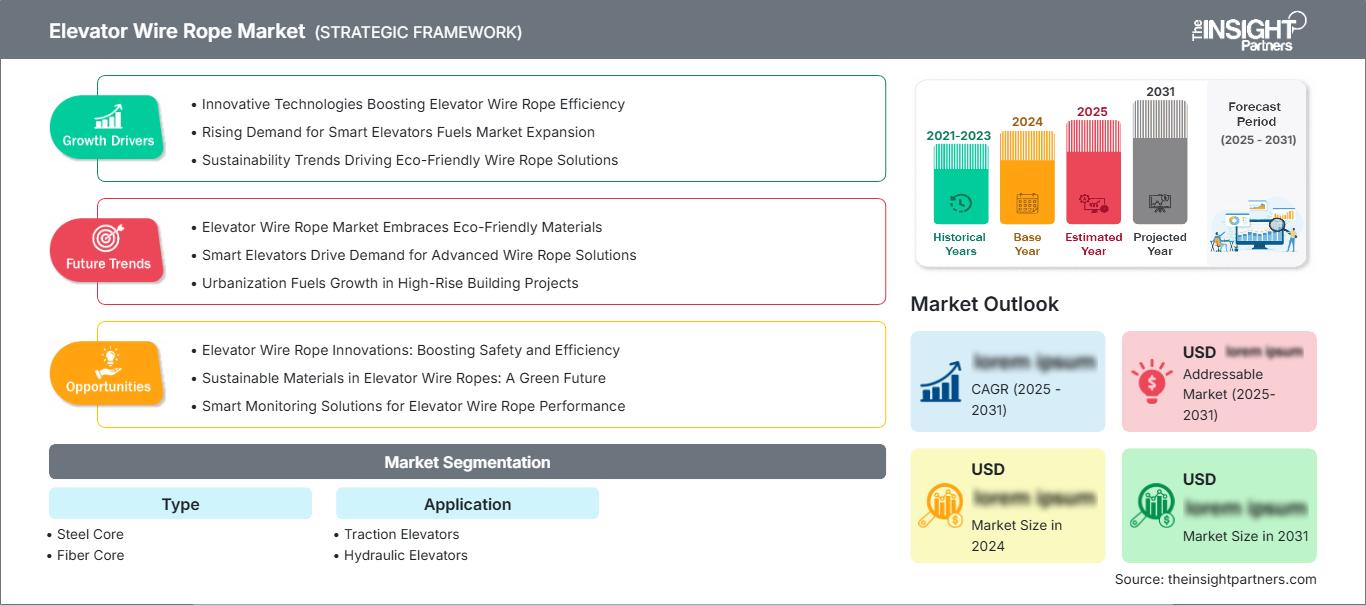
Regional Insights
< North America Elevator Wire Rope Market
North America is estimated to account for 9–11% share in 2025 and expand at a 3.2–3.8% CAGR through 2034. The US dominates regional consumption, followed by Canada and Mexico. Replacement of aging ropes is a major demand contributor because established commercial, residential, healthcare, and institutional buildings require recurring inspection and modernization. Modernization projects also create opportunities for higher-performance ropes.
The structural demand of the area is further strengthened by codes on elevator safety, accessibility needs, urban renewal, and renovation of old structures. The high cost of labor leads the contractors as well as property owners to opt for ropes which have longer life expectancy with predictable maintenance schedules. The machine-room-less elevators and higher speed traction systems also require precise control of rope diameter, tension, elongation, and sheave compatibility.
U.S. Elevator Wire Rope Market
North America is dominated by the U.S., representing 77-80% of the market for 2025 and growing at a CAGR of 3.1-3.7% till 2034. The large number of elevators already installed in the country makes sure of a continuing demand for replacements along with commercial renovations and accessibility renovations for modernization. Suppliers such as WireCo WorldGroup Inc. and ALPS Wire Rope Corporation get an edge due to industrial distributors and technical service providers.
Traction elevators make up the majority of the demand for rope as these are extensively used in commercial buildings, hospitals, hotels, residential buildings, and institutions. Replacement is now decided more on the basis of life cycle, dimensional stability, and suitability to the sheaves already in use rather than just the price of the new rope. Modernization of the old installations also helps the market.
Europe Elevator Wire Rope Market
The Europe segment constitutes 16-19% share in 2025 and is expected to record CAGR of 2.8-3.4%. Germany leads the region backed by its industrial nature and existing ecosystem for elevator manufacturing. The UK, France, Italy, and Spain are other major contributors due to modernization and replacement demands. Safety certifications and quality considerations form an essential part of European buying behavior.
UK is noted for having a large existing base and constant demand for modernization. Outdated commercial and residential buildings drive replacement needs, whereas safety and accessibility modifications motivate refurbishment efforts. PFEIFER Drako Drahtseilwerk GmbH has a local presence due to its UK subsidiaries that handle application engineering, distribution, and elevator ropes services for both replacements and installations.
Germany remains the top market in Europe due to its well-established industrial network, elevator industry, and engineering abilities. The market is driven by traction elevators used in commercial, residential, industrial, and public buildings. Gustav Wolf GmbH and PFEIFER Drako Drahtseilwerk GmbH enhance local supply capacities, while modernization initiatives offer consistent demands for engineered ropes.
France, Italy, and Spain are key markets in Europe, where the demand is driven by the renovations of cities, tourism infrastructure, residential buildings, and public buildings. Italy takes advantage of an extensive installed base as well as specialist manufacturing skills, while France and Spain increasingly focus on modernization, safety, and accessibility initiatives.
APAC Elevator Wire Rope Market
APAC accounts for 62-66% market share in 2025 and is forecasted to record a CAGR of 4.0-4.6%. APAC is the leader among all regions. The biggest market in APAC is China; other major markets include Japan, South Korea, India, and Australia. High-rise building, urbanization, investments in infrastructure, and extensive manufacturing capabilities drive demand.
The biggest market in terms of installed and produced units is China, and India is a promising market for growth. In Japan and South Korea, modernization and technological sophistication drive demand. Expansion of production capacities, safety regulations, and growing use of high-speed elevators drive engineered ropes demand in the region.
Middle East & Africa Elevator Wire Rope Market
Middle East & Africa is expected to expand at a 3.5–4.2% CAGR. Saudi Arabia and the UAE lead regional demand through high-rise construction, hospitality projects, airports, and large mixed-use developments. South Africa provides a more replacement-oriented market supported by established commercial infrastructure and modernization.
Saudi Arabia benefits from major urban and tourism projects, while the UAE continues to require elevator systems for high-rise and hospitality developments. South Africa and the rest of MEA remain more dependent on refurbishment and infrastructure activity. The region's emphasis on high-rise construction supports technically demanding traction elevator rope applications.
Segmentation Analysis
Type
The Type segment is projected to expand at a 3.5–3.9% CAGR from 2026–2034. Selection depends on elevator speed, load, sheave configuration, bending cycles, elongation requirements, and system design. Steel Core products are increasingly relevant for demanding installations, while Fiber Core products remain important where flexibility, weight, and established elevator specifications influence purchasing decisions.
- Steel Core: Steel Core ropes are preferred for demanding traction applications requiring high strength, dimensional stability, and resistance to crushing. Their importance increases with higher loads, speeds, and intensive operating cycles.
- Fiber Core: Fiber Core ropes remain widely used because of flexibility, established OEM specifications, and favorable bending performance. They serve a broad installed base and remain important in standard traction and replacement applications.
Application
The Application segment is forecast to grow at a 3.4–3.8% CAGR from 2026–2034. Traction elevators account for the majority of demand because they dominate mid-rise and high-rise installations. Hydraulic elevators retain relevance in low-rise applications where lower travel distances and building configuration make hydraulic systems technically and economically appropriate.
- Traction Elevators: Traction Elevators represent the largest application because they serve high-rise, commercial, residential, and institutional buildings. Their repeated sheave bending cycles create continuous demand for ropes engineered around fatigue resistance and dimensional stability.
- Hydraulic Elevators: Hydraulic Elevators remain relevant in low-rise buildings, warehouses, and selected institutional applications. Their rope requirements differ from traction systems, creating a specialized replacement market rather than the dominant volume opportunity.
Opportunity Snapshot
| Segment Name | Revenue Contribution | Trend Tag | Adoption Stage |
| Traction Elevators | High | High-Rise Systems | Mature |
| Hydraulic Elevators | Low | Low-Rise Access | Mature |
Elevator Wire Rope Market Growth Drivers and Impact Analysis
Expansion of Elevator Modernization Programs
Modernization is creating a durable replacement cycle because many installed elevators require upgrades to ropes, controls, drives, doors, and safety systems rather than complete replacement. Rope renewal is particularly attractive when building owners seek improved reliability without undertaking full shaft reconstruction. This favors suppliers capable of matching existing rope dimensions while offering improved fatigue performance, elongation control, and service life. Modernization also creates technical-service opportunities because contractors increasingly require inspection, tensioning, installation, and replacement guidance. The impact is strongest in North America and Europe, where established elevator fleets are comparatively mature. As modernization becomes more integrated with broader building refurbishment, rope manufacturers can gain through specification agreements with elevator service companies and by supplying customized replacement products for diverse legacy installations.
Urban Verticalization and High-Rise Construction
Increasing urban density is encouraging vertical development, particularly across Asia Pacific and selected Middle Eastern markets. High-rise buildings require elevator systems capable of handling greater travel distances, higher operating speeds, and intensive passenger cycles. These conditions raise the performance requirements placed on hoist ropes, particularly regarding fatigue resistance, breaking strength, elongation, and sheave interaction. New high-rise construction therefore supports demand for engineered traction ropes with consistent manufacturing tolerances. China, India, the UAE, and Saudi Arabia provide important opportunities because infrastructure development and urban expansion are increasing vertical transportation requirements. For rope manufacturers, this driver supports investments in high-strength constructions, precision manufacturing, technical certification, and local application engineering. It also encourages closer collaboration with elevator OEMs during system design rather than relying exclusively on replacement sales.
Rising Emphasis on Rope Safety and Lifecycle Performance
Safety requirements are shifting purchasing decisions toward measurable rope performance rather than basic commodity specifications. Elevator operators increasingly consider fatigue endurance, diameter stability, lubrication retention, elongation, corrosion resistance, and inspection characteristics when selecting replacement ropes. This trend raises the value of quality-control systems and application-specific engineering. Manufacturers with testing facilities and established certification processes can differentiate their products through documented performance and technical support. The effect is especially important in regulated markets where inspection and maintenance practices influence replacement timing. Over time, higher attention to lifecycle cost can support premium engineered products because reduced downtime and longer replacement intervals may offset higher initial prices. Suppliers that combine rope manufacturing with inspection, installation guidance, and maintenance support can therefore strengthen customer retention and improve their position in recurring replacement programs.
Elevator Wire Rope Market Future Trends
Development of Higher-Performance Rope Constructions
The Elevator Wire Rope Market is likely to move toward constructions that combine higher breaking strength with improved fatigue resistance and controlled elongation. Manufacturers are expected to refine strand geometry, core design, lubrication systems, and surface treatment to support smaller sheaves and compact elevator machinery. Higher-performance ropes can help reduce system weight and improve installation flexibility without compromising safety margins. Demand should be strongest in high-rise and high-speed traction elevators, where repeated bending and greater travel distances place greater stresses on ropes. Product development is also likely to emphasize consistent diameter and tension behavior because these characteristics influence ride quality, sheave wear, and maintenance requirements. Digital production monitoring and more rigorous testing could further improve batch consistency and strengthen OEM qualification.
Expansion of Localized Manufacturing and Technical Services
Manufacturers are expected to increase regional production, warehousing, and technical-service capabilities as elevator demand expands beyond traditional markets. Localized supply can reduce lead times, simplify replacement planning, and improve responsiveness for OEMs and maintenance contractors. India is particularly important because its elevator installation base is expanding alongside urban infrastructure development. Southeast Asia and the Middle East also offer opportunities for regional distribution and technical support. Suppliers are likely to combine manufacturing expansion with training, inspection, rope selection, installation assistance, and digital documentation. This broader service model can improve customer retention while reducing the risk associated with incorrect rope selection or installation. Over the forecast period, geographic proximity and technical responsiveness should become increasingly important alongside manufacturing scale.
Elevator Wire Rope Market Opportunities
Localized Supply for High-Growth Asian Markets
India and other Asian economies provide opportunities for manufacturers to establish localized production, finishing, warehousing, and technical-support capabilities. Local supply can reduce transportation time and inventory requirements while allowing producers to adapt products to regional elevator OEM specifications. India is particularly attractive because urban construction, infrastructure investment, and modernization are expanding the installed elevator base. Manufacturers can strengthen their position by developing partnerships with elevator OEMs, maintenance companies, distributors, and engineering contractors. Product localization should focus on high-strength traction ropes, replacement configurations, and application-specific constructions rather than competing solely on commodity pricing. Investments in testing facilities and technical training would further support market entry. Companies that establish local qualification and service capabilities can improve customer access while building a recurring replacement business.
Premium Replacement Ropes and Lifecycle Services
The replacement market offers an opportunity to combine premium ropes with inspection, installation, tensioning, and maintenance services. Building owners increasingly seek reliability and reduced downtime, creating room for suppliers to demonstrate lifecycle value rather than competing primarily on initial rope price. Manufacturers can develop service packages around rope inspection, replacement scheduling, condition assessment, and technical documentation. Such offerings are particularly relevant to hospitals, hotels, office towers, transport facilities, and large residential complexes where elevator availability directly affects building operations. Digital records can also improve replacement planning by linking rope specifications, installation dates, inspection results, and service intervals. A service-oriented strategy can therefore create recurring revenue and strengthen relationships with elevator maintenance contractors while differentiating technically advanced rope products from lower-cost alternatives.
Recent Developments
- December 2025: Ascent Lifting, a Shorehill Capital portfolio company, completed the acquisition of Hoisting Wire Rope and Sling LLC in late October 2025. This is Ascent Lifting's fifth acquisition, enhancing its position as a distributor of lifting and rigging products with 42 locations nationwide. Hoisting Wire Rope and Sling, based in Corpus Christi, Texas, supplies wire rope, slings, and related equipment, and offers rigging services. Post-acquisition, it will function as a branch of Ascent's CERTEX division, improving service capabilities in Texas and bolstering Ascent Lifting's statewide presence.
- March 2025: Rajratan Global Wire Limited plans to introduce wire rope at its Pithampur plant, with the Board of Directors approving new machinery for this production. The initiative aims to transform the existing 12,000 TPA capacity of black wire into 10,000 TPA of wire rope, enhancing the company's product portfolio and overall value proposition.
Frequently Asked Questions

- Comprehensive Market Sizing and Forecast Analysis
- Detailed Segmentation Analysis
- In-Depth Market Dynamics Assessment
- Regional and Country-Level Insights
- Competitive Landscape and Company Benchmarking
- Strategic Business Intelligence
Recent Reports
Testimonials

The Insight Partners provided valuable market intelligence that supported our global go-to-market strategy. Their team was professional, responsive, and attentive to our feedback, providing thoughtful analysis and helpful methodological clarifications throughout the project.
Junmo Kim Chief Financial Officer (CFO), Enertech Co., Ltd.
The Insight Partners' SCADA System Market report is comprehensive, with valuable insights on current trends and future forecasts. The team was highly professional, responsive, and supportive throughout. We are very satisfied and highly recommend their services.
RAN KEDEM Partner, Reali Technologies LTDs
I requested a report on a very specific software market and the team produced the report in a few days. The information was very relevant and well presented. I then requested some changes and additions to the report. The team was again very responsive and I got the final report in less than a week.
JEAN-HERVE JENN Chairman, Future Analytica
We worked with The Insight Partners for an important market study and forecast. They gave us clear insights into opportunities and risks, which helped shape our plans. Their research was easy to use and based on solid data. It helped us make smart, confident decisions. We highly recommend them.
PIYUSH NAGPAL Sr. Vice President, High Beam Global
The Insight Partners delivered insightful, well-structured market research with strong domain expertise. Their team was professional and responsive throughout. The user-friendly website made accessing industry reports seamless. We highly recommend them for reliable, high-quality research services
YUKIHIKO ADACHI CEO, Deep Blue, LLC.
This is the first time I have purchased a market report from The Insight Partners.While I was unsure at first, I visited their web site and felt more comfortable to take the risk and purchase a market report.I am completely satisfied with the quality of the report and customer service. I had several questions and comments with the initial report, but after a couple of dialogs over email with their analyst I believe I have a report that I can use as input to our strategic planning process.Thank you so much for taking the extra time and making this a positive experience.I will definitely recommend your service to others and you will be my first call when we need further market data.
JOHN SUZUKI President and Chief Executive Officer, Board Director, BK Technologies
I wish to appreciate your support and the professionalism you displayed in the course of attending to my request for information regarding to infectious disease IVD market in Nigeria. I appreciate your patience, your guidance, and the fact that you were willing to offer a discount, which eventually made it possible for us to close a deal. I look forward to engaging The Insight Partners in the future, all thanks to the impression you have created in me as a result of this first encounter.
DR CHIJIOKE ONYIA MANAGING DIRECTOR, PineCrest Healthcare Ltd.Reason to Buy
- Informed Decision-Making
- Understanding Market Dynamics
- Competitive Analysis
- Identifying Emerging Markets
- Customer Insights
- Market Forecasts
- Risk Mitigation
- Boosting Operational Efficiency
- Strategic Planning
- Investment Justification
- Tracking Industry Innovations
- Aligning with Regulatory Trends





 Get Free Sample for