
Emulsion Adhesives Market Size, Share & Demand by 2034
Coverage: By Type (Acrylic Polymer Emulsion, Lattices, Vinyl Acetate Ethylene (VAE) Emulsion, Polyurethane Dispersion (PUD), Polyvinyl Acetate (PVA) Emulsion, Others); Application (Tapes and Labels, Paper and Packaging, Construction, Automotive and Transportation, Woodworking, Others) , and Geography (North America, Europe, Asia Pacific, and South and Central America)
- Status : Data Released
- Report Code : TIPRE00005488
- Category : Chemicals and Materials
- No. of Pages : 150
- Available Report Formats :


- Last update date : August 18, 2026


2025 Market Size
US$ 13.11 Bn
Base year value
2034 Forecast
US$ 15.49 Bn
Projected by 2034
CAGR 2026-2034
1.87 %
Growth rate
Addressable Market
US$ 129.59 Bn
(2026-2034)
The global Emulsion Adhesives market was valued at US$ 13.11 billion in 2025 and is expected to reach US$ 15.49 billion by 2034; it is estimated to record a CAGR of 1.87% during 2026-2034.
Emulsion Adhesives Market Assessment and Insights
- North America: North America represented an estimated 32–36% Emulsion Adhesives Market share in 2025 and is expected to grow at a 3.0–3.8% CAGR during 2026–2034, supported by packaging, construction, transportation, and established adhesive manufacturing capabilities.
- US: The US accounted for approximately 78–82% of North American demand in 2025, with growth of 3.0–3.7% CAGR during 2026–2034, led by packaging and industrial applications.
- Europe: Europe held an estimated 24–28% share in 2025 and is projected to expand at 2.5–3.3% CAGR during 2026–2034, with Germany, France, Italy, the UK, and Spain supporting demand through sustainable packaging and industrial production.
- Asia Pacific: Asia Pacific captured approximately 29–33% share in 2025 and is expected to register 3.2–4.0% CAGR during 2026–2034, led by China, India, Japan, and South Korea.
- Largest Segment: Acrylic Polymer Emulsion accounted for approximately 34–38% market share in 2025, with a 2.8–3.6% CAGR during 2026–2034, reflecting broad substrate compatibility and performance.
- High Growth Segment: Paper and Packaging represented approximately 31–35% share in 2025, with a 2.8–3.6% CAGR during 2026–2034, supported by recyclable packaging conversion.
- Key companies analyzed in detail: 3M Company, Bostik SA, Ashland Inc., CEMEDINE CO., LTD., H.B. Fuller Company, Henkel AG & Co. KGaA, Paramelt B.V., Pidilite Industries Limited, Dow Inc., Wacker Chemie AG.
Source: The Insight Partners' analysis based on proprietary research, government publications, company annual reports, investor presentations, industry databases, and expert interviews.
According to the Emulsion Adhesives Market report, the industry has moved from traditional formulation to engineered water-based products that enhance adhesion, processing, and environmental performance. The acrylic polymers, vinyl acetate products, polyurethane dispersions, and associated lattices respond to the needs of particular applications. Adhesive development for the packaging converting industry has resulted in products that adhere to papers, boards, films, and coated substrates. The construction and woodworking industries demand higher wet adhesion, flexibility, and environmental stability of their products.
There is change in production processes where polymer properties and raw material availability, energy input, regulations, and consumer requirements become an important part of adhesive design. It becomes more common for manufacturers to optimize formulations and test applications to reduce the coating weight without reducing adhesion. Thus, it will be more favorable to the companies that have knowledge about the polymer chemistry, laboratory for application testing, and regional manufacturing capabilities. In this competitive environment, there are global adhesive producers and regional ones.
Demand in the future will be driven by the trend towards packaging structures that are recyclable and processes that have low emissions. It is expected that Europe will still be an important center for technology development since packaging legislation supports design for recycling approaches, while North American producers will concentrate on productivity, converting automation, and high performance pressure sensitive adhesive applications. The Asia Pacific region will take advantage of its packaging conversions and industrialization, especially in China and India.
The Emulsion Adhesives Market trends indicate that areas for investments are expected to include water-based polymer technologies, application labs, production flexibility, and customer-specific formulas. Adhesive manufacturers with ability to provide reliable adhesion over difficult substrates at reduced drying times will have competitive edge. The market environment will also be more favorable for suppliers with ability to combine formulation chemistry with technical support, regulations, and reliability in their supply chains rather than just product prices.
Emulsion Adhesives Market Report Scope
| Report Attribute | Details |
|---|---|
| Market size in 2025 | US$ 13.11 Billion |
| Market Size by 2034 | US$ 15.49 Billion |
| Global CAGR (2026 - 2034) | 1.87% |
| Historical Data | 2021-2024 |
| Forecast period | 2026-2034 |
Emulsion Adhesives Market Analysis
Demand is driven by converters and manufacturers who need reliable bondability under conditions of high speed production. There is considerable use of adhesives in paper and packaging applications because of the need to produce cartons, seal cases, manufacture bags, label products, laminate papers, and do other conversions. Tapes and labels also offer a wide scope for use. The construction, woodworking, and transport industries also demand adhesive products with special flexibility, water-resistance, and substrate adhesion properties.
The value chain starts from monomers, polymers, additives, fillers, surfactants, and other raw materials used in the formulation process, followed by emulsion polymerization, blending, quality control, packing, distribution, and technical support services. Fluctuations in raw material costs may affect margins since polymer science is an important part of product economics. Companies that have diversified sources of supplies and regional facilities to manufacture products and applications labs can react to customer demands better. Bostik SA and Wacker Chemie AG demonstrate the importance of having deep technology and formulating expertise in different downstream applications.
The Emulsion Adhesives Market forecasts indicate that competitive dynamics arise out of factors such as product performance, expertise in formulation, support in application process, manufacturing presence, and customer qualification processes. The major competitor of Henkel AG & Co. KGaA is H.B. Fuller Company in terms of adhesive products that cover packaging, tapes, industrial bonding, and many more applications. 3M Company uses adhesive technologies in conjunction with a wide range of tape and industrial solutions in order to have great access to downstream customers.
The remaining competitors use strategic positioning for differentiation purposes. Dow Inc. uses knowledge in polymer and materials, Ashland Inc. utilizes expertise in specialty chemicals, Pidilite Industries Limited has a high level of exposure to construction, woodworking, and end user-oriented bonding applications. CEMEDINE CO., LTD. has specialized bonding capabilities in Japan and international markets. Paramelt B.V. and Wacker Chemie AG provide expertise in formulation and polymers, whereas Bostik SA provides water-based technologies.
● REPORT CUSTOMIZATION
Tailor This Report To Align With Your Specific Business Requirements
This report can be customized to align precisely with your business objectives, scope, and target markets. Customization options include tailored segmentation, geography, competitive analysis, and strategic insights to support informed decision-making.
Customize This Report →WHAT YOU CAN ADJUST
- ● Segmentations
- ● Geography
- ● Competitive Analysis
- ● Language Preferences
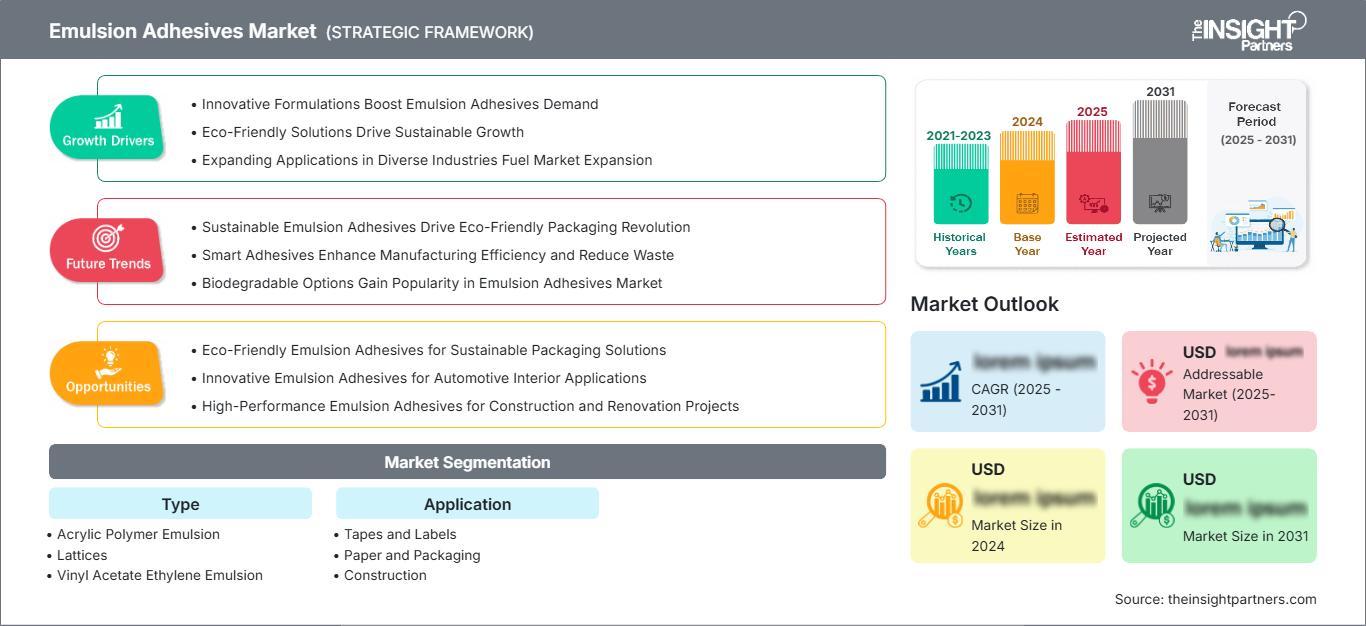
Emulsion Adhesives Market: Strategic Insights
Regional Insights
North America Emulsion Adhesives Market
North America is projected to make up 32% - 36% of the Emulsion Adhesives Market share in 2025, thus being one of the largest regional markets. Consumption is driven by developed packaging conversion, construction renovation, automotive manufacturing, furniture manufacturing, and industrial labeling. The regional market is predicted to grow at a CAGR of 3.0% - 3.8% between 2026 and 2034 as the producers introduce low-emission, easy processible, and recyclable substrate compatible formulations.
The region has an advantage in terms of advanced converting machinery, experienced adhesive producers and large technical services network. Packaging is one of the key consumption sectors, namely cartons, labels, bags and paper-based constructions. Construction and woodworking industries serve as additional sources of consumption due to bonding of porous substrates and engineered wood products. USA is the leader among the national markets, and Canada and Mexico are also involved through packaging, automotive, construction and manufacturing. Development of the product is currently aimed at simplifying formulation and improving drying and moisture resistance while not losing production speed.
U.S. Emulsion Adhesives Market
The US represents approximately 78–82% of North American Emulsion Adhesives Market demand in 2025. The market is expected to grow at a 3.0–3.7% CAGR during 2026–2034, supported by packaging conversion, construction activity, automotive production, and industrial labeling.
Large corporations have substantial business and technical activities in the country and include the 3M Company, H.B. Fuller Company, Henkel AG & Co. KGaA, Dow Inc., and Ashland Inc. There has been an increase in packaging products using sustainable paper constructions and automated converting. In construction applications, the usage of the adhesives is driven by the need for renovations and engineered wood products. For automotive applications, the use of the product is dictated by the need for reliable bonding performance in interiors and components.
Europe Emulsion Adhesives Market
Europe is estimated to hold a 24–28% share of the Emulsion Adhesives Market in 2025 and is projected to grow at a 2.5–3.3% CAGR during 2026–2034. Germany remains a leading market because of its industrial manufacturing, automotive, packaging, and woodworking base. The UK and France also contribute through packaging conversion, construction, and consumer goods manufacturing. Italy and Spain provide additional demand from furniture, footwear, packaging, and construction industries.
Recycling focus and chemical management are becoming part of regulatory pressure affecting adhesives development and package design. Waterborne systems become more important as the need arises for minimizing solvent contact and compatibility with paper packaging constructions. Henkel AG & Co. KGaA and Bostik SA are very well positioned locally, whereas Paramelt B.V. provides special adhesive products. European manufacturers are now competing on the basis of efficiency, performance, and compatibility with recycling-focused package designs, rather than just on price alone.
APAC Emulsion Adhesives Market
Asia Pacific is estimated to account for 29–33% of the Emulsion Adhesives Market in 2025 and is expected to register a 3.2–4.0% CAGR during 2026–2034. China is the leading regional market, supported by packaging manufacturing, construction, electronics, furniture, and industrial production. India is another important growth center because of expanding packaging conversion and infrastructure activity.
Japan and South Korea contribute through advanced manufacturing, automotive production, electronics, and specialized industrial bonding, while Australia provides demand through construction and packaging. Regional producers and international companies are expanding formulation capabilities to serve diverse substrate requirements. Policy initiatives encouraging lower-emission materials and increasing paper-based packaging adoption further support water-based adhesive technologies. The region's large manufacturing base and expanding domestic consumption provide a broad platform for long-term market development.
Middle East & Africa Emulsion Adhesives Market
Middle East and Africa represents a smaller regional opportunity, with growth expected at approximately 3.0–4.0% CAGR during 2026–2034. Saudi Arabia and the UAE are important markets because of infrastructure investment, packaging manufacturing, construction, and diversification initiatives. South Africa contributes through packaging, woodworking, construction, and industrial applications.
Regional demand is increasingly influenced by infrastructure development, food and beverage packaging, and manufacturing diversification. Producers serving the region must manage temperature, logistics, raw-material availability, and application requirements. Saudi Arabia and the UAE benefit from large-scale construction and industrial investment, while South Africa provides a more diversified manufacturing base. Local distribution networks and technical service capabilities remain important because customers often require application-specific formulations and dependable supply.
Segmentation Analysis
Type
Acrylic Polymer Emulsion remains a leading chemistry because of its adhesion, flexibility, water resistance, and compatibility with diverse substrates. The segment is expected to grow at a 2.8–3.6% CAGR during 2026–2034, supported by packaging, tapes, labels, construction, and industrial applications. Formulators increasingly optimize acrylic systems for lower coating weights and improved performance on recycled substrates.
- Acrylic Polymer Emulsion: Broad substrate compatibility and resistance characteristics make this chemistry important for labels, tapes, packaging, construction, and industrial bonding, supporting continued use across demanding applications.
- Lattices: Latex-based systems provide flexibility and useful adhesion characteristics for selected paper, packaging, construction, and industrial applications, particularly where formulation economics and processing requirements remain important.
- Vinyl Acetate Ethylene Emulsion: VAE systems provide flexibility and strong adhesion while supporting lower-emission formulations, making them relevant to packaging, woodworking, construction, and applications requiring balanced performance.
- Polyurethane Dispersion: Polyurethane dispersions offer strong adhesion, flexibility, and resistance properties and are particularly relevant where demanding substrates, durability, and performance requirements justify higher formulation complexity.
- Polyvinyl Acetate Emulsion: PVAc emulsions remain widely used for paper, woodworking, packaging, and general bonding because they offer established processing characteristics, economical formulation, and reliable adhesion to porous substrates.
Application
Tapes and Labels continue to represent an important application, while Paper and Packaging is expected to remain the principal demand center. The application segment is projected to grow at a 2.8–3.6% CAGR during 2026–2034, supported by packaging conversion, labeling, and increased use of recyclable substrates.
- Tapes and Labels: Pressure-sensitive and label applications require consistent tack, adhesion, clean processing, and substrate compatibility, supporting continued demand from packaging, logistics, healthcare, consumer goods, and industrial markets.
- Paper and Packaging: Cartons, cases, bags, labels, and paper-based packaging require dependable bonding at high converting speeds, making this application strategically important as recyclable packaging structures expand.
- Construction: Emulsion adhesives are used in selected flooring, insulation, wall covering, panel, and related applications where low odor, substrate compatibility, and ease of application support contractor productivity.
- Automotive and Transportation: Vehicle manufacturing uses adhesive systems for selected interior, trim, component, and material-bonding applications where lightweight construction and production efficiency influence formulation selection.
- Woodworking: Furniture and engineered-wood production relies on established emulsion technologies for bonding porous materials, with demand shaped by furniture output, construction activity, processing speed, and finished-product durability.
Opportunity Snapshot
| Segment Name | Revenue Contribution | Trend Tag | Adoption Stage |
| Tapes and Labels | High | Smart Labeling | Mature |
| Paper and Packaging | High | Recyclable Packaging | Scaling |
| Construction | Medium | Low-VOC Bonding | Mature |
| Automotive and Transportation | Medium | Lightweight Assembly | Scaling |
| Woodworking | Medium | Engineered Wood | Mature |
Emulsion Adhesives Market Growth Drivers and Impact Analysis
Expansion of Recyclable Paper-Based Packaging
The transition toward recyclable packaging structures is creating opportunities for adhesive formulations that support paper-based substrates without compromising converting efficiency. Packaging manufacturers increasingly need bonding systems that function across recycled fibers, coated papers, boards, and multilayer structures while maintaining adequate wet tack and final bond strength. This requirement expands the role of emulsion technologies in carton forming, case sealing, labeling, bag manufacturing, and paper lamination. The commercial impact extends beyond volume growth because converters increasingly evaluate adhesives according to recyclability compatibility, processing temperature, drying behavior, and chemical composition. Suppliers capable of demonstrating reliable performance on changing fiber compositions can strengthen customer relationships and reduce qualification barriers. As packaging producers redesign structures to meet sustainability objectives, adhesive suppliers with formulation flexibility and application testing capabilities are positioned to capture incremental demand from conversion lines adopting new materials.
Demand for Lower-Emission Manufacturing Processes
Manufacturers are increasingly evaluating adhesives according to environmental performance alongside traditional bonding properties. Emulsion systems can support lower solvent exposure and reduced volatile organic compound emissions in applications where water-based chemistry provides adequate performance. The impact is particularly relevant to packaging, construction, woodworking, and selected industrial applications where workplace conditions, odor, and process emissions influence material selection. Demand is therefore shifting toward formulations that combine environmental attributes with faster setting, reliable adhesion, moisture resistance, and production efficiency. This creates opportunities for suppliers to differentiate through polymer design, additives, drying optimization, and application-specific formulation. The commercial benefit is not limited to regulatory compliance. Customers can also use lower-emission adhesive systems to improve workplace conditions and support corporate sustainability targets. As specifications become more demanding, formulation performance and technical service are likely to become stronger competitive differentiators.
Growth of High-Speed Automated Converting
Packaging and labeling manufacturers are increasing automation and production-line speeds, raising the performance requirements placed on adhesive systems. Adhesives must deliver consistent viscosity, rapid development of bond strength, controlled application, and stable performance under continuous operating conditions. Formulations that fail to maintain these characteristics can create downtime, rejected products, or increased maintenance requirements. Emulsion adhesive suppliers therefore have opportunities to develop products optimized for automated dispensing and high-throughput converting equipment. Improved rheology control and application consistency can reduce material waste and support more predictable production. The impact is particularly relevant to paper packaging, labels, cases, and cartons, where small variations in adhesive performance can affect large production volumes. Suppliers that combine chemistry expertise with equipment knowledge and application testing can become more deeply integrated into customer manufacturing processes, strengthening retention and supporting premium positioning.
Emulsion Adhesives Market Future Trends
Design-for-Recycling Adhesive Formulations
Packaging development is increasingly moving toward structures that can enter established recycling streams with fewer barriers. This trend will encourage adhesive manufacturers to develop formulations that provide strong bonding during product use while creating fewer complications during recycling and fiber recovery. Water-based technologies are well positioned where they can deliver adequate adhesion without undermining substrate recyclability. Future development is likely to emphasize compatibility with recycled fibers, reduced adhesive application weights, improved wash-off characteristics where required, and better performance on coated or treated papers. Packaging converters will increasingly evaluate adhesive systems as part of the complete package rather than as an isolated input. Consequently, suppliers will need to provide technical evidence demonstrating how formulations perform across complete packaging structures. This trend should favor companies with application laboratories and close relationships with converters and packaging producers.
Higher-Performance Water-Based Polymer Platforms
Future product development will focus on improving the performance gap between water-based and higher-performance conventional adhesive technologies. Advances in polymer architecture, particle design, crosslinking, additives, and formulation control can improve resistance, flexibility, wet tack, and adhesion to difficult substrates. These developments will expand potential applications beyond traditional paper and porous materials into more demanding industrial and transportation uses. Customers are likely to prioritize products that provide multiple performance benefits without requiring major equipment changes. Formulation suppliers may increasingly develop modular platforms that can be adjusted for different substrates, curing conditions, and application speeds. Such technology can reduce development time for customers and improve manufacturing flexibility. As environmental requirements become more influential in purchasing decisions, the ability to combine lower-emission chemistry with high production performance will become an important source of differentiation.
Emulsion Adhesives Market Opportunities
Expansion in Emerging Packaging Manufacturing Hubs
Investment opportunities are emerging in countries where packaging production is expanding faster than established adhesive supply infrastructure. India, Southeast Asia, and selected Middle Eastern markets offer attractive conditions because food, beverage, consumer goods, e-commerce, and pharmaceutical packaging require increasing volumes of cartons, labels, bags, and paper-based formats. Local production or regional blending can reduce logistics costs and improve responsiveness to customer requirements. Suppliers can also develop application centers that adapt global adhesive platforms to local substrates, climate conditions, machinery, and converting practices. Strategic partnerships with packaging converters can accelerate product qualification and improve market access. Rather than competing solely through imported commodity formulations, suppliers can create value by offering technical service, customized viscosity and drying characteristics, and reliable regional supply. This approach can strengthen customer retention while supporting expansion into rapidly industrializing packaging markets.
Specialty Formulations for Difficult Substrates
A second opportunity lies in developing emulsion systems capable of bonding recycled, coated, low-surface-energy, or otherwise difficult substrates. Packaging redesign and material substitution are creating new bonding challenges that standard formulations may not address consistently. Customers increasingly require adhesives that maintain performance despite variations in substrate composition, surface treatment, moisture, and production conditions. Suppliers can respond through polymer modification, functional additives, improved wetting, and application-specific chemistry. Specialty products can command stronger margins because qualification depends on performance rather than price alone. Automotive, transportation, construction, and industrial users may provide additional opportunities where substrate diversity and durability requirements are high. Investment in application testing and customer co-development can reduce qualification risk and create long-term supply relationships. The strongest opportunity is likely to arise where formulation expertise directly solves production problems that conventional commodity adhesives cannot address efficiently.
Recent Developments
- March 2026: Mitsubishi Chemical Corporation (MCC) is transferring its acrylic emulsion business and the synthetic resin emulsion operations of Japan Coating Resin Corporation (JCR) to Konishi. Finalized on 17 February 2026, the complete transfer is set for 1 December 2026, aligning with MCC’s Medium-Term Management Plan 2029 aimed at optimizing its portfolio for sustainable growth. Established in 1959, JCR focuses on synthetic resin emulsions for various applications and reported net sales of approximately EUR 76.6 million in the fiscal year ending March 2025, employing 294 staff. The transfer aims to enhance competitive positioning under Konishi while maintaining the innovative strengths and customer relationships of both businesses in Japan..
- July 2025: Henkel Adhesive Technologies has introduced Loctite Liofol LA 7837/LA 6265, a new solvent-free adhesive system designed for high-performance packaging applications, particularly in retort packaging for pet food. This system offers enhanced food safety and reliable processing while reducing CO2 emissions by minimizing material use and eliminating the energy-intensive drying step necessary for solvent-based products.
Frequently Asked Questions

- Comprehensive Market Sizing and Forecast Analysis
- Detailed Segmentation Analysis
- In-Depth Market Dynamics Assessment
- Regional and Country-Level Insights
- Competitive Landscape and Company Benchmarking
- Strategic Business Intelligence
Recent Reports
Testimonials

The Insight Partners' SCADA System Market report is comprehensive, with valuable insights on current trends and future forecasts. The team was highly professional, responsive, and supportive throughout. We are very satisfied and highly recommend their services.
RAN KEDEM Partner, Reali Technologies LTDs
I requested a report on a very specific software market and the team produced the report in a few days. The information was very relevant and well presented. I then requested some changes and additions to the report. The team was again very responsive and I got the final report in less than a week.
JEAN-HERVE JENN Chairman, Future Analytica
We worked with The Insight Partners for an important market study and forecast. They gave us clear insights into opportunities and risks, which helped shape our plans. Their research was easy to use and based on solid data. It helped us make smart, confident decisions. We highly recommend them.
PIYUSH NAGPAL Sr. Vice President, High Beam Global
The Insight Partners delivered insightful, well-structured market research with strong domain expertise. Their team was professional and responsive throughout. The user-friendly website made accessing industry reports seamless. We highly recommend them for reliable, high-quality research services
YUKIHIKO ADACHI CEO, Deep Blue, LLC.
This is the first time I have purchased a market report from The Insight Partners.While I was unsure at first, I visited their web site and felt more comfortable to take the risk and purchase a market report.I am completely satisfied with the quality of the report and customer service. I had several questions and comments with the initial report, but after a couple of dialogs over email with their analyst I believe I have a report that I can use as input to our strategic planning process.Thank you so much for taking the extra time and making this a positive experience.I will definitely recommend your service to others and you will be my first call when we need further market data.
JOHN SUZUKI President and Chief Executive Officer, Board Director, BK Technologies
I wish to appreciate your support and the professionalism you displayed in the course of attending to my request for information regarding to infectious disease IVD market in Nigeria. I appreciate your patience, your guidance, and the fact that you were willing to offer a discount, which eventually made it possible for us to close a deal. I look forward to engaging The Insight Partners in the future, all thanks to the impression you have created in me as a result of this first encounter.
DR CHIJIOKE ONYIA MANAGING DIRECTOR, PineCrest Healthcare Ltd.Reason to Buy
- Informed Decision-Making
- Understanding Market Dynamics
- Competitive Analysis
- Identifying Emerging Markets
- Customer Insights
- Market Forecasts
- Risk Mitigation
- Boosting Operational Efficiency
- Strategic Planning
- Investment Justification
- Tracking Industry Innovations
- Aligning with Regulatory Trends





 Get Free Sample for