
Energy Trading Risk Management (ETRM) Software Market Growth, Trends & Demand by 2034
Coverage: By Component (Software, Services); Deployment (On-Premise, Cloud-based); Organization Size (Small and Medium Enterprises, Large Enterprises); End-user (Power and Gas Utilities, Oil and Gas Producers, Agriculture, Metals and Mining, Chemicals, Environmental Products and Renewables, Others) , and Geography (North America, Europe, Asia Pacific, and South and Central America)
- Status : Data Released
- Report Code : TIPRE00026581
- Category : Technology, Media and Telecommunications
- No. of Pages : 150
- Available Report Formats :


- Last update date : March 23, 2026


2025 Market Size
US$ 3.0 Bn
Base year value
2034 Forecast
US$ 6.4 Bn
Projected by 2034
CAGR 2026-2034
8.78 %
Growth rate
Addressable Market
US$ 42.10 Bn
(2026-2034)
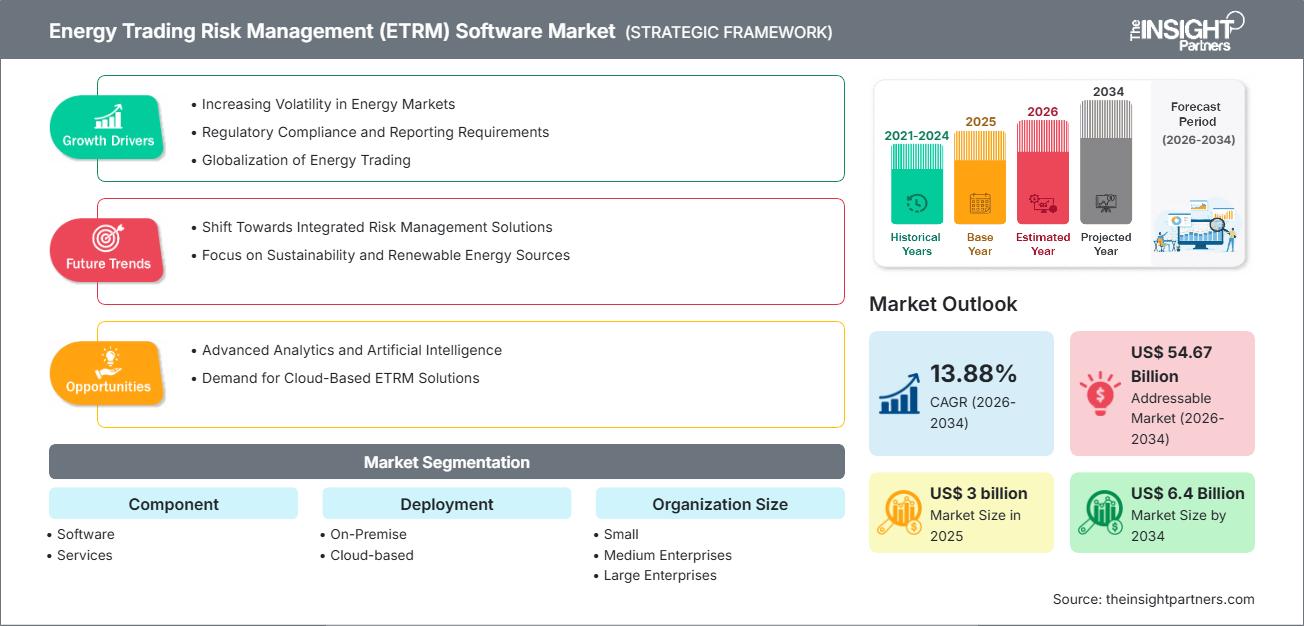
The global Energy Trading Risk Management (ETRM) Software market was valued at US$ 3.0 billion in 2025 and is expected to reach US$ 6.4 billion by 2034; it is estimated to record a CAGR of 8.78% during 2026-2034.
Key market dynamics include the escalating volatility in energy prices driven by geopolitical tensions, the rapid decentralization of energy grids, and the increasing complexity of multi-commodity portfolios. Additionally, the market is expected to benefit from the global transition toward renewable energy assets, the rising need for real-time data analytics to manage intermittency, and the implementation of stringent regulatory reporting mandates such as MiFID II and Dodd-Frank.
Energy Trading Risk Management (ETRM) Software Market Analysis
The energy trading risk management (ETRM) software market analysis reveals a critical shift toward cloud-native, API-first architectures as firms move away from rigid legacy systems. Strategic opportunities are emerging in the integration of Artificial Intelligence (AI) and Machine Learning (ML) for predictive price forecasting and automated trade execution, which offer a distinct competitive advantage in high-frequency trading environments. The analysis also indicates that procurement trends are increasingly favoring modular platforms that allow for the plug-and-play of specialized microservices, such as carbon credit tracking or weather-informed demand forecasting. For vendors, differentiation now hinges on providing straight-through processing (STP) capabilities that unify front, middle, and back-office functions into a single source of truth, thereby reducing operational risk and manual errors.
Energy Trading Risk Management (ETRM) Software Market Overview
Energy trading risk management (ETRM) software is evolving from a back-office compliance tool to a front-office strategic engine. Historically focused on capturing trades and basic VaR (Value at Risk) calculations, modern ETRM systems are now tasked with managing the volatility of renewables, hydrogen, and environmental certificates. Both global enterprise software providers and specialized niche vendors are competing to offer solutions that handle the massive data volumes generated by smart grids and IoT-enabled energy assets. As the energy industry undergoes digital transformation, the demand for scalable, cloud-based solutions is rising, particularly among mid-tier utilities and independent power producers who previously relied on spreadsheets. For instance, the market in the US represents a mature and technologically advanced landscape for ETRM solutions, characterized by a highly competitive merchant power sector and diverse regional transmission organizations. The market is increasingly dominated by a shift toward cloud-based modernization as players seek to manage the extreme price swings and congestion costs inherent in the rapidly evolving North American energy grid.
Market Research Highlights
- Global market for Energy Trading Risk Management (ETRM) Software was valued at US$ 3.00 Billion in 2025
- Annual market size is expected to reach US$ 6.40 Billion by 2034
- Total addressable market (TAM) during 2026-2034 is projected to reach approximately US$ 54.67 Billion
- Market is anticipated to register a CAGR of 13.88% during the forecast period
- The United States represents a key market, supported by Increasing Volatility in Energy Markets, Regulatory Compliance and Reporting Requirements, Globalization of Energy Trading, as well as evolving industry dynamics
- Market analysis covers North America, Europe, Asia-Pacific, South and Central America, Middle East and Africa, with growth evaluated across the forecast period
- Market opportunities such as Advanced Analytics and Artificial Intelligence, Demand for Cloud-Based ETRM Solutions are expected to influence market dynamics and addressable market
- Report profiles industry participants, including Infosys, Wipro, Hitachi Energy, Power Costs, Inc., EKA Software Solutions, Euit LLC, FIS Global, Navitasoft, Open Access Technology International, Inc., nGenue, LLC, while analyzing competitive strategies and innovation developments
-
Source: The Insight Partners' analysis based on proprietary research, government publications, company annual reports, investor presentations, industry databases, and expert interviews.
● REPORT CUSTOMIZATION
Tailor This Report To Align With Your Specific Business Requirements
This report can be customized to align precisely with your business objectives, scope, and target markets. Customization options include tailored segmentation, geography, competitive analysis, and strategic insights to support informed decision-making.
Customize This Report →WHAT YOU CAN ADJUST
- ● Segmentations
- ● Geography
- ● Competitive Analysis
- ● Language Preferences
Energy Trading Risk Management (ETRM) Software Market: Strategic Insights
-
Get Top Key Market Trends of this report.This FREE sample will include data analysis, ranging from market trends to estimates and forecasts.
Energy Trading Risk Management (ETRM) Software Market Drivers and Opportunities
Market Drivers:
- Rising Energy Price Volatility: Sharp fluctuations in global oil, gas, and power prices—exacerbated by geopolitical instability—have made robust risk assessment tools indispensable. ETRM software provides the real-time visibility required to hedge exposures and protect profit margins against unpredictable market swings.
- Renewable Energy Integration and Intermittency: The global shift toward wind and solar power introduces significant supply uncertainty. ETRM platforms are essential for modeling weather-dependent generation, managing imbalance risks, and optimizing the dispatch of battery storage systems.
- Stringent Regulatory Compliance: Governments worldwide are tightening oversight on energy trading to prevent market manipulation. ETRM systems automate the complex reporting requirements for various international jurisdictions, ensuring firms remain compliant while avoiding heavy financial penalties.
Market Opportunities:
- Adoption of AI-Driven Predictive Analytics: There is a substantial opportunity to embed AI and machine learning into ETRM stacks to enhance demand forecasting and algorithmic trading. These technologies can identify hidden patterns in massive datasets, providing traders with actionable insights that manual analysis cannot achieve.
- Expansion into Environmental and Carbon Markets: As Net Zero targets become corporate mandates, the demand for tracking carbon credits, renewable energy certificates (RECs), and green hydrogen is surging. Vendors can capture new market share by offering specialized modules for these emerging environmental commodities.
- Digital Transformation of Small and Mid-Sized Enterprises (SMEs): The proliferation of SaaS (Software-as-a-Service) models has lowered the barrier to entry for smaller firms. Providing cost-effective, scalable, and easy-to-deploy cloud solutions offers a pathway to tap into the growing segment of independent power producers and retail energy providers.
Energy Trading Risk Management (ETRM) Software Market Report Segmentation Analysis
The Energy Trading Risk Management (ETRM) Software Market share is analyzed across various segments to provide a clearer understanding of its structure, growth potential, and emerging trends. Below is the standard segmentation approach used in most industry reports:
By Component:
- Software: This segment includes the core digital platforms used for trade capture, risk modeling, and position management. It represents the primary revenue generator as firms invest in advanced analytics and AI-enhanced forecasting engines.
- Services: Comprises implementation, consulting, and maintenance support. As ETRM systems become more complex and integrated with other enterprise systems (like ERPs), the demand for specialized technical services continues to grow.
By Deployment:
- Cloud-based: The fastest-growing deployment model, offering scalability, lower upfront costs, and easier remote access. It is increasingly preferred by companies looking for agile, future-proof solutions.
- On-Premise: Traditionally favored by large enterprises with high-security requirements and existing legacy infrastructure. While it offers maximum data control, its growth is slower compared to cloud alternatives.
By Organization Size:
- Small and Medium Enterprises: A burgeoning segment benefiting from the shift toward SaaS, allowing smaller trading desks to access sophisticated risk tools without massive capital expenditure.
- Large Enterprises: The dominant segment, consisting of global oil majors and large-scale utilities that require highly customized, multi-commodity, and multi-currency enterprise solutions.
By End-user:
- Power and Gas Utilities: The largest end-user group, focused on balancing load and generation while managing grid volatility.
- Oil and Gas Producers: Utilize ETRM for supply chain optimization, hedging production, and managing complex physical logistics.
- Agriculture, Metals, and Mining: These markets use specialized modules to manage commodity-specific risks, such as crop yields or mineral price fluctuations.
- Chemicals, Environmental Products and Renewables, Others: A rapidly expanding segment driven by the need to track carbon offsets and trade renewable certificates.
By Geography:
- North America
- Europe
- Asia Pacific
- South & Central America
- Middle East & Africa
Energy Trading Risk Management (ETRM) Software Market Report Scope
| Report Attribute | Details |
|---|---|
| Market size in 2025 | US$ 3.0 Billion |
| Market Size by 2034 | US$ 6.4 Billion |
| Global CAGR (2026 - 2034) | 8.78% |
| Historical Data | 2021-2024 |
| Forecast period | 2026-2034 |
| Segments Covered |
By Component
|
| Regions and Countries Covered |
North America
|
| Market leaders and key company profiles |
|
Energy Trading Risk Management (ETRM) Software Market Players Density: Understanding Its Impact on Business Dynamics
The Energy Trading Risk Management (ETRM) Software Market is growing rapidly, driven by increasing end-user demand due to factors such as evolving consumer preferences, technological advancements, and greater awareness of the product's benefits. As demand rises, businesses are expanding their offerings, innovating to meet consumer needs, and capitalizing on emerging trends, which further fuels market growth.
Energy Trading Risk Management (ETRM) Software Market Share Analysis by Geography
Asia-Pacific is expected to grow fastest in the coming years due to rapid market liberalization and rising energy consumption. Emerging markets in South & Central America, the Middle East, and Africa also present untapped opportunities as regional players modernize their trading infrastructure and formalize risk protocols.
The ETRM software market is undergoing a significant transformation, moving from legacy on-premise silos to cloud-native, integrated ecosystems. The energy transition, a surge in data-driven decision-making, and the expansion of global commodity trading drive growth. Below is a summary of market share and trends by region:
North America
- Market Share: Holds the largest share, driven by a mature trading culture and advanced digital infrastructure.
- Key Drivers:
- High adoption of cloud-native ETRM solutions to manage nodal price volatility.
- Rapid growth in renewable energy capacity requires sophisticated grid analytics.
- Presence of leading global ETRM software vendors and technology innovators.
- Trends: Increasing use of AI for weather-informed demand forecasting and a focus on integrating battery storage assets into trading portfolios.
Europe
- Market Share: A major regional player, anchored by complex cross-border power markets and strict environmental regulations.
- Key Drivers:
- Stringent mandates for carbon tracking and environmental product trading.
- High price volatility in natural gas markets is driving a need for robust hedging tools.
- Integration of decentralized energy resources (DERs) across the EU grid.
- Trends: A strategic shift toward Power Purchase Agreement (PPA) management software and specialized modules for hydrogen and green energy certificates.
Asia-Pacific
- Market Share: The fastest-growing region, with China, India, and Australia acting as primary growth engines.
- Key Drivers:
- Liberalization of domestic power and gas markets in major economies.
- Massive investments in smart grid technology and renewable energy infrastructure.
- Rising disposable incomes and urbanization are leading to increased energy demand.
- Trends: Heavy adoption of mobile-enabled trading dashboards and B2B contracts for high-end analytics used in the emerging LNG and renewables industry.
South and Central America
- Market Share: An emerging market with a growing focus on modernizing state-owned energy entities.
- Key Drivers:
- Modernization of aging grid infrastructure to reduce transmission losses and risk.
- Growing awareness of the need for formal risk management in volatile commodity markets.
- Expansion of the renewable energy industry, particularly solar and wind, in Brazil and Chile.
- Trends: Growth of farm-to-table boutique brands for bio-energy and the introduction of regional trading hubs to harmonize energy standards.
Middle East and Africa
- Market Share: A developing market transitioning from traditional oil-centric operations to diversified energy portfolios.
- Key Drivers:
- Strategic investments in Smart Cities and advanced energy management systems.
- Shift toward becoming global hubs for green hydrogen production and trading.
- High demand for robust ETRM tools to manage the transition from fossil fuels to renewables.
- Trends: Implementation of modern risk-monitoring technologies to formalize local energy markets and reduce reliance on manual spreadsheet processes.
High Market Density and Competition
Competition is intensifying due to the presence of established leaders such as Infosys, Wipro, and Eka Software Solutions. Regional specialists and niche innovators like Navitasoft, EUIT LLC, alongside diversified giants such as Hitachi Energy, contribute to a highly fragmented and rapidly evolving landscape.
This competitive environment pushes vendors to differentiate through:
- Cloud-Native Innovation: Transitioning to SaaS models that offer lower total cost of ownership and faster deployment cycles compared to legacy on-premise systems.
- AI and Advanced Analytics: Embedding machine learning algorithms to provide superior predictive insights for price, demand, and risk modeling.
- Modular Microservices Architecture: Allowing clients to purchase only the specific functionalities they need—such as logistics or PPA management—rather than a monolithic suite.
- Vertical Integration: Managing the entire trade lifecycle from trade capture to financial settlement and regulatory reporting within a single, unified platform.
Opportunities and Strategic Moves
- Partnership with Tech Innovators: Form strategic alliances with AI and weather-data providers to enhance the predictive capabilities of ETRM platforms for renewable energy.
- Expansion into ESG and Carbon Tracking: Develop specialized modules for environmental, social, and governance (ESG) reporting to appeal to firms facing increased pressure from investors and regulators.
Major Companies operating in the Energy Trading Risk Management (ETRM) Software Market are:
- Infosys
- Wipro
- Hitachi Energy
- Power Costs, Inc.
- EKA Software Solutions
- Euit LLC
- FIS Global
- Navitasoft
- Open Access Technology International, Inc.
- nGenue, LLC
Disclaimer: The companies listed above are not ranked in any particular order.
Energy Trading Risk Management (ETRM) Software Market News and Recent Developments
- In December 2025, Fendahl signed a new deal with a major US-based petrochemicals company to modernize its trading infrastructure. The new customer utilized the Fusion ETRM Software to engage in both physical and financial LPG trading, including the management of swaps and futures. Additionally, the firm relied on the platform's integrated modules for transportation, storage, and inventory management.
- In April 2025, Infosys, a global leader in next-generation digital services and consulting, announced a definitive agreement to acquire MRE Consulting Ltd., a technology and business consulting service provider. This strategic investment brought newer capabilities for Infosys in trading and risk management, significantly strengthening its global service offerings for ETRM Software within the energy sector.
Energy Trading Risk Management (ETRM) Software Market Report Coverage and Deliverables
The Energy Trading Risk Management (ETRM) Software Market Size and Forecast (2021–2034) report provides a detailed analysis of the market covering below areas:
- Energy Trading Risk Management (ETRM) Software Market size and forecast at global, regional, and country levels for all the key market segments covered under the scope
- Energy Trading Risk Management (ETRM) Software Market trends, as well as market dynamics such as drivers, restraints, and key opportunities
- Detailed PEST and SWOT analysis
- Energy Trading Risk Management (ETRM) Software Market analysis covering key market trends, global and regional framework, major players, regulations, and recent market developments
- Industry landscape and competition analysis covering market concentration, heat map analysis, prominent players, and recent developments in the Energy Trading Risk Management (ETRM) Software Market.
- Detailed company profiles
Frequently Asked Questions

- Comprehensive Market Sizing and Forecast Analysis
- Detailed Segmentation Analysis
- In-Depth Market Dynamics Assessment
- Regional and Country-Level Insights
- Competitive Landscape and Company Benchmarking
- Strategic Business Intelligence
Recent Reports
Testimonials

The Insight Partners' SCADA System Market report is comprehensive, with valuable insights on current trends and future forecasts. The team was highly professional, responsive, and supportive throughout. We are very satisfied and highly recommend their services.
RAN KEDEM Partner, Reali Technologies LTDs
I requested a report on a very specific software market and the team produced the report in a few days. The information was very relevant and well presented. I then requested some changes and additions to the report. The team was again very responsive and I got the final report in less than a week.
JEAN-HERVE JENN Chairman, Future Analytica
We worked with The Insight Partners for an important market study and forecast. They gave us clear insights into opportunities and risks, which helped shape our plans. Their research was easy to use and based on solid data. It helped us make smart, confident decisions. We highly recommend them.
PIYUSH NAGPAL Sr. Vice President, High Beam Global
The Insight Partners delivered insightful, well-structured market research with strong domain expertise. Their team was professional and responsive throughout. The user-friendly website made accessing industry reports seamless. We highly recommend them for reliable, high-quality research services
YUKIHIKO ADACHI CEO, Deep Blue, LLC.
This is the first time I have purchased a market report from The Insight Partners.While I was unsure at first, I visited their web site and felt more comfortable to take the risk and purchase a market report.I am completely satisfied with the quality of the report and customer service. I had several questions and comments with the initial report, but after a couple of dialogs over email with their analyst I believe I have a report that I can use as input to our strategic planning process.Thank you so much for taking the extra time and making this a positive experience.I will definitely recommend your service to others and you will be my first call when we need further market data.
JOHN SUZUKI President and Chief Executive Officer, Board Director, BK Technologies
I wish to appreciate your support and the professionalism you displayed in the course of attending to my request for information regarding to infectious disease IVD market in Nigeria. I appreciate your patience, your guidance, and the fact that you were willing to offer a discount, which eventually made it possible for us to close a deal. I look forward to engaging The Insight Partners in the future, all thanks to the impression you have created in me as a result of this first encounter.
DR CHIJIOKE ONYIA MANAGING DIRECTOR, PineCrest Healthcare Ltd.Reason to Buy
- Informed Decision-Making
- Understanding Market Dynamics
- Competitive Analysis
- Identifying Emerging Markets
- Customer Insights
- Market Forecasts
- Risk Mitigation
- Boosting Operational Efficiency
- Strategic Planning
- Investment Justification
- Tracking Industry Innovations
- Aligning with Regulatory Trends





 Get Free Sample for