
Environmental Agricultural Wireless Sensors Market Trends, Share & Demand by 2034
Environmental Agricultural Wireless Sensors Market Size and Forecasts (2021 - 2034), Global and Regional Share, Trends, and Growth Opportunity Analysis Report Coverage : By Sensor Type (Soil Moisture Sensors, Temperature Sensors, Humidity Sensors, Nutrient Sensors), Product Type (Standalone Sensors, Integrated Sensor Systems, Cloud-based Sensors), Application (Precision Farming, Soil Health Monitoring, Crop Monitoring, Weather Forecasting), End Use (Agricultural Producers, Agricultural Services, Research Institutions)
- Status : Data Released
- Report Code : TIPRE00039419
- Category : Electronics and Semiconductor
- No. of Pages : 150
- Available Report Formats :


- Last update date : August 14, 2026


2025 Market Size
US$ 3.52 Bn
Base year value
2034 Forecast
US$ 12.95 Bn
Projected by 2034
CAGR 2026-2034
15.57 %
Growth rate
Addressable Market
US$ 69.97 Bn
(2026-2034)
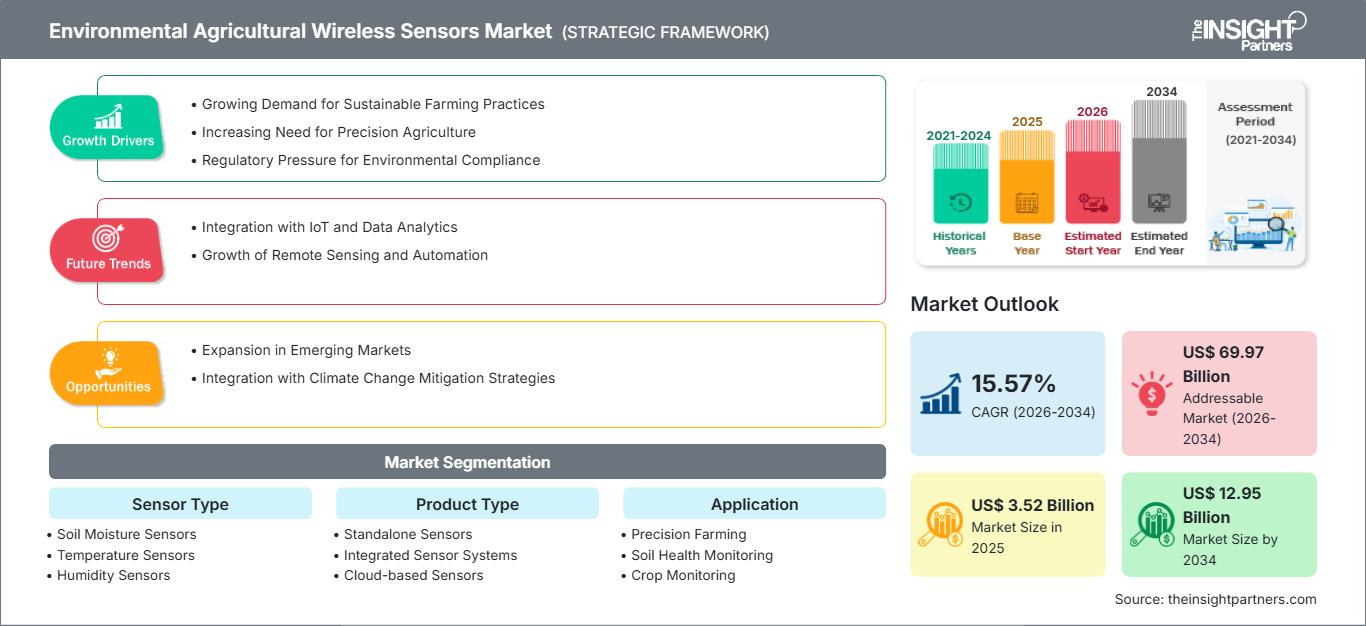
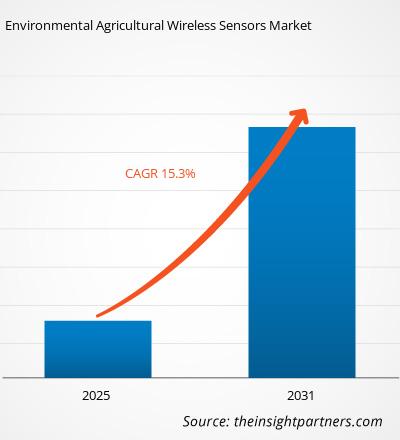
The Environmental Agricultural Wireless Sensors Market is valued at US$ 3.52 Billion in 2025 and is projected to reach US$ 12.95 Billion by 2034, expanding at a CAGR of 15.57% during 2026–2034. Adoption is advancing as growers combine field-level sensing, wireless connectivity, and agronomic software to manage water, nutrients, crop stress, and local weather conditions with greater precision across commercial farms and research-led production environments.
North America remains a high-value deployment arena, with an estimated 14.5–16.0% CAGR supported by large farm economics, mature irrigation infrastructure, and expanding digital agronomy services. The Environmental Agricultural Wireless Sensors Market size benefits from rising demand for near-real-time soil and weather intelligence, while public conservation incentives and stronger rural connectivity are lowering implementation barriers for producers seeking measurable input efficiency and auditable sustainability outcomes.
Environmental Agricultural Wireless Sensors Market Assessment and Insights
- North America: Held 34–37% Environmental Agricultural Wireless Sensors Market share in 2025 and is expected to grow at 14.5–16.0% during 2026–2034, supported by precision irrigation, service-led distribution, and established farm-management platforms.
- US: Represented 78–82% of North America in 2025 and is projected to expand at 14.8–16.2% through 2034 as connected agronomy penetrates midsize farms.
- Europe: Accounted for 25–28% in 2025 and should grow at 13.5–15.0%, led by Germany, France, the UK, Italy, and Spain through water, soil, and compliance applications.
- Asia Pacific: Captured 27–30% in 2025 and is forecast to rise at 17.0–18.8%, with China, Japan, India, South Korea, and Australia driving climate-smart deployment.
- Largest Segment: Soil moisture sensors held 31–35% market share in 2025 and are expected to register 14.8–16.3% CAGR through 2034.
- High Growth Segment: Cloud-based sensors represented 22–26% market share in 2025 and are projected to expand at 18.0–20.0% CAGR through 2034.
- Key companies analyzed in detail: METER Group, Inc.; Libelium Comunicaciones Distribuidas S.L.; Teralytic, Inc.; Farmobile LLC; Robert Bosch GmbH; AgSense, LLC; Sensaphone; SyncroFarm Inc.; Dalian Optronics Co., Ltd.; and CropX Technologies Ltd.
Source: The Insight Partners' analysis based on proprietary research, government publications, company annual reports, investor presentations, industry databases, and expert interviews.
Initially, the products involved individual probes, proprietary gateways, and occasional readings, making their agronomic utility limited to irrigation planning only. Nowadays, the Environmental Agricultural Wireless Sensors Market is moving towards the systems where soil, canopy, and weather conditions are measured together using low-power wide area networking, cellular communication, and cloud computing. The hardware manufacturers develop more robust and stable sensors, whereas software companies focus on creating solutions compatible with different vendors and providing automated suggestions to farmers. The production becomes modular – the vendors can develop the same architecture for the radio, power, and enclosures used in several types of sensors while adjusting probes to local soils and crops.
Over 2034, the market is expected to expand from big commercial farms to cooperatives, agricultural services networks, and scientifically proven smallholder initiatives. The investments will probably flow towards platforms which show their agronomic accuracy, need minimal maintenance, and can integrate with the irrigation system or machines control. The regulatory pressure regarding nutrients' losses, water distribution, and traceability will become a driver for business case. Moreover, the development of satellite and terrestrial connections will help to cover areas with poor infrastructure.
Environmental Agricultural Wireless Sensors Market Report Scope
| Report Attribute | Details |
|---|---|
| Market size in 2025 | US$ 3.52 Billion |
| Market Size by 2034 | US$ 12.95 Billion |
| Global CAGR (2026 - 2034) | 15.57% |
| Historical Data | 2021-2024 |
| Forecast period | 2026-2034 |
Environmental Agricultural Wireless Sensors Market Analysis
Environmental Agricultural Wireless Sensors growth is driven by the requirement for turning environmental variables into action. Soil moisture, temperature, humidity, and nutrient measurements provide information necessary for proper irrigation, fertilization, pest risk assessment, and crop stage identification. Research demonstrates that in-ground sensors provide near real-time information on soil and plant parameters, whereas precision technology can decrease inputs' wastage. The ecosystem includes component manufacturers, sensors, connection, agronomic platform providers, distributors, advisors, and farmers.
The Environmental Agricultural Wireless Sensors Market trends indicate that the cost of ownership is becoming lower due to lower-power radios, solar power generation, local processing, and standardization of application programming interfaces. But calibration, correct installation, batteries replacement, and reliable connection are still critical. Hence, suppliers compete not by price, but by the overall reliability of operation. Revenues from software subscriptions and agronomic services are increasing, while distributors and irrigation companies accelerate sales by integrating sensors in existing processes.
There is fragmentation in the competition landscape with specialists and diversified engineering organizations adopting different strategic positions. The METER Group concentrates on environmental measurements, Libelium promotes interoperable Internet of Things (IoT) infrastructure, and CropX Technologies combines field equipment with agronomic advice. The Robert Bosch company provides sensing technology and embedded intelligence systems, while AgSense and Farmobile link monitoring with irrigation and farm data systems.
Investments are moving towards sensor fusion, enterprise dashboards, and channel partnerships rather than hardware expansion. While Teralytic focuses on soil analytics, Sensaphone is concerned with remote condition alerts, and SyncroFarm along with Dalian Optronics with application-specific deployment. Competitive advantage will depend less on models, openness, regional agronomy, and serviceability. Growth will come via partnerships with equipment manufacturers, irrigation firms, input suppliers, insurers, and food processing companies requiring field-level analytics.
● REPORT CUSTOMIZATION
Tailor This Report To Align With Your Specific Business Requirements
This report can be customized to align precisely with your business objectives, scope, and target markets. Customization options include tailored segmentation, geography, competitive analysis, and strategic insights to support informed decision-making.
Customize This Report →WHAT YOU CAN ADJUST
- ● Segmentations
- ● Geography
- ● Competitive Analysis
- ● Language Preferences
Environmental Agricultural Wireless Sensors Market: Strategic Insights
Regional Insights
North America Environmental Agricultural Wireless Sensors Market
North America held 34–37% of global revenue in 2025 and is expected to expand at 14.5–16.0% CAGR through 2034. Share of the Environmental Agricultural Wireless Sensors Market has been driven by extensive mechanization, valuable irrigated crops, advanced dealers, and adoption of digital agronomy. Irrigation issues in the west production area drive the need for sensors that measure soil moisture, evapotranspiration, and weather at the local level to make decisions about irrigation.
Other areas include conservation schemes, university extension agencies, and commercial providers who convert the information into action in the field. The challenge in the region is the lack of adoption in large and small farms. In response, manufacturers have adopted subscriptions, easy to maintain equipment, and systems. Contribution from Canada includes grains, horticulture, and greenhouse, and from Mexico export-oriented fruits and vegetables.
U.S. Environmental Agricultural Wireless Sensors Market
The U.S. accounted for 78–82% of North American revenue in 2025 and is forecast to grow at 14.8–16.2% CAGR. Federal reporting indicates precision agriculture practices were used by only 27% of farms or ranches in 2023, revealing material whitespace beyond large operations. There is most demand for sensors where the cost of irrigation, the value of crops, shortage of labor, or environmental reporting necessitates deployment of the system.
Some companies that are involved in this venture include METER Group, AgSense, Farmobile, Sensaphone, Teralytic, and CropX Technologies. There has been diversification in applications from water-based irrigation systems to applications that deal with nutrient movement, frost warnings, greenhouse controls, and insurance reports. The specialty crop belts in California, Pacific Northwest, Florida, and Southwest have a lot of interest in sensor networks.
Europe Environmental Agricultural Wireless Sensors Market
Europe represented 25–28% of 2025 revenue and is projected to record 13.5–15.0% CAGR. Germany leads through engineering capacity, machinery integration, and environmental compliance. The UK utilizes research networks along with farm services digitalization, and farmers use sensors to help with variable precipitation, soil compaction, and efficient inputs in cereals, horticulture, and protected cropping.
France consists of vast farmland acreages along with digitization and water policies. The demands for sensors in vineyards, orchards, vegetable production, and dry areas of irrigation in Italy and Spain are also high. The European Commission works towards IoT, sensors, analytics, and decision-making for accurate operations. Though data governance and interoperability standards could increase buying time for some vendors, it will work well for others with a safe platform and agronomic performance.
APAC Environmental Agricultural Wireless Sensors Market
Asia Pacific held 27–30% in 2025 and should post 17.0–18.8% CAGR, the fastest regional range. The Chinese excel in their approach of agriculture modernization and electronics domestically produced, whereas Japan and South Korea focus on automation as well as protection in agriculture. India has a scale advantage due to efficient irrigation and services deployment, while Australia concentrates on drought management and connectivity of extensive farms. Digital agriculture, wider cell phone coverage, and changing climatic conditions make use of sensor networks more feasible.
Middle East & Africa Environmental Agricultural Wireless Sensors Market
Middle East and Africa is expected to expand at 15.0–17.0% CAGR. Controlled environment agriculture, water optimization, and food security infrastructure investments drive demand for moisture and nutrients management capabilities from Saudi Arabia and UAE, respectively.
South Africa leads diversification in open field operations through commercial horticulture and grain production, whereas the rest of the MEA region is still projects driven. Solar energy, low-power communication, and managed services become critical in regions where there is lack of grid availability and connectivity. Water shortage becomes the most compelling economic driver.
Segmentation Analysis
Sensor Type
The Environmental Agricultural Wireless Sensors Market scope across sensor types reflects the shift from single-variable monitoring toward multi-parameter agronomy. Sensor Type is projected to expand at 15.0–16.5% CAGR during 2026–2034, supported by crop-specific calibration, falling communications costs, and demand for continuous field visibility. Soil moisture remains foundational, while nutrient sensing gains strategic importance as fertilizer costs and runoff controls intensify.
- Soil Moisture Sensors: These devices hold the strongest position because irrigation timing generates immediate savings, measurable yield protection, and straightforward integration with pumps, pivots, and advisory platforms.
- Temperature Sensors: Demand centers on frost alerts, germination windows, greenhouse control, and disease models, making temperature data a low-cost anchor for wider environmental sensing networks.
- Humidity Sensors: Humidity monitoring is strategically important in protected crops and disease-prone regions, where canopy moisture conditions influence spraying, ventilation, and fungal-risk decisions.
- Nutrient Sensors: Nutrient devices address fertilizer efficiency and leaching risk, but adoption depends on calibration, soil variability management, and trusted interpretation within localized agronomic models.
Product Type
Product Type is forecast to grow at 15.8–17.3% CAGR through 2034. Standalone devices remain useful for focused monitoring, but integrated and cloud-based products capture more value by linking multiple measurements with alerts, recommendations, and equipment controls. Buyers increasingly assess connectivity coverage, application interfaces, cybersecurity, battery life, and subscription economics alongside sensor accuracy.
- Standalone Sensors: Standalone products serve trials, research plots, and budget-sensitive farms, offering simple deployment but limited value unless readings connect to broader management workflows.
- Integrated Sensor Systems: Integrated systems combine probes, gateways, weather inputs, and control interfaces, making them attractive for irrigation automation, greenhouses, and multi-field commercial operations.
- Cloud-based Sensors: Cloud-connected products support remote fleets, benchmarking, alerts, and model updates, creating recurring revenue and enabling advisers to manage many farms from one interface.
Application
Application is expected to register 15.3–16.8% CAGR during 2026–2034. Precision farming leads spending because sensor data can directly guide irrigation, fertigation, spraying, and field scouting. Soil health and crop monitoring broaden the value proposition beyond immediate input savings, while localized weather sensing fills gaps between public stations and field-level conditions.
- Precision Farming: This application converts spatial and temporal readings into variable decisions, supporting efficient inputs, repeatable operations, and integration with machinery or irrigation controls.
- Soil Health Monitoring: Soil health programs use moisture, temperature, and nutrient signals to track root-zone conditions, validate regenerative practices, and improve long-term field management.
- Crop Monitoring: Crop monitoring combines environmental readings with growth observations to identify stress earlier, prioritize scouting, and improve timing of protection or nutrition interventions.
- Weather Forecasting: On-farm weather sensing improves hyperlocal forecasts and alerts, helping producers manage frost, heat, disease pressure, spraying windows, and irrigation demand.
End Use
End Use is projected to expand at 14.9–16.4% CAGR through 2034. Agricultural producers remain the principal buyers, but service companies increasingly aggregate demand and lower technical barriers. Research institutions influence specification, calibration, and validation, improving confidence in emerging nutrient and multi-depth sensing approaches.
- Agricultural Producers: Producers prioritize systems with clear payback, reliable alerts, and compatibility with existing pumps, machinery, phones, and farm-management software across seasons.
- Agricultural Services: Advisers, irrigation dealers, and cooperatives deploy sensors across client portfolios, turning technical support and interpretation into scalable recurring service models.
- Research Institutions: Universities and institutes require calibrated, high-resolution instruments for trials, environmental monitoring, and model development, establishing evidence later used in commercial recommendations.
Opportunity Snapshot
| Application | Revenue Contribution | Trend Tag | Adoption Stage |
| Precision Farming | High | Closed Loop | Scaling |
| Soil Health Monitoring | Medium | Root Intelligence | Scaling |
| Crop Monitoring | High | Stress Alerts | Scaling |
| Weather Forecasting | Medium | Microclimate Data | Mature |
Environmental Agricultural Wireless Sensors Market Growth Drivers and Impact Analysis
Water Scarcity Makes Field-Level Measurement Economically Actionable
Increasing pressure exists for agriculture to derive greater benefits from water shortages. The FAO shows that although 23% of cultivated land has irrigation infrastructure, this generates 48% of the world's value of crops, while over 60% of the irrigated land falls into high and very high water stress categories. Sensing moisture, temperature, and weather conditions through wireless devices transforms such a structural issue into an operational one. Farmers may time their irrigation based on the root zone conditions, stop unnecessary water pumping, and identify irrigation issues before damage to crops occurs. The effect is most pronounced in orchards, vegetable gardens, vineyards, and controlled environments, where crop value enables a denser sensor network deployment.
Precision Agriculture Adoption Still Has Significant Headroom
Despite the known advantages, adoption has yet to reach saturation. A U.S. government study revealed that 27 percent of farms or ranches employed precision agriculture techniques in 2023, although there was a significant increase in the use of technology as the farm size increased. Wireless environmental sensors would help expand precision farming beyond just machine guidance by providing real-time data on the state of the soil and the crops growing in it. As such, it would aid in making decisions regarding irrigation, fertilization, scouting, and protection of the fields. The practical outcome would be a large addressable market composed of mid-sized farms that would have lower initial cost and ease of adoption.
Compliance and Supply-Chain Reporting Elevate Data Value
Verifiable evidence of water, nutrients, soil and emissions management practices has become an essential criterion for food organizations, regulatory bodies and financiers. Sensors in the field produce time-stamped documentation that is suitable for sustainability reporting, conservation initiatives and assurance purposes in conjunction with calibration and management of models as well as data. According to the European Commission, Internet of Things, sensors, analytics and decision support systems are instruments that make operations more targeted. Frameworks related to CAP are beginning to establish evaluation of digitalization of agriculture. Apart from acquisition of new hardware, market influence is expanding to secure storage of data, interfaces, dashboards and reports.
Environmental Agricultural Wireless Sensors Market Future Trends
Edge Intelligence Will Convert Readings into Local Decisions
The Trends in Environmental Agricultural Wireless Sensors Market are likely to be dominated by edge computing that removes noise, identifies anomalies and takes action without persistent access to the cloud. Localized machine learning models can use the moisture profile, temperature, humidity, and growth state of the plant to make recommendations regarding irrigation and detect any issues with the sensors without relying on the cloud. This approach would reduce the power requirements of the system, increase speed and allow operations in areas where connectivity is inconsistent. While the cloud would play an important role in managing fleets and updating machine learning models, most of the intelligence will move closer to gateways and sensors.
Interoperable Sensor Fusion Will Replace Closed Device Silos
Future deployments will combine terrestrial probes, weather stations, satellite imagery, machinery data, and agronomic records through common interfaces. Sensor fusion addresses the weakness of any single data stream and enables higher-confidence decisions across variable fields. Buyers will favor platforms that preserve data ownership and can connect competing hardware brands, irrigation controls, and farm-management systems. Open architecture will also let agricultural service providers assemble crop-specific packages instead of relying on one vendor. As data volumes rise, quality scoring and provenance will become essential. Competitive differentiation will shift from owning every device to orchestrating trusted data, localized models, and automated workflows across heterogeneous farm technology stacks.
Environmental Agricultural Wireless Sensors Market Opportunities
Managed Sensor Services for Midsize and Fragmented Farms
One investable opportunity is a managed-service model that bundles hardware, installation, connectivity, maintenance, and seasonal interpretation into a per-acre or per-field fee. This structure lowers capital barriers and addresses the shortage of on-farm technical expertise. Agricultural cooperatives, irrigation dealers, crop advisers, and rural telecom operators can serve as distribution partners, aggregating demand and providing local support. Environmental Agricultural Wireless Sensors Market Forecasts support prioritizing regions where farm fragmentation limits direct enterprise selling but water or fertilizer costs create clear payback. Investors should target modular platforms, multilingual applications, and replaceable probes. Success depends on low churn, reliable field service, and evidence that recommendations improve operational outcomes.
Verification Platforms for Water, Nutrient, and Carbon Programs
A second opportunity lies in converting sensor records into verification services for food companies, lenders, insurers, and conservation programs. Integrated measurements can substantiate irrigation timing, nutrient movement, soil conditions, and extreme-weather exposure when supported by transparent methods. Platform developers should build auditable data pipelines, permissions, and standardized reports rather than relying on raw dashboards. Partnerships with agronomists and research institutions can validate thresholds across crops and soils. Revenue can combine device deployment, analytics subscriptions, and reporting fees. The strongest offerings will separate measured observations from modelled estimates, protect farmer control over data, and connect sustainability claims to operational decisions that improve resilience and resource productivity.
Recent Developments
- November 2025: Internet Initiative Japan Inc. (IIJ) and Sony Semiconductor Solutions Corporation (Sony) announced the signing of an agreement to establish a joint venture that will offer soil moisture sensors and irrigation navigation services for smart agriculture. The new company is scheduled to begin operations in April 2026. By combining IIJ’s expertise in communication technologies and smart agriculture with Sony’s technological capabilities in sensor development and other areas, the company aims to support improvements in work quality and efficiency in agricultural practices, while contributing to sustainable agriculture that is resilient to climate change.
- April 2026: LI-COR backed by global investment firm Battery Ventures, announces the launch of the LI-300 and LI-350 Soil Moisture Sensors: two new additions to the company's longstanding and comprehensive portfolio of environmental research instrumentation. Designed for every user, these easy-to-deploy sensors provide clear and consistent insights into a variety of research and commercial applications.
- February 2026: Researchers at Purdue University have developed an innovative wireless sensing platform designed to monitor subsoil conditions, helping farmers optimize the use of water, fertilizers, and other agricultural inputs. The technology aims to reduce farming costs, minimize environmental impact, and improve crop productivity through more precise data-driven decisions.
Frequently Asked Questions

- Comprehensive Market Sizing and Forecast Analysis
- Detailed Segmentation Analysis
- In-Depth Market Dynamics Assessment
- Regional and Country-Level Insights
- Competitive Landscape and Company Benchmarking
- Strategic Business Intelligence
Recent Reports
Testimonials

The Insight Partners' SCADA System Market report is comprehensive, with valuable insights on current trends and future forecasts. The team was highly professional, responsive, and supportive throughout. We are very satisfied and highly recommend their services.
RAN KEDEM Partner, Reali Technologies LTDs
I requested a report on a very specific software market and the team produced the report in a few days. The information was very relevant and well presented. I then requested some changes and additions to the report. The team was again very responsive and I got the final report in less than a week.
JEAN-HERVE JENN Chairman, Future Analytica
We worked with The Insight Partners for an important market study and forecast. They gave us clear insights into opportunities and risks, which helped shape our plans. Their research was easy to use and based on solid data. It helped us make smart, confident decisions. We highly recommend them.
PIYUSH NAGPAL Sr. Vice President, High Beam Global
The Insight Partners delivered insightful, well-structured market research with strong domain expertise. Their team was professional and responsive throughout. The user-friendly website made accessing industry reports seamless. We highly recommend them for reliable, high-quality research services
YUKIHIKO ADACHI CEO, Deep Blue, LLC.
This is the first time I have purchased a market report from The Insight Partners.While I was unsure at first, I visited their web site and felt more comfortable to take the risk and purchase a market report.I am completely satisfied with the quality of the report and customer service. I had several questions and comments with the initial report, but after a couple of dialogs over email with their analyst I believe I have a report that I can use as input to our strategic planning process.Thank you so much for taking the extra time and making this a positive experience.I will definitely recommend your service to others and you will be my first call when we need further market data.
JOHN SUZUKI President and Chief Executive Officer, Board Director, BK Technologies
I wish to appreciate your support and the professionalism you displayed in the course of attending to my request for information regarding to infectious disease IVD market in Nigeria. I appreciate your patience, your guidance, and the fact that you were willing to offer a discount, which eventually made it possible for us to close a deal. I look forward to engaging The Insight Partners in the future, all thanks to the impression you have created in me as a result of this first encounter.
DR CHIJIOKE ONYIA MANAGING DIRECTOR, PineCrest Healthcare Ltd.Reason to Buy
- Informed Decision-Making
- Understanding Market Dynamics
- Competitive Analysis
- Identifying Emerging Markets
- Customer Insights
- Market Forecasts
- Risk Mitigation
- Boosting Operational Efficiency
- Strategic Planning
- Investment Justification
- Tracking Industry Innovations
- Aligning with Regulatory Trends





 Get Free Sample for