
Epoxy Resins Market Trends, Share & Demand by 2034
Coverage: By Form (Solid, Liquid, Solution); Application (Paints and Coatings, Adhesives and Sealants, Composites, Others); End User Industry (Building and Construction, Consumer Goods, Aerospace, Marine, Others) , and Geography (North America, Europe, Asia Pacific, and South and Central America)
- Status : Data Released
- Report Code : TIPRE00023633
- Category : Chemicals and Materials
- No. of Pages : 150
- Available Report Formats :


- Last update date : September 01, 2026


2025 Market Size
US$ 14.86 Bn
Base year value
2034 Forecast
US$ 27.03 Bn
Projected by 2034
CAGR 2026-2034
6.9 %
Growth rate
Addressable Market
US$ 189.49 Bn
(2026-2034)
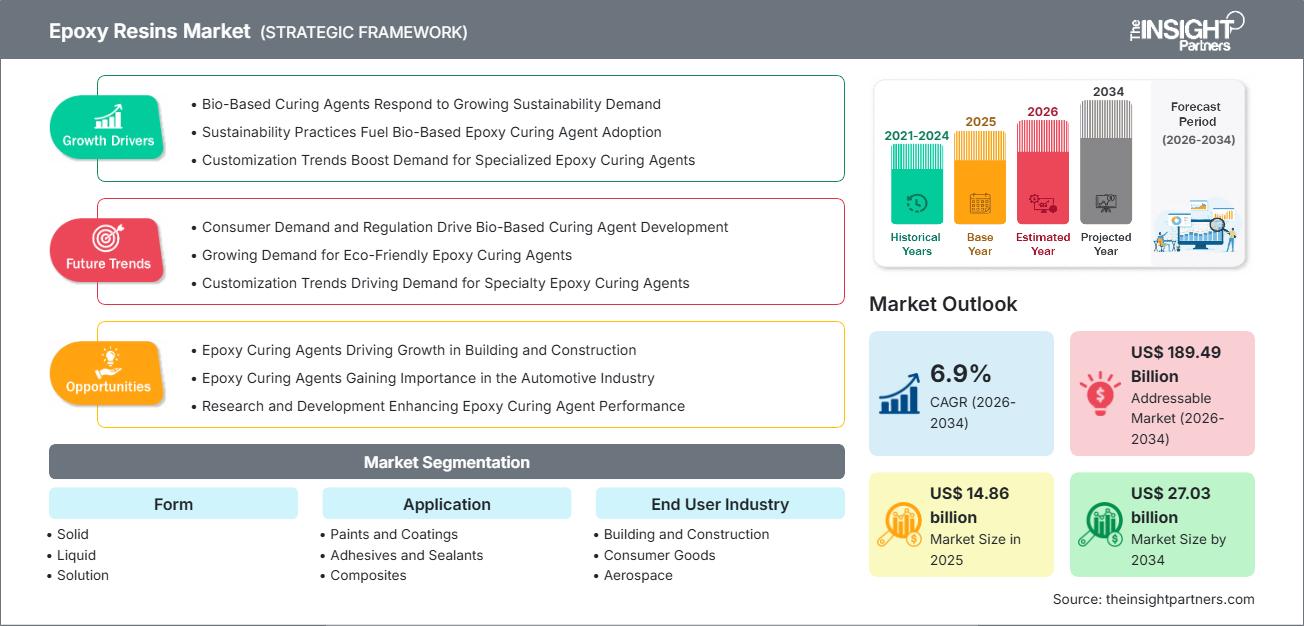
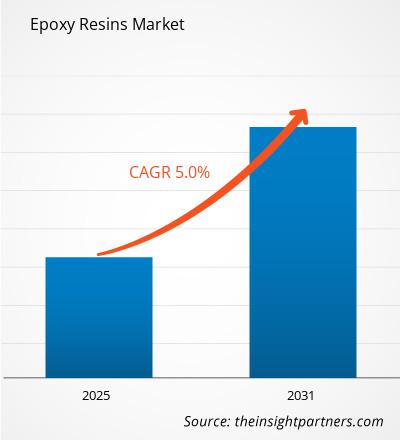
The Epoxy Resins Market generated US$ 14.86 billion in 2025 and is projected to reach US$ 27.03 billion by 2034, expanding at a CAGR of 6.9% during 2026–2034. The growth will be attributed to extensive usage in protective coatings, structural adhesives, composites and construction materials. Growth in infrastructure spending, lightweighting needs, electrical applications and need for corrosion resistance are expected to fuel the market growth in developed and developing countries.
Growth in North America will benefit from increasing spending on infrastructure renovation, installation of renewable energy equipment, manufacturing of aircrafts and domestic industries production. The size of Epoxy Resins Market is also affected by spending on durable floorings, protective coatings, composite materials, electronics components and lower emission products.
Epoxy Resins Market Assessment and Insights
- North America: North America represented a 9.2% share in 2025 and is expected to grow at a 5.0–5.5% CAGR between 2026–2034, supported by infrastructure renewal, aerospace composites, industrial coatings, and domestic manufacturing investments.
- US: The US accounted for 85.7% of North America's 2025 share and is projected to expand at a 5.0–5.5% CAGR during 2026–2034, led by construction, aerospace, electronics, and protective coatings.
- Europe: Europe held a 13.7% share in 2025 and is forecast to grow at a 5.8–6.3% CAGR during 2026–2034. Germany, the UK, France, Italy, and Spain remain important markets because of automotive, marine, renewable-energy, and industrial applications.
- Asia Pacific: Asia Pacific commanded a 62.1% share in 2025 and is anticipated to advance at a 5.0–5.5% CAGR during 2026–2034. China, India, Japan, and South Korea benefit from manufacturing, electronics, construction, automotive, and renewable-energy activity.
- Largest Segment: Paints and Coatings represented a 45–50% market share in 2025 and is expected to expand at a 4.8–5.3% CAGR during 2026–2034, supported by corrosion protection and industrial maintenance.
- High Growth Segment: Composites held a 15–20% market share in 2025 and is projected to grow at a 7.0–7.5% CAGR during 2026–2034, driven by lightweight aerospace, transportation, and wind applications.
- Key companies analyzed in detail: BASF SE, Atul Limited, Dow Inc., Hexion Inc., Huntsman Corporation, KUKDO CHEMICAL CO., LTD., NAN YA PLASTICS CORPORATION, Olin Corporation, Solvay SA, Techstorm Advanced Materials.
Source: The Insight Partners' analysis based on proprietary research, government publications, company annual reports, investor presentations, industry databases, and expert interviews.
While Epoxy Resins Market have been shifting demand from traditional industrial coatings to composites, electronics, adhesives, and infrastructure protection applications, there is still considerable need for both liquid systems as well as solid and solution grade materials, driven by processing requirements and end-use performance considerations, such as cure characteristics, adhesion, corrosion resistance, and mechanical properties under severe conditions.
In the coming years, suppliers will focus on improving product performance, geographical capability, and reduced emissions. Geographical diversification of production facilities, including in India and Southeast Asia, may be an opportunity to develop new manufacturing facilities. Regulations on volatile organic compounds, chemical exposures, and product carbon footprint may lead to improvements in formulations. There will also be new opportunities in renewable energy infrastructure, electric mobility, electronics, and transportation composites.
Epoxy Resins Market Report Scope
| Report Attribute | Details |
|---|---|
| Market size in 2025 | US$ 14.86 billion |
| Market Size by 2034 | US$ 27.03 billion |
| Global CAGR (2026 - 2034) | 6.9% |
| Historical Data | 2021-2024 |
| Forecast period | 2026-2034 |
Epoxy Resins Market Analysis
The Epoxy Resins Market is driven by the needs of the protective coating, adhesive, composite, and construction material sectors due to high adhesion, chemical resistance, dimensional stability, and strength. The industry value chain consists of upstream raw materials, resin producers, modifying agents and hardeners suppliers, formulators, distribution companies, fabricators, and industrial users. Regional economics play an important role as well as bisphenol-containing feedstocks and intermediates determine the cost of delivery and logistics impact export flows.
More and more frequently, application-specific demands drive choice of the type of resins used. In paint and coating business, formulators look for corrosion resistance, surface durability, reactivity and regulatory compliance; composite producers care about glass transition temperature, toughness, viscosity and productivity. Feedstocks costs and availability play a big role in supply. It opens the door to integrated producers and distributors who can assure stable specs, fast delivery and technical support.
Positioning has become an increasingly competitive function of specialty chemistry versus commodity mass. The five chemical producers that possess general technical competencies mentioned in the Epoxy Resins Market Report are BASF SE, Dow Inc., Hexion Inc., Huntsman Corporation, and Olin Corporation. On the other hand, Atul Limited, KUKDO CHEMICAL CO., LTD., NAN YA PLASTICS CORPORATION, Solvay SA, and Techstorm Advanced Materials cater to specific regional and application niches. Product innovation is becoming more about sustainability, processability, composite performance, and regulatory flexibility.
In addition, investment plans have become more geographically selective. Chemical producers are investing in regional manufacture where higher utilization is facilitated by demand from automotive, electronics, infrastructural, and renewable energy industries. An example of regional production by BASF indicates the need to satisfy coating applications locally. Again, the specialty adhesives produced by Huntsman illustrate how competitiveness is achieved through regulatory and sustainability features.
● REPORT CUSTOMIZATION
Tailor This Report To Align With Your Specific Business Requirements
This report can be customized to align precisely with your business objectives, scope, and target markets. Customization options include tailored segmentation, geography, competitive analysis, and strategic insights to support informed decision-making.
Customize This Report →WHAT YOU CAN ADJUST
- ● Segmentations
- ● Geography
- ● Competitive Analysis
- ● Language Preferences
Epoxy Resins Market: Strategic Insights
Regional Insights
North America Epoxy Resins Market
The North America region was a 9.2% Epoxy Resins Market Share in 2025, and is forecast to have a CAGR of 5.0-5.5% during 2026-2034. This region will benefit from rehabilitation of infrastructure, maintenance in industry, manufacture in aerospace industry, renewable energy projects, and increasing demands for protective materials with durability. The product demand would be mainly in coatings, adhesives, composites, electrical applications, and construction products.
The US is 85.7% of North America’s 2025 market, providing it with the leading position among all regions. The US will have manufacturing, aerospace programs, rehabilitation of bridges and transport, and industrial flooring, thus diversifying the demand in the region. Canada will contribute through energy infrastructure, construction, and transportation projects. In addition, Mexico will help with automotive and manufacturing activities in the region.
U.S. Epoxy Resins Market
The USA is the largest country of North America in terms of its share of 85.7% for 2025 and it is anticipated to register a CAGR of 5.0–5.5% between 2026 and 2034. The application areas include industrial coatings, construction, aerospace, electronics, automotive, marine systems, and composite fabrication. Resin technology availability near the region has been vital to the end-users who look forward to receiving materials faster and in large quantities.
The firms BASF SE, Dow Inc., Hexion Inc., Huntsman Corporation, and Olin Corporation have been important from both technical and commercial perspectives in the US market. Coatings and adhesives benefit from construction and maintenance activities, but aerospace and transportation production processes need high-performance composite material systems. Renewables also stimulate resin system demand for tough conditions.
Europe Epoxy Resins Market
Europe had a share of 13.7% in 2025 and will grow at a CAGR of 5.8-6.3% during 2026-2034. Germany has been the largest market in the country, due to its strong presence in the automotive industry, industrial manufacturing, machinery, and advanced material sector. Environmental regulations and product durability demands are driving the growth in Europe in addition to lower emission formulating technologies.
In the UK, there has been growth in the aerospace, marine, offshore wind energy, and infrastructure sectors, which requires the use of composite and protective coatings having high service life. Germany has benefited from its automotive manufacturing and industrial machinery and construction application sectors. In France, Italy, and Spain, there have been contributions through transportation, infrastructure, marine applications, machinery, and renewable energy projects.
APAC Epoxy Resins Market
APAC constituted a market share of 62.1% in 2025 and is anticipated to grow at a rate of 5.0–5.5% CAGR in 2026–2034, thus being the key regional market. China is leading, whereas India, Japan, and South Korea offer high demand in electronics, automotive, construction, and manufacturing industries.
Projects in China that pertain to manufacturing and infrastructures create demand in the region. There are also advanced uses of applications for electronics, vehicles, and composite materials being offered by Japan and South Korea. India, on the other hand, is preferred for construction, manufacturing, renewable energy, and transportation projects.
Middle East & Africa Epoxy Resins Market
Middle East & Africa demand is anticipated to grow at a 5.0% – 5.5% CAGR between 2026 and 2034. The top regional market is Saudi Arabia with energy infrastructure, construction, diversification in industry, and large scale developments. UAE makes its contribution through commercial construction, marine work, infrastructure, and industrial facilities.
South Africa is still a vital market for mining, infrastructure, transportation, and industrial maintenance applications. The Rest of MEA gets its strength from oil & gas assets, water infrastructure, power plants, and construction. Protective coatings continue to remain strategically significant because of the ability of epoxy coatings to prevent corrosion in harsh conditions such as exposure to chemicals, moisture, abrasion, and temperature changes.
Segmentation Analysis
Form
The Form segment is expected to expand at a 6.5–7.0% CAGR during 2026–2034. Liquid grades benefit from broad formulation flexibility, while solid and solution forms serve specialized coating, adhesive, and industrial applications. Product selection depends on processing method, viscosity, curing requirements, storage conditions, and end-use performance. Increasing specialization is encouraging suppliers to develop grades optimized for automated processing, composites, and environmentally constrained applications.
- Solid: Solid resins remain important in powder coatings, industrial formulations, and applications requiring controlled handling. Their storage stability and compatibility with thermal processing support continued use across manufacturing and protective coating systems.
- Liquid: Liquid epoxy resins provide broad formulation flexibility and efficient mixing with curing agents, supporting paints, adhesives, composites, flooring, and construction applications where viscosity control and processing convenience are important.
- Solution: Solution epoxy systems provide application flexibility where resin dilution, film formation, and controlled viscosity are required. They remain relevant to formulated coatings and specialized industrial products requiring consistent application characteristics.
Application
The Application segment is projected to grow at a 6.0–6.5% CAGR during 2026–2034. Paints and coatings remain the largest application because epoxy chemistry combines adhesion, chemical resistance, and corrosion protection. Adhesives and sealants benefit from structural bonding requirements, while composites gain from lightweighting and performance demands in aerospace, transportation, wind energy, and industrial equipment.
- Paints and Coatings: Paints and coatings represent the largest application base, supported by corrosion protection, flooring, pipelines, machinery, marine assets, and infrastructure. Their durability makes epoxy systems valuable where maintenance intervals and surface protection are critical.
- Adhesives and Sealants: Adhesives and sealants benefit from demand for structural bonding, especially in transportation, construction, electronics, and industrial assembly. Epoxy formulations provide strong adhesion and mechanical integrity across diverse substrates.
- Composites: Composites are gaining strategic importance because epoxy matrices enable lightweight, high-strength structures. Aerospace, wind-energy, automotive, and marine manufacturers increasingly use epoxy-based composite systems to balance weight, stiffness, durability, and processing requirements.
End User Industry
The End User Industry segment is estimated to advance at a 6.2–6.7% CAGR during 2026–2034. Building and construction remains a major consumption base, while aerospace and marine applications favor higher-performance systems. Consumer goods demand is supported by durable components, electronics-related applications, and protective finishes. End users increasingly evaluate resin suppliers according to performance consistency and application-specific technical support.
- Building and Construction: Construction applications include flooring, structural bonding, repair systems, protective coatings, and infrastructure rehabilitation. Demand is supported by durability requirements and the need to extend service life in commercial, industrial, and public assets.
- Consumer Goods: Consumer goods applications use epoxy systems in durable components, coatings, electrical products, appliances, and specialized assemblies. Consistent appearance, adhesion, mechanical strength, and resistance to household chemicals influence formulation selection.
- Aerospace: Aerospace applications require high-performance epoxy systems with controlled weight, thermal stability, mechanical strength, and reliable processing. Composite structures and structural adhesives remain important areas for advanced resin development.
- Marine: Marine applications depend on epoxy chemistry for corrosion protection, composite structures, repair systems, and bonding. Resistance to moisture, saltwater, chemicals, and mechanical stress makes epoxy systems suitable for demanding marine environments.
Opportunity Snapshot
| End User Industry | Revenue Contribution | Trend Tag | Adoption Stage |
| Building and Construction | High | Infrastructure Repair | Mature |
| Consumer Goods | Medium | Durable Components | Mature |
| Aerospace | Medium | Lightweight Composites | Scaling |
| Marine | Medium | Corrosion Protection | Scaling |
Epoxy Resins Market Growth Drivers and Impact Analysis
Infrastructure Rehabilitation Expands Demand for Durable Resin Systems
The aging nature of the existing infrastructure creates a continuous need for protective coatings, repair materials, floor systems, and structural adhesives. The application of epoxy resins is especially pertinent in cases where there is a need for adhesion and resistance of concrete, steel, and composite surfaces to moisture, chemicals, abrasions, and loads. A rehabilitation project will create repeat demand due to the fact that bridges, industrial floors, pipes, water systems, and other transportation systems require maintenance as opposed to a single installation of materials. The commercial effect is not just determined by resin tonnage since there is a tendency for construction companies to request materials based on formulation. Companies capable of providing uniform cure behavior at different sites will be better able to retain their customers.
Lightweighting Accelerates Epoxy Use in Advanced Composite Structures
Lightweighting continues to be a key consideration in aerospace, transportation, renewables, and certain industrial sectors. The use of epoxy resins enables companies to mix reinforcing materials with a thermoset resin system capable of ensuring good bonding, dimensional stability, and performance control. As a result, increased use of composites will drive greater demand for high-performance resins with glass transition temperatures, toughness, fast processes, or suitability for automation. This impact is important since advanced composite applications will always have higher technological requirements compared with commodity coating applications. Manufacturers should invest in application development, testing, and process suitability. Increased use of wind-energy components, aircraft structures, electric cars, and lightweight transportation can lead to the use of advanced resin systems where weight reduction is desired but not at the expense of durability and productivity.
Electronics Manufacturing Raises Requirements for High-Performance Epoxy Materials
Electronic equipment increasingly requires materials capable of electrical insulation, dimensional stability, thermal management, and protection from moisture and mechanical stress. Epoxy systems are used in encapsulation, bonding, laminates, and protective applications, making electronics manufacturing an important outlet for specialized grades. Semiconductor packaging, printed circuit boards, power electronics, and electrical components require controlled viscosity, low ionic contamination, thermal resistance, and dependable curing. These specifications create opportunities for higher-value products rather than simple volume expansion. As manufacturing capacity expands across Asia, suppliers can benefit from localized technical support and faster qualification cycles. The impact is also relevant to supply-chain strategy because electronics customers typically require consistent batch performance and reliable delivery. Resin producers that develop application-specific materials can therefore improve customer integration and reduce substitution risk.
Epoxy Resins Market Future Trends
Low-Emission and Lower-Impact Resin Systems Become Design Priorities
Sustainability requirements are likely to shift epoxy development toward lower-emission systems, improved resource efficiency, and formulations compatible with evolving environmental expectations. Future products will increasingly balance performance with reduced VOC emissions, lower processing temperatures, longer service life, and improved material efficiency. Bio-based feedstocks may gain selective adoption where they can meet demanding technical specifications without compromising curing or durability. Manufacturers are also likely to evaluate carbon footprints across raw materials, production, transportation, and end-use performance. The Epoxy Resins Market Trends encourage regional sourcing and process optimization alongside chemistry innovation. Customers may increasingly compare suppliers using both technical specifications and environmental metrics, creating a more complex purchasing framework. The result should be gradual differentiation between commodity resin grades and specialty products designed around specific sustainability and performance requirements.
Digitized Manufacturing Supports More Precise Resin Formulation
Digital process control is expected to influence resin production and downstream formulation by improving batch consistency, traceability, and process optimization. Advanced monitoring can help producers control viscosity, reaction conditions, curing behavior, and quality parameters more precisely. Downstream composite manufacturers may also use simulation and digital process models to optimize resin flow, impregnation, curing cycles, and component performance. These capabilities can reduce material waste and shorten qualification periods for selected applications. Digitalization may also strengthen collaboration between resin suppliers and customers by enabling faster troubleshooting and formulation adjustment. Over time, data-driven manufacturing could become especially important for aerospace, electronics, and automated composite production, where process variation has substantial implications for quality. Suppliers that combine chemistry expertise with digital technical services may gain stronger positions in specialized value chains.
Epoxy Resins Market Opportunities
Regional Specialty Resin Production in Emerging Manufacturing Hubs
Manufacturing expansion in India, Southeast Asia, and selected Middle Eastern economies in the Epoxy Resins Market Forecast creates opportunities for regional specialty resin production and technical centers. Local manufacturing can reduce transportation exposure, improve delivery times, and support customer qualification requirements. Investors can target applications with established local demand, including construction coatings, automotive components, electronics, renewable energy, and industrial adhesives. Partnerships with formulators and distributors can provide market access while reducing the risk associated with entering fragmented customer bases. Producers can also prioritize modular capacity that allows gradual expansion as utilization increases. The opportunity is strongest for differentiated grades where customers value technical service and supply reliability rather than purely commodity pricing. Regional facilities can additionally serve as diversification points for multinational customers seeking alternatives to concentrated production networks.
High-Performance Composite Resin Platforms for Aerospace and Wind Energy
Advanced composite manufacturing offers an attractive opportunity for suppliers capable of developing resin systems around demanding processing and performance requirements. Aerospace customers require high thermal stability, toughness, fatigue resistance, and predictable curing, while wind-energy manufacturers prioritize durability, processing efficiency, and structural reliability. Investment in specialty resin platforms can therefore create higher-value opportunities than participation in conventional coating applications alone. Suppliers can collaborate with composite fabricators, component manufacturers, and engineering firms during qualification to develop application-specific grades. Automated fiber placement, resin transfer molding, infusion, and pultrusion also create differentiated requirements for viscosity and cure kinetics. Strategic investment should focus on formulations that reduce cycle times while maintaining mechanical performance. Such products can improve customer productivity and establish stronger technical relationships that are less vulnerable to commodity price competition.
Recent Developments
- April 2026: Microtex launched B1-151, a bio-based epoxy resin system for high-performance composite components. The system provides a glass transition temperature of up to 150°C and supports glass, carbon, aramid, and hybrid reinforcements. It contains up to 21% total bio-based content in the formulated system, while offering a 30-day out life and 12-month storage life.
- February 2025: Westlake Epoxy announced the launch of EpoVIVE, a portfolio of epoxy phenolic resins and curing agents designed with sustainability attributes. The portfolio incorporates ISCC PLUS mass-balanced renewable raw materials, lower-VOC waterborne epoxy dispersions, safer material options, and circularity-focused formulations for applications including composites, aerospace, automotive, construction, marine, and protective coatings.
Frequently Asked Questions

- Comprehensive Market Sizing and Forecast Analysis
- Detailed Segmentation Analysis
- In-Depth Market Dynamics Assessment
- Regional and Country-Level Insights
- Competitive Landscape and Company Benchmarking
- Strategic Business Intelligence
Recent Reports
Testimonials

The Insight Partners' SCADA System Market report is comprehensive, with valuable insights on current trends and future forecasts. The team was highly professional, responsive, and supportive throughout. We are very satisfied and highly recommend their services.
RAN KEDEM Partner, Reali Technologies LTDs
I requested a report on a very specific software market and the team produced the report in a few days. The information was very relevant and well presented. I then requested some changes and additions to the report. The team was again very responsive and I got the final report in less than a week.
JEAN-HERVE JENN Chairman, Future Analytica
We worked with The Insight Partners for an important market study and forecast. They gave us clear insights into opportunities and risks, which helped shape our plans. Their research was easy to use and based on solid data. It helped us make smart, confident decisions. We highly recommend them.
PIYUSH NAGPAL Sr. Vice President, High Beam Global
The Insight Partners delivered insightful, well-structured market research with strong domain expertise. Their team was professional and responsive throughout. The user-friendly website made accessing industry reports seamless. We highly recommend them for reliable, high-quality research services
YUKIHIKO ADACHI CEO, Deep Blue, LLC.
This is the first time I have purchased a market report from The Insight Partners.While I was unsure at first, I visited their web site and felt more comfortable to take the risk and purchase a market report.I am completely satisfied with the quality of the report and customer service. I had several questions and comments with the initial report, but after a couple of dialogs over email with their analyst I believe I have a report that I can use as input to our strategic planning process.Thank you so much for taking the extra time and making this a positive experience.I will definitely recommend your service to others and you will be my first call when we need further market data.
JOHN SUZUKI President and Chief Executive Officer, Board Director, BK Technologies
I wish to appreciate your support and the professionalism you displayed in the course of attending to my request for information regarding to infectious disease IVD market in Nigeria. I appreciate your patience, your guidance, and the fact that you were willing to offer a discount, which eventually made it possible for us to close a deal. I look forward to engaging The Insight Partners in the future, all thanks to the impression you have created in me as a result of this first encounter.
DR CHIJIOKE ONYIA MANAGING DIRECTOR, PineCrest Healthcare Ltd.Reason to Buy
- Informed Decision-Making
- Understanding Market Dynamics
- Competitive Analysis
- Identifying Emerging Markets
- Customer Insights
- Market Forecasts
- Risk Mitigation
- Boosting Operational Efficiency
- Strategic Planning
- Investment Justification
- Tracking Industry Innovations
- Aligning with Regulatory Trends





 Get Free Sample for