
Europe Hospital at Home Market Growth & Future 2031
Europe Hospital at Home Market Size and Forecast (2021 - 2031), Regional Share, Trend, and Growth Opportunity Analysis Report Coverage: By Component (Equipment and Devices and Software and Services), Service Type (Acute Care at Home, Chronic Disease Management at Home, Post Acute or Transitional Care, Palliative Care and Hospice Care, and Rehabilitation Services), Delivery Mode (Remote Monitoring and Telehealth, In-person Home Visits, and Hybrid Models), Patient Demographic ( Adult Patients and Pediatric Patients), Indication (Cardiovascular Conditions, Respiratory Diseases, Orthopedic and Post-Surgical Recovery, Infectious Diseases, Neurological Rehabilitation, and Others), End User (Hospitals and Health Systems, Home Health Agencies, Primary Care or Physician Groups, and Private HaH Providers), and Geography
Historic Data: 2021-2023 | Base Year: 2024 | Forecast Period: 2025-2031- Status : Published
- Report Code : TIPRE00042181
- Category : Life Sciences
- No. of Pages : 198
- Available Report Formats :



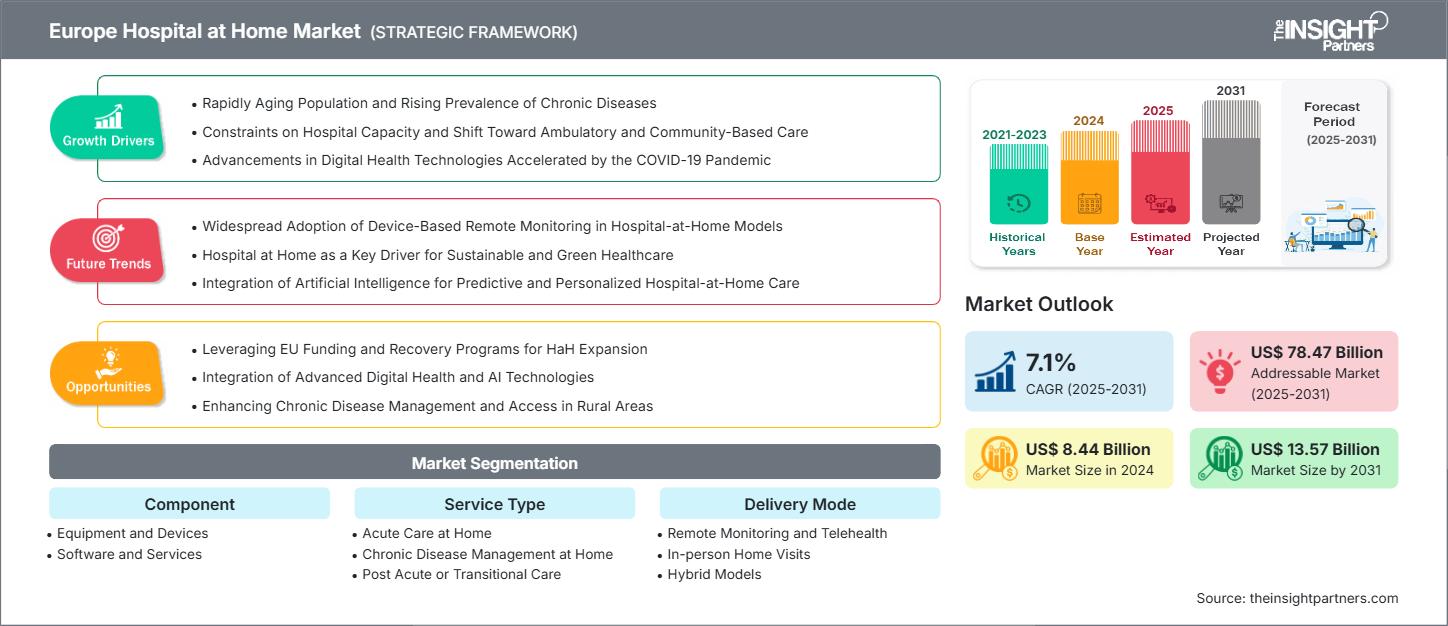
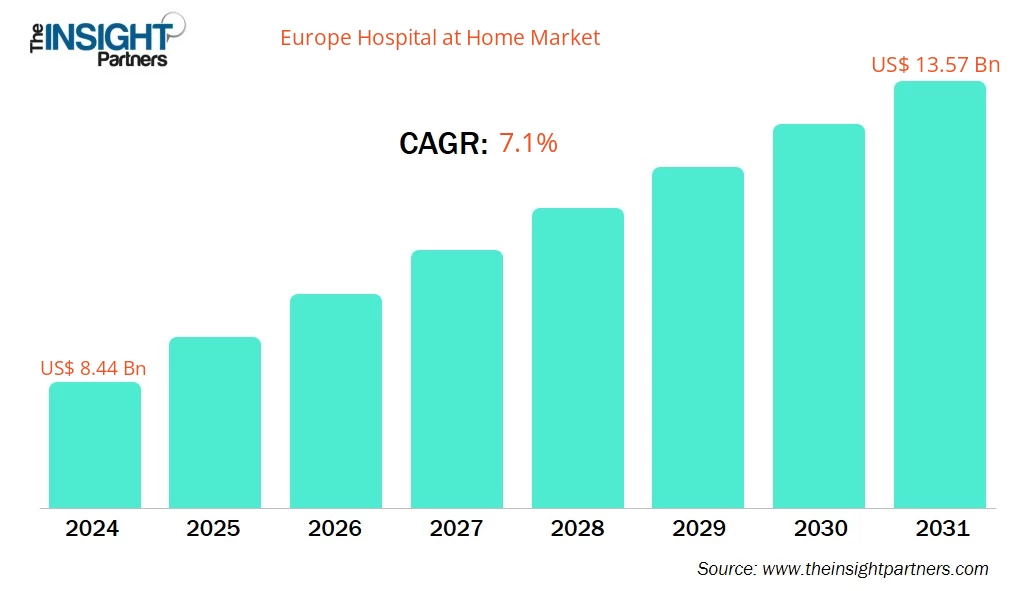
The Europe hospital at home market size is projected to reach US$ 13.57 billion by 2031 from US$ 8.44 billion in 2024. The market is expected to register a CAGR of 7.1% from 2025 to 2031.
Europe Hospital at Home Market Analysis
The rapidly aging population and rising prevalence of chronic diseases, constraints on hospital capacity, and shift toward ambulatory and community-based care, advancements in digital health technologies accelerated by the COVID-19 pandemic, are key factors driving market growth. Additionally, leveraging EU funding and recovery programs for HaH expansion, integration of digital health and AI technologies, and enhancing chronic disease management and access in rural areas are expected to create ample opportunities for the market in the coming years.
Europe Hospital at Home Market Overview
Comprising virtual wards and acute care delivery at patients' homes is a significant trend for the future of the healthcare system. This model combines remote monitoring, multidisciplinary teams, nursing visits, and digital technologies to deliver hospital-level interventions safely at home, thus facilitating admission avoidance and early discharge.
Currently, the UK, through the NHS virtual wards, is leading the way in adoption for frailty, respiratory infections, and acute conditions. The focus is on technology, enabling care to ease bed pressures. In France, hospitalization domicile (HAD) is mainly for intricately handled cases such as infusion and palliative care through specialized structures. Countries such as Germany, Sweden, and the Netherlands are increasingly employing digital, physical, and telehealth-supported programs to tackle hospital overcrowding.
Private startups such as Doccla, Sciensus, Cera, Air Liquide Healthcare, and Philips are leading the way in the remote ecosystems innovation. The fragmented scene that merges public systems with private enablers to facilitate equity, staff training, and standardized implementation across regions is a blend of the two sectors.
Customize This Report To Suit Your Requirement
Get FREE CUSTOMIZATIONEurope Hospital at Home Market: Strategic Insights
-
Get Top Key Market Trends of this report.This FREE sample will include data analysis, ranging from market trends to estimates and forecasts.
Europe Hospital at Home Market Drivers and Opportunities
Market Drivers:
- Rapidly Aging Population and Rising Prevalence of Chronic Diseases: The multimorbidity of the elderly and Europe's aging population (21.6% over 65 in 2024, projected to 32.5% by 2100) are the main reasons for the HaH expansion, which helps to decrease the risk of hospitalizations, such as infections, and provides independent geriatric care.
- Constraints on Hospital Capacity and Shift Toward Ambulatory and Community-Based Care: The number of hospital beds in the EU has decreased by 8% from 2012 to 2022, which has caused the hospitals to transfer the patients to community care; HaH, by enabling acute care at home, thus liberating hospital beds, is a solution to overcrowding while keeping the quality of care high in countries with a low number of beds such as the UK and Sweden.
- Advancements in Digital Health Technologies Accelerated by the COVID-19 Pandemic: Telehealth adoption in Europe surged due to the COVID-19 pandemic. The use of remote monitoring, wearables, and AI is a method of lowering hospital readmission rates and a virtual ward solution in the UK, Norway, Sweden, and France's HAD system.
Market Opportunities:
- Leveraging EU Funding and Recovery Programs for HaH Expansion: EU4Health and other 2025 programs provide grants for digital health and health system resilience, by which HaH can be expanded with funding for infrastructure, training, and tools. This expansion can lead to a potential reduction in hospital admissions by 20, 30% in France and the UK.
- Integration of Advanced Digital Health and AI Technologies: Europe's strategy for digital health through EHDS, AI innovations, and telehealth adoption is to make HaH more efficient with remote monitoring and predictive analytics, thus chronic management is improved, readmissions are reduced by 15- 25%, and the workforce shortage problem is alleviated.
- Enhancing Chronic Disease Management and Access in Rural Areas: Projects in Poland, Italy, Ireland, and Greece implement home-based and telecare models to treat chronic diseases in rural areas, which in turn increases access, decreases hospital visits, and facilitates the fairness of the community through the integration of HaH services.
Europe Hospital at Home Market Report Segmentation Analysis
The Europe hospital at home market is divided into different segments to give a clearer view of how it works, its growth potential, and the latest trends. Below is the standard segmentation approach used in industry reports:
By Component:
- Equipment and Devices: Equipment and devices support the transformation of traditional hospital wards into the hospital at home setups by keeping the patients under remote medical surveillance through the use of wearable devices, vital signs monitors, infusion pumps, as well as oxygen concentrators of leading brands such as Philips and Medtronic.
- Software and Services: The demand for software and services is driven by digital platforms, telemedicine, analytics, and managed care from companies such as Doccla and Current Health.
By Service Type:
- Acute Care at Home
- Chronic Disease Management at Home
- Post Acute/ Transitional Care
- Palliative Care and Hospice Care
- Rehabilitation Services
By Delivery Mode:
- Remote Monitoring and Telehealth
- In-person Home Visits
- Hybrid Models
Patient Demographic:
- Adult Patients
- Pediatric Patients
Indication:
- Cardiovascular Conditions
- Respiratory Diseases
- Orthopedic and Post-Surgical Recovery
- Infectious Diseases
- Neurological Rehabilitation
- Others
Care Provider:
- Hospitals and Health Systems
- Home Health Agencies
- Primary Care/Physician Groups
- Private HaH Providers
By Geography:
- Europe
Europe Hospital at Home Market Report Scope
| Report Attribute | Details |
|---|---|
| Market size in 2024 | US$ 8.44 Billion |
| Market Size by 2031 | US$ 13.57 Billion |
| CAGR (2025 - 2031) | 7.1% |
| Historical Data | 2021-2023 |
| Forecast period | 2025-2031 |
| Segments Covered |
By Component
|
| Regions and Countries Covered |
Europe
|
| Market leaders and key company profiles |
|
Europe Hospital at Home Market Players Density: Understanding Its Impact on Business Dynamics
The Europe Hospital at Home Market is growing rapidly, driven by increasing end-user demand due to factors such as evolving consumer preferences, technological advancements, and greater awareness of the product's benefits. As demand rises, businesses are expanding their offerings, innovating to meet consumer needs, and capitalizing on emerging trends, which further fuels market growth.
Europe Hospital at Home Market Share Analysis by Geography
Europe present opportunities for hospital at home providers.
The Europe hospital at home market grows differently in each nation due to the increasing prevalence of chronic disorders, surging government initiatives, and rising inclination toward home care. Below is a summary of market share and trends by region:
1. Europe
- Market Share: Germany holds a significant portion of the Europe market
- Key Drivers: Rapidly aging population, rising prevalence of chronic diseases, and hospital capacity constraints and cost pressures
- Trends: Digital Integration and AI and Expansion of Virtual Wards
Europe Hospital at Home Market Players Density: Understanding Its Impact on Business Dynamics
High Market Density and Competition
Competition is intense due to the presence of established players such as Doccla, Air Liquide, Cera Care, and LNA Santé. Regional and niche players add to the competitive landscape across regions.
This high level of competition urges companies to stand out by offering:
- Advanced Products
- Value-added services such as customization and sustainable solutions
- Competitive pricing models
- Regulatory compliance
Opportunities and Strategic Moves
- Governments in Germany, France, the UK, and Spain are reducing the hospital burden by responding to the rising demand for cost-effective care by promoting HaH (Hospital at Home) programs for chronic conditions such as diabetes and post-surgical recovery.
- The scope of these programs is extended by digital tools, including telemedicine, remote patient monitoring (RPM), and wearables, which are backed by the high level of internet access and EU initiatives such as EU4Health and Horizon Europe.
- Philips joined with smartQare for the creation of integrated monitoring platforms across Europe, and Owlet Inc. It introduced EU-certified baby monitors in Germany, France, and the UK.
- Health systems commit themselves to the integration of telehealth and the training of the workforce to scale HaH, with the NHS being at the forefront of palliative care models. There is a focus on product launches, partnerships, and investments in AI, driven tools as a means to manage chronic diseases and support aging in place, which leads to the creation of ecosystems among hospitals, payers, and tech firms.
Other companies analyzed during the course of research:
- Koninklijke Philips N.V.
- Fresenius SE & Co. KGaA
- Huma
- Medtronic
- Clariane (formerly Korian)
- emeis (formerly Orpea)
- Linde Healthcare
- HaD France
- Colisée
- DomusVi
- Kenbi
- Qida
- Inizio Engage
- Mediq
- Siemens Healthineers
- Roche Diagnostics
- Baxter International
- Alloheim (via homecare links)
- Attendo
- Barchester Healthcare
- HC-One
- Birdie
- Heim Health
Europe Hospital at Home Market News and Recent Developments
- In September 2025, Air Liquide was awarded a large contract in Spain to care for patients living with respiratory conditions at home. The Community of Madrid, Spain, has selected Air Liquide to support at home 70,000 patients living with respiratory conditions, such as chronic obstructive pulmonary disease (COPD) and sleep apnea. The healthcare services provided at home enable chronic patients to meet their needs and maintain their autonomy and quality of life.
- In September 2024, Doccla built a virtual bed tech to help doctors remotely manage patients who have either been discharged early or, in some cases, never go to the hospital at all. After gaining traction in the UK and Ireland, it has now raised US$ 46 million (Euro 35 million) to expand in Europe.
Europe Hospital at Home Market Report Coverage and Deliverables
The " Europe Hospital at Home Market Size and Forecast (2021–2031)" report provides a detailed analysis of the market covering below areas:
- Hospital at Home market size and forecast at global, regional, and country levels for all the key segments covered under the scope
- Hospital at Home market trends, as well as dynamics such as drivers, restraints, and key opportunities
- Detailed PEST and SWOT analysis
- Hospital at Home market analysis covering key trends, global and regional framework, major players, regulations, and recent market developments
- Industry landscape and competition analysis covering market concentration, heat map analysis, prominent players, and recent developments for the market
- Detailed company profiles
Frequently Asked Questions

- Historical Analysis (2 Years), Base Year, Forecast (7 Years) with CAGR
- PEST and SWOT Analysis
- Market Size Value / Volume - Regional, Country
- Industry and Competitive Landscape
- Excel Dataset
Recent Reports
Testimonials

The Insight Partners' SCADA System Market report is comprehensive, with valuable insights on current trends and future forecasts. The team was highly professional, responsive, and supportive throughout. We are very satisfied and highly recommend their services.
RAN KEDEM Partner, Reali Technologies LTDs
I requested a report on a very specific software market and the team produced the report in a few days. The information was very relevant and well presented. I then requested some changes and additions to the report. The team was again very responsive and I got the final report in less than a week.
JEAN-HERVE JENN Chairman, Future Analytica
We worked with The Insight Partners for an important market study and forecast. They gave us clear insights into opportunities and risks, which helped shape our plans. Their research was easy to use and based on solid data. It helped us make smart, confident decisions. We highly recommend them.
PIYUSH NAGPAL Sr. Vice President, High Beam Global
The Insight Partners delivered insightful, well-structured market research with strong domain expertise. Their team was professional and responsive throughout. The user-friendly website made accessing industry reports seamless. We highly recommend them for reliable, high-quality research services
YUKIHIKO ADACHI CEO, Deep Blue, LLC.
This is the first time I have purchased a market report from The Insight Partners.While I was unsure at first, I visited their web site and felt more comfortable to take the risk and purchase a market report.I am completely satisfied with the quality of the report and customer service. I had several questions and comments with the initial report, but after a couple of dialogs over email with their analyst I believe I have a report that I can use as input to our strategic planning process.Thank you so much for taking the extra time and making this a positive experience.I will definitely recommend your service to others and you will be my first call when we need further market data.
JOHN SUZUKI President and Chief Executive Officer, Board Director, BK Technologies
I wish to appreciate your support and the professionalism you displayed in the course of attending to my request for information regarding to infectious disease IVD market in Nigeria. I appreciate your patience, your guidance, and the fact that you were willing to offer a discount, which eventually made it possible for us to close a deal. I look forward to engaging The Insight Partners in the future, all thanks to the impression you have created in me as a result of this first encounter.
DR CHIJIOKE ONYIA MANAGING DIRECTOR, PineCrest Healthcare Ltd.Reason to Buy
- Informed Decision-Making
- Understanding Market Dynamics
- Competitive Analysis
- Identifying Emerging Markets
- Customer Insights
- Market Forecasts
- Risk Mitigation
- Boosting Operational Efficiency
- Strategic Planning
- Investment Justification
- Tracking Industry Innovations
- Aligning with Regulatory Trends
Unlock Exclusive Report Discounts
Enquire Now




 Get Free Sample For