
Expandable Microspheres Market Trends, Share & Demand by 2034
Coverage: by Type (Dry, Wet); End-Use Industry (Automotive, Construction, Sports and Leisure, Consumer Goods, Others) , and Geography (North America, Europe, Asia Pacific, and South and Central America)
- Status : Data Released
- Report Code : TIPRE00009046
- Category : Chemicals and Materials
- No. of Pages : 150
- Available Report Formats :


- Last update date : September 15, 2026


2025 Market Size
US$ 663.83 Mn
Base year value
2034 Forecast
US$ 1,139.85 Mn
Projected by 2034
CAGR 2026-2034
6.19 %
Growth rate
Addressable Market
US$ 8,164.44 Mn
(2026-2034)
The Expandable Microspheres Market are engineered polymeric particles that expand when exposed to controlled heat, providing lightweighting, controlled foaming, insulation, and volume modification across industrial products. The market was valued at US$ 663.83 Million in 2025 and is projected to reach US$ 1,139.85 Million by 2034, registering a 6.19% CAGR during 2026–2034. Demand is supported by lightweight materials, precision foaming, and formulation efficiency across automotive, construction, consumer goods, and sports applications.
Across North America, adoption is supported by lightweight vehicle components, advanced coatings, construction materials, and specialty polymer processing. The Expandable Microspheres Market size is influenced by demand for lower-density formulations and controlled expansion technologies, with the regional market expected to record a modeled 5.8–6.4% CAGR during 2026–2034 as manufacturers prioritize material efficiency and performance optimization.
Expandable Microspheres Market Assessment and Insights
- North America: North America is expected to account for a 28–32% Expandable Microspheres Market share in 2025, with a 5.8–6.4% CAGR between 2026–2034. Automotive lightweighting, specialty coatings, construction materials, and established polymer-processing capabilities support sustained regional adoption.
- US: The US is estimated to represent 23–27% of the global market in 2025, expanding at a 5.9–6.5% CAGR between 2026–2034, supported by automotive materials, coatings, and advanced manufacturing applications.
- Europe: Europe is estimated to hold a 24–28% share in 2025, growing at a 5.5–6.1% CAGR between 2026–2034. Germany, France, Italy, and the UK remain important markets because automotive engineering, construction materials, coatings, and specialty polymers require controlled density reduction.
- Asia Pacific: Asia Pacific is projected to capture a 27–31% share in 2025 and grow at a 6.7–7.4% CAGR between 2026–2034. China, Japan, South Korea, India, and Australia benefit from expanding manufacturing, polymer processing, automotive production, and infrastructure investment.
- Largest Segment: Dry microspheres represent the leading type, with a modeled 55–59% market share in 2025 and a 6.0–6.5% CAGR during 2026–2034, supported by convenient handling and broad industrial processing compatibility.
- High Growth Segment: Automotive represents the high-growth end-use segment, with an estimated 25–29% market share in 2025 and a 6.8–7.5% CAGR during 2026–2034, driven by vehicle lightweighting and component performance requirements.
- Key companies analyzed in detail: AkzoNobel N.V., Bublon GmbH, Chase Corporation, Kureha Corporation, Mark Impex, Matsumoto Yushi-Seiyaku Co., Ltd., Nanjing Chemical Material Corp., Nouryon, Sekisui Chemical Co., Ltd., The Kish Company, Inc.
Source: The Insight Partners' analysis based on proprietary research, government publications, company annual reports, investor presentations, industry databases, and expert interviews.
Technology base in the Expandable Microspheres Market has developed from thermal particles to grades which have been designed to achieve narrower activation range, smaller size particles, larger expansion ratio and polymer compatibility. The manufacturers are becoming more focused on designing microspheres for coatings, elastomers, plastics, adhesives, and light weight composites. Such advancements enable the processors to lower the density while retaining the surface finish, dimensional stability, and formation of cells. Microsphere products now include dry and wet forms in addition to those with grades suited for various processing temperatures and matrices.
Future advancements in the Expandable Microspheres Market will probably revolve around high temperature formulations, fine particle design, and materials that allow low consumption. Growth in investments in the manufacture of automobiles and construction materials in different regions can create additional uses of microspheres in areas such as Asia Pacific and North America. Regulations regarding material efficiency, emission levels, worker safety and sustainable production can promote formulations with less use of fillers without compromising performance of the products.
Expandable Microspheres Market Report Scope
| Report Attribute | Details |
|---|---|
| Market size in 2025 | US$ 663.83 Million |
| Market Size by 2034 | US$ 1,139.85 Million |
| Global CAGR (2026 - 2034) | 6.19% |
| Historical Data | 2021-2024 |
| Forecast period | 2026-2034 |
Expandable Microspheres Market Analysis
The growth potential for the Expandable Microspheres Market is highly correlated with the transition towards light weighting and controlled polymer foaming. They help achieve low density, alter physical properties, provide insulating capability, and ensure uniform closed cell structure formation without being dependent on chemical blowing agents alone. The value chain for the industry involves specialist polymer providers, microsphere producers, compounders, coating formulation companies, adhesives manufacturers, parts makers, and finished goods makers. Consequently, demand is influenced by material performance and successful incorporation in existing manufacturing procedures.
Supply in the Expandable Microspheres Market remains highly technology-intensive because the consistency in terms of particle size, shell strength, expansion temperature, and gas holding requires controlled polymerization and quality control. The qualification process may increase lead times for customers, especially in automotive and engineered plastics industries. Consequently, leading manufacturers compete on application specific products, expertise, and wide portfolio, rather than prices alone. This creates competitive advantages for suppliers that can tackle formulation and processing problems.
The Expandable Microspheres Market analysis portrays a relatively concentrated competition scenario in which the existing producers merge their unique technologies with a wide range of applications. The Expancel range of products in the portfolio of Nouryon includes dry, wet, expanded, and unexpanded varieties, whereas Kureha Corporation specializes in thermally expandable microcapsules for challenging temperatures. The other producers include Matsumoto Yushi-Seiyaku Co., Ltd., Sekisui Chemical Co., Ltd., AkzoNobel N.V., and Chase Corporation, which enter the market using unique material and application-based approach.
The emerging investment trends are more inclined towards smaller size of particles, higher temperatures for activation, environmentally friendly formulation, and customization for specific grades. The Expancel XS200 product by Nouryon represents the need to customize microspheres for thin film coating applications, whereas the development of another product known as Expancel 081 is aimed at enhancing the performance of paperboard.
● REPORT CUSTOMIZATION
Tailor This Report To Align With Your Specific Business Requirements
This report can be customized to align precisely with your business objectives, scope, and target markets. Customization options include tailored segmentation, geography, competitive analysis, and strategic insights to support informed decision-making.
Customize This Report →WHAT YOU CAN ADJUST
- ● Segmentations
- ● Geography
- ● Competitive Analysis
- ● Language Preferences
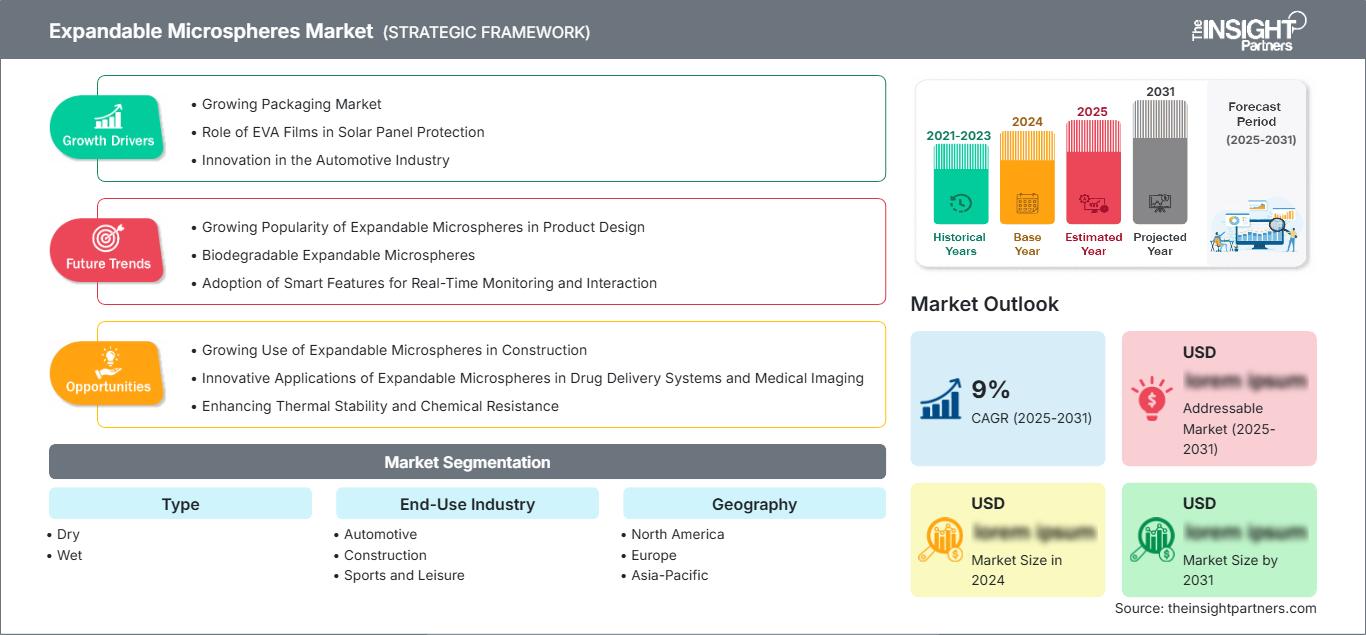
Expandable Microspheres Market: Strategic Insights
Regional Insights
North America Expandable Microspheres Market
North America is estimated to hold a 28–32% share in 2025, with a modeled 5.8–6.4% CAGR through 2034. The United States consumes the majority of the region in terms of microspheres, driven by the use of automotive components, coating materials, construction material, adhesives, and polymer processing. The existence of an advanced industrial base makes it possible for manufacturers to incorporate microspheres into their manufacturing process. The demand is boosted by the need to reduce weight and material usage while maintaining mechanical and functional properties.
Canada and Mexico provide demand through their automotive, construction, and manufacturing sectors that are part of the broader North American industrial base. Regional processors are increasingly preferring materials that are easy to formulate and exhibit consistent expansion characteristics. The automotive sector continues to be strategically vital due to the capability of microspheres to meet weight-reduction goals among other needs. Continued investment in advanced materials is expected to keep regional growth within the modeled 5.8–6.4% CAGR range.
U.S. Expandable Microspheres Market
The US represents approximately 82–88% of North America's market in 2025, with a modeled 5.9–6.5% CAGR through 2034. The demand is spread out among various applications in automotive, coatings, construction, consumer goods, and specialty polymer processing. There are some suppliers and compounders who have technical ability to qualify customers and assist in application development.
More and more automotive manufacturers are using microspheres in lightweight interior applications, weather stripping, coating and sealing applications. Construction formulators make use of these microspheres in lightweight coatings, sealants, adhesives and similar applications where a lower density provides benefits. The inclusion of companies such as Nouryon, AkzoNobel N.V., Chase Corporation and others providing specialty materials provides technical access advantage. Growth in US will be driven by technology and materials advancement.
Europe Expandable Microspheres Market
Europe is projected to represent a 24–28% share in 2025, expanding at a modeled 5.5–6.1% CAGR through 2034. Germany takes the lead in regional demand owing to its automotive and industrial production industries, while the United Kingdom, France, Italy, and Spain offer valuable prospects in coatings, construction, consumer goods, and specialty polymers applications.
Germany continues to be the key market since engineering of vehicles, industrial manufacturing, and polymer processing make a number of applications possible due to density reduction and foam control. The UK and France generate demand through their coatings, construction, and specialty manufacturing. Italy enjoys opportunities in footwear, consumer goods, and industrial coatings, while Spain can benefit from construction and automotive-based manufacturing. High demands are placed on producers in Europe regarding material efficiency, product safety, and optimization of production processes.
APAC Expandable Microspheres Market
Asia Pacific is estimated to account for a 27–31% share in 2025 and expand at a 6.7–7.4% CAGR through 2034. China is the major driver of regional demand, followed by Japan, South Korea, India, and Australia. The automotive industry, electronics, building and construction, and polymer processing drive adoption.
In China, large-scale manufacturing together with increasing demand for light weighting materials is seen, while in Japan and South Korea, precision materials and processing is emphasized. In India, growing opportunities can be identified in the automotive industry, building and construction, consumer goods manufacturing, and industrial manufacturing. Australia provides smaller yet specialized demand linked to building and construction, and industrial products.
Middle East & Africa Expandable Microspheres Market
Middle East and Africa represents a smaller but developing market, with a modeled 5.0–5.7% CAGR through 2034. Saudi Arabia and UAE have possibilities via construction, infrastructure, coatings, and industrial diversification, whereas South Africa has applications in automotive and manufacturing industries.
Saudi Arabia is investing heavily in infrastructure development and industrial capability, hence possibilities in lightweight formulations for construction and specialty materials. UAE has prospects via large-scale construction works and modern coatings. South Africa is the major manufacturing hub in sub-Saharan Africa whereas the rest of MEA has selected prospects via construction and consumer goods. Adoption within the region would be dependent upon processing capabilities locally, import of specialty materials, and energy-efficient infrastructure investments.
Segmentation Analysis
Type
Type is divided into Dry and Wet formats. The segment is expected to expand at a modeled 6.0–6.5% CAGR during 2026–2034. Dry materials benefit from convenient transportation, storage, and integration into solvent-free or polymer-based formulations, while wet formats provide dispersion advantages for water-containing systems. Selection depends on process conditions, formulation chemistry, required expansion behavior, and handling requirements.
- Dry: Dry microspheres are widely suited to powder blending, polymer compounding, coatings, adhesives, and extrusion processes. Their low moisture content simplifies storage and enables integration where water would interfere with formulation performance or processing conditions.
- Wet: Wet microspheres provide easier dispersion in water-containing formulations and can reduce dust during handling. They are strategically relevant to coatings, waterborne systems, and applications where homogeneous distribution is critical to consistent expansion and surface performance.
End-Use Industry
The End-Use Industry segment is projected to record a modeled 6.3–6.9% CAGR during 2026–2034. Demand spans automotive, construction, sports and leisure, and consumer goods. Application selection is influenced by lightweighting, tactile properties, insulation, controlled foaming, surface finish, and processing efficiency. Automotive is positioned as the leading growth area because component manufacturers increasingly evaluate advanced lightweighting materials.
- Automotive: Automotive applications use microspheres for lightweight components, weather strips, coatings, sealing systems, and sound-damping structures. Their controlled expansion supports density reduction while helping maintain dimensional and functional characteristics.
- Construction: Construction demand centers on lightweight coatings, sealants, adhesives, and insulation-related formulations. Microspheres can reduce density and improve handling while supporting surface modification and controlled cell formation in finished materials.
- Sports and Leisure: Sports and leisure applications include footwear, protective equipment, recreational products, and performance materials. Lightweighting, cushioning, resilience, and controlled texture make microspheres useful where weight and user comfort influence product design.
- Consumer Goods: Consumer goods applications include coatings, footwear, packaging-related materials, decorative products, and household formulations. Manufacturers use microspheres to modify density, texture, appearance, and processing characteristics while maintaining consistent product quality.
Opportunity Snapshot
| End-Use Industry | Revenue Contribution | Trend Tag | Adoption Stage |
|---|---|---|---|
| Automotive | High | Vehicle Lightweighting | Scaling |
| Construction | High | Lightweight Coatings | Scaling |
| Sports and Leisure | Medium | Cushioned Materials | Scaling |
| Consumer Goods | Medium | Texture Modification | Mature |
Expandable Microspheres Market Growth Drivers and Impact Analysis
Vehicle Lightweighting and Material Efficiency Requirements
Automotive manufacturers are under continuing pressure to improve vehicle efficiency without compromising safety, durability, comfort, or manufacturing productivity. Expandable Microspheres Market will help meet this goal by reducing the density of the materials in selected polymers, elastomers, coatings, and sealants. By using them in controlled activation, producers can design internal structure while still preserving valuable surface properties. This market does not only cover passenger cars since commercial cars and mobility solutions also aim at reducing the weight of the parts. For those producers who can supply their products in grades suitable for use in high-temperature polymers, this will open up more challenging applications. Higher utilization of engineering plastics in interior and exterior vehicle parts will enlarge the application range. However, qualification criteria are quite significant, and once materials are qualified, changing is rather difficult.
Expansion of Lightweight Construction and Coating Formulations
Construction manufacturers increasingly seek formulations that reduce material consumption, simplify handling, and improve thermal or surface performance. Expandable Microspheres Market can contribute to these objectives in coatings, sealants, adhesives, and related lightweight materials. Their ability to expand under controlled heat or provide low-density filler characteristics allows formulators to modify density without relying exclusively on conventional mineral fillers. This creates opportunities in decorative coatings, elastomeric systems, insulation-related products, and specialized construction compounds. Regional construction modernization in Asia Pacific and infrastructure investment in North America and the Middle East provide additional demand pathways. Suppliers with technical support capabilities can accelerate adoption by helping formulators optimize particle size, activation temperature, dosage, and compatibility with existing production equipment. The result is a growing emphasis on application-specific microsphere grades rather than standardized products.
Demand for Precision Foaming in Advanced Polymer Processing
Precision polymer processing is becoming an important driver as manufacturers seek repeatable cell structures, controlled density, improved moldability, and consistent finished-product quality. Thermally Expandable Microspheres Market provide a differentiated route because expansion can be activated within defined processing windows and maintained after cooling. This characteristic is relevant to engineered plastics, elastomers, artificial leather, footwear, foaming inks, and automotive components. Kureha's portfolio illustrates how grades can be designed for different processing temperatures and expansion ratios, while Nouryon's broad Expancel range demonstrates the value of application-specific selection. As processors adopt more sophisticated extrusion and injection-molding techniques, microspheres can help address sink marks, weight reduction, surface quality, and controlled foaming requirements. This expands demand beyond traditional coatings into higher-value polymer applications where performance consistency is critical.
Expandable Microspheres Market Future Trends
Smaller Particle Architectures for Thin-Layer Applications
The Expandable Microspheres Market trends landscape is moving toward smaller particle architectures that allow microspheres to perform effectively in thin coatings and precision formulations. Smaller particles can minimize surface irregularities while supporting density reduction and controlled expansion. This direction is particularly relevant to decorative paints, specialty coatings, electronics-related materials, and thin polymer layers. Nouryon's Expancel XS200, introduced in 2025, illustrates this development through a particle size of approximately 10 micrometers and an application focus on thin-layer interior paint. Future products are likely to emphasize narrower particle-size distributions, optimized shell structures, and more precise activation profiles. Such developments can expand the technology into formulations where conventional microspheres have been limited by surface finish, layer thickness, or processing sensitivity. Suppliers will increasingly compete through precision rather than simply higher expansion ratios.
Bio-Based and Lower-Impact Microsphere Formulations
Sustainability considerations are expected to influence the next generation of microsphere technologies as manufacturers examine renewable feedstocks, lower-impact processing routes, and material-efficiency benefits. Bio-based shell or formulation concepts could reduce dependence on fossil-derived inputs while retaining the functional advantages of controlled expansion. Nouryon has already showcased Expancel BIO as a partially bio-based concept, indicating increasing attention to alternative material pathways. The broader trend also includes reducing product weight, lowering filler consumption, and improving manufacturing efficiency, which can generate resource savings beyond the microsphere itself. Commercial adoption will depend on maintaining expansion performance, storage stability, process compatibility, and cost competitiveness. Suppliers capable of demonstrating measurable environmental advantages without sacrificing technical performance are likely to gain stronger consideration among customers with increasingly formal sustainability requirements.
Expandable Microspheres Market Opportunities
Expansion into High-Temperature Engineering Plastics
The Expandable Microspheres Market scope is widening as suppliers develop grades capable of operating at increasingly demanding processing temperatures. High-temperature engineering plastics used in automotive, electronics, industrial equipment, and specialized consumer products require foaming technologies that remain stable during molding and extrusion. Developing microspheres with tailored shell chemistry and activation profiles can address this requirement while enabling density reduction and improved moldability. Kureha already offers S-series grades designed for processing above 190°C, demonstrating the technical pathway toward higher-temperature applications. Investment in similar product development could open new value pools beyond conventional coatings, footwear, and elastomers. Suppliers should prioritize compatibility testing with polypropylene, ABS, polyamide, and other engineering polymers, while compounders can develop masterbatch formats that simplify dispersion. Such collaboration can shorten customer qualification cycles and support wider adoption.
Regional Production and Application Development in Asia Pacific
The Expandable Microspheres Market Forecasts indicate attractive strategic potential in Asia Pacific as automotive production, construction activity, consumer manufacturing, and polymer processing expand across China, India, Japan, and Southeast Asia. Localized technical centers and regional supply arrangements could reduce lead times while enabling suppliers to tailor grades to regional formulation practices. China offers a particularly broad manufacturing ecosystem, while India presents opportunities across automotive, construction, footwear, and consumer products. Producers can pursue partnerships with compounders, coating manufacturers, adhesive formulators, and component suppliers to establish application references. Investment should focus on localized technical service, inventory availability, formulation laboratories, and customer qualification programs rather than capacity expansion alone. Regionalization can improve supply resilience and create stronger relationships with processors that require application-specific particle size, activation temperature, and expansion characteristics.
Recent Developments
- April 2026: Nouryon — Nouryon introduced Expancel 081 microspheres at Pulp and Beyond 2026 in Helsinki. The grade is designed for paperboard production, where adding up to 1% can increase bulk and thickness by 15–25% while supporting higher recycled-fiber or filler content. The development expands microsphere applications into material-efficiency and fiber-reduction strategies for paperboard manufacturing.
- January 2026: Kumyang, a major player in the market for Blowing agents, expanded its product portfolio with heat-expandable microspheres. A new product introduced: evolved, heat-expandable microspheres, are particularly light and dispense with the combination of formamide and ammonia. This is achieved by using azodicarbonamide (ADC), a Blowing agents for the expansion of PVC (polyvinyl chloride) as well as natural and synthetic rubber.
Frequently Asked Questions

- Comprehensive Market Sizing and Forecast Analysis
- Detailed Segmentation Analysis
- In-Depth Market Dynamics Assessment
- Regional and Country-Level Insights
- Competitive Landscape and Company Benchmarking
- Strategic Business Intelligence
Recent Reports
Testimonials

The Insight Partners provided valuable market intelligence that supported our global go-to-market strategy. Their team was professional, responsive, and attentive to our feedback, providing thoughtful analysis and helpful methodological clarifications throughout the project.
Junmo Kim Chief Financial Officer (CFO), Enertech Co., Ltd.
The Insight Partners' SCADA System Market report is comprehensive, with valuable insights on current trends and future forecasts. The team was highly professional, responsive, and supportive throughout. We are very satisfied and highly recommend their services.
RAN KEDEM Partner, Reali Technologies LTDs
I requested a report on a very specific software market and the team produced the report in a few days. The information was very relevant and well presented. I then requested some changes and additions to the report. The team was again very responsive and I got the final report in less than a week.
JEAN-HERVE JENN Chairman, Future Analytica
We worked with The Insight Partners for an important market study and forecast. They gave us clear insights into opportunities and risks, which helped shape our plans. Their research was easy to use and based on solid data. It helped us make smart, confident decisions. We highly recommend them.
PIYUSH NAGPAL Sr. Vice President, High Beam Global
The Insight Partners delivered insightful, well-structured market research with strong domain expertise. Their team was professional and responsive throughout. The user-friendly website made accessing industry reports seamless. We highly recommend them for reliable, high-quality research services
YUKIHIKO ADACHI CEO, Deep Blue, LLC.
This is the first time I have purchased a market report from The Insight Partners.While I was unsure at first, I visited their web site and felt more comfortable to take the risk and purchase a market report.I am completely satisfied with the quality of the report and customer service. I had several questions and comments with the initial report, but after a couple of dialogs over email with their analyst I believe I have a report that I can use as input to our strategic planning process.Thank you so much for taking the extra time and making this a positive experience.I will definitely recommend your service to others and you will be my first call when we need further market data.
JOHN SUZUKI President and Chief Executive Officer, Board Director, BK Technologies
I wish to appreciate your support and the professionalism you displayed in the course of attending to my request for information regarding to infectious disease IVD market in Nigeria. I appreciate your patience, your guidance, and the fact that you were willing to offer a discount, which eventually made it possible for us to close a deal. I look forward to engaging The Insight Partners in the future, all thanks to the impression you have created in me as a result of this first encounter.
DR CHIJIOKE ONYIA MANAGING DIRECTOR, PineCrest Healthcare Ltd.Reason to Buy
- Informed Decision-Making
- Understanding Market Dynamics
- Competitive Analysis
- Identifying Emerging Markets
- Customer Insights
- Market Forecasts
- Risk Mitigation
- Boosting Operational Efficiency
- Strategic Planning
- Investment Justification
- Tracking Industry Innovations
- Aligning with Regulatory Trends





 Get Free Sample for