
Extrusion Equipment Market Growth, Trends & Demand by 2034
Coverage: by Product Type (Single Screw Extruders, Twin Screw Extruders, Downstream Equipment, and Others); Load Type (Variable and Hydrostatic); End-users (Plastic Goods, Processed Food, Pharmaceutical, Construction Materials, and Others), and Geography (North America, Europe, Asia Pacific, and South and Central America)
- Status : Data Released
- Report Code : TIPRE00002809
- Category : Manufacturing and Construction
- No. of Pages : 150
- Available Report Formats :


- Last update date : September 28, 2026


2025 Market Size
US$ 10.31 Bn
Base year value
2034 Forecast
US$ 17.48 Bn
Projected by 2034
CAGR 2026-2034
6.04 %
Growth rate
Addressable Market
US$ 125.84 Bn
(2026-2034)
The extrusion equipment market is projected to expand from US$ 10.31 Billion in 2025 to US$ 17.48 Billion by 2034, registering a CAGR of 6.04% during 2026–2034. Demand is backed up by modernization of processing lines for polymers, food, pharmaceuticals, and construction materials, and consumers are becoming more concerned about consistency of throughput, energy efficiency, automation, and ability to work with recycled or formula-sensitive feedstocks in continuous manufacturing operations around the world.
The North American extrusion equipment market size of extrusion equipment is driven by the expected 5.4% – 6.0% CAGR until 2034. Line replacement, reshoring of engineered plastics, and recycled content packaging investments are the sources of orders in the region.
Extrusion Equipment Market Assessment and Insights
- North America: Accounted for 22–25% share in 2025 and is expected to grow at 5.4–6.0% CAGR during 2026–2034, supported by line retrofits, recycling investments, strong after-sales capability, and advanced controls.
- US: Represented 78–82% of North American revenue in 2025 and is forecast to advance at 5.5–6.1% CAGR through 2034 on modernization spending.
- Europe: Held 23–26% share in 2025 and should register 5.2–5.8% CAGR during 2026–2034. Germany leads, while the UK, France, Italy, and Spain sustain specialized machinery demand.
- Asia Pacific: Captured 40–44% share in 2025 and is projected to expand at 6.5–7.1% CAGR through 2034, led by China, Japan, India, and South Korea.
- Largest Segment: Single screw extruders held 47–51% market share in 2025 and are expected to grow at 5.4–6.0% CAGR during 2026–2034.
- High Growth Segment: Twin screw extruders represented 31–35% market share in 2025 and are projected to post 6.7–7.3% CAGR during 2026–2034.
- Key companies analyzed in detail: Coperion GmbH, Milacron LLC, The Japan Steel Works, Ltd., KraussMaffei Extrusion GmbH, Clextral SAS, Shibaura Machine Co., Ltd., The Conair Group, Inc., Leistritz Extrusionstechnik GmbH, Bausano & Figli S.p.A., and battenfeld-cincinnati Germany GmbH.
Source: The Insight Partners' analysis based on proprietary research, government publications, company annual reports, investor presentations, industry databases, and expert interviews.
Development of equipment has evolved from mechanical engineering of manpower intensive assembly lines to the digital control of gravity feed, temperature loops, automatic die adjustments, and condition monitoring. The suppliers demanded modular barrels and screws which would be able to process regrinds, loaded compounds, food ingredients, and pharmaceuticals without change of systems. Torque density and efficiency ensure maximum production without overheating. Integration of equipment is now an acquisition matter since cooling, calibration, cutting, and conveying together save material and labor in case of changeovers.
Future investments will be made in polymer processing centers in Asia, reclamation plants in North America, and pipe and profile manufacture in the Middle East. Extended Producer Responsibility, recycling legislation, and infrastructure require equipment that can cope with varying input materials while providing traceability of output quality. Manufacturers who possess testing laboratories, service engineers, and upgrade capabilities are bound to profit from replacement, and scalability will make it possible for small manufacturers to stagger investments.
Extrusion Equipment Market Report Scope
| Report Attribute | Details |
|---|---|
| Market size in 2025 | US$ 10.31 Billion |
| Market Size by 2034 | US$ 17.48 Billion |
| Global CAGR (2026 - 2034) | 6.04% |
| Historical Data | 2021-2024 |
| Forecast period | 2026-2034 |
Extrusion Equipment Market Analysis
The worldwide extrusion machinery industry growth has resulted from the increasing demand for pipes, sheet, profiles, films, compounds, pellets, foods, and formulations. The resin makers, compounders, converters, integrators, tooling specialists, and services form an interdependent value chain where screw design, feeding, die and downstream synchronization affect yields.
The supply process is technically complex due to gearboxes, corrosive resistant barrels, drive systems, controls, and precise dies being required of qualified suppliers. Long lead times are more conducive to modular standardization; however, trial runs on recycled feedstock or heat sensitive formulas are crucial. Assemble locally and warehousing of wear parts is becoming important as a procurement strategy due to the reduced risks.
The analysis of the extrusion machinery industry reveals that the competition will shift from specification to productivity over its lifecycle. For example, Coperion GmbH and Leistritz Extrusionstechnik GmbH have machines with high torque compounding, whereas KraussMaffei Extrusion GmbH and battenfeld-cincinnati Germany GmbH handle pipe, profile, recycle, and polymer making machines. The companies with the installed base and application engineering are Milacron LLC, Shibaura Machine Co., Ltd., and The Japan Steel Works, Ltd.
The company known for food/feed processing is Clextral SAS, whereas The Conair Group, Inc. specializes in material handling. In terms of equipment customization and monitoring, Bausano & Figli S.p.A. is the company to excel. The areas for future investments of the company are pilot centers, local presence, energy saving upgrades, and software transforming operational data into preventive maintenance and recipes.
● REPORT CUSTOMIZATION
Tailor This Report To Align With Your Specific Business Requirements
This report can be customized to align precisely with your business objectives, scope, and target markets. Customization options include tailored segmentation, geography, competitive analysis, and strategic insights to support informed decision-making.
Customize This Report →WHAT YOU CAN ADJUST
- ● Segmentations
- ● Geography
- ● Competitive Analysis
- ● Language Preferences
Extrusion Equipment Market: Strategic Insights
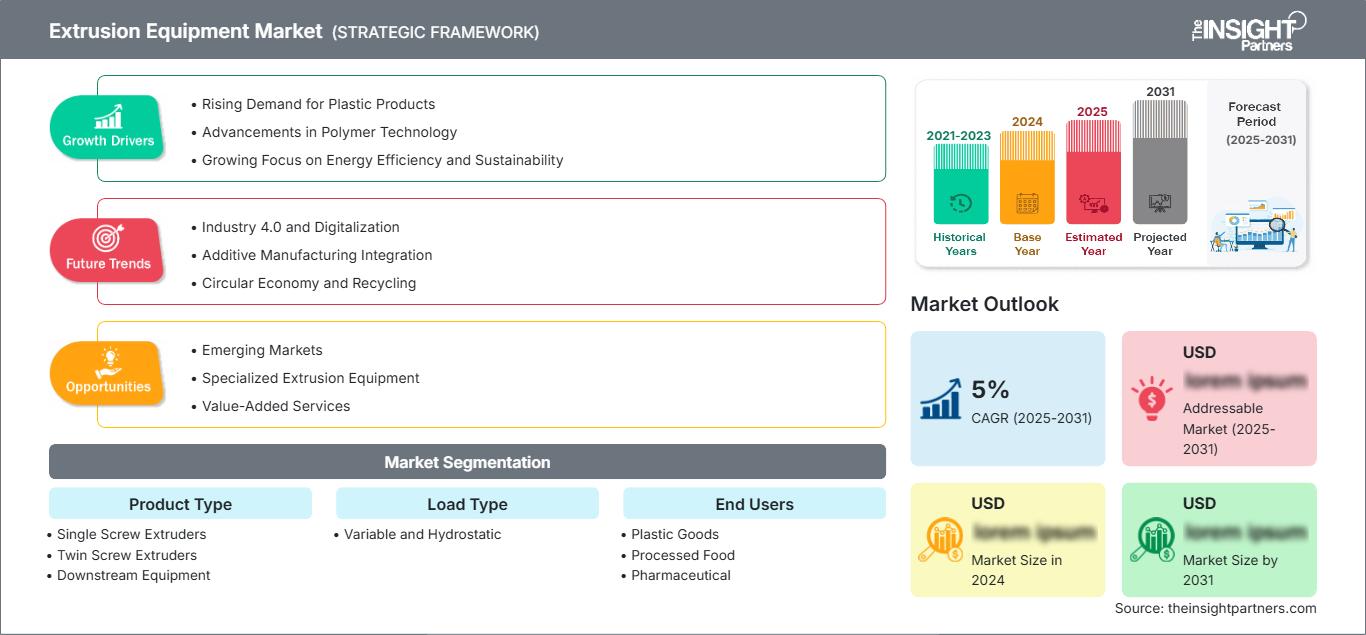
Regional Insights
North America extrusion equipment market
In 2025, North America had 22-25% of total revenues worldwide and is forecasted to grow at CAGR 5.4-6.0% in 2026-2034. The extrusion equipment market share of extrusion equipment accounts for an advanced installation base in terms of plastics, medical compounds, food processing, and construction products. Investment in replacement focuses on energy-efficient drives, automation, and screw flexibility.
The US and Canada are improving their capability to extrude plastics from recyclable materials without compromising product quality with changing raw materials. Regional availability of service, economic feasibility of retrofits, and quick delivery of spares favor purchases. Mexico makes its contribution via automotive, appliance, packaging, and construction materials industries, creating demand for reliable equipment capable of handling several grades of material with minimal down time.
U.S. Extrusion Equipment market
The USA was responsible for 78–82% of North American revenues in 2025 and will be growing at a CAGR of 5.5–6.1% until 2034. A large pool of converters drives sales of pipe, profiles, sheets, compounding equipment, and auxiliary machinery. Milacron LLC, The Conair Group, Inc., and other international vendors have sales, service, testing, or installed-base business to mitigate resistance.
Applications rely more on post-consumer recycled polyolefins, custom blends, multilayer films, medical tubing, and big extrusions for food processing. Buyers are interested in the cost per kilogram versus the purchasing price, focusing on uptime, scrap, power consumption, and formula repeatability. Public spending on infrastructure development and industrial manufacturing will support the building materials and industrial plastic markets, but availability of funds will constrain some green field developments.
Europe Extrusion Equipment market
In Europe, the revenue share was 23-26% in 2025, while the region is expected to achieve CAGR of 5.2-5.8% through 2034, with Germany leading. The machinery cluster, compounders, and recycling ecosystem enable highly specified twin-screw and downstream machinery in the region. In the UK, there is emphasis on packaging circularity and medical applications, whereas France combines expertise in food-processing along with polymer conversion.
Italy remains an active participant in customized pipe and profile machinery owing to specialist engineering, whereas Spain gets advantage out of packaging, construction, and automotive conversion. In the entire region, increasing costs of energy and circular economy policies lead to renewal of less efficient machinery. Customers require more traceable process data, low temperature compounding, rapid cleanability, and recyclate capability.
APAC Extrusion Equipment market
Asia Pacific accounted for 40-44% of revenue in 2025 and is expected to generate 6.5-7.1% CAGR till 2034, driven by China. Significant amounts of plastics processing equipment, urban infrastructure, packaging and electronics manufacturing, and converters’ operations support demand for machinery.
Japan and South Korea focus on high precision and advanced compounds, India focuses on pipe, packaging, and food processing equipment, and Australia selectively invests in recycling projects. Favorable industrial policy, manufacturing of machinery domestically, and expanding network of converters enhance project economics, while export-oriented production drives automation and monitoring.
Middle East & Africa Extrusion Equipment market
The Middle East and Africa market is forecasted to expand at a CAGR of 5.8% to 6.4% from 2026 to 2034. Saudi Arabia leads due to petrochemical synergy, localization drives, and infrastructural development needs, whereas the UAE provides impetus for packaging and construction applications.
South Africa serves as the anchor for regional diverse processing operations, covering food, pipe, and consumer goods. Rest-of-MEA demand is driven by water systems, residential developments, and utilities infrastructure. Energy availability could aid resin processing, but service availability, financials, and competent operators dictate machinery purchases.
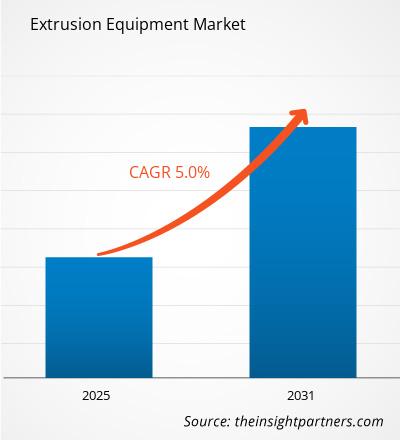
Segmentation Analysis
Product Type
Product Type is projected to expand at 5.9–6.5% CAGR during 2026–2034. The extrusion equipment market scope spans core melting and mixing assets plus downstream units that determine finished geometry and line speed. Procurement increasingly favors modular platforms, integrated controls, and retrofit-ready configurations that balance throughput, formulation flexibility, energy use, and maintenance accessibility.
- Single Screw Extruders: These systems retain the largest position in high-volume pipe, profile, sheet, and film applications because of straightforward operation, dependable output, and favorable lifecycle economics.
- Twin Screw Extruders: Demand is strongest in compounding, recycling, food, and pharmaceutical processing, where intensive mixing, devolatilization, accurate residence-time control, and formulation flexibility create strategic value.
- Downstream Equipment: Calibrators, cooling systems, haul-offs, cutters, pelletizers, and conveyors gain importance as processors seek synchronized lines, lower scrap, consistent dimensions, and reduced manual intervention.
Load Type
Load Type is expected to register 5.7–6.3% CAGR during 2026–2034. Selection depends on pressure stability, throughput variation, energy management, and maintenance capability. Variable-load solutions fit processors handling frequent recipe or output changes, while hydrostatic configurations suit applications requiring smooth force transmission and repeatable control under demanding operating conditions.
- Variable: Variable-load systems support flexible production schedules and changing formulations by matching power and process settings to output requirements, helping reduce energy waste and stabilize product quality.
- Hydrostatic: Hydrostatic systems provide controlled loading and smooth operation for demanding processes, making them strategically relevant where pressure consistency, durability, and protection of sensitive materials are prioritized.
End Users
End Users are forecast to grow at 6.0–6.6% CAGR during 2026–2034. Investment patterns differ by hygiene, material, throughput, and qualification requirements. Plastic goods and construction favor scale and recyclate compatibility, processed food values recipe flexibility, and pharmaceutical production prioritizes validated controls, cleaning, containment, and batch-to-batch repeatability.
- Plastic Goods: This application remains the broadest demand base, spanning packaging, automotive components, consumer products, cable, sheet, and profiles, with modernization centered on recycled content and digital quality control.
- Processed Food: Twin-screw lines support snacks, cereals, pet food, and alternative proteins, where rapid formulation changes, texture control, sanitation, and scalable throughput guide equipment purchasing.
- Pharmaceutical: Hot-melt extrusion gains strategic relevance for continuous manufacturing and difficult formulations, requiring precise temperature control, documentation, cleanability, containment, and dependable scale-up from development to production.
- Construction Materials: Pipe, window profile, decking, insulation, and composite applications sustain demand for durable lines capable of high output, dimensional stability, filler handling, and recycled-feedstock processing.
Opportunity Snapshot
| End Users | Revenue Contribution | Trend Tag | Adoption Stage |
| Plastic Goods | High | Recycled Content | Mature |
| Processed Food | Medium | Protein Texturing | Scaling |
| Pharmaceutical | Low | Continuous Manufacturing | Emerging |
| Construction Materials | High | Infrastructure Pipes | Mature |
Extrusion Equipment Market Growth Drivers and Impact Analysis
Circular processing requirements reshape capital spending
Post-consumer material should be used more efficiently by packaging and construction processors without compromising productivity, aesthetics, or performance. This need creates new business opportunities not only for full lines but also for retrofit systems which connect melt filtration, pelletizing, control, and analysis. The bottom line is that the focus of the procurement changes from capacity to yield. Processing plants that standardize recycled resins have less interaction with virgin resins and thus pass more quality tests. The result is shorter qualification periods and higher success rate in technically challenging programs.
Automation addresses quality and workforce constraints
The processors need to ensure continuity of the output despite scarcity of skilled labor. The use of automatic startup procedures, gravimetric feeding, thermal closed loop control, formulations, and remote diagnostics makes the use of labor less necessary. The applications that are most applicable include situations when there is frequent change in products or specifications that are highly particular, such as medical tubes, engineered materials, and medicines. Visibility of the processes will mean early detection of potential problems such as wearing out of the screw, feeder drifting, and cooling problems. This leads to less scrap and downtime, thus standardizing the processes at various locations.
Infrastructure and urbanization sustain profile and pipe demand
A lot of extruded tube is used in water systems, sanitation, construction, power transmission, and telecommunications, while cable protection, window frames, and composites are also involved in this process. This development is especially important for Asian and Middle Eastern countries due to their rapid urbanization and home manufacturing plans. High-output equipment has been traditionally in demand because of large production batches. However, customers need quick change of dies and multi-layer technology to reduce material costs. The proximity of raw materials may improve project efficiency, while financial and construction processes impact the schedule. Machine manufacturers providing high-output extrusion systems with calibration, cooling, haul-off, and cutting equipment have much more chances to succeed.
Extrusion Equipment Market Future Trends
Self-optimizing lines move toward practical deployment
The extrusion equipment market trends will increasingly center on models that compare live pressure, torque, temperature, vibration, and product measurements with validated operating windows. Rather than merely alerting operators, future controls will recommend or execute bounded adjustments to feeders, screw speed, heating, cooling, and haul-off. Adoption will begin in repeatable, high-volume applications where data sets are sufficiently rich and quality costs are visible. Machine builders will need transparent algorithms, secure connectivity, and clear override protocols. The outcome should be faster startups, fewer off-spec transitions, and more consistent performance across shifts, plants, and operator experience levels.
Application-specific modularity replaces one-size platforms
Future machines will integrate generic mechanical core components along with specialized modules for feeding, venting, screw elements, dies, and auxiliary equipment based on applications. In this way, processors will be able to modify lines to process recycled plastics, bioplastics, alternative protein sources, battery components, or pharmaceutical substances, without the need to revamp the entire machine. Digital twin technology and pilot testing will enable processors to choose the modules before installing, mitigating scale-up risk. Even commercial versions can shift towards capacity growth in phases, software subscription models, and performance-based services. Machine manufacturers that retain inter-operable control systems and module libraries can cater to processors dealing with uncertain product portfolios and evolving regulations.
Extrusion Equipment Market Opportunities
Build localized retrofit and lifecycle-service platforms
Installed machines represent a sizable addressable base for drives, controls, feeders, barrels, screws, filtration, and downstream upgrades. extrusion equipment market Forecasts support investment in regional service hubs that combine audits, wear measurement, energy benchmarking, and application trials. A modular retrofit portfolio can shorten payback periods for processors unable to justify greenfield lines while creating recurring revenue for suppliers. Priority markets include North America and Europe, where aging assets coexist with stringent quality and energy expectations. Successful providers should stock critical parts, train local technicians, and quantify improvements in output, scrap, power consumption, and maintenance intervals before proposing broader modernization programs.
Scale specialist systems for food and pharmaceutical processing
Extrusion for food and pharmaceuticals rewards suppliers capable of bringing process science to bear in a validated manufacturing system. Potential applications include high moisture protein texturization, nutritionally dense snacks, pet food, continuous granulation, and hot melt drug delivery. These processes demand sanitary design, precise dosing, control of residence time, formula protection, and robust scale up. Resources should be committed to developing pilot facilities, modular process equipment, and collaboration with ingredient, formulation, and analytical experts. Since qualifications are greater than in commodity plastics, suppliers can compete based on technical expertise in addition to price. Facilities in Asia and North America would speed customer development.
Recent Developments
- March 2026: Coperion GmbH – The company unveiled the RF400 roller feeder for consistent electrode dry coating, extending its process-equipment portfolio toward battery manufacturing. The launch links precision feeding with continuous production requirements and illustrates how extrusion-adjacent engineering is moving into energy-storage materials.
- July 2025: KraussMaffei Extrusion GmbH – The company presented recycling-focused compounding systems for K 2025, including a BluePower-based twin-screw platform for food-grade recycled PET with throughput up to 12 tons per hour and reported energy savings of up to 20% versus conventional systems.
Frequently Asked Questions

- Comprehensive Market Sizing and Forecast Analysis
- Detailed Segmentation Analysis
- In-Depth Market Dynamics Assessment
- Regional and Country-Level Insights
- Competitive Landscape and Company Benchmarking
- Strategic Business Intelligence
Recent Reports
Testimonials

The Insight Partners provided valuable market intelligence that supported our global go-to-market strategy. Their team was professional, responsive, and attentive to our feedback, providing thoughtful analysis and helpful methodological clarifications throughout the project.
Junmo Kim Chief Financial Officer (CFO), Enertech Co., Ltd.
The Insight Partners' SCADA System Market report is comprehensive, with valuable insights on current trends and future forecasts. The team was highly professional, responsive, and supportive throughout. We are very satisfied and highly recommend their services.
RAN KEDEM Partner, Reali Technologies LTDs
I requested a report on a very specific software market and the team produced the report in a few days. The information was very relevant and well presented. I then requested some changes and additions to the report. The team was again very responsive and I got the final report in less than a week.
JEAN-HERVE JENN Chairman, Future Analytica
We worked with The Insight Partners for an important market study and forecast. They gave us clear insights into opportunities and risks, which helped shape our plans. Their research was easy to use and based on solid data. It helped us make smart, confident decisions. We highly recommend them.
PIYUSH NAGPAL Sr. Vice President, High Beam Global
The Insight Partners delivered insightful, well-structured market research with strong domain expertise. Their team was professional and responsive throughout. The user-friendly website made accessing industry reports seamless. We highly recommend them for reliable, high-quality research services
YUKIHIKO ADACHI CEO, Deep Blue, LLC.
This is the first time I have purchased a market report from The Insight Partners.While I was unsure at first, I visited their web site and felt more comfortable to take the risk and purchase a market report.I am completely satisfied with the quality of the report and customer service. I had several questions and comments with the initial report, but after a couple of dialogs over email with their analyst I believe I have a report that I can use as input to our strategic planning process.Thank you so much for taking the extra time and making this a positive experience.I will definitely recommend your service to others and you will be my first call when we need further market data.
JOHN SUZUKI President and Chief Executive Officer, Board Director, BK Technologies
I wish to appreciate your support and the professionalism you displayed in the course of attending to my request for information regarding to infectious disease IVD market in Nigeria. I appreciate your patience, your guidance, and the fact that you were willing to offer a discount, which eventually made it possible for us to close a deal. I look forward to engaging The Insight Partners in the future, all thanks to the impression you have created in me as a result of this first encounter.
DR CHIJIOKE ONYIA MANAGING DIRECTOR, PineCrest Healthcare Ltd.Reason to Buy
- Informed Decision-Making
- Understanding Market Dynamics
- Competitive Analysis
- Identifying Emerging Markets
- Customer Insights
- Market Forecasts
- Risk Mitigation
- Boosting Operational Efficiency
- Strategic Planning
- Investment Justification
- Tracking Industry Innovations
- Aligning with Regulatory Trends





 Get Free Sample for