
Far-field Speech and Voice recognition Market Size, Share & Growth by 2034
Coverage: by Component (Microphones, Digital Signal Processors, Software); Application (Smart TV/STB, Smart Speakers, Automotive, Robotics); Microphone Solutions (Single Microphone, Linear Arrays, Circular Arrays) , and Geography (North America, Europe, Asia Pacific, and South and Central America)
- Status : Data Released
- Report Code : TIPRE00004035
- Category : Electronics and Semiconductor
- No. of Pages : 150
- Available Report Formats :


- Last update date : August 18, 2026


2025 Market Size
US$ 14.76 Bn
Base year value
2034 Forecast
US$ 38.00 Bn
Projected by 2034
CAGR 2026-2034
11.08 %
Growth rate
Addressable Market
US$ 233.01 Bn
(2026-2034)
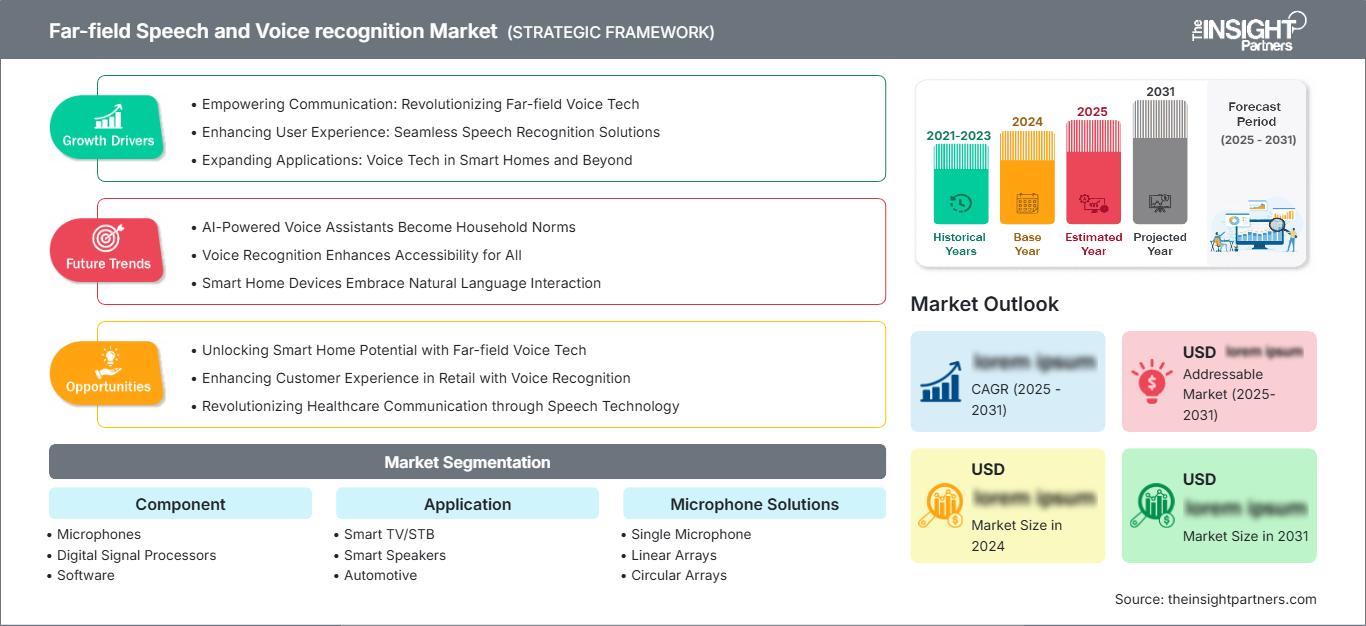
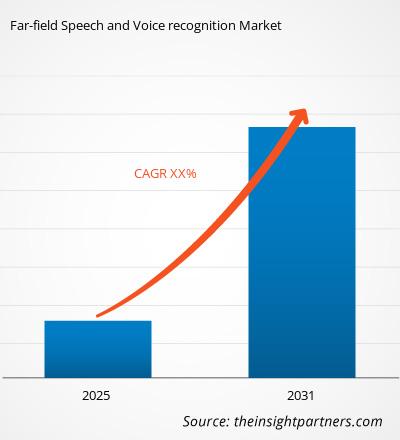
The global Far-field Speech and Voice recognition market was valued at US$ 14.76 billion in 2025 and is expected to reach US$ 38 billion by 2034; it is estimated to record a CAGR of 11.08% during 2026-2034.
Far-field Speech and Voice recognition Market Assessment and Insights
- North America – The region holds approximately 35–38% Far-Field Speech And Voice Recognition market share in 2025 and is growing at a CAGR range of 11–13% between 2026–2034, driven by strong smart home penetration and automotive voice system adoption.
- US – Accounts for nearly 78–82% of North America share in 2025, advancing at a CAGR range of 10–12% between 2026–2034, supported by leading technology companies and consumer electronics demand.
- Europe – Represents approximately 24–27% share in 2025 and is expanding at a CAGR range of 10–12% between 2026–2034, with Germany, the UK, and France leading adoption in automotive and industrial applications.
- Asia Pacific – Holds roughly 28–31% share in 2025 and is projected to grow at the fastest CAGR range of 13–15% between 2026–2034, propelled by China, Japan, South Korea, and India's smart device manufacturing.
- Largest Segment – Microphones command the largest component share at 40–43% in 2025, growing at a CAGR range of 11–13% between 2026–2034, as multi-microphone arrays become standard in premium devices.
- High Growth Segment – Software represents the fastest-growing segment with a CAGR range of 14–16% between 2026–2034, holding 28–31% share in 2025, fueled by AI-powered voice processing algorithm advancements.
- Key companies analyzed in detail: Alango Technologies Ltd., Andrea Electronics, Cirrus Logic, Inc., DSP Group, HARMAN International, MATRIX, Qualcomm Technologies, Inc., Rochester Electronics, Synaptics Incorporated, and VOCAL Technologies.
Source: The Insight Partners' analysis based on proprietary research, government publications, company annual reports, investor presentations, industry databases, and expert interviews.
According to the Far-Field Speech And Voice Recognition market report, the following factors should be highlighted: fast development of digital signal processing, microphone arrays, and machine learning noise cancellation algorithms. In turn, the evolution from single-microphone to linear and circular arrays led to more accurate voice detection under noisy conditions. Concerning production trends, the market is evolving in the direction of integration into system-on-chip design with integrated DSP, audio codec, and voice pre-processing technologies for applications such as smart speakers, TVs, and automotive infotainment.
The Far-Field Speech And Voice Recognition market trends include growth of deployments in new geographic regions like Southeast Asia, Latin America, and the Middle East; growing investments in edge AI chips and 5G IoT devices; supportive regulation concerning accessibility and hands-free voice recognition in vehicles; and standardization of voice assistants and multi-language support.
Far-field Speech and Voice recognition Market Report Scope
| Report Attribute | Details |
|---|---|
| Market size in 2025 | US$ 14.76 Billion |
| Market Size by 2034 | US$ 38.00 Billion |
| Global CAGR (2026 - 2034) | 11.08% |
| Historical Data | 2021-2024 |
| Forecast period | 2026-2034 |
Far-field Speech and Voice recognition Market Analysis
The Far-Field Speech And Voice Recognition market forecast indicates that demand for hands-free operation in smart homes, cars, and the enterprise is the major driver. The value chain includes microphones manufacturers, DSP chip makers, software algorithms providers, and solution integrators for end users. MEMS microphone providers like Knowles and TDK have increased their production capacity in line with higher demand for microphone arrays, whereas DSP providers like Qualcomm and Synaptics have developed dedicated neural processors for voice recognition.
The current supply dynamics demonstrate the move towards vertical platform providers combining hardware and software stacks. Companies like Cirrus Logic and HARMAN International deliver comprehensive audio subsystems with far-field voice processing features. The advantages of this approach include simplified development process by OEMs and better performance in adverse acoustic conditions. The industry focuses more and more on edge computing as it decreases latency and ensures compliance with data protection laws in Europe and North America.
The competitive environment consists of established semiconductor firms, DSP software specialists, and new-age startups focused on AI capabilities. Qualcomm Technologies is the leader with approximately 17-18% market share due to the Snapdragon solutions with integrated Hexagon DSP cores enhanced by machine learning accelerators for voice processing. Synaptics Incorporated has 10-11% market share due to its AudioSmart product family. Cirrus Logic retains 8-9% market share based on innovative audio codec and amplifier solutions.
Key trends include positioning regarding edge AI and multimodal user interfaces. For example, in 2024, Alango Technologies teamed up with DSP Group in order to enhance far-field voice solutions for smart devices. HARMAN International is intensifying collaboration with SoundHound AI to offer conversational voice experience in cars. Such initiatives indicate industry acknowledgment of the fact that voice interactions will dominate as devices become increasingly smart.
● REPORT CUSTOMIZATION
Tailor This Report To Align With Your Specific Business Requirements
This report can be customized to align precisely with your business objectives, scope, and target markets. Customization options include tailored segmentation, geography, competitive analysis, and strategic insights to support informed decision-making.
Customize This Report →WHAT YOU CAN ADJUST
- ● Segmentations
- ● Geography
- ● Competitive Analysis
- ● Language Preferences
Far-field Speech and Voice recognition Market: Strategic Insights
Regional Insights
North America Far-Field Speech and Voice Recognition Market
North America accounts for approximately 35–38% of global Far-Field Speech And Voice Recognition market in 2025, with the region expected to expand at a CAGR range of 11–13% through 2034. Demand is driven primarily by the U.S., where there are key technology companies, heavy adoption of smart homes, and integration with voice systems in automobiles. Canada’s contributions to demand come from contact center automation and bilingual voice interfaces.
Key structural factors include the prevalence of high-speed broadband, the comfort level of consumers with voice assistants such as Alexa and Google Assistant, and policies supporting hands-free driving. The large presence of semiconductor and software firms in locations such as Silicon Valley, Austin, and Boston drives ongoing innovation in far-field voice recognition technology.
U.S. Far-Field Speech and Voice Recognition Market
The United States represents approximately 78–82% of North America Far-Field Speech And Voice Recognition market in 2025, advancing at a CAGR range of 10–12% through 2034. The drivers of domestic demand include smart speaker market penetration exceeding 50%, adoption of automotive voice commands in more than 60% of new cars, and voice biometrics deployment by enterprises for automating customer services.
Vendor location is limited to Qualcomm Technologies based out of San Diego, Synaptics based in California, and HARMAN International having substantial R&D facilities in several states. The application development trends include the growing use of far field microphones embedded in smart TVs/STBs for voice search and content management applications.
Europe Far-Field Speech and Voice Recognition Market
Europe holds approximately 24–27% of global Far-Field Speech and Voice Recognition market in 2025, expanding at a CAGR range of 10–12% through 2034. Germany takes the lead in terms of the region's adoption rates at 32-35% of Europe share due to adoption in automobiles' voice assistants and industrial IoT applications in manufacturing units.
The UK accounts for 18-21% of Europe share, and the growth is fueled by increased adoption in smart home devices and voice authentication solutions used in mobile banking in financial services. France, Italy, and Spain combined make up 25-28% of Europe share with increased adoption in consumer electronics and hospitality voice assistants, among others. The need for multi-language support fuels software localization by international platforms.
APAC Far-Field Speech and Voice Recognition Market
Asia Pacific constitutes roughly 28-31% of the total worldwide share of Far-Field Speech & Voice Recognition in 2025, expected to have the highest growth rate in terms of CAGR between 13-15% up to 2034. China is dominating this market segment with 40-43% APAC share owing to homegrown smart speaker brands, automotive manufacturing, and policies for AI and voice technology advancements.
Other countries in the Asia Pacific region like Japan, South Korea, India, and Australia together account for the rest of the demand share. The contribution from Japan and South Korea comes from the development in consumer electronics and automotive voice technologies, whereas in India, the fast growth in the use of voice technology in smartphones with support for local languages is noteworthy.
Middle East & Africa Far-Field Speech and Voice Recognition Market
In the Middle East & Africa (MEA), 6-8% of the total global Far-Field Speech And Voice Recognition market share is held by the year 2025, at a Compound Annual Growth Rate (CAGR) of 12-14% till 2034. Saudi Arabia & UAE dominate in the regional market share of 55-60%, due to their efforts in smart cities, tourist sector, and voice recognition programs for governments.
15-18% of MEA share in this technology is held by South Africa, fueled by the automation of contact centers in enterprises and financial sectors. The other MEA nations display some demand in the telecommunications and government sectors. Energy & Infrastructure include developments in 5G network infrastructure, development of more data centers, and higher smartphone usage to develop voice-based applications.
Segmentation Analysis
Component
The Component segment is projected to grow at a CAGR range of 12–14% between 2026–2034. This segment encompasses microphones, digital signal processors, and software solutions that form the foundational technology stack for far-field voice recognition systems. Market dynamics reflect increasing demand for integrated hardware-software platforms that deliver superior noise cancellation and voice capture accuracy.
- Microphones – Microphones command 40–43% share in 2025, serving as the primary audio input transducers in far-field systems with multi-array configurations becoming standard in premium devices.
- Digital Signal Processors – Digital Signal Processors represent 30–33% share in 2025, providing real-time acoustic signal processing, beamforming, and echo cancellation capabilities essential for accurate voice recognition.
- Software – Software accounts for 28–31% share in 2025, encompassing voice pre-processing algorithms, wake word detection, and machine learning models optimized for edge deployment on resource-constrained devices.
Application
In the Far-Field Speech And Voice Recognition market, the Application segment is expected to expand at a CAGR range of 11–13% between 2026–2034. This segment includes smart TV/STB, smart speakers, automotive, and robotics applications where far-field voice interfaces enable hands-free control and natural human-machine interaction across diverse use cases.
- Smart TV/STB – Smart TV/STB applications hold 25–28% share in 2025, with voice search, content navigation, and smart home control driving adoption in connected entertainment systems globally.
- Smart Speakers – Smart Speakers represent 35–38% share in 2025, serving as the primary consumer touchpoint for voice assistants with multi-microphone arrays enabling room-scale voice capture.
- Automotive – Automotive applications account for 22–25% share in 2025, integrating voice command systems for infotainment, navigation, and vehicle control to enhance driver safety and user experience.
- Robotics – Robotics applications comprise 12–15% share in 2025, leveraging far-field voice for human-robot interaction in service, industrial, and consumer robotic platforms.
Microphone Solutions
The Microphone Solutions segment will advance at a CAGR range of 10–12% between 2026–2034. This segment categorizes microphone array architectures including single microphones, linear arrays, and circular arrays that determine voice capture patterns and beamforming capabilities in far-field systems.
- Single Microphone – Single Microphone solutions hold 42–45% share in 2025, offering cost-effective voice input for budget-conscious devices with basic noise cancellation and limited directional sensitivity.
- Linear Arrays – Linear Arrays represent 30–33% share in 2025, providing enhanced directional voice capture for smart speakers and soundbars with improved noise rejection in horizontal planes.
- Circular Arrays – Circular Arrays account for 22–25% share in 2025, delivering 360-degree voice pickup for premium smart speakers and conference systems with superior beamforming and source localization.
Opportunity Snapshot
| Application | Revenue Contribution | Trend Tag | Adoption Stage |
|---|---|---|---|
| Smart TV/STB | High | Voice Search | Mature |
| Smart Speakers | High | Multi-Assistant | Scaling |
| Automotive | Medium | In-Car Voice | Scaling |
| Robotics | Low | Service Bots | Emerging |
Far-field Speech and Voice recognition Market Growth Drivers and Impact Analysis
Smart Home Ecosystem Expansion
The proliferation of smart home devices including speakers, thermostats, lighting, and security systems creates substantial demand for Far-Field Speech And Voice Recognition technology. Consumers increasingly expect seamless voice control across all connected devices, driving adoption of multi-microphone arrays and advanced DSP algorithms that enable accurate voice capture from room-scale distances. Industry estimates suggest over 500 million smart home devices shipped globally in 2025, with voice interfaces serving as the primary interaction modality in 60–70% of these products. This ecosystem expansion generates recurring revenue opportunities for component suppliers, software developers, and platform providers throughout the value chain.
Automotive Voice Interface Integration
Automotive manufacturers are integrating far-field voice recognition systems as standard features in mid-range and premium vehicles to enhance driver safety and user experience. Regulatory mandates around hands-free operation in multiple jurisdictions, combined with consumer demand for natural language control of infotainment, navigation, and climate systems, accelerate adoption. Qualcomm's Snapdragon Digital Chassis platforms now power over 75 million vehicles as of 2025, with integrated voice processing capabilities enabling multi-zone recognition and contextual understanding. This trend creates multi-year design win pipelines for semiconductor companies and specialized voice software providers targeting automotive-grade certification requirements.
Edge AI and Privacy-Focused Processing
Growing concerns around data privacy and latency requirements drive migration of voice processing from cloud-based to edge-based architectures. On-device speech recognition eliminates the need to transmit audio streams to remote servers, addressing regulatory compliance under GDPR and similar frameworks while reducing response times to sub-100 millisecond levels. Synaptics' Astra SR80 and SRW1500 series, announced in 2026, exemplify this shift with AI-enhanced audio processing optimized for local execution. This transition creates opportunities for companies offering low-power DSP chips, efficient neural network models, and voice processing software stacks that balance accuracy with computational constraints.
Far-field Speech and Voice recognition Market Future Trends
Multi-Modal Voice and Gesture Interfaces
Future Far-Field Speech and Voice Recognition systems will increasingly combine voice with gesture recognition, gaze tracking, and contextual awareness to create more natural human-machine interactions. This convergence enables devices to interpret user intent more accurately by fusing multiple input modalities, reducing errors in noisy environments or when voice commands are ambiguous. Semiconductor companies are developing sensor fusion platforms that integrate microphone arrays with cameras, radar, and IMU sensors to support these advanced interaction paradigms. This trend will reshape product designs across smart home, automotive, and robotics segments as manufacturers differentiate through richer, more intuitive user experiences.
Regional Language and Dialect Support Expansion
As voice technology penetrates emerging markets in Asia, Latin America, and Africa, support for regional languages, dialects, and code-switching scenarios becomes critical for adoption. Current voice assistants primarily support major languages like English, Spanish, Mandarin, and Hindi, leaving significant addressable markets underserved. Companies like Alango Technologies and DSP Group are investing in multilingual DSP algorithms and acoustic models that can adapt to diverse phonetic patterns and accent variations. This expansion will require substantial investment in training data collection, model fine-tuning, and localization partnerships with regional technology providers to achieve acceptable accuracy levels across diverse linguistic contexts.
Far-field Speech and Voice recognition Market Opportunities
Industrial IoT and Voice-Enabled Manufacturing
Industrial IoT applications present significant opportunities for Far-Field Speech And Voice Recognition deployment in manufacturing, logistics, and field service environments. Workers in these settings often have hands occupied with tools or equipment, making voice interfaces ideal for accessing documentation, updating work orders, and communicating with remote experts. Ruggedized microphone arrays and noise-cancellation algorithms designed for factory floor acoustics can enable reliable voice capture in high-noise industrial settings. Companies offering industrial-grade voice solutions with integration to MES, ERP, and CMMS systems can capture value in this underserved segment as Industry 4.0 initiatives accelerate globally.
Healthcare and Assistive Voice Technologies
Healthcare settings offer compelling opportunities for far-field voice technology in clinical documentation, patient monitoring, and assistive communication for individuals with disabilities. Voice-enabled systems can reduce administrative burden on clinicians by automating note-taking and order entry, while voice interfaces in smart home environments can support aging-in-place for elderly populations. Alango Technologies' hearing augmentation technology, showcased at CES 2025, demonstrates how DSP algorithms can enhance speech intelligibility for hearing-impaired users. Regulatory pathways for medical device certification and reimbursement models for assistive technologies will shape commercialization timelines, but long-term market potential remains substantial.
Recent Developments
- March 2026: Synaptics Incorporated announced the expansion of its Astra Series with AI-enhanced premium audio and connected solutions for developers, including the Astra SR80 and Astra SRW1500 Series offering highly integrated, AI-enhanced audio and voice processing solutions for developers targeting smart home and automotive applications.
- January 2026: Qualcomm Technologies unveiled the Snapdragon Wear Elite Platform, a personal AI platform designed to unlock the next generation of truly personal, always-on, intelligent wearable computing devices with NPU-powered on-device AI processing for voice and audio applications.
- July 2025: Alango Technologies announced collaboration with Bestechnic, leveraging the BES2800YP SoC and Alango's advanced DSP software to introduce a feature-rich solution for hearing enhancement in hearable devices such as true wireless stereo earbuds and smart glasses.
Frequently Asked Questions

- Comprehensive Market Sizing and Forecast Analysis
- Detailed Segmentation Analysis
- In-Depth Market Dynamics Assessment
- Regional and Country-Level Insights
- Competitive Landscape and Company Benchmarking
- Strategic Business Intelligence
Recent Reports
Testimonials

The Insight Partners provided valuable market intelligence that supported our global go-to-market strategy. Their team was professional, responsive, and attentive to our feedback, providing thoughtful analysis and helpful methodological clarifications throughout the project.
Junmo Kim Chief Financial Officer (CFO), Enertech Co., Ltd.
The Insight Partners' SCADA System Market report is comprehensive, with valuable insights on current trends and future forecasts. The team was highly professional, responsive, and supportive throughout. We are very satisfied and highly recommend their services.
RAN KEDEM Partner, Reali Technologies LTDs
I requested a report on a very specific software market and the team produced the report in a few days. The information was very relevant and well presented. I then requested some changes and additions to the report. The team was again very responsive and I got the final report in less than a week.
JEAN-HERVE JENN Chairman, Future Analytica
We worked with The Insight Partners for an important market study and forecast. They gave us clear insights into opportunities and risks, which helped shape our plans. Their research was easy to use and based on solid data. It helped us make smart, confident decisions. We highly recommend them.
PIYUSH NAGPAL Sr. Vice President, High Beam Global
The Insight Partners delivered insightful, well-structured market research with strong domain expertise. Their team was professional and responsive throughout. The user-friendly website made accessing industry reports seamless. We highly recommend them for reliable, high-quality research services
YUKIHIKO ADACHI CEO, Deep Blue, LLC.
This is the first time I have purchased a market report from The Insight Partners.While I was unsure at first, I visited their web site and felt more comfortable to take the risk and purchase a market report.I am completely satisfied with the quality of the report and customer service. I had several questions and comments with the initial report, but after a couple of dialogs over email with their analyst I believe I have a report that I can use as input to our strategic planning process.Thank you so much for taking the extra time and making this a positive experience.I will definitely recommend your service to others and you will be my first call when we need further market data.
JOHN SUZUKI President and Chief Executive Officer, Board Director, BK Technologies
I wish to appreciate your support and the professionalism you displayed in the course of attending to my request for information regarding to infectious disease IVD market in Nigeria. I appreciate your patience, your guidance, and the fact that you were willing to offer a discount, which eventually made it possible for us to close a deal. I look forward to engaging The Insight Partners in the future, all thanks to the impression you have created in me as a result of this first encounter.
DR CHIJIOKE ONYIA MANAGING DIRECTOR, PineCrest Healthcare Ltd.Reason to Buy
- Informed Decision-Making
- Understanding Market Dynamics
- Competitive Analysis
- Identifying Emerging Markets
- Customer Insights
- Market Forecasts
- Risk Mitigation
- Boosting Operational Efficiency
- Strategic Planning
- Investment Justification
- Tracking Industry Innovations
- Aligning with Regulatory Trends





 Get Free Sample for