
Farming Tools Market Growth, Share & Trends by 2034
Coverage: by Type (Hand tools, Power tools); End-user (Residential, Commercial) , and Geography (North America, Europe, Asia Pacific, and South and Central America)
- Status : Data Released
- Report Code : TIPRE00005002
- Category : Manufacturing and Construction
- No. of Pages : 150
- Available Report Formats :


- Last update date : July 28, 2026


2025 Market Size
US$ 133.28 Bn
Base year value
2034 Forecast
US$ 224.60 Bn
Projected by 2034
CAGR 2026-2034
5.97 %
Growth rate
Addressable Market
US$ 1,620.98 Bn
(2026-2034)
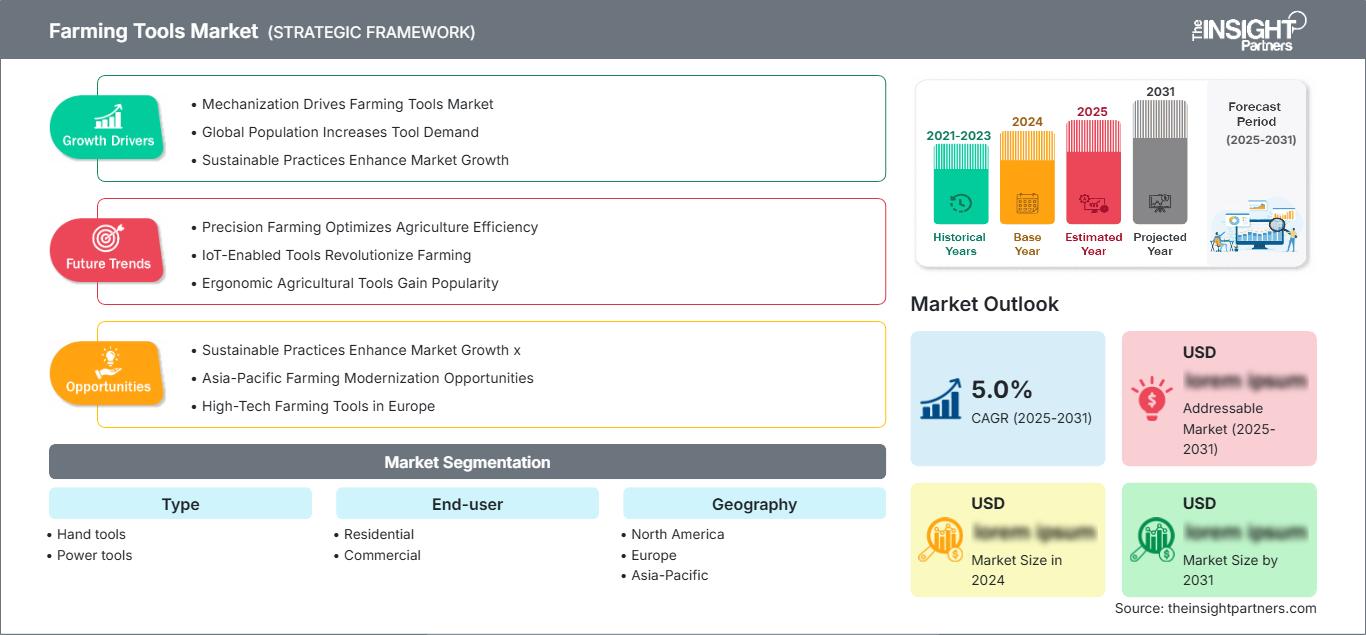
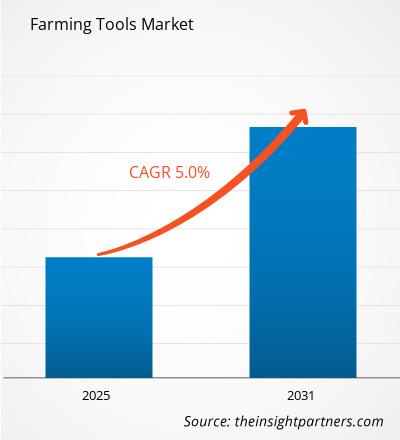
The farming tools market size was US$ 133.28 Billion in 2025 and is expected to be US$ 224.60 Billion in 2034, expanding at a CAGR of 5.97% from 2026 to 2034. Factors driving this market include tool replacement, upgrading of smaller farms, commercial landscaping, and residential gardening. The usage of hand tools and power tools is crucial to soil preparation, trimming, maintenance, harvesting assistance, and overall efficiency on farms.
In North America, the size of the market for farming tools is driven by the large land area, replacement of sturdy tools, and increasing adoption of electric tools. It is projected to expand in the CAGR range of 5.2–5.8% through 2034, with the help of professional landscaping, specialty crops production, and rural distribution channels.
Farming Tools Market Assessment and Insights
- North America accounted for 28–32% share in 2025 and is expected to grow at a CAGR of 5.2–5.8% during 2026–2034, supported by mechanized farm maintenance, residential gardening, and commercial landscaping replacement cycles.
- US represented 70–74% of North America in 2025 and is projected to grow at a CAGR of 5.1–5.7% during 2026–2034, led by large farm acreage and battery tool adoption.
- Europe held 22–26% share in 2025 and is forecast to grow at a CAGR of 4.8–5.4% during 2026–2034, with Germany, the UK, France, Italy, and Spain leading replacement-led demand.
- Asia Pacific captured 30–34% share in 2025 and is expected to expand at a CAGR of 6.5–7.1% during 2026–2034, driven by China, India, Japan, South Korea, and Australia.
- Largest Segment Hand tools held 58–62% market share in 2025 and is projected to grow at a CAGR of 4.9–5.5% during 2026–2034 due to affordability and broad utility.
- High Growth Segment Power tools held 38–42% market share in 2025 and is forecast to grow at a CAGR of 6.8–7.4% during 2026–2034 as users prioritize productivity.
- Key companies analyzed in detail: Bellota, Chillington Tool Company, Falcon Garden Tools, Fiskars Corporation, Herramientas Agrícolas S.A., Truper Herramientas, S.A. de C.V., Bully Tools, Inc., Burgon & Ball Ltd., Sneeboer & Zn B.V., Spear & Jackson Group plc
Source: The Insight Partners' analysis based on proprietary research, government publications, company annual reports, investor presentations, industry databases, and expert interviews.
There has been a change in the nature of tool demand from simple commodity tools to those that last longer and have ergonomic designs that reduce the fatigue of users and help them perform their tasks precisely. In addition, there has been the use of tools made using hardened steel, light-weighted handles, components that can be replaced, and those powered by batteries to address the needs of both cost-conscious farms and professionals.
In the future, there will continue to be a need to consider emerging geographies in the sense that small farms will be shifting from their simple tools while urban and peri-urban farmers will purchase small-scale tools for food gardens. There is an expectation that public training, rural distribution networks, and climate-smart agriculture will result in greater awareness of safe and appropriate-scale tools.
Farming Tools Market Report Scope
| Report Attribute | Details |
|---|---|
| Market size in 2025 | US$ 133.28 Billion |
| Market Size by 2034 | US$ 224.60 Billion |
| Global CAGR (2026 - 2034) | 5.97% |
| Historical Data | 2021-2024 |
| Forecast period | 2026-2034 |
Farming Tools Market Analysis
The growth in the farming tools industry is driven by the need for equipment used in agriculture, horticulture, landscaping, and home gardening. In its value chain, there are steel manufacturers, manufacturers of handle and motor components, tool manufacturers, distributors, farm stores, online sellers, and service providers. The supply chain gives an advantage to businesses that can make a balance between cheap manual tools and more expensive powered tools as well as deal with price volatility in metals.
Farming Tools Market Analysis shows that commercial users are more concerned with the total cost of ownership of the equipment rather than its purchase price. Commercial users look for blades that are strong, batteries that are standard, grips that are ergonomic, and parts that can be replaced in order not to delay the planting, maintenance, and harvest. Home users are still price-sensitive but premium sales are growing due to compactness, weight, and versatility.
Competitors are still operating separately, with heritage hand tools competing with diversified garden tools manufacturers. Fiskars Corporation, Bellota, Spear & Jackson Group plc, and Burgon & Ball Ltd. focus on design, brand equity, and market presence, whereas Falcon Garden Tools, Truper Herramientas, S.A. de C.V., and Bully Tools, Inc. are competing with their products' longevity, cost, and distribution channels.
Strategic positioning is evolving into portfolio diversification, regional production capability, and collaboration in distribution. Manufacturers are now investing in battery-powered platform, high-quality forged steel, and urban gardening products. The joint ventures between AMES, Bellota, Corona, and Burgon & Ball show that consolidation is ongoing in terms of lawn, garden, and professional hand tools portfolios.
● REPORT CUSTOMIZATION
Tailor This Report To Align With Your Specific Business Requirements
This report can be customized to align precisely with your business objectives, scope, and target markets. Customization options include tailored segmentation, geography, competitive analysis, and strategic insights to support informed decision-making.
Customize This Report →WHAT YOU CAN ADJUST
- ● Segmentations
- ● Geography
- ● Competitive Analysis
- ● Language Preferences
Farming Tools Market: Strategic Insights
Regional Insights
North America farming tools market
North America represented 28–32% market share in 2025, with a CAGR of 5.2–5.8% from 2026 to 2034. Farming tools market share relies on the presence of large farm holdings, well-established retail networks, and professional landscape requirements. Frequent replacement is required due to soil exposure, wear-and-tear, and seasonal use.
Electrically operated pruners, trimmers, cultivators, and mini-tilling equipment are becoming popular owing to the difficulty in getting labor and efficiency without resorting to larger machines. Rural and suburban buyers are served by farm stores, home improvement stores, and online avenues, whereas commercial grounds maintenance buyers favor premium tools.
U.S. Farming Tools Market
The US accounted for 70-74% of North America in 2025 and was projected to record a CAGR of 5.1-5.7% between 2026 and 2034. It is attributed to the wide spread of farming acreage, growing of specialty crops, landscaping activities, and gardening activities among homeowners.
The market is fortified through brand reputation, imports, and local manufacture of shovels, hoes, forks, rakes, pruners, and power accessories for the garden. Commercial consumers look for products which are reliable and supported with services, while consumers in residential segment look for smaller tools for use in raised beds, lawns, orchards, and gardens.
Europe Farming Tools Market
The Europe market has a 22-26% share in 2025 and is expected to grow at a CAGR of 4.8-5.4% between 2026-2034. Demand from Germany is driven by their advanced horticulture, landscaping, and tool retail industry. The United Kingdom also provides stable gardening demand, whereas France, Italy, and Spain provide demand for pruning, wine, orchards, and vegetable gardening tools.
Buyers in Europe prefer those tools which are repairable, ergonomically designed, and durable since there is pressure on sustainability due to which the buyer behavior has changed. High-quality brands have an edge in terms of designing, however, competition is tough due to imported tools.
APAC Farming Tools Market
The APAC region had a market share of 30-34% in 2025 and is projected to register a CAGR of 6.5-7.1% during 2026-2034. China, India, Japan, South Korea, and Australia dominate the region. Smaller farms, orchards, plantations, and vegetable cultivation contribute to consistent tool requirement.
Farm productivity improvement policies, rural mechanization facilities, and horticulture development policies have been instrumental in promoting the use of robust manual tools and small power tools. In-country production helps to keep low-end tools affordable, whereas commercial farms and landscaping operations prefer to purchase advanced tools to reduce their labor efforts.
Middle East & Africa Farming Tools Market
Middle East & Africa is forecast to grow at a CAGR of 5.6–6.2% during 2026–2034. Saudi Arabia and the UAE support demand through landscaping, controlled agriculture, and infrastructure-linked greening, while South Africa leads regional commercial agriculture and retail availability.
Across the Rest of MEA, smallholder farming remains tool-intensive because mechanization access is uneven. Energy infrastructure, irrigation projects, and food-security programs create demand for maintenance tools, while affordability and durability remain decisive purchase criteria in rural markets.
Segmentation Analysis
Type
Type is projected to grow at a CAGR of 5.6–6.2% during 2026–2034. The farming tools market scope across this segment spans essential manual implements and powered equipment used for cultivation, pruning, trimming, digging, and maintenance. Buyers select products based on task frequency, user fatigue, tool life, repairability, and price-performance fit.
- Hand tools retain the largest position because hoes, spades, forks, rakes, sickles, and pruners are affordable, widely distributed, and essential for small farms, gardens, orchards, and landscaping crews.
- Power tools are strategically important as users seek faster trimming, pruning, tilling, and maintenance. Battery formats improve convenience, reduce noise, and help commercial operators manage labor constraints.
End-user
End-user is estimated to grow at a CAGR of 5.7–6.3% during 2026–2034. Residential demand is shaped by gardening, landscaping, and small food plots, while commercial demand is driven by farms, nurseries, estates, and maintenance contractors. The segment benefits from rising awareness of ergonomic tools, durable materials, and productivity gains.
- Residential users purchase compact, easy-to-store tools for lawns, patios, vegetable gardens, and orchards. Demand rises when products combine affordability, low maintenance, and comfortable handling.
- Commercial users require stronger tools for repetitive field, nursery, landscaping, and maintenance work. Procurement favors durability, spare-part access, productivity, and supplier reliability over entry-level pricing.
Opportunity Snapshot
| Segment Name | Revenue Contribution | Trend Tag | Adoption Stage |
| Residential | Medium | Urban Gardens | Scaling |
| Commercial | High | Labor Saving | Mature |
Farming Tools Market Growth Drivers and Impact Analysis
Labor Efficiency and Tool Ergonomics
The increasing demands to perform more work with fewer workers on farms and in landscaping businesses are driving the commercial viability of ergonomic and motorized tools. Lightweight handles, sharper blades, vibration suppression, and better grips ensure less fatigue while digging, cutting, pruning, and weed removal. The effect of this trend can be observed in terms of premiumization, where consumers purchase expensive products instead of cheaper ones because they increase efficiency at work and decrease the possibility of getting injured. This trend drives manufacturers towards achieving higher margins and differentiation in terms of better ergonomics than the simple quality of steel or pricing. Another reason for the rising importance of comfort in tool design is the growing awareness of occupational safety.
The use of improved materials, weight balance, cushioned handles, and handle design is now being seen in new products aimed at improving ergonomics without sacrificing durability. With such technology, workers can remain productive without physical strain or risk of repetitive stress injury. In addition, contractors and landscaping businesses understand that ergonomically designed tools will not only help increase efficiency among employees but also reduce their absenteeism. Labor shortage continues to be felt in agriculture and landscaping in different parts of the world, meaning that there is going to be a high demand for improved tools that combine durability and comfort.
Growth in Residential Gardening and Landscaping
Home gardening, edible landscaping, and outdoor living expenditures keep increasing the customer pool for farming and garden tools that are portable. People are purchasing pruners, trowels, forks, rakes, and power tools for lawns, patio gardens, raised beds, and fruit trees. This trend is favorable to brands with effective retail presentation, instructional packaging, and versatile products. At the same time, this trend inspires product development of portable products easy to store and handle, thereby enabling the farming tools market to serve customers outside farming activities.
The increased prevalence of gardening as a hobby, coupled with the use of such pastime for obtaining fresh produce, is making customers increase their spending on dependable gardening equipment. The growing trend among people of taking care of their gardens and landscapes as well as the desire to live sustainably and make improvements at home is also fueling demand for convenient and easy-to-use products that suit gardeners of different experience level. To respond to the changing consumer demands, manufacturers of gardening equipment are designing smaller product lines featuring high portability, storage convenience, and multiplicity to increase usability in confined outdoor areas. Retailers are also diversifying product assortment in online and organized retail channels to reach a wider range of customers.
Smallholder Modernization in Emerging Economies
Smallholders in emerging economies continue to depend on scale-appropriate tools because full mechanization remains costly and unevenly accessible. Affordable hoes, sickles, spades, cultivators, sprayers, and compact powered implements help improve timeliness in planting, weeding, and harvesting. Training programs and rural distribution models increase awareness of safer and more productive equipment. The commercial impact is a large replacement market where durability, local availability, and price discipline are critical, giving regional manufacturers and global brands room to compete. Continued efforts to improve agricultural productivity and rural livelihoods are encouraging greater adoption of efficient manual and semi-mechanized farming tools among small-scale producers.
Government initiatives, agricultural extension services, and development organizations are promoting improved farming practices while increasing access to affordable equipment suited to local cultivation methods. Better availability of rural financing, dealer networks, and maintenance support also enables farmers to replace worn-out tools with higher-quality alternatives that improve operational efficiency. Manufacturers are increasingly tailoring product designs to regional crop requirements, soil conditions, and user preferences, ensuring greater practicality and long-term durability. As smallholder agriculture remains a significant contributor to food production across emerging economies, demand for dependable, cost-effective farming tools is expected to remain strong, supporting consistent replacement purchases and creating growth opportunities for both regional producers and established international brands.
Farming Tools Market Future Trends
Battery Ecosystems for Compact Farm Tasks
One of the most relevant farming tools market trends is the shift from single-use electric products toward shared battery ecosystems. Users prefer interchangeable batteries that can operate pruners, trimmers, sprayers, cultivators, and cutters across the same platform. This trend will influence brand loyalty, accessory sales, and service models because buyers will evaluate compatibility before adding new tools. Suppliers that design durable, weather-resistant, and repairable battery systems can capture recurring revenue while reducing the hesitation associated with standalone powered equipment purchases.
Sustainable Materials and Repairable Designs
Manufacturers are expected to place greater emphasis on recycled metals, responsibly sourced wood, replaceable heads, and repairable handles as buyers scrutinize product life and waste. Professional users already prefer tools that can be maintained instead of discarded, while European and premium retail channels increasingly reward sustainability claims supported by design evidence. This trend will reshape procurement specifications, packaging, and warranties, encouraging companies to compete on lifecycle value. Brands that document material quality and repair options will strengthen trust.
Farming Tools Market Opportunities
Commercial Tool Kits for Specialty Crops
Suppliers can capture value by designing bundled kits for vineyards, orchards, nurseries, greenhouse farms, and vegetable producers. These customers require pruning, tying, soil preparation, cutting, and maintenance tools that work together across seasonal operations. The opportunity is strongest where distributors can offer training, replacement blades, and service support. The farming tools market forecasts point to stronger uptake of task-specific kits because commercial buyers want predictable procurement and consistent quality. Bundling also helps manufacturers increase average order value while simplifying selection for dealers and end users.
Rural Retail and Digital Distribution Expansion
Distribution remains a major opportunity because many rural buyers still depend on limited local inventory and informal channels. Manufacturers that combine dealer networks, mobile demonstrations, digital catalogs, and spare-part availability can improve conversion in fragmented markets. E-commerce can support comparison, but after-sales access remains essential for powered tools and higher-value implements. The strongest opportunity lies in hybrid distribution models that connect rural stores with online ordering and localized service. This approach can expand reach without requiring costly company-owned retail infrastructure.
Recent Developments
- February 2026: Griffon Corporation announced strategic actions under which AMES U.S. and Canada businesses and ONCAP’s Venanpri Tools, including Bellota, Corona, and Burgon & Ball, would form a joint venture focused on hand tools, lawn and garden products, and professional and consumer channels.
- January 2026: John Deere has introduced an expanded lineup of tillage equipment aimed at providing greater flexibility for farmers operating across different field sizes and production systems. The new portfolio includes smaller two-section high-speed disk models available in four working widths, along with autonomy-ready rippers and field cultivators designed to support evolving precision agriculture practices.
Frequently Asked Questions

- Comprehensive Market Sizing and Forecast Analysis
- Detailed Segmentation Analysis
- In-Depth Market Dynamics Assessment
- Regional and Country-Level Insights
- Competitive Landscape and Company Benchmarking
- Strategic Business Intelligence
Recent Reports
Testimonials

The Insight Partners provided valuable market intelligence that supported our global go-to-market strategy. Their team was professional, responsive, and attentive to our feedback, providing thoughtful analysis and helpful methodological clarifications throughout the project.
Junmo Kim Chief Financial Officer (CFO), Enertech Co., Ltd.
The Insight Partners' SCADA System Market report is comprehensive, with valuable insights on current trends and future forecasts. The team was highly professional, responsive, and supportive throughout. We are very satisfied and highly recommend their services.
RAN KEDEM Partner, Reali Technologies LTDs
I requested a report on a very specific software market and the team produced the report in a few days. The information was very relevant and well presented. I then requested some changes and additions to the report. The team was again very responsive and I got the final report in less than a week.
JEAN-HERVE JENN Chairman, Future Analytica
We worked with The Insight Partners for an important market study and forecast. They gave us clear insights into opportunities and risks, which helped shape our plans. Their research was easy to use and based on solid data. It helped us make smart, confident decisions. We highly recommend them.
PIYUSH NAGPAL Sr. Vice President, High Beam Global
The Insight Partners delivered insightful, well-structured market research with strong domain expertise. Their team was professional and responsive throughout. The user-friendly website made accessing industry reports seamless. We highly recommend them for reliable, high-quality research services
YUKIHIKO ADACHI CEO, Deep Blue, LLC.
This is the first time I have purchased a market report from The Insight Partners.While I was unsure at first, I visited their web site and felt more comfortable to take the risk and purchase a market report.I am completely satisfied with the quality of the report and customer service. I had several questions and comments with the initial report, but after a couple of dialogs over email with their analyst I believe I have a report that I can use as input to our strategic planning process.Thank you so much for taking the extra time and making this a positive experience.I will definitely recommend your service to others and you will be my first call when we need further market data.
JOHN SUZUKI President and Chief Executive Officer, Board Director, BK Technologies
I wish to appreciate your support and the professionalism you displayed in the course of attending to my request for information regarding to infectious disease IVD market in Nigeria. I appreciate your patience, your guidance, and the fact that you were willing to offer a discount, which eventually made it possible for us to close a deal. I look forward to engaging The Insight Partners in the future, all thanks to the impression you have created in me as a result of this first encounter.
DR CHIJIOKE ONYIA MANAGING DIRECTOR, PineCrest Healthcare Ltd.Reason to Buy
- Informed Decision-Making
- Understanding Market Dynamics
- Competitive Analysis
- Identifying Emerging Markets
- Customer Insights
- Market Forecasts
- Risk Mitigation
- Boosting Operational Efficiency
- Strategic Planning
- Investment Justification
- Tracking Industry Innovations
- Aligning with Regulatory Trends





 Get Free Sample for