
Fencing Market Growth, Trends & Demand by 2034
Coverage: by Material Type (Metal, Wood, Plastic and Composite, Concrete, Others); End-user (Residential, Industrial, Agricultural, Government, Defense, Others) , and Geography (North America, Europe, Asia Pacific, and South and Central America)
- Status : Data Released
- Report Code : TIPRE00008294
- Category : Chemicals and Materials
- No. of Pages : 150
- Available Report Formats :


- Last update date : September 22, 2026


2025 Market Size
US$ 36.36 Bn
Base year value
2034 Forecast
US$ 64.72 Bn
Projected by 2034
CAGR 2026-2034
6.61 %
Growth rate
Addressable Market
US$ 456.85 Bn
(2026-2034)
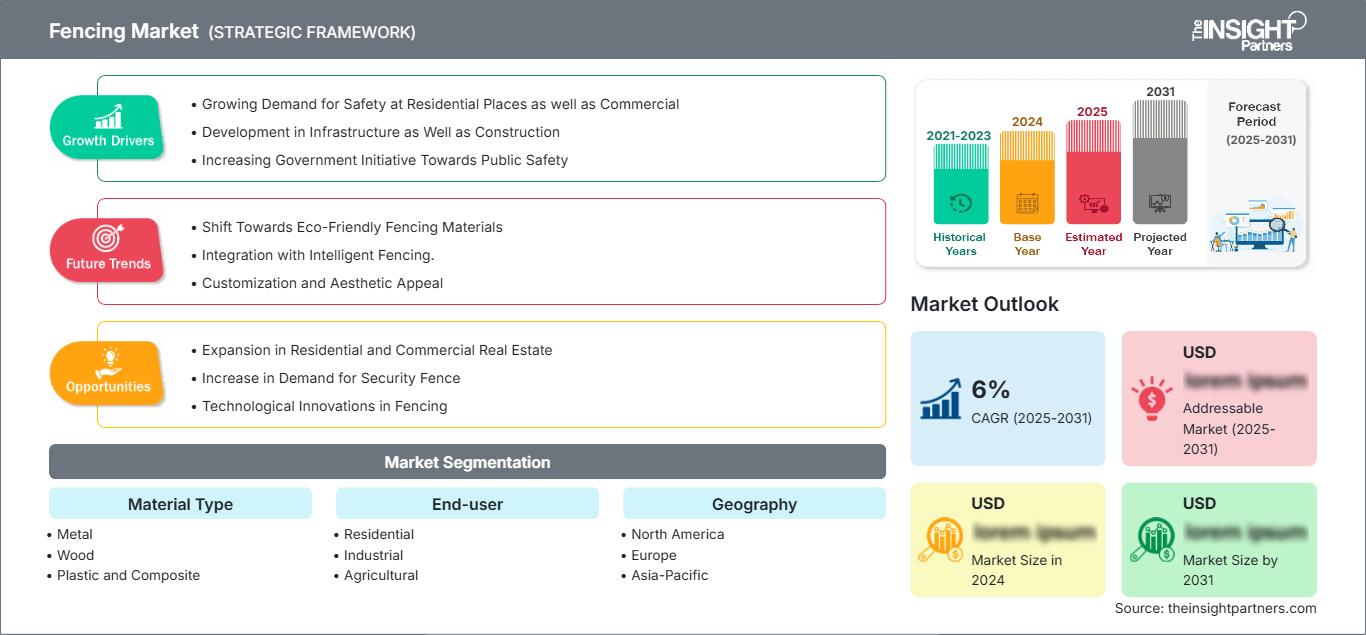
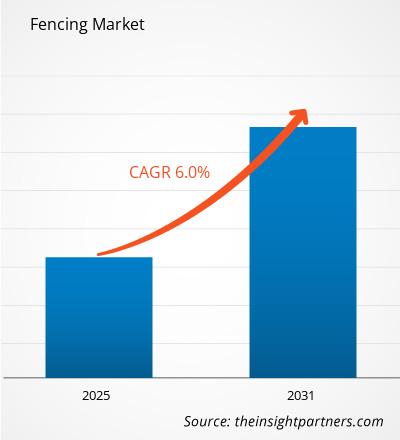
The Fencing Market was valued at US$ 36.36 Billion in 2025 and is projected to reach US$ 64.72 Billion by 2034, expanding at a 6.61% CAGR during 2026–2034. Demand is supported by residential construction, infrastructure development, agricultural land protection, industrial perimeter security, and government and defense requirements. Material innovation is also broadening the use of metal, wood, plastic, composite, and concrete fencing systems across diverse installation environments.
North America is expected to remain a significant demand center, supported by residential replacement activity, commercial construction, infrastructure protection, and heightened requirements for controlled-access perimeters. The Fencing Market size in the region is influenced by renovation spending, security upgrades, and consumer preference for low-maintenance vinyl and composite systems, while steel fencing remains important for industrial and institutional applications.
Fencing Market Assessment and Insights
- North America: North America accounted for a 27–31% Fencing Market share in 2025 and is expected to expand at a 6.0–6.7% CAGR between 2026–2034, supported by residential replacement, commercial construction, perimeter security, and demand for durable low-maintenance systems.
- US: The US represented a 23–27% share in 2025 and is projected to grow at a 5.9–6.6% CAGR between 2026–2034, supported by housing activity, infrastructure investment, and perimeter protection.
- Europe: Europe held a 21–25% share in 2025 and is forecast to register a 5.7–6.4% CAGR between 2026–2034, with Germany, the UK, France, Italy, and Spain driving residential renovation, infrastructure, industrial, and security applications.
- Asia Pacific: Asia Pacific represented a 31–35% share in 2025 and is projected to grow at a 7.1–7.9% CAGR between 2026–2034, led by China, India, Japan, South Korea, and Australia through construction, agriculture, and infrastructure development.
- Largest Segment: Metal accounted for a 52–57% market share in 2025 and is projected to grow at a 6.4–7.0% CAGR during 2026–2034, supported by strength and security applications.
- High Growth Segment: Composite represented a 8–12% market share in 2025 and is expected to grow at a 7.8–8.6% CAGR during 2026–2034, driven by durability and low-maintenance demand.
- Key companies analyzed in detail: Ameristar Perimeter Security USA Inc., Bekaert, Betafence, CertainTeed LLC, Gregory Industries, Hoover Fence Co., Jerith Manufacturing Company, Long Fence Company, Ply Gem Residential Solutions, and Poly Vinyl Creations, Inc.
Source: The Insight Partners' analysis based on proprietary research, government publications, company annual reports, investor presentations, industry databases, and expert interviews.
Product development has evolved fencing from simply marking the boundaries to engineered structures that offer a combination of functionality, looks, corrosion protection, privacy, access control, and ease of installation. Steel products still dominate when it comes to fencing that offers security, while vinyl, composite and treated wood are designed to meet the demands of residential fencing design. As such, the Fencing Market is becoming segmented in terms of use, longevity, installation considerations, and material properties.
Growth in the future will be driven by urban development, agricultural advancements, need for critical infrastructure protection, and replacement demand. Suppliers have also been paying attention to the environment through the use of recyclable plastics, better coatings, material efficiency, and design solutions that minimize maintenance costs. Such trends are giving rise to increased opportunities in the Fencing Market for product manufacturers.
Fencing Market Report Scope
| Report Attribute | Details |
|---|---|
| Market size in 2025 | US$ 36.36 Billion |
| Market Size by 2034 | US$ 64.72 Billion |
| Global CAGR (2026 - 2034) | 6.61% |
| Historical Data | 2021-2024 |
| Forecast period | 2026-2034 |
Fencing Market Analysis
The driving factors in Fencing Market development are construction of houses, remodelling, commercial establishments, industrial construction, agricultural uses, and security concerns. The chain of demand for fences starts with individuals and companies owning private property, constructors, developers, farms, industries, power plants, and government organizations and goes down the line to designers, distributors, manufacturers, installers, and specialized contractors. The materials selected are selected according to the needs for strength, design, weather, maintenance, and price.
The Fencing Market report shows that manufacturing chain includes steel wire and sheet producers, aluminum and polymer suppliers, wood producers, composite manufacturers, coating producers, fence fabricators, hardware producers, and installers. Metal fences are produced using existing facilities, while polymer and composite fences utilize extruding and profiling facilities. The role of regional distributors remains highly significant as the volume of fencing materials is high relatively to its price.
According to the Fencing Market forecast, the competitive structure of the industry consists of multinational material experts, regional producers, building product producers having vertical integration, and specialist fencing installers. Bekaert and Betafence have solid technological strength in steel wire, mesh, perimeter protection, and security systems. Ameristar Perimeter Security USA Inc. focuses on engineering perimeter solutions, while CertainTeed LLC and Ply Gem Residential Solutions take part actively in exterior products for residential use.
Regional firms fight through customizing, contractor relations, installation services, quick turnaround time, and design optimization. Gregory Industries, Hoover Fence Co., Jerith Manufacturing Company, Long Fence Company, and Poly Vinyl Creations Inc. cater to particular needs for residential, commercial, ornamental, and security applications. Investments are being made in automation, anti-corrosion finishes, design software, recycled polymers, and installations that are easy and reduce installation costs.
● REPORT CUSTOMIZATION
Tailor This Report To Align With Your Specific Business Requirements
This report can be customized to align precisely with your business objectives, scope, and target markets. Customization options include tailored segmentation, geography, competitive analysis, and strategic insights to support informed decision-making.
Customize This Report →WHAT YOU CAN ADJUST
- ● Segmentations
- ● Geography
- ● Competitive Analysis
- ● Language Preferences
Fencing Market: Strategic Insights
Regional Insights
North America Fencing Market
North America represented a 27–31% share in 2025 and is expected to grow at a 6.0–6.7% CAGR during 2026–2034. Replacement in residential buildings, commercial building constructions, infrastructure protection, and need for privacy fences are some of the important structural factors. Vinyl and composite materials enjoy the advantage of reduced maintenance, whereas steel is chosen when there is need for more security.
In the region, majority of the demand is from US, owing to well-established contractor network and wide material availability. In Canada, residential construction, agriculture applications, and institutional applications make up the demand side. There is a growing trend of differentiating products based on wind-resistance properties, corrosion protection, decorative coatings, privacy fencing, and easy installation.
U.S. Fencing Market
The US accounted for a 23–27% share of North America in 2025 and is projected to grow at a 5.9–6.6% CAGR during 2026–2034. Replacement of residential buildings, multifamily buildings, commercial properties, utility sites, educational institutions, and infrastructure represents diverse demand. Cost considerations in construction favor products that save on installation time and maintenance.
Ameristar Perimeter Security USA Inc., CertainTeed LLC, Hoover Fence Co., Jerith Manufacturing Company, Long Fence Company, and Ply Gem Residential Solutions meet the needs of various segments of the market. Residential construction is better suited for vinyl, ornamental metal, wooden, and composite fences, whereas industrial and government construction prefers the strength, access control, anti-climb capabilities, and security systems of steel fences. Housing affordability trends could limit demand from new construction, giving rise to replacements and renovations.
Europe Fencing Market
Europe held a 21–25% share in 2025 and is projected to expand at a 5.7–6.4% CAGR during 2026–2034. In the aspect of demand, Germany is leading, followed by the UK, France, Italy, and Spain, in which security fencing, infrastructure, agriculture, and renovation play a role in replacement cycles.
Germany has industrial buildings, logistics infrastructure, agricultural lands, and residential renovation, thus increasing demand. The UK has demands for residential bordering, security fencing, and commercial buildings. Replacement ensures that there is recurring demand. There is also demand in France owing to agriculture, residences, and the public sector. Demand in Italy and Spain is in the residential, agricultural, tourist, and infrastructure sectors.
APAC Fencing Market
APAC accounted for a 31–35% share in 2025 and is expected to grow at a 7.1–7.9% CAGR during 2026–2034. When we talk about regional demands, China ranks number one followed by India, Japan, South Korea, and Australia. The reasons behind this are industrialization, infrastructure development, agriculture development, and urbanization.
The advantages with respect to China are that of infrastructural development and industrial development whereas India offers opportunities in urbanization, logistics, agriculture, and infrastructural development. On the other hand, Japan and South Korea prefer durable systems having technical specifications and Australia prefers agriculture and security systems.
Middle East & Africa Fencing Market
Middle East and Africa is projected to expand at a 5.8–6.6% CAGR during 2026–2034, supported by infrastructure, security, agriculture, and industrial development. Saudi Arabia and the UAE represent leading Gulf markets, while South Africa anchors demand in southern Africa.
The country of Saudi Arabia is able to benefit from the significant amount of infrastructure and urban development that exists, but the UAE needs systems around their commercial, logistics, industrial, and institutional structures. South Africa is able to utilize the technology in residential, agriculture, industrial, and security uses. The RoMEA needs continue to be less integrated, with climate, property lines, and infrastructure security being key considerations.
Segmentation Analysis
Material Type
Material Type determines structural strength, lifecycle cost, appearance, maintenance requirements, and environmental suitability. Metal remains the dominant material because it serves residential, industrial, agricultural, government, and defense requirements. Wood retains importance in residential and agricultural applications, while plastic and composite systems address low-maintenance preferences. Concrete is suited to high-durability and permanent boundary applications. The segment is expected to grow at a 6.3–7.0% CAGR during 2026–2034. The Fencing Market scope therefore spans both conventional materials and engineered alternatives.
- Metal: Metal fencing provides high strength, security, design flexibility, and compatibility with gates and access-control systems. Steel remains especially important for industrial, government, defense, and infrastructure applications requiring robust perimeter protection.
- Wood: Wood fencing maintains relevance in residential and agricultural settings because of its natural appearance, availability, repairability, and design flexibility. Treatment and coating technologies influence durability in exposed environments.
- Plastic and Composite: Plastic and composite systems appeal to customers seeking low maintenance, moisture resistance, color stability, and design consistency. They are particularly relevant to residential privacy, decorative, and replacement applications.
- Concrete: Concrete fencing provides substantial permanence, impact resistance, privacy, and security. Its heavier construction suits fixed boundaries, high-durability applications, and properties where long service life outweighs transportation and installation complexity.
End-user
End-user segmentation reflects differences in security requirements, aesthetics, installation conditions, procurement processes, and lifecycle priorities. Residential applications emphasize appearance and privacy, while industrial, agricultural, government, and defense users prioritize durability and controlled access. The segment is forecast to grow at a 6.1–6.9% CAGR during 2026–2034.
- Residential: Residential demand combines privacy, security, landscaping, pet containment, and aesthetic requirements. Buyers increasingly favor vinyl, composite, ornamental metal, and treated wood products that reduce maintenance while improving curb appeal.
- Industrial: Industrial facilities require robust boundaries around plants, warehouses, logistics centers, utilities, and equipment. Steel mesh, palisade, and high-security systems are favored where access control and intrusion resistance are critical.
- Agricultural: Agricultural fencing supports livestock management, crop protection, property demarcation, and controlled movement. Requirements vary by terrain, animal type, acreage, and maintenance access, creating demand for practical durable systems.
- Government: Government applications include public buildings, schools, parks, transportation assets, utilities, and administrative properties. Procurement typically emphasizes standards compliance, lifecycle cost, safety, durability, and integration with controlled-access infrastructure.
- Defense: Defense applications require high-security perimeter systems capable of resisting climbing, cutting, forced entry, and other intrusion methods. Product selection is driven by threat assessments, site conditions, access control, surveillance integration, and reliability.
Opportunity Snapshot
| End-user | Revenue Contribution | Trend Tag | Adoption Stage |
|---|---|---|---|
| Residential | High | Privacy Systems | Mature |
| Industrial | High | Perimeter Security | Mature |
| Agricultural | Medium | Livestock Control | Mature |
| Government | Medium | Access Control | Scaling |
| Defense | Medium | High-Security | Scaling |
Fencing Market Growth Drivers and Impact Analysis
Residential Renovation and Privacy Requirements Support Recurring Demand
Home fencing presents a need for continuous replacement due to wear and tear caused by the weather, corrosion, impact, degradation, and change of homeowner tastes. The need for privacy will also prompt customers to replace fences when they develop outdoor living space, put up swimming pools, add pets or change landscaping design. Vinyl and composite fences take advantage of minimal maintenance needs whereas ornamental metal fence is durable and aesthetically pleasing. Contractors prefer fences which have standard components such as posts, panels and gates because they facilitate easy installation and scheduling of the work. For the manufacturers, renovation projects offer a wide range of consumers who are not tied to one construction season. Manufacturers also have options of offering their products in different colors, textures, privacy levels, modularity and warranties.
Infrastructure Security Raises Demand for Engineered Perimeter Systems
Fencing is critical infrastructure and it should work in conjunction with a security system, and not just as fencing alone. Utility, transport, data center, logistic center, prison and manufacturing facility are among the facilities that now incorporate their perimeters as part of the security system that includes surveillance, lighting, access control and intrusion detection system. This also means that more technical demands have been placed on the anti-climb geometry, anti-tampering design, and integration with the electronics of the security system.High strength steel and engineered mesh systems are ideal for this purpose since they have visibility, structural capability, and compatibility with security technologies. Consequently, purchasing trends are moving towards proven systems and reliability of operation rather than just material cost. Companies with engineering capability, project management skills, and installation services will be able to compete better for major infrastructure contracts.
Agricultural Modernization Expands Requirements for Durable Boundary Systems
Increased agricultural modernization has been contributing to rising requirements for fencing systems that help in cattle control, crop protection, farm property management, and efficient operation. More professional and larger farms have need for reliable and long-lasting fences, which should be compatible with gates, cattle management systems, and other accesses. The fence has to endure harsh weather conditions, pressure from animals, vegetation, and movements of various machinery and still be affordable to operate on large territories. Metal fences are still relevant due to their strength and flexibility; there are also special polymer and composite fences for particular uses where corrosion or maintenance is problematic. Growing commercial agriculture in the developing countries could contribute to rising demand for standard fencing materials and not for those that are manufactured locally.
Fencing Market Future Trends
Recyclable Polymers and Composite Materials Will Gain Share
The Fencing Market trends show that material innovation is expected to center on recycled polymers, recyclable composite systems, bio-based additives, and longer-lasting formulations. The manufacturers aim to lower the use of new materials and preserve impact resistance, weatherability, UV stability, and dimensional uniformity. Closed-loop manufacturing processes might get more prevalent where it is economically feasible to recover production waste and used products. Recycled content in composite fencing is expected to grow as technological improvements are achieved. Such trends will encourage customers to consider material sustainability in addition to durability and aesthetics. Material certification, recycled content information, and detailed composition of the material will take a growing importance in commercial purchasing processes. Eventually, material efficient companies and those having material recycling plans might gain an edge over their competitors in projects where there are any sustainability requirements from developers or government entities.
Digital Design and Modular Installation Will Reshape Project Delivery
Digital configuration tools are expected to become more important as fencing projects become increasingly customized. Software can allow contractors and property owners to model boundaries, calculate panel and post quantities, configure gates, estimate material requirements, and visualize finished installations before ordering. Manufacturers can connect these tools with distributor inventories and standardized product libraries, reducing errors between design and installation. Modular systems will reinforce this transition because standardized components can be configured across different site geometries without extensive fabrication. Prefabricated panels and integrated hardware can also reduce labor requirements where skilled installation capacity is constrained. Over the longer term, digital workflows may connect manufacturers, distributors, installers, and end users through shared project information. This could shorten quotation cycles, improve material planning, and reduce installation waste across residential and commercial projects.
Fencing Market Opportunities
Localized Manufacturing in High-Growth Construction Economies
Manufacturers can pursue localized production in countries where construction, agriculture, and infrastructure spending are expanding faster than established fencing capacity. Local facilities can reduce freight costs, shorten delivery times, and allow product specifications to reflect regional building practices and climate conditions. India, Southeast Asia, the Middle East, and selected Latin American economies offer opportunities for regional manufacturing partnerships, distribution centers, or contract fabrication. Companies should prioritize modular steel panels, coated wire systems, vinyl profiles, composite components, and standardized gates that can serve multiple end-user groups. Local sourcing of posts, hardware, and packaging can further improve competitiveness. Strategic partnerships with construction distributors and installation contractors can accelerate market entry without requiring extensive retail infrastructure. Suppliers should also evaluate corrosion exposure, wind conditions, labor availability, and local procurement standards before selecting manufacturing locations.
Integrated Security and Fencing Solutions for Critical Infrastructure
A significant opportunity exists in combining physical fencing with gates, access control, surveillance, sensors, and perimeter monitoring. Infrastructure owners increasingly need security systems that can detect, delay, assess, and respond to unauthorized access rather than merely establish a visible boundary. Manufacturers can develop integrated offerings by partnering with electronic-security providers or incorporating mounting provisions, cable pathways, sensor supports, and automated gates into fencing systems. Such solutions can increase the value of each project and create recurring opportunities for maintenance and system upgrades. Industrial facilities, utilities, transportation infrastructure, data centers, and government sites are particularly suitable targets because security requirements are higher and procurement is more specification-driven. Suppliers should invest in engineering, interoperability, installation expertise, and project management capabilities to compete for complex contracts rather than relying solely on standardized fencing products.
Recent Developments
- March 2026: Betafence announced that it would discontinue mobile and temporary fencing products from March 4, 2026, directing customers toward ZND as a potential future supplier. Betafence stated that the decision would allow it to concentrate resources on its core fencing and perimeter-protection solutions, reinforcing its strategic focus on permanent security applications.
- June 2025: CertainTeed LLC expanded its ONE PRECISION ASSEMBLIES offsite construction solution into the Southeast US, adding Alabama, South Carolina, Georgia, Florida, Tennessee, Kentucky, and Mississippi. The expansion strengthened CertainTeed's exposure to rapidly developing residential construction markets and broader exterior-building-product demand.
Frequently Asked Questions

- Comprehensive Market Sizing and Forecast Analysis
- Detailed Segmentation Analysis
- In-Depth Market Dynamics Assessment
- Regional and Country-Level Insights
- Competitive Landscape and Company Benchmarking
- Strategic Business Intelligence
Recent Reports
Testimonials

The Insight Partners' SCADA System Market report is comprehensive, with valuable insights on current trends and future forecasts. The team was highly professional, responsive, and supportive throughout. We are very satisfied and highly recommend their services.
RAN KEDEM Partner, Reali Technologies LTDs
I requested a report on a very specific software market and the team produced the report in a few days. The information was very relevant and well presented. I then requested some changes and additions to the report. The team was again very responsive and I got the final report in less than a week.
JEAN-HERVE JENN Chairman, Future Analytica
We worked with The Insight Partners for an important market study and forecast. They gave us clear insights into opportunities and risks, which helped shape our plans. Their research was easy to use and based on solid data. It helped us make smart, confident decisions. We highly recommend them.
PIYUSH NAGPAL Sr. Vice President, High Beam Global
The Insight Partners delivered insightful, well-structured market research with strong domain expertise. Their team was professional and responsive throughout. The user-friendly website made accessing industry reports seamless. We highly recommend them for reliable, high-quality research services
YUKIHIKO ADACHI CEO, Deep Blue, LLC.
This is the first time I have purchased a market report from The Insight Partners.While I was unsure at first, I visited their web site and felt more comfortable to take the risk and purchase a market report.I am completely satisfied with the quality of the report and customer service. I had several questions and comments with the initial report, but after a couple of dialogs over email with their analyst I believe I have a report that I can use as input to our strategic planning process.Thank you so much for taking the extra time and making this a positive experience.I will definitely recommend your service to others and you will be my first call when we need further market data.
JOHN SUZUKI President and Chief Executive Officer, Board Director, BK Technologies
I wish to appreciate your support and the professionalism you displayed in the course of attending to my request for information regarding to infectious disease IVD market in Nigeria. I appreciate your patience, your guidance, and the fact that you were willing to offer a discount, which eventually made it possible for us to close a deal. I look forward to engaging The Insight Partners in the future, all thanks to the impression you have created in me as a result of this first encounter.
DR CHIJIOKE ONYIA MANAGING DIRECTOR, PineCrest Healthcare Ltd.Reason to Buy
- Informed Decision-Making
- Understanding Market Dynamics
- Competitive Analysis
- Identifying Emerging Markets
- Customer Insights
- Market Forecasts
- Risk Mitigation
- Boosting Operational Efficiency
- Strategic Planning
- Investment Justification
- Tracking Industry Innovations
- Aligning with Regulatory Trends





 Get Free Sample for