
Flexible Fire Resistant Sealant Market Demand, Share & Growth by 2034
Coverage: By Product Type (Elastometric Type, Intumescent Type); Application (Residential Building, Commercial Building, Industrial Building, Others), and Geography (North America, Europe, Asia Pacific, and South and Central America)
- Status : Data Released
- Report Code : TIPRE00013911
- Category : Chemicals and Materials
- No. of Pages : 150
- Available Report Formats :


- Last update date : September 17, 2026


2025 Market Size
US$ 4.10 Bn
Base year value
2034 Forecast
US$ 5.80 Bn
Projected by 2034
CAGR 2026-2034
3.93 %
Growth rate
Addressable Market
US$ 44.97 Bn
(2026-2034)
The Flexible Fire Resistant Sealant Market was valued at US$ 4.10 Billion in 2025 and is projected to reach US$ 5.80 Billion by 2034, expanding at a CAGR of 3.93% during 2026–2034. The market consists of flexible sealing products which create barriers against fire, smoke, and gas through expansion joints, penetrations, and construction gaps while allowing movement of substrates.
There will be an increase in demand for North America with CAGR of 3.60 to 4.10 percent between 2026 to 2034. This growth can be attributed to stringent fire safety norms, renovation of old commercial buildings, and specification of test assemblies. North America Flexible Fire Resistant Sealant Market Size enjoys an advantage in terms of having passive fire protection network and testing of joint and penetration assemblies.
Flexible Fire Resistant Sealant Market Assessment and Insights
- North America: The region represented a 29–33% share in 2025 and is expected to grow at a CAGR of 3.60–4.10% between 2026–2034, supported by stringent fire codes, renovation activity, and established passive-fire-protection specifications.
- US: The US accounted for 77–82% of North American demand in 2025 and is projected to register a 3.70–4.20% CAGR during 2026–2034, led by commercial construction and firestop compliance.
- Europe: Europe held a 25–29% share in 2025 and is forecast to expand at 3.40–3.90% CAGR, with Germany, the UK, France, Italy, and Spain supported by fire-safety standards, renovation programs, and energy-efficient building upgrades.
- Asia Pacific: Asia Pacific captured a 27–31% share in 2025 and is anticipated to record 4.40–5.00% CAGR through 2034, with China, Japan, India, and South Korea benefiting from construction expansion and improving passive-fire-protection practices.
- Largest Segment: Elastometric Type held a 54–59% market share in 2025 and is expected to grow at a CAGR of 3.70–4.20% during 2026–2034, reflecting broad movement-joint applications.
- High Growth Segment: Industrial Building represented a 24–28% share in 2025 and is projected to expand at 4.20–4.70% CAGR, supported by manufacturing, energy, logistics, and infrastructure facilities.
- Key companies analyzed in detail: 3M Company, Bostik SA, Sika AG, JMH Group, H.B. Fuller Company, Hilti Aktiengesellschaft, Pecora Corporation, ROCKWOOL A/S, Specified Technologies Inc., Tremco Incorporated.
Source: The Insight Partners' analysis based on proprietary research, government publications, company annual reports, investor presentations, industry databases, and expert interviews.
The Flexible Fire Resistant Sealant market will move away from traditional joint sealant solutions to tested systems offering movement ability, smoke management, sound insulation, moisture protection, and fire resistance. Elastomeric materials will continue to be used on joints subject to movement due to temperature and substrate expansion, while intumescent formulations will be increasingly used on combustibles and services. Manufacturing will focus on stability, non-shrinkage, adhesion, ease of application, and compatibility with concrete, gypsum, metals, masonry, and other building components.
Future developments will become more code-driven in terms of regional building codes, digital specification tools, and reduced emissions of building materials. Asia Pacific will be a growing market thanks to the ongoing commercial, industrial, and infrastructure projects, while Europe will be characterized by renovation work. North America will favor tested systems, increased contractor productivity, and system documentation. Companies that produce comprehensive portfolios of passive fire protection products will be able to capitalize on their specification opportunity.
Flexible Fire Resistant Sealant Market Report Scope
| Report Attribute | Details |
|---|---|
| Market size in 2025 | US$ 4.10 Billion |
| Market Size by 2034 | US$ 5.80 Billion |
| Global CAGR (2026 - 2034) | 3.93% |
| Historical Data | 2021-2024 |
| Forecast period | 2026-2034 |
Flexible Fire Resistant Sealant Market Analysis
Demand is directly correlated with fire rating installations and refurbishments of fire-resistant walls, floors, curtain-wall junctions, construction joints, cable penetrations, and mechanical service openings. Hence, the growth rate of the Flexible Fire Resistant Sealant Market is dependent not only on the level of construction but also on the amount of firestop tests needed. Product choice depends on the fire ratings, movements, substrates, installation conditions, and maintenance requirements.
The value chain starts from polymer, resin, fillers, pigments, curing agent, and flame retardants suppliers, and further includes formulation, testing, packaging, distribution, and installation at job site. The supply factors are impacted by the supply levels of silicones, acrylics, polyurethanes, and additives. Manufacturers focus more on one-component formulations due to easier installation and fewer mistakes. However, the products should be evaluated in the context of firestop assemblies rather than only on material itself.
Demand is highly related to the installation and retrofitting of fire rated walls, floors, curtain wall joints, construction joints, cable openings, and mechanical-service openings. Therefore, the growth of the Flexible Fire Resistant Sealant Market Report relies not only on the construction activities but also on the number of penetrations that require firestopping. The decisions regarding product choice are made by architects, fire engineers, contractors, distributors, and property owners based on fire rating, movement capability, substrate compatibility, application ease and maintenance requirements.
The value chain begins from the suppliers of the polymers, resins, fillers, pigments, curing agents, and flame retardants prior to the formulation, testing, packaging, distribution, and on-site installation process. The supply condition is influenced by the availability of silicone, acrylic, polyurethane and additives. Manufacturers pay increasingly more attention to single-component products due to the easier installation that can prevent the errors in mixing and boost the efficiency. However, the products must be evaluated not as materials but as assemblies.
● REPORT CUSTOMIZATION
Tailor This Report To Align With Your Specific Business Requirements
This report can be customized to align precisely with your business objectives, scope, and target markets. Customization options include tailored segmentation, geography, competitive analysis, and strategic insights to support informed decision-making.
Customize This Report →WHAT YOU CAN ADJUST
- ● Segmentations
- ● Geography
- ● Competitive Analysis
- ● Language Preferences
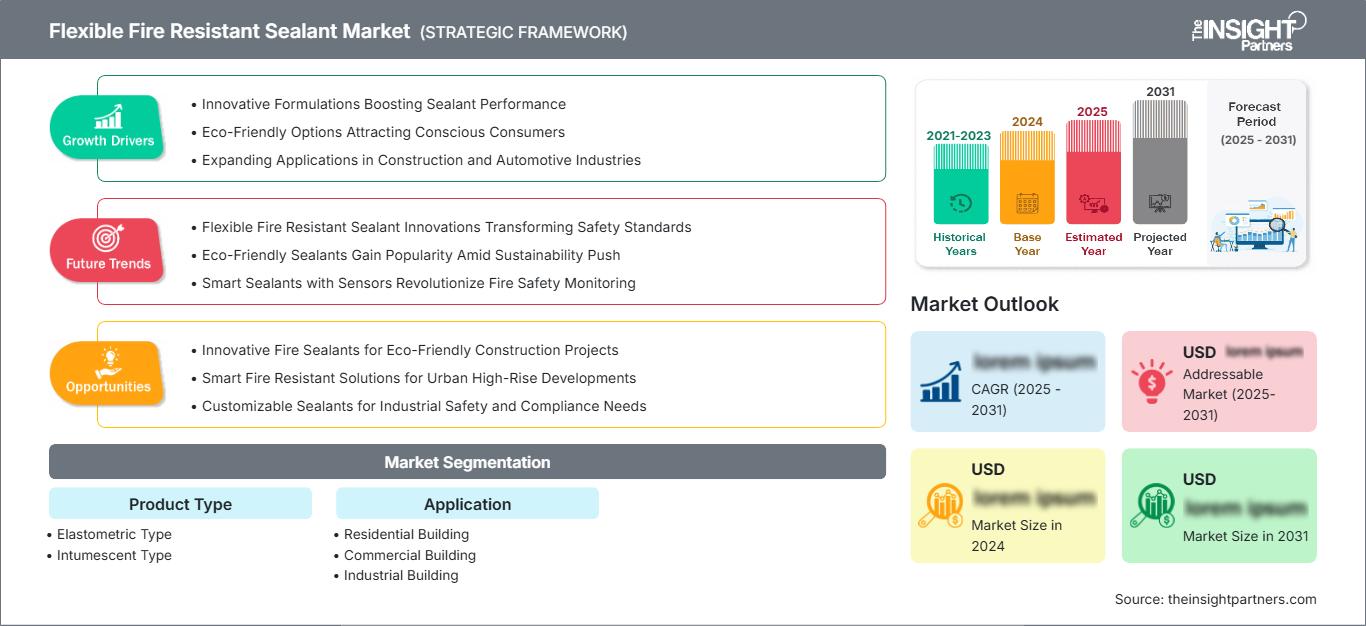
Flexible Fire Resistant Sealant Market: Strategic Insights
Regional Insights
North America Flexible Fire Resistant Sealant Market
North America held 29-33% of the total Flexible Fire Resistant Sealant Market share in 2025 and is expected to experience a CAGR of 3.60-4.10% between 2025 and 2034. The United States has the largest consumption in the region due to mandatory firestop requirements, commercial buildings, healthcare construction, data centers, and renovations of old buildings. Contributions from Canada will come from commercial, institutional, and infrastructural projects that require fire tested assemblies.
The growth of demand will be driven by requirements for through penetrations, construction joints, and perimeter fire barriers. Products are now selected based on their ability to resist movement, smoke seal, sound absorption, and water intrusion besides fire resistance. Availability of reliable manufacturers and distributors will drive the market, and at the same time, inspection and documentation requirements will drive contractors to utilize tested systems.
U.S. Flexible Fire Resistant Sealant Market
The US accounted for 77%–82% of North America consumption in 2025 and will experience growth at 3.70%–4.20% CAGR over 2026–2034. Commercial structures, healthcare establishments, educational establishments, tall structures, and data centers continue to represent major end-user segments. Typical features include fire test ratings, movement capabilities, smoke management, and accommodation of penetrations.
3M Company, Hilti Aktiengesellschaft, Specified Technologies Inc., Tremco Incorporated, and Pecora Corporation enjoy high market presence within construction applications. Increasing refurbishment of old buildings and compartmentalization are other contributing factors. Increasing preference among contractors for gun grade, ready to install materials that ensure simplified installation process, without compromising performance within approved assemblies.
Europe Flexible Fire Resistant Sealant Market
Europe’s market accounted for 25–29% and is expected to register a CAGR of 3.40–3.90% during 2026–2034. Germany continues to be a major contributor on account of industrial construction and fire-safety engineering expertise. The UK market is driven by compartmentation rules and renovations, while the French, Italian, and Spanish markets contribute due to commercial, residential, and industrial construction.
Germany represents high industrial construction combined with stringent building material requirements; therefore, there is increased demand for firestop products, including joint and penetration sealing solutions. The UK market is focused on compartmentation, renovation, and compliance in high-density buildings. The French, Italian, and Spanish markets present growth potential in terms of commercial renovations, residential projects, transport infrastructure, and industrial construction.
APAC Flexible Fire Resistant Sealant Market
APAC represented 27–31% of global demand in 2025 and is expected to achieve a 4.40–5.00% CAGR. China is the leading market, while Japan and South Korea maintain mature industrial applications. India and Australia provide additional opportunities through commercial construction, infrastructure, manufacturing, and institutional projects.
Industrial expansion and urban development remain important demand factors. China benefits from extensive construction activity, India from infrastructure and commercial development, and Australia from stringent building-performance requirements. Greater adoption of passive-fire-protection systems is encouraging the use of tested sealants around service penetrations and construction joints.
Middle East & Africa Flexible Fire Resistant Sealant Market
Demand in the Middle East and Africa is projected to rise at a CAGR of 3.20–3.80% to 2034. Key markets are represented by Saudi Arabia and UAE, driven by major construction projects. South Africa offers a relatively well-established construction and manufacturing base, while the rest of MEA drives demand via localized projects.
Fire-rated joint sealants and fire-rated penetration sealants have their application scope in energy infrastructure, airport infrastructure, transport infrastructure, hospitals, and large construction projects. Specifiers increasingly factor in the aspect of passive fire protection in design as part of the project design process.
Segmentation Analysis
Product Type
The Product Type segment is projected to expand at a CAGR of 3.70–4.20% during 2026–2034. Product selection depends on required movement capability, fire mechanism, substrate conditions, penetration configuration, and installation environment. Elastomeric systems remain widely applicable, while intumescent technologies provide expansion-based protection around vulnerable penetrations and joints.
- Elastometric Type: Elastomeric sealants provide flexibility and movement accommodation across dynamic joints. Their ability to remain pliable after curing makes them important for construction interfaces exposed to thermal cycling, vibration, and structural movement.
- Intumescent Type: Intumescent formulations expand when exposed to elevated temperatures, helping maintain protection around penetrants and openings. They are strategically important where changing penetration geometry requires expansion to preserve the firestop barrier.
Application
The Application segment is expected to register a CAGR of 3.60–4.10% through 2034. Adoption varies with building occupancy, fire-compartment requirements, construction density, and penetration complexity. Commercial and industrial projects typically require extensive fire-rated service coordination, while residential applications increasingly incorporate passive-fire measures.
- Residential Building: Residential demand is influenced by compartmentation, electrical penetrations, plumbing services, and fire-rated wall assemblies. Multi-family housing and high-density developments provide stronger opportunities where numerous services cross fire-resisting construction.
- Commercial Building: Commercial buildings require extensive sealing around cables, pipes, ducts, façade interfaces, and construction joints. Hospitals, offices, hotels, and retail facilities represent important users because uninterrupted compartmentation is central to occupant safety.
- Industrial Building: Industrial facilities require specialized sealing for mechanical, electrical, process, and utility penetrations. Manufacturing plants, warehouses, energy facilities, and logistics centers offer sustained demand because fire protection must accommodate complex service configurations.
Opportunity Snapshot
| Application | Revenue Contribution | Trend Tag | Adoption Stage |
|---|---|---|---|
| Residential Building | Medium | Compartment Sealing | Scaling |
| Commercial Building | High | Firestop Systems | Mature |
| Industrial Building | High | Penetration Sealing | Scaling |
Flexible Fire Resistant Sealant Market Growth Drivers and Impact Analysis
Stricter compartmentation and fire-safety enforcement
There is growing recognition among construction officials and building owners of the need for compartmentalization due to the potential hazard from flames and smoke moving unchecked through service openings in a structure’s fire-resistant components. This is increasing the significance of tested joint and penetration systems rather than simply depending on the traditional building materials alone. Sealants are important especially at points where pipes, cables, ductwork, and structural items penetrate walls or floors. The result is increased specification-driven purchases, documentation requirements, and needs for products that will work with certified assemblies. Companies with comprehensive certification lines can have greater access to projects since engineers and builders prefer products with tested results.
Expansion of high-density commercial and industrial facilities
Today’s modern commercial and industrial buildings have many complex systems like electrical, communication, HVAC, plumbing and process systems. Therefore, data centers, hospitals, logistics centers, manufacturing plants and other big buildings need many penetration seals. This makes it necessary to use flexible sealants that can move along and provide barriers for fire and smoke. Sealing materials may be exposed to vibration, temperature variations, moisture and mechanical stress in the industrial environment, hence creating a need for better sealing materials. Manufacturers have an opportunity to differentiate themselves in areas such as adhesion, flexibility, waterproofing, acoustics and ease of installation.
Renovation of aging buildings and infrastructure
A substantial installed base of older buildings creates recurring opportunities for remediation, replacement, and upgrading of fire-rated assemblies. Renovation projects often involve newly routed cables, upgraded mechanical services, or changes to wall and floor configurations that create additional penetrations. Existing structures may also contain outdated sealing materials that no longer correspond to current specifications. Flexible firestop products can address these conditions because many are available in repairable or re-enterable formulations. The commercial impact is particularly relevant in mature markets where new construction growth is moderate but refurbishment expenditure remains substantial. Suppliers that offer technical surveys, compatible replacement systems, and documentation for retrofit projects can strengthen customer retention while increasing recurring demand from building owners and facility-management contractors.
Flexible Fire Resistant Sealant Market Future Trends
Digital specification and firestop documentation integration
Future procurement will increasingly connect sealant selection with digital building specifications, product libraries, and project documentation. Designers and contractors are likely to use digital tools to identify compatible firestop assemblies based on wall type, penetrant, joint configuration, and required resistance. This can reduce specification errors and improve traceability during inspection. Manufacturers may therefore invest in searchable databases, digital engineering judgments, installation guides, and model-based product information. The Flexible Fire Resistant Sealant Market Trends will benefit as documentation becomes a competitive differentiator rather than a supporting service. Suppliers with structured technical data can improve specification visibility while helping contractors verify whether installed products correspond with approved system configurations and project requirements.
Multifunctional firestop formulations
Future formulations are expected to combine fire resistance with additional performance characteristics, including acoustic sealing, moisture resistance, low emissions, movement accommodation, and improved application behavior. Multifunctionality can reduce the number of products required at complex building interfaces and simplify contractor procurement. Silicone, acrylic, polyurethane, and hybrid chemistries may be optimized for different combinations of flexibility, adhesion, curing behavior, and fire performance. Manufacturers are also likely to explore formulations that support lower environmental impact without compromising certification requirements. This trend could shift competition toward performance packages rather than simple fire-rating comparisons, particularly in hospitals, offices, transportation facilities, and other projects where acoustic and indoor-environment considerations influence material selection.
Flexible Fire Resistant Sealant Market Opportunities
Expansion through emerging construction economies
Manufacturers can pursue growth by strengthening technical distribution and specification support in India, Southeast Asia, the Middle East, and selected Latin American markets. These regions combine expanding commercial construction with increasing adoption of international building practices. Local technical teams can help contractors understand firestop system selection, penetration preparation, joint movement, and installation requirements. Strategic partnerships with distributors and building-material suppliers can improve project access without requiring extensive manufacturing investment at the outset. The Flexible Fire Resistant Sealant Market Forecast is particularly attractive where high-rise buildings, hospitals, airports, data centers, and industrial facilities are increasing. Suppliers can prioritize certified products and application training to build specification credibility while adapting packaging and distribution models to local contractor practices.
Integrated passive-fire-protection portfolios
A second opportunity lies in combining flexible sealants with complementary passive-fire products, including collars, wraps, boards, mortars, coatings, and penetration devices. Large projects frequently require multiple protection methods because service configurations vary throughout a building. Vendors that can supply a coordinated portfolio may simplify procurement, technical approval, and installation training for contractors. This strategy also creates opportunities for system-level specification with architects, fire engineers, and mechanical contractors. Investment should focus on compatibility testing, application guidance, and technical service rather than solely increasing product variants. A broad portfolio can improve account penetration and reduce dependence on individual sealant categories, particularly in complex commercial, healthcare, industrial, and infrastructure projects requiring multiple fire-resistance configurations.
Recent Developments
- January 2026: Nullifire launched FS704, a next-generation fire-resistant hybrid sealant designed for linear joints in concrete, steel, drywall, and timber assemblies. The solvent-free, paintable formulation provides up to 2 hours of fire resistance, up to 25% movement capability, and resistance to ageing and weathering. The product is also free from phthalates, isocyanates, and silicone.
- March 2025: PENOSIL introduced new fire-resistant sealing solutions, including FireStop Intumescent Acrylic 681, FireStop Intumescent Graphite Acrylic 682, and FireStop Hybrid 720. The products target joints and service penetrations, with selected systems achieving fire resistance ratings of up to EI240. The development emphasizes low-VOC formulations, movement capability, third-party testing, and suitability for residential and commercial construction.
Frequently Asked Questions

- Comprehensive Market Sizing and Forecast Analysis
- Detailed Segmentation Analysis
- In-Depth Market Dynamics Assessment
- Regional and Country-Level Insights
- Competitive Landscape and Company Benchmarking
- Strategic Business Intelligence
Recent Reports
Testimonials

The Insight Partners provided valuable market intelligence that supported our global go-to-market strategy. Their team was professional, responsive, and attentive to our feedback, providing thoughtful analysis and helpful methodological clarifications throughout the project.
Junmo Kim Chief Financial Officer (CFO), Enertech Co., Ltd.
The Insight Partners' SCADA System Market report is comprehensive, with valuable insights on current trends and future forecasts. The team was highly professional, responsive, and supportive throughout. We are very satisfied and highly recommend their services.
RAN KEDEM Partner, Reali Technologies LTDs
I requested a report on a very specific software market and the team produced the report in a few days. The information was very relevant and well presented. I then requested some changes and additions to the report. The team was again very responsive and I got the final report in less than a week.
JEAN-HERVE JENN Chairman, Future Analytica
We worked with The Insight Partners for an important market study and forecast. They gave us clear insights into opportunities and risks, which helped shape our plans. Their research was easy to use and based on solid data. It helped us make smart, confident decisions. We highly recommend them.
PIYUSH NAGPAL Sr. Vice President, High Beam Global
The Insight Partners delivered insightful, well-structured market research with strong domain expertise. Their team was professional and responsive throughout. The user-friendly website made accessing industry reports seamless. We highly recommend them for reliable, high-quality research services
YUKIHIKO ADACHI CEO, Deep Blue, LLC.
This is the first time I have purchased a market report from The Insight Partners.While I was unsure at first, I visited their web site and felt more comfortable to take the risk and purchase a market report.I am completely satisfied with the quality of the report and customer service. I had several questions and comments with the initial report, but after a couple of dialogs over email with their analyst I believe I have a report that I can use as input to our strategic planning process.Thank you so much for taking the extra time and making this a positive experience.I will definitely recommend your service to others and you will be my first call when we need further market data.
JOHN SUZUKI President and Chief Executive Officer, Board Director, BK Technologies
I wish to appreciate your support and the professionalism you displayed in the course of attending to my request for information regarding to infectious disease IVD market in Nigeria. I appreciate your patience, your guidance, and the fact that you were willing to offer a discount, which eventually made it possible for us to close a deal. I look forward to engaging The Insight Partners in the future, all thanks to the impression you have created in me as a result of this first encounter.
DR CHIJIOKE ONYIA MANAGING DIRECTOR, PineCrest Healthcare Ltd.Reason to Buy
- Informed Decision-Making
- Understanding Market Dynamics
- Competitive Analysis
- Identifying Emerging Markets
- Customer Insights
- Market Forecasts
- Risk Mitigation
- Boosting Operational Efficiency
- Strategic Planning
- Investment Justification
- Tracking Industry Innovations
- Aligning with Regulatory Trends





 Get Free Sample for