Flexible Plastic Packaging Market Size & Overview
The Flexible Plastic Packaging Market is valued at US$ 199.97 Billion in 2025 and is projected to reach US$ 318.75 Billion by 2034, expanding at a 5.32% CAGR during 2026–2034. The market encompasses plastic and aluminum foil materials across pouches, rollstock, bags, films and wraps, with flexography, rotogravure, and digital printing supporting applications in food and beverages, pharmaceuticals and nutraceuticals, and cosmetics and personal care.
North America remains an important demand center, supported by established packaged-food supply chains, pharmaceutical manufacturing, convenience-oriented formats, and continued conversion from rigid to lightweight packaging. The Flexible Plastic Packaging Market size is also influenced by investments in recyclable structures, downgauging, high-barrier films, and digitally enabled short-run production. North America is modeled to expand at approximately ~5% CAGR through 2034, reflecting mature but resilient replacement and conversion demand.
The Flexible Plastic Packaging Market growth is mainly driven by the demand for light-weight and compact packaging options in food, beverages, healthcare, personal care, and household industries. Films, pouches, and bags provide a good balance between protection and reduced material usage compared to many rigid options, while various special pouch types such as resealable, spouted, retort, vacuum, and high-barrier types cater to specific needs. The value chain includes polymer suppliers, aluminum foil suppliers, film extrusion plants, laminators, printing facilities, converters, machine manufacturers, brand owners, retailers, and recyclers. Therefore, demand is not only driven by packaging quantities but also by resin prices, conversion efficiency, shelf-life requirements, and machine capability. The supply side of the business is increasingly driven by the availability and price of polyethylene, polypropylene, polyester, aluminum foil, inks, adhesives, and recyclates. Large converters have an advantage in terms of procurement efficiency, integrated manufacturing operations, geographic coverage, and good relationships with global brands, while regional converters focus on customization and fast delivery. The industry is therefore experiencing consolidation among technologically advanced firms alongside a large regional converter sector. Flexible packaging manufacturers are also adapting their packaging structure to be recyclable without compromising sealing, barrier, filling line, and food contact properties.
The Flexible Plastic Packaging Market analysis suggests that competition trends are transitioning from mere film conversion to an integration of material science, design engineering, sustainability, and customer qualification. The merger of Amcor and Berry Global was achieved in April 2025, making significant additions to its portfolio and scope. Other players include Sonoco Products Company, Constantia Flexibles, Huhtamaki Oyj, Mondi, Sealed Air, Transcontinental Inc., CCL Industries, Coveris, and ProAmpac, who all compete in varying combinations of films, pouches, labels, specialty structures, and end use applications. Investments are being made into recyclable mono-material structures, high barrier products, automation, digital printing, and capacity to serve regional customers. Amcor informed about the availability of recycle ready solutions for 96% of its flexible packaging portfolio by square meter at the end of FY25, demonstrating the extent of sustainable product innovation in leading manufacturers.
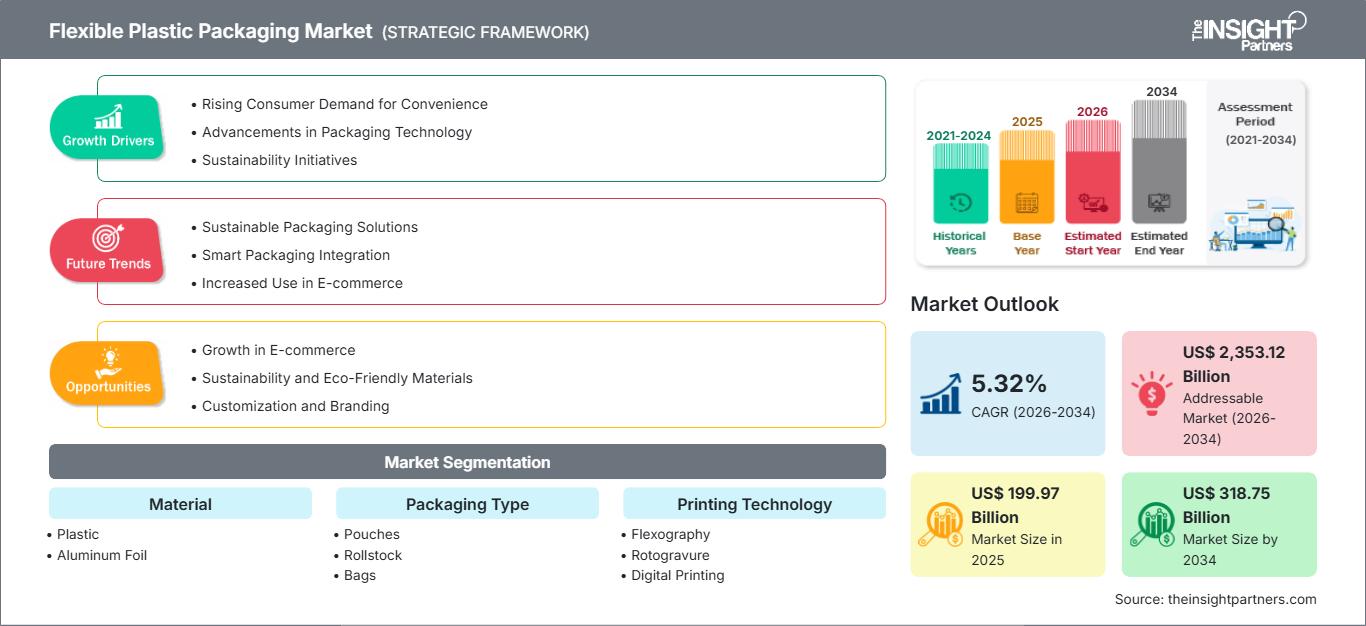
Flexible Plastic Packaging Market Assessment and Insights
Regional Outlook
- North America: ~24% of the global market in 2025 | ~5% CAGR through 2034. Market position: North America represents a major mature regional market, supported by sophisticated food and beverage processing, pharmaceutical packaging demand, established converting infrastructure, and continued investment in lightweight and recyclable flexible formats.
- US: ~81% of North American market revenue in 2025 | ~5% CAGR through 2034. Market position: The US anchors North American demand through its large packaged-food, healthcare, personal-care, and retail ecosystems. Brand owners increasingly prioritize material efficiency, shelf-life performance, and recyclable packaging structures.
- Europe: ~27% of the global market in 2025 | ~5% CAGR through 2034. Market position: Europe combines mature flexible-packaging consumption with strong regulatory pressure for recyclability. Germany is the leading country in Europe, supported by advanced converting capabilities, food manufacturing, consumer-goods production, and established recycling infrastructure.
- Asia Pacific: ~40% of the global market in 2025 | ~6% CAGR through 2034. Market position: Asia Pacific is the largest and fastest-growing region, led by China, with India, Japan, and South Korea contributing through expanding packaged-food consumption, manufacturing capacity, exports, and investments in higher-performance flexible packaging.
Segment Outlook
- Plastic: ~88% Share in 2025 | ~5% CAGR through 2034. Market position: Plastic remains the dominant material because polyethylene, polypropylene, polyester, and multilayer structures provide a strong combination of barrier performance, sealability, machinability, lightweighting, and cost efficiency across high-volume packaging applications.
- Digital Printing: ~8% Share in 2025 | ~9% CAGR through 2034. Market position: Digital printing is the high-growth main segment as brands seek shorter production runs, versioning, personalization, rapid artwork changes, and reduced setup requirements, particularly for premium consumer products and targeted promotional campaigns.
Competitive Coverage
Amcor plc, ProAmpac, Sonoco Products Company, Constantia Flexibles, Huhtamaki Oyj, Mondi, Sealed Air, Transcontinental Inc., CCL Industries, Coveris
Methodology
The Insight Partners follows Data Collection & Secondary Research, Primary Research, Data Analysis, and Data Triangulation & Final Review to validate market estimates and insights.
Source: The Insight Partners' analysis based on proprietary research, government publications, company annual reports, investor presentations, industry databases, and expert interviews.
Flexible Plastic Packaging Market Trends
Mono-Material Architecture and Recycle-Ready Performance
The Flexible Plastic Packaging Market trends indicate that future product development is likely to increasingly prioritize structures designed around a single dominant polymer family while retaining the barrier and sealing characteristics demanded by modern packaging lines. This trend will not eliminate multilayer engineering, because food safety, oxygen protection, moisture resistance, and retort performance can still require multiple functional layers. Instead, innovation is moving toward compatible polymer combinations, coatings, adhesives, and barrier technologies that simplify recovery. Huhtamaki describes the transition from complex multilayer structures toward mono-material solutions as a response to changing regulatory and customer requirements. Suppliers that can demonstrate recyclability without sacrificing shelf life or machinability should gain stronger access to brand-owner qualification programs.
Digitally Enabled Packaging Production and Versioning
Digital printing is expected to become more integrated into flexible packaging workflows as brands seek shorter campaigns, regional product variants, personalized graphics, and faster artwork changes. The technology can reduce dependence on long production runs and make smaller-volume variants more economically practical. This is particularly relevant for premium food, seasonal products, cosmetics, and targeted promotional programs. Digital workflows can also support tighter integration between artwork management, production scheduling, variable information, and quality control. Over time, the commercial opportunity should extend beyond printing equipment to inks, substrates, workflow software, inspection systems, and finishing technologies. The resulting production model favors converters that can combine conventional high-volume printing with digitally enabled flexible capacity.
Flexible Plastic Packaging Market Growth Factors
Expansion of Convenience-Oriented Food and Beverage Formats
Consumer demand for portability, resealability, portion control, and longer shelf life is increasing the addressable range for flexible formats across snacks, sauces, ready meals, frozen foods, pet food, and beverages. Pouches and high-performance films can integrate zippers, spouts, easy-open seals, and retort or vacuum functionality, allowing brands to match packaging with specific consumption occasions. The commercial impact extends beyond packaging volume because higher-value structures require specialized films, adhesives, barrier layers, printing, and converting expertise. This supports value growth for suppliers capable of delivering consistent machinability and product protection. In emerging markets, improving organized retail and packaged-food penetration can add incremental volume, while mature markets are more likely to generate demand through format conversion, premiumization, and functional upgrades.
Regulatory Push Toward Recyclable and Resource-Efficient Structures
Packaging regulation is accelerating investment in designs that use fewer materials and can move through established recovery systems. The EU PPWR entered into force in 2025 and is designed to improve circularity, recycling, resource efficiency, and harmonization across packaging markets. This creates commercial pressure for converters to redesign multilayer structures, qualify compatible polymers, increase recycled-content use, and preserve barrier performance during material simplification. The impact is visible in product-development strategies across major suppliers, including mono-material polyethylene and polypropylene structures and recycle-ready portfolios. Companies with internal material-science capabilities can reduce qualification timelines, while smaller converters may increasingly rely on partnerships with resin producers, recyclers, equipment suppliers, and brand owners to satisfy evolving specifications.
Growth of Pharmaceutical and Personal-Care Packaging Requirements
Healthcare, nutraceutical, cosmetics, and personal-care applications are expanding the role of flexible packaging beyond high-volume food products. These categories require precise barrier properties, controlled sealing, hygiene, product protection, and strong graphics, creating opportunities for specialized films and laminates. Pharmaceutical applications also benefit from lightweight sachets and pouches where controlled material use can coexist with product protection. Personal-care brands are increasingly exploring refill and concentrated-product formats that can reduce packaging material per use. The market impact is a shift toward technically differentiated structures rather than commodity film alone. Suppliers able to combine regulatory compliance, high-quality printing, controlled converting, and consistent barrier performance can participate in higher-specification applications with longer customer qualification cycles.
Flexible Plastic Packaging Market Opportunities
Regionalized Production for Emerging Consumer Markets
Investment opportunities exist in localized converting capacity across high-growth consumer markets where packaged-food, personal-care, pharmaceutical, and modern-retail penetration is increasing. Regional production can reduce lead times, improve responsiveness to local artwork and regulatory requirements, and lower dependence on imported finished packaging. Asia Pacific offers particularly strong structural potential because of manufacturing scale and expanding domestic consumption, while selected Middle Eastern and African markets can benefit from proximity to polymer feedstocks and growing food-processing infrastructure. Investors should evaluate polymer availability, power reliability, printing and lamination capabilities, recycling infrastructure, customer concentration, and export connectivity rather than capacity alone. Facilities designed for multiple substrates and flexible format changes can serve a wider customer base and reduce dependence on one end-use category.
High-Barrier and Specialty Flexible Structures
Specialty packaging provides an opportunity to move beyond commodity film conversion into applications where barrier performance, thermal resistance, seal integrity, or product protection determines supplier selection. Pharmaceutical, nutraceutical, retort food, medical, personal-care, and sensitive-food applications can require tightly controlled specifications and extensive customer qualification, creating stronger technical differentiation. Investment in coating, extrusion, lamination, inspection, and laboratory capabilities can therefore support entry into higher-value programs. Companies can also pursue specialty structures that combine improved recyclability with demanding performance requirements. The Flexible Plastic Packaging Market Forecasts point toward continued value creation from differentiated applications where material engineering and process control become more important than basic conversion capacity.
Segmentation Analysis
Material
Material is projected to record a ~5% CAGR during 2026–2034. The flexible plastic packaging market scope spans plastic and aluminum foil structures used to provide lightweighting, barrier protection, sealability, printability, and product protection. Adoption decisions depend on barrier requirements, material efficiency, recyclability, heat resistance, sealing performance, cost, and compatibility with packaging machinery.
- Plastic: Plastic remains the dominant material category across flexible packaging because polyethylene, polypropylene, polyester, and related polymers offer lightweight construction, strong sealability, processability, and broad compatibility with food, beverage, pharmaceutical, personal-care, and household applications. Increasing development of mono-material and recyclable structures is further shaping material selection.
- Aluminum Foil: Aluminum foil is strategically important for applications requiring high protection against oxygen, moisture, light, aroma, and other external factors. It is commonly incorporated into high-barrier laminates used for sensitive foods, pharmaceutical products, retort applications, and products requiring extended shelf-life protection.
Packaging Type
Packaging Type is projected to record a ~5% CAGR during 2026–2034. The flexible plastic packaging market across pouches, rollstock, bags, films, and wraps is influenced by convenience requirements, product protection, filling-line compatibility, material efficiency, shelf-life objectives, and consumer handling preferences.
- Pouches: Pouches support stand-up, flat, spouted, retort, and resealable formats across food, beverages, pet care, personal care, and household products. Their lightweight construction, portability, efficient material utilization, and ability to incorporate functional closures make them increasingly important for convenience-oriented packaging applications.
- Rollstock: Rollstock is widely used in automated form-fill-seal operations where manufacturers require flexibility in pack dimensions, sealing configurations, and production efficiency. It remains strategically important for high-volume food, snack, meat, dairy, and consumer-product packaging because it integrates efficiently with established packaging machinery.
- Bags: Bags serve applications including snacks, frozen foods, pet food, agricultural products, household products, and selected industrial goods. Their broad printable surfaces, lightweight construction, scalable production, and compatibility with different closures and filling systems support continued adoption across high-volume packaging applications.
- Films and Wraps: Films and wraps provide versatile solutions for wrapping, flow wrapping, overwrapping, lidding, and specialty barrier applications. Their strategic importance is linked to downgauging, machinability, printability, sealing performance, and the development of structures that can meet evolving recyclability requirements.
Printing Technology
Printing Technology is projected to record a ~6% CAGR during 2026–2034. Printing requirements within the flexible plastic packaging market vary according to production volume, artwork complexity, color consistency, customization, substrate characteristics, setup requirements, and turnaround time. Flexography and rotogravure remain important for high-volume production, while digital printing is expanding for shorter and more variable runs.
- Flexography: Flexography remains widely used for high-volume flexible packaging because it supports efficient production, broad substrate compatibility, rapid printing, and increasingly sophisticated color management. It is particularly relevant for recurring food, beverage, household, and consumer-product packaging programs requiring consistent graphics at commercial scale.
- Rotogravure: Rotogravure supports long production runs requiring high-quality reproduction, precise color consistency, and detailed graphics. It remains strategically important for established branded packaging programs where large order volumes and relatively stable artwork can justify the associated cylinder preparation and production economics.
- Digital Printing: Digital printing enables shorter production runs, variable artwork, customization, rapid design changes, and reduced setup requirements. Its adoption is increasing among brands seeking targeted campaigns, regional product variants, seasonal packaging, personalization, and faster time to market without relying on conventional plate-based production.
Application
Application is projected to record a ~5% CAGR during 2026–2034. The flexible plastic packaging market analysis across food and beverages, pharmaceuticals and nutraceuticals, and cosmetics and personal care reflects differences in barrier requirements, product sensitivity, regulatory requirements, shelf-life expectations, branding needs, and consumer convenience.
- Food and Beverages: Food and beverage applications represent a broad demand base covering snacks, bakery products, dairy, frozen foods, meat, sauces, ready meals, beverages, and other packaged products. Flexible structures are selected for barrier protection, shelf life, lightweighting, convenience, machinability, and increasingly for compatibility with recyclable packaging strategies.
- Pharmaceuticals and Nutraceuticals: Pharmaceutical and nutraceutical applications require controlled barrier properties, hygiene, product protection, tamper evidence, and regulatory compliance. Flexible packaging supports sachets, pouches, strip formats, and specialized protective structures where moisture, oxygen, light, and contamination control are important to product integrity.
- Cosmetics and Personal Care: Cosmetics and personal-care applications use flexible packaging for sachets, wipes, creams, refills, pouches, and specialized dispensing formats. Demand is influenced by portability, premium graphics, convenience, controlled dispensing, refill models, material efficiency, and the growing emphasis on packaging sustainability.
Opportunity Snapshot
| Application | Revenue Contribution | Trend Tag | Adoption Stage |
|---|---|---|---|
| Food and Beverages | High | Convenience Pouches | Mature |
| Pharmaceuticals and Nutraceuticals | Medium | Barrier Protection | Scaling |
| Cosmetics and Personal Care | Medium | Refill Formats | Scaling |
Regional Insights
North America Flexible Plastic Packaging Market
North America accounted for approximately ~24% of global demand in 2025 and is expected to expand at ~5% CAGR through 2034. The region boasts a high level of development in food processing, pharmaceutical production, cosmetics brands, and retail distribution centers. Consumer preferences are centered on pouches, bags, films, and high barrier packages where convenience, extending shelf life, lightweighting, and effective filling lines are economically relevant features. The USA ranks as the major region in terms of demand, along with Canada and Mexico due to food processing, consumer goods, manufacturing, and logistics.
Growth is becoming increasingly linked to material innovation rather than increased volume. Material downgauging, recyclability, recyclate content, improved barrier performance, and digital manufacturing capability are being invested in by brand owners and converters. The balance of mature consumption and continued format conversions keeps the pace of volume increase slow but drives value growth. Proximity of the supplier to large consumer-goods manufacturers is strategically significant due to qualification considerations, food contact compliance, printability, and machine compatibility.
U.S. Flexible Plastic Packaging Market
The US represented approximately ~81% of North American revenue in 2025 and is expected to grow at ~5% CAGR through 2034. Its size shows significant use of packaged foods, beverages, pharma products, cosmetic and personal care products. Flexible packaging is especially useful for snacks, frozen foods, meat and seafood, pet foods, medical products and personal care products where barrier properties and easy opening and resealability are essential.
The competition consists of Amcor plc, Sonoco Products Company, Sealed Air, ProAmpac and many other specialized converters operating for national and regional brands. The demand has been impacted by the needs of retailers and sustainability goals of the brands, which makes packaging suppliers seek to decrease material usage and develop structures that are suitable for recycling. The growth will hence include substitution of rigid packaging, premiumization, specialization and transition into better recyclable structures, instead of increasing packaging amounts.
Europe Flexible Plastic Packaging Market
Europe represented approximately ~27% of the global Flexible Plastic Packaging Market share in 2025 and is projected to expand at ~5% CAGR through 2034. Germany is the leading country in Europe, supported by its large industrial base, food manufacturing ecosystem, consumer-goods production, and sophisticated packaging-conversion capabilities. The UK has substantial demand from branded food, beverages, pharmaceuticals, and personal care, while France combines food processing and consumer-product demand with strong packaging sustainability initiatives.
Germany and Italy offer critical converting and machinery eco-systems, while France and Spain represent large demand for food, beverages, and consumer goods products. Region-wide, recyclability has become a purchasing criterion rather than just a development goal for the products. The EU Regulation on Packaging and Packaging Waste came into force in February 2025 and created the legislative base aiming at increased circularity and resource efficiency and recycling of packaging throughout its life cycle.
The consequence of this legislation has been a stronger trend towards mono-material polyethylene and polypropylene structures, downgauging, recycle content, and design able to go through recycling processes. Huhtamaki singled out the trend towards simplification of multilayer structures and switching to mono-material solutions due to changing European regulations. These trends create an advantage for converters with good formulation, printing, barriers and recycling design competencies.
APAC Flexible Plastic Packaging Market
Asia Pacific held approximately ~40% of global revenue in 2025 and is forecast to grow at ~6% CAGR through 2034, making it the largest and fastest-growing region. Being the dominant nation within the Asia Pacific region, China benefits from substantial manufacturing, food & beverages industry, consumer goods demand and an extensive converting environment. India is becoming increasingly important through its penetration into the packaged food market and organized retailing.
The Japan and South Korea regions are contributing with their advanced packaging solutions, specialty applications in electronics, healthcare and premium consumer goods and Australia for its dependable food, beverage, healthcare and household products demand. Localization, automation, material recycling and improvements in packaging regulations are driving investment decisions. The presence of both large manufacturing capabilities and growing consumption are presenting converters with opportunities to service multinationals and local businesses alike.
Middle East & Africa Flexible Plastic Packaging Market
Middle East & Africa is projected to grow at approximately ~6% CAGR through 2034. Saudi Arabia and the UAE possess the best organized packaging eco-systems due to food processing, consumer goods, petrochemical feedstocks, retail modernization, and logistics investments. South Africa is an important subregional manufacturing and consumption hub, while Rest of MEA consists of different markets where packaging demand is tied to population increase, food distribution, healthcare, and penetration of consumer products.
The benefits of feedstock in the region allow for polymer availability in major Gulf economies, while infrastructure investment increases modern manufacturing and distribution capacity. Flexible formats become more significant when lightweight packaging can help to alleviate logistics problems and increase the shelf life of products. In addition, regional converters have an advantage in proximity to petrochemical production and exports, although flexible packaging adoption varies according to recycling infrastructure, regulation, purchasing power, and development of food and pharmaceutical supply chains.
Flexible Plastic Packaging Market Report Scope
| Report Attribute | Details |
|---|---|
| Market size in 2025 | US$ 199.97 Billion |
| Market Size by 2034 | US$ 318.75 Billion |
| Global CAGR (2026 - 2034) | 5.32% |
| Historical Data | 2021-2024 |
| Forecast period | 2026-2034 |
| Segments Covered | Material, Packaging Type, Printing Technology, Application |
| Region scope | North America, Europe, Asia-Pacific, South and Central America, Middle East and Africa |
Recent Developments
- September 2026: Sealed Air — Sealed Air introduced CRYOVAC ZeroPrep hand-dispensing pouches for food-service condiments. The flexible pouch format is designed to reduce preparation and cleanup requirements while providing controlled dispensing and resealing, illustrating continued development of convenience-oriented flexible packaging for food-service operations.
- September 2026: Cosmo Speciality Chemicals launched CosmoFlex, an analog printable coating system engineered to boost printability and ink adhesion on flexible packaging and label films across BOPP and PET substrates.
Frequently Asked Questions

Recent Reports






