
Inhalation Drug Delivery Device Market Trends & Growth Forecast 2034
Coverage: By Types (Inhale and Nebulizer), Age Group (20 - 40 Years, 41 - 65 Years, 66 - 80 Years and 85+ Years) Distribution Channel (Hospitals Pharmacies, Retail Pharmacies and Online Pharmacies), and Geography (North America, Europe, Asia Pacific, Middle East & Africa, South and Central America and Asia Pacific)
- Status : Published
- Report Code : TIPRE00044075
- Category : Life Sciences
- No. of Pages : 307
- Available Report Formats :


- Last update date : October 07, 2026


2025 Market Size
US$ 35,097.56 Mn
Base year value
2034 Forecast
US$ 54,751.68 Mn
Projected by 2034
CAGR 2026-2034
5.1 %
Growth rate
Addressable Market
US$ 408,421.75 Mn
(2026-2034)
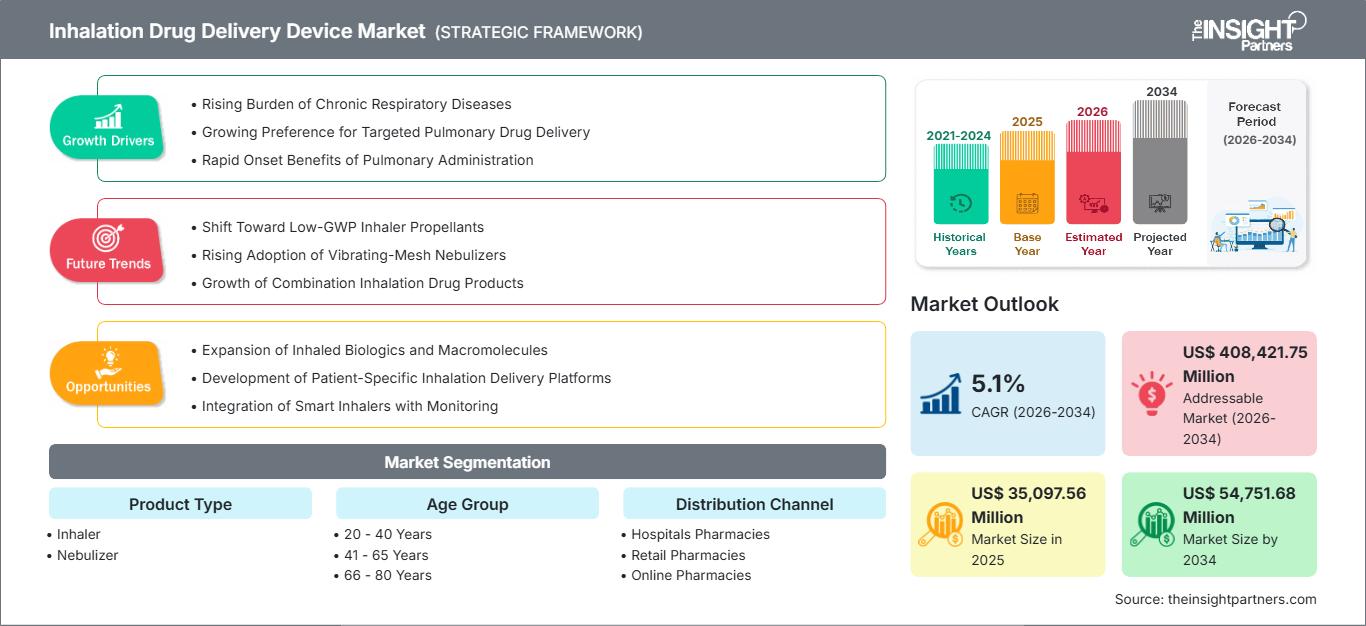
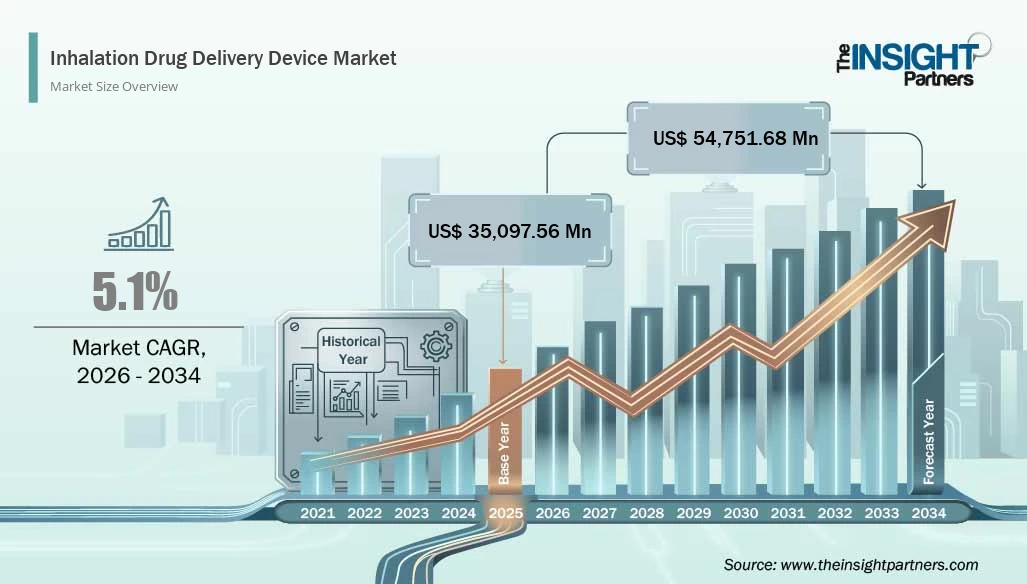
The Inhalation Drug Delivery Device Market was valued at US$ 35,097.56 Million in 2025 and is projected to reach US$ 54,751.68 Million by 2034. The market is expected to register a CAGR of 5.1% during 2026–2034. Expansion is due to continuous use of lungs for drug delivery, an increasing number of patients who need long-term respiratory management, and the ongoing innovation of portable devices for inhalation or nebulization of drugs.
North America remains a central commercial and innovation hub, with the Inhalation Drug Delivery Device Market size supported by an estimated regional CAGR of 4.6–5.0% during 2026–2034. A well-developed respiratory care system, availability of pharmacy, and the use of maintenance inhalers ensure repeat business. Pharmaceutical companies are also working on lower-emission propellants, combinations, adherence monitoring systems, and unique generics that help achieve environmental goals, affordability concerns, and the problem of inaccurate inhalation techniques by patients.
Inhalation Drug Delivery Device Market Assessment and Insights
- North America: The region represented a 33–35% share in 2025 and is expected to record a 4.6–5.0% CAGR between 2026–2034, supported by established reimbursement, respiratory specialists, and widespread maintenance-therapy utilization.
- US: The country accounted for 86–89% of North American revenue in 2025 and is projected to expand at a 4.5–4.9% CAGR between 2026–2034.
- Europe: Europe held a 27–29% share in 2025 and is anticipated to register a 4.9–5.3% CAGR between 2026–2034, led by Germany, the UK, France, Italy, and Spain.
- Asia Pacific: Asia Pacific represented a 29–31% share in 2025 and is expected to grow at a 5.3–5.7% CAGR between 2026–2034, with China, Japan, and India leading demand.
- Largest Segment: Inhalers captured a 90–93% market share in 2025 and are estimated to grow at a 4.9–5.2% CAGR between 2026–2034, reflecting portable administration and broad therapeutic compatibility.
- High Growth Segment: Online pharmacies held a 12–14% market share in 2025 and are projected to register a 6.7–7.4% CAGR between 2026–2034 as digital prescription fulfillment expands.
- Key companies analyzed in detail: GSK plc, AstraZeneca PLC, Boehringer Ingelheim International GmbH, Novartis AG, Teva Pharmaceutical Industries Ltd., Cipla Limited, Taian Dalu Medical Instrument Co., Ltd., Koninklijke Philips N.V., OMRON Corporation, and PARI GmbH.
Source: The Insight Partners' analysis based on proprietary research, government publications, company annual reports, investor presentations, industry databases, and expert interviews.
The development of devices has seen the shift from traditional pressurized metered-dose systems and stationary compressor nebulizers to dry powder inhalers, soft mist devices, portable mesh nebulizers, and digital-enabled inhalers. The production of devices is becoming increasingly driven by molding technology, valving, aerosols, compatibility between formulations and devices, and regulatory data for combination products. The Inhalation Drug Delivery Device Market is also facing a propellant transition phase where companies are evaluating low global warming potential propellants while maintaining similar plume geometry, emitted dose, stability, and handling properties.
Over the forecast period, companies will be focusing on making devices scalable in Asia-Pacific, Latin America, Middle East, and Africa. The areas of focus will include investment in cost-effective generics, portable nebulization, dose tracking capabilities, and simple interfaces. Regulatory support in promoting sustainable inhalers, access to essential medicines, and respiratory management at home provides favourable tailwinds, although the successful commercialization of such devices will be contingent on clinical comparability, manufacturing consistency, affordability, and patient acceptability.
Inhalation Drug Delivery Device Market Report Scope
| Report Attribute | Details |
|---|---|
| Market size in 2025 | US$ 35,097.56 Million |
| Market Size by 2034 | US$ 54,751.68 Million |
| Global CAGR (2026 - 2034) | 5.1% |
| Historical Data | 2021-2024 |
| Forecast period | 2026-2034 |
Inhalation Drug Delivery Device Market Analysis
The increase in the number of asthma and COPD patients drives market growth in Inhalation Drug Delivery Device Market, while increasing aged population raises the repeat usage of maintenance drugs. Value chain comprises of the manufacturers of Active Pharmaceutical Ingredient, formulations, cans, valves, plastics, electronics, combination products, wholesalers, pharmacies, hospitals, and homecare. Reliability at each step is very essential as aerosol particle size, valve performance, resistance, and patient administration skills have a direct impact on pulmonary deposition.
Strategy of supply is moving towards dual sourcing for actuators, valves, semiconductors, and pharmaceutical grade polymers. Co-ordination will be required between the design of the device and the development of the formulation; hence development cycles will be longer than those required for the conventional oral drugs. Inhaler devices have high volume manufacturing processes that have been proven effective, while the nebulizer devices compete on low noise level, portability, and shorter treatment times.
The competitive intensity ranges from patented combination therapies, branded devices, generic inhalers, to specialized nebulizers. The market analysis of the Inhalation Drug Delivery Device shows that GSK plc and AstraZeneca PLC are establishing themselves within their respiratory franchise and low carbon platform, while Boehringer Ingelheim International GmbH and Novartis AG continue to maintain a differentiation in their drug delivery technology.
The competitors are Koninklijke Philips N.V., OMRON Corporation, and PARI GmbH by means of technology, usability, and flexibility in application. The Taian Dalu Medical Instrument Co., Ltd. is responding to the needs in terms of equipment supply in economically challenging markets. There is an increasing focus in capital investment towards sustainable propellants, connectivity of sensors, human factors validation, and filling capabilities. Strategic success is now determined by regulatory approval of the drug-delivery system itself.
● REPORT CUSTOMIZATION
Tailor This Report To Align With Your Specific Business Requirements
This report can be customized to align precisely with your business objectives, scope, and target markets. Customization options include tailored segmentation, geography, competitive analysis, and strategic insights to support informed decision-making.
Customize This Report →WHAT YOU CAN ADJUST
- ● Segmentations
- ● Geography
- ● Competitive Analysis
- ● Language Preferences
Inhalation Drug Delivery Device Market: Strategic Insights
Regional Insights
North America Inhalation Drug Delivery Device Market
North America accounted for a 33–35% Inhalation Drug Delivery Device Market share in 2025 and is expected to expand at a 4.6–5.0% CAGR during 2026–2034. Recurring prescriptions for asthma and COPD, extensive retail pharmacy networks, and established coverage for maintenance therapies support volume stability. Adoption is also reinforced by specialist-led treatment escalation and greater use of combination inhalers.
Competitive activity centres on lower-carbon pressurized devices, complex generics, connected adherence tools, and therapies serving patients inadequately controlled by dual treatment. The region’s mature regulatory framework requires extensive aerosol performance, usability, and manufacturing data, raising development barriers but supporting product differentiation. Home respiratory care additionally sustains demand for portable compressor and mesh nebulizers among older adults, pediatric patients, and individuals who cannot generate sufficient inspiratory flow for certain dry-powder devices.
U.S. Inhalation Drug Delivery Device Market
The US represented 86–89% of North American revenue in 2025 and is projected to register a 4.5–4.9% CAGR during 2026–2034. High diagnosis rates, wide availability of drugs, and processes for drug-device combinations are enabling economies of scale. The retail pharmacies have significant weight due to the need for repeat dispensing, counselling, adjudication, and substitution of controller and rescue medications.
GSK plc, AstraZeneca PLC, Boehringer Ingelheim International GmbH, Teva Pharmaceutical Industries Ltd., and Novartis AG have a strong presence in respiratory care, and OMRON Corporation, PARI GmbH, and Koninklijke Philips N.V. cover nebulization and homecare needs. The applications are moving towards single inhaler combination treatment, ease of actuation, portability of aerosols, and systems that record the use patterns. Although generics can enhance accessibility, device specific training is still needed because of differences in handling, flow resistance, priming and adherence caused by platform substitution.
Europe Inhalation Drug Delivery Device Market
Europe held a 27–29% share in 2025 and is forecast to expand at a 4.9–5.3% CAGR during 2026–2034. Germany sets the pace in regional demand due to high treated population numbers, wide insurance coverage and good pharmacy route. Lifecyle emissions have become an increasing part of procurement assessment together with clinical efficacy, usability and cost of treatment.
The UK uses well-defined respiratory therapy protocols combined with focus on less emitting inhalers and proper technique. Germany promotes not only branded devices but also reimbursable generic versions, however reliable performance and economic value should be proven by manufacturers. France, Italy, Spain provide prescriptions in national healthcare systems, with tender and substitution regulations affecting supplier position.
European region invests into development of low-emissions propellants, dry powder technologies, recyclable products and local combination devices production. Device manufacturers who provide environmental benefits according to patients' needs are able to meet all European prescribers’ needs.
APAC Inhalation Drug Delivery Device Market
Asia Pacific captured a 29–31% share in 2025 and is projected to record a 5.3–5.7% CAGR during 2026–2034, the fastest regional pace. China is the leader in the regional market, thanks to its large-scale manufacturing capability, increasing diagnoses, hospital availability, and local production of respiratory devices.
The advanced and smaller-sized systems are more favoured in Japan and South Korea, whereas India can be seen to have some potential in the market with the availability of affordable inhalers and locally produced generic devices.
Middle East & Africa Inhalation Drug Delivery Device Market
The Middle East and Africa market is expected to expand at a 4.7–5.1% CAGR during 2026–2034. Saudi Arabia is leading the regional commercial opportunity by way of healthcare development, hospital building, and chronic disease care. UAE focuses on advanced private care facilities along with connected healthcare infrastructure.
South Africa offers the most diverse pharmacy and clinical distribution network in the region, while Rest of MEA faces challenges of affordability and lack of inhaled medications. Energy-driven infrastructure development projects, urban hospitals, local distributor collaboration, and portable nebulizers offer opportunities, but maintenance and consumables pose challenges to suppliers.
Segmentation Analysis
Product
The product segment is expected to register a 5.0–5.3% CAGR during 2026–2034. Inhalation Drug Delivery Device Market Scope covers portable inhalers and electric nebulizers providing maintenance, rescue, acute-care, and home-care applications. The choice depends on factors such as formulation, inspiratory capability, dose accuracy, duration of therapy, portability, and patient skill. The inhalers take a larger share in recurring prescriptions, but the nebulizers still hold strategic significance.
- Inhaler: Inhalers represented 91.8% of revenue in 2025, due to its small size, quick administration, repeat prescription, wide therapeutic application, and usage in both asthma and COPD management.
- Nebulizer: Nebulizers accounted for 8.2% in 2025 and are crucial for paediatric, elderly, acute care, and patients with low inspiratory flow rates needing extended administration without actuation coordination.0.
Age Group
The age-group segment is projected to record a 5.0–5.4% CAGR during 2026–2034. Factors such as aging-induced respiratory dysfunction, concomitant disease, dexterity problems, and cognitive load determine the type of device to use. Younger users prefer devices that are portable and provide discrete dosing, while older users need devices that offer low resistance, dosing markers, easy loading, caregiver assistance, or nebulization.
- 20 - 40 Years: This group represented 11.8% in 2025 and prefer portability, adherence through apps, discretion during use, and technology that is adaptable to an active lifestyle and workplace environment.
- 41 - 65 Years: Accounting for 29.5% in 2025, This population is a source of repeated demand owing to chronic respiratory diseases management, occupational hazards, smoking, and upgradations in medication.
- 66 - 80 Years: The leading age group held 42.6% in 2025, As a result of more cases of COPD, multimorbidity, repeated controller medication, and need for simple and caregiver-assisted usage.
- 85+ Years: This group represented 16.1% in 2025 and the need for respiratory devices that can be used even with decreased inspiratory airflow, poor dexterity, cognitive disability, caregiver assistance, etc.
Distribution Channel
The distribution-channel segment is expected to expand at a 4.9–5.3% CAGR during 2026–2034. Retail pharmacies are key to repeat prescription dispensing, and hospital pharmacies are key for therapy onset, emergency respiratory care, and discharge management. Online pharmacies become important via electronic prescribing, automatic refilling, and home delivery, although their growth depends on reliable logistics that do not rely on the cold chain, counseling, and authorization.
- Hospitals Pharmacies: Hospital pharmacies accounted for 37.5% in 2025, serving acute episodes, specialist-initiated therapy, severe disease, discharge prescriptions, and patients requiring supervised device selection or training.
- Retail Pharmacies: Retail pharmacies represented 50.0% in 2025 and keep up their dominance through local availability, refill schedule, claims process, generic substitution, and technique counselling by pharmacists.
- Online Pharmacies: Online pharmacies captured 12.5% in 2025, with demand is backed by electronic prescribing, subscription programs, home delivery, cost comparisons, and web-based availability to chronic patients.
Opportunity Snapshot
Inhalation Drug Delivery Device Market Forecasts indicate that age-specific device design will create investment opportunities across portability, low-resistance actuation, dose visibility, and caregiver-supported administration.
| Age Group | Revenue Contribution | Trend Tag | Adoption Stage |
| 20 - 40 Years | Low | Connected Adherence | Scaling |
| 41 - 65 Years | High | Combination Therapy | Mature |
| 66 - 80 Years | High | Assisted Actuation | Mature |
| 85+ Years | Medium | Caregiver Support | Scaling |
Inhalation Drug Delivery Device Market Growth Drivers and Impact Analysis
Expanding Long-Term Management of Respiratory Disease
More stringent demands in terms of constant management of asthma and COPD drive up the need for inhalers in rescue, maintenance, and combination modes. Inhalation allows for drug delivery directly into the lungs with lower systemic absorption than other methods. The commercial opportunity is recurrent and not one-time, since patients will need to get refills, new inhaler units, retraining in their use, and eventually escalation in their treatment. Population aging makes this trend more prevalent through increased COPD prevalence, decreased lung function, and reliance on at-home care. Companies may react by developing platforms that would fit different strengths of breath, different manual skills, and cognitive capacities. Pharmacies and clinics have the advantage of repeated dispensing, while payers are interested in compliance and exacerbations prevention, since poor management of the condition could lead to ER visits, hospitalizations, and additional costs.
Transition Toward Lower-Carbon Inhalation Platforms
Environmental considerations of metered-dose inhalers under pressure are driving investments in alternative propellants, dry powder products, soft mist devices, and recyclable technology. Such evolution has created an entire cycle of replacements from the formulation development stage to the material selection of canisters, choice of elastomers, valve selection, filling equipment, testing for stability, and registration procedures. Pharmaceutical companies need to maintain the same efficacy and customer acceptance level but reduce the impact on the environment. According to the report of GSK plc, the next generation of their salbutamol inhaler containing HFA-152a would be able to cut down greenhouse gas emissions per inhaler up to 92%. This trend involves higher investments but might help to improve their portfolio with respect to healthcare procurement goals.
Expansion of Home-Based and Self-Administered Care
The management of chronic diseases through healthcare is evolving out of the hospital environment to encompass the use of portable inhalers, mesh nebulizers, light compressors and remote monitoring devices. Administration in the patient’s own home environment may be able to cut down on travel and make treatment easier, especially for senior citizens and those with co-morbidities. Suppliers of these products are now competing not just based on the number of aerosols that their devices deliver but also based on such attributes as noise, weight, treatment time, battery-powered use, need for cleaning, ease of use by caregivers and others. This trend makes retail and online pharmacies highly strategically positioned because prescriptions, consumable items, masks, mouthpieces and spare parts are brought closer to the patients.
Inhalation Drug Delivery Device Market Future Trends
Connected Devices Will Shift Toward Actionable Clinical Workflows
The trends in Inhalation Drug Delivery Device Market will take shape around more advanced features than simple counters. The new technology may involve connecting the information obtained from devices with the refilling history at pharmacies, consultations and care management processes. The most valuable proposition would come out of situations where the data leads to intervention, such as coaching for technique or medication evaluation, not just recording actuations. Privacy measures, interoperability, battery duration, sensor precision, reimbursement policies and proof that monitoring helps outcomes will influence adoption of devices. The manufacturers will probably prefer modular sensors and digital components that do not make additional waste of disposable devices.
Platform Engineering Will Support Broader Combination Therapies
Inhaled devices of the future will increasingly be configurable delivery platforms that will support a variety of active ingredients, particle characteristics, and disease-specific dosing regimes. Combination therapies administered using a single device may make it easier for patients to take their medication but will also put pressure on the formulation, suspension stability, valve, and aerosolization aspects of the process. AstraZeneca PLC’s 2026 US approval of Breztri for asthma is an example of the regulatory push towards single-inhaler triple therapies outside of COPD. The development process for such medications must thus give special consideration to comparator studies for devices, emitted dose consistency, and human factors studies.
Inhalation Drug Delivery Device Market Opportunities
Affordable Devices for High-Burden Emerging Economies
The large access gap in low- and middle-income countries represents an opening for manufacturing companies to develop durable inhalers and nebulizers with affordability in mind. The most investible options will be those that offer high volume domestic manufacture, simple design, accurate dosage administration, and tie-up with governmental purchasing bodies or pharmaceutical chains. Manufacturers will have to focus on providing cost-effective controllers, consistent refills, techniques training, and packaging that can withstand heat and humidity. Local assembly will help cut down on costs and increase tender competitiveness. According to FIRS, inhalers were readily available in only 26% of low-income countries against 93% of high-income countries, suggesting a large gap in access.
Age-Responsive Design and Assisted Administration
Revenue is concentrated in users who are elderly, making it possible to invest in the design of resistance-free airflow routes, large indicators, tactile response, simple loading process, and dose indication that can be understood by caregivers. Companies have the opportunity to distinguish their products based on their usability validation for patients who have arthritis, low visual acuity, mental impairments, or low inspiratory flow rather than just using adult and healthy individuals. The makers of nebulizers can enhance their products by focusing on noise reduction, shortening treatment time, and ease of cleaning. The developers of inhalers can come up with breath-actuated technology and training aids.
Recent Developments
- August 2026: Cipla has received clearance from the U.S. Food and Drug Administration (U.S. FDA) for its abbreviated new drug application (ANDA) for generic Advair Diskus (fluticasone propionate and salmeterol inhalation powder).
- May 2026: AstraZeneca’s Trixeo Aerosphere already licensed for the treatment of chronic obstructive pulmonary disease (COPD) in adults, has now been approved for use in the UK with an innovative, next-generation propellant with near-zero Global Warming Potential (GWP).
- April 2026: Cipla secured US FDA approval for its AB-rated generic Ventolin HFA, which has enhanced its US respiratory portfolio.
Frequently Asked Questions

- Comprehensive Market Sizing and Forecast Analysis
- Detailed Segmentation Analysis
- In-Depth Market Dynamics Assessment
- Regional and Country-Level Insights
- Competitive Landscape and Company Benchmarking
- Strategic Business Intelligence
Recent Reports
Testimonials

The Insight Partners' SCADA System Market report is comprehensive, with valuable insights on current trends and future forecasts. The team was highly professional, responsive, and supportive throughout. We are very satisfied and highly recommend their services.
RAN KEDEM Partner, Reali Technologies LTDs
I requested a report on a very specific software market and the team produced the report in a few days. The information was very relevant and well presented. I then requested some changes and additions to the report. The team was again very responsive and I got the final report in less than a week.
JEAN-HERVE JENN Chairman, Future Analytica
We worked with The Insight Partners for an important market study and forecast. They gave us clear insights into opportunities and risks, which helped shape our plans. Their research was easy to use and based on solid data. It helped us make smart, confident decisions. We highly recommend them.
PIYUSH NAGPAL Sr. Vice President, High Beam Global
The Insight Partners delivered insightful, well-structured market research with strong domain expertise. Their team was professional and responsive throughout. The user-friendly website made accessing industry reports seamless. We highly recommend them for reliable, high-quality research services
YUKIHIKO ADACHI CEO, Deep Blue, LLC.
This is the first time I have purchased a market report from The Insight Partners.While I was unsure at first, I visited their web site and felt more comfortable to take the risk and purchase a market report.I am completely satisfied with the quality of the report and customer service. I had several questions and comments with the initial report, but after a couple of dialogs over email with their analyst I believe I have a report that I can use as input to our strategic planning process.Thank you so much for taking the extra time and making this a positive experience.I will definitely recommend your service to others and you will be my first call when we need further market data.
JOHN SUZUKI President and Chief Executive Officer, Board Director, BK Technologies
I wish to appreciate your support and the professionalism you displayed in the course of attending to my request for information regarding to infectious disease IVD market in Nigeria. I appreciate your patience, your guidance, and the fact that you were willing to offer a discount, which eventually made it possible for us to close a deal. I look forward to engaging The Insight Partners in the future, all thanks to the impression you have created in me as a result of this first encounter.
DR CHIJIOKE ONYIA MANAGING DIRECTOR, PineCrest Healthcare Ltd.Reason to Buy
- Informed Decision-Making
- Understanding Market Dynamics
- Competitive Analysis
- Identifying Emerging Markets
- Customer Insights
- Market Forecasts
- Risk Mitigation
- Boosting Operational Efficiency
- Strategic Planning
- Investment Justification
- Tracking Industry Innovations
- Aligning with Regulatory Trends





 Get Free Sample for