
FTTx Pipes Market Share, Size & Demand by 2034
Coverage: by Material Type (HDPE, MDPE, PVC); Product Type (Standard Ducts, Micro Ducts, Pathways, Others); Industry Vertical (Telecom, Power, Transport, Building and Infrastructure, Others); Application (Backbone, Metropolitan, Mobile Backhaul) , and Geography (North America, Europe, Asia Pacific, and South and Central America)
- Status : Data Released
- Report Code : TIPRE00009049
- Category : Chemicals and Materials
- No. of Pages : 150
- Available Report Formats :


- Last update date : October 26, 2026


2025 Market Size
US$ 10.9 Bn
Base year value
2034 Forecast
US$ 18.89 Bn
Projected by 2034
CAGR 2026-2034
6.30 %
Growth rate
Addressable Market
US$ 134.81 Bn
(2026-2034)
The FTTx pipes market size is valued at US$ 10.9 Billion in 2025 and is projected to reach US$ 18.89 Billion by 2034, registering a CAGR of 6.30% during 2026–2034. The market covers ducts and pathway products used to protect, route, and expand fiber infrastructure across access and aggregation networks. Demand spans new fiber deployments, network densification, upgrades, and replacement activity across telecom and adjacent infrastructure applications.
North America is expected to expand at ~6% CAGR through 2034, supported by sustained fiber-to-the-home construction, competitive network builds, and migration from legacy access technologies. High existing fiber availability, rural broadband investment, and continuing network overbuild activity sustain demand for durable ducts, microducts, and pathway systems.
FTTx Pipes Market Assessment and Insights
Regional Outlook
- North America: ~28% of the global FTTx pipes market share in 2025 | ~6% CAGR through 2034. Market position: North America remains a major mature deployment market, supported by extensive fiber construction, competitive overbuilds, rural broadband programs, and continuing conversion of legacy access networks to higher-capacity fiber architectures.
- US: ~78% of North American market revenue in 2025 | ~6% CAGR through 2034. Market position: The US anchors North American demand because of its large broadband footprint, sustained fiber passings, and operator investment across urban, suburban, and rural territories, with ducts supporting both initial builds and network expansion.
- Europe: ~25% of the global market in 2025 | ~5% CAGR through 2034. Market position: Europe is a mature but expanding fiber market, with France, Germany, the UK, Italy, and Spain driving procurement. France is the leading country in Europe, while broadband modernization supports continued duct demand.
- Asia Pacific: ~34% of the global market in 2025 | ~8% CAGR through 2034. Market position: Asia Pacific is the largest and fastest-growing region, led by China, Japan, South Korea, India, and Australia. Large subscriber bases, urbanization, 5G backhaul, and national broadband programs sustain infrastructure expansion.
Segment Outlook
- Telecom: ~58% Share in 2025 | ~6% CAGR through 2034. Market position: Telecom leads because FTTx ducts are primarily deployed to protect and route fiber in access, aggregation, and backhaul networks. Operator construction, fiber densification, and legacy infrastructure replacement create recurring requirements.
- Mobile Backhaul: ~31% Share in 2025 | ~8% CAGR through 2034. Market position: Mobile backhaul has a higher growth trajectory as operators add fiber capacity around dense radio sites, small-cell locations, and upgraded transport networks. Higher traffic loads increase demand for scalable pathways and spare duct capacity.
Competitive Coverage
AfriPipes, APL Apollo Pipes Limited, Craley Group Limited, Evopipes, Furukawa Electric Co., Ltd., Gabo Systemtechnik GmbH, GM Plast, HFCL Limited, KNET Co., Ltd., Orbia Advance Corporation, S.A.B. de C.V.
Methodology
The Insight Partners follows Data Collection & Secondary Research, Primary Research, Data Analysis, and Data Triangulation & Final Review to validate market estimates and insights.
Source: The Insight Partners' analysis based on proprietary research, government publications, company annual reports, investor presentations, industry databases, and expert interviews.
FTTx conduits market has progressed from traditional cable conduit solutions to advanced products that are oriented towards blowing fiber, microtrenching, high density cabling, and flexibility of network. High-density polyethylene (HDPE) is still important due to its mechanical properties, flexibility, chemical resistance, and underground installation capability. Innovations are centered on microducts, pathway cables, internally lubricated conduits, and configuration for narrow right-of-way applications. The production costs rely on the supply of polymer material, efficiency of extrusion process, dimensional tolerance, and customization of products according to the requirements of the operators.
Future prospects of the industry depend upon emerging fiber optic markets and improved economics of deployment. The Asia Pacific region possesses good growth opportunities as operators and national governments expand fiber reach in urban and underdeveloped regions. India, Southeast Asia, and chosen markets of the Middle East could benefit from additional demand driven by broadband penetration, digital applications, and investments in infrastructure.
FTTx Pipes Market Report Scope
| Report Attribute | Details |
|---|---|
| Market size in 2025 | US$ 10.9 Billion |
| Market Size by 2034 | US$ 18.89 Billion |
| Global CAGR (2026 - 2034) | 6.30% |
| Historical Data | 2021-2024 |
| Forecast period | 2026-2034 |
FTTx Pipes Market Analysis
The FTTx pipes market is closely related to the deployment, construction, and upgrading of fiber routes. The market ecosystem involves plastic suppliers, duct extruders, accessories manufacturers, cable producers, civil engineering contractors, system integrators, and telecom carriers. While standard ducts are usually utilized for major routes, microducts and multi-pipe systems enable telecom network owners to reserve capacity and add more fibers to existing installations without further excavation. Thus, market supply depends on economics of plastics, manufacturing capabilities, schedule management, and regional logistics.
Competitive positioning of manufacturers is becoming more dependent upon dimensional accuracy, blowing qualities, customization features, supply chain capabilities, and service offerings related to technical support. Manufacturers such as AfriPipes and GM Plast specialize in specialized pipes, whereas companies like APL Apollo Pipes Limited manufacture HDPE plastics for telecom uses. On the other hand, companies like Furukawa Electric Co., Ltd. and HFCL Limited operate within the optical connectivity systems. Similarly, some companies such as Evopipes, Gabo Systemtechnik GmbH, KNET Co., Ltd., Craley Group Limited, and Orbia Advance Corporation, S.A.B. de C.V. have specialized capabilities either geographically or through products.
● REPORT CUSTOMIZATION
Tailor This Report To Align With Your Specific Business Requirements
This report can be customized to align precisely with your business objectives, scope, and target markets. Customization options include tailored segmentation, geography, competitive analysis, and strategic insights to support informed decision-making.
Customize This Report →WHAT YOU CAN ADJUST
- ● Segmentations
- ● Geography
- ● Competitive Analysis
- ● Language Preferences
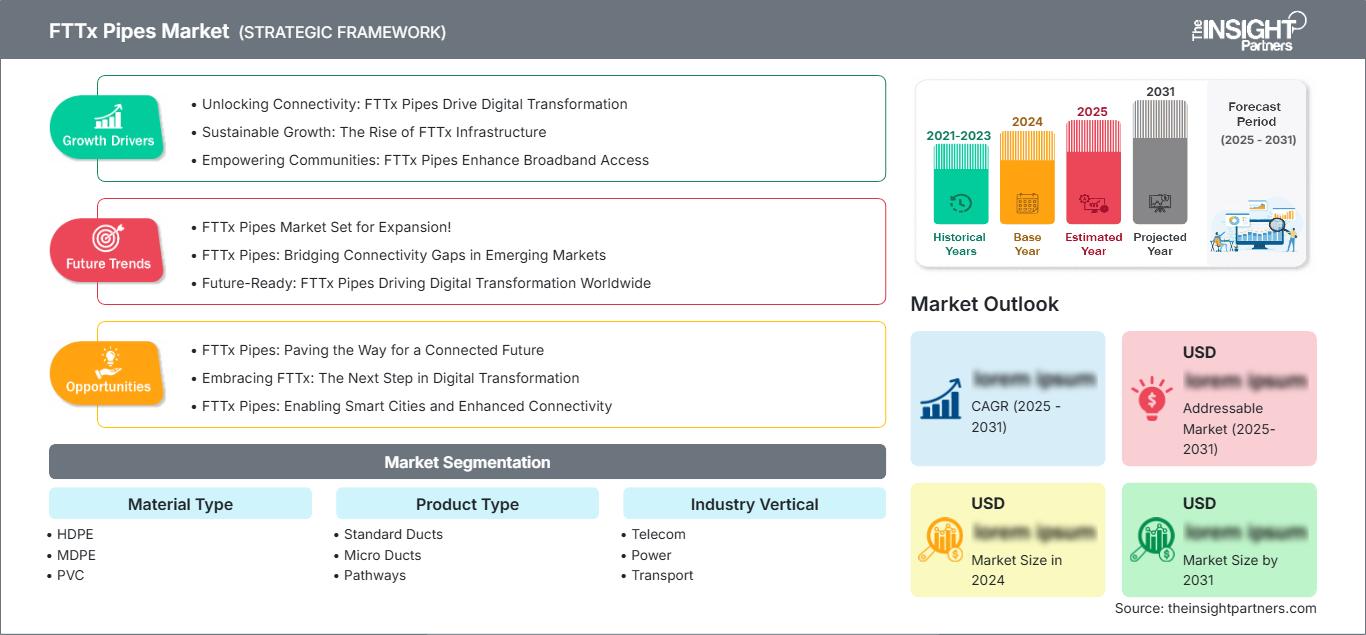
FTTx Pipes Market: Strategic Insights
Regional Insights
North America FTTx pipes market
North America FTTx pipes market is supported by a large installed fiber base and continuing construction where operators extend coverage, add competing networks, or upgrade existing routes. The region is expected to record ~6% CAGR through 2034. The US accounts for ~78% of North American revenue in 2025, while Canada contributes through broadband expansion and network modernization. Demand is strongest for durable underground pathways supporting long service lives and staged cable deployment.
A defining feature is the coexistence of greenfield construction and overbuild. Fiber Broadband Association data indicate that US fiber passed more than 60% of primary households in 2025, while FTTH passings approached 100 million homes. This creates requirements for both first-pass duct installation and additional pathways for second or third fiber networks. Rural programs and private operator investment can therefore sustain duct consumption.
U.S. FTTx pipes market
The U.S. FTTx pipes market represents ~78% of North American revenue in 2025 and is expected to grow at ~6% CAGR through 2034. The demand is positively affected by broadband infrastructure development, copper cable upgrades, and densification of the networks. Pathways need to be able to withstand the distance, terrain, urbanization, and adding cables in the future without further excavations.
High Density Polyethylene (HDPE) telecommunication ducts are utilized in trenches, roads, walkways, and connections between communication centers and local sites. APL Apollo Pipes Limited offers PLB Ducts that are made specifically for the purposes of laying optical fiber and communication cables. This means that there is a preference towards manufacturers of HDPE ducts with production quality and delivery capabilities.
Europe FTTx pipes market
Europe FTTx pipes market represented ~25% of global revenue in 2025 and is projected to expand at ~5% CAGR through 2034. This market features mature broadband networks and ongoing fiber deployment, thereby requiring further pathing and capacity growth. France is the leading market in Europe, whereas Germany, the UK, Italy, and Spain are still procurement markets.
France enjoys ongoing fiber deployment and experienced operators. Germany holds development potential due to network renovation and fiber deployment efforts. The UK ensures full-fiber deployment owing to competition between operators and regional efforts. Italy and Spain ensure ongoing demand through city renovations, rural areas, and network densification. In all of these markets, microducts can help to save civil works in case of lacking rights-of-way, whereas standard ducts continue to play their role in longer distances.
APAC FTTx pipes market
The FTTx pipes market forecast shows that APAC accounts for ~34% of global revenue in 2025 and is forecast to grow at ~8% CAGR through 2034, making it the largest and fastest-growing regional market. China is the leading country in Asia Pacific, with Japan, South Korea, India, and Australia also contributing significant demand. Large broadband populations and extensive urban infrastructure support high deployment volumes.
Fiber pathway needs of China become very high due to its vast size. Whereas for Japan and South Korea the benefits come from already well-established systems of high speed broadband. India has got plenty of possibilities for growth in terms of fiberizing and investing in digital infrastructure. Australia requires a need for network expansion due to a geographically wide market.
Middle East & Africa FTTx pipes market
Middle East & Africa FTTx pipes market is expected to expand at ~7% CAGR through 2034. Saudi Arabia and the UAE provide important Middle Eastern demand centers because urban development, digital transformation, and communications investment require underground pathways. South Africa is a major African deployment center, while the rest of MEA includes emerging broadband markets.
The regional infrastructure environment favors products capable of tolerating heat, dust, UV exposure, and demanding installation conditions. Fiber expansion around smart-city projects, residential developments, transport corridors, and enterprise networks can create demand for standard ducts and microduct systems. Shared trenching with utilities and transport infrastructure can also improve the economics of additional telecom pathways.
Segmentation Analysis
Material Type
Material Type is expected to grow at ~5% CAGR through 2034. HDPE remains central because it combines flexibility, impact resistance, chemical resistance, and suitability for underground cable routing. MDPE and PVC remain relevant where mechanical characteristics, installation practices, standards, and project economics favor alternative materials.
- HDPE: HDPE is widely used for telecom ducts because flexibility supports trench, directional, and coiled installations. Resistance to moisture and environmental stress supports long service life.
- MDPE: MDPE provides an alternative polymer choice where a balance of flexibility, toughness, and processing economics is required. Relevance depends on regional specifications and operator standards.
- PVC: PVC remains relevant where rigid conduit behavior and established installation practices are preferred. Demand depends on local construction methods, standards, and comparative material economics.
Product Type
Product Type is expected to grow at ~7% CAGR through 2034. Standard ducts remain important for principal routes, while microducts and pathways support network densification, constrained construction, and staged capacity additions. Product selection increasingly reflects excavation costs, installation speed, and future expansion requirements.
- Standard Ducts: Standard ducts support backbone, access, and distribution routes where robust protection and straightforward cable installation are priorities. Broad dimensional availability makes them foundational across fiber networks.
- Micro Ducts: Microducts enable high-density deployment within smaller pathways and are valuable where civil works are expensive or disruptive. They support cable blowing, modularity, and staged network expansion.
- Pathways: Pathways provide organized cable-routing structures for buildings, transport infrastructure, and complex corridors. Their importance increases where multiple communication routes must be protected and maintained.
Industry Vertical
Industry Vertical is expected to grow at ~6% CAGR through 2034. Telecom is the principal demand center, while power, transport, and building and infrastructure applications broaden the addressable opportunity. Shared civil corridors can support cross-sector deployment.
- Telecom: Telecom operators and contractors are core buyers because ducts protect optical fiber in access, aggregation, and transport networks. Demand follows subscriber connections, network densification, competitive builds, and modernization.
- Power: Power utilities use protected pathways for communications, monitoring, control, and related cable infrastructure. Grid modernization can increase demand for reliable underground routing.
- Transport: Railways, roads, airports, and other transport systems require protected communications pathways for signaling, surveillance, operational communications, and passenger services.
- Building and Infrastructure: Buildings, campuses, industrial sites, and public infrastructure require organized pathways for fiber connectivity. Demand is linked to construction, smart-building systems, and multiple service providers.
Application
Application is expected to grow at ~7% CAGR through 2034. Backbone routes support concentrated traffic over longer distances, metropolitan networks connect dense demand centers, and mobile backhaul increasingly requires scalable pathways around upgraded radio infrastructure.
- Backbone: Backbone applications require reliable pathways across long-distance and high-capacity routes. Duct systems protect strategic fiber assets and provide capacity for route diversity and future cable installation.
- Metropolitan: Metropolitan applications connect access networks, data centers, enterprises, and aggregation sites in dense areas. Compact duct configurations can simplify deployment where civil costs are high.
- Mobile Backhaul: Mobile backhaul connects radio sites with aggregation and core networks. Fiberization increases pathway requirements near cell sites, small cells, transport corridors, and dense urban locations.
Opportunity Snapshot
| Industry Vertical | Revenue Contribution | Trend Tag | Adoption Stage |
| Telecom | High | Fiber Expansion | Scaling |
| Power | Medium | Grid Digitalization | Scaling |
| Transport | Medium | Corridor Fiber | Scaling |
| Building and Infrastructure | Medium | Smart Connectivity | Scaling |
FTTx Pipes Market Growth Drivers and Impact Analysis
Fiber broadband expansion increases addressable duct demand
Rollout of fiber will continue to be the primary means of driving demand for FTTx pipelines since deployment of new fiber requires installation of infrastructure to create the pathway for the same. In established markets, competition through overbuild may lead to an increase in ducts required despite good availability of fiber. In emerging markets, broadband for the first time will create longer pathways and infrastructure needs. This effect will be most pronounced on providers who offer standard ducts along with microducts and bundles. Expansion also increases the recurring demand for fittings, closures, marking, and accessories. Operators' push for rapid installation will favor providers with consistent quality of extrusion and delivery capabilities.
Network densification raises demand for flexible pathway systems
The increase in traffic volumes is taking network development from a straightforward extension of coverage to densification and capacity management. Networks for mobile communication, business applications, cloud computing, and heavy applications need additional fiber connections between access nodes, aggregation points, and transport equipment. This makes microducts and pathways that will support several cables or sequential installation of them preferable. The implications are not confined to initial pipe sales because modular infrastructure solutions generate further sales as operators put additional fibers, customers, or network operators in place. This is an opportunity for vendors to design their products accordingly.
Infrastructure programs improve project visibility for duct suppliers
Initiatives for public broadband, utility modernization, transport digitalization, and urban construction will provide more predictable pipeline of opportunities for pathway producers. In case when civil construction projects are designed at corridor level, telecommunication conduits may be built concurrently along with roads, railways, utilities, and other infrastructures, decreasing costs of creation of fiber pathways. This will lead to early purchases and preference for suppliers who are manufacturing in the region, having standard products, and good documentation of projects. The result for producers will be the change from transactional sales to program sales approach.
FTTx Pipes Market Future Trends
Higher-density microduct architectures will reshape network design
The FTTx pipes market trends show that future fiber construction is likely to place greater emphasis on compact pathway architectures that preserve capacity for later network additions. Microduct bundles, high-density configurations, and products designed for cable blowing can reduce the physical footprint of new routes while allowing operators to stage investment. This is particularly relevant in dense cities where excavation is expensive and rights-of-way are constrained. Suppliers are likely to focus more heavily on internal surface engineering, dimensional precision, bundle identification, and compatibility with higher fiber-count cables. Procurement may increasingly evaluate total deployment and expansion economics rather than initial duct price alone, creating opportunities for differentiated products with measurable installation benefits.
Circular materials and lower-impact manufacturing will gain relevance
Environmental requirements are expected to become more visible in duct procurement as network owners and infrastructure developers increase attention to material efficiency and lifecycle performance. Recycled polymer content, manufacturing waste recovery, lightweighting, and longer service life can reduce the environmental burden associated with large-scale pathway installation. The shift will not remove the importance of mechanical performance because ducts must protect valuable fiber assets under demanding conditions. Instead, suppliers are likely to balance recycled content with dimensional stability, impact resistance, and installation reliability. Environmental documentation may become increasingly relevant in tender processes, encouraging manufacturers to improve traceability and product-level sustainability.
FTTx Pipes Market Opportunities
Local manufacturing can capture regional broadband build programs
Regional manufacturing represents an opportunity where telecom ducts are bulky relative to unit value and project schedules require dependable delivery. Local extrusion capacity can shorten logistics distances, reduce freight exposure, and allow manufacturers to tailor dimensions, colors, bundles, and packaging to operator specifications. The opportunity is relevant in emerging fiber markets where construction is accelerating but supply chains remain fragmented. Suppliers can strengthen their position by pairing local production with standardized quality systems and technical support. Partnerships with telecom contractors and system integrators can improve market access by embedding duct products within broader deployment packages and reducing procurement complexity.
Integrated pathway solutions can increase value per deployment
Suppliers can expand commercial value by moving beyond standalone ducts toward integrated pathway packages containing microducts, sub-ducts, connectors, closures, markers, chambers, and installation accessories. Contractors benefit when components are engineered to work together because compatibility reduces field adjustments and installation uncertainty. Integrated offerings can also support project documentation, testing, and standardized maintenance. The opportunity is strongest in metropolitan and mobile network projects where installation conditions vary across short distances and rapid deployment has high economic value. Manufacturers with complementary portfolios can deepen customer relationships and participate in a greater share of project spending.
Recent Developments
- September 2026: HFCL Limited announced approval of an additional investment of for expansion of optical fiber, optical fiber cable, and preform manufacturing capacities. The expansion reinforces the company's broader optical connectivity supply position and indicates continued investment in fiber infrastructure capacity supporting network construction.
- August 2026: Furukawa Electric Co., Ltd. announced the acquisition of fixed assets for production of optical fibers and optical fiber cables. The investment strengthens optical infrastructure manufacturing capacity and supports communications network supply requirements.
Frequently Asked Questions

- Comprehensive Market Sizing and Forecast Analysis
- Detailed Segmentation Analysis
- In-Depth Market Dynamics Assessment
- Regional and Country-Level Insights
- Competitive Landscape and Company Benchmarking
- Strategic Business Intelligence
Recent Reports
Testimonials

The Insight Partners provided valuable market intelligence that supported our global go-to-market strategy. Their team was professional, responsive, and attentive to our feedback, providing thoughtful analysis and helpful methodological clarifications throughout the project.
Junmo Kim Chief Financial Officer (CFO), Enertech Co., Ltd.
The Insight Partners' SCADA System Market report is comprehensive, with valuable insights on current trends and future forecasts. The team was highly professional, responsive, and supportive throughout. We are very satisfied and highly recommend their services.
RAN KEDEM Partner, Reali Technologies LTDs
I requested a report on a very specific software market and the team produced the report in a few days. The information was very relevant and well presented. I then requested some changes and additions to the report. The team was again very responsive and I got the final report in less than a week.
JEAN-HERVE JENN Chairman, Future Analytica
We worked with The Insight Partners for an important market study and forecast. They gave us clear insights into opportunities and risks, which helped shape our plans. Their research was easy to use and based on solid data. It helped us make smart, confident decisions. We highly recommend them.
PIYUSH NAGPAL Sr. Vice President, High Beam Global
The Insight Partners delivered insightful, well-structured market research with strong domain expertise. Their team was professional and responsive throughout. The user-friendly website made accessing industry reports seamless. We highly recommend them for reliable, high-quality research services
YUKIHIKO ADACHI CEO, Deep Blue, LLC.
This is the first time I have purchased a market report from The Insight Partners.While I was unsure at first, I visited their web site and felt more comfortable to take the risk and purchase a market report.I am completely satisfied with the quality of the report and customer service. I had several questions and comments with the initial report, but after a couple of dialogs over email with their analyst I believe I have a report that I can use as input to our strategic planning process.Thank you so much for taking the extra time and making this a positive experience.I will definitely recommend your service to others and you will be my first call when we need further market data.
JOHN SUZUKI President and Chief Executive Officer, Board Director, BK Technologies
I wish to appreciate your support and the professionalism you displayed in the course of attending to my request for information regarding to infectious disease IVD market in Nigeria. I appreciate your patience, your guidance, and the fact that you were willing to offer a discount, which eventually made it possible for us to close a deal. I look forward to engaging The Insight Partners in the future, all thanks to the impression you have created in me as a result of this first encounter.
DR CHIJIOKE ONYIA MANAGING DIRECTOR, PineCrest Healthcare Ltd.Reason to Buy
- Informed Decision-Making
- Understanding Market Dynamics
- Competitive Analysis
- Identifying Emerging Markets
- Customer Insights
- Market Forecasts
- Risk Mitigation
- Boosting Operational Efficiency
- Strategic Planning
- Investment Justification
- Tracking Industry Innovations
- Aligning with Regulatory Trends





 Get Free Sample for