
Galvanized Steel Market Size, Share & Forecast by 2034
Coverage: by Product Type (Electro-Galvanized Steel, Hot-dip Galvanized Steel); End Product (Fasteners, Steel Main Frames, Cable Support System, Hand Rails, Safety Barriers, Others); End-Use Industry (Construction, Automotive, Home Appliances, Others) , and Geography (North America, Europe, Asia Pacific, and South and Central America)
- Status : Data Released
- Report Code : TIPRE00009461
- Category : Chemicals and Materials
- No. of Pages : 150
- Available Report Formats :


- Last update date : July 09, 2026


2025 Market Size
US$ 186.08 Bn
Base year value
2034 Forecast
US$ 261.5 Bn
Projected by 2034
CAGR 2026-2034
3.85 %
Growth rate
Addressable Market
US$ 2,032.54 Bn
(2026-2034)
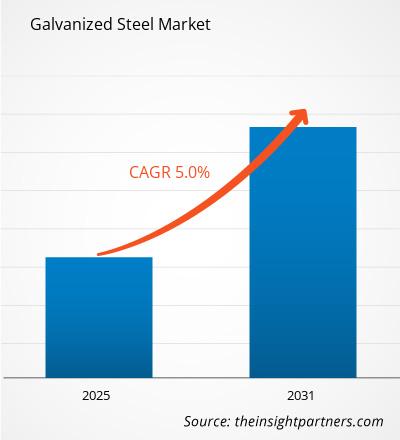
The Galvanized Steel Market was valued at US$ 186.08 Billion in 2025 and is projected to reach US$ 261.5 Billion by 2034, expanding at a CAGR of 3.85% during 2026–2034. Demand remains strong due to the material's excellent corrosion resistance, cost-effective lifecycle, and growing use in construction, transportation, renewable energy, and industrial manufacturing. Efforts to modernize infrastructure, expand urban areas, and replace old steel assets continue to boost long-term demand. Meanwhile, manufacturers are investing in better coating technologies and sustainable production methods.
North America is expected to have a CAGR of 3.2% to 3.8% from 2026 to 2034, driven by ongoing investments in infrastructure repair, manufacturing, and domestic steel production. Public spending on bridges, highways, renewable energy projects, and industrial facilities stimulates the consumption of corrosion-resistant steel products. The rising use of galvanized steel in electric vehicle manufacturing, utility infrastructure, and commercial construction further supports the growth of the regional galvanized steel market.
Galvanized Steel Market Assessment and Insights
- North America: Accounted for 20–23% share in 2025 and is projected to grow at a CAGR of 3.2–3.8% during 2026–2034. Strong infrastructure investment, industrial reshoring initiatives, and renewable energy installations continue to strengthen regional demand for corrosion-resistant steel products.
- U.S.: Represented 78–82% of North American demand in 2025 and is anticipated to expand at a CAGR of 3.3–3.9% during 2026–2034. Federal infrastructure spending and automotive manufacturing remain major consumption drivers.
- Europe: Held 21–24% share in 2025 and is forecast to register a CAGR of 3.1–3.7% during 2026–2034. Germany, Italy, France, and the UK continue to lead regional demand through automotive manufacturing, renewable energy investments, and modernization of commercial infrastructure.
- Asia Pacific: Captured 44–48% share in 2025 and is expected to record a CAGR of 4.2–4.8% during 2026–2034. China, India, Japan, South Korea, and Australia continue expanding galvanized steel consumption across construction, manufacturing, renewable energy, and transportation infrastructure.
- Largest Segment – Building and Construction: Held a market share of 39–43% in 2025 and is projected to expand at a CAGR of 3.6–4.0% during 2026–2034. Continued investments in residential, commercial, industrial, and public infrastructure projects sustain long-term consumption.
- High Growth Segment – Wind and Solar: Accounted for 10–13% of the galvanized steel market share in 2025 and is anticipated to grow at a CAGR of 5.6–6.2% during 2026–2034. Renewable energy capacity expansion and increasing offshore wind installations continue driving demand for durable galvanized structural components.
- Key companies analyzed in detail: Cleveland-Cliffs Inc., Ansteel Group Corporation Limited, ArcelorMittal S.A., China Baowu Steel Group Corporation Limited, Gerdau S.A., JFE Steel Corporation, Jiangsu Shagang Group Co., Ltd., Nippon Steel Corporation, POSCO Holdings Inc., Tata Steel Limited.
Source: The Insight Partners' analysis based on proprietary research, government publications, company annual reports, investor presentations, industry databases, and expert interviews.
Improvements in continuous galvanizing technologies, process automation, zinc use efficiency, and eco-friendly coating systems have greatly boosted production capabilities, reflecting key galvanized steel market trends across the global value chain. Steel producers keep investing in digital manufacturing, energy-efficient furnaces, and high-performance coating lines to meet changing customer needs. These changes help manufacturers make products more durable, lower maintenance costs, and improve supply reliability in automotive, infrastructure, renewable energy, and industrial applications. This also strengthens the overall growth of the galvanized steel market.
Looking ahead, investments in Southeast Asia, the Middle East, and some Latin American economies are likely to diversify production capacity and create new demand centers. Government-supported infrastructure projects, renewable energy initiatives, and efforts to localize industries continue to promote capacity expansion. Sustainability regulations that encourage recyclable construction materials and lower lifecycle emissions should also support long-term trends in the market. At the same time, ongoing technological advancements are expanding the overall opportunities in the galvanized steel market across new industrial applications.
Galvanized Steel Market Report Scope
| Report Attribute | Details |
|---|---|
| Market size in 2025 | US$ 186.08 Billion |
| Market Size by 2034 | US$ 261.5 Billion |
| Global CAGR (2026 - 2034) | 3.85% |
| Historical Data | 2021-2024 |
| Forecast period | 2026-2034 |
Galvanized Steel Market Analysis
Growing investments in urban infrastructure, transportation networks, industrial facilities, and renewable energy projects continue to boost global consumption of galvanized steel, supporting further expansion of the galvanized steel market size. Demand remains strong because galvanized steel lasts longer, provides better corrosion protection, and requires less maintenance than untreated steel. Automotive manufacturers are increasingly using high-quality galvanized steel to improve structural durability while achieving lighter vehicle designs. These factors continue to support the growth of the market, despite fluctuations in raw material prices.
The industry value chain includes iron ore suppliers, steel manufacturers, zinc producers, galvanizing facilities, component fabricators, distributors, engineering contractors, and end-use industries. Integrated production facilities are optimizing coating consistency through automation, digital quality monitoring, and predictive maintenance systems. At the same time, manufacturers are expanding production of high-strength galvanized grades that are suitable for electric vehicles, utility infrastructure, precision engineering, and renewable energy projects, which enhances the overall analysis of the market.
Competition remains moderately consolidated, with established integrated steel producers focusing on operational efficiency, product development, sustainability efforts, and regional capacity optimization to strengthen their galvanized steel market share. Companies like Cleveland-Cliffs Inc., ArcelorMittal S.A., Nippon Steel Corporation, POSCO Holdings Inc., and Tata Steel Limited are investing in new coating technologies, low-carbon steelmaking efforts, and adding value to their product lines to improve their competitive edge across global end-use industries.
Asian manufacturers, including China Baowu Steel Group Corporation Limited, Ansteel Group Corporation Limited, Jiangsu Shagang Group Co., Ltd., and JFE Steel Corporation, are increasing their production capabilities while focusing on technology upgrades and enhancing their export competitiveness. Meanwhile, Gerdau S.A. is strengthening its position through regional manufacturing integration and products aimed at infrastructure. Investments in recycling, energy efficiency, digital manufacturing, and high-quality coated products are expected to support sustainable competitive advantages and increase the overall market share of galvanized steel among leading global players.
● REPORT CUSTOMIZATION
Tailor This Report To Align With Your Specific Business Requirements
This report can be customized to align precisely with your business objectives, scope, and target markets. Customization options include tailored segmentation, geography, competitive analysis, and strategic insights to support informed decision-making.
Customize This Report →WHAT YOU CAN ADJUST
- ● Segmentations
- ● Geography
- ● Competitive Analysis
- ● Language Preferences
Galvanized Steel Market: Strategic Insights

Regional Insights
North America Galvanized Steel Market
North America made up 20 to 23% of global revenue in 2025. It is expected to grow at a rate of 3.2 to 3.8% from 2026 to 2034. The demand in the region is driven by public infrastructure repair, industrial reshoring, and updating transportation assets. Investments in renewable energy transmission networks, commercial buildings, and utility infrastructure further boost the use of galvanized steel across various industries.
The region also benefits from strong domestic steel manufacturing capabilities and increasing investments in electric vehicle production, reinforcing the regional galvanized steel market share. There is high demand for corrosion-resistant structural materials, especially in bridges, rail infrastructure, logistics facilities, warehouses, and manufacturing plants. The growing use of sustainable construction practices and lifecycle cost optimization continues to promote the use of galvanized steel for long-term infrastructure projects.
U.S. Galvanized Steel Market
The United States accounted for 78 to 82% of North American demand in 2025 and is expected to grow at a compound annual growth rate of 3.3 to 3.9% from 2026 to 2034. Domestic infrastructure modernization programs, manufacturing investments, and utility upgrades continue to support steady demand in commercial, industrial, and transportation sectors. The rise of electric vehicle manufacturing further boosts the need for corrosion-resistant automotive steel products.
Leading domestic steel producers are investing in coating technologies, production efficiency, and high-strength galvanized steel grades. Building construction, energy infrastructure, telecommunications, and agricultural equipment are key end-use sectors. Ongoing investment in renewable energy generation, transmission infrastructure, and industrial reshoring efforts is likely to maintain long-term consumption throughout the forecast period.
Europe Galvanized Steel Market
Europe held 21 to 24% of the global market share in 2025 and is expected to have a CAGR of 3.1 to 3.7% from 2026 to 2034. Germany remains the top regional galvanized steel market because of its large automotive manufacturing base, strong engineering sector, and solid industrial infrastructure. Ongoing investments in sustainable construction and renewable energy projects further boost the demand for galvanized steel.
The United Kingdom continues to increase its use of galvanized steel through commercial construction, offshore wind projects, transportation infrastructure, and warehouse development. The growing replacement of aging infrastructure, along with investments in energy transition, helps maintain steady market growth and supports the use of higher-performance galvanized steel products.
France, Italy, and Spain together drive significant regional demand through infrastructure upgrades, industrial manufacturing, logistics facilities, renewable energy projects, and public construction efforts. Continued investment in sustainable buildings and transportation projects is likely to support stable galvanized steel consumption throughout the forecast period.
APAC Galvanized Steel Market
Asia Pacific made up 44 to 48% of global revenue in 2025 and is expected to grow at a rate of 4.2 to 4.8% from 2026 to 2034. China is still the leader in the region for production and consumption, driven by a lot of construction work and manufacturing capacity.
Japan and South Korea play important roles through their automotive production and high-value manufacturing. Technology-driven galvanizing processes continue to support demand for premium products.
India and Australia are seeing increased consumption due to infrastructure projects, investments in renewable energy, mining initiatives, and industrial growth, which all contribute to steady growth in the region.
Middle East & Africa Galvanized Steel Market
The Middle East and Africa is expected to grow at a rate of 4.1 to 4.6% from 2026 to 2034. Saudi Arabia is still driving regional demand by diversifying its industries and developing large-scale infrastructure. The UAE is boosting consumption through commercial construction, logistics facilities, and investments in renewable energy. South Africa is an important galvanized steel market for industrial manufacturing and mining equipment. Other countries in the MEA region are benefiting from urbanization, improved transportation infrastructure, energy investments, and industrial development projects. These factors support gradual long-term market growth.
Segmentation Analysis
Type
The type segment is projected to register a CAGR of 3.8 to 4.2% from 2026 to 2034. Product selection mainly depends on corrosion resistance needs, coating thickness, production costs, and end-use performance. Manufacturers are working on better galvanizing technologies that improve coating consistency, lengthen product life, and lower maintenance costs in construction, automotive, industrial equipment, and utility infrastructure. The growing use of premium coated products and automated galvanizing lines is likely to support steady segment growth during the forecast period.
- Hot-dipped Galvanized Steel: Hot-dipped galvanized steel is the leading product category due to its excellent corrosion resistance, thick zinc coating, and its use in structural applications like buildings, bridges, industrial facilities, transmission towers, and renewable energy infrastructure.
- Electroplate Galvanized Steel: Electroplate galvanized steel is commonly used where a precise surface finish, exact dimensions, and good paintability are important. The demand for this product category is driven by automotive body panels, home appliances, electronic equipment, and precision-engineered components.
Application
The application segment is expected to grow at a CAGR of 3.9 to 4.3% from 2026 to 2034. End-use demand keeps diversifying in areas like infrastructure development, automotive production, renewable energy projects, industrial manufacturing, and public utility work. Product durability, lower lifecycle costs, recyclability, and compatibility with modern fabrication methods are important factors that support long-term use across various industries.
- Building and Construction: This segment is the largest application because galvanized steel provides excellent structural durability, corrosion protection, and low maintenance costs across residential, commercial, industrial, transportation, and public infrastructure developments.
- Automotive: Vehicle manufacturers increasingly use galvanized steel to enhance corrosion protection, structural integrity, crash performance, and long-term durability. It also supports lightweight vehicle design and higher manufacturing quality standards.
- Wind and Solar: Renewable energy developers keep increasing their use of galvanized steel for mounting structures, transmission components, offshore foundations, and support infrastructure due to its strong resistance to harsh environmental conditions.
- Home Appliances: Appliance manufacturers rely on galvanized steel for washing machines, refrigerators, air-conditioning systems, ovens, and kitchen equipment because of its corrosion resistance, surface quality, and manufacturing efficiency.
- Telecommunication: Telecommunication infrastructure uses galvanized steel for communication towers, equipment shelters, transmission poles, and structural supports that need to last in tough outdoor conditions.
- Agriculture: Agricultural equipment makers use galvanized steel for storage silos, irrigation systems, fencing, livestock facilities, and machinery that faces constant moisture and corrosive environments.
- Oil and Gas: The oil and gas industry continues to use galvanized steel in pipelines, storage facilities, support structures, offshore platforms, and processing facilities that require long-term corrosion protection and reliable operation.
Opportunity Snapshot
| Segment Name | Revenue Contribution | Trend Tag | Adoption Stage |
| Building and Construction | High | Green Buildings | Mature |
| Automotive | High | EV Platforms | Scaling |
| Wind and Solar | High | Solar Mounting | Scaling |
| Home Appliances | Medium | Smart Appliances | Mature |
| Telecommunication | Medium | 5G Towers | Scaling |
| Agriculture | Medium | Precision Farming | Emerging |
| Oil and Gas | Medium | Pipeline Renewal | Mature |
Galvanized Steel Market Growth Drivers and Impact Analysis
Global infrastructure modernization accelerates demand for corrosion-resistant steel
Governments in both developed and emerging economies are focusing on investments in transportation infrastructure, public utilities, industrial corridors, logistics hubs, and urban development. These projects increasingly use galvanized steel because the lifecycle costs are much lower than untreated options, mainly due to less maintenance and a longer operational life. Demand is rising for bridges, airports, rail systems, ports, warehouses, and public buildings, where durability is a key factor in procurement. As infrastructure spending increasingly supports sustainability goals and resilience standards, it also strengthens the long-term galvanized steel market forecast while encouraging manufacturers to invest in higher-capacity galvanizing lines, automation technologies, and better coating quality.
Expansion of renewable energy projects increases coated steel consumption
Rapid deployment of solar parks, offshore wind farms, transmission infrastructure, and energy storage facilities is creating ongoing demand for galvanized structural components. Solar mounting systems, wind turbine towers, substations, transmission poles, and supporting frameworks need high corrosion resistance due to constant environmental exposure. Utility developers increasingly choose galvanized steel because it lasts longer and requires less maintenance over project lifecycles. Growing investments in electricity grid modernization and renewable generation capacity in Asia Pacific, Europe, and North America are likely to create more opportunities for high-quality galvanized products made with better coating technologies and improved environmental performance.
Automotive manufacturing transitions toward advanced galvanized grades
Vehicle manufacturers are increasingly using high-strength galvanized steel. This material improves structural safety, resists corrosion, and boosts manufacturing efficiency while aiding in lightweight vehicle design. The rise in electric vehicle production is driving demand even further, as durable materials are needed for battery enclosures, structural reinforcements, chassis parts, and body panels. Steel producers are responding with ongoing improvements in coating technologies, metallurgy, and precision manufacturing processes that improve consistency and performance. Partnerships between automotive manufacturers and integrated steel producers are likely to support the development of high-quality products while increasing steady demand in global transportation markets.
Galvanized Steel Market Future Trends
Digital manufacturing transforms galvanizing operations
Steel manufacturers are adopting Industry 4.0 technologies in galvanizing facilities to boost efficiency, ensure consistent products, and support predictive maintenance. Artificial intelligence, machine vision, real-time process monitoring, and advanced analytics help producers optimize zinc use, coating thickness, and production quality while lowering downtime and manufacturing costs. Digital traceability also enhances customer trust by offering detailed production records and quality assurance documentation. Ongoing investment in smart manufacturing platforms is likely to increase productivity and meet stricter quality demands in automotive, renewable energy, infrastructure, and industrial applications during the forecast period.
Sustainability initiatives reshape steel production strategies
Environmental rules and corporate decarbonization commitments continue to push steel manufacturers, representing some of the most significant galvanized steel market trends influencing future production strategies. Companies are putting money into electric arc furnace technologies, buying renewable electricity, recovering waste heat, and applying low-carbon coatings. Customers in construction, automotive, and industrial manufacturing are increasingly looking for suppliers who can show lower lifecycle emissions and responsible production methods. These sustainability efforts are likely to shape procurement choices, product development, investment focuses, and competitive advantages in the global galvanized steel industry over the next ten years.
Galvanized Steel Market Opportunities
Expansion of manufacturing capacity in emerging industrial economies
Industrialization in Southeast Asia, the Middle East, and some African countries is creating good investment opportunities for galvanized steel manufacturers. Governments are supporting local manufacturing with industrial parks, export incentives, better logistics, and policies that boost steel use in construction, automotive, and engineering industries. Companies that invest in galvanizing facilities in the region can lower transportation costs, improve supply chain response, and build stronger customer relationships. Partnering with fabricators, engineering contractors, and infrastructure developers can further increase long-term revenue potential. Expanding into high-growth economies will also help diversify geographic exposure and improve resilience against changes in regional demand and supply chain issues.
Development of premium galvanized products for high-value applications
Manufacturers have great opportunities to create galvanized steel products specifically for electric vehicles, renewable energy infrastructure, telecommunications, and precision engineering. Customers are asking for better corrosion resistance, improved formability, tighter dimensional tolerances, and better coating performance in challenging operating environments. Investing in research and development, coating technologies, and digital quality management systems supports long-term galvanized steel market growth by allowing producers to differentiate their offerings and capture higher-value applications. Working with automotive OEMs, renewable energy developers, and industrial equipment manufacturers is likely to speed up the commercialization of specialized galvanized products aimed at next-generation industrial applications.
Recent Developments
- June 2026: GX Steel “JGreeX” adopted to new office building of the Imabari Shipbuilding Group. This is the second time that “JGreeX™” has been adopted in an Imabari Shipbuilding Group office building, following its adoption at the Marugame Craft Office. The design and construction of these new office buildings are the responsibility of RN Construction Co., Ltd.
- May 2026: Nippon Steel Corporation (Nippon Steel) and Sanyo Special Steel Co., Ltd. (Sanyo Special Steel), a wholly-owned subsidiary of Nippon Steel, announced that their respective Boards of Directors resolved to conduct a merger (the “Merger”) with Nippon Steel as the surviving company and Sanyo Special Steel as the dissolving company, effective as of April 1, 2027, as follows.
Frequently Asked Questions

- Comprehensive Market Sizing and Forecast Analysis
- Detailed Segmentation Analysis
- In-Depth Market Dynamics Assessment
- Regional and Country-Level Insights
- Competitive Landscape and Company Benchmarking
- Strategic Business Intelligence
Recent Reports
Testimonials

The Insight Partners' SCADA System Market report is comprehensive, with valuable insights on current trends and future forecasts. The team was highly professional, responsive, and supportive throughout. We are very satisfied and highly recommend their services.
RAN KEDEM Partner, Reali Technologies LTDs
I requested a report on a very specific software market and the team produced the report in a few days. The information was very relevant and well presented. I then requested some changes and additions to the report. The team was again very responsive and I got the final report in less than a week.
JEAN-HERVE JENN Chairman, Future Analytica
We worked with The Insight Partners for an important market study and forecast. They gave us clear insights into opportunities and risks, which helped shape our plans. Their research was easy to use and based on solid data. It helped us make smart, confident decisions. We highly recommend them.
PIYUSH NAGPAL Sr. Vice President, High Beam Global
The Insight Partners delivered insightful, well-structured market research with strong domain expertise. Their team was professional and responsive throughout. The user-friendly website made accessing industry reports seamless. We highly recommend them for reliable, high-quality research services
YUKIHIKO ADACHI CEO, Deep Blue, LLC.
This is the first time I have purchased a market report from The Insight Partners.While I was unsure at first, I visited their web site and felt more comfortable to take the risk and purchase a market report.I am completely satisfied with the quality of the report and customer service. I had several questions and comments with the initial report, but after a couple of dialogs over email with their analyst I believe I have a report that I can use as input to our strategic planning process.Thank you so much for taking the extra time and making this a positive experience.I will definitely recommend your service to others and you will be my first call when we need further market data.
JOHN SUZUKI President and Chief Executive Officer, Board Director, BK Technologies
I wish to appreciate your support and the professionalism you displayed in the course of attending to my request for information regarding to infectious disease IVD market in Nigeria. I appreciate your patience, your guidance, and the fact that you were willing to offer a discount, which eventually made it possible for us to close a deal. I look forward to engaging The Insight Partners in the future, all thanks to the impression you have created in me as a result of this first encounter.
DR CHIJIOKE ONYIA MANAGING DIRECTOR, PineCrest Healthcare Ltd.Reason to Buy
- Informed Decision-Making
- Understanding Market Dynamics
- Competitive Analysis
- Identifying Emerging Markets
- Customer Insights
- Market Forecasts
- Risk Mitigation
- Boosting Operational Efficiency
- Strategic Planning
- Investment Justification
- Tracking Industry Innovations
- Aligning with Regulatory Trends





 Get Free Sample for