
Gaucher Disease Treatment Market Growth, Size & Forecast by 2034
Coverage: By Disease Type (Neuropathic, Perinatal Lethal, Slow Neurogenic Decay); Treatment Approach (Enzyme Replacement Therapy, Substrate Reduction Therapy, Surgery); End Users (Hospitals, Ambulatory Surgical Centers, Clinical research institutes) , and Geography (North America, Europe, Asia Pacific, and South and Central America)
- Status : Data Released
- Report Code : TIPRE00020038
- Category : Life Sciences
- No. of Pages : 150
- Available Report Formats :


- Last update date : November 18, 2026


2025 Market Size
US$ 1.96 Bn
Base year value
2034 Forecast
US$ 3.22 Bn
Projected by 2034
CAGR 2026-2034
5.67 %
Growth rate
Addressable Market
US$ 23.48 Bn
(2026-2034)
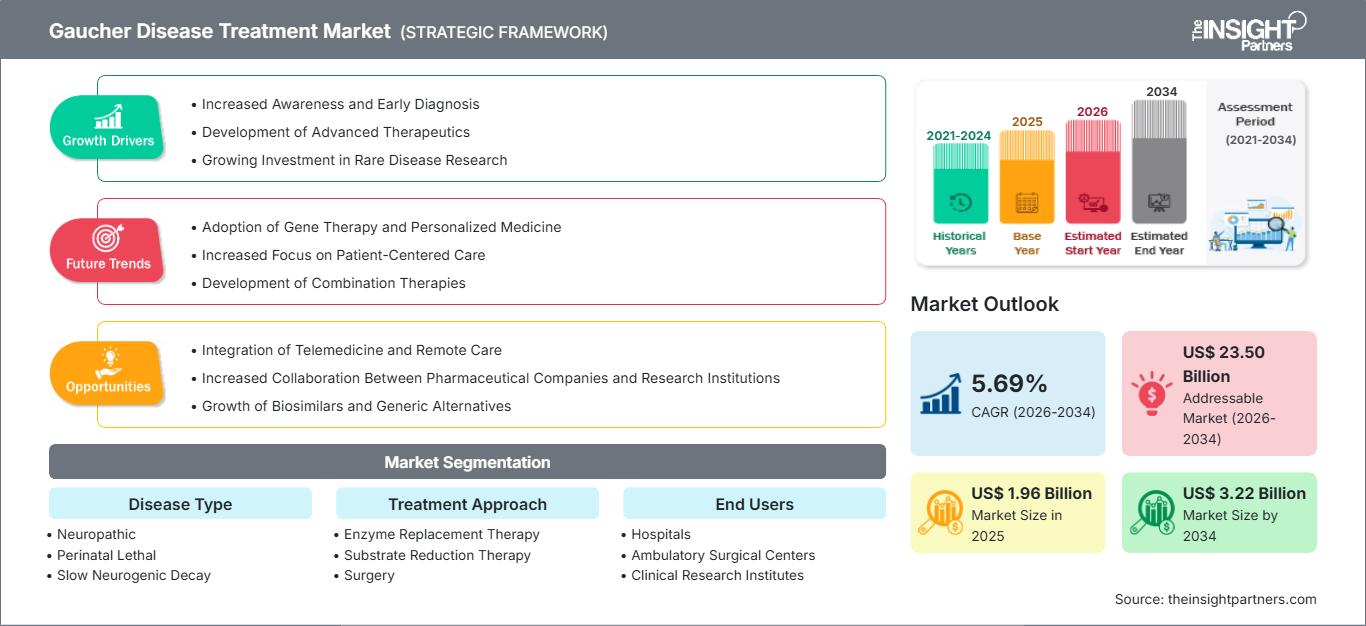
The gaucher disease treatment market was valued at US$ 1.96 Billion in 2025 and is projected to reach US$ 3.22 Billion by 2034, registering a 5.67% CAGR during 2026–2034. Growth is supported by improving diagnosis rates for rare genetic disorders, wider availability of enzyme replacement therapies, increasing awareness among healthcare professionals, and continued investment in orphan drug development. Advances in disease monitoring and long-term treatment management are also strengthening patient outcomes and supporting market expansion.
North America continues to represent the most established regional landscape for rare disease management, supported by advanced reimbursement frameworks, strong orphan drug commercialization pathways, and specialist treatment centers. The region is projected to expand at ~5% CAGR through 2034. The gaucher disease treatment market size in North America benefits from early diagnosis initiatives, extensive genetic screening infrastructure, and active participation of pharmaceutical companies in rare disease therapeutic development.
Gaucher Disease Treatment Market Assessment and Insights
Regional Outlook
- North America: ~42% of the global market in 2025 | ~5% CAGR through 2034. Market position: Leading regional market supported by mature rare disease treatment infrastructure, high treatment penetration, favorable reimbursement systems, and strong commercial presence of major biopharmaceutical companies.
- US: ~84% of North American market revenue in 2025 | ~5% CAGR through 2034. Market position: Largest country market within North America due to extensive specialist networks, greater diagnostic awareness, robust orphan drug access, and consistent therapeutic adoption.
- Europe: ~31% of the global market in 2025 | ~5% CAGR through 2034. Market position: Well-established market led by Germany, France, and the UK, supported by coordinated rare disease policies, academic research strength, and expanding patient management programs.
- Asia Pacific: ~20% of the global market in 2025 | ~7% CAGR through 2034. Market position: Fastest-growing region driven by improving diagnosis rates, expanding healthcare access, increasing rare disease awareness, and policy support across major economies.
Segment Outlook
- Treatment Approach: ~58% Share in 2025 | ~6% CAGR through 2034. Market position: Leadership is supported by the essential role of therapeutic interventions in disease management, particularly enzyme replacement therapies that remain the standard of care for many diagnosed patients.
- End Users: ~24% Share in 2025 | ~7% CAGR through 2034. Market position: Growth is driven by increasing specialization of treatment centers, expansion of research-based care delivery models, and rising patient referrals to advanced healthcare facilities.
Competitive Coverage
Abbott, Aptalis Pharma, Sanofi S.A. (Genzyme Corporation), GSK plc, Pfizer Inc., Takeda Pharmaceutical Company Limited, Eli Lilly and Company, Enobia Pharma Inc., Anthera Pharmaceuticals, Inc., BioMarin Pharmaceutical Inc.
Methodology
The Insight Partners follows Data Collection & Secondary Research, Primary Research, Data Analysis, and Data Triangulation & Final Review to validate market estimates and insights.
Source: The Insight Partners' analysis based on proprietary research, government publications, company annual reports, investor presentations, industry databases, and expert interviews.
Increasing understanding of lysosomal storage disorders has reshaped the treatment landscape over the last decade. Innovations in biotechnology have enabled improved enzyme therapies, refined disease monitoring protocols, and more personalized patient management strategies. Regulatory incentives for orphan drugs have encouraged manufacturers to develop specialized therapeutic options, while earlier identification of affected patients has improved treatment initiation rates. Growing collaboration between healthcare providers, patient advocacy groups, and research institutions continues to strengthen clinical outcomes and expand access to specialized care.
Over the forecast period, emerging markets are expected to contribute additional demand as healthcare systems improve rare disease capabilities. Investments in genetic testing infrastructure, growing clinical research activity, and supportive reimbursement discussions are expected to accelerate adoption. Pipeline innovation involving next-generation therapeutics and disease-modifying approaches may further improve treatment accessibility, while regulatory support for orphan drug development is expected to sustain long-term market momentum across multiple regions.
Gaucher Disease Treatment Market Report Scope
| Report Attribute | Details |
|---|---|
| Market size in 2025 | US$ 1.96 Billion |
| Market Size by 2034 | US$ 3.22 Billion |
| Global CAGR (2026 - 2034) | 5.67% |
| Historical Data | 2021-2024 |
| Forecast period | 2026-2034 |
Gaucher Disease Treatment Market Analysis
The gaucher disease treatment market growth trajectory is largely influenced by improving diagnosis rates and growing awareness of inherited metabolic disorders. Demand is concentrated in specialized healthcare systems where patients have access to genetic testing, long-term disease monitoring, and reimbursement-supported treatment pathways. The value chain encompasses drug developers, biotechnology manufacturers, specialty distributors, treatment centers, diagnostic laboratories, and patient support organizations. Strong coordination among these participants contributes to treatment continuity and improved clinical outcomes.
Supply dynamics remain favorable due to ongoing investments in biologics manufacturing capabilities and orphan-drug commercialization programs. Market participants continue to focus on treatment accessibility, physician education, and expanded patient identification initiatives. As more healthcare providers integrate rare disease screening into routine clinical practice, patient referral networks are becoming increasingly efficient.
The gaucher disease treatment market analysis indicates a moderately concentrated competitive environment characterized by established rare disease specialists and diversified pharmaceutical companies. Sanofi S.A. through Genzyme, Takeda Pharmaceutical Company Limited, Pfizer Inc., and BioMarin Pharmaceutical Inc. maintain strong visibility due to their expertise in specialized disease management and biotechnology-based therapeutics. Strategic positioning increasingly depends on clinical differentiation, long-term efficacy profiles, and patient-support services.
Investment activity continues to focus on gene-based therapies, next-generation biologics, and precision medicine technologies. Companies such as GSK plc, Eli Lilly and Company, and emerging biotechnology developers are exploring partnerships, licensing arrangements, and research collaborations to strengthen their portfolios. As rare disease treatment standards evolve, competitive success will increasingly depend on innovation, patient access strategies, and regulatory execution.
● REPORT CUSTOMIZATION
Tailor This Report To Align With Your Specific Business Requirements
This report can be customized to align precisely with your business objectives, scope, and target markets. Customization options include tailored segmentation, geography, competitive analysis, and strategic insights to support informed decision-making.
Customize This Report →WHAT YOU CAN ADJUST
- ● Segmentations
- ● Geography
- ● Competitive Analysis
- ● Language Preferences
Gaucher Disease Treatment Market: Strategic Insights
Regional Insights
North America gaucher disease treatment market
North America represents the largest regional contributor to industry revenue, accounting for ~42% of global demand. The regional gaucher disease treatment market is expected to advance at ~5% CAGR through 2034. Strong clinical infrastructure, extensive specialist networks, and established reimbursement systems support broad treatment availability across major healthcare institutions. Rare disease awareness campaigns have also contributed to earlier diagnosis and treatment intervention.
The region benefits from a mature orphan-drug ecosystem that encourages continued therapeutic innovation. Healthcare providers increasingly emphasize long-term disease management programs, while regulatory agencies support accelerated pathways for rare-condition treatments. Large-scale pharmaceutical participation and advanced biotechnology capabilities further reinforce North America's leading position in the global marketplace.
U.S. gaucher disease treatment market
The United States accounts for ~84% of North American revenue and is projected to expand at ~5% CAGR through 2034. The country benefits from robust healthcare spending, extensive genetic testing adoption, and widespread access to specialized treatment facilities. Major academic medical centers play a significant role in disease identification, monitoring, and clinical research activities.
Strong commercial presence from companies including Sanofi S.A., Takeda Pharmaceutical Company Limited, and Pfizer Inc. contributes to ongoing therapeutic availability. Increasing use of precision diagnostics and enhanced physician awareness continue to support patient identification. The country remains the most influential innovation hub within the North American rare disease treatment ecosystem.
Europe gaucher disease treatment market
Europe accounted for ~31% of global gaucher disease treatment market revenue in 2025 and is projected to record ~5% CAGR through 2034. The region benefits from coordinated orphan-disease policies, established healthcare systems, and extensive access to specialist treatment centers. Germany represents the leading country in Europe due to strong healthcare infrastructure, active rare disease research programs, and broad access to advanced therapies.
France and the United Kingdom also contribute significantly through national rare disease strategies and growing clinical trial participation. Academic institutions across Western Europe continue to strengthen disease awareness and facilitate earlier diagnosis.
Italy and Spain are expanding their rare disease capabilities through enhanced diagnostic programs and increased patient support initiatives. Cross-border collaboration among European healthcare networks promotes knowledge sharing and treatment standardization. Regulatory incentives supporting orphan medicines continue to attract investment and encourage long-term innovation throughout the regional market.
APAC gaucher disease treatment market
Asia Pacific represented ~20% of global gaucher disease treatment market share in 2025 and is forecast to expand at ~7% CAGR through 2034, making it the fastest-growing regional market. Improvements in healthcare infrastructure and rare disease awareness are increasing patient identification rates throughout the region. Government initiatives supporting genetic testing and specialty healthcare services are also strengthening demand.
Japan remains the leading country in Asia Pacific owing to advanced healthcare systems and established rare disease management frameworks. China, South Korea, India, and Australia are experiencing increased investment in diagnostics, specialist treatment centers, and regulatory pathways that support orphan drug adoption.
Middle East & Africa gaucher disease treatment market
The Middle East and Africa market for Gaucher disease treatments is estimated to grow at a ~6% CAGR through 2034. Increasing understanding of genetic disorders and the development of healthcare infrastructure have been making significant contributions to advancements in diagnosis and the availability of treatment options. Advanced specialized healthcare centers in metropolitan cities are gaining capacity to handle such complex rare diseases.
Countries like Saudi Arabia are fast becoming prominent in the Middle East & Africa market owing to their focus on modernizing the healthcare system and developing rare disease programs. The United Arab Emirates, South Africa, and other regional markets are continually advancing diagnostic services and advanced treatments.
Segmentation Analysis
Disease Type
Disease classification still plays an important role in treatment planning, monitoring, and overall patient management. Since there are various forms of Gaucher disease with distinct therapeutic needs, these differences affect how patients are managed and how resources are allocated. In this category, the Neuropathic disease form is predicted to grow at a ~6% CAGR through 2034 in the gaucher disease treatment market, driven by growing recognition and specialized management approaches.
- Neuropathic: This sub-segment requires specialized neurological assessment and long-term monitoring due to nervous-system involvement. Management complexity often necessitates multidisciplinary care teams, creating significant clinical interest and research activity.
- Perinatal Lethal: Characterized by severe early-onset manifestations, this category presents considerable treatment challenges. Demand for improved diagnostic and supportive care strategies remains important despite the comparatively limited patient population.
- Slow Neurogenic Decay: Patients often require prolonged monitoring and individualized disease management plans. Growing understanding of disease progression is supporting refinements in therapeutic decision-making and clinical care pathways.
Treatment Approach
Treatments are the primary commercial foundation of the market, as they affect therapy outcomes, treatment costs, and disease management methods. Further development of biotechnological science, improved access to treatments, and greater knowledge among doctors will ensure continued popularity. The most popular treatment is Enzyme Replacement Therapy, and it is expected to grow at ~6% CAGR until 2034 as healthcare systems continue prioritizing proven treatment modalities.
- Enzyme Replacement Therapy: Considered a standard care approach for many patients, this treatment addresses enzyme deficiency and remains widely referenced in clinical management protocols across major healthcare markets.
- Substrate Reduction Therapy: This approach offers an alternative mechanism for disease control and may provide additional flexibility for selected patient groups depending on clinical requirements.
- Surgery: Surgical intervention is generally reserved for specific complications and supportive treatment needs. Utilization depends heavily on individual disease severity and clinical presentation.
End Users
End-user dynamics influence treatment, the quality of disease monitoring, and the overall patient experience. Specialization in rare diseases and a multidisciplinary approach to their treatment are influencing the provision of services in healthcare facilities. Clinical Research Institutes are expected to show a ~7% CAGR through 2034, driven by growth in rare disease research, trials, and therapies.
- Hospitals: Hospitals remain primary treatment locations due to their ability to deliver comprehensive diagnostic, therapeutic, and monitoring services required for long-term disease management.
- Ambulatory Surgical Centers: These facilities support selected procedures and specialized interventions while contributing to healthcare efficiency and patient convenience.
- Clinical Research Institutes: Research organizations play an essential role in advancing therapeutic innovation, generating clinical evidence, and supporting development of future treatment approaches.
Opportunity Snapshot
| End Users | Revenue Contribution | Trend Tag | Adoption Stage |
| Hospitals | High | Specialty Care | Mature |
| Ambulatory Surgical Centers | Medium | Outpatient Shift | Scaling |
| Clinical Research Institutes | Medium | Rare Disease | Scaling |
Gaucher Disease Treatment Market Growth Drivers and Impact Analysis
Expanding Rare Disease Diagnosis and Genetic Screening Programs
The increasing trend towards genetic testing and rare disease screening initiatives is greatly enhancing the rate of patient detection worldwide. In the past, one of the main challenges faced with Gaucher disease was that of under-diagnosis because of its clinical similarities with various other hematological and metabolic disorders. However, in modern times, advances in physician training, the availability of molecular diagnostic services, and the utilization of newborn and targeted screening initiatives are leading to earlier treatment. Early detection will lead to better disease management and a decreased risk of complications. Referral networks will also be enhanced through improvements within healthcare systems. With growing awareness among clinicians and advocacy groups, many patients will enter long-term treatment programs.
Strong Regulatory Support for Orphan Drug Development
Regulatory incentives for orphan diseases have continued to spur innovation in the treatment space. These incentives include market exclusivity, fast-track approval processes, tax breaks, and grants that have spurred the growth of rare disease portfolios among pharmaceutical firms. Gaucher disease continues to offer promising opportunities for the development of specialty drugs, given the potential for marked improvements in treatment outcomes through intervention. There is ongoing support from regulators in North America, Europe, and a select few Asia-Pacific nations for the development and commercialization of rare diseases. These mechanisms will not only lower the risk of drug development but also spur innovation. Long-term regulatory support is expected to enhance product availability and strengthen competitive activity across the market.
Advancements in Biopharmaceutical Manufacturing Capabilities
Continuous advancements in biopharmaceutical manufacturing technologies are leading to greater efficiencies in the production of complex therapeutics for the management of Gaucher disease. There is considerable investment in manufacturing processes to improve efficiency, quality, and resilience, thereby providing an uninterrupted flow of treatments. Advanced manufacturing systems help make the process scalable while adhering to the strict regulatory requirements for orphan drug manufacturing. Technological developments are also leading to simplifications in the production processes of biological therapies. In today’s world, where specialized therapeutics for lysosomal storage disorders are increasingly becoming important for global healthcare service providers, a dependable supply chain is a key market driver. Improved manufacturing ecosystems support commercialization efforts, facilitate global distribution, and contribute to broader patient access over the forecast period.
Gaucher Disease Treatment Market Future Trends
Next-Generation Gene and Cell-Based Therapeutics
The gaucher disease treatment market trends are increasingly influenced by research into gene therapies and advanced cellular approaches designed to address the underlying causes of disease. Future developments in therapy will be centered around disease modification, and not just symptom treatment. With research in areas such as genetic correction methods, therapies will become less frequent and more effective for patients in the long run. As clinical evidence continues to mount and regulation becomes easier, advanced therapy platforms can serve as an additional standard of care. Companies developing these platforms will have competitive advantages due to their added value propositions and expanded rare disease portfolios.
Greater Integration of Precision Medicine in Rare Disease Care
Precision medicine is likely to play a more significant role in managing Gaucher disease in the future. Due to developments in genomics, biomarkers, and personalized treatment monitoring, it will become easier to design care plans tailored for patients. Predictive analytics may be applied in future healthcare models in order to select the best treatment and track its progress. In this way, it will be possible not only to ensure greater treatment effectiveness but also to allocate healthcare resources rationally. As precision diagnostics become more widely available, healthcare providers may develop increasingly customized disease management strategies that enhance long-term patient outcomes and support market evolution.
Gaucher Disease Treatment Market Opportunities
Expansion into Emerging Rare Disease Treatment Markets
Significant opportunities exist in countries that still lack the ability to diagnose and treat rare diseases. Programs to modernize healthcare systems, improve specialist capacity, and increase knowledge of genetic conditions create the prerequisites for long-term market growth. Pharmaceutical companies that build partnerships in diagnostics, physician training programs, and patient support will increase their products' market access. From the perspective of the gaucher disease treatment market forecast, there is reason to expect that emerging markets in Asia Pacific, Latin America, and parts of the Middle East will drive significant demand. Strategic investments targeting diagnosis and treatment accessibility could generate substantial commercial value over the forecast period.
Collaborative Research and Rare Disease Innovation Networks
Working together with biotechnology companies, research institutions, health care delivery organizations, and patient organizations holds great promise for growth. Collaboration among stakeholders will help accelerate clinical development, improve patient recruitment, and contribute to the development of real-world evidence. Companies that collaborate within innovation ecosystems will gain quicker access to innovations and new treatment technologies. The growing need for knowledge of rare diseases is driving collaboration in precision medicine and biotherapeutics. Collaboration is expected to drive innovation in treatment and new sources of value creation within the ecosystem.
Frequently Asked Questions

- Comprehensive Market Sizing and Forecast Analysis
- Detailed Segmentation Analysis
- In-Depth Market Dynamics Assessment
- Regional and Country-Level Insights
- Competitive Landscape and Company Benchmarking
- Strategic Business Intelligence
Recent Reports
Testimonials

The Insight Partners provided valuable market intelligence that supported our global go-to-market strategy. Their team was professional, responsive, and attentive to our feedback, providing thoughtful analysis and helpful methodological clarifications throughout the project.
Junmo Kim Chief Financial Officer (CFO), Enertech Co., Ltd.
The Insight Partners' SCADA System Market report is comprehensive, with valuable insights on current trends and future forecasts. The team was highly professional, responsive, and supportive throughout. We are very satisfied and highly recommend their services.
RAN KEDEM Partner, Reali Technologies LTDs
I requested a report on a very specific software market and the team produced the report in a few days. The information was very relevant and well presented. I then requested some changes and additions to the report. The team was again very responsive and I got the final report in less than a week.
JEAN-HERVE JENN Chairman, Future Analytica
We worked with The Insight Partners for an important market study and forecast. They gave us clear insights into opportunities and risks, which helped shape our plans. Their research was easy to use and based on solid data. It helped us make smart, confident decisions. We highly recommend them.
PIYUSH NAGPAL Sr. Vice President, High Beam Global
The Insight Partners delivered insightful, well-structured market research with strong domain expertise. Their team was professional and responsive throughout. The user-friendly website made accessing industry reports seamless. We highly recommend them for reliable, high-quality research services
YUKIHIKO ADACHI CEO, Deep Blue, LLC.
This is the first time I have purchased a market report from The Insight Partners.While I was unsure at first, I visited their web site and felt more comfortable to take the risk and purchase a market report.I am completely satisfied with the quality of the report and customer service. I had several questions and comments with the initial report, but after a couple of dialogs over email with their analyst I believe I have a report that I can use as input to our strategic planning process.Thank you so much for taking the extra time and making this a positive experience.I will definitely recommend your service to others and you will be my first call when we need further market data.
JOHN SUZUKI President and Chief Executive Officer, Board Director, BK Technologies
I wish to appreciate your support and the professionalism you displayed in the course of attending to my request for information regarding to infectious disease IVD market in Nigeria. I appreciate your patience, your guidance, and the fact that you were willing to offer a discount, which eventually made it possible for us to close a deal. I look forward to engaging The Insight Partners in the future, all thanks to the impression you have created in me as a result of this first encounter.
DR CHIJIOKE ONYIA MANAGING DIRECTOR, PineCrest Healthcare Ltd.Reason to Buy
- Informed Decision-Making
- Understanding Market Dynamics
- Competitive Analysis
- Identifying Emerging Markets
- Customer Insights
- Market Forecasts
- Risk Mitigation
- Boosting Operational Efficiency
- Strategic Planning
- Investment Justification
- Tracking Industry Innovations
- Aligning with Regulatory Trends





 Get Free Sample for