
Glucagon-Like Peptide-1 Agonists Market Demand, Trends & Forecast by 2034
Coverage: By Drug ( Exenatide, Liraglutide, Dulaglutide, Lixisenatide), By Molecule (Semaglutide,Tirzepatide,Other GLP-1 molecules), By Format (Single-dose formulations, Multi-dose formulations, Tablets), By Indication (Diabetes, Obesity, Others), by Route of Administration (Subcutaneous, Oral, Others), By Type (Patented Drugs, Biosimilars), and Geography (North America, Europe, Asia Pacific, and South and Central America)
- Status : Data Released
- Report Code : TIPRE00008997
- Category : Life Sciences
- No. of Pages : 150
- Available Report Formats :


- Last update date : June 22, 2026


2025 Market Size
US$ 64.09 Bn
Base year value
2034 Forecast
US$ 249.11 Bn
Projected by 2034
CAGR 2026-2034
16.28 %
Growth rate
Addressable Market
US$ 1,321.28 Bn
(2026-2034)
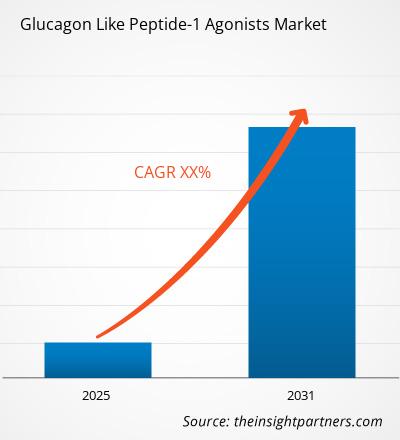
The global Glucagon-Like Peptide-1 (GLP-1) agonists market size is projected to reach US$ 249.11 billion by 2034 from US$ 64.09 billion in 2025. The market is anticipated to register a CAGR of 16.28% during the forecast period 2026–2034.
Key market dynamics include the surging global prevalence of metabolic disorders, a paradigm shift in obesity treatment toward pharmacological intervention, and significant clinical data supporting the reduction of major adverse cardiovascular events (MACE). Additionally, the market is expected to benefit from high-volume production scaling, the anticipated launch of multiple oral peptide candidates, and expanding regulatory approvals for indications such as obstructive sleep apnea and chronic kidney disease.
Glucagon-Like Peptide-1 Agonists Market Analysis
The GLP-1 agonists market analysis shows a transition from second-line diabetes management to a primary therapeutic pillar for holistic metabolic health. The market trends indicate a massive surge in demand that has consistently outpaced global manufacturing capacity, leading to significant investments in fill-finish facilities and API production. Strategic opportunities are emerging in the integration of digital health platforms with GLP-1 therapy to manage the high discontinuation rates often caused by gastrointestinal side effects. The analysis also notes that market expansion depends on navigating complex pricing negotiations with payers and the upcoming entry of biosimilar versions of earlier-generation molecules. Competitive differentiation now stands out based on clinical superiority in weight loss percentages and the development of multi-receptor agonists that target GIP and glucagon receptors alongside GLP-1.
Glucagon-Like Peptide-1 Agonists Market Overview
Metabolic health therapies have evolved from basic glucose control to comprehensive disease-modifying treatments. The market includes high-efficacy dual-agonist peptides and oral small molecules that mimic natural incretin hormones. Both legacy pharmaceutical giants and specialized biotech firms compete in this market, utilizing recombinant DNA technology and advanced delivery systems. Growing demand for effective weight-management solutions among the aging populations of North America and Europe has turned these medications into the most significant revenue drivers in the modern pharmaceutical landscape. North America leads in revenue due to its established reimbursement framework and high obesity rates, while Asia-Pacific is advancing through rapid urbanization and increased healthcare access in China and India. The US market is poised for significant shifts as early patents for pioneering GLP-1 molecules expire. Authorized generics and settled patent litigation have paved the way for lower-cost alternatives. This transition is expected to broaden patient access, alleviate persistent supply shortages, and intensify competition within the established pharmaceutical landscape.
Market Research Highlights
- Global market for Glucagon-Like Peptide-1 Agonists was valued at US$ 64.09 Billion in 2025
- Annual market size is expected to reach US$ 249.11 Billion by 2034
- Total addressable market (TAM) during 2026-2034 is projected to reach approximately US$ 1,321.28 Billion
- Market is anticipated to register a CAGR of 16.28% during the forecast period
- The United States represents a key market, supported by Unlocking Potential: GLP-1 Agonists Transform Diabetes Care, Empowering Patients: The Rise of GLP-1 in Weight Management, Innovation Ahead: GLP-1 Agonists Drive Market Growth and Hope, as well as evolving industry dynamics
- Market analysis covers North America, Europe, Asia-Pacific, South and Central America, Middle East and Africa, with growth evaluated across the forecast period
- Market opportunities such as GLP-1 Agonists: Revolutionizing Diabetes Care for a Healthier Future, Personalized Weight Loss Solutions with GLP-1 Agonists, Innovative GLP-1 Therapies Transforming Metabolic Health are expected to influence market dynamics and addressable market
- Report profiles industry participants, including NovoNordisk, Sanofi, Eli Lilly, AstraZeneca, Boehringer Ingelheim, Pfizer Inc., Amgen, Hanmi Pharmaceutical, Innovent Biologics, Viking Therapeutics, while analyzing competitive strategies and innovation developments
-
Source: The Insight Partners' analysis based on proprietary research, government publications, company annual reports, investor presentations, industry databases, and expert interviews.
● REPORT CUSTOMIZATION
Tailor This Report To Align With Your Specific Business Requirements
This report can be customized to align precisely with your business objectives, scope, and target markets. Customization options include tailored segmentation, geography, competitive analysis, and strategic insights to support informed decision-making.
Customize This Report →WHAT YOU CAN ADJUST
- ● Segmentations
- ● Geography
- ● Competitive Analysis
- ● Language Preferences
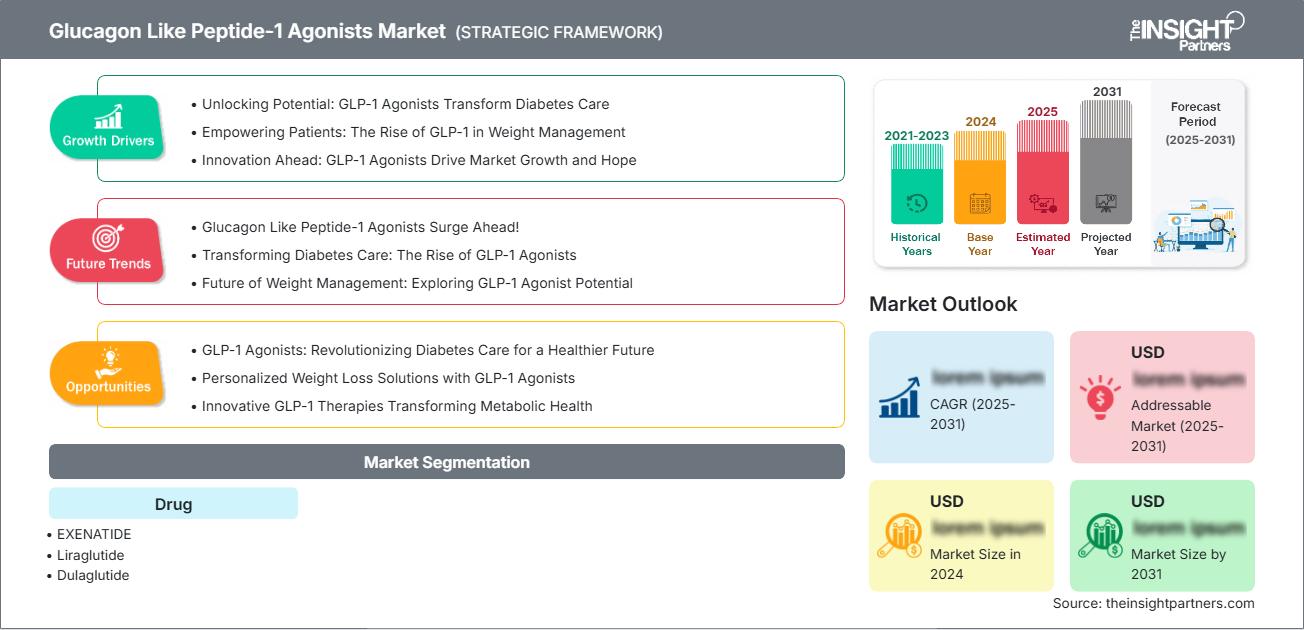
Glucagon-Like Peptide-1 Agonists Market: Strategic Insights
-
Get Top Key Market Trends of this report.This FREE sample will include data analysis, ranging from market trends to estimates and forecasts.
Glucagon-Like Peptide-1 Agonists Market Drivers and Opportunities
Market Drivers:
- Rising Global Burden of Type 2 Diabetes and Obesity: The exponential increase in metabolic syndrome cases worldwide provides a massive and growing patient base for GLP-1 therapies.
- Proven Cardiovascular and Renal Benefits: Compelling results from cardiovascular outcomes trials (CVOTs) have expanded the use of GLP-1 agonists to prevent heart failure and kidney progression.
- Shift Toward Patient-Friendly Dosing: The transition from daily to once-weekly injections and the move toward oral tablets has significantly improved patient adherence and market penetration.
Market Opportunities:
- Expansion into Pediatric and Geriatric Populations: Tailoring GLP-1 therapies for adolescent obesity and age-related metabolic decline offers a clear competitive advantage in specialized medicine.
- Untapped Potential in MASH and Neurodegeneration: Clinical trials exploring GLP-1 efficacy in metabolic dysfunction-associated steatohepatitis (MASH) and Alzheimer’s disease represent the next multi-billion-dollar frontiers.
- Growth of the Biosimilar Sector: The upcoming patent expiration of several first-generation GLP-1 molecules creates a massive opportunity for cost-effective versions in emerging economies.
Glucagon-Like Peptide-1 Agonists Market Report Segmentation Analysis
The GLP-1 Agonists Market share is analyzed across various segments to provide a clearer understanding of its structure, growth potential, and emerging trends. Below is the standard segmentation approach used in most industry reports:
By Product:
- Ozempic (semaglutide): The dominant brand for type 2 diabetes, widely recognized for its secondary weight-loss benefits and cardiovascular protection.
- Wegovy: The first high-dose semaglutide approved specifically for chronic weight management, seeing unprecedented demand in the obesity sector.
- Mounjaro: A dual GLP-1 and GIP receptor agonist that has demonstrated industry-leading efficacy in both glycemic control and weight reduction.
- Others: Includes established brands such as Trulicity, Victoza, and Saxenda, as well as emerging triple-agonist therapies.
By Molecule:
- Semaglutide: Currently the leading molecule by market share, available in various doses and formats for both diabetes and obesity.
- Tirzepatide: A high-growth dual-agonist molecule expected to capture a significant share as supply capacity expands globally.
- Other GLP-1 molecules: Includes liraglutide, dulaglutide, and lixisenatide, which remain vital in specific clinical scenarios and regional markets.
By Type:
- Patented drugs: The primary value driver of the market, consisting of high-margin branded products under active patent protection.
- Biosimilars: An emerging segment expected to grow rapidly as patents for early GLP-1 molecules expire, increasing affordability in price-sensitive regions.
By Format (Dosage Form):
- Single-dose formulations: Preferred for convenience and accuracy, primarily utilized in once-weekly autoinjector pens.
- Multi-dose formulations: Commonly used for daily-dose products and in certain healthcare settings to optimize supply.
- Tablets (oral formulations): The fastest-growing format, removing the psychological barrier of injections and simplifying long-term chronic care.
By Route of Administration (ROA):
- Subcutaneous (SC): The traditional and most common route, ensuring high bioavailability and consistent therapeutic levels.
- Oral: A rising segment driven by advancements in peptide delivery technology that allow for effective absorption through the digestive tract.
By Indication:
- Diabetes: The historical foundation of the market, focusing on HbA1c reduction and metabolic stability in type 2 diabetics.
- Obesity: The most explosive growth segment, as clinical guidelines increasingly recognize obesity as a primary chronic disease requiring medical treatment.
- Other indications: Encompasses emerging uses such as cardiovascular risk reduction, MASH, and potential neuroprotective applications.
By End User:
- Hospital & specialty clinics: Critical for the initial diagnosis, treatment titration, and management of patients with severe metabolic complications.
- Home care settings and Fitness/weight management facilities: The largest volume segment, where patients self-administer maintenance doses as part of long-term lifestyle management.
- Long-term care facilities: A growing segment as metabolic health becomes a priority in the management of elderly patients with multiple comorbidities.
By Geography:
- North America
- Europe
- Asia Pacific
- South & Central America
- Middle East & Africa
Glucagon-Like Peptide-1 Agonists Market Report Scope
| Report Attribute | Details |
|---|---|
| Market size in 2025 | US$ 64.09 Billion |
| Market Size by 2034 | US$ 249.11 Billion |
| Global CAGR (2026 - 2034) | 16.28% |
| Historical Data | 2021-2024 |
| Forecast period | 2026-2034 |
| Segments Covered |
By Drug
|
| Regions and Countries Covered |
North America
|
| Market leaders and key company profiles |
|
Glucagon-Like Peptide-1 Agonists Market Players Density: Understanding Its Impact on Business Dynamics
The Glucagon-Like Peptide-1 Agonists Market is growing rapidly, driven by increasing end-user demand due to factors such as evolving consumer preferences, technological advancements, and greater awareness of the product's benefits. As demand rises, businesses are expanding their offerings, innovating to meet consumer needs, and capitalizing on emerging trends, which further fuels market growth.
Glucagon-Like Peptide-1 Agonists Market Share Analysis by Geography
Asia-Pacific region is expected to grow fastest in the coming years due to a massive diabetic patient pool and increasing healthcare expenditure. Emerging markets in South & Central America, the Middle East, and Africa also present untapped opportunities for pharmaceutical leaders and biosimilar manufacturers to expand their metabolic health portfolios.
The GLP-1 agonists market is undergoing a significant transformation, moving from a secondary diabetes treatment to a global blockbuster category for weight management and cardiovascular health. Growth is driven by the rising prevalence of obesity, a surge in consumer demand for effective medical weight loss, and the expansion of clinical indications. Below is a summary of market share and trends by region:
1. North America
- Market Share: Holds the largest share globally, driven by high drug pricing and a robust obesity-treatment culture.
- Key Drivers:
- Widespread adoption of high-efficacy brands like Wegovy and Zepbound for chronic weight management.
- Favorable reimbursement landscape for type 2 diabetes and expanding coverage for obesity.
- Concentration of key market players and advanced clinical research infrastructure.
- Trends: Rapid integration of telehealth platforms for GLP-1 prescribing and a shift toward once-weekly subcutaneous delivery systems.
2. Europe
- Market Share: Represents a substantial portion of the global market, anchored by strict regulatory frameworks and national healthcare systems.
- Key Drivers:
- Strong clinical guidelines favoring GLP-1 agonists for patients with high cardiovascular risk.
- Presence of Novo Nordisk (Denmark), a global leader in the incretin space.
- Increasing government focus on reducing the long-term economic burden of obesity-related complications.
- Trends: A strategic focus on cost-effectiveness and value-based pricing, alongside a growing preference for oral semaglutide formulations to improve patient adherence.
3. Asia-Pacific
- Market Share: The fastest-growing region, with China and India serving as the primary drivers for volume growth.
- Key Drivers:
- Massive consumer base seeking advanced treatments for type 2 diabetes and lifestyle-induced obesity.
- Rise in disposable incomes and a burgeoning middle class willing to pay for premium metabolic therapies.
- Increasing domestic manufacturing capabilities for GLP-1 biosimilars.
- Trends: Heavy reliance on digital pharmacy channels and B2B contracts for hospital supply chains, coupled with a surge in local clinical trials for regional molecule variations.
4. South and Central America
- Market Share: An emerging market with a growing private-pay sector in countries like Brazil and Chile.
- Key Drivers:
- Modernization of chronic disease management protocols in urban healthcare centers.
- Rising interest in medical weight loss among high-income demographics.
- Expansion of global pharmaceutical distribution networks into major Latin American cities.
- Trends: Growth of specialty metabolic clinics and the introduction of branded GLP-1 agonists to differentiate from traditional metformin-based treatments.
5. Middle East and Africa
- Market Share: Developing market with high potential due to some of the world’s highest diabetes and obesity rates in the GCC region.
- Key Drivers:
- Strategic government health initiatives like Saudi Vision 2030, focusing on preventive care and metabolic health.
- High demand for advanced, once-weekly therapies to simplify treatment regimens.
- Investments in local pharmaceutical clusters to improve drug security and reduce reliance on imports.
- Trends: Implementation of smart healthcare monitoring to track patient progress on GLP-1 therapy, with a focus on high-potency molecules for the obesity segment.
High Market Density and Competition
Competition is intensifying due to the presence of established leaders such as Novo Nordisk, Eli Lilly, and AstraZeneca. Global innovators and niche players like Sanofi and Pfizer, alongside emerging biotech firms, also contribute to a diverse and rapidly expanding market landscape.
This competitive environment pushes vendors to differentiate through:
- Efficacy Benchmarking: Companies are engaged in head-to-head trials to prove superior weight loss percentages, often aiming for the threshold.
- Supply Chain Resilience: Leaders are investing billions in manufacturing to ensure a consistent supply and eliminate the shortages that have plagued the market.
- Indication Broadening: Expanding labels to include non-metabolic conditions to secure broader insurance coverage and physician preference.
Opportunities and Strategic Moves
- Partner with Digital Health and Telehealth Providers: Tap into the surging demand for convenient, remote access to obesity and diabetes management, particularly in the North American and European markets.
- Expand into Non-Metabolic Indications: Target emerging therapeutic areas such as NASH/MASH, Alzheimer’s disease, and sleep apnea to appeal to a broader specialist physician base and secure wider insurance coverage.
Major Companies operating in the Glucagon-Like Peptide-1 Agonists Market are:
- NovoNordisk
- Sanofi
- Eli Lilly
- AstraZeneca
- Boehringer Ingelheim
- Pfizer Inc.
- Amgen
- Hanmi Pharmaceutical
- Innovent Biologics
- Viking Therapeutics
Disclaimer: The companies listed above are not ranked in any particular order.
Glucagon-Like Peptide-1 Agonists Market News and Recent Developments
- In December 2025, Novo Nordisk announced that the US Food and Drug Administration (FDA) approved the Wegovy® pill (once-daily oral semaglutide 25 mg) to reduce excess body weight and maintain weight reduction long term and to reduce the risk of major adverse cardiovascular events. The Wegovy® pill is the first oral glucagon-like peptide-1 (GLP-1) receptor agonist therapy approved for weight management.
- In April 2024, Sanofi India Limited launched its’ new diabetes drug Soliqua® after having received the marketing authorization from the Central Drugs Standard Control Organization (CDSCO). Soliqua® is indicated as treatment in adults with obesity and type 2 diabetes mellitus, to improve glycemic control as an adjunct to diet and exercise, in those who are insufficiently controlled on oral or injectable therapies. Soliqua® is a once-daily injectable combination drug containing insulin glargine 100 Units/ml, which is a long-acting basal insulin and lixisenatide, a GLP-1 receptor agonist.
Glucagon-Like Peptide-1 Agonists Market Report Coverage and Deliverables
The Glucagon-Like Peptide-1 Agonists Market Size and Forecast (2021–2034) report provides a detailed analysis of the market covering below areas:
- Glucagon-Like Peptide-1 Agonists Market size and forecast at global, regional, and country levels for all the key market segments covered under the scope
- Glucagon-Like Peptide-1 Agonists Market trends, as well as market dynamics such as drivers, restraints, and key opportunities
- Detailed PEST and SWOT analysis
- Glucagon-Like Peptide-1 Agonists Market analysis covering key market trends, global and regional framework, major players, regulations, and recent market developments
- Industry landscape and competition analysis covering market concentration, heat map analysis, prominent players, and recent developments in the Glucagon-Like Peptide-1 Agonists Market.
- Detailed company profiles
Frequently Asked Questions

- Comprehensive Market Sizing and Forecast Analysis
- Detailed Segmentation Analysis
- In-Depth Market Dynamics Assessment
- Regional and Country-Level Insights
- Competitive Landscape and Company Benchmarking
- Strategic Business Intelligence
Recent Reports
Testimonials

The Insight Partners' SCADA System Market report is comprehensive, with valuable insights on current trends and future forecasts. The team was highly professional, responsive, and supportive throughout. We are very satisfied and highly recommend their services.
RAN KEDEM Partner, Reali Technologies LTDs
I requested a report on a very specific software market and the team produced the report in a few days. The information was very relevant and well presented. I then requested some changes and additions to the report. The team was again very responsive and I got the final report in less than a week.
JEAN-HERVE JENN Chairman, Future Analytica
We worked with The Insight Partners for an important market study and forecast. They gave us clear insights into opportunities and risks, which helped shape our plans. Their research was easy to use and based on solid data. It helped us make smart, confident decisions. We highly recommend them.
PIYUSH NAGPAL Sr. Vice President, High Beam Global
The Insight Partners delivered insightful, well-structured market research with strong domain expertise. Their team was professional and responsive throughout. The user-friendly website made accessing industry reports seamless. We highly recommend them for reliable, high-quality research services
YUKIHIKO ADACHI CEO, Deep Blue, LLC.
This is the first time I have purchased a market report from The Insight Partners.While I was unsure at first, I visited their web site and felt more comfortable to take the risk and purchase a market report.I am completely satisfied with the quality of the report and customer service. I had several questions and comments with the initial report, but after a couple of dialogs over email with their analyst I believe I have a report that I can use as input to our strategic planning process.Thank you so much for taking the extra time and making this a positive experience.I will definitely recommend your service to others and you will be my first call when we need further market data.
JOHN SUZUKI President and Chief Executive Officer, Board Director, BK Technologies
I wish to appreciate your support and the professionalism you displayed in the course of attending to my request for information regarding to infectious disease IVD market in Nigeria. I appreciate your patience, your guidance, and the fact that you were willing to offer a discount, which eventually made it possible for us to close a deal. I look forward to engaging The Insight Partners in the future, all thanks to the impression you have created in me as a result of this first encounter.
DR CHIJIOKE ONYIA MANAGING DIRECTOR, PineCrest Healthcare Ltd.Reason to Buy
- Informed Decision-Making
- Understanding Market Dynamics
- Competitive Analysis
- Identifying Emerging Markets
- Customer Insights
- Market Forecasts
- Risk Mitigation
- Boosting Operational Efficiency
- Strategic Planning
- Investment Justification
- Tracking Industry Innovations
- Aligning with Regulatory Trends





 Get Free Sample for