
Graphene Composites Market Trends, Size & Forecast by 2034
Coverage: By Product Type (Ceramic-based Graphene Composites, Metal-based Graphene Composites, Polymer-based Graphene Composites, Others); End-use Industry (Automotive, Energy Storage and Generation, Electronics, Aerospace, Building and Construction, Others) , and Geography (North America, Europe, Asia Pacific, and South and Central America)
- Status : Data Released
- Report Code : TIPRE00022231
- Category : Chemicals and Materials
- No. of Pages : 150
- Available Report Formats :


- Last update date : July 21, 2026


2025 Market Size
US$ 53.96 Mn
Base year value
2034 Forecast
US$ 1,429.22 Mn
Projected by 2034
CAGR 2026-2034
50.62 %
Growth rate
Addressable Market
US$ 6,245.28 Mn
(2026-2034)
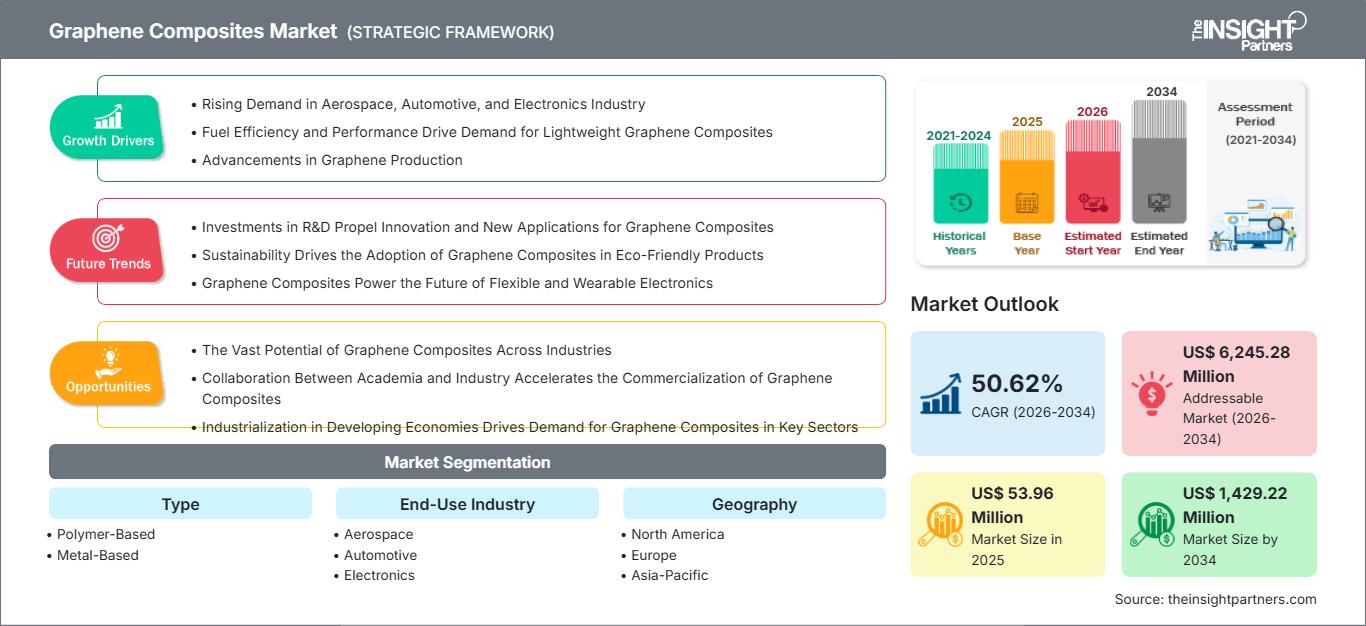
The graphene composites market is advancing rapidly as manufacturers integrate graphene into advanced material systems to achieve superior strength, conductivity, thermal stability, and lightweight performance. The market was valued at US$ 53.96 Million in 2025 and is projected to reach US$ 1,429.22 Million by 2034, expanding at a CAGR of 50.62% during 2026–2034. Commercialization of graphene-enhanced materials across high-value industries continues to strengthen long-term industry fundamentals.
North America remains among the most technologically advanced regions for graphene composite commercialization because of strong aerospace manufacturing, electric vehicle innovation, and government-supported advanced materials research. The graphene composites market size is expanding steadily across the region as research institutions collaborate with industrial manufacturers to accelerate product validation and scale production. Regional demand is anticipated to register a CAGR ranging between 47–50% during 2026–2034, supported by investments in next-generation mobility and energy storage applications.
Graphene Composites Market Assessment and Insights
- North America: Accounted for 33–36% share in 2025 and is anticipated to expand at a CAGR of 47–50% during 2026–2034, supported by aerospace innovation, EV manufacturing, defense modernization, and continuous investment in advanced composite research.
- US: Represented 77–81% of the North American market in 2025 and is projected to record a CAGR of 47–50% during 2026–2034, driven by expanding graphene research, commercialization initiatives, and demand from aerospace and electronics manufacturers.
- Europe: Held 27–30% share in 2025 and is expected to grow at a CAGR of 49–52% during 2026–2034, led by Germany, the UK, France, Italy, and Spain through strong sustainability policies and advanced manufacturing investments.
- Asia Pacific: Captured 28–31% share in 2025 and is forecast to expand at a CAGR of 52–55% during 2026–2034, with China, Japan, South Korea, and India driving large-scale manufacturing, battery innovation, and electronics production.
- Largest Segment: Polymer-Based composites accounted for 63–67% market share in 2025 and are projected to register a CAGR of 49–52% during 2026–2034, owing to their lightweight characteristics and compatibility with automotive and aerospace manufacturing.
- High Growth Segment: Energy Storage represented 14–18% market share in 2025 and is anticipated to witness a CAGR of 56–59% during 2026–2034, driven by battery performance improvements, supercapacitor development, and renewable energy integration.
- Key companies analyzed in detail: XG Sciences, Inc., Applied Graphene Materials plc, G6 Materials Corp., Graphene Composites Limited, NanoXplore Inc., PMG 3D Technologies Company Limited, Graphmatech AB, Nano Graphene Inc., Directa Plus Plc, The Sixth Element (Changzhou) Materials Technology Co., Ltd.
Source: The Insight Partners' analysis based on proprietary research, government publications, company annual reports, investor presentations, industry databases, and expert interviews.
Graphene-enabled materials have progressed from laboratory-scale innovation toward commercial production as manufacturing technologies improve and graphene dispersion techniques become more consistent. Growing investments in advanced nanomaterials, combined with expanding industrial acceptance, are enhancing production efficiency while reducing technical barriers. The graphene composites market growth is supported by increasing adoption in lightweight structural components, conductive materials, electromagnetic shielding products, and thermal management systems across multiple industries.
The future growth of the market will be facilitated by commercialization activities in the Asia Pacific region, North America, and Europe, where public and private investments in graphene are steadily boosting the ecosystem. Growing funding of battery technology, sustainable construction materials, and aerospace technology programs can boost product development. Improved standardization, regulation of advanced materials, and industry collaborations can help achieve market scale and competitiveness.
Graphene Composites Market Report Scope
| Report Attribute | Details |
|---|---|
| Market size in 2025 | US$ 53.96 Million |
| Market Size by 2034 | US$ 1,429.22 Million |
| Global CAGR (2026 - 2034) | 50.62% |
| Historical Data | 2021-2024 |
| Forecast period | 2026-2034 |
Graphene Composites Market Analysis
Increasing demand for lightweight, multifunctional materials is transforming industrial manufacturing across transportation, aerospace, electronics, and energy sectors. Graphene incorporation enhances tensile strength, electrical conductivity, corrosion resistance, and thermal performance without significantly increasing component weight. These characteristics support product innovation while improving operational efficiency and lifecycle performance. Consequently, manufacturers continue expanding graphene integration into structural composites, conductive polymers, and specialized engineering materials, strengthening the graphene composites market ecosystem across high-value industrial applications.
The raw material suppliers, graphene suppliers, compounding formulators, composite fabricators, component fabricators, and the application sectors are all contributors to the value chain of the industry. Graphene fabrication is getting more consistent and the manufacturing costs are going down with the development of various methods of making graphene, such as chemical vapor deposition, the exfoliation process, and sustainable processes of making it.
The level of competition is still rising due to the fact that existing nanomaterial manufacturers and upcoming technologies are focusing on making more investments for the differentiation of products, IP rights, and manufacturing capabilities. It has been noted from the analysis of the graphene composites market that some of the key players such as NanoXplore Inc., XG Sciences, Inc., Applied Graphene Materials plc, Directa Plus Plc, and Graphmatech AB have been building their commercial portfolio through partnerships, customization of materials, and innovation based on applications.
Investment activity is expanding beyond graphene production toward downstream product development and application engineering. Industrial partnerships increasingly emphasize scalable manufacturing, quality assurance, and regulatory compliance to accelerate commercialization. Companies, including PMG 3D Technologies Company Limited, Nano Graphene Inc., and The Sixth Element (Changzhou) Materials Technology Co., Ltd., are broadening their technological capabilities through production expansion and research partnerships. As commercialization advances, differentiation is expected to depend increasingly on material consistency, application expertise, and supply chain integration rather than graphene production capacity alone.
● REPORT CUSTOMIZATION
Tailor This Report To Align With Your Specific Business Requirements
This report can be customized to align precisely with your business objectives, scope, and target markets. Customization options include tailored segmentation, geography, competitive analysis, and strategic insights to support informed decision-making.
Customize This Report →WHAT YOU CAN ADJUST
- ● Segmentations
- ● Geography
- ● Competitive Analysis
- ● Language Preferences
Graphene Composites Market: Strategic Insights
Regional Insights
North America Graphene Composites Market
North America accounted for 33–36% of the global graphene composites market share in 2025, supported by advanced aerospace manufacturing, defense modernization, electric vehicle production, and extensive nanotechnology research. Continuous investments from government agencies, universities, and private companies encourage the commercialization of graphene-enhanced materials across structural, conductive, and thermal applications. Regional manufacturers increasingly integrate graphene composites into aircraft components, automotive parts, and energy storage technologies, supporting sustained industrial demand.
The regional market is expected to expand at a CAGR of 47–50% during 2026–2034 as commercialization accelerates across transportation, electronics, and infrastructure sectors. Growing collaboration between research laboratories and industrial manufacturers continues to improve graphene processing technologies while reducing production costs. Favorable innovation ecosystems, established intellectual property frameworks, and rising private investment are expected to strengthen North America's competitive position throughout the forecast period.
U.S. Graphene Composites Market
The United States represented 77–81% of the North American market in 2025, reflecting its leadership in aerospace engineering, defense innovation, advanced electronics, and electric mobility. In addition to federal research funding, nanotechnology-based programs run by universities and business alliances, graphene-composite commercialization continues to receive financial assistance. Moreover, the nation enjoys access to technology developers, specialty materials manufacturers, and high-quality component manufacturers catering to the domestic and international market segments.
The United States market is expected to exhibit a CAGR of 47-50% during 2026-2034 due to the increased use of graphene-based materials for enhancing structural properties, thermal conductivity, and durability. Demand is increasing in aerospace assemblies, lightweight auto components, semiconductor packaging, and batteries among others. The active involvement of businesses such as XG Sciences, Inc. and G6 Materials Corp., coupled with expanding industrial alliances, keeps reinforcing the innovation ecosystem of the nation.
Europe Graphene Composites Market
Europe held 27–30% of the global market in 2025, supported by strong research infrastructure and advanced manufacturing capabilities. Germany continues to be the region's leader due to its automotive engineering skills and innovations. UK is enhancing commercialization of graphene through the establishment of graphene research hubs and companies with an emphasis on technologies. France, on the other hand, enhances adoption of graphene through aerospace manufacture and development of advanced materials.
Italy and Spain continue to increase their adoption of graphene composites in automotive, construction, renewable energy, and industrial manufacture industries. Collaboration efforts and sustainability initiatives have seen increased development of lightweight materials for increased energy efficiency and decreased emission rates. Europe is expected to register a CAGR of 49-52% between 2026 and 2034.
APAC Graphene Composites Market
Asia Pacific accounted for 28–31% of global revenue in 2025, with China leading regional production, followed by Japan, South Korea, India, and Australia. Expanding electronics manufacturing, battery production, and automotive industries continue stimulating demand for graphene-enhanced composite materials across commercial applications.
The region is expected to register the fastest expansion at a CAGR of 52–55% during 2026–2034. Government support for advanced materials, domestic graphene manufacturing capacity, and increasing industrial research investments are accelerating commercialization while strengthening regional competitiveness across high-value manufacturing industries.
Middle East & Africa Graphene Composites Market
The Middle East & Africa are gradually emerging as a promising market, supported by industrial diversification initiatives in Saudi Arabia and the UAE alongside expanding manufacturing investments in South Africa. Infrastructure modernization, renewable energy projects, and advanced material adoption are encouraging greater interest in graphene-enhanced composites across industrial applications.
The regional market is projected to grow at a CAGR of 45–48% during 2026–2034. Continued investments in energy infrastructure, industrial innovation, and research partnerships are expected to strengthen long-term demand, while broader economic diversification strategies create new commercialization opportunities across the Rest of the Middle East & Africa.
Segmentation Analysis
Type
The Type segment represents the technological foundation of material development within the graphene composites industry and is expected to register a CAGR of 50–53% during 2026–2034. Manufacturers are increasingly optimizing graphene loading levels, dispersion quality, and matrix compatibility to improve mechanical strength, thermal conductivity, and electrical performance. The graphene composites market scope continues to expand as advanced material engineering enables adoption across lightweight transportation systems, industrial equipment, and high-performance electronic applications.
- Polymer-based: The most significant use is that of polymer-based graphene composite materials due to their light weight, anti-corrosive properties, flexibility, and processability. These types of materials are extensively used in automobile parts, aerospace, sports goods, and electronic housing components.
- Metal-based: The metal-based graphene composite materials find an increasing number of applications where extremely good thermal conductivity and wear resistance are needed. Their application ranges from aerospace to military equipment to industrial machines.
End-Use Industry
The End-Use Industry segment is projected to expand at a CAGR of 51–54% during 2026–2034, reflecting increasing commercialization across diverse industrial sectors. Continuous improvements in graphene production technologies and composite processing methods are enabling broader industrial acceptance. Manufacturers increasingly collaborate with end users to develop application-specific materials that deliver measurable performance improvements while supporting sustainability and lightweight engineering objectives.
Aerospace: Aerospace companies make use of graphene composite materials more often to decrease the structural weight and increase the strength and thermal stability of the structure. Innovations in the aircraft and satellites' components help maintain high demand.
Automotive: The automotive industry uses graphene composite materials in various applications such as body panels, battery cases, interior components, and structural components.
- Electronic Components: Graphene composites find their application in electronics for thermal control, conductive coatings, flexible electronics, electromagnetic interference shielding, and semiconductor packaging, where high conductivity and small size are crucial features.
- Construction & Building: Applications in construction grow as a result of graphene composites improving concrete, coatings, insulators, and structural materials in terms of longevity, crack-resistance, corrosion resistance, etc.
- Energy Storage: The fastest developing area of application is energy storage, where graphene composites enhance battery electrodes, supercapacitors, conductive properties and charging characteristics. Investment in renewable energy systems and electric mobility boosts commercialization.
Opportunity Snapshot
| End-Use Industry | Revenue Contribution | Trend Tag | Adoption Stage |
| Aerospace | High | Lightweight Airframes | Scaling |
| Automotive | High | EV Components | Scaling |
| Electronics | High | Thermal Control | Mature |
| Building and Construction | Medium | Smart Concrete | Emerging |
| Energy Storage | High | Fast Charging | Scaling |
Graphene Composites Market Growth Drivers and Impact Analysis
Growing adoption of lightweight materials in transportation industries
The transportation industry has not relented on its preference for light-weighting in order to enhance fuel efficiency, maximize the driving distance of electric vehicles and minimize lifecycle emission. The graphene composites have shown high strength-to-weight ratios coupled with better thermal and electrical properties that make them highly desirable for aerospace and automotive industries. The aircraft industry needs structural materials that can help in reducing the weight of the entire plane without reducing safety while the electric vehicle industry needs light-weighting batteries and structural materials. Increased funding for sustainable mobility projects in North America, Europe and the Asia Pacific region will continue to boost the adoption of these materials.
Expansion of advanced energy storage technologies
With the rise in application of renewable energy sources and electric cars, there is an increase in need for batteries and supercapacitors with higher energy density, increased charging speed, and prolonged service life. Graphene composites improve electrical conductivity, thermal properties, and electrode stability, thus playing an important role in the development of energy storage devices of the future. Investments in the construction of battery factories, power grid scale storage installations, and research on advanced materials will help drive commercial prospects. The cooperation of material suppliers, battery manufacturers, and research organizations contributes to product innovations. These factors will help build stable supply chains and the use of graphene-based energy storage components in industry during the forecast period.
Increasing commercialization of advanced nanomaterials
The commercial viability of graphene-enabled products is growing due to greater scalability, standardization, and economic viability in manufacturing processes. Quality control advancements, improved graphene dispersing methods, and increased process reliability have lowered technical barriers hindering the industrialization of graphene-based materials. While governments are still providing support to nanotechnology research, industrial organizations are investing in pilot manufacturing operations as well as commercialization projects. High levels of intellectual property protection, along with strategic cooperation between universities, technology innovators, and manufacturing firms, are fostering an innovation environment. With further development of industrial qualification processes, graphene composite materials will be utilized in valuable applications like aerospace, electronics, industrial machinery, medical devices, and construction materials.
Graphene Composites Market Future Trends
Integration with next-generation battery technologies
Battery developers are increasingly incorporating graphene composites into advanced lithium-ion, solid-state, and hybrid battery systems to improve conductivity, charging speed, cycle life, and thermal stability. The graphene composites market trends indicate that future product development will increasingly focus on high-performance electrode materials capable of supporting electric vehicles, renewable energy storage, and portable electronics. Continued collaboration among battery manufacturers, graphene producers, and research organizations is expected to accelerate commercial deployment while supporting global energy transition objectives through improved battery efficiency and durability.
Expansion of multifunctional smart composite materials
The future advancements in material science are anticipated to take a leap from reinforcing material structures to multifunctional materials that can provide mechanical stress sensing, electrical conductivity, thermal management, and electromagnetic shielding all in one material platform. The manufacturers are developing platforms made of several properties at once without adding additional components to the structure. The expected areas of application for such advancements include aerospace and defense industries, smart infrastructure, wearables, and autonomous transportation systems. With the development of digital manufacturing technologies, multifunctional graphene composites will likely become an important field of industrial research and investments.
Graphene Composites Market Opportunities
Scaling commercial production for electric mobility
Rapid expansion of electric vehicle production presents a significant investment opportunity for graphene composite manufacturers. Demand continues increasing for lightweight structural components, battery enclosures, thermal management materials, and conductive polymers that improve vehicle efficiency and safety. Graphene composites market Forecasts indicate that expanding battery manufacturing capacity and government incentives supporting zero-emission transportation will strengthen downstream demand. Companies investing in scalable graphene production, application engineering, and long-term supply agreements with automotive manufacturers are expected to gain competitive advantages as commercialization accelerates. Strategic partnerships between material suppliers and original equipment manufacturers will remain essential for achieving consistent product quality and industrial-scale deployment.
Development of sustainable infrastructure materials
Modernization projects related to infrastructure development in the developed world and emerging countries present lucrative opportunities for graphene-based construction materials. There is an increasing trend toward the use of robust concrete, anti-corrosion coatings, light-weight panels, and energy-saving construction technology which will contribute to the higher usage of graphene in construction applications. Infrastructure investment plans along with sustainability measures that focus on reducing carbon emissions, will help boost the market for composite materials. Companies that have the potential to deliver significant performance benefits and cost-effective manufacturing of products are well positioned to capitalize on infrastructure investment plans.
Recent Developments
- January 2026: Directa Plus Plc announced its full-year 2025 trading update, reporting revenue growth, improved EBITDA performance, and continued optimization of its graphene production platform. The company also expanded capabilities for manufacturing advanced graphene materials targeting PFAS remediation, defense, and regulated industrial applications while strengthening operational efficiency.
- September 2025: NanoXplore Inc. announced a leadership transition, with founder Soroush Nazarpour stepping down as Chief Executive Officer following the annual general meeting while remaining Vice Chairman and Founder. The company stated that the transition supports continuity as it advances the commercialization of graphene materials for transportation, industrial, and energy storage applications.
Frequently Asked Questions

- Comprehensive Market Sizing and Forecast Analysis
- Detailed Segmentation Analysis
- In-Depth Market Dynamics Assessment
- Regional and Country-Level Insights
- Competitive Landscape and Company Benchmarking
- Strategic Business Intelligence
Recent Reports
Testimonials

The Insight Partners' SCADA System Market report is comprehensive, with valuable insights on current trends and future forecasts. The team was highly professional, responsive, and supportive throughout. We are very satisfied and highly recommend their services.
RAN KEDEM Partner, Reali Technologies LTDs
I requested a report on a very specific software market and the team produced the report in a few days. The information was very relevant and well presented. I then requested some changes and additions to the report. The team was again very responsive and I got the final report in less than a week.
JEAN-HERVE JENN Chairman, Future Analytica
We worked with The Insight Partners for an important market study and forecast. They gave us clear insights into opportunities and risks, which helped shape our plans. Their research was easy to use and based on solid data. It helped us make smart, confident decisions. We highly recommend them.
PIYUSH NAGPAL Sr. Vice President, High Beam Global
The Insight Partners delivered insightful, well-structured market research with strong domain expertise. Their team was professional and responsive throughout. The user-friendly website made accessing industry reports seamless. We highly recommend them for reliable, high-quality research services
YUKIHIKO ADACHI CEO, Deep Blue, LLC.
This is the first time I have purchased a market report from The Insight Partners.While I was unsure at first, I visited their web site and felt more comfortable to take the risk and purchase a market report.I am completely satisfied with the quality of the report and customer service. I had several questions and comments with the initial report, but after a couple of dialogs over email with their analyst I believe I have a report that I can use as input to our strategic planning process.Thank you so much for taking the extra time and making this a positive experience.I will definitely recommend your service to others and you will be my first call when we need further market data.
JOHN SUZUKI President and Chief Executive Officer, Board Director, BK Technologies
I wish to appreciate your support and the professionalism you displayed in the course of attending to my request for information regarding to infectious disease IVD market in Nigeria. I appreciate your patience, your guidance, and the fact that you were willing to offer a discount, which eventually made it possible for us to close a deal. I look forward to engaging The Insight Partners in the future, all thanks to the impression you have created in me as a result of this first encounter.
DR CHIJIOKE ONYIA MANAGING DIRECTOR, PineCrest Healthcare Ltd.Reason to Buy
- Informed Decision-Making
- Understanding Market Dynamics
- Competitive Analysis
- Identifying Emerging Markets
- Customer Insights
- Market Forecasts
- Risk Mitigation
- Boosting Operational Efficiency
- Strategic Planning
- Investment Justification
- Tracking Industry Innovations
- Aligning with Regulatory Trends





 Get Free Sample for