
Green Mining Market Share, Growth & Forecast by 2034
Coverage: by Mining Type (Surface, Underground); Technology (Power Reduction, Fuel and Maintenance Reduction, Emission Reduction, Water Reduction, Others) , and Geography (North America, Europe, Asia Pacific, and South and Central America)
- Status : Data Released
- Report Code : TIPRE00010307
- Category : Manufacturing and Construction
- No. of Pages : 150
- Available Report Formats :


- Last update date : August 17, 2026


2025 Market Size
US$ 13.76 Bn
Base year value
2034 Forecast
US$ 17.90 Bn
Projected by 2034
CAGR 2026-2034
2.97 %
Growth rate
Addressable Market
US$ 143.77 Bn
(2026-2034)
The green mining market is projected to grow from US$ 13.76 Billion in 2025 to US$ 17.90 Billion by 2034; it is expected to record a CAGR of 2.97% from 2026 to 2034. Adoption is supported by cleaner mining systems, power optimization, fuel-efficiency programs, emission-control upgrades, and water-reduction technologies across surface and underground mines.
Across North America, adoption is expected to advance at an estimated 3.0–3.4% CAGR through 2034, supported by stricter permitting, investor scrutiny, and mine-site electrification. The green mining market size in the region is also shaped by Canadian critical-minerals projects and U.S. demand for traceable copper, lithium, nickel, and other transition materials.
Green Mining Market Assessment and Insights
- North America held 31–34% share in 2025 and is growing at a 3.0–3.4% CAGR between 2026–2034, led by mine electrification, transparent mineral sourcing, and water-efficiency upgrades.
- US accounted for 64–68% of North America in 2025 and is expanding at a 3.1–3.5% CAGR between 2026–2034, supported by battery minerals and cleaner equipment trials.
- Europe represented 27–30% share in 2025 and is growing at a 2.8–3.2% CAGR between 2026–2034, with the UK, Germany, France, Sweden, and Finland leading low-emission mining practices.
- Asia Pacific captured 24–27% share in 2025 and is growing at a 3.2–3.6% CAGR between 2026–2034, driven by China, Australia, India, Japan, and South Korea.
- Largest Segment Surface mining held 62–66% market share in 2025 and is advancing at a 2.6–3.0% CAGR between 2026–2034 due to scalable equipment electrification.
- High Growth Segment Emission reduction held 24–28% market share in 2025 and is growing at a 3.5–3.9% CAGR between 2026–2034 as miners prioritize decarbonization.
- Key companies analyzed in detail: BHP Group Limited, Dundee Precious Metals Inc., Glencore plc, Jiangxi Copper Corporation Limited, Rio Tinto Group, Saudi Arabian Mining Company, Shandong Gold Mining Co., Ltd., Tata Steel Limited, Vale S.A., Teck Resources Limited.
Source: The Insight Partners' analysis based on proprietary research, government publications, company annual reports, investor presentations, industry databases, and expert interviews.
Mining sustainability has moved from compliance reporting to operational design. The green mining market now reflects technology shifts in haulage electrification, renewable power procurement, advanced ventilation, ore sorting, tailings monitoring, and water recycling. Production will also evolve due to more scrutiny on environmental considerations for critical-mineral projects and efficiency efforts by established companies to reduce diesel consumption, minimize maintenance shut-downs, and increase energy efficiency per ton of mined material.
In the forecast period, new mining jurisdictions will receive investments due to environmental considerations at an early stage of project development. Tailwind regulations in Canada, the EU, Australia, and the Gulf region will favor mining assets that are both secure in minerals and have low emissions and responsible water management. Mining firms with clear technological roadmaps will benefit from easier financing, off-take contracts, and community approval.
Green Mining Market Report Scope
| Report Attribute | Details |
|---|---|
| Market size in 2025 | US$ 13.76 Billion |
| Market Size by 2034 | US$ 17.90 Billion |
| Global CAGR (2026 - 2034) | 2.97% |
| Historical Data | 2021-2024 |
| Forecast period | 2026-2034 |
Green Mining Market Analysis
Demand is anchored in the need to produce transition minerals with lower environmental impact. The green mining market growth is reinforced by customer requirements for traceable, lower-carbon copper, nickel, lithium, iron ore, and gold. According to IEA, the benefits of innovation include a potential cost cut of up to 60% in drilling and increased chances of discovering resources. It makes the business case for cleaner exploration and extraction technology stronger.
The mining value chain comprises miners, machinery suppliers, power producers, monitoring software providers, regulatory agencies, financiers, and consumers of the end-product. The supply chain dynamics remain uneven since underground mines require ventilation and power improvements, whereas surface mines are easier to transition into electrified transportation and micro-grids.
Competitive positioning is shaped by scale, commodity exposure, and capital discipline. BHP Group Limited and Rio Tinto Group are testing battery-electric haulage, Vale S.A. is expanding circular mining practices, and Teck Resources Limited is linking sustainability metrics with mine planning. This green mining market analysis indicates that companies able to quantify emission, energy, and water savings will command stronger stakeholder confidence.
Investment trends support phased introduction in preference to full site renovation. Glencore plc, Saudi Arabian Mining Company, Dundee Precious Metals Inc., Jiangxi Copper Corporation Limited, Shandong Gold Mining Co., Ltd., and Tata Steel Limited are likely to coordinate their renovations according to the life of the asset, permit requirements, and availability of energy. Differentiation will be based on performance rather than sustainability statements.
● REPORT CUSTOMIZATION
Tailor This Report To Align With Your Specific Business Requirements
This report can be customized to align precisely with your business objectives, scope, and target markets. Customization options include tailored segmentation, geography, competitive analysis, and strategic insights to support informed decision-making.
Customize This Report →WHAT YOU CAN ADJUST
- ● Segmentations
- ● Geography
- ● Competitive Analysis
- ● Language Preferences
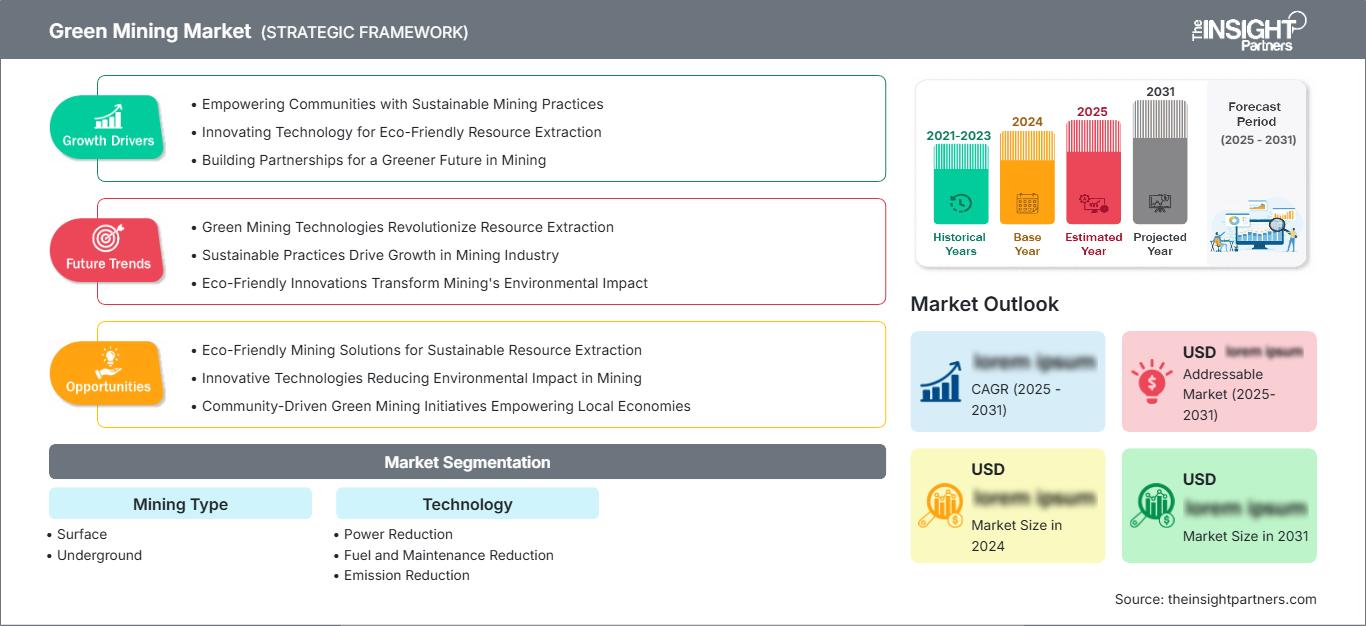
Green Mining Market: Strategic Insights
Regional Insights
North America green mining market
North America accounted for 31–34% of the global green mining market in 2025 and is expected to grow at a 3.0–3.4% CAGR during the forecast period. The expansion of the market is enabled by the critical minerals strategy of Canada, clean energy supply chain projects of the United States, and more rigorous reporting standards for mine site emissions, water use, biodiversity management, and tailings management. The focus on sustainability as a core concept of resource development is gaining momentum to assure mineral supply for years to come and meet environmental goals.
The strongest adoption will be found among copper, nickel, lithium, potash, and gold mining projects, where the combination of renewable electricity generation, batteries, diesel replacement technologies, and modern IT tools is used. Tests with equipment electrification, fleet upgrades, and long-term electricity purchasing agreements enable risk and cost reduction. Furthermore, permitting complexities and community expectations are motivating mining companies to implement emission reduction technologies, water recycling, and land rehabilitation earlier in the project development stage. The region enjoys well-developed technology communities and opportunities for green mining finance.
U.S. Green Mining Market
The United States represented 64–68% of the North American market in 2025 and is projected to expand at a 3.1–3.5% CAGR over the forecast period. The demand is heavily concentrated on four materials, namely copper, lithium, rare earth elements, and aggregates, and in all these areas, there is a clear linkage between domestic mineral security and environmental responsibility through federal and state policies. There have been increases in investment in the extraction of critical minerals owing to the need for stable material sources.
The presence of mining companies is defined through the use of technology partnerships, the development of the battery supply chain, and increased scrutiny when obtaining permits to operate mines. Such technologies as electric drilling systems, fleet management, water treatment, renewable energy, and emission monitoring platforms are especially crucial. Sustainability performance information is currently used by mining firms to increase their interactions with communities, secure investments, and negotiate offtake agreements with downstream manufacturers. The use of such technologies as artificial intelligence and predictive maintenance is also becoming popular.
Europe Green Mining Market
Europe held 27–30% of the global market in 2025 and is forecast to grow at a 2.8–3.2% CAGR. The United Kingdom leads in mining finance, sustainability reporting, ESG advisory services, and technology innovation that supports environmentally responsible extraction practices. Contributions of Germany can be seen in its mining equipment innovations, integration of recycling process, decarbonization strategies for industries, and development of energy-efficient processing technologies. Within the entire region, the framework of permitting has shifted towards more emphasis on biodiversity conservation, water conservation, and carbon reduction goals.
France, Italy, and Spain are some smaller but significant markets as they have mineral processing capability, industrial demands, and policies regarding European Union raw materials. In addition to this, the countries of the Nordic region also have an important role to play, especially Sweden and Finland, which have mining knowledge along with electrification and automation processes and low-carbon electricity grids.
In the coming years, there will be more emphasis on the circular economy approach and critical minerals, along with sustainable supply chain processes.
APAC Green Mining Market
Asia Pacific captured 24–27% of the global green mining market share in 2025 and is expected to grow at a 3.2–3.6% CAGR. China remains the leading market by scale, driven by its extensive mining industry and growing focus on improving resource efficiency, emissions performance, and environmental compliance. Australia continues to advance haulage electrification, renewable energy deployment, autonomous mining operations, and dry-processing technologies across iron ore and critical mineral mining sites, helping reduce operational emissions and water consumption.
Demand from Japan and South Korea is influenced by the two nations' high capability in battery production and material supply chain, promoting sustainable practices among mineral value chains. India is increasingly adopting clean practices in the extraction of coal, iron ore, and bauxite minerals due to the modernization programs and environmental management programs. Industrialization trends, favorable government policies, export-based industries, and growing expectations from stakeholders are driving the adoption of green technology in the region.
Middle East & Africa Green Mining Market
The Middle East & Africa market is projected to grow at a 3.0–3.4% CAGR during the forecast period. Saudi Arabia is emerging as a regional leader through mineral sector diversification programs, major infrastructure investments, and ambitious renewable energy initiatives designed to reduce dependence on hydrocarbons. The United Arab Emirates complements regional growth through mining-related processing activities, logistics capabilities, investment platforms, and sustainability-focused industrial development strategies.
South Africa remains a key market due to its established mining sector, where deep mining operations, power reliability concerns, and water scarcity challenges create strong demand for efficiency-enhancing technologies. Mining companies are increasingly investing in renewable energy systems, advanced water management solutions, and operational automation to improve productivity and sustainability performance. Across the rest of the MEA region, adoption levels depend on factors such as grid infrastructure availability, project financing access, regulatory development, and the integration of environmental safeguards into new mining projects. Increasing international investment and partnerships are expected to support broader implementation of green mining practices over the coming years.
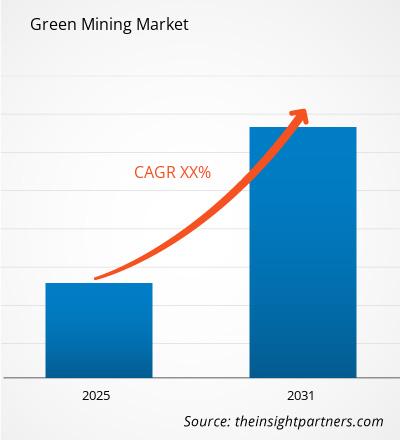
Segmentation Analysis
Mining Type
The mining type segment is expected to grow at a 2.7–3.1% CAGR between 2026–2034. The market scope across surface and underground operations depends on mine depth, energy intensity, fleet composition, and ventilation needs. Surface mines lead deployment because haul roads, charging points, and renewable supply can be planned more flexibly.
- Surface mining benefits from larger fleets, predictable operating layouts, and easier integration of electric trucks, trolley assist, renewable power, and automated dispatch systems.
- Underground mining adoption is driven by ventilation savings, diesel particulate reduction, worker safety, and battery-electric loaders, although infrastructure complexity slows rapid conversion.
Technology
The technology segment is projected to grow at a 3.0–3.4% CAGR between 2026–2034. Adoption is driven by measurable reductions in energy use, fuel consumption, emissions, maintenance intensity, and water dependence. Mine operators increasingly favor modular technologies that can be deployed without interrupting production or requiring full asset redesign.
- Power Reduction solutions improve energy efficiency through smart ventilation, optimized comminution, renewable integration, and digital load management, making them central to cost and emissions control.
- Fuel and Maintenance Reduction technologies reduce diesel use, extend equipment life, and lower downtime through electrified fleets, predictive maintenance, trolley assist, and optimized haul-road management.
- Emission Reduction systems address Scope 1 and Scope 2 impacts through renewable power, electrified equipment, methane control, carbon accounting, and cleaner processing routes.
- Water Reduction technologies support water recycling, dry tailings, closed-loop processing, and real-time discharge monitoring, especially in arid regions and communities facing water stress.
Opportunity Snapshot
| Technology | Revenue Contribution | Trend Tag | Adoption Stage |
|---|---|---|---|
| Power Reduction | High | Smart Energy | Scaling |
| Fuel and Maintenance Reduction | Medium | Fleet Electrification | Scaling |
| Emission Reduction | High | Carbon Control | Scaling |
| Water Reduction | Medium | Closed Loop | Emerging |
Green Mining Market Growth Drivers and Impact Analysis
Electrification of heavy mining fleets
The battery electric haul truck, loader, drill, and trolley assistance system are increasingly viable means of lowering diesel fuel use in big mining operations. According to Reuters, the mining sector produces 4 to 7% of all global emissions. Thus, the reduction of fuel usage is important in operational considerations. The electrification of a fleet is also useful in reducing the requirements for underground ventilation, maintenance, and energy management in conjunction with renewable energy. The market benefit is most felt with investments in long-term resources, where investment in charging equipment pays off many times over during production.
Water stewardship in stressed mining regions
The scarcity of water resources is impacting mine design in regions such as copper, lithium, gold, and iron ore regions, where withdrawal practices are strictly monitored by the local communities and authorities. Closed-loop processing, dry tailings, filtration techniques, and discharge analysis help in reducing vulnerability to operational disruptions and licensing problems. This is because the technologies will directly affect the market, as the availability of water resources will decide whether or not an expansion project will be initiated on schedule. Water management is particularly critical in Australia, Chile, India, South Africa, and certain Middle Eastern nations.
Responsible mineral sourcing requirements
Buyers downstream are increasingly demanding proof that the minerals are being mined with reduced emissions, safe tailings management, and environmental monitoring. This is shifting the paradigm of green mining from an efficiency-based approach at the mine site level to a business need through offtake agreements, financing requirements, and client audits. It is a factor that will drive the adoption of technologies such as digital monitoring, carbon accounting, lifecycle assessment, and third-party verification methods. For established miners, responsible sourcing is beneficial, while for emerging miners, it creates challenges.
Green Mining Market Future Trends
AI-enabled environmental optimization
The green mining market trends will increasingly center on AI models that link geological data, fleet movement, energy loads, water flows, and tailings monitoring into real-time operating decisions. IEA analysis notes that AI-based geological exploration can reduce drilling costs by up to 60% and increase discovery success rates by as much as four times. Future systems will not only find resources faster but also select lower-impact mine plans earlier. This will shift sustainability from retrospective reporting to predictive control, helping operators reduce waste, energy intensity, and disturbance before capital is committed.
Renewable-powered mine ecosystems
Mine sites are supposed to develop into comprehensive energy ecosystems where they generate their power using solar, wind, storage, and even contracts with the grid as well as using electric fleets and load management technologies. As a result, such projects will help to minimize the risks associated with diesel price fluctuations and become more resilient in terms of power provision for remote areas where the power infrastructure is poor. For large players, hybrid power strategies will allow matching the loads of processing plants, charging plans, and ventilation.
Green Mining Market Opportunities
Retrofitting mature surface mines
Mature surface mines offer a practical route for technology providers because they already have established haul roads, workshops, power access, and production data. The green mining market forecasts point to opportunities in modular charging, diesel-displacement packages, ore sorting, and energy-management software that can be introduced without major mine redesign. Investors should prioritize assets with long remaining mine lives, high diesel exposure, and clear baseline emissions data. For operators, retrofits can deliver measurable savings while avoiding the execution risk of full greenfield transformation.
Water-efficient mineral processing hubs
Processing hubs that combine water recycling, dry stacking, advanced filtration, and digital discharge monitoring can serve multiple mines in regions where water access constrains expansion. This opportunity is relevant for critical minerals, gold, copper, and phosphate projects that must satisfy both production and community requirements. Technology vendors can create recurring revenue through service contracts, consumables, and monitoring platforms. Governments can also support shared infrastructure to attract responsible mineral investment. The strongest business cases will appear where permitting delays, water tariffs, and tailings risks materially affect project economics.
Recent Developments
- June 2025: Rio Tinto Group — Rio Tinto, BHP, BlueScope, Woodside Energy, and Mitsui Iron Ore Development advanced the NeoSmelt pilot project, supported by ARENA funding, to test a lower-carbon DRI-ESF pathway for Pilbara iron ore
- October 2025- Discovery Green and Glencore have signed a 20-year renewable energy supply agreement which will see the replacement of most of the electricity consumption at four of Glencore's major mining operations with renewable energy
Frequently Asked Questions

- Comprehensive Market Sizing and Forecast Analysis
- Detailed Segmentation Analysis
- In-Depth Market Dynamics Assessment
- Regional and Country-Level Insights
- Competitive Landscape and Company Benchmarking
- Strategic Business Intelligence
Recent Reports
Testimonials

The Insight Partners' SCADA System Market report is comprehensive, with valuable insights on current trends and future forecasts. The team was highly professional, responsive, and supportive throughout. We are very satisfied and highly recommend their services.
RAN KEDEM Partner, Reali Technologies LTDs
I requested a report on a very specific software market and the team produced the report in a few days. The information was very relevant and well presented. I then requested some changes and additions to the report. The team was again very responsive and I got the final report in less than a week.
JEAN-HERVE JENN Chairman, Future Analytica
We worked with The Insight Partners for an important market study and forecast. They gave us clear insights into opportunities and risks, which helped shape our plans. Their research was easy to use and based on solid data. It helped us make smart, confident decisions. We highly recommend them.
PIYUSH NAGPAL Sr. Vice President, High Beam Global
The Insight Partners delivered insightful, well-structured market research with strong domain expertise. Their team was professional and responsive throughout. The user-friendly website made accessing industry reports seamless. We highly recommend them for reliable, high-quality research services
YUKIHIKO ADACHI CEO, Deep Blue, LLC.
This is the first time I have purchased a market report from The Insight Partners.While I was unsure at first, I visited their web site and felt more comfortable to take the risk and purchase a market report.I am completely satisfied with the quality of the report and customer service. I had several questions and comments with the initial report, but after a couple of dialogs over email with their analyst I believe I have a report that I can use as input to our strategic planning process.Thank you so much for taking the extra time and making this a positive experience.I will definitely recommend your service to others and you will be my first call when we need further market data.
JOHN SUZUKI President and Chief Executive Officer, Board Director, BK Technologies
I wish to appreciate your support and the professionalism you displayed in the course of attending to my request for information regarding to infectious disease IVD market in Nigeria. I appreciate your patience, your guidance, and the fact that you were willing to offer a discount, which eventually made it possible for us to close a deal. I look forward to engaging The Insight Partners in the future, all thanks to the impression you have created in me as a result of this first encounter.
DR CHIJIOKE ONYIA MANAGING DIRECTOR, PineCrest Healthcare Ltd.Reason to Buy
- Informed Decision-Making
- Understanding Market Dynamics
- Competitive Analysis
- Identifying Emerging Markets
- Customer Insights
- Market Forecasts
- Risk Mitigation
- Boosting Operational Efficiency
- Strategic Planning
- Investment Justification
- Tracking Industry Innovations
- Aligning with Regulatory Trends





 Get Free Sample for