
Hair Dryer Market Growth, Size & Forecast by 2034
Coverage: By Product (Corded, Cordless); Distribution Channel (Offline, Online); End-user (Professional, Individual), and Geography (North America, Europe, Asia Pacific, and South and Central America)
- Status : Data Released
- Report Code : TIPRE00014530
- Category : Electronics and Semiconductor
- No. of Pages : 150
- Available Report Formats :


- Last update date : September 10, 2026


2025 Market Size
US$ 10.05 Bn
Base year value
2034 Forecast
US$ 16.91 Bn
Projected by 2034
CAGR 2026-2034
5.95 %
Growth rate
Addressable Market
US$ 122.11 Bn
(2026-2034)
The Hair Dryer Market was valued at US$ 10.05 Billion in 2025 and is projected to reach US$ 16.91 Billion by 2034, registering a CAGR of 5.95% during 2026–2034. Expansion is supported by personal grooming expenditure, replacement demand, professional salon activity, premium appliance adoption, and technological differentiation around airflow, heat management, ionic conditioning, lightweight construction, and energy efficiency across developed and emerging consumer markets.
North America remains a mature but attractive market, with the Hair Dryer Market size supported by high household penetration, established salon infrastructure, premium beauty spending, and regular replacement cycles. The regional outlook indicates a CAGR of 5–7% during 2026–2034, while premiumization and product innovation continue to strengthen demand for lightweight motors, intelligent temperature control, specialized attachments, quieter operation, and hair-care functionality.
Hair Dryer Market Assessment and Insights
- North America accounted for a 30–34% share in 2025 and is expected to grow at a CAGR of 5–7% during 2026–2034, supported by premiumization, salon activity, replacement demand, and established beauty retail.
- US represented 88–92% of North America's 2025 demand and is projected to grow at a CAGR of 5–7%, supported by high appliance penetration, premium styling, and frequent replacement.
- Europe held a 20–24% share in 2025 and is forecast to grow at a CAGR of 4–6%, with Germany, the UK, France, Italy, and Spain supporting demand through salons and premium personal-care appliances.
- Asia Pacific captured a 27–31% share in 2025 and is anticipated to expand at a CAGR of 7–9%, led by China, Japan, South Korea, India, and Australia through urbanization, e-commerce, and grooming expenditure.
- Largest Segment: Corded products held a 80–84% market share in 2025 and are expected to grow at a CAGR of 5–7%, supported by continuous power and professional reliability.
- High Growth Segment: Cordless products represented a 16–20% market share in 2025 and are projected to grow at a CAGR of 9–11%, driven by portability and battery improvements.
- Key companies analyzed in detail: Conair Corporation, Dyson Limited, Groupe SEB, Helen of Troy Limited, Koninklijke Philips N.V., Panasonic Corporation, The Procter & Gamble Company, Sharp Corporation, Spectrum Brands, Inc., and SYSKA LED Lights Pvt. Ltd.
Source: The Insight Partners' analysis based on proprietary research, government publications, company annual reports, investor presentations, industry databases, and expert interviews.
The Hair Dryer Market is evolving from traditional heating air appliances towards more specialized styling appliances that utilize ionic conditioning, controlled heat, high-speed motors, ergonomic design, and accessories. Production will emphasize increasing efficiency of motors, light-weight design, noise reduction, and miniaturization of components. High-end products will be competing by means of speed, control over temperature, positioning, and specialized airflow instead of just power output.
In the future, funding would need to focus more on high-end appliances, small-sized designs, cordless appliances, and styling systems. There is a great deal of potential for growth in Asia Pacific due to growing disposable incomes and online shopping which expand access to branded products. Efficiency of energy consumption and awareness of the consumers of heat damage are prompting manufacturers to develop low consumption motors, adaptive systems, and faster drying systems.
Hair Dryer Market Report Scope
| Report Attribute | Details |
|---|---|
| Market size in 2025 | US$ 10.05 Billion |
| Market Size by 2034 | US$ 16.91 Billion |
| Global CAGR (2026 - 2034) | 5.95% |
| Historical Data | 2021-2024 |
| Forecast period | 2026-2034 |
Hair Dryer Market Analysis
The development of the Hair Dryer Market has been spurred by regular personal grooming needs, salon demands, replacements, and a consumer inclination towards speed in the styling process. The value chain involves manufacturers of motor parts, heating elements, plastic components, electronic components, assemblers of appliances, manufacturers of brands, distributors, salons, specialty stores, market places, and service providers. Consumer needs increasingly favor products that are convenient and provide noticeable hair care benefits.
The Hair Dryer Market report shows that product supply is affected by motors, heating elements, electronics control parts, housing, batteries, sensors, and accessories. For mass hair dryers, production scale plays an important role, but for premium hair dryers, production processes need engineering specifications and high-quality components. The online channel increases access and ease of comparisons between products, whereas the offline channel is still valid for demonstrations, immediate availability, warranties, and professional purchases.
Hair Dryer Market analysis suggests a competitive landscape in terms of mass-market, professional, and technology-led products. Conair Corporation ensures a comprehensive range of styling tools, while Dyson Limited focuses on fast motors, airflow science, intelligent attachments, and premium design. Groupe SEB and Koninklijke Philips N.V. compete based on their vast product ranges and worldwide distribution networks, while Panasonic Corporation concentrates on engineering and haircare technologies.
Participation is ensured by Helen of Troy Limited through its product brands such as Hot Tools and Drybar, and by Spectrum Brands, Inc. through its wide reach in the consumer personal care market. Procter & Gamble Company has capabilities in global consumer brands, while Sharp Corporation brings electronics to the game, and SYSKA LED Lights Pvt. Ltd. is active in India’s value market.
● REPORT CUSTOMIZATION
Tailor This Report To Align With Your Specific Business Requirements
This report can be customized to align precisely with your business objectives, scope, and target markets. Customization options include tailored segmentation, geography, competitive analysis, and strategic insights to support informed decision-making.
Customize This Report →WHAT YOU CAN ADJUST
- ● Segmentations
- ● Geography
- ● Competitive Analysis
- ● Language Preferences
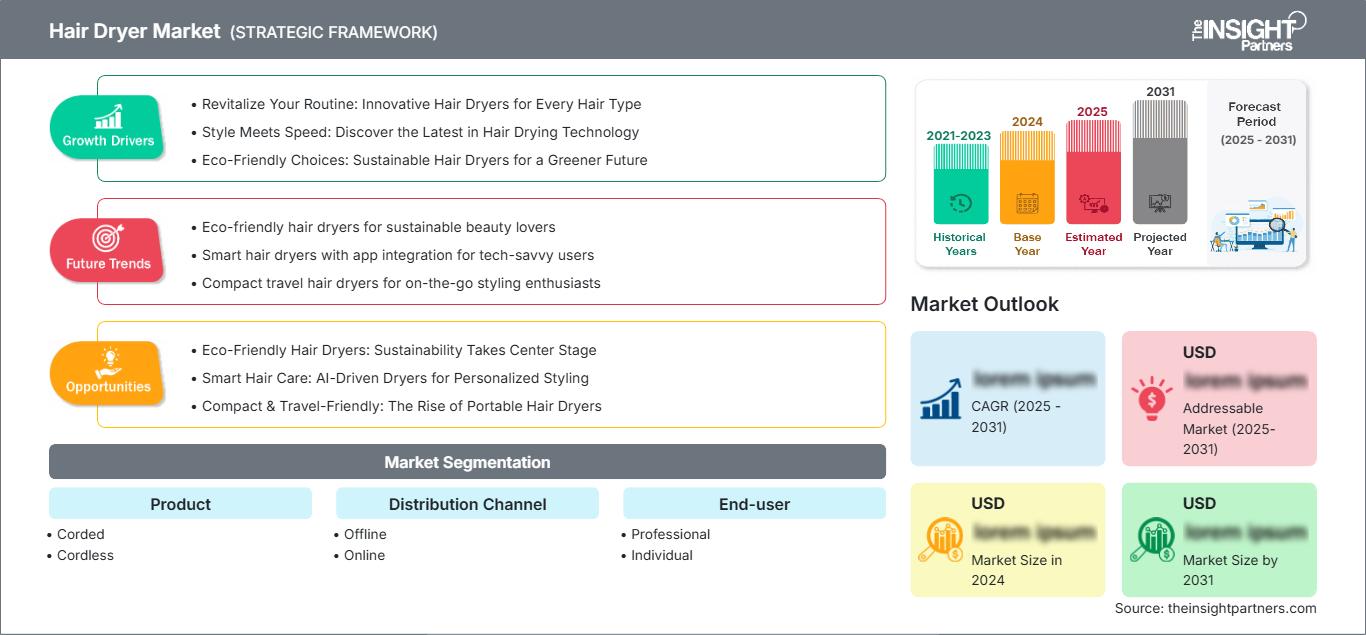
Hair Dryer Market: Strategic Insights
Regional Insights
North America Hair Dryer Market
North America held a 30–34% share in 2025 and is expected to grow at a CAGR of 5–7% through 2034. The US is a major part of the regional demand due to the higher level of household penetration, existing salon infrastructure, premium beauty expenditures, and high replacement rate. Canada adds through styling services offered by professionals, specialty retailing, and premium consumer goods with brands distributed in the neighboring country.
High-speed motors, ionic conditioning, heat control, diffusers, and lightweight professional tools are demanded in the region. Physical demonstration of goods coupled with their purchase online becomes more popular among retailers, whereas salons play an essential role in informing consumers about premium tools. Corded goods are still necessary for continuous professional use, but cordless goods may take a stronger position for traveling purposes.
U.S. Hair Dryer Market
The US represents 88–92% of North America's 2025 market and is projected to grow at a CAGR of 5–7% through 2034. The market is bolstered by large networks of salons, selling of beauty products, use of high-end appliances and replacements. There is substantial commercial presence of Conair Corporation, Dyson Limited, Helen of Troy Limited, and Spectrum Brands, Inc.
There are various applications including home styling, salons, hospitality, and travel uses. The consumer is increasingly concerned about drying time, weight, heat control, noise, attachments, and hair protection rather than wattage alone. Online retailing is increasingly becoming a tool for discovery and comparison, although specialist stores are still valuable for demonstrations of premium appliances. Corded appliances are preferred by professionals due to daily use requirements.
Europe Hair Dryer Market
Europe represented a 20–24% share in 2025 and is expected to grow at a CAGR of 4–6%. Germany leads the way, followed by the United Kingdom, France, Italy, and Spain. These hair dryer market shares consist of well-established salon practices, premiumization, well-established appliance technology, and consumers’ concerns about energy efficiency, durability, and regulated heating.
Professional beauty practices in the United Kingdom, advanced Internet retailing, and premium brands create an attractive environment for this market. Germany enjoys the benefits of well-established appliance technology and consumers’ concerns about durability. France, Italy, and Spain make their contributions through the culture of beauty, salon practices, tourism, and household grooming. In Europe, smaller design, better motors, thermal control, and increased product life become increasingly important buying factors, especially premium and professional ones.
APAC Hair Dryer Market
APAC held a 27–31% share in 2025 and is projected to grow at a CAGR of 7–9%, with China leading the region. Japan and South Korea bring demand based on technology while India and Australia provide opportunities for development via personal care expenditure, salons, and online shopping.
Urbanization, increase in disposable incomes, production of electronics and ecommerce facilitate the use. For China large scale manufacturing and local brands are advantageous, engineering and hair performance are critical for Japan, styling is the key element for South Korea, and mass market is important for India while premium demand is significant for Australia.
Middle East & Africa Hair Dryer Market
Middle East & Africa is expected to grow at a CAGR of 4–6% through 2034. Saudi Arabia and UAE are the main markets driven by personal care spend, hospitality, salons, tourism and retail. South Africa is a key market for Sub-Saharan Africa whereas the Rest of MEA region has price-sensitive demand.
UAE is a strong commercial center driven by tourism, high-end retail and hospitality facilities. Saudi Arabia has growing demand due to beauty treatments and spending by consumers. South Africa helps demand because of urban retail and professional salons. The Rest of MEA region has potential for durable small appliances via accessible retail channels and digitization.
Segmentation Analysis
Product
The Hair Dryer Market scope across Product is expected to expand at a CAGR of 5–7% during 2026–2034. Corded models retain the largest installed base because they provide continuous power, while cordless models benefit from portability and improving battery technology. Product differentiation increasingly focuses on motor efficiency, heat protection, weight, acoustic performance, and styling flexibility.
- Corded products remain the mainstream choice for households and salons because uninterrupted electrical power supports sustained drying, high airflow, repeated professional use, and consistent performance during extended styling sessions.
- Cordless products address travel, mobility, convenience, and compact storage requirements, with strategic importance increasing as battery capacity, charging systems, motor efficiency, and thermal management improve.
Distribution Channel
The Distribution Channel segment is projected to grow at a CAGR of 6–8% during 2026–2034. Offline retail retains importance for established brands and professional buyers, while online channels gain traction through broad assortment, reviews, promotions, direct-brand storefronts, and convenient delivery. Digital merchandising is therefore becoming increasingly important for new launches and premium positioning.
- Offline channels remain important for product demonstrations, warranty confidence, immediate availability, salon procurement, and consumers who prefer physical evaluation of ergonomics, weight, noise, and attachments.
- Online channels support rapid comparison, broad geographic reach, consumer reviews, targeted promotions, and direct-to-consumer strategies, making digital merchandising increasingly important for emerging and premium brands.
End-user
The End-user segment is expected to grow at a CAGR of 5–7% through 2034. Individual consumers generate broad household demand, while professional users prioritize durability, airflow consistency, ergonomics, and repeated-use reliability. Premiumization is particularly relevant where performance directly influences service quality, styling outcomes, operating time, and equipment replacement decisions.
- Professional users prioritize durable motors, long operating cycles, precise airflow, ergonomic handling, and specialized attachments, making reliability and service support central to purchasing decisions.
- Individual users represent broad household demand and increasingly seek compact appliances, hair-protection technologies, fast drying, intuitive controls, and versatile styling capabilities for daily personal grooming.
Opportunity Snapshot
| End-user | Revenue Contribution (High/Medium/Low) | Trend Tag (MAX 2 words) | Adoption Stage (Emerging/Scaling/Mature) |
| Professional | Medium | Salon Performance | Mature |
| Individual | High | Home Styling | Mature |
Hair Dryer Market Growth Drivers and Impact Analysis
Premiumization of Personal Grooming Appliances
In the consumer's mind, differences in the hair dryer market now center on the performance, styling, hair care, and convenience of the product rather than simply its ability to dry hair. Higher end devices can earn higher price points based on factors such as speed of drying, control of heat, reduction of frizziness, weight reduction, or styling tools. This offers scope for manufacturers to differentiate through engineering and experience design. From a business perspective, the opportunities span both professional and personal markets, where higher end devices may be able to achieve better profit margins and help with the upgrading of existing machinery. Well-recognized technology platforms may also help foster an accessories ecosystem of diffusers, concentrators, and styling nozzles.
Growth of Online Beauty and Appliance Commerce
Digital retailing is transforming consumer behavior around discovery, comparison, and purchase of personal-care appliances. Online channels have detailed specifications, reviews, demos, prices, and marketing exposure, eliminating any informational edge that traditional retailers have always enjoyed. This is especially significant for new entrants in the category who do not have wide retail footprints. The implication is even more relevant for established manufacturers who may create their own online storefronts to help with consumer data access and product launches. Increased price transparency from competition online forces differentiation to be based on technological claims, warranty policies, reviews, and content quality. Hence, manufacturers are spending resources on creating videos, optimizing marketplaces, educating, and promoting products.
Rising Demand for Hair-Health Features
Hair-health concerns increasingly influence product specifications as consumers become more attentive to heat exposure, moisture retention, frizz control, and scalp comfort. Manufacturers are responding with ionic systems, ceramic heating, controlled-temperature modes, sensors, specialized airflow patterns, and moisture-oriented technologies. This expands the value proposition because the appliance becomes positioned as a hair-care tool rather than a simple heated blower. Professional stylists can also benefit from technologies that improve consistency and reduce excessive heat during repeated use. The market impact is accelerating feature differentiation, particularly in premium categories where consumers evaluate performance through hair texture and styling outcomes. Companies that substantiate hair-protection claims and communicate them clearly can strengthen brand loyalty while supporting higher-value product tiers and creating greater separation from conventional low-cost appliances.
Hair Dryer Market Future Trends
Intelligent Heat and Airflow Personalization
Hair Dryer Market trends are moving toward intelligent heat and airflow personalization through temperature sensors, adaptive controls, attachment recognition, and more responsive motor systems. Instead of relying exclusively on fixed heat and speed settings, advanced models can adjust output according to selected styling objectives, attachment type, or environmental conditions. This development can simplify professional-grade functionality for individual consumers while improving consistency. Connectivity may remain selective because many users prefer simple interfaces for routine grooming, but software-enabled presets and diagnostics could differentiate premium products. Manufacturers are likely to compete increasingly on control algorithms, sensor accuracy, motor response, and thermal management. As these technologies mature, intelligent functions may migrate from flagship appliances into mid-premium models, broadening adoption and making electronics integration a more important component of product development.
Ultra-Compact and Battery-Efficient Designs
Compact engineering is expected to become a more important product-development direction as consumers seek appliances suitable for travel, small bathrooms, gyms, and mobile professional work. Smaller motors, optimized airflow paths, efficient heating systems, and improved batteries can reduce weight without sacrificing useful performance. Cordless formats will benefit most when manufacturers can deliver sufficient operating time, rapid charging, thermal safety, and convenient battery servicing. Travel products may incorporate folding mechanisms, dual-voltage compatibility, and detachable accessories. The strategic challenge will be balancing compactness with drying speed and battery endurance. Brands that solve this trade-off can expand beyond traditional home use into hospitality, travel retail, mobile salons, and professional kits, creating additional use cases without depending entirely on conventional full-size corded formats.
Hair Dryer Market Opportunities
Regional Product Localization
Hair Dryer Forecasts indicate that regional localization can create attractive opportunities as manufacturers tailor products to purchasing power, hair characteristics, climate, voltage requirements, retail structures, and consumer preferences. Asia Pacific is particularly relevant because markets differ significantly in price sensitivity and adoption maturity. A single global model may therefore underperform compared with portfolios designed around local requirements. Companies can use modular platforms to vary motors, accessories, packaging, controls, and pricing while retaining common engineering foundations. India and Southeast Asia provide opportunities for affordable feature-rich appliances, while Japan, South Korea, Australia, and urban China can support premium technology-led models. Strategic localization can improve channel relationships and reduce inventory complexity. Manufacturers should prioritize regions where e-commerce penetration, salon development, and grooming expenditure provide pathways from product trials to repeat purchases and wider distribution.
Professional and Hospitality Partnerships
Professional salons, hotels, resorts, and beauty academies provide valuable routes for manufacturers seeking visibility, product validation, and recurring institutional demand. Hospitality buyers can require durable appliances with compact storage, standardized specifications, service support, and replacement availability, creating different purchasing criteria from households. Salon partnerships can generate demonstrations and recommendations that influence subsequent individual purchases. Manufacturers can develop dedicated professional ranges while transferring selected technologies into consumer products, creating a bridge between channels. Investment should focus on durable motors, ergonomic designs, easy maintenance, attachment compatibility, and dependable service networks. Partnerships with training institutions can support stylist familiarity with new technologies and improve adoption of advanced models. This approach can strengthen brand credibility while creating predictable institutional demand alongside consumer sales, especially in premium hospitality and professional beauty environments.
Recent Developments
- November 2025: The new ELMISTA hair dryer was jointly developed by Panasonic and Milbon Co., Ltd., Japanese manufacturer of salon-exclusive haircare products and cosmetics. While drying, ELMISTA can use Airy Mist technology to spray a fine, precise amount of beauty serum to repair damaged hair. It delivers uniform serum application even to the hair roots, which are difficult to reach. With ELMISTA, anyone can achieve salon-level results.
- June 2025: Panasonic Corporation Philips (NYSE: PHG, AEX: PHIA), a global leader in health technology and innovation, proudly announces the launch of the Philips Hair Dryer 8000 – a next-generation breakthrough in premium hair care. Powered by cutting-edge BLDC (Brushless DC Motor) technology and enhanced with ThermoShield Advanced sensors, this revolutionary hair dryer delivers ultra-stable airflow and precise temperature control to protect hair from heat damage. Designed to preserve up to 100% of hair’s natural strength for strong, shiny and moisture-rich hair, the Philips Hair Dryer 8000 sets a new benchmark in high-performance, salon-quality styling at home.
- January 2024: L’Oréal Groupe unveiled a next-generation hair drying tool designed with professional stylists for both beauty professionals and consumers at home: AirLight Pro. Developed in partnership with Zuvi, a hardware startup company established by drone engineers and leading scientists, AirLight Pro uses a combination of infrared-light technology and wind to care for the hair with visually smoother and hydrated hair while also drying hair faster with optimized heat flow across multiple hair types, and up to 31% less energy consumption.
Frequently Asked Questions

- Comprehensive Market Sizing and Forecast Analysis
- Detailed Segmentation Analysis
- In-Depth Market Dynamics Assessment
- Regional and Country-Level Insights
- Competitive Landscape and Company Benchmarking
- Strategic Business Intelligence
Recent Reports
Testimonials

The Insight Partners provided valuable market intelligence that supported our global go-to-market strategy. Their team was professional, responsive, and attentive to our feedback, providing thoughtful analysis and helpful methodological clarifications throughout the project.
Junmo Kim Chief Financial Officer (CFO), Enertech Co., Ltd.
The Insight Partners' SCADA System Market report is comprehensive, with valuable insights on current trends and future forecasts. The team was highly professional, responsive, and supportive throughout. We are very satisfied and highly recommend their services.
RAN KEDEM Partner, Reali Technologies LTDs
I requested a report on a very specific software market and the team produced the report in a few days. The information was very relevant and well presented. I then requested some changes and additions to the report. The team was again very responsive and I got the final report in less than a week.
JEAN-HERVE JENN Chairman, Future Analytica
We worked with The Insight Partners for an important market study and forecast. They gave us clear insights into opportunities and risks, which helped shape our plans. Their research was easy to use and based on solid data. It helped us make smart, confident decisions. We highly recommend them.
PIYUSH NAGPAL Sr. Vice President, High Beam Global
The Insight Partners delivered insightful, well-structured market research with strong domain expertise. Their team was professional and responsive throughout. The user-friendly website made accessing industry reports seamless. We highly recommend them for reliable, high-quality research services
YUKIHIKO ADACHI CEO, Deep Blue, LLC.
This is the first time I have purchased a market report from The Insight Partners.While I was unsure at first, I visited their web site and felt more comfortable to take the risk and purchase a market report.I am completely satisfied with the quality of the report and customer service. I had several questions and comments with the initial report, but after a couple of dialogs over email with their analyst I believe I have a report that I can use as input to our strategic planning process.Thank you so much for taking the extra time and making this a positive experience.I will definitely recommend your service to others and you will be my first call when we need further market data.
JOHN SUZUKI President and Chief Executive Officer, Board Director, BK Technologies
I wish to appreciate your support and the professionalism you displayed in the course of attending to my request for information regarding to infectious disease IVD market in Nigeria. I appreciate your patience, your guidance, and the fact that you were willing to offer a discount, which eventually made it possible for us to close a deal. I look forward to engaging The Insight Partners in the future, all thanks to the impression you have created in me as a result of this first encounter.
DR CHIJIOKE ONYIA MANAGING DIRECTOR, PineCrest Healthcare Ltd.Reason to Buy
- Informed Decision-Making
- Understanding Market Dynamics
- Competitive Analysis
- Identifying Emerging Markets
- Customer Insights
- Market Forecasts
- Risk Mitigation
- Boosting Operational Efficiency
- Strategic Planning
- Investment Justification
- Tracking Industry Innovations
- Aligning with Regulatory Trends





 Get Free Sample for