
High Performance Fiber Market Demand, Trends & Forecast by 2034
High Performance Fiber Market Size and Forecasts (2021–2034), Global and Regional Share, Trends, and Growth Opportunity Analysis Report Coverage : by Type (Carbon Fiber, Aramid, PBI, PPS, Glass Fiber, Ceramics); Application (Electronics and Communication, Textile, Aerospace and Defense, Automotive); and Geography (North America, Europe, Asia Pacific, and South and Central America)
- Status : Data Released
- Report Code : TIPRE00040391
- Category : Chemicals and Materials
- No. of Pages : 150
- Available Report Formats :


- Last update date : August 10, 2026


2025 Market Size
US$ 20.57 Bn
Base year value
2034 Forecast
US$ 40.73 Bn
Projected by 2034
CAGR 2026-2034
7.89 %
Growth rate
Addressable Market
US$ 275.87 Bn
(2026-2034)
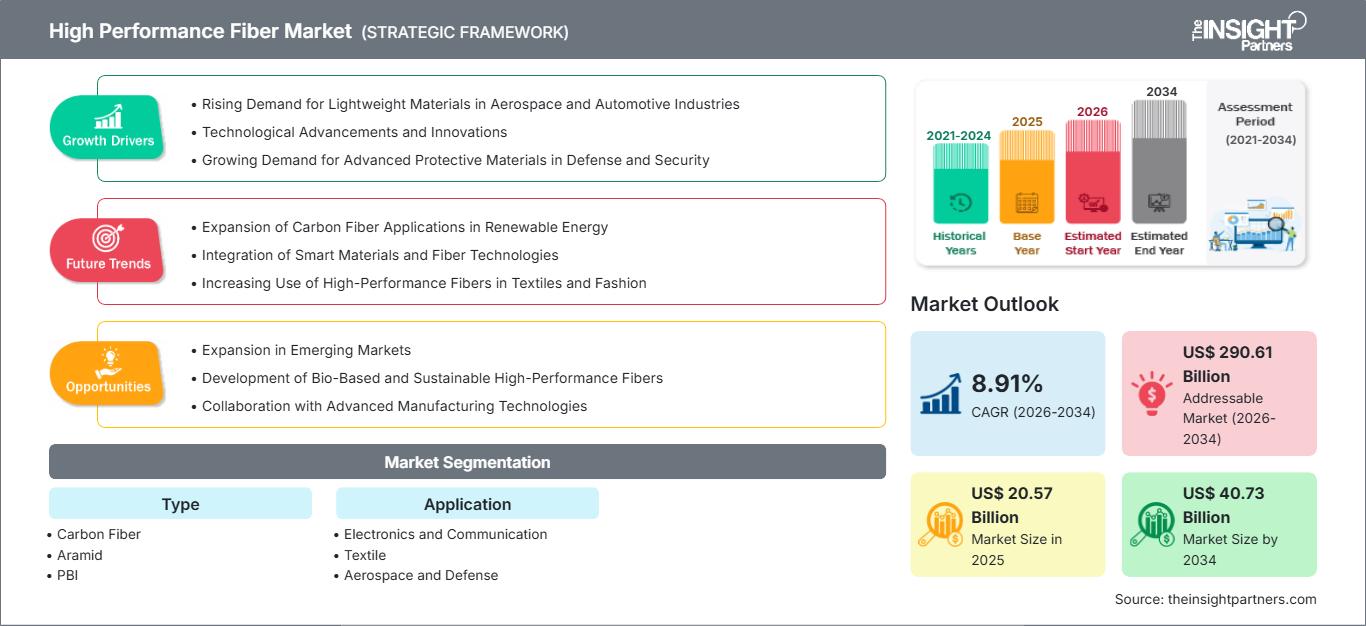
The High Performance Fiber market was valued at US$ 20.57 billion in 2025 and is expected to reach US$ 40.73 billion by 2034; it is estimated to record a CAGR of 7.89% during 2026-2034.
High Performance Fiber Market Assessment and Insights
- North America: Accounted for 30–34% share in 2025 and is projected to grow at a CAGR of 8.0%–9.0% during 2026–2034. Strong aerospace production, military procurement programs, and composite material adoption continue to support regional demand for advanced fiber solutions.
- US: Represented 75–80% of North American demand in 2025 and is anticipated to expand at a CAGR of 8.1%–9.1% during 2026–2034, supported by defense, aviation, and high-performance industrial applications.
- Europe: Held a 24–28% share in 2025 and is expected to record a CAGR of 7.5%–8.5% during 2026–2034. Germany, France, the UK, and Italy remain major centers for aerospace engineering, automotive innovation, and advanced manufacturing.
- Asia Pacific: Captured a 35–39% share in 2025 and is forecast to grow at a CAGR of 9.5%–10.5% during 2026–2034. China, Japan, South Korea, and India continue expanding investments in composites, electronics, and transportation sectors.
- Largest Segment: Carbon Fiber accounted for a market share of 38–42% in 2025 and is projected to register a CAGR of 8.5%–9.5% during 2026–2034, supported by broad use in aerospace, automotive, and wind energy structures.
- High Growth Segment: Aerospace and Defense represented a market share of 26–30% in 2025 and is anticipated to grow at a CAGR of 9.8%–10.8% during 2026–2034 due to increasing aircraft production and defense modernization initiatives.
- Key companies analyzed in detail: Teijin Limited, DuPont de Nemours, Inc., Yantai Tayho Advanced Materials Co., Ltd., Solvay SA, Mitsubishi Chemical Corporation, Owens Corning, PBI Performance Products, Inc., Royal Ten Cate B.V., Kureha Corporation, and Toray Industries, Inc.
Source: The Insight Partners' analysis based on proprietary research, government publications, company annual reports, investor presentations, industry databases, and expert interviews.
Advancements in fiber engineering have transformed the performance profile of modern industrial materials. Improvements in precursor technologies, manufacturing efficiency, resin compatibility, and thermal resistance have enabled broader commercial adoption across high-value applications. Carbon fiber and aramid fiber producers continue investing in capacity expansion while downstream industries increasingly prioritize weight reduction and energy efficiency. These developments are reshaping supply chains and encouraging greater integration between fiber manufacturers, composite producers, and end-use industries.
Looking ahead, investment activity is expected to accelerate across emerging manufacturing hubs in Asia and selected Middle Eastern economies. Government support for advanced materials research, growing localization strategies, and sustainability objectives are likely to encourage new production facilities and technology partnerships. Expanding adoption of lightweight materials in electric mobility, next-generation aircraft, and communication infrastructure is expected to create favorable long-term conditions for market participants.
High Performance Fiber Market Report Scope
| Report Attribute | Details |
|---|---|
| Market size in 2025 | US$ 20.57 Billion |
| Market Size by 2034 | US$ 40.73 Billion |
| Global CAGR (2026 - 2034) | 7.89% |
| Historical Data | 2021-2024 |
| Forecast period | 2026-2034 |
High Performance Fiber Market Analysis
The demand outlook for the market remains closely linked to developments in aerospace, defense, electronics, and transportation industries. Growing emphasis on fuel efficiency, emissions reduction, and structural performance has increased the use of advanced fibers in critical applications. In addition, the increasing deployment of electric vehicles and renewable energy systems is creating new opportunities for fiber-reinforced composites. These factors continue to support long-term high performance fiber market growth across both developed and emerging economies.
A complex value chain connects raw material suppliers, fiber manufacturers, composite fabricators, component producers, and end users. Supply dynamics are influenced by precursor availability, energy costs, manufacturing technology, and qualification requirements in regulated industries. As production capabilities expand in Asia Pacific and selected European markets, manufacturers are focusing on improving scalability while maintaining stringent performance standards required by aerospace and industrial customers.
Competitive intensity within the industry remains driven by technological differentiation, product quality, and long-term customer relationships. The high performance fiber market analysis indicates that leading participants are investing heavily in advanced production technologies, specialty fiber development, and downstream composite capabilities. Companies increasingly seek strategic partnerships with aerospace manufacturers, automotive suppliers, and defense contractors to strengthen market positioning and secure long-term contracts.
Toray Industries, Inc., Teijin Limited, Mitsubishi Chemical Corporation, and Solvay SA continue expanding advanced material portfolios to address evolving customer requirements. Meanwhile, DuPont de Nemours, Inc., Owens Corning, Kureha Corporation, Yantai Tayho Advanced Materials Co., Ltd., PBI Performance Products, Inc., and Royal Ten Cate B.V. maintain focus on specialized applications requiring superior thermal resistance, mechanical strength, and durability. Continuous innovation and targeted capital investments remain essential competitive strategies across the industry.
● REPORT CUSTOMIZATION
Tailor This Report To Align With Your Specific Business Requirements
This report can be customized to align precisely with your business objectives, scope, and target markets. Customization options include tailored segmentation, geography, competitive analysis, and strategic insights to support informed decision-making.
Customize This Report →WHAT YOU CAN ADJUST
- ● Segmentations
- ● Geography
- ● Competitive Analysis
- ● Language Preferences
High Performance Fiber Market: Strategic Insights
Regional Insights
North America High Performance Fiber Market
North America accounted for approximately 30–34% of the global market in 2025 and is expected to grow at a CAGR of 8.0%–9.0% during 2026–2034. The region benefits from a mature aerospace ecosystem, extensive defense expenditures, and strong research capabilities. Aircraft manufacturers and defense contractors continue increasing the use of lightweight composite structures to improve operational efficiency and performance while meeting stringent regulatory requirements.
The presence of advanced manufacturing infrastructure and a well-established composite materials industry further supports regional expansion. Investments in electric mobility, industrial automation, and renewable energy projects continue generating demand for high-strength fibers. The region also represents a significant portion of the global high performance fiber market share, supported by continuous innovation and substantial spending on advanced engineering applications.
U.S. High Performance Fiber Market Market
The U.S. accounted for around 75-80% of the demand in North America in 2025 and is estimated to grow at a CAGR of 8.1% to 9.1% during 2034. Demand is driven by aerospace manufacturing, efforts toward defense modernization, and the growing use of advanced composite materials in transportation. Investments in R&D bolster its standing as a hub of innovation in advanced fibers.
Important players in terms of manufacturers, technologists, and end users have a significant presence in the country. Growth in commercial aviation, military aircraft projects, and interest in lightweight parts for electric vehicles will continue to fuel market growth. The use of high-performance materials in communication systems and industrial machinery will further expand opportunities for application across multiple sectors.
Europe High Performance Fiber Market
Europe accounted for 24-28% of the market share in 2025 and is expected to exhibit a CAGR of 7.5%-8.5% from 2026-2034. Germany continues to dominate owing to its automotive engineering capabilities and efficient manufacturing processes. Germany makes ongoing investments in lightweight materials technologies to improve vehicle efficiency and competitiveness across many industries.
The UK benefits from a highly developed aerospace industry and constant innovations in defense technology. France is seeing constant demand for fibers for their commercial aviation products and innovations in materials. Italy and Spain continue to make efforts to increase the use of composites in the transportation, industrial manufacturing, and engineering sectors. Regional sustainability goals and industrial modernization programs are expected to support long-term adoption of advanced fiber materials throughout Europe.
APAC High Performance Fiber Market
Asia-Pacific is estimated to account for about 35-39% of worldwide demand in 2025 and is expected to grow at a CAGR of 9.5%-10.5% through 2034. China will remain the largest market for carbon fibers due to extensive manufacturing operations and growing investment in the aerospace, transportation, and renewable energy sectors.
Japan and South Korea will continue developing advanced fiber technology, while India and Australia will leverage their industrial and infrastructure investments. Government policies promoting domestic manufacturing and technology development will help the region maintain its dominant position through the forecast period.
Middle East & Africa High Performance Fiber Market
The Middle East and Africa market is expected to record a CAGR of 7.0%–8.0% during 2026–2034. Saudi Arabia and the United Arab Emirates are investing in industrial diversification strategies that encourage adoption of advanced materials across aerospace, energy, and manufacturing sectors.
South Africa remains a significant market due to its industrial and related fiber applications. In the wider region, growth in the infrastructural sector, energy initiatives, and increasing interest in local production capabilities will drive the use of advanced fiber solutions in the coming years.
Segmentation Analysis
Type
The Type segment is anticipated to witness a CAGR of 8.7%-9.7% from 2026-2034. Material choice remains an important factor in determining product acceptance across the aerospace, automotive, defense, electronics, and industrial industries. Properties such as tensile strength, thermal resistance, chemical resistance, and light weight are considered when making purchases. The growing scope of the high-performance fibers market continues to spur innovations in fiber formulations and processes.
- Carbon Fiber: Carbon fiber remains the dominant material category due to its exceptional strength-to-weight ratio, corrosion resistance, and suitability for aerospace structures, electric vehicles, wind energy components, and advanced industrial equipment.
- Aramid: Aramid fibers are widely utilized in ballistic protection, protective apparel, aerospace components, and industrial reinforcement applications where high impact resistance, dimensional stability, and thermal performance are essential requirements.
- PBI: PBI fibers serve specialized applications requiring extreme heat resistance and flame protection. Demand is concentrated in firefighter apparel, military equipment, industrial safety garments, and high-temperature operating environments.
- PPS: PPS fibers are increasingly adopted in filtration systems, industrial textiles, and chemical processing applications due to their strong resistance to chemicals, elevated temperatures, and demanding operational conditions.
- Glass Fiber: Glass fiber maintains a significant position across transportation, construction, electronics, and infrastructure applications, offering a balance of mechanical performance, cost efficiency, and manufacturing flexibility.
- Ceramics: Ceramic fibers address niche but strategically important applications involving thermal insulation, furnace linings, aerospace systems, and industrial equipment operating under extreme temperature conditions.
Application
The Applications segment will experience a CAGR of 9.0%-10.0% from 2026 to 2034. There is rising demand due to the growing adoption of advanced materials for use in various applications like transportation, communication infrastructure, aerospace systems, and industrial manufacturing. Growing technological advancements and requirements are pushing the usage of advanced fibers in such applications.
- Electronics and Communication: Advanced fibers support lightweight structural components, insulation materials, and specialty applications within telecommunications infrastructure, electronic devices, and next-generation communication networks.
- Textile: Technical textiles increasingly incorporate advanced fibers to enhance durability, thermal protection, mechanical strength, and performance characteristics across industrial, defense, and specialized commercial applications.
- Aerospace and Defense: Aerospace and defense applications utilize advanced fibers extensively in aircraft structures, protective systems, propulsion components, and mission-critical equipment requiring exceptional performance and reliability.
- Automotive: Automotive manufacturers continue increasing fiber utilization to reduce vehicle weight, improve energy efficiency, support electrification strategies, and enhance structural integrity across passenger and commercial vehicles.
Opportunity Snapshot
| Application | Revenue Contribution | Trend Tag | Adoption Stage |
| Electronics and Communication | Medium | 5G Infrastructure | Scaling |
| Textile | Medium | Protective Apparel | Mature |
| Aerospace and Defense | High | Lightweight Aircraft | Mature |
| Automotive | High | EV Lightweighting | Scaling |
High Performance Fiber Market Growth Drivers and Impact Analysis
Increasing Adoption of Lightweight Materials in Aerospace Manufacturing
The emphasis on lightweight construction in commercial aviation and the defense sectors persists due to the need to enhance fuel efficiency, payload capacity, and overall performance. Fiber technology has become an important material for constructing aircraft fuselages, wings, interior components, and military equipment. The International Air Transport Association (IATA) estimates that passenger loads will increase consistently across the industry, resulting in increased airplane production in the coming decade. Fiber technology provides significant weight savings compared to metallic products without compromising structural strength.
Rising Electrification of the Automotive Industry
Electric vehicle manufacturers have been using high-end fiber products to address battery weight and driving range concerns. Lighter designs ensure optimal car performance while meeting safety and performance standards. Governments in North America, Europe, and Asia-Pacific continue to encourage vehicle electrification through various initiatives such as offering tax credits, tightening emissions standards, and developing supportive infrastructure programs. High-end fibers enable the production of lightweight car parts and battery enclosures without sacrificing strength and resilience. With the rapid development of new-generation electric platforms by automakers, high-end materials will be used more widely.
Growing Demand for Industrial and Protective Applications
Various industries now demand materials that perform well in harsh environments characterized by heat, chemical exposure, abrasion, and mechanical stress. The advanced fibers are more functional, offering greater performance attributes that enable their use in filtration, industrial processes, protective clothing, and advanced engineering systems. The safety laws in the manufacturing, energy, and defense industries are continually encouraging the use of high-performance protective products. Aramid, PBI, and ceramic fibers are important fibers used in applications that require flame resistance and thermal stability. The growing activities in the industrial sector and rising safety concerns will help generate continuous demand.
High Performance Fiber Market Future Trends
Expansion of Sustainable Composite Manufacturing Technologies
Pathways for future growth will revolve around sustainability, resource conservation, and circular use of materials. Technologies for recycling carbon fiber composites are expected to increase material recovery rates and reduce life-cycle costs. Manufacturers will develop processes that generate fewer emissions and employ renewable energy sources. The high performance fiber market trends are expected to influence purchasing decisions among clients in the aerospace, automotive, and industrial sectors who are seeking eco-friendly materials. Continued progress in sustainable manufacturing practices is expected to improve industry competitiveness while supporting broader environmental objectives across global supply chains.
Advanced Automation and Digital Manufacturing Integration
Fiber manufacturing technologies are expected to affect fiber and composite production over the next 10 years. The use of automation and artificial intelligence, along with predictive maintenance and quality control systems, will not only increase production efficiency but also decrease variability. Process optimization techniques that rely on big data are increasingly being applied by manufacturers. The implementation of digital technologies in production plants will enable greater manufacturing consistency and scalability. Such developments may hasten the commercial success of advanced fiber applications while enabling producers to meet changing customer needs across aerospace, electronics, transportation, and industry.
High Performance Fiber Market Opportunities
Expansion Opportunities in Emerging Aerospace Supply Chains
Emerging aerospace manufacturing hubs across Asia Pacific and the Middle East are creating attractive investment opportunities for fiber producers and composite manufacturers. The government is continually promoting localization strategies, manufacturing programs, and diversification schemes to foster the development of aerospace ecosystems. Regional suppliers that develop local manufacturing capabilities can have a more advantageous relationship with customers and a more responsive supply chain. According to long-term high performance fiber market forecasts, there is likely to be an increased demand for lightweight materials in commercial and military aircraft applications. Investments in regional manufacturing capacity, along with strategic partnerships, will enhance competitive advantage and market growth in the future.
Development of Next-Generation Electric Mobility Solutions
The global shift towards electric mobility creates substantial opportunities for suppliers of advanced materials. Car makers look for new ideas to reduce weight, increase energy efficiency, and improve the structural properties of vehicles. High-strength fibers provide benefits in batteries, in vehicle body structures, and in special automotive parts. Future investments in electric-car platforms, charging stations, and mobility innovations are expected to drive further growth in demand. Organizations that can develop affordable material solutions and scalable production processes have an opportunity to strengthen their market position.
Recent Developments
- July 2026: Teijin Ltd. developed a long carbon fiber-reinforced (CFRP) thermoset composite that combines a heat-activated, self-healing function with high recyclability and equivalent mechanical properties to conventional CFRP.
- April 2026: Toray Composite Materials America, Inc., a Toray Group company specializing in PAN-based carbon fiber and carbon fiber prepreg, entered into a long-term carbon fiber supply agreement with Syensqo SA. The agreement, spanning five years, took effect in January 2026.
Frequently Asked Questions

- Comprehensive Market Sizing and Forecast Analysis
- Detailed Segmentation Analysis
- In-Depth Market Dynamics Assessment
- Regional and Country-Level Insights
- Competitive Landscape and Company Benchmarking
- Strategic Business Intelligence
Recent Reports
Testimonials

The Insight Partners' SCADA System Market report is comprehensive, with valuable insights on current trends and future forecasts. The team was highly professional, responsive, and supportive throughout. We are very satisfied and highly recommend their services.
RAN KEDEM Partner, Reali Technologies LTDs
I requested a report on a very specific software market and the team produced the report in a few days. The information was very relevant and well presented. I then requested some changes and additions to the report. The team was again very responsive and I got the final report in less than a week.
JEAN-HERVE JENN Chairman, Future Analytica
We worked with The Insight Partners for an important market study and forecast. They gave us clear insights into opportunities and risks, which helped shape our plans. Their research was easy to use and based on solid data. It helped us make smart, confident decisions. We highly recommend them.
PIYUSH NAGPAL Sr. Vice President, High Beam Global
The Insight Partners delivered insightful, well-structured market research with strong domain expertise. Their team was professional and responsive throughout. The user-friendly website made accessing industry reports seamless. We highly recommend them for reliable, high-quality research services
YUKIHIKO ADACHI CEO, Deep Blue, LLC.
This is the first time I have purchased a market report from The Insight Partners.While I was unsure at first, I visited their web site and felt more comfortable to take the risk and purchase a market report.I am completely satisfied with the quality of the report and customer service. I had several questions and comments with the initial report, but after a couple of dialogs over email with their analyst I believe I have a report that I can use as input to our strategic planning process.Thank you so much for taking the extra time and making this a positive experience.I will definitely recommend your service to others and you will be my first call when we need further market data.
JOHN SUZUKI President and Chief Executive Officer, Board Director, BK Technologies
I wish to appreciate your support and the professionalism you displayed in the course of attending to my request for information regarding to infectious disease IVD market in Nigeria. I appreciate your patience, your guidance, and the fact that you were willing to offer a discount, which eventually made it possible for us to close a deal. I look forward to engaging The Insight Partners in the future, all thanks to the impression you have created in me as a result of this first encounter.
DR CHIJIOKE ONYIA MANAGING DIRECTOR, PineCrest Healthcare Ltd.Reason to Buy
- Informed Decision-Making
- Understanding Market Dynamics
- Competitive Analysis
- Identifying Emerging Markets
- Customer Insights
- Market Forecasts
- Risk Mitigation
- Boosting Operational Efficiency
- Strategic Planning
- Investment Justification
- Tracking Industry Innovations
- Aligning with Regulatory Trends





 Get Free Sample for