
Hospital Management Software (HMS) Market Growth, Size & Forecast by 2034
Hospital Management Software (HMS) Market Size and Forecasts (2021–2034), Global and Regional Share, Trends, and Growth Opportunity Analysis Report Coverage : By Type of Deployment (On-Premises and Cloud-Based), Mode of Delivery (Web-Based, Mobile-Based, and On-Premises), Application (EHR, RCM, Patient Management, LIS), End User (Hospitals, Clinics, Healthcare Research Centers)
- Status : Data Released
- Report Code : TIPRE00039457
- Category : Technology, Media and Telecommunications
- No. of Pages : 150
- Available Report Formats :


- Last update date : August 04, 2026


2025 Market Size
US$ 39.34 Bn
Base year value
2034 Forecast
US$ 87.89 Bn
Projected by 2034
CAGR 2026-2034
9.34 %
Growth rate
Addressable Market
US$ 568.14 Bn
(2026-2034)
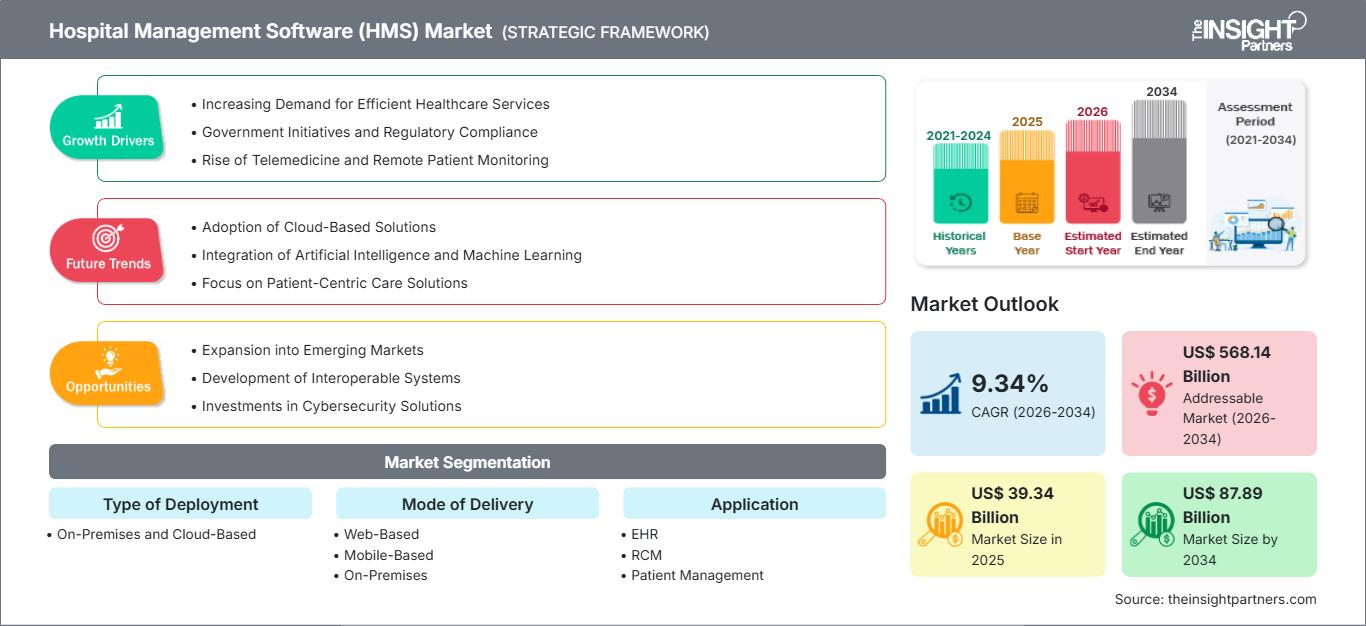
The hospital management software market was valued at US$ 39.34 Billion in 2025 and is projected to reach US$ 87.89 Billion by 2034, registering a CAGR of 9.34% during 2026–2034. Growing adoption of integrated healthcare information systems, electronic medical records, and cloud-enabled hospital operations continues to support long-term market expansion across developed and emerging healthcare markets. The market continues to expand as healthcare providers accelerate digital transformation initiatives to improve operational efficiency, patient outcomes, and regulatory compliance.
Across North America, healthcare organizations continue investing in integrated digital platforms that improve clinical workflows, revenue cycle management, and patient engagement. The hospital management software market size in the region benefits from mature healthcare IT infrastructure, favorable reimbursement policies, and increasing cloud adoption among hospitals and multi-specialty healthcare providers. North America accounted for an estimated 40–44% share in 2025 and is expected to register a CAGR of 8.6–9.2% during 2026–2034, supported by continued investments in artificial intelligence, cybersecurity, and interoperable healthcare systems.
Hospital Management Software (HMS) Market Assessment and Insights
- North America: North America remained the leading regional market with an estimated 40–44% share in 2025. Advanced healthcare IT infrastructure, strong regulatory support for electronic health records, and increasing cloud migration are projected to support a CAGR of 8.6–9.2% during 2026–2034.
- U.S.: The U.S. accounted for approximately 82–86% of the North American market in 2025. Large-scale healthcare digitization, high software spending, and strong adoption of AI-enabled clinical solutions are anticipated to drive a CAGR of 8.7–9.3% during 2026–2034.
- Europe: Europe represented an estimated 25–29% share in 2025, led by Germany, the UK, France, and the Nordic countries. Expanding healthcare interoperability initiatives are expected to contribute to a CAGR of 8.8–9.4% during 2026–2034.
- Asia Pacific: Asia Pacific accounted for 22–26% of the global market in 2025, driven by China, Japan, India, South Korea, and Australia. Increasing healthcare infrastructure investments and digital health programs are expected to generate a CAGR of 10.5–11.1% during 2026–2034.
- Largest Segment: Cloud-Based deployment dominated with an estimated 60–64% market share in 2025 and is projected to expand at a CAGR of 9.8–10.4% during 2026–2034, supported by scalability, lower maintenance costs, and remote accessibility.
- High Growth Segment: Mobile-Based delivery emerged as the fastest-growing segment with an estimated 24–28% market share in 2025 and is forecast to register a CAGR of 11.0–11.6% during 2026–2034, owing to increasing clinician mobility and remote patient management.
- Key companies analyzed in detail: eClinicalWorks, Inc., Mediware Information Systems, Inc., Epic Systems Corporation, Greenway Health, LLC, Practice Fusion, Inc., ZOLL Medical Corporation, Oracle Health (formerly Cerner Corporation), Veradigm Inc. (formerly Allscripts Healthcare Solutions, Inc.), McKesson Corporation, and athenahealth, Inc.
Source: The Insight Partners' analysis based on proprietary research, government publications, company annual reports, investor presentations, industry databases, and expert interviews.
Healthcare organizations worldwide are transforming operational models by replacing fragmented legacy systems with integrated digital hospital management platforms capable of supporting clinical, financial, and administrative workflows through a unified environment, driving growth in the Hospital Management Software Market. Increased usage of cloud computing, artificial intelligence, interoperability standards, and analytics has resulted in enhanced functionality of the software but made its implementation easier for users. Growing focus on the issues of electronic health records, security and safety of patients has driven the implementation of these software solutions among hospitals, clinics with specialties, and healthcare networks.
As far as future trends in software implementation in hospitals are concerned, there can be expected greater investments in the digital healthcare infrastructure in the developing countries, aiming at the provision of universal healthcare and connected health solutions. It is expected that artificial intelligence in healthcare decision support system, prediction, telehealth and cloud hospital information systems are going to change approaches to software implementation. Regulatory efforts to address the issue of interoperability and health information exchange, together with investments in cybersecurity, are supposed to drive software adoption.
Hospital Management Software (HMS) Market Report Scope
| Report Attribute | Details |
|---|---|
| Market size in 2025 | US$ 39.34 Billion |
| Market Size by 2034 | US$ 87.89 Billion |
| Global CAGR (2026 - 2034) | 9.34% |
| Historical Data | 2021-2024 |
| Forecast period | 2026-2034 |
Hospital Management Software (HMS) Market Analysis
The hospital management software market growth is primarily supported by increasing demand for integrated healthcare information systems that improve patient care, optimize operational efficiency, and strengthen financial management. Healthcare practitioners keep updating their digital infrastructure in order to simplify the process of scheduling appointments, maintaining clinical documents, processing billing procedures, managing pharmacies, laboratories, and communicating with patients. The increased usage of electronic health records, telemedicine systems, and decision support systems powered by artificial intelligence is contributing to a persistent demand for hospital management software solutions.
Market participants include software companies, cloud infrastructure vendors, healthcare IT integrators, cybersecurity vendors, consulting companies, and managed service providers cooperating to provide scalable and interoperable healthcare IT platforms. An increase in regulatory standards concerning patient privacy, interoperability, and digital documentation management is promoting the adoption of centralized software platforms, which would allow integration of different clinical and administrative processes and secure data exchanges within the healthcare ecosystems.
The hospital management software market analysis highlights intense competition centered on interoperability, cloud innovation, cybersecurity, artificial intelligence integration, and workflow automation. Leading companies, including Epic Systems Corporation, Oracle Health, eClinicalWorks, Inc., athenahealth, Inc., McKesson Corporation, Greenway Health, LLC, Veradigm Inc., Practice Fusion, Inc., ZOLL Medical Corporation, and Mediware Information Systems, Inc. continue investing in platform enhancements, strategic partnerships, and healthcare-specific digital transformation initiatives to strengthen competitive positioning.
Technology companies are making more investments in cloud-based health technology platforms, predictive analysis, generative AI, and solutions for health data interoperability to facilitate the seamless exchange of information between hospitals, health centers, laboratories, and health research facilities. The companies’ strategy of making more acquisitions, innovating products, and partnering with health care providers ensures that software capabilities improve alongside the improvement of clinical outcomes, efficiency, and patient experience.
● REPORT CUSTOMIZATION
Tailor This Report To Align With Your Specific Business Requirements
This report can be customized to align precisely with your business objectives, scope, and target markets. Customization options include tailored segmentation, geography, competitive analysis, and strategic insights to support informed decision-making.
Customize This Report →WHAT YOU CAN ADJUST
- ● Segmentations
- ● Geography
- ● Competitive Analysis
- ● Language Preferences
Hospital Management Software (HMS) Market: Strategic Insights
Regional Insights
North America Hospital Management Software Market
North America accounted for an estimated 40–44% share of the global Hospital Management Software Market in 2025 and remains the largest regional contributor due to its advanced healthcare information technology infrastructure, strong regulatory support for electronic health records, and widespread adoption of cloud-based healthcare platforms. Hospitals and integrated delivery networks continue investing in digital solutions that improve patient care, streamline clinical workflows, and strengthen operational efficiency. The region is expected to record a CAGR of 8.6–9.2% during 2026–2034, supported by continuous investments in artificial intelligence, cybersecurity, and interoperable healthcare systems.
Healthcare providers across the region are accelerating the modernization of legacy hospital information systems to improve data accessibility, revenue cycle performance, and patient engagement. Favorable government initiatives promoting health information exchange, increasing telehealth adoption, and strong private-sector investments continue to support software implementation. The hospital management software market share remains highest in North America because of mature digital infrastructure, high healthcare expenditure, and the presence of leading healthcare technology providers delivering advanced clinical and administrative software solutions.
U.S. Hospital Management Software Market
The U.S. represented approximately 82–86% of the North American Hospital Management Software Market in 2025 and continues to dominate regional adoption through extensive healthcare IT spending and comprehensive digital transformation initiatives. The country is projected to register a CAGR of 8.7–9.3% during 2026–2034, supported by increasing implementation of cloud-native electronic health records, artificial intelligence-enabled clinical decision support, and integrated hospital management platforms.
Major technology providers, including Epic Systems Corporation, Oracle Health, athenahealth, Inc., McKesson Corporation, and eClinicalWorks, Inc., maintain a significant presence across the country, continuously introducing innovative healthcare software solutions. Hospitals and healthcare systems increasingly deploy integrated platforms to manage patient records, clinical documentation, billing, pharmacy operations, laboratory information, and scheduling functions while improving regulatory compliance, interoperability, and operational efficiency across large healthcare networks.
Europe Hospital Management Software Market
Europe accounted for an estimated 25–29% share of the global Hospital Management Software Market in 2025 and is anticipated to register a CAGR of 8.8–9.4% during 2026–2034. Regional growth is supported by government-backed healthcare digitization strategies, expanding adoption of electronic medical records, and increasing investments in secure healthcare information exchange. Germany leads the regional market owing to its advanced hospital infrastructure and continued investments in digital healthcare modernization.
The United Kingdom continues expanding adoption through National Health Service digital transformation initiatives and increased investments in integrated healthcare platforms. Germany benefits from nationwide digital health programs, strong healthcare infrastructure, and the growing implementation of interoperable clinical information systems. France, Italy, and Spain are steadily adopting hospital management software to improve healthcare administration, patient data management, laboratory operations, and care coordination while complying with evolving healthcare data protection and interoperability regulations.
APAC Hospital Management Software Market
Asia Pacific represented 22–26% of the global Hospital Management Software Market in 2025 and is projected to achieve the highest regional expansion with a CAGR of 10.5–11.1% during 2026–2034. China remains the largest contributor, while Japan, India, South Korea, and Australia continue to increase investments in healthcare digitalization and hospital information technology infrastructure.
Government-led digital health initiatives, expanding healthcare infrastructure, increasing patient volumes, and broader cloud adoption continue driving software implementation throughout the region. Hospitals and specialty healthcare providers are investing in integrated management platforms to improve clinical efficiency, optimize resource utilization, support electronic medical records, and strengthen healthcare delivery across both urban and rural healthcare systems.
Middle East & Africa Hospital Management Software Market
The Middle East & Africa Hospital Management Software Market is expected to register a CAGR of 9.2–9.8% during 2026–2034, driven by increasing investments in healthcare modernization, hospital infrastructure development, and national digital health strategies. Saudi Arabia leads regional adoption, followed by the United Arab Emirates and South Africa, where governments continue expanding healthcare digitization initiatives.
Healthcare organizations throughout the region are implementing integrated software platforms to improve patient administration, clinical documentation, financial management, and healthcare resource planning. Ongoing investments in smart hospitals, electronic health record systems, cloud infrastructure, and secure healthcare data exchange continue supporting long-term adoption while improving operational efficiency and patient outcomes across the broader Middle East and African healthcare landscape.
Segmentation Analysis
Type of Deployment
The Type of Deployment segment is projected to register a CAGR of 9.7–10.3% during 2026–2034 as healthcare organizations increasingly modernize digital infrastructure to improve accessibility, scalability, and regulatory compliance. The hospital management software market scope continues to expand with growing preference for flexible deployment models that support secure data management, interoperability, and seamless integration with electronic health record systems, laboratory platforms, and financial management applications across hospitals and healthcare networks.
- On-Premises: On-premises deployment remains relevant among healthcare organizations requiring complete control over infrastructure, patient data, and regulatory compliance. Large hospitals continue utilizing this model where legacy systems, internal security policies, and customized workflows remain operational priorities.
- Cloud-Based: Cloud-based deployment dominates new implementations because it offers scalability, lower maintenance costs, remote accessibility, automatic software updates, and easier integration with digital healthcare ecosystems. Healthcare providers increasingly prefer cloud solutions to improve operational efficiency while reducing capital expenditure.
Mode of Delivery
The Mode of Delivery segment is anticipated to expand at a CAGR of 10.0–10.6% during 2026–2034 as healthcare providers prioritize flexible access to clinical and administrative applications across multiple devices and locations. Digital transformation initiatives, increasing telehealth adoption, and demand for real-time healthcare information continue driving innovation in software delivery models.
- Web-Based: Web-based solutions remain widely deployed because they provide centralized access through secure browsers without requiring extensive local installation. Hospitals benefit from simplified software maintenance, interoperability, and efficient collaboration across multiple departments and healthcare facilities.
- Mobile-Based: Mobile-based platforms continue experiencing rapid adoption as physicians, nurses, and healthcare administrators increasingly require secure access to patient information, appointment schedules, clinical workflows, and operational dashboards through smartphones and tablets.
- On-Premises: On-premises delivery continues serving healthcare providers with highly customized infrastructure requirements, allowing direct system control, internal hosting, and compliance with strict organizational security policies and regional healthcare regulations.
Application
The Application segment is forecast to record a CAGR of 9.4–10.0% during 2026–2034, supported by increasing demand for integrated healthcare management platforms capable of streamlining clinical documentation, financial administration, patient engagement, and laboratory operations. Healthcare organizations continue to adopt specialized applications to improve operational efficiency while enhancing the quality of care and regulatory compliance.
- EHR: Electronic Health Record applications remain fundamental to healthcare digitization by enabling secure patient record management, clinical documentation, care coordination, and regulatory reporting while improving continuity of care across healthcare providers.
- RCM: Revenue Cycle Management solutions help healthcare organizations optimize billing accuracy, claims processing, reimbursement management, and financial reporting while reducing administrative burdens and improving operational profitability.
- Patient Management: Patient management applications simplify appointment scheduling, admissions, discharge planning, communication, and care coordination, improving patient experience while enabling healthcare providers to manage increasing patient volumes efficiently.
- LIS: Laboratory Information Systems support sample tracking, laboratory workflow automation, diagnostic reporting, and integration with electronic health records, improving operational accuracy, turnaround time, and regulatory compliance within healthcare laboratories.
End User
The End User segment is expected to register a CAGR of 9.6–10.2% during 2026–2034 as healthcare providers continue investing in comprehensive digital management platforms to enhance operational performance, improve clinical outcomes, and optimize resource utilization. Growing healthcare digitization, expanding patient populations, and stronger regulatory requirements continue supporting software adoption across diverse healthcare organizations.
- Hospitals: Hospitals represent the largest end-user category due to their complex operational requirements, including patient administration, clinical documentation, pharmacy management, laboratory integration, billing, and resource planning across multiple departments.
- Clinics: Clinics increasingly implement integrated software platforms to improve appointment scheduling, patient record management, billing, teleconsultation support, and administrative efficiency while delivering more personalized healthcare services.
- Healthcare Research Centers: Healthcare research centers utilize hospital management software to manage research data, clinical trial coordination, regulatory documentation, patient information security, and collaboration among multidisciplinary healthcare research teams.
Opportunity Snapshot
| End User | Revenue Contribution | Trend Tag | Adoption Stage |
|---|---|---|---|
| Hospitals | High | Smart Hospitals | Mature |
| Clinics | Medium | Digital Clinics | Scaling |
| Healthcare Research Centers | Medium | Clinical Research | Emerging |
Hospital Management Software (HMS) Market Growth Drivers and Impact Analysis
Healthcare digital transformation strengthens demand for integrated platforms
Healthcare organizations globally are implementing strategies aimed at enhancing efficiency in clinical and administrative processes as well as increasing the level of quality in the provision of services to patients. The trend involves hospitals adopting advanced management systems that allow electronic medical records to be connected together with laboratory information, pharmacy operations, billing and scheduling. In addition to government policies favoring interoperability and the use of digital health records, the increased demand from patients to receive seamless services is also driving software development. Cloud computing, artificial intelligence and predictive analysis have also enhanced efficiency in operational processes through automation and better clinical decisions.
Rising emphasis on interoperability and electronic health records
The integration of information from hospitals, clinics, laboratories, pharmacies, and diagnostic centers has become a requirement for the effective functioning of the current healthcare systems. The regulatory measures that have been put forward in order to promote the health information exchange process are making healthcare organizations invest in interoperable hospital management software solutions that allow for effective delivery of care. With the help of integrations with electronic health records systems, laboratory information management systems, medical imaging solutions, and revenue cycle management software, it becomes possible for healthcare organizations to optimize clinical processes and minimize inefficiencies.
Growing cybersecurity investments improve healthcare software adoption
Continued growth in the adoption of digital health infrastructure is prompting healthcare firms to invest in enhanced cybersecurity measures due to ever-increasing sophistication in the nature of cyberattacks. Suppliers of hospital management software are incorporating sophisticated identity management systems, multi-factor authentication, encryption technologies, and zero-trust security frameworks in order to ensure that sensitive patient information is safe from potential cyberattacks. The need to comply with various healthcare data security laws also drives firms to update their legacy technology solutions through the adoption of cloud-based platforms that offer superior levels of security. With more hospitals embracing digitalization, cybersecurity will continue to play an important role in software acquisitions during the forecast period.
Hospital Management Software (HMS) Market Future Trends
Artificial intelligence reshapes hospital operations and clinical workflows
The hospital management software market trends indicate growing integration of artificial intelligence across administrative and clinical workflows. AI-powered scheduling, predictive analytics, clinical decision support, medical documentation automation, and patient flow optimization are becoming standard capabilities within modern healthcare software platforms. Hospitals are increasingly leveraging machine learning to improve diagnosis support, optimize staffing levels, reduce operational costs, and enhance patient outcomes. As healthcare providers expand digital transformation strategies, intelligent automation is expected to become a defining feature of next-generation hospital management software solutions.
Cloud-native healthcare platforms gain widespread enterprise adoption
The healthcare sector is progressively shifting from traditional on-premises systems to cloud-based hospital management solutions that offer enhanced scalability and interoperability. By deploying cloud solutions, healthcare organizations can streamline software management processes, ensure effective disaster recovery, boost collaboration between facilities, and speed up digital transformation. New modular cloud-based solutions that feature telemedicine, remote patient monitoring, and advanced patient engagement services are consistently emerging among vendors. It is anticipated that such trends will significantly impact healthcare IT strategy in the coming years.
Hospital Management Software (HMS) Market Opportunities
Emerging healthcare infrastructure creates long-term expansion potential
Rapid healthcare infrastructure development across Asia Pacific, the Middle East, Africa, and Latin America presents substantial opportunities for software vendors and healthcare technology providers. Governments continue investing in hospital modernization, electronic health records, digital public health initiatives, and connected healthcare ecosystems to improve service accessibility and operational efficiency. Hospital management software market Forecasts indicate sustained demand for scalable cloud-based platforms capable of supporting expanding healthcare networks. Vendors offering localized solutions, multilingual interfaces, flexible pricing models, and strong implementation services are expected to strengthen their competitive position while addressing the evolving requirements of developing healthcare systems.
Value-based healthcare drives demand for advanced analytics platforms
Healthcare is moving more and more towards value-based care, which means taking care of patients’ outcomes, efficiency, and cost savings. This makes it possible for software companies working with hospital management to offer such innovations as advanced analytics, artificial intelligence, predictive reporting, and population health management in their healthcare systems. What organizations are looking for is improved clinical performance measurement, efficiency, financial management, and patient engagement, while meeting regulatory reporting requirements. Those technology providers who will be able to offer integrated and data-driven ecosystems for healthcare management will have good prospects of investment.
Frequently Asked Questions

- Comprehensive Market Sizing and Forecast Analysis
- Detailed Segmentation Analysis
- In-Depth Market Dynamics Assessment
- Regional and Country-Level Insights
- Competitive Landscape and Company Benchmarking
- Strategic Business Intelligence
Recent Reports
Testimonials

The Insight Partners' SCADA System Market report is comprehensive, with valuable insights on current trends and future forecasts. The team was highly professional, responsive, and supportive throughout. We are very satisfied and highly recommend their services.
RAN KEDEM Partner, Reali Technologies LTDs
I requested a report on a very specific software market and the team produced the report in a few days. The information was very relevant and well presented. I then requested some changes and additions to the report. The team was again very responsive and I got the final report in less than a week.
JEAN-HERVE JENN Chairman, Future Analytica
We worked with The Insight Partners for an important market study and forecast. They gave us clear insights into opportunities and risks, which helped shape our plans. Their research was easy to use and based on solid data. It helped us make smart, confident decisions. We highly recommend them.
PIYUSH NAGPAL Sr. Vice President, High Beam Global
The Insight Partners delivered insightful, well-structured market research with strong domain expertise. Their team was professional and responsive throughout. The user-friendly website made accessing industry reports seamless. We highly recommend them for reliable, high-quality research services
YUKIHIKO ADACHI CEO, Deep Blue, LLC.
This is the first time I have purchased a market report from The Insight Partners.While I was unsure at first, I visited their web site and felt more comfortable to take the risk and purchase a market report.I am completely satisfied with the quality of the report and customer service. I had several questions and comments with the initial report, but after a couple of dialogs over email with their analyst I believe I have a report that I can use as input to our strategic planning process.Thank you so much for taking the extra time and making this a positive experience.I will definitely recommend your service to others and you will be my first call when we need further market data.
JOHN SUZUKI President and Chief Executive Officer, Board Director, BK Technologies
I wish to appreciate your support and the professionalism you displayed in the course of attending to my request for information regarding to infectious disease IVD market in Nigeria. I appreciate your patience, your guidance, and the fact that you were willing to offer a discount, which eventually made it possible for us to close a deal. I look forward to engaging The Insight Partners in the future, all thanks to the impression you have created in me as a result of this first encounter.
DR CHIJIOKE ONYIA MANAGING DIRECTOR, PineCrest Healthcare Ltd.Reason to Buy
- Informed Decision-Making
- Understanding Market Dynamics
- Competitive Analysis
- Identifying Emerging Markets
- Customer Insights
- Market Forecasts
- Risk Mitigation
- Boosting Operational Efficiency
- Strategic Planning
- Investment Justification
- Tracking Industry Innovations
- Aligning with Regulatory Trends





 Get Free Sample for