
Hydro Turbines Market Growth, Demand & Size by 2034
Coverage: by Capacity (Small (Less than 1 MW), Medium (1 MW to 10 MW), and Large (10 MW and above)); Type (Reaction, Impulse, Gravity, and Others); and Configuration (Spiral Casing, and Multi-stage), and Geography (North America, Europe, Asia Pacific, and South and Central America)
- Status : Data Released
- Report Code : TIPTE100001354
- Category : Manufacturing and Construction
- No. of Pages : 150
- Available Report Formats :


- Last update date : November 13, 2026


2025 Market Size
US$ 5.81 Bn
Base year value
2034 Forecast
US$ 9.6 Bn
Projected by 2034
CAGR 2026-2034
5.75 %
Growth rate
Addressable Market
US$ 69.88 Bn
(2026-2034)
The Hydro Turbines Market was valued at US$ 5.81 Billion in 2025 and is projected to reach US$ 9.6 Billion by 2034, registering a CAGR of 5.75% during 2026–2034. The market covers turbine systems supplied for new hydropower stations, pumped-storage schemes, rehabilitation programs, and distributed hydro installations, across capacity, type, and configuration categories.
North America is expected to record an estimated ~5% CAGR through 2034. Hydro Turbines Market size expansion in the region is supported by refurbishment of long-lived utility assets and rising demand for flexible generation that can balance variable wind and solar output. Public power investment, industrial self-generation, and life-extension programs sustain orders even where greenfield dam construction remains selective.
Hydro Turbines Market Assessment and Insights
Regional Outlook
- North America: ~25% of the global market in 2025 | ~5% CAGR through 2034. Market position: The region ranks third, supported by extensive refurbishment needs, Canadian hydropower dependence, U.S. relicensing, and demand for flexible low-carbon generation.
- US: ~62% of North American market revenue in 2025 | ~5% CAGR through 2034. Market position: The country leads North America through utility modernization, domestic specialist suppliers, industrial hydro assets, and growing attention to pumped-storage applications.
- Europe: ~27% of the global market in 2025 | ~5% CAGR through 2034. Market position: A mature installed base sustains rehabilitation demand, led by Norway and France, while Germany, Italy, Spain, and the UK advance flexibility projects.
- Asia Pacific: ~38% of the global market in 2025 | ~7% CAGR through 2034. Market position: Asia Pacific is the largest and fastest-growing region, led by China, with India, Japan, South Korea, and Australia expanding storage and modernization pipelines.
Segment Outlook
- Type: Type leads because turbine selection directly determines hydraulic performance, with reaction systems serving the broadest range of medium-head and high-volume projects.
- Capacity: Capacity shows the strongest growth as large pumped-storage projects and distributed small-hydro installations expand simultaneously across diverse grid and off-grid settings.
Competitive Coverage
GE Vernova Inc., Cornell Pump Company, Siemens AG, Renewables First Ltd., ANDRITZ AG, Kirloskar Brothers Limited, Norcan Hydraulic Turbine Inc., Canyon Industries, Inc., Gilbert Gilkes & Gordon Ltd., Nautilus LLC
Methodology
The Insight Partners follows Data Collection & Secondary Research, Primary Research, Data Analysis, and Data Triangulation & Final Review to validate market estimates and insights.
Source: The Insight Partners' analysis based on proprietary research, government publications, company annual reports, investor presentations, industry databases, and expert interviews.
There is a trend towards water to wire solutions when procuring turbines. This includes hydraulic design, generator, power electronics, automation and condition monitoring systems. There is an increasing push to produce more optimal runners to allow more operation at varying conditions. The industry is project based, with bespoke engineering, long lead times for large castings, forgings, generators and controls. However small turbine equipment is becoming more standardised with less engineering required. Rehabilitating is becoming strategic due to the flexibility improvements and increased life that can be gained from upgrading the electromechanical components.
Pumped Storage, uprating, digital control systems and climate resilient rehabilitating are becoming more invested in up to 2034. Asia Pacific has the deepest pipeline and localisation requirements. Africa has some targeted greenfield opportunities, related to electrification and multi purpose water. North America and Europe will focus on increasing life and grid services. However, there are regulatory drivers such as clean energy targets, capacity market reforms and long duration storage recognition. Challenges could include permitting, environmental protection, revenue streams and supplier capability to gain good engineering resources.
Hydro Turbines Market Report Scope
| Report Attribute | Details |
|---|---|
| Market size in 2025 | US$ 5.81 Billion |
| Market Size by 2034 | US$ 9.6 Billion |
| Global CAGR (2026 - 2034) | 5.75% |
| Historical Data | 2021-2024 |
| Forecast period | 2026-2034 |
Hydro Turbines Market Analysis
The market is growing due to the need for extra renewable generation, flexibility and increased generation from existing civil infrastructure. Utilities find turbines very valuable as they provide many services including ramping, frequency, inertia and reserve. This means there is demand for new conventional schemes, Pumped storage, rehabilitating, industrial captive and small run of river schemes. Buyers are now looking for turbines with the highest efficiencies throughout their lifetime, with varying heads and flows.
There is a variety of players within the ecosystem. Project developers, utilities, civil contractors, hydraulic labs, turbine and generators manufacturers, foundries, automation providers and service specialists. Large turbines will require bespoke engineering, modelling, large parts, on site assembly and long commissioning periods. Potential challenges could be sourcing specialist castings, high grade electrical steel, large machining and experienced on site resources. Smaller equipment is more standardised however economics are very dependent on the hydrology, civils, connections and permitting.
Market analysis shows there is competition between global players and regional players. ANDRITZ AG and GE Vernova Inc compete on complex large hydro and rehabilitating schemes. Gilbert Gilkes & Gordon Ltd, Canyon Industries, Inc, Renewables First Ltd, Nautilus LLC and Norcan Hydraulic Turbine Inc provide solutions for smaller and medium schemes or niche services. Cornell Pump Company and Kirloskar Brothers Limited provide fluid handling and manufacturing capabilities. Siemens AG provides electrification, generators, drives and grid integration.
Investment will focus on flexible operating, variable speed equipment, digital governors, predictive maintenance and guaranteed performance within their operating window. Strategic positioning requires access to existing base, local manufacture, benchmark schemes, funding partners and managing environmental requirements. Those with good service networks will gain revenue from regular refurbishments. Specialised players will be able to stand out by providing faster engineering, standardised products and expertise at difficult sites. Partnerships with civil contractors and utilities will still be key as the value of turbines cannot be separated from waterways, generators, controls and grid.
● REPORT CUSTOMIZATION
Tailor This Report To Align With Your Specific Business Requirements
This report can be customized to align precisely with your business objectives, scope, and target markets. Customization options include tailored segmentation, geography, competitive analysis, and strategic insights to support informed decision-making.
Customize This Report →WHAT YOU CAN ADJUST
- ● Segmentations
- ● Geography
- ● Competitive Analysis
- ● Language Preferences
Hydro Turbines Market: Strategic Insights
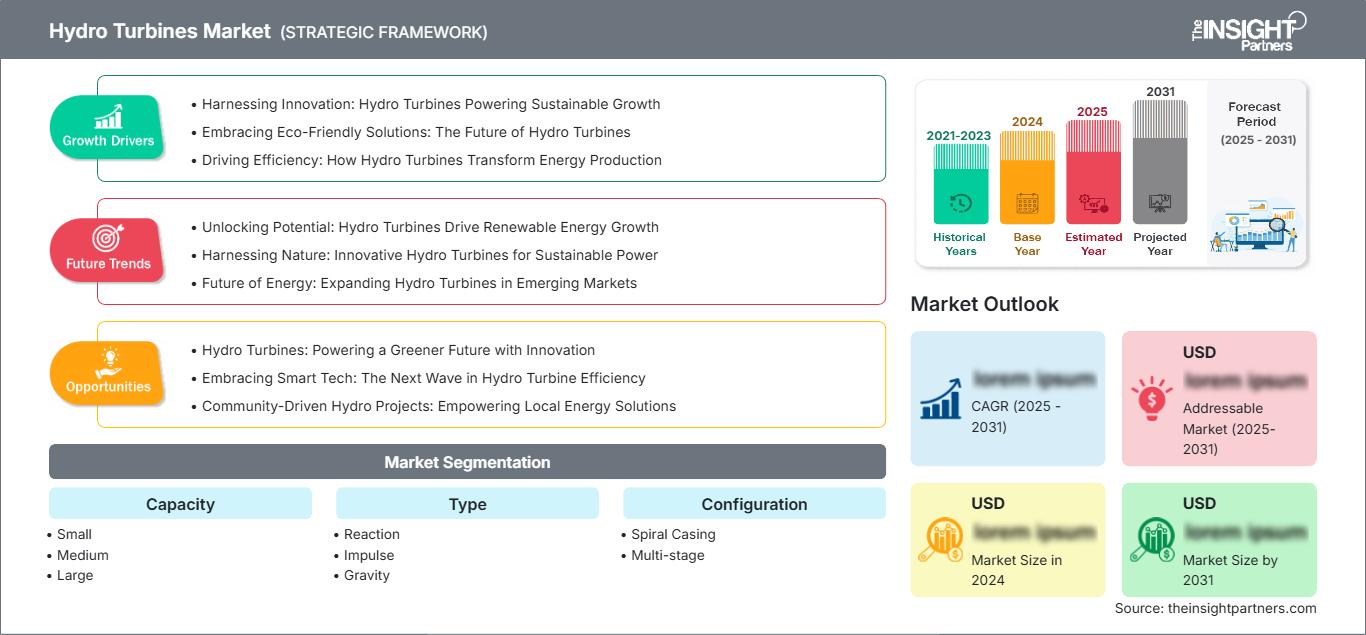
Regional Insights
North America Hydro Turbines Market
North America represents ~25% of the global revenue in 2025 and will see ~5% CAGR growth from here through to 2034. The Hydro Turbines Market share is driven by having a large existing base within Canada and the United States alongside heavy utility ownership and regular demand for turbine generator retrofits. Many assets are aging and needing runner replacements, wicket gate upgrades, generator retrofits and new control systems.
Growth is focused on retrofitting and upgrading. Canadian utilities are investing in long term asset life extensions. U.S. utilities and industrial sectors are looking at up-rating, relicensing and pumped storage. As more wind and solar gets added to the grid there is increasing interest in fast response and long duration storage. Purchases are favouring those who can provide complete solutions including hydro design, electrical equipment, automation and outage planning plus meet the requirements for fish protection, water usage and sediment reduction.
U.S. Hydro Turbines Market
The U.S. is the largest Hydro Turbines Market Share in North America with ~62% of revenues in 2025. It is expected to grow at ~5% CAGR through to 2034. The U.S. has a large asset base from federal, municipal, investor owned utilities and industrial sectors. Retention is key and many assets will benefit from increased reliability and flexibility without the need to build new dams, canals or power stations.
Domestic manufacturers include GE Vernova Inc., Canyon Industries, Inc., Cornell Pump Company and Nautilus LLC. This is in addition to international suppliers. They can provide complete solutions for large scale utility retrofits, pumped storage, municipal water supplies, irrigation drops and industrial water. Fish friendly solutions, digital monitoring, low flow and compact designs are all valued. Licensing and environmental impact will be a major factor. Getting involved early will be important.
Europe Hydro Turbines Market
Europe is ~27% of the global revenue in 2025 and will see ~5% CAGR growth through to 2034. Norway is the largest country with lots of installed hydropower. France also has large capacity available and has an active retrofit and pumped storage agenda. Germany has high quality manufacture and storage solutions. The UK market focuses on small hydro, retrofits and flexibility.
Italy and Spain add further large alpine and reservoir assets. Water availability, renewables and asset life extensions will drive investment. With a lot of mature assets there is a desire to increase efficiency, increase operating range, automation and adapt to climate change. Pumped storage is becoming more acknowledged as a valuable infrastructure solution to balance renewables however the economics of the project will depend on market design and long term revenues.
ANDRITZ AG, Siemens AG, Renewables First Ltd., and Gilbert Gilkes & Gordon Ltd. provide a wide network of suppliers and engineers. Focus will be on reducing outages, maximising asset lifetime and meeting ecological flows and fish passage. There will be less focus on volume of assets but more complex retrofits with high levels of service to increase flexibility.
Asia Pacific Hydro Turbines Market
Asia Pacific dominates the market with ~38% of global revenue in 2025. It is the fastest growing region seeing ~7% CAGR through to 2034. China is the largest country with a large asset base, domestic manufacture and pumped storage pipeline. India is increasing storage purchases. Japan and South Korea focus on upgrading their assets to be more resilient and have high quality variable speed systems.
Australia is an opportunity for pumped storage and renewables. Overall, increased electricity demand, increased industrialisation, energy security and localisation policies are driving orders for large turbine generators. Kirloskar Brothers Limited and global suppliers are competing with strong local manufacturers. Permitting, funding, transmission and having suppliers capable of providing large electromechanical packages will be key factors.
Middle East & Africa Hydro Turbines Market
The Middle East & Africa Hydro Turbines Market Share is expected to see ~6% CAGR through to 2034. South Africa is the largest country with existing pumped storage and a need to balance the grid. Overall there will be demand for assets across Africa due to electrification, regional trading, irrigation and multi-purpose water schemes.
Opportunities exist in Saudi Arabia and UAE though they will be selective as they do not have many river hydro schemes. The rest of MEA will have new build and retrofit opportunities in river basin economies. Funding, transmission, hydrology and sovereign risks will affect the timing. Suppliers with lifecycle service solutions, local training and reliable equipment to work in high sediment or remote areas will be in a stronger position.
Segmentation Analysis
Capacity
Capacity is forecast to expand at ~7% CAGR during 2026–2034. The Hydro Turbines Market scope spans distributed installations through utility-scale projects, with procurement shaped by head, flow, civil constraints, grid role, and financing. Large projects capture high contract values through pumped storage and major conventional schemes, while small and medium systems benefit from modularization, rehabilitation, and use of existing water infrastructure.
- Small: Standardized packages serve run-of-river, municipal water, irrigation, industrial, and remote-grid sites. Their strategic value lies in shorter construction cycles and the ability to monetize low-head or modest-flow resources.
- Medium: Medium-capacity systems address regional utilities, industrial captive generation, and refurbishment projects. They balance customization with manageable manufacturing and civil requirements, creating opportunities for regional suppliers and packaged electromechanical solutions.
- Large: Large units dominate contract value in major dams and pumped-storage stations. Buyers prioritize proven hydraulic design, model testing, grid-response capability, local manufacturing, and long-term service because failures carry substantial operational consequences.
Type
Type segment in the Hydro Turbines Market is expected to register ~6% CAGR during 2026–2034 and represents the largest main segment at ~55% share in 2025. Selection follows hydraulic head, discharge, cavitation limits, efficiency curve, and operational duty. Reaction turbines address the widest utility applications, impulse machines suit high-head sites, and gravity-oriented concepts extend generation into low-head water systems.
- Reaction: Francis, Kaplan, and related designs serve broad head and flow combinations, making reaction systems central to conventional hydro, pumped storage, and rehabilitation. Variable operation and cavitation performance increasingly shape specifications.
- Impulse: Pelton and similar machines are strategically important for high-head, lower-flow locations. Mountainous geographies, long penstocks, and water-resource development support demand, while erosion resistance matters in sediment-laden rivers.
- Gravity: Gravity-based concepts target very-low-head waterways, weirs, canals, and existing water infrastructure. Their opportunity depends on simplified civil works, fish compatibility, modular deployment, and acceptable economics at comparatively modest output.
Configuration
Configuration segment in the Hydro Turbines Market is projected to grow at ~6% CAGR during 2026–2034. Project engineers choose layouts to manage flow distribution, pressure, staging, footprint, maintenance access, and efficiency. Spiral casings remain important for uniform runner admission in reaction machines, while multi-stage arrangements address specialized pressure or energy-recovery conditions where a single hydraulic stage is insufficient.
- Spiral Casing: Spiral casings distribute water around reaction-turbine runners and support efficient, balanced operation. Demand tracks medium and large Francis installations, rehabilitation projects, and precision manufacturing requirements for complex embedded or fabricated components.
- Multi-stage: Multi-stage configurations serve specialized high-pressure or energy-recovery duties. Adoption is narrower but strategically relevant where staged conversion improves operating fit, enables compact arrangements, or supports industrial and water-network applications.
Opportunity Snapshot
| Application | Revenue Contribution | Trend Tag | Adoption Stage |
|---|---|---|---|
| Power Generation | High | Grid Flexibility | Mature |
| Pumped Storage | High | Long Storage | Scaling |
| Industrial Energy Recovery | Medium | Pressure Recovery | Scaling |
| Water Infrastructure | Medium | Embedded Generation | Emerging |
| Remote and Mini-grid | Low | Rural Resilience | Emerging |
Hydro Turbines Market Growth Drivers and Impact Analysis
Renewable Integration Raises the Value of Flexible Hydro
Power systems with growing wind and solar shares require resources that can change output quickly, maintain frequency, provide inertia, and shift energy across longer periods. Reservoir hydro and pumped storage can deliver several of these services from one asset, increasing the strategic value of turbine performance beyond annual electricity generation. This changes procurement priorities toward wider operating ranges, rapid mode changes, variable-speed capability, and controls that coordinate with grid signals. The impact is strongest on large reversible units and modernization packages, but it also benefits conventional plants that can be uprated for more flexible dispatch. Revenue therefore shifts toward integrated turbine, generator, converter, automation, and service scopes.
Aging Fleets Create a Durable Rehabilitation Pipeline
Many hydropower stations have operated for decades, exposing runners, guide vanes, bearings, seals, generators, and controls to wear, fatigue, cavitation, and obsolescence. Where dams and waterways remain serviceable, rehabilitation can restore efficiency and reliability at lower permitting and construction risk than a greenfield project. Owners can also redesign hydraulic components for changed flow regimes or new dispatch patterns. This creates recurring demand for inspection, model testing, runner replacement, generator rewinding, automation, and outage management. The impact favors suppliers with access to historical drawings, reverse-engineering capability, field-service teams, and manufacturing capacity that can meet tight outage windows.
Electrification and Energy Security Support New Capacity
Rising electricity consumption, industrial development, and concern over imported fuels are strengthening the case for domestic renewable generation. Hydropower can combine firm energy with water-management functions such as irrigation, flood control, and drinking-water support, improving project economics where benefits are coordinated. Emerging economies increasingly pair hydro resources with regional transmission and industrial expansion, while mature markets use storage to protect system reliability. The resulting impact is geographically uneven: Asia Pacific and selected African markets offer new-build demand, whereas Europe and North America emphasize modernization and storage. Bankability still depends on hydrology, environmental safeguards, revenue certainty, and transmission access.
Hydro Turbines Market Future Trends
Variable-Speed and Digitally Orchestrated Plants
Hydro Turbines Market trends will increasingly center on variable-speed operation, digital twins, high-frequency condition data, and plant-wide optimization. Variable-speed pumped storage can adjust pumping power and improve response across changing grid conditions, while advanced governors coordinate hydraulic limits with electricity-market signals. Digital models will connect design data, operating history, vibration, temperature, pressure, and efficiency measurements to predict degradation and optimize maintenance. The commercial implication is a higher software, controls, and lifecycle-service content per project. Suppliers will need cybersecurity capability, interoperable platforms, and evidence that algorithms improve availability without compromising safe hydraulic operation.
Climate-Adaptive Hydraulic Design
Changing precipitation, snowmelt, drought frequency, floods, and sediment loads will make historical hydrology less reliable as the sole basis for turbine optimization. Future equipment will be designed for broader flow and head envelopes, stronger abrasion resistance, improved cavitation behavior, and operating strategies that preserve ecological flows. Refurbishment studies will increasingly test multiple climate scenarios rather than one design point. This trend favors adjustable, modular, and replaceable components, along with monitoring that detects erosion and performance drift. It also raises the importance of basin-level planning because turbine economics depend on water allocation, reservoir operations, and competing municipal, agricultural, and environmental requirements.
Hydro Turbines Market Opportunities
Convert Existing Sites into Flexible Storage Assets
Owners and investors can screen existing reservoirs, cascades, quarries, mines, and hydropower stations for conversion or expansion into pumped-storage assets. Using established grid connections and civil infrastructure can reduce development uncertainty, although geotechnical, water, and environmental constraints still require rigorous assessment. Hydro Turbines Market Forecasts support opportunity in reversible pump-turbines, variable-speed motor-generators, converters, balance-of-plant equipment, and controls. Suppliers can improve win rates by forming early partnerships with developers, civil contractors, and transmission planners, then offering bankable performance guarantees, local manufacturing, and long-term service. Projects with multiple revenue streams are likely to attract financing first.
Scale Modular Hydro in Water Networks and Industry
Municipal water systems, irrigation canals, industrial pressure-reduction stations, and existing weirs contain energy that is often dissipated rather than converted. Modular turbines and pump-as-turbine solutions can monetize suitable sites with limited new impoundment, especially when generation offsets local electricity purchases. The opportunity requires standardized screening tools, compact equipment, simplified controls, and delivery models that reduce engineering cost per site. Vendors can partner with water utilities, engineering firms, and energy-service companies to aggregate portfolios. Success depends on dependable flow data, interconnection economics, maintenance access, and equipment designed to tolerate debris, sediment, and variable operating conditions.
Recent Developments
- October 2026: Voith GmbH & Co. KGaA announced an award for the 90 MW Jomori hydropower project in Bhutan, extending its project base in a country where hydropower is central to electricity exports and development. The contract signals continuing demand for high-head equipment and regional engineering support in South Asia.
- October 2026: ANDRITZ was selected to supply four Pelton turbine-generator units for Bhutan’s 600 MW Khorlochhu project. Its scope covers design, manufacture, installation, testing, commissioning, auxiliary equipment, and balance of plant, supported by manufacturing facilities in India.
- June 2025: GE Vernova Inc. commissioned the first of four 250 MW variable-speed units at India’s Tehri pumped-storage plant. The full project adds 1 GW and combines pump-turbines, doubly fed motor-generators, converters, power electronics, and controls to support faster response and grid flexibility.
Frequently Asked Questions

- Comprehensive Market Sizing and Forecast Analysis
- Detailed Segmentation Analysis
- In-Depth Market Dynamics Assessment
- Regional and Country-Level Insights
- Competitive Landscape and Company Benchmarking
- Strategic Business Intelligence
Recent Reports
Testimonials

The Insight Partners provided valuable market intelligence that supported our global go-to-market strategy. Their team was professional, responsive, and attentive to our feedback, providing thoughtful analysis and helpful methodological clarifications throughout the project.
Junmo Kim Chief Financial Officer (CFO), Enertech Co., Ltd.
The Insight Partners' SCADA System Market report is comprehensive, with valuable insights on current trends and future forecasts. The team was highly professional, responsive, and supportive throughout. We are very satisfied and highly recommend their services.
RAN KEDEM Partner, Reali Technologies LTDs
I requested a report on a very specific software market and the team produced the report in a few days. The information was very relevant and well presented. I then requested some changes and additions to the report. The team was again very responsive and I got the final report in less than a week.
JEAN-HERVE JENN Chairman, Future Analytica
We worked with The Insight Partners for an important market study and forecast. They gave us clear insights into opportunities and risks, which helped shape our plans. Their research was easy to use and based on solid data. It helped us make smart, confident decisions. We highly recommend them.
PIYUSH NAGPAL Sr. Vice President, High Beam Global
The Insight Partners delivered insightful, well-structured market research with strong domain expertise. Their team was professional and responsive throughout. The user-friendly website made accessing industry reports seamless. We highly recommend them for reliable, high-quality research services
YUKIHIKO ADACHI CEO, Deep Blue, LLC.
This is the first time I have purchased a market report from The Insight Partners.While I was unsure at first, I visited their web site and felt more comfortable to take the risk and purchase a market report.I am completely satisfied with the quality of the report and customer service. I had several questions and comments with the initial report, but after a couple of dialogs over email with their analyst I believe I have a report that I can use as input to our strategic planning process.Thank you so much for taking the extra time and making this a positive experience.I will definitely recommend your service to others and you will be my first call when we need further market data.
JOHN SUZUKI President and Chief Executive Officer, Board Director, BK Technologies
I wish to appreciate your support and the professionalism you displayed in the course of attending to my request for information regarding to infectious disease IVD market in Nigeria. I appreciate your patience, your guidance, and the fact that you were willing to offer a discount, which eventually made it possible for us to close a deal. I look forward to engaging The Insight Partners in the future, all thanks to the impression you have created in me as a result of this first encounter.
DR CHIJIOKE ONYIA MANAGING DIRECTOR, PineCrest Healthcare Ltd.Reason to Buy
- Informed Decision-Making
- Understanding Market Dynamics
- Competitive Analysis
- Identifying Emerging Markets
- Customer Insights
- Market Forecasts
- Risk Mitigation
- Boosting Operational Efficiency
- Strategic Planning
- Investment Justification
- Tracking Industry Innovations
- Aligning with Regulatory Trends





 Get Free Sample for