
Hydronic Control Market Growth, Trends & Forecast by 2034
Coverage: by Component (Actuators, Flow Controllers, Valves, Control Panels, and Others); Installation Type (New Installation, and Retrofit Installation); and End-User (Residential, Industrial, and Commercial), and Geography (North America, Europe, Asia Pacific, and South and Central America)
- Status : Data Released
- Report Code : TIPEL00002319
- Category : Electronics and Semiconductor
- No. of Pages : 150
- Available Report Formats :


- Last update date : September 17, 2026


2025 Market Size
US$ 32.38 Bn
Base year value
2034 Forecast
US$ 49.46 Bn
Projected by 2034
CAGR 2026-2034
4.82 %
Growth rate
Addressable Market
US$ 371.49 Bn
(2026-2034)
The Hydronic Control Market was valued at US$ 32.38 Billion in 2025 and is projected to reach US$ 49.46 Billion by 2034, registering a CAGR of 4.82% during 2026–2034. Market expansion will be backed up by the modernization of the heating and cooling system infrastructure, the increased usage of efficient heating and ventilation air conditioning system (HVAC), and the growing need for the regulation of temperature, pressure, and flow within the residential, commercial, and industrial spaces.
In North America, the Hydronic Control Market Size is expected to grow at a projected rate of 4.4-5.0% compound annual growth rate (CAGR) between 2026 and 2034. The replacement of old building equipment and stringent energy performance standards are contributing towards the growth in demand for smart valves, actuators, and flow control systems.
Hydronic Control Market Assessment and Insights
- North America: North America accounted for an estimated 31–35% share in 2025 and is expected to grow at a 4.4–5.0% CAGR between 2026–2034, supported by HVAC retrofits, building decarbonization initiatives, and rising adoption of digitally controlled hydronic equipment.
- US: The US represented approximately 78–82% of North American demand in 2025 and is projected to expand at a 4.5–5.1% CAGR between 2026–2034, supported by commercial modernization and replacement demand.
- Europe: Europe held an estimated 28–32% share in 2025 and is anticipated to grow at a 4.1–4.7% CAGR between 2026–2034, led by Germany, the UK, France, Italy, and Spain, where energy-efficient heating upgrades remain significant.
- Asia Pacific: Asia Pacific represented approximately 24–28% share in 2025 and is projected to record a 5.3–5.9% CAGR between 2026–2034, with China, Japan, South Korea, India, and Australia supporting industrial and building-system investments.
- Largest Segment: Commercial end use accounted for an estimated 38–42% market share in 2025 and is expected to expand at a 4.7–5.3% CAGR during 2026–2034, driven by offices, hospitals, educational facilities, and mixed-use developments.
- High Growth Segment: Retrofit Installation represented approximately 42–46% market share in 2025 and is projected to grow at a 5.4–6.0% CAGR during 2026–2034, benefiting from energy upgrades and replacement of inefficient controls.
- Key companies analyzed in detail: Siemens AG, Danfoss A/S, Honeywell International Inc., Schneider Electric SE, BELIMO Holding AG, IMI plc, Johnson Controls International plc, Xylem Inc., Spirotech B.V., and Reflex Winkelmann GmbH.
Source: The Insight Partners' analysis based on proprietary research, government publications, company annual reports, investor presentations, industry databases, and expert interviews.
Automation has increasingly made hydronic systems transition from mechanically controlled setups into electronically monitored systems that can respond to varying building loads. Enhanced sensor connectivity, digital actuators, pressure independent valves and integrated control platforms have resulted in changes in the focus of manufacturing. This includes the integration of mechanical design knowledge with software, electronics, and applications. While this is the case, it is important to note that supply trends will be shaped by semiconductor supplies, localized manufacturing, and demand for products that are adaptable to existing pipe infrastructure and newer low temperature heating/cooling systems.
In terms of the future, upcoming urban markets and renovations will increase the addressable market segment to go beyond commercial HVAC applications. Funding will be allocated more and more to electrified heating, district energy solutions, heat pump technologies and smart building management systems where water side controls are required. In this context, it is also important to highlight that energy efficiency measures and regulations related to reduced emissions will encourage replacement expenditures. It is likely that companies which are able to offer integrated systems, application engineering, and lifecycle services will gain an edge.
Hydronic Control Market Report Scope
| Report Attribute | Details |
|---|---|
| Market size in 2025 | US$ 32.38 Billion |
| Market Size by 2034 | US$ 49.46 Billion |
| Global CAGR (2026 - 2034) | 4.82% |
| Historical Data | 2021-2024 |
| Forecast period | 2026-2034 |
Hydronic Control Market Analysis
More building owners are paying attention to the reduction of HVAC energy consumption without affecting the comfort level, leading to the consistent need for improved water-side balancing and automation controls. Hydronic Control Market growth is thus dependent on the dynamic connection among the equipment manufacturers, HVAC contractors, consulting engineers, building owners, and control system integrators. The valves, actuators, flow controllers, and panels should work together as an ecosystem and not independently. The prevailing market favors generalists with broad ranges of products and extensive distribution channels whereas specialists rely on hydraulic proficiency and engineering services.
There are chances for integrated designs during new constructions but replacement is still a significant cycle because there are many buildings with manual balancing and aged equipment. The adoption of heat pumps makes it necessary for there to be good flow and temperature control under various conditions. Suppliers are thus modifying their products in order to fit into low-temperature systems and digitally controlled facilities. Availability of electronic parts, metals, casting, and special seals may affect manufacturing schedules.
The Hydronic Control Market report suggests the presence of competition based on scale, engineering abilities, software, and channel access in this industry. Siemens AG and Schneider Electric SE have an advantage because of their comprehensive offerings in the domain of building automation. Danfoss A/S and BELIMO Holding AG keep their leadership in HVAC control systems. IMI plc, Spirotech B.V., and Reflex Winkelmann GmbH offer specific hydraulic and system management solutions. Honeywell International Inc., Johnson Controls International plc, and Xylem Inc. create competition with their connected infrastructure, building controls, water technologies, and relationships with customers.
Investment opportunities in the industry focus on digital product development, energy optimization software, production resilience at the regional level, and M&A transactions for expanding their technical competencies. Large companies take advantage of customer relationships by using them to sell control and monitoring systems, while specialists emphasize system performance verification. Another element of strategic differentiation in this industry involves the capability to integrate with the building management system and support contractors with design, commissioning, and operation processes.
● REPORT CUSTOMIZATION
Tailor This Report To Align With Your Specific Business Requirements
This report can be customized to align precisely with your business objectives, scope, and target markets. Customization options include tailored segmentation, geography, competitive analysis, and strategic insights to support informed decision-making.
Customize This Report →WHAT YOU CAN ADJUST
- ● Segmentations
- ● Geography
- ● Competitive Analysis
- ● Language Preferences
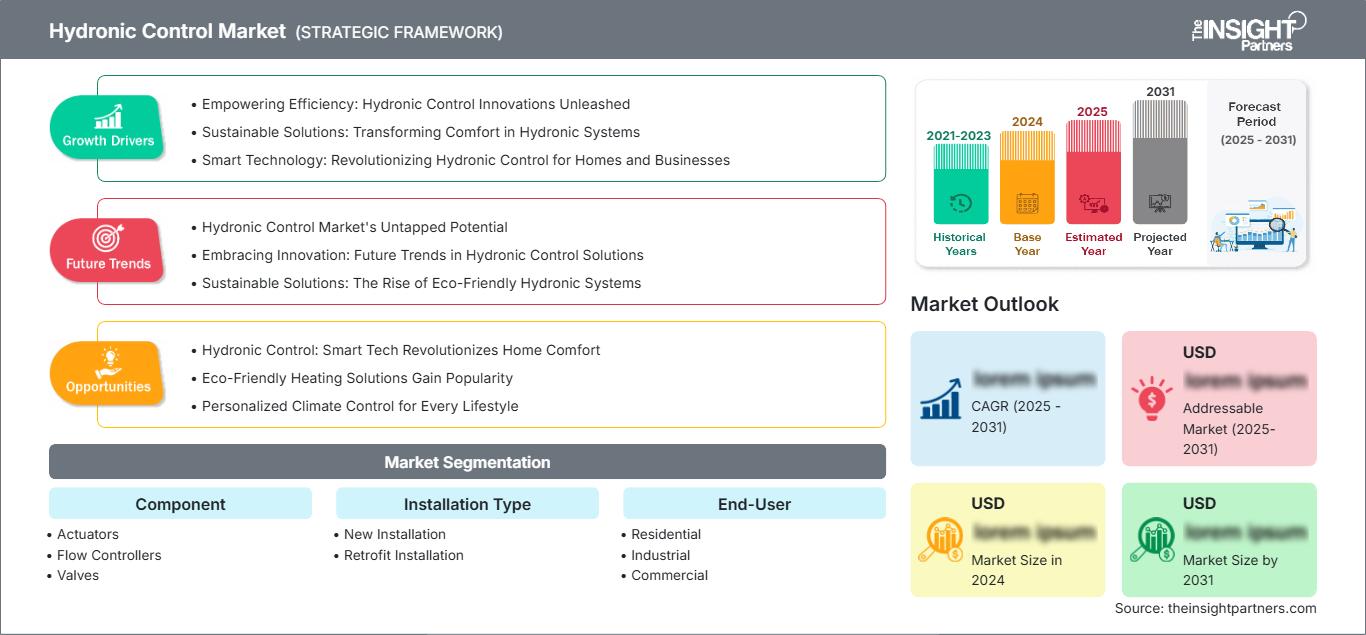
Hydronic Control Market: Strategic Insights
Regional Insights
North America Hydronic Control Market
In North America, the Hydronic Control Market Share was 31–35% in 2025, and the market is anticipated to grow with a CAGR of 4.4–5.0% from 2026 to 2034. The need for upgrading of old HVAC systems continues to remain an essential structural factor influencing the growth in this segment, especially in commercial properties, institutional structures, and multifamily structures. There is a growing need to have energy-efficient performance in which the owners opt for automated valves, balancing, and connectivity in the control system to enhance efficiency in operations and minimize heating and pumping requirements.
The U.S. is the leading regional demand generator for the market, while Canada provides demand through its heating needs in cold climatic conditions. There is a growing trend among manufacturers to provide products compatible with heat pumps, radiant systems, and integration into the building automation system. The retrofitting segment is particularly significant as it enables owners to attain performance gains without replacing the whole mechanical system.
U.S. Hydronic Control Market
Around 78-82% share of North American demand was held by the United States in 2025 and the market would witness a CAGR of 4.5-5.1% in the period from 2026 to 2034. The application markets include commercial offices, hospitals, education complexes, hotels, and residential buildings. Electronic actuators, pressure independent valves, and intelligent interfaces which could be integrated in building management systems have become priorities for replacement projects.
The key players active in the market and operating in the country include Siemens AG, Honeywell International Inc., Schneider Electric SE, Johnson Controls International plc, and Xylem Inc. Alongside these are HVAC control system vendors. Trends in the market include variable flow systems, heat pump installation, and intelligent balancing during renovations. Operational costs and improved equipment efficiency in terms of commissioning and maintenance are driving the market.
Europe Hydronic Control Market
Europe constituted about 28–32% of the total market in 2025 and is projected to register 4.1–4.7% CAGR between 2026 and 2034. The already established base of hydronic heating systems in the region along with decarbonization strategies and building renovations will create replacement opportunities. Germany will continue to be the top nation owing to its large building infrastructure, manufacturing environment, and move towards adoption of efficient heating systems and compatible hydronic heating system infrastructure.
The UK will see a positive trend on account of building renovation, heat pumps installations, and need for efficient energy management in commercial buildings. Germany will continue creating demands for balancing valves, actuators, and controls owing to retrofitting of already installed hydronic heating systems to achieve low-temperature operations. France, Italy, and Spain will see growth owing to renovation drives, climate-specific needs of heating and cooling, and installation of efficient commercial building infrastructure.
APAC Hydronic Control Market
AAsia-Pacific had an approximated market share of 24-28% in 2025 and is expected to expand at a rate of 5.3-5.9% CAGR between 2026 and 2034, the highest among all the major regions. Commercial construction, district energy, and industrial developments drive the regional demand for China, whereas Japan and South Korea account for the use of advanced HVAC and automation technologies.
India and Australia provide opportunities with urban development projects, energy-efficient buildings and infrastructure improvements. Precision control on the water side is vital for industrial facilities, data centers, health care facilities, and large commercial developments. Energy efficiency policies improve the use of hydronics.
Middle East & Africa Hydronic Control Market
Middle East & Africa is forecast to grow at a CAGR of 4.8%-5.4% between 2026-2034, driven by investments in infrastructure development and increased demand for efficient cooling solutions. In the region, Saudi Arabia will lead growth, while UAE gains from substantial commercial projects, district cooling systems, hospitality industry investments, and building automation technologies.
South Africa’s contribution will be through modernization of commercial and institutional buildings, while Rest of MEA offers selective growth in urban infrastructure and industrial applications. Costs of energy, water management needs, and efficient HVAC performance have led to increasing adoption of automated flow and pressure control systems.
Segmentation Analysis
Component
Component demand is expected to expand at a 4.6–5.2% CAGR during 2026–2034, reflecting the need for integrated control architectures across heating and cooling systems. The Hydronic Control Market scope within this segment extends from individual mechanical devices to digitally connected assemblies. Product selection depends on system size, operating conditions, energy objectives, and compatibility with building automation platforms. Suppliers are increasingly developing components that simplify commissioning and provide stable performance under variable-load conditions.
- Actuators: Actuators are gaining importance as automated HVAC systems require accurate valve positioning and compatibility with digital building controls. Their strategic value increases where frequent load changes require responsive, repeatable adjustment.
- Flow Controllers: Flow controllers support hydraulic stability by maintaining designed operating conditions across varying pressure environments. Demand is strengthened by energy-efficiency objectives, variable-speed pumping, and the need to reduce commissioning complexity.
- Valves: Valves remain fundamental to water-side regulation and represent a broad installed base across new and existing systems. Product differentiation increasingly centers on pressure independence, durability, leakage control, and automation compatibility.
- Control Panels: Control panels coordinate equipment operation and provide centralized visibility for complex installations. Their importance rises when facilities integrate multiple pumps, valves, sensors, and communication interfaces into unified building-management architectures.
Installation Type
Installation Type is expected to grow at a 5.0–5.6% CAGR during 2026–2034, with replacement activity increasing alongside continuing construction demand. Retrofit projects are particularly significant because large installed building stocks require energy improvements without full mechanical replacement. New projects, however, provide opportunities for integrated controls designed around advanced HVAC architectures, including heat pumps, variable-flow distribution, and connected building automation.
- New Installation: New installations benefit from the ability to integrate controls during system design and commissioning. Demand is linked to commercial construction, institutional projects, industrial facilities, and developments adopting digitally managed HVAC infrastructure.
- Retrofit Installation: Retrofit installation is strategically important because existing buildings require improved efficiency and operational control. Upgrades often prioritize compatible components that minimize disruption while addressing balancing, pressure regulation, and automation requirements.
End-User
End-User demand is anticipated to register a 4.8–5.4% CAGR during 2026–2034, supported by diverse requirements across buildings and process environments. Commercial facilities remain the largest demand center because of their extensive HVAC infrastructure, while industrial users prioritize process reliability and operational efficiency. Residential adoption is supported by hydronic heating upgrades, heat-pump deployment, and growing interest in automated temperature management.
- Residential: Residential demand is influenced by hydronic heating modernization, heat-pump adoption, and replacement of aging control equipment. Compact, reliable, and installer-friendly solutions are increasingly important as homeowners pursue lower operating costs.
- Industrial: Industrial users require dependable flow, pressure, and temperature control across manufacturing and utility applications. Investment decisions emphasize reliability, system availability, process requirements, and compatibility with broader automation and energy-management strategies.
- Commercial: Commercial facilities generate the highest demand due to extensive HVAC networks in offices, hospitals, hotels, educational institutions, and mixed-use developments. Energy optimization and centralized building management increase the strategic importance of advanced controls.
Opportunity Snapshot
| End-User | Revenue Contribution | Trend Tag | Adoption Stage |
|---|---|---|---|
| Residential | Medium | Heat Pump | Scaling |
| Industrial | High | Process Cooling | Mature |
| Commercial | High | Smart Buildings | Mature |
Hydronic Control Market Growth Drivers and Impact Analysis
Building Energy Retrofits and Performance Requirements
Energy retrofits are increasing demand for equipment that improves HVAC efficiency without requiring complete replacement of piping and mechanical infrastructure. Building owners are under greater pressure to reduce operating costs and demonstrate measurable energy performance, making balancing, pressure control, and automated regulation increasingly relevant. Hydronic upgrades can reduce system inefficiencies caused by unstable flow, excessive pumping, and poor temperature control. The impact is particularly significant in commercial and institutional properties with long equipment replacement cycles. Suppliers that provide compatible retrofit products can access a broad installed base while contractors benefit from shorter project durations compared with full system replacement. The resulting demand supports actuators, control valves, flow-management devices, and digital interfaces across mature building markets.
Heat-Pump Deployment and Low-Temperature System Design
Electrification is changing the operating characteristics of heating systems and increasing the importance of accurate water-side management. Heat pumps typically perform most effectively when hydronic distribution systems maintain suitable flow rates and temperature conditions, creating demand for compatible control technologies. Low-temperature heating configurations can also expose weaknesses in poorly balanced legacy systems, encouraging investment in valves, actuators, and flow-control equipment. The market impact extends beyond new installations because existing buildings may require hydraulic adjustments before adopting electrified heating equipment. Manufacturers therefore have opportunities to develop products optimized for lower temperature differentials and variable operating conditions. Integration with sensors and automation platforms can further improve system responsiveness, commissioning, and lifecycle performance for property owners.
Digital Building Management and Predictive Operations
The increasing digitalization of building infrastructure is expanding the role of hydronic equipment from passive mechanical hardware toward data-enabled system components. Facility managers increasingly seek visibility into temperature, flow, valve position, and equipment status to improve operational decisions. Connected actuators and control panels can provide data to broader building-management systems, supporting fault detection and targeted maintenance. This transition creates additional value for suppliers capable of combining physical equipment with communication protocols and software compatibility. Predictive maintenance can also reduce disruption in critical facilities such as hospitals and industrial plants. As connected infrastructure expands, demand is likely to favor products that deliver accurate field performance while remaining interoperable with existing automation architectures and maintenance workflows.
Hydronic Control Market Future Trends
Integrated Hydraulic Intelligence and Connected Devices
Future system architectures will increasingly combine sensors, actuators, flow-control equipment, and software into coordinated networks. Hydronic Control Market trends are expected to favor devices capable of communicating operational data to building platforms rather than functioning only through local adjustment. Greater integration can improve commissioning, identify performance deviations, and support automated responses to occupancy and weather conditions. Suppliers will likely differentiate through interoperability, cybersecurity, software tools, and lifecycle analytics. Standardized communication capabilities may become increasingly important as building owners avoid closed technology ecosystems. This trend can also reshape installer practices, requiring stronger digital commissioning skills and closer coordination between mechanical contractors, controls specialists, and facility-management teams throughout the asset lifecycle.
Design Optimization for Flexible Heating and Cooling Loads
Buildings are expected to operate with increasingly variable thermal loads as occupancy patterns, climate conditions, electrification technologies, and renewable-energy integration evolve. Future control systems will therefore require greater flexibility than conventional fixed-flow configurations. Equipment capable of maintaining hydraulic stability under changing demand should become more important in mixed-use developments, campuses, and district energy applications. Manufacturers are likely to emphasize compact products with wider operating ranges and easier digital configuration. Product development may also focus on simplifying adaptation of existing systems to new heat sources and cooling requirements. These changes could increase the value of modular control architectures that support phased renovation rather than requiring simultaneous replacement of entire mechanical systems.
Hydronic Control Market Opportunities
Retrofit Solutions for Existing Commercial Building Portfolios
A major investment opportunity lies in developing packaged retrofit solutions for large commercial and institutional building portfolios. Hydronic Control Market Forecasts indicate that replacement activity can provide a more predictable demand base than construction-dependent equipment sales in mature economies. Suppliers can create value by combining valves, actuators, balancing technologies, sensors, and commissioning support into standardized upgrade packages. Partnerships with energy-service companies, facility managers, and mechanical contractors could accelerate deployment across multiple properties. Investors may also find opportunities in digital tools that quantify energy savings before and after installation. Solutions that minimize downtime and avoid extensive piping modifications are particularly attractive because they reduce project complexity and improve the economic case for modernization programs.
Localized Manufacturing and Application Engineering in Emerging Markets
Emerging markets offer opportunities for suppliers willing to adapt products and commercial models to local infrastructure requirements. Investment in regional assembly, technical support, and contractor training can reduce lead times and improve customer confidence in advanced control technologies. China, India, the Middle East, and selected Southeast Asian markets are particularly relevant because urban development and infrastructure investment continue to expand the installed base of complex HVAC systems. Local application engineering can also address differences in climate, water quality, construction practices, and energy systems. Strategic partnerships with distributors and engineering firms may provide faster market access than direct expansion alone, while localized service capabilities can strengthen long-term customer relationships and recurring replacement demand.
Recent Developments
- June 2026: Siemens AG announced further expansion of its building technology and digital building capabilities through continued development of interoperable automation solutions designed to improve energy performance and operational visibility across commercial infrastructure. The initiative supports integration between field devices and building-management platforms, strengthening the company's positioning in connected HVAC and energy-management applications.
- April 2026: Schneider Electric SE continued advancing its building-energy management portfolio through integrated digital and electrification solutions aimed at improving operational efficiency across commercial infrastructure. Its strategy emphasizes connected architecture, monitoring, and lifecycle optimization, areas that increasingly influence demand for compatible HVAC and hydronic control equipment within smart building projects.
- October 2025: BELIMO Holding AG continued expanding its focus on energy-efficient HVAC control technologies, including intelligent field devices and solutions designed to improve water-side performance. The company's product strategy remains aligned with increasing requirements for measurable energy efficiency, digital connectivity, and simplified commissioning in commercial and institutional building applications.
Frequently Asked Questions

- Comprehensive Market Sizing and Forecast Analysis
- Detailed Segmentation Analysis
- In-Depth Market Dynamics Assessment
- Regional and Country-Level Insights
- Competitive Landscape and Company Benchmarking
- Strategic Business Intelligence
Recent Reports
Testimonials

The Insight Partners' SCADA System Market report is comprehensive, with valuable insights on current trends and future forecasts. The team was highly professional, responsive, and supportive throughout. We are very satisfied and highly recommend their services.
RAN KEDEM Partner, Reali Technologies LTDs
I requested a report on a very specific software market and the team produced the report in a few days. The information was very relevant and well presented. I then requested some changes and additions to the report. The team was again very responsive and I got the final report in less than a week.
JEAN-HERVE JENN Chairman, Future Analytica
We worked with The Insight Partners for an important market study and forecast. They gave us clear insights into opportunities and risks, which helped shape our plans. Their research was easy to use and based on solid data. It helped us make smart, confident decisions. We highly recommend them.
PIYUSH NAGPAL Sr. Vice President, High Beam Global
The Insight Partners delivered insightful, well-structured market research with strong domain expertise. Their team was professional and responsive throughout. The user-friendly website made accessing industry reports seamless. We highly recommend them for reliable, high-quality research services
YUKIHIKO ADACHI CEO, Deep Blue, LLC.
This is the first time I have purchased a market report from The Insight Partners.While I was unsure at first, I visited their web site and felt more comfortable to take the risk and purchase a market report.I am completely satisfied with the quality of the report and customer service. I had several questions and comments with the initial report, but after a couple of dialogs over email with their analyst I believe I have a report that I can use as input to our strategic planning process.Thank you so much for taking the extra time and making this a positive experience.I will definitely recommend your service to others and you will be my first call when we need further market data.
JOHN SUZUKI President and Chief Executive Officer, Board Director, BK Technologies
I wish to appreciate your support and the professionalism you displayed in the course of attending to my request for information regarding to infectious disease IVD market in Nigeria. I appreciate your patience, your guidance, and the fact that you were willing to offer a discount, which eventually made it possible for us to close a deal. I look forward to engaging The Insight Partners in the future, all thanks to the impression you have created in me as a result of this first encounter.
DR CHIJIOKE ONYIA MANAGING DIRECTOR, PineCrest Healthcare Ltd.Reason to Buy
- Informed Decision-Making
- Understanding Market Dynamics
- Competitive Analysis
- Identifying Emerging Markets
- Customer Insights
- Market Forecasts
- Risk Mitigation
- Boosting Operational Efficiency
- Strategic Planning
- Investment Justification
- Tracking Industry Innovations
- Aligning with Regulatory Trends





 Get Free Sample for