
Livestock Monitoring System Market Trends, Size & Forecast by 2034
Coverage: By Technology (Collar-Based Monitoring, Ear Tag Health Monitoring, Internal Monitoring Systems and Others), Application (Animal Health Monitoring [Disease Detection, Temperature Monitoring, Others], Reproductive Monitoring [Heat Detection, Fertility Management, Others], Feeding and Nutrition Monitoring [Feed Efficiency Monitoring, Rumen Monitoring, pH Monitoring], Water Management Monitoring, Welfare Monitoring, Others), Animal Type (Dairy Cattle, Beef Cattle, Swine, Poultry, Others), and Geography
- Status : Published
- Report Code : TIPRE00043794
- Category : Life Sciences
- No. of Pages : 352
- Available Report Formats :


- Last update date : August 13, 2026


2025 Market Size
US$ 5.72 Bn
Base year value
2034 Forecast
US$ 13.31 Bn
Projected by 2034
CAGR 2026-2034
9.8 %
Growth rate
Addressable Market
US$ 84.57 Bn
(2026-2034)
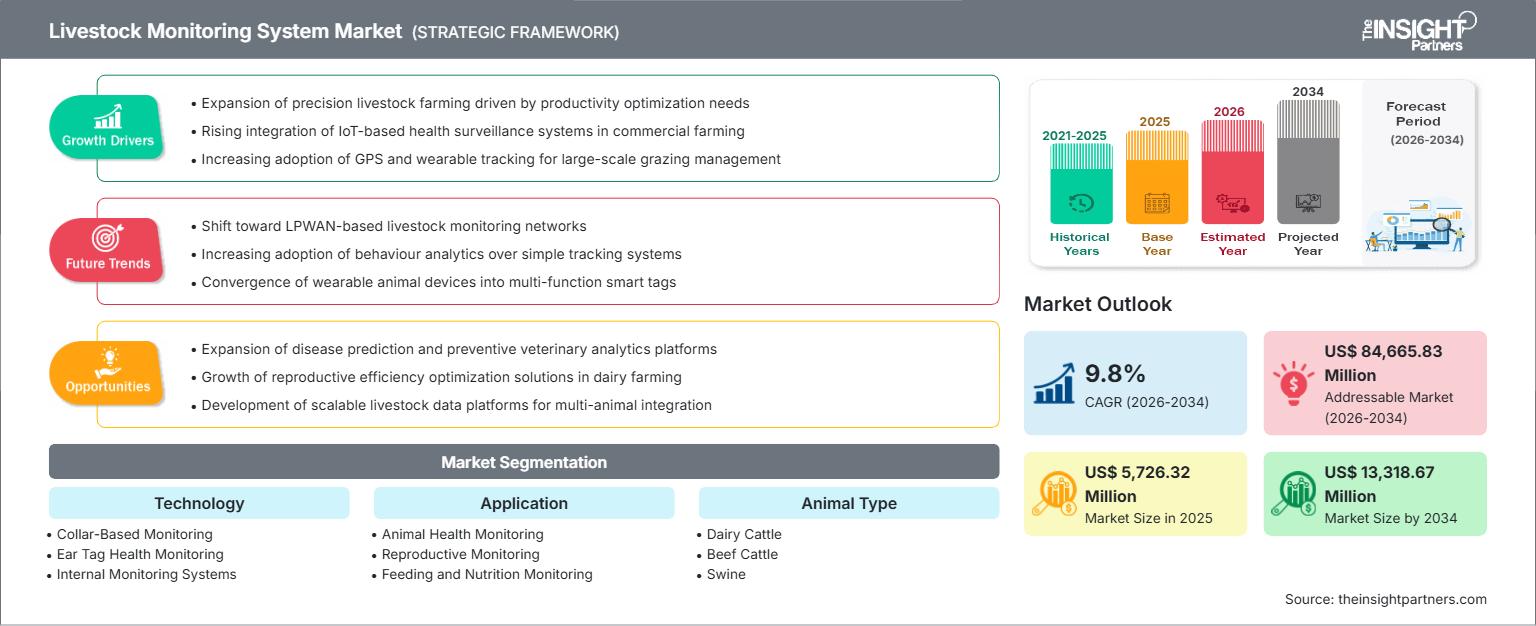
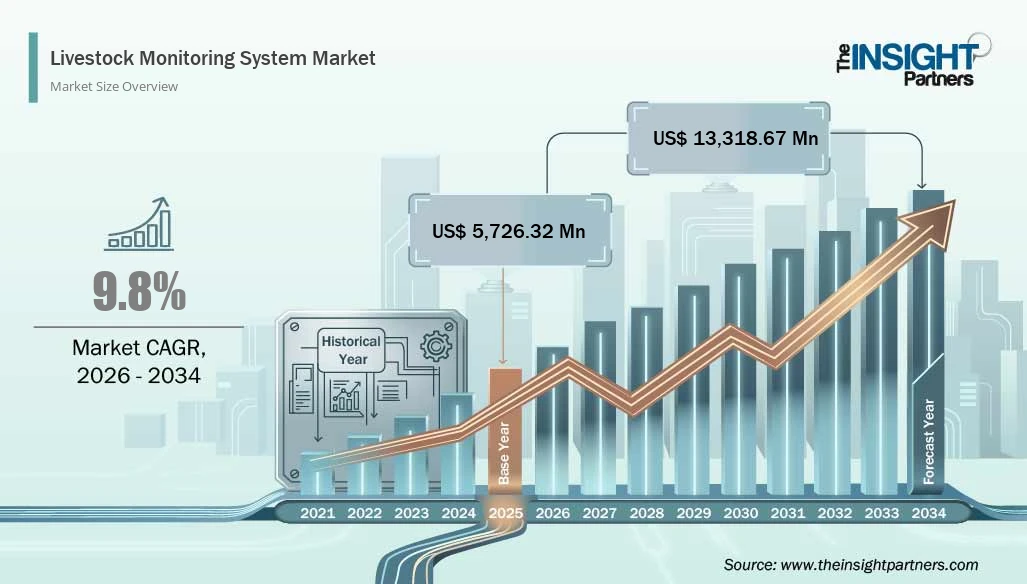
Livestock Monitoring System Market was valued at US$ 5.72 billion in 2025 and is projected to reach US$ 13.31 billion by 2034. It is expected to register a CAGR of 9.8% from 2026 to 2034. Expansions are backed by precision livestock farming, linked animal wearables, data-driven herd management, and farm productivity necessities in dairy cattle, beef cattle, swine, and poultry animals.
North America continues to be one of the significant geographical regions for Livestock Monitoring System Market size because of the presence of technologically advanced dairy farms, integrated herd management, and extensive adoption of sensor-based health monitoring systems. It is expected to register a CAGR of 9.2-9.6% from 2026 to 2034, owing to automation spending, veterinary monitoring requirement, and increased usage of cloud services for converting activities, rumination, fertility, and feeding into farm level decisions.
Livestock Monitoring System Market Assessment and Insights
- North America accounted for 34-36% share in 2025 and is expected to grow at a CAGR of 9.2-9.6% between 2026-2034, supported by large dairy herds, integrated farm software, and strong veterinary diagnostics infrastructure.
- US represented 82-85% of North America share in 2025 and is projected to grow at a CAGR of 8.9-9.3% between 2026-2034 as large farms expand monitoring coverage.
- Europe held 28-30% share in 2025 and is forecast to grow at a CAGR of 8.4-8.8% between 2026-2034, led by Germany, the Netherlands, France, and the UK.
- Asia Pacific captured 22-24% share in 2025 and is projected to grow at a CAGR of 11.6-12.2% between 2026-2034, led by China, India, Japan, Australia, and South Korea.
- Largest Segment collar-based monitoring held 55.9% market share in 2025 and is expected to grow at a CAGR of 9.0-9.4% during 2026-2034 due to mature dairy use.
- High Growth Segment internal monitoring systems held 9.1% market share in 2025 and is projected to grow at a CAGR of 12.8-13.4% during 2026-2034.
- Key companies analyzed in detail: smaXtec animal care GmbH, DeLaval International AB, Lely Holding S.à r.l., GEA Group Aktiengesellschaft, Allflex Livestock Intelligence, Afimilk Ltd., SenseHub, CowManager B.V., Shanghai AllyNav Technology Co., Ltd., and Censortec A/S.
Source: The Insight Partners' analysis based on proprietary research, government publications, company annual reports, investor presentations, industry databases, and expert interviews.
The Precision Livestock devices have evolved from standalone identification devices to decision-making platforms that include a combination of a collar, ear tag, bolus, camera, and analysis using software. There have been changes in production dynamics because bigger farms seek labor efficiency, early disease detection, reproductive precision, and feed efficiency. Within the Livestock Monitoring System Market, the dominant installed devices remain collars; however, internally placed sensors and AI-driven platforms become increasingly relevant where the farmer requires physiological data beyond behavioral insights.
Further growth will come from the new dairy basins, formal animal welfare programs, and the development of farm automation technologies. The Asia Pacific region will probably outperform established markets in terms of growth from its relatively low starting point due to the digitization of organized dairy and swine farms. Additionally, the regulation around traceability, antimicrobial stewardship, and animal welfare data will make sensor data increasingly valuable.
Livestock Monitoring System Market Report Scope
| Report Attribute | Details |
|---|---|
| Market size in 2025 | US$ 5.72 Billion |
| Market Size by 2034 | US$ 13.31 Billion |
| Global CAGR (2026 - 2034) | 9.8% |
| Historical Data | 2021-2025 |
| Forecast period | 2026-2034 |
Livestock Monitoring System Market Analysis
The Livestock Monitoring System Market will be fueled by the need for measurable gains in fertility, health, labor efficiency, and herd visibility on farms. In dairy farms, activity and rumination sensors are used to detect early signs of estrus, risk of mastitis, metabolic stress, and lameness. Swine and poultry operators have started looking into water, feed, and environment monitoring due to their rapid productivity impacts.
The value chain consists of sensor companies, farm equipment suppliers, veterinary service providers, cloud software companies, connectivity suppliers, and distribution firms. The hardware segment is still vulnerable to battery life, durability of the devices, chip availability, and installation fees. Nonetheless, software subscriptions have improved the profitability of the suppliers through the recurring nature of the analysis income, which balances out hardware margins and enables model updates.
Livestock Monitoring System Market analysis indicates a competitive landscape shaped by platform depth rather than device count alone. DeLaval International AB, Lely Holding S.à r.l., and GEA Group Aktiengesellschaft benefit from installed dairy automation bases, while smaXtec animal care GmbH, CowManager B.V., Afimilk Ltd., and Censortec A/S compete through specialized monitoring capabilities.
Strategic positioning is increasingly tied to interoperability, predictive algorithms, and data ownership. Allflex Livestock Intelligence and SenseHub leverage identification and herd intelligence coverage, while Shanghai AllyNav Technology Co., Ltd. supports precision agriculture expansion in Asian livestock operations. Companies are investing in AI, mobile dashboards, and advisory integration to convert device readings into operational actions.
● REPORT CUSTOMIZATION
Tailor This Report To Align With Your Specific Business Requirements
This report can be customized to align precisely with your business objectives, scope, and target markets. Customization options include tailored segmentation, geography, competitive analysis, and strategic insights to support informed decision-making.
Customize This Report →WHAT YOU CAN ADJUST
- ● Segmentations
- ● Geography
- ● Competitive Analysis
- ● Language Preferences
Livestock Monitoring System Market: Strategic Insights
Regional Insights
North America Livestock Monitoring System Market
North America held a 34-36% Livestock Monitoring System Market share in 2025 and is expected to expand at a CAGR of 9.2-9.6% during 2026-2034. The region benefits from high herd consolidation, mature dairy automation, and strong veterinary service integration. Farms with thousands of animals increasingly require real-time visibility because manual observation becomes less reliable as herd size rises.
Adoption is strongest in dairy cattle, followed by swine and beef operations that use collars, ear tags, and water or feeding sensors to identify abnormal behavior earlier. Structural drivers include labor shortages, animal welfare audits, digital milk production records, and disease surveillance needs. System upgrades increasingly combine wearable data with reproductive, nutrition, and herd management software.
U.S. Livestock Monitoring System Market
The US accounted for 82-85% of North America revenue in 2025 and is projected to grow at a CAGR of 8.9-9.3% through 2034. Scale plays an important part as bigger commercial dairy and pork farms can afford sensors on several barns, parlors, and feeding areas.
The companies are widespread in their presence, including such giants as Allflex Livestock Intelligence, SenseHub, DeLaval International AB, GEA Group Aktiengesellschaft, Lely Holding S.à r.l., CowManager B.V., and Afimilk Ltd. The use of the technology is growing mainly in such applications as animal health monitoring, reproductive monitoring, and feeding optimization.
Europe Livestock Monitoring System Market
Europe represented 28-30% share in 2025 and is forecast to grow at a CAGR of 8.4-8.8% through 2034. Germany leads due to its extensive dairy mechanization, strong cattle numbers, and early adoption of automated milking and welfare monitoring technologies.
UK progress with regard to adoption is being driven by herd health initiatives, time and cost saving innovations, and concerns about mastitis, lameness, and fertility performance. The use of connected collars, camera analysis and milk sensing technology become increasingly important for the farms that balance production objectives with the welfare of animals and sustainability reporting requirements.
Germany still remains the major revenue source, whereas France, Italy, Spain, and the Netherlands provide steady demand due to the modernization and traceability demands. The emphasis in France and Italy is on herd efficiency and milk quality, in Spain – on water and heat stress management, in the Netherlands – on high density dairies within environmental restrictions.
APAC Livestock Monitoring System Market
APAC held 22-24% share in 2025 and is expected to register a CAGR of 11.6-12.2% during 2026-2034. China is the dominant player owing to its substantial investments in dairy farming, pig farming biosecurity upgrades, and digital farm management solutions.
In Japan, South Korea, India, and Australia, growth is spurred by labor shortages, planned expansion in dairy farming, and the need for precision grazing. Food security, disease control, and increasing livestock production efficiency are the policy motivations behind digital adoption. Cloud-based ear tags, collars, and farm dashboards are growing increasingly available.
Middle East & Africa Livestock Monitoring System Market
Middle East & Africa is expected to grow at a CAGR of 7.8-8.3% during 2026-2034, with Saudi Arabia leading adoption. Large-scale dairy farms, arid production systems, and the need for water conservation generate demand for the integration of monitoring the health, feeding, watering, and environment of animals.
The UAE concentrates on automating farms, while South Africa promotes adoption within dairy and beef operations. The RoMEA region is still at an early stage of development owing to the lack of connectivity and costs. Livestock monitoring is beneficial in areas where cooling and feeding operations are energy intensive.
Segmentation Analysis
Technology
Technology is projected to grow at a CAGR of 9.2-9.7% during 2026-2034 as farms combine wearable devices, internal sensors, and software platforms. The Livestock Monitoring System Market scope is widening from basic identification toward continuous health, fertility, and productivity analytics. Technology selection depends on herd size, species, connectivity, and data depth required for operational decisions.
- Collar Monitoring Systems continue to hold sway due to extensive applications in dairy cows for monitoring rumination activities, movement behaviors, heat detection, and visibility in both automated and semi-automated farms.
- Ear Tag Health Monitoring systems have received greater traction because of easy implementation, suitability across different livestock groups, and increased application in identification, behavioral, and health monitoring systems.
- Internal Monitoring Systems are utilized on farms that need to understand their livestock physiology better in terms of temperature and pH levels.
Application
Application is expected to grow at a CAGR of 9.4-9.9% during 2026-2034 as monitoring shifts from reactive herd checks to predictive management. Health and reproduction remain high-value applications because they directly affect milk yield, conception intervals, treatment costs, animal welfare outcomes, and replacement rates across commercial farms.
- Animal health monitoring is the biggest source of application demand because there is a requirement for an early warning system about lameness, mastitis predisposition, metabolic stress, fever, behaviour problems, and lower levels of rumination.
- Reproductive health monitoring is strategically significant due to digital tools that are used for heat detection, mating, calving alerts, and pregnancy control, and reduce missed mating occasions.
- Feeding and nutrition monitoring is justified by farm needs to improve feed efficiency, rations adjustments, and monitor body conditions and stable production under dietary changes or stress.
- Water management monitoring is appropriate for intensive operations and arid climates, where any changes in water intake can show health problems, equipment failures or heat stress.
- Animal welfare monitoring is growing in importance due to increased demands from retailers, processors, and regulatory bodies regarding documented animal well-being, mobility, stress, and behaviour.
Animal Type
Animal Type is forecast to grow at a CAGR of 9.1-9.6% during 2026-2034. Dairy cattle remain the anchor population because productivity, fertility, and health outcomes can be directly monetized. Swine and poultry are gaining attention as disease prevention, water monitoring, and environmental control become essential for high-density production.
- Dairy cattle continue to be the main species for which the implementation of IoT devices occurs. In this respect, the use of collars, milk meters, reproduction analytics, and herd management system plays an important role.
- Beef cattle utilization is associated mainly with location tracking, visibility during grazing, illness warnings, and better management of distributed herds.
- For swine the demand for swine IoT devices comes from biosecurity, weight performance, water consumption, and reproductive monitoring needs.
- In case of Poultry animals, the increasing attention to environmental sensors and welfare indicators along with water intake monitoring becomes apparent.
Opportunity Snapshot
| Application | Revenue Contribution | Trend Tag | Adoption Stage |
| Animal Health Monitoring | High | Disease Alerts | Mature |
| Reproductive Monitoring | High | Fertility Analytics | Mature |
| Feeding and Nutrition Monitoring | Medium | Feed Efficiency | Scaling |
| Water Management Monitoring | Low | Intake Alerts | Emerging |
| Welfare Monitoring | Medium | Welfare Scoring | Scaling |
| Others | Low | Farm Insights | Emerging |
Livestock Monitoring System Market Growth Drivers and Impact Analysis
Rising Need for Early Disease Detection Across Herds
The need for disease detection is turning out to be an important reason behind adopting IoT solutions in farm animals. One missed episode of the disease can lead to low milk yield, high veterinary expenses, high costs related to antibiotics, and even transmission risks within the herd. IoT sensors assist in detecting any irregularities in terms of animal behaviour or physiological parameters before there are noticeable signs. This helps in making sure that the treatment is timely and even helps in keeping record of the decision taken for the same. Early detection of such diseases like mastitis, lameness, metabolic stress, and fever on dairy farms is important for protecting its economics.
Labor Shortages Accelerating Farm Automation Decisions
The lack of labor availability is making livestock farmers look at technologies that will help to cut down on the number of observations and checks that must be done by hand along with paper record keeping. For dairy farmers, there is increasing use of collars, ear tags, cameras, and milk sensors in an effort to automate heat detection, health alerts, and sorting of herds. There is even greater appeal when there is one system that can cover a range of functions like reproduction, health, feed and location of the animals. In advanced countries, the reason for use is linked to succession problems in addition to wage increases. In developing countries, large organized farms require standardization in supervision over different sheds.
Traceability and Welfare Reporting Moving into Procurement Criteria
Processor, retailer, and regulator organizations are becoming more insistent on collecting documentation regarding welfare conditions, treatments, and productivity. Data collected via sensors can be used as proof in relation to health care programs, reproduction choices, mobility verification, and proper use of medicine. This changes the role of monitoring from an optional method of increasing productivity into one that enables compliance and access to markets. Supply chains of dairy and meat products are employing data to enhance transparency, reduce unnecessary loss, and showcase responsible production. The most noticeable results can be observed in Europe and North America due to the development of welfare audits and sustainability reporting. In the long run, traceability standards will favor those with digitized data.
Livestock Monitoring System Market Future Trends
AI-Led Predictive Herd Intelligence
Market trends for AI-based Livestock Monitoring are expected to evolve from alerts to predictive herd intelligence. While today’s systems only track activity changes, in the future, systems will integrate information about behavior, milk quality, feeding, mobility, weather, and previous treatments to suggest next steps to take. Predictive herd intelligence will help with early lameness detection, fertility management, metabolic risks identification, and herd productivity assessment. The most widespread adoption is expected in those cases when it becomes possible to collect data on farms from milking robots, collars, cameras, and enterprise systems. Vendors with large databases will be able to enhance their models, while farmers will ask for understandable alerts to avoid fatigue from constant warnings.
Expansion of Multispecies Monitoring Platforms
The platforms of the future would be developed for cattle, swine, poultry, and small ruminants through modular software, not single species dashboards. This move is expected to work to the advantage of integrated livestock operators who use more than one type of animal and need to have consistent visibility at all production facilities. The setups would be different based on the species, but the analytics layers would be gradually standardized regarding alerting, welfare scoring, water monitoring, and performance analysis. The ability to work with more than one species is important for vendors to penetrate new markets where multispecies operation is the norm and investments in farm equipment are phased.
Livestock Monitoring System Market Opportunities
Data-Driven Services for Mid-Sized Farms
Medium-sized farms offer a considerable investment potential since they are too big to be handled manually yet not sufficiently automated. Suppliers can fill this gap with a combination of hardware, mobile dashboard, financing, and consultancy services. According to Livestock Monitoring System Market Forecasts, more profit is expected in cases when the vendors provide outcome-focused solutions related to fertility, decrease of diseases, or labor costs saving. Such farms may need easy installation, notifications about issues, and connection with milking and feeding systems. The distributors, veterinarians will help in increasing adoption. Companies capable of lowering the cost barrier and demonstrating tangible results of productivity will have a chance to move from premium farms to commercial farms.
Climate-Resilient Monitoring in Heat-Stressed Regions
Heat stress, lack of water, and variations in feed provide opportunities for monitoring systems that integrate animal behavior with environment and intake metrics. Dry and tropical zones require solutions that can identify lower water consumption, rumination changes, panting, stress in mobility, and changes in feed intake before losses from production increase. Solutions designed specifically for Saudi Arabia, the United Arab Emirates, India, Australia, and Latin America are necessary to maintain welfare and production efficiency due to climate. Companies will be able to distinguish themselves by offering durable equipment, minimal connection requirement, solar energy compatibility for the gateway, and advice models for heat mitigation.
Recent Developments
- June 2025: Lely Holding S.à r.l. - Lely launched Astronaut A5 Next, Astronaut Max, and Lely Hub during Future Farm Days 2025. The company stated that Astronaut Max can connect up to 18 milking robots for farms with 500-1,100 cows, while Eartag ID became part of its cow health portfolio.
- April 2025: DeLaval International AB - DeLaval launched BioSensors Milk Cell Analysis, an online sensor for VMS V300 milking robots that uses optical technology to count somatic cells in milk. The system supports early mastitis detection, dry-off decisions, udder health management, and reduced unnecessary antibiotic treatments.
- March 2024: GEA Group Aktiengesellschaft acquired CattleEye Ltd., a Northern Ireland-based agricultural software company, adding AI-based lameness detection and body condition scoring to its DairyNet portfolio. GEA said CattleEye was already used to monitor more than 100,000 cows worldwide at the time of acquisition.
Frequently Asked Questions

- Comprehensive Market Sizing and Forecast Analysis
- Detailed Segmentation Analysis
- In-Depth Market Dynamics Assessment
- Regional and Country-Level Insights
- Competitive Landscape and Company Benchmarking
- Strategic Business Intelligence
Recent Reports
Testimonials

The Insight Partners' SCADA System Market report is comprehensive, with valuable insights on current trends and future forecasts. The team was highly professional, responsive, and supportive throughout. We are very satisfied and highly recommend their services.
RAN KEDEM Partner, Reali Technologies LTDs
I requested a report on a very specific software market and the team produced the report in a few days. The information was very relevant and well presented. I then requested some changes and additions to the report. The team was again very responsive and I got the final report in less than a week.
JEAN-HERVE JENN Chairman, Future Analytica
We worked with The Insight Partners for an important market study and forecast. They gave us clear insights into opportunities and risks, which helped shape our plans. Their research was easy to use and based on solid data. It helped us make smart, confident decisions. We highly recommend them.
PIYUSH NAGPAL Sr. Vice President, High Beam Global
The Insight Partners delivered insightful, well-structured market research with strong domain expertise. Their team was professional and responsive throughout. The user-friendly website made accessing industry reports seamless. We highly recommend them for reliable, high-quality research services
YUKIHIKO ADACHI CEO, Deep Blue, LLC.
This is the first time I have purchased a market report from The Insight Partners.While I was unsure at first, I visited their web site and felt more comfortable to take the risk and purchase a market report.I am completely satisfied with the quality of the report and customer service. I had several questions and comments with the initial report, but after a couple of dialogs over email with their analyst I believe I have a report that I can use as input to our strategic planning process.Thank you so much for taking the extra time and making this a positive experience.I will definitely recommend your service to others and you will be my first call when we need further market data.
JOHN SUZUKI President and Chief Executive Officer, Board Director, BK Technologies
I wish to appreciate your support and the professionalism you displayed in the course of attending to my request for information regarding to infectious disease IVD market in Nigeria. I appreciate your patience, your guidance, and the fact that you were willing to offer a discount, which eventually made it possible for us to close a deal. I look forward to engaging The Insight Partners in the future, all thanks to the impression you have created in me as a result of this first encounter.
DR CHIJIOKE ONYIA MANAGING DIRECTOR, PineCrest Healthcare Ltd.Reason to Buy
- Informed Decision-Making
- Understanding Market Dynamics
- Competitive Analysis
- Identifying Emerging Markets
- Customer Insights
- Market Forecasts
- Risk Mitigation
- Boosting Operational Efficiency
- Strategic Planning
- Investment Justification
- Tracking Industry Innovations
- Aligning with Regulatory Trends





 Get Free Sample for