
Industrial Exhaust System Market Size, Demand & Growth by 2034
Coverage: by Type (General and Local); End-user Industry (Oil & Gas, Chemical, Metal & Mining, Textile, and Automotive), and Geography (North America, Europe, Asia Pacific, and South and Central America)
- Status : Data Released
- Report Code : TIPMC00002744
- Category : Manufacturing and Construction
- No. of Pages : 150
- Available Report Formats :


- Last update date : August 28, 2026


2025 Market Size
US$ 3.76 Bn
Base year value
2034 Forecast
US$ 5.06 Bn
Projected by 2034
CAGR 2026-2034
3.35 %
Growth rate
Addressable Market
US$ 40.05 Bn
(2026-2034)
The industrial exhaust system market was valued at US$ 3.76 Billion in 2025 and is projected to reach US$ 5.06 Billion by 2034, expanding at a CAGR of 3.55% during 2026–2034. Demand reflects sustained replacement of aging fans, ducts, hoods, collectors, and controls across hazardous production environments, alongside greenfield capacity additions. Buyers increasingly assess complete capture, conveyance, filtration, discharge, monitoring, and maintenance performance rather than sourcing isolated ventilation components.
North America remains a technically mature demand center, with an estimated 3.2–3.8% CAGR through 2034. The industrial exhaust system market size is supported by enforceable source-capture requirements and recurring modernization in automotive, metals, chemicals, energy, and advanced manufacturing. Retrofit spending increasingly favors variable-speed drives, monitored airflow, efficient motors, modular collectors, and engineered makeup-air balance, particularly where operators must document exposure control and reduce electricity consumption without compromising process continuity.
Industrial Exhaust System Market Assessment and Insights
- North America: Represented 30–34% Industrial Exhaust System Market share in 2025 and is expected to record a 3.2–3.8% CAGR between 2026–2034, supported by compliance-led retrofits, reshoring projects, and replacement of inefficient installed systems.
- US: Accounted for 78–82% of North American demand in 2025 and should expand at a 3.3–3.9% CAGR between 2026–2034.
- Europe: Held 25–29% share in 2025 and is projected to grow at a 3.0–3.6% CAGR between 2026–2034; Germany, the UK, France, Italy, and Spain anchor demand.
- Asia Pacific: Captured 27–31% share in 2025 and is forecast at a 4.2–4.8% CAGR between 2026–2034, led by China, Japan, South Korea, India, and Australia.
- Largest Segment: General systems held 54–58% market share in 2025 and are expected to advance at a 3.0–3.6% CAGR between 2026–2034.
- High Growth Segment: Local systems represented 42–46% market share in 2025 and should register a 4.0–4.6% CAGR between 2026–2034.
- Key companies analyzed in detail: Greenheck Fan Corporation, Loren Cook Company, Twin City Fan Companies, Ltd., TROX GmbH, Systemair AB, Howden Group Limited, Nederman Holding AB, Donaldson Company, Inc., CECO Environmental Corp., and Camfil AB.
Source: The Insight Partners' analysis based on proprietary research, government publications, company annual reports, investor presentations, industry databases, and expert interviews.
Industrial Exhaust System Market trends will focus increasingly on verifiable carbon reductions rather than sustainability. Manufacturers will be exploring the use of biobased adhesives, carbon capture fillers, recovered backing, energy from renewable sources, and take-back programs for recovering the installed floorings. Environmental declarations at the product level will become more uniform since the procurement departments will demand data about cradle-to-gate processes and recycling content. The design aspect will respond with the use of separable layers, material flows, and the application of adhesives that facilitate recovery. Business buyers will increasingly rate suppliers according to their ability to collect and recycle the materials in addition to the price and aesthetics.
Industrial Exhaust System Market Report Scope
| Report Attribute | Details |
|---|---|
| Market size in 2025 | US$ 3.76 Billion |
| Market Size by 2034 | US$ 5.06 Billion |
| Global CAGR (2026 - 2034) | 3.35% |
| Historical Data | 2021-2024 |
| Forecast period | 2026-2034 |
Industrial Exhaust System Market Analysis
Industrial Exhaust System Market Growth is driven by the stricter management of dust, fumes, mists, vapors, and gases from industrial processes. As per OSHA recommendations, general exhaust systems, local exhaust systems, make-up air, HVAC and recirculation are recognized as different but often combined techniques. The resulting value chain involves consulting, fan and hood manufacturers, duct fabricators, filtration experts, motors and controls, installation, test and maintenance firms.
Supply environment is application-driven not commoditized one. Stainless steels, coated metals, exotic polymers, explosion-proof motors, sensors, and filters affect lead time and profitability. Fans can be configured fast, whereas corrosive, hot or explosive processes require special packages, field measurements, balancing and testing. Filters, belts, bearings, dampers, and monitoring services provide steady income between projects.
Industrial exhaust systems market analysis highlights fragmented competition, characterized by platform providers globally and local engineering specialists. Greenheck Fan Corporation, Loren Cook Company, and Twin City Fan Companies, Ltd., are fierce competitors in equipment for air movement. TROX GmbH and Systemair AB provide comprehensive ventilation ranges. Howden Group Limited covers complex requirements in heavy industries, and Nederman Holding AB, Donaldson Company, Inc., CECO Environmental Corp., and Camfil AB focus on capture and filtration.
Current investments are made in digital monitoring and energy optimization, modularity, and strategic acquisitions. The key competitive advantage will come from demonstrating capture effectiveness, efficiency of the whole system, service response, and proper documentation instead of pure air flow capability. The companies that can combine fans, collectors, control systems, and services in the field can mitigate interface risks for the plants.
● REPORT CUSTOMIZATION
Tailor This Report To Align With Your Specific Business Requirements
This report can be customized to align precisely with your business objectives, scope, and target markets. Customization options include tailored segmentation, geography, competitive analysis, and strategic insights to support informed decision-making.
Customize This Report →WHAT YOU CAN ADJUST
- ● Segmentations
- ● Geography
- ● Competitive Analysis
- ● Language Preferences
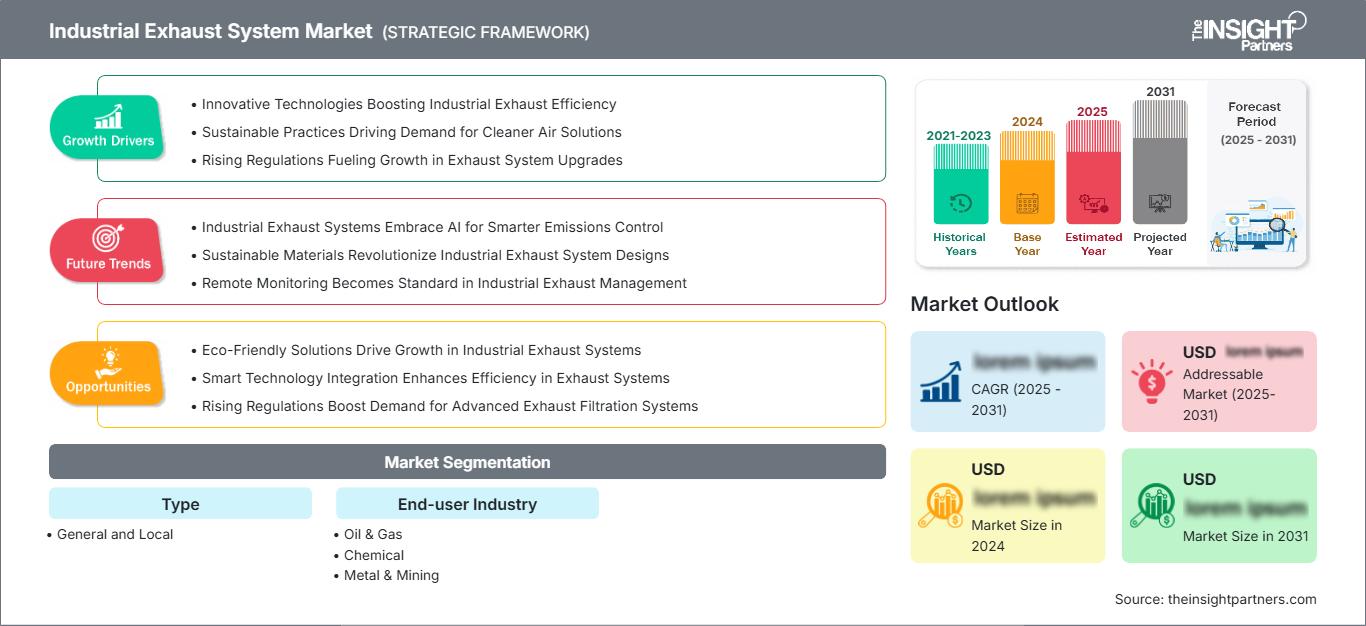
Industrial Exhaust System Market: Strategic Insights
Regional Insights
North America industrial exhaust system market
The North American industrial exhaust system market held 30–34% of global demand in 2025 and is modeled to expand at a 3.2–3.8% CAGR during 2026–2034. This vendor’s share is due to its high installed base in automotive, chemical, metal, mining, food processing, oil and gas, warehouse, and manufacturing sectors. Rules for source capture, insurance inspections, union-based health programs, and corporate exposure limits create a need for regular balancing, inspecting, and retrofitting.
Replacement systems in the industrial exhaust system market often integrate airflow sensors, variable frequency drives, efficiency motors, and condition monitoring with existing hoods, ductwork, and collectors. Investment in mining and processing by Canada, as well as automobile and electronics production by Mexico, complements investments in US manufacturing automation. The buying process is heavily specification-oriented owing to corrosive streams, combustible dust, extreme temperatures, and outdoor discharges. Close proximity to test labs, on-site service engineers, certified products, and stock components helps suppliers during limited time periods.
U.S. Industrial Exhaust System Market
The Industrial Exhaust System Market forecast shows that US represented 78–82% of North American revenue in 2025 and is estimated to grow at a 3.3–3.9% CAGR through 2034. Basic requirements of national regulations on engineering controls for ventilation, including proper capture and exhaust of hazardous contaminates, create basic demand. Semiconductor fabrication, battery factories, data center auxiliary facilities, metal-working, chemicals, refining, and reshored manufacturing contribute to greenfield projects, while existing plants produce retrofits with fans, collectors, ducting, and controls.
Greenheck Fan Corporation, Loren Cook Company, Twin City Fan Companies, Ltd., Donaldson Company, Inc., and CECO Environmental Corp. supply significant amounts of domestic product, engineering, distribution channels, or services. Trends include source control of fumes in welding and machining processes, dust collection in finishing and material handling, and corrosion resistance for chemical processing. Customers demand performance by Fan Energy Index, easy maintenance, remote alarm, airflow measurement, and redundancy. The timing of project implementation depends on permitting, financial planning, shutdown plans, and qualified installation personnel.
Europe Industrial Exhaust System Market
Europe accounted for 25–29% of global sales in 2025 and is projected to post a 3.0–3.6% CAGR during 2026–2034, with Germany leading. The energy pricing, safety for machines, controls on worker exposure, and decarbonizing of industry lead to efficiency, recovery of heat, demand-controlled air flows, and leak prevention. There is retrofit opportunity in the UK in the industries of metals, automotive, chemicals, and old-fashioned manufacturing where the use of engineering for local extraction allows for modernization without building renewal.
There are favorable conditions in Germany for the existence of dense clusters of machinery, automotive, chemical, fabrication, and environmental technologies industries, which means a tendency for integration and high-quality equipment. France includes aerospace, automotive, chemical, and nuclear supply chain industries; Italy - machinery, textile, ceramic, and metalworking industries; Spain - automotive, food processing, chemical, and renewable equipment manufacturing industries. The companies of TROX GmbH, Systemair AB, Nederman Holding AB, Howden Group Limited, and Camfil AB enhance engineering and distribution in the region. For customers, it is important to have proved capturing, sound control, efficient motors, good filtration, and servicing.
APAC Industrial Exhaust System Market
Asia Pacific held 27–31% of global demand in 2025 and should achieve a 4.2–4.8% CAGR through 2034, the fastest regional pace. China dominates via metals, chemicals, automobiles, batteries, electronics, and general industry. Precision controls and energy efficiency drive Japanese and Korean priorities, while automotive, refining, chemicals, steel, and textiles form Indian priorities.
Australia has mining and mineral processing projects. Policy enforcement, industrial parks, export manufacture, and multinational safety standards promote uptake. Competition based on price is intense; however, complexity drives suppliers with corrosion prevention, explosion protection, filtration integration, and commissioning capabilities to be successful.
Middle East & Africa Industrial Exhaust System Market
The Middle East and Africa market is modeled at a 3.6–4.2% CAGR during 2026–2034, with Saudi Arabia leading. Refining, petrochemicals, mining, metals, cement, and industrial diversification create demand for high-temperature and corrosion-resistant packages. The UAE adds downstream processing, logistics, and advanced manufacturing projects.
South Africa anchors mining, smelting, automotive, and chemicals demand, while the Rest of MEA remains project-led. Localization requirements and remote operating conditions raise the value of durable designs, spare-parts availability, training, and condition monitoring. Procurement often bundles ventilation with emissions-control, process-air, or plant-upgrade contracts.
Segmentation Analysis
Type
The Type segment is projected to expand at a 3.4–4.0% CAGR during 2026–2034. The industrial exhaust system market scope spans whole-space dilution and source-specific capture, with selection governed by contaminant toxicity, release concentration, process mobility, workforce proximity, and makeup-air balance. General systems retain scale in large facilities, while local configurations gain relevance where high-hazard emissions must be captured before dispersion.
- General: General exhaust serves broad, lower-concentration loads across large production areas. Its installed-base strength supports replacement demand, although energy consumption and limited source specificity encourage smarter airflow control.
- Local: Local exhaust captures fumes, dust, mist, vapor, or gas near generation points. Its strategic importance rises with welding automation, chemical handling, finishing, and high-exposure processes.
End-user Industry
The End-user Industry segment is expected to grow at a 3.3–3.9% CAGR during 2026–2034. Demand varies with contaminant chemistry, production intensity, regulation, and investment cycles. Heavy industries require rugged fans and collection equipment, chemicals prioritize corrosion resistance and containment, textiles manage lint and heat, while automotive plants combine welding-fume, paint, machining-mist, and general ventilation systems across integrated facilities.
- Oil & Gas: Refineries, terminals, compressor stations, and processing assets require reliable extraction of vapors, heat, and process emissions, with hazardous-area certification and corrosion resistance shaping specifications.
- Chemical: Chemical facilities prioritize contained capture, compatible materials, scrubber integration, and redundant operation because toxic, corrosive, or reactive streams impose stringent engineering and maintenance requirements.
- Metal & Mining: Dust, welding fumes, grinding particulates, furnace heat, and material-transfer emissions sustain demand for rugged source capture, abrasion-resistant ducting, collectors, and high-temperature fans.
- Textile: Mills use exhaust systems to manage lint, fiber, humidity, heat, and airborne contaminants, supporting product quality, fire-risk reduction, equipment cleanliness, and worker comfort.
- Automotive: Body shops, paint lines, battery assembly, machining, testing, and welding cells require coordinated local and general extraction, making automotive a technically diverse, specification-rich customer group.
Opportunity Snapshot
| End-user Industry | Revenue Contribution | Trend Tag | Adoption Stage |
| Oil & Gas | High | Vapor Safety | Mature |
| Chemical | High | Corrosion Control | Scaling |
| Metal & Mining | High | Dust Capture | Mature |
| Textile | Medium | Lint Recovery | Scaling |
| Automotive | High | Welding Automation | Scaling |
Industrial Exhaust System Market Growth Drivers and Impact Analysis
Stricter control of workplace airborne contaminants
Industrial operators must prevent harmful dust, fumes, mists, vapors, and gases from entering employee breathing zones. Regulations and industrial hygiene policies hence focus on engineered capture velocities, proper hood positioning, appropriate conveying, filtration, and safe exhaust. The effect transcends initial equipment purchase due to the fact that there is need to balance airflows, replace filters, and keep the system running amid changing production arrangements. Hazardous activities like welding, abrasive blasting, chemical transfer, metal finishing, and dusty material handling result into continuous need for local exhaust ventilation. Facilities which lack capacity to modify their processes hence end up installing extraction from the source, thus making compliance expenditures resilient despite slow plant investments.
Energy efficiency becomes a lifecycle procurement criterion
Fans run constantly and constitute an important electrical load particularly where oversized systems bring in conditioned makeup air irrespective of production needs. Increasing power prices and efficiency goals are driving purchases to efficient impeller design, efficient motors, variable speed drives, pressure control, zoning, extraction, heat recovery and automated damper sequencing. These effects on the market are most pronounced in retrofits where the savings can be enough to support investment outside of regulatory compliance considerations. Improved controls also result in less noise, filter loading, and flow that is not necessary, prolonging equipment life. This means that suppliers must compete on fan curve performance, Fan Energy Index performance, turndown capabilities, and validated operating points more than just nameplate capacities.
Industrial capacity expansion raises engineered ventilation intensity
Chemicals, batteries, automotive, metals, refining, and advanced manufacturing facilities need the inclusion of ventilation systems along with the other process systems and utilities and fire protection systems at their design stage. Greenfield facilities tend to have more automated cells and enclosed processes as well as quality processes than existing sites and hence have more capture points and interfaces. The implications of that range from fans, hood, ducts, collectors, scrubbers, dampers, stacks, sensors, and makeup air systems. Growth in Asia Pacific and Gulf regions increases the project pipeline while reshoring in North America increases the complexity of projects and documentation requirements. However, awards are milestone-dependent and susceptible to delays due to permitting and construction challenges.
Industrial Exhaust System Market Future Trends
Connected airflow assurance and predictive maintenance
The key factors behind future trends of the global industrial exhaust system industry will be centered around constant monitoring rather than occasional manual checks. The pressure sensors, motor current readings, vibration analysis, damper positions, and cloud-linked dashboard solutions may reveal filter blockage, duct leakage, belts wearout, or reduced capturing efficiency prior to an event. Digital logging would assist operators in proving the functioning of the ventilation during hazardous processes, while maintenance crews would have the ability to prioritize corrective actions according to their level of priority. Compatibility with open communication standards will become important as extraction systems start interacting with production cells, building management, and environmental reporting solutions.
Modular source capture for flexible production layouts
Factories are becoming reconfigured more often as a result of changing products, robotics, batteries, and local supply chains. That is likely to support modular hoods, modular arms, plug-and-play ductwork, mini collectors, and distributed controls that can travel with the machinery. In comparison with large, static systems, modular designs can provide faster shutdown times, fewer overdesigned airflows, and separation from maintenance. Manufacturers are likely to pre-design packages for applications like welding workstations, additive manufacturing, machining operations, charging stations, and laboratory chemistry. Computer design programs and digital twins will aid with sizing and clash detection before installation.
Industrial Exhaust System Market Opportunities
Brownfield energy-performance retrofits
Aging installed systems often run at fixed speed, lack airflow feedback, and depend on manual dampers. Investors and suppliers can target audits that combine capture testing, duct-loss measurement, fan-system assessment, and utility analysis, then phase upgrades around planned shutdowns. Priority measures include efficient motors, variable-frequency drives, resized impellers, sealed ductwork, automated dampers, heat recovery, and smarter filter controls. Commercial models can link project payments to verified power savings or availability improvements, reducing customer capital barriers. The opportunity is attractive because existing hoods and collectors may remain usable, lowering project risk, while service contracts create recurring revenue. Success requires credible baselines, operator training, and post-installation measurement.
Localized engineering and aftermarket networks in emerging regions
Asia Pacific, the Middle East, and Africa offer growth, but imported equipment alone rarely resolves application risk. Vendors can invest in regional laboratories, field engineering, certified fabrication, spare-parts hubs, distributor training, and mobile commissioning teams. Local capability shortens lead times, adapts systems to climate and materials, and supports plant owners after handover. Joint ventures with duct fabricators, filtration specialists, or process integrators can provide market access without duplicating every function. Attractive targets include Indian metals and automotive clusters, Gulf petrochemicals and mining, Southeast Asian electronics, and African mineral processing. Differentiation should emphasize measured capture, hazardous-duty compliance, service response, and total ownership cost.
Recent Developments
- June 2026: CECO Environmental Corp. – Completed its acquisition of Thermon Group Holdings, creating a broader industrial environmental and thermal-solutions platform. The combination expands cross-selling potential across energy, chemical, power, and industrial customers while adding scale in engineered, mission-critical equipment and aftermarket services. The transaction strengthens CECO's ability to package complementary technologies for complex facilities
- June 2026: Nederman Holding AB – Reported the acquisition of an Australian distributor of fume and dust filtration systems, extending direct market reach and service capacity. The move supports localized engineering, installation, spare-parts availability, and customer support in a mining- and manufacturing-intensive geography where reliable source capture and filtration are critical
- June 2025: Greenheck Fan Corporation – Announced high-wind certification for SQ Outdoor, KSQ, and RSQ inline fan models through Miami-Dade Notice of Acceptance and Florida Product Approval. The validation broadens suitability for weather-exposed ventilation applications in high-wind regions and helps consulting engineers specify certified equipment for resilient industrial and commercial exhaust installations
Frequently Asked Questions

- Comprehensive Market Sizing and Forecast Analysis
- Detailed Segmentation Analysis
- In-Depth Market Dynamics Assessment
- Regional and Country-Level Insights
- Competitive Landscape and Company Benchmarking
- Strategic Business Intelligence
Recent Reports
Testimonials

The Insight Partners' SCADA System Market report is comprehensive, with valuable insights on current trends and future forecasts. The team was highly professional, responsive, and supportive throughout. We are very satisfied and highly recommend their services.
RAN KEDEM Partner, Reali Technologies LTDs
I requested a report on a very specific software market and the team produced the report in a few days. The information was very relevant and well presented. I then requested some changes and additions to the report. The team was again very responsive and I got the final report in less than a week.
JEAN-HERVE JENN Chairman, Future Analytica
We worked with The Insight Partners for an important market study and forecast. They gave us clear insights into opportunities and risks, which helped shape our plans. Their research was easy to use and based on solid data. It helped us make smart, confident decisions. We highly recommend them.
PIYUSH NAGPAL Sr. Vice President, High Beam Global
The Insight Partners delivered insightful, well-structured market research with strong domain expertise. Their team was professional and responsive throughout. The user-friendly website made accessing industry reports seamless. We highly recommend them for reliable, high-quality research services
YUKIHIKO ADACHI CEO, Deep Blue, LLC.
This is the first time I have purchased a market report from The Insight Partners.While I was unsure at first, I visited their web site and felt more comfortable to take the risk and purchase a market report.I am completely satisfied with the quality of the report and customer service. I had several questions and comments with the initial report, but after a couple of dialogs over email with their analyst I believe I have a report that I can use as input to our strategic planning process.Thank you so much for taking the extra time and making this a positive experience.I will definitely recommend your service to others and you will be my first call when we need further market data.
JOHN SUZUKI President and Chief Executive Officer, Board Director, BK Technologies
I wish to appreciate your support and the professionalism you displayed in the course of attending to my request for information regarding to infectious disease IVD market in Nigeria. I appreciate your patience, your guidance, and the fact that you were willing to offer a discount, which eventually made it possible for us to close a deal. I look forward to engaging The Insight Partners in the future, all thanks to the impression you have created in me as a result of this first encounter.
DR CHIJIOKE ONYIA MANAGING DIRECTOR, PineCrest Healthcare Ltd.Reason to Buy
- Informed Decision-Making
- Understanding Market Dynamics
- Competitive Analysis
- Identifying Emerging Markets
- Customer Insights
- Market Forecasts
- Risk Mitigation
- Boosting Operational Efficiency
- Strategic Planning
- Investment Justification
- Tracking Industry Innovations
- Aligning with Regulatory Trends





 Get Free Sample for