
Industrial Films Market Growth, Size & Forecast by 2034
Industrial Films Market Size and Forecasts (2021 - 2034), Global and Regional Share, Trends, and Growth Opportunity Analysis Report Coverage : by Type (LLDPE, LDPE, HDPE, PET/BOPET, PP/BOPP, CPP, PVC, Polyamide/BOPA); End Use Industry (Agriculture, Industrial Packaging, Construction, Medical, Transportation); and Geography (North America, Europe, Asia Pacific, and South and Central America)
- Status : Data Released
- Report Code : TIPRE00040267
- Category : Chemicals and Materials
- No. of Pages : 150
- Available Report Formats :


- Last update date : August 28, 2026


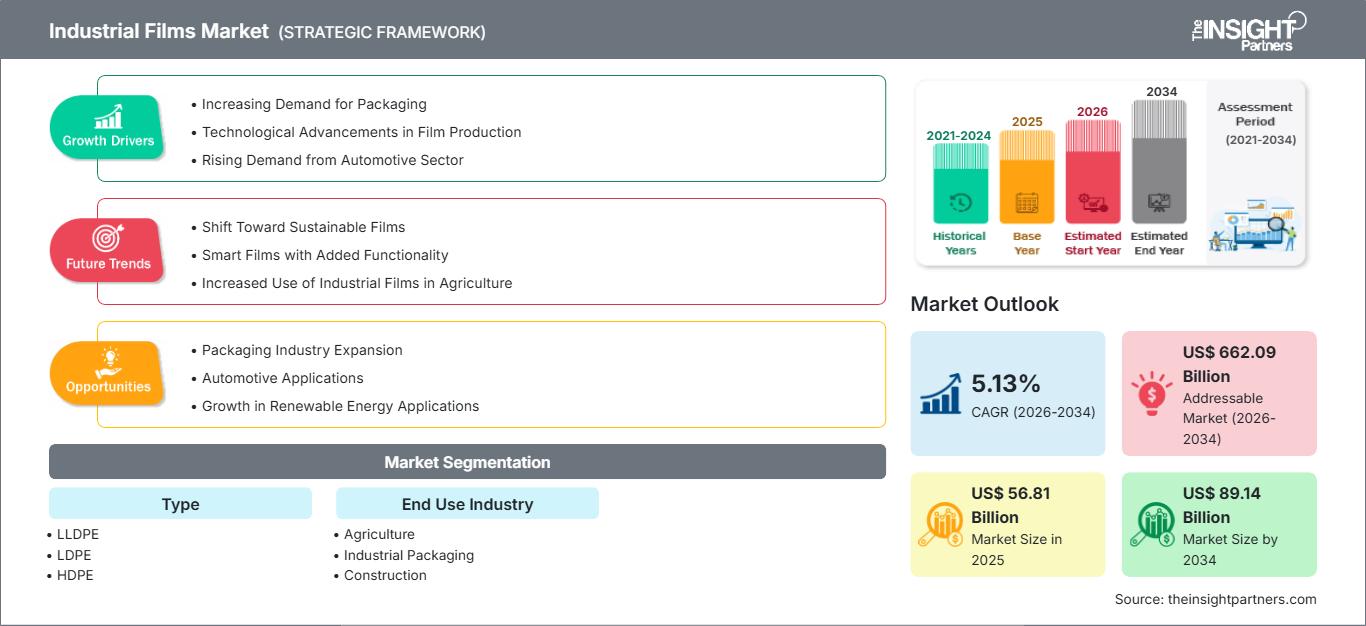
2025 Market Size
US$ 56.81 Bn
Base year value
2034 Forecast
US$ 89.14 Bn
Projected by 2034
CAGR 2026-2034
5.13 %
Growth rate
Addressable Market
US$ 662.09 Bn
(2026-2034)
The industrial films market was valued at US$ 56.81 Billion in 2025 and is projected to reach US$ 89.14 Billion by 2034, expanding at a CAGR of 5.13% during 2026–2034. Growth reflects sustained requirements for lightweight protective materials, high-performance packaging structures, agricultural films, construction membranes, and specialized films used in transportation and medical applications. Material engineering, downgauging, multilayer structures, and increasing demand for functional barrier properties are reshaping production priorities across major end-use industries.
North America industrial films market size remains an attractive regional market, supported by advanced packaging conversion infrastructure, agricultural film adoption, construction activity, and demand for technically differentiated materials. The region is estimated to expand at a 4.6–5.1% CAGR during 2026–2034, with recycling requirements, lightweighting initiatives, and investment in higher-performance film structures supporting value growth across established applications.
Industrial Films Market Assessment and Insights
- North America: The region represented a 24–28% share in 2025 and is projected to grow at a 4.6–5.1% CAGR between 2026–2034, supported by packaging conversion, construction membranes, agricultural applications, and specialized transportation films.
- US: The US accounted for 70–74% of North America's 2025 share and is expected to expand at a 4.5–5.0% CAGR between 2026–2034, led by packaging, agriculture, and industrial applications.
- Europe: Europe held a 22–26% share in 2025 and is expected to grow at a 4.3–4.9% CAGR between 2026–2034, with Germany, Italy, France, the UK, and Spain providing important demand centers.
- Asia Pacific: Asia Pacific represented a 39–43% share in 2025 and is forecast to grow at a 5.8–6.4% CAGR between 2026–2034, led by China, Japan, India, South Korea, and Australia.
- Largest Segment: LLDPE held a 18–22% market share in 2025 and is expected to grow at a 5.1–5.5% CAGR during 2026–2034, benefiting from strength, flexibility, and downgauging potential.
- High Growth Segment: Medical represented a 7–10% market share in 2025 and is expected to grow at a 6.2–6.8% CAGR during 2026–2034, driven by sterile packaging and healthcare consumables.
- Key companies analyzed in detail: Toyobo Co., Ltd., DuPont de Nemours, Inc., Tekra, LLC, Muraplast d.o.o., Transcendia, Inc., Mondi plc, RM TOHCELLO CO., LTD., FUJIFILM Corporation, Bogucki Folie Sp. z o.o., Toray Industries, Inc.
Source: The Insight Partners' analysis based on proprietary research, government publications, company annual reports, investor presentations, industry databases, and expert interviews.
The industrial films market has changed from films that are produced through commodity films to engineered films that give controlled thickness, puncture resistance, heat stability, optical characteristics, barrier properties, and better printability. The technologies of multilayer extrusion, biaxial orientation, surface treatment, and specialized coating have expanded the functionality of polyethylene, polyester, polypropylene, polyamide, and PVC films. Film producers have focused on downgauging without compromising the mechanical properties of the films.
In the future, industrial films market growth will be seen in the hands of companies that can merge efficiency of materials with recycling and functionality according to applications. Asia Pacific is likely to remain a key region for production and consumption. On the other hand, the regions of North America and Europe will focus more on the use of higher-value films, circular economy, and compliance.
Industrial Films Market Report Scope
| Report Attribute | Details |
|---|---|
| Market size in 2025 | US$ 56.81 Billion |
| Market Size by 2034 | US$ 89.14 Billion |
| Global CAGR (2026 - 2034) | 5.13% |
| Historical Data | 2021-2024 |
| Forecast period | 2026-2034 |
Industrial Films Market Analysis
The industrial films market growth will be driven by the demand for lightweight materials that offer protection against moisture, mechanical stress, insulation properties, surface protection, and efficiency during handling. Packaging converters will continue to play a key role in the value chain, but agricultural producers, construction contractors, medical suppliers, and transportation equipment manufacturers will diversify the demand further. Resin providers will impact prices by having different sources of polyethylene, polypropylene, PET, PVC, and polyamide, while film converters will impact performance in terms of extrusion, orientation, coating, printing, and lamination abilities.
Increasingly, supply-side considerations will be based on resin prices, energy use, equipment efficiency, and size of converters. Large converters will have an advantage in terms of cost optimization through economies of scale, but specialists will rely more on customized specifications and speed. Availability of recycled resins may become another supply consideration since quality can impact the look, strength, sealability, and legality of film production.
Competitors in the industrial films market report highlights the global diversified manufacturing firms with film converters specialized in particular applications. Toyobo Co., Ltd. and Toray Industries, Inc. concentrate on high performance polyester films and functional films, whereas DuPont de Nemours, Inc. is active in specialized film-related materials and applications. Mondi plc is combining flexible packaging technology with sustainability-driven solutions, while FUJIFILM Corporation concentrates on technologically complex film and functional material applications. Tekra, LLC, Muraplast d.o.o., Transcendia, Inc., RM TOHCELLO CO., LTD., and Bogucki Folie Sp. z o.o. enhance competition via specialization in conversion, coating, and application technologies.
Investment is being shifted to broader production lines, advanced coating technologies, multi-layer structures, recycling-friendly designs, and specific applications-based products. Positioning is becoming less dependent on mere film capacity and more on qualification ability, product uniformity, customer integration, geographical closeness, and resin versatility. The producers capable of reducing the amount of material used in their products will be well positioned to preserve profit margins as their customers pursue the twin goals of cost cutting and sustainability.
● REPORT CUSTOMIZATION
Tailor This Report To Align With Your Specific Business Requirements
This report can be customized to align precisely with your business objectives, scope, and target markets. Customization options include tailored segmentation, geography, competitive analysis, and strategic insights to support informed decision-making.
Customize This Report →WHAT YOU CAN ADJUST
- ● Segmentations
- ● Geography
- ● Competitive Analysis
- ● Language Preferences
Industrial Films Market: Strategic Insights
Regional Insights
North America industrial films market
North America had a industrial films market share of 24–28% in 2025 and is expected to experience CAGR of 4.6–5.1% during 2026–2034. Dominant market share comes from the United States, thanks to advanced technology of flexible packaging conversion, substantial agricultural activity, construction applications, and specific industrial manufacturing. Canada participates through packaging of food, agriculture, construction, and resource-related applications, while Mexico leverages manufacturing integration and exports.
Regional demand tends to be driven by lightweighting, downgauging, and sustainable packaging structures. Film producers improve their products by enhancing sealing properties, barriers, puncture resistance, and multi-layer structures in order to respond to converters' needs. Agricultural films benefit from controlled environment cultivation and crop protection methods. Applications for construction include vapor barriers, membranes for insulation, protective covers, and geomembranes. Infrastructure maturity and technological manufacturing ensure value growth, while fluctuations of resin prices should not be overlooked as well.
U.S. industrial films Market
The US represented 70–74% of the North American share in 2025 and is expected to expand at a 4.5–5.0% CAGR during 2026–2034. Its scale is supported by extensive packaging conversion, agricultural film consumption, construction activity, medical manufacturing, and transportation production. Domestic producers and international suppliers maintain established relationships with converters and industrial customers.
There is an evolution in design toward thinner materials that will have better properties in terms of their strength, barrier, sealability, and recyclability. The needs of the medical field will be enhanced by sterilization packaging and clean room manufacturing conditions. Applications in the transportation field will take advantage of films that will provide protection, insulation, surface finishes, and functionality related to components. Company involvement will include film makers and specialty converters worldwide.
Europe industrial films Market
In 2025, Europe held a market share of 22–26%, and the region's market share is expected to grow at a CAGR of 4.3–4.9% between 2026 and 2034. Germany emerges as a key manufacturing hub due to applications in automotive, industrial packaging, machinery, and chemical processing. The UK continues to be relevant for packaging, healthcare, agriculture, and construction films, and France sees the combination of food packaging, agriculture, and industrial use. Italy has capabilities in converting and machinery, and Spain leverages agriculture and flexible packaging.
The regulatory framework pushes towards redesign of recyclable and efficient structures. EU's Packaging and Packaging Waste Regulation defines recyclability and recycled content targets for plastics packaging, thus making the material selection, mono-material construction, and recycling-friendly design more critical. Germany is a leading country due to its manufacturing presence, while Italy and France contribute with converters and packaging sectors. Competitiveness among manufacturers is defined by the amount of material used, its barrier properties, and compliance level.
APAC industrial films Market
APAC held a 39–43% share in 2025 and is expected to grow at a 5.8–6.4% CAGR during 2026–2034, making it the largest regional market. China leads regional demand, followed by Japan, India, South Korea, and Australia. Expanding packaging conversion, agriculture, construction, electronics, and transportation manufacturing support broad film consumption.
The country has large-scale production and a significant level of demand for downstream products, while Japan and South Korea are focused on functionality and performance of films. India has advantages owing to packaging of foods, agriculture, construction, and manufacturing activities. Australia ensures demand for its products in agriculture, construction, and industrial packaging. Policy initiatives are increasingly aimed at resource efficiency and local manufacturing.
Middle East & Africa industrial films Market
Middle East and Africa demand is projected to expand at a 5.0–5.6% CAGR during 2026–2034. Saudi Arabia leads regional development through industrial diversification and infrastructure investment, while the UAE supports packaging, logistics, construction, and manufacturing applications. South Africa remains an important African production and conversion center.
The use of films is backed up by food security, agricultural use, construction film uses, and industrial packaging. Petrochemicals in the region offer access to polyethylene and polypropylene resins, especially in the Gulf area. Projects to develop infrastructure and food security will boost the demand for agriculture and construction films. But suppliers in the region will have to contend with risks related to imports, resin prices, recycling infrastructure, and regulations.
Segmentation Analysis
Type
The Type segment is expected to expand at a 5.0–5.4% CAGR during 2026–2034. Demand is influenced by resin economics, mechanical performance, optical properties, barrier requirements, processing compatibility, and recyclability. Polyethylene grades remain fundamental for flexible and protective applications, while PET, PP, PVC, and polyamide support more demanding functional requirements. Material substitution increasingly depends on achieving performance with lower film thickness.
- LLDPE: Strong flexibility, puncture resistance, and downgauging potential support broad adoption in packaging, agricultural, and industrial applications. Its processing balance makes it strategically important for converters seeking material efficiency.
- LDPE: Demand remains concentrated in applications requiring flexibility, transparency, sealing performance, and low-temperature toughness, particularly packaging and agricultural films where ease of processing remains important.
- HDPE: High stiffness, strength, and chemical resistance support industrial packaging, construction, and specialized protective applications. Its performance profile makes it valuable where rigidity and durability are prioritized.
- PET/BOPET: High tensile strength, dimensional stability, transparency, and barrier capability support technically demanding packaging and industrial structures. It remains important for applications requiring consistent processing and premium surface properties.
- PP/BOPP: Strong clarity, stiffness, moisture resistance, and efficient conversion support packaging demand. BOPP is strategically relevant for lightweight structures requiring high productivity and attractive print surfaces.
- CPP: Heat sealability, flexibility, and compatibility with laminated structures support packaging applications. Demand is closely linked to converter requirements for reliable sealing and high-speed processing.
- PVC: Chemical resistance, flexibility, and established processing infrastructure support selected construction, industrial, and specialty applications, although sustainability considerations increasingly influence material-selection decisions.
- Polyamide/BOPA: High toughness, puncture resistance, and gas-barrier performance support demanding packaging structures. Its strategic role is strongest where mechanical protection and barrier performance must coexist.
End Use Industry
The End Use Industry segment is projected to grow at a 5.1–5.5% CAGR during 2026–2034. Demand is diversified across packaging, agriculture, construction, healthcare, and transportation. Packaging provides scale, while medical and transportation applications offer higher-value opportunities requiring tighter specifications. Regulatory requirements, material efficiency, product protection, and application-specific qualification remain central to purchasing decisions.
- Agriculture: Films support greenhouse cultivation, mulching, silage, and crop protection by managing moisture, temperature, weeds, and exposure. Demand is strategically linked to productivity improvement and controlled-environment agriculture.
- Industrial Packaging: Heavy-duty wrapping, liners, pallet protection, and flexible industrial formats require durability, sealing performance, and efficient material use. Automation and logistics optimization reinforce demand for consistent film quality.
- Construction: Films provide moisture control, protection, insulation-related functions, and temporary covering. Infrastructure expansion and energy-efficiency requirements support continued adoption of technically specified film structures.
- Medical: Sterile packaging, protective barriers, and healthcare consumables require controlled materials, consistent thickness, cleanliness, and sealing performance. Qualification requirements create higher entry barriers and support specialized suppliers.
- Transportation: Films are used for surface protection, insulation, component protection, and specialized manufacturing processes. Vehicle lightweighting and increasing material complexity support demand for engineered film solutions.
Opportunity Snapshot
| End Use Industry | Revenue Contribution | Trend Tag | Adoption Stage |
| Agriculture | Medium | Crop Protection | Scaling |
| Industrial Packaging | High | Load Protection | Mature |
| Construction | Medium | Moisture Barrier | Mature |
| Medical | Medium | Sterile Barrier | Scaling |
| Transportation | Medium | Surface Protection | Scaling |
Industrial Films Market Growth Drivers and Impact Analysis
Expansion of lightweight and flexible packaging structures
Packaging converters increasingly prioritize material efficiency because film weight directly affects transportation, storage, and packaging economics. Downgauging is therefore becoming an important design objective, provided strength, sealability, puncture resistance, and barrier performance remain within customer specifications. Multilayer structures enable converters to assign specific functions to individual layers, reducing unnecessary material use while maintaining product protection. This creates opportunities for producers with advanced extrusion, orientation, and coating capabilities. The impact extends beyond food packaging into industrial goods, e-commerce, consumer products, and healthcare. Suppliers that demonstrate consistent film performance at lower thicknesses can strengthen customer relationships and improve equipment utilization. At the same time, downgauging increases technical qualification requirements, making process control and formulation expertise increasingly important competitive capabilities across the value chain.
Growth of controlled-environment and protected agriculture
Agricultural films are increasingly used as productivity-enhancing inputs rather than simple protective coverings. Greenhouse films, mulch films, silage films, and related structures can influence moisture retention, temperature management, weed control, crop protection, and storage efficiency. Adoption is particularly relevant where producers face water constraints, variable weather, or pressure to improve yield from limited land resources. Demand therefore depends on agricultural investment, crop economics, irrigation availability, and the expansion of protected cultivation. Film manufacturers can capture value through ultraviolet stabilization, infrared management, anti-drip properties, improved durability, and application-specific formulations. The resulting opportunity extends across developed agricultural markets and emerging production regions. As farmers and agribusinesses increasingly evaluate inputs according to productivity and resource efficiency, technically differentiated films can command stronger strategic importance than basic commodity structures.
Rising requirements for healthcare and high-specification films
Healthcare manufacturing places stringent requirements on film cleanliness, consistency, barrier properties, seal integrity, and traceability. Growth in sterile packaging, diagnostic products, medical consumables, and pharmaceutical distribution increases demand for materials that can perform reliably under controlled production conditions. Unlike commodity packaging, medical applications frequently require customer qualification, validated processing, and documented material performance, creating higher barriers to entry. This favors suppliers with strong quality systems and specialized converting capabilities. Demand also encourages development of films with improved puncture resistance, transparency, controlled friction, and compatibility with sterilization processes. As healthcare supply chains become more sophisticated, film producers can strengthen market positions through application engineering and long-term qualification programs. The commercial impact is therefore likely to be greater in value terms than would be indicated by volume growth alone.
Industrial Films Market Future Trends
Recyclability-led redesign of multilayer film structures
The industrial films market trends are moving toward structures designed around end-of-life recovery rather than performance alone. Converters are evaluating mono-material polyethylene and polypropylene structures, compatible coatings, simplified laminations, and recycled-content integration. The objective is to preserve barrier, sealing, strength, and printability while improving sorting and recycling compatibility. This shift will encourage resin suppliers, film producers, adhesive manufacturers, and converters to collaborate earlier during product development. It will also increase demand for formulations that tolerate recycled feedstocks without unacceptable changes in appearance or mechanical properties. Regulatory requirements in Europe are accelerating this direction, while multinational brand owners are extending packaging specifications across regions. Over time, product development is likely to emphasize design-for-recycling metrics alongside traditional film performance measures.
Functional films for electrification and advanced manufacturing
Demand for specialized films is likely to expand beyond conventional packaging as electrification, electronics manufacturing, and advanced industrial processes increase. High-temperature insulation, battery-related separator structures, release films, optical films, protective layers, and specialized processing films require precise thickness control and highly consistent surface characteristics. Producers with coating, orientation, and polymer-engineering expertise can move toward higher-value applications where qualification cycles are longer but customer relationships are more durable. Automotive electrification can support demand for films used in battery and electrical systems, while semiconductor manufacturing creates requirements for ultra-clean and dimensionally stable materials. This transition should gradually diversify revenue away from purely packaging-oriented applications and increase the strategic value of proprietary formulations, surface treatment technologies, and application-specific technical support.
Industrial Films Market Opportunities
Developing recycling-compatible specialty film portfolios
The industrial films market scope creates an opportunity for producers to develop recyclable specialty structures that retain the performance expected from conventional multilayer films. Investment can focus on compatible polymers, barrier coatings, recycled-content formulations, and processing technologies that maintain strength and sealing characteristics. Suppliers can target brand owners and converters facing regulatory deadlines by offering qualification-ready structures rather than isolated resin solutions. Commercial success will depend on proving performance across actual packaging lines, demonstrating consistent recycled-content quality, and supporting customers with material-conversion expertise. Partnerships across resin producers, converters, recyclers, and equipment suppliers can reduce development cycles. Companies able to combine circularity with reliable processing may gain preferred-supplier status in applications where customers need measurable improvements without compromising line speed or product protection.
Building regional production platforms in high-growth economies
industrial films market Forecasts indicate that investment opportunities will increasingly emerge in countries where packaging conversion, manufacturing, agriculture, and infrastructure are expanding simultaneously. India, Southeast Asia, selected Middle Eastern economies, and parts of Latin America offer potential for localized film production because proximity reduces transportation costs and improves responsiveness to converters. Regional facilities can also reduce exposure to international logistics disruptions and allow producers to tailor grades to local applications. Investment decisions should prioritize resin availability, converter density, energy costs, technical labor, export connectivity, and recycling infrastructure. Joint ventures or technology partnerships can provide a lower-risk entry route than wholly owned greenfield capacity. Producers with established application know-how can use these platforms to serve both domestic customers and nearby export markets.
Recent Developments
- August 2026: Godrej Industries Group unveiled new brand film: 'At Godrej Industries, We craft'
- April 2026: Dai Nippon Printing Co., Ltd. (DNP) announced that it will begin mass production in April 2026 of a new decorative film for automotive displays. The new decorative film combines high-quality design features, such as woodgrain patterns, with advanced optical performance that enables clear display of images and icons only when required.
Frequently Asked Questions

- Comprehensive Market Sizing and Forecast Analysis
- Detailed Segmentation Analysis
- In-Depth Market Dynamics Assessment
- Regional and Country-Level Insights
- Competitive Landscape and Company Benchmarking
- Strategic Business Intelligence
Recent Reports
Testimonials

The Insight Partners' SCADA System Market report is comprehensive, with valuable insights on current trends and future forecasts. The team was highly professional, responsive, and supportive throughout. We are very satisfied and highly recommend their services.
RAN KEDEM Partner, Reali Technologies LTDs
I requested a report on a very specific software market and the team produced the report in a few days. The information was very relevant and well presented. I then requested some changes and additions to the report. The team was again very responsive and I got the final report in less than a week.
JEAN-HERVE JENN Chairman, Future Analytica
We worked with The Insight Partners for an important market study and forecast. They gave us clear insights into opportunities and risks, which helped shape our plans. Their research was easy to use and based on solid data. It helped us make smart, confident decisions. We highly recommend them.
PIYUSH NAGPAL Sr. Vice President, High Beam Global
The Insight Partners delivered insightful, well-structured market research with strong domain expertise. Their team was professional and responsive throughout. The user-friendly website made accessing industry reports seamless. We highly recommend them for reliable, high-quality research services
YUKIHIKO ADACHI CEO, Deep Blue, LLC.
This is the first time I have purchased a market report from The Insight Partners.While I was unsure at first, I visited their web site and felt more comfortable to take the risk and purchase a market report.I am completely satisfied with the quality of the report and customer service. I had several questions and comments with the initial report, but after a couple of dialogs over email with their analyst I believe I have a report that I can use as input to our strategic planning process.Thank you so much for taking the extra time and making this a positive experience.I will definitely recommend your service to others and you will be my first call when we need further market data.
JOHN SUZUKI President and Chief Executive Officer, Board Director, BK Technologies
I wish to appreciate your support and the professionalism you displayed in the course of attending to my request for information regarding to infectious disease IVD market in Nigeria. I appreciate your patience, your guidance, and the fact that you were willing to offer a discount, which eventually made it possible for us to close a deal. I look forward to engaging The Insight Partners in the future, all thanks to the impression you have created in me as a result of this first encounter.
DR CHIJIOKE ONYIA MANAGING DIRECTOR, PineCrest Healthcare Ltd.Reason to Buy
- Informed Decision-Making
- Understanding Market Dynamics
- Competitive Analysis
- Identifying Emerging Markets
- Customer Insights
- Market Forecasts
- Risk Mitigation
- Boosting Operational Efficiency
- Strategic Planning
- Investment Justification
- Tracking Industry Innovations
- Aligning with Regulatory Trends





 Get Free Sample for