
Industrial Gearbox Market Size, Demand & Growth by 2034
Coverage: by Type (Standard Gearbox, and Precision Gearbox); Application (Power generation, Agriculture, Construction & Mining Equipment, General machinery, and others), and Geography (North America, Europe, Asia Pacific, and South and Central America)
- Status : Data Released
- Report Code : TIPTE100001355
- Category : Manufacturing and Construction
- No. of Pages : 150
- Available Report Formats :


- Last update date : August 28, 2026


2025 Market Size
US$ 32.54 Bn
Base year value
2034 Forecast
US$ 46.73 Bn
Projected by 2034
CAGR 2026-2034
4.10 %
Growth rate
Addressable Market
US$ 359.96 Bn
(2026-2034)
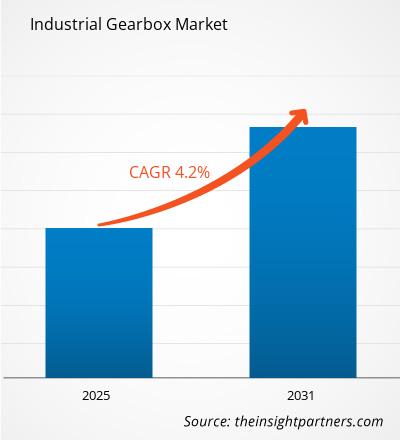
The industrial gearbox market was valued at US$ 32.54 Billion in 2025 and is projected to reach US$ 46.73 Billion by 2034, registering a CAGR of 4.10% during 2026–2034. Demand reflects the essential role of enclosed gear systems in converting speed and torque across power generation, agriculture, construction and mining equipment, and general machinery, while replacement cycles support a dependable aftermarket alongside expenditure on new production capacity.
Across North America, the industrial gearbox market size expansion is expected to track a 3.6–4.2% CAGR through 2034. Factory reshoring, expanding data-driven maintenance, and replacement of aging conveyor and processing assets are principal contributors. The region also benefits from local engineering support for mining, bulk handling, food processing, and energy installations, where lifecycle reliability and rapid service response carry greater purchasing weight than initial equipment cost.
Industrial Gearbox Market Assessment and Insights
- North America: Accounted for a 24–27% share in 2025 and is projected to record a 3.6–4.2% CAGR between 2026–2034, supported by equipment replacement, domestic manufacturing investment, and service-intensive process industries.
- US: Represented 76–80% of North American revenue in 2025, with a 3.7–4.3% CAGR between 2026–2034, led by automation and energy infrastructure renewal.
- Europe: Held a 26–29% share in 2025 and is expected to expand at a 3.4–4.0% CAGR between 2026–2034, with Germany, the UK, Italy, and France leading engineered-drive demand.
- Asia Pacific: Captured a 38–42% share in 2025 and is forecast to grow at a 4.7–5.3% CAGR between 2026–2034, underpinned by China, Japan, India, and South Korea.
- Largest Segment: Standard Gearbox held a 70–74% market share in 2025 and is projected to expand at a 3.7–4.3% CAGR during 2026–2034.
- High Growth Segment: Precision Gearbox represented a 26–30% market share in 2025 and is forecast to register a 5.0–5.6% CAGR during 2026–2034.
- Key companies analyzed in detail: Bonfiglioli S.p.A., Essential Power Transmission Pvt. Ltd., Sumitomo Heavy Industries, Ltd., Nanjing High Speed Gear Manufacturing Co., Ltd., Griffin Gear, Inc., Cleveland Gear Company, Inc., Flender International GmbH, SEW-EURODRIVE GmbH & Co KG, Getriebebau NORD GmbH & Co. KG, and ZOLLERN GmbH & Co. KG.
Source: The Insight Partners' analysis based on proprietary research, government publications, company annual reports, investor presentations, industry databases, and expert interviews.
This product classification has transitioned from mechanically efficient, mostly isolated reducers to flexible drive packages interfaced with sensors, controls, and lifecycle services. Advancements in tooth design, heat treatments, bearing selection, sealing, and lubrication have helped boost torque density whereas digital engineering has reduced configuration time. Manufacturing has become more modular as vendors integrate standard housing and gear stages with custom-designed shafts, cooling, surface treatments, and sensors to accommodate lead-time reduction and technical requirements of mills, conveyors, crushers, turbines, mixers, and production automation.
Until 2034, expansion will move beyond traditional industrial hubs due to the development of processing facilities, logistics infrastructure, energy generation, and construction in India, Southeast Asia, the Gulf countries, and certain African countries. The improvement of efficiency standards in motor drives and the whole drive system will promote right sizing and efficient gearing. Projects for renewable generation, water supply and treatment facilities, and mineral processing should ensure sufficient demand for engineered products; local assembly and services will become crucial in regions with lengthy logistics chains and emphasis on reliability.
Industrial Gearbox Market Report Scope
| Report Attribute | Details |
|---|---|
| Market size in 2025 | US$ 32.54 Billion |
| Market Size by 2034 | US$ 46.73 Billion |
| Global CAGR (2026 - 2034) | 4.10% |
| Historical Data | 2021-2024 |
| Forecast period | 2026-2034 |
Industrial Gearbox Market Analysis
The expansion of the industrial gearbox market is built on capital expenditures related to automation, bulk material handling systems, renewable energy generation, and drive replacements. The consideration of total cost of ownership becomes more relevant now, since inadequate gearbox will affect capacity and incur higher electrical, lubrication, and maintenance costs. Orders originate from end-users through OEMs, engineers, distributors, and servicing professionals, resulting in multiple specification opportunities until the purchase is made.
Upstream requirements include alloy steels, casting housings, bearings, seals, oils, motors, sensors, and machining. Long lead time is associated with large forgings and custom internals. Modular manufacturing, regional stock, and remanufacturing minimize this threat, while service centers gain from ongoing services including inspections, alignment, lubricant analysis, rebuilding, and emergency replacements.
According to the industrial gearbox market forecast, this is a highly fragmented industry, where platform providers work alongside regional engineering firms. The main competitors in the market are Flender International GmbH, SEW-EURODRIVE GmbH & Co KG, Bonfiglioli S.p.A., Sumitomo Heavy Industries, Ltd., and Getriebebau NORD GmbH & Co. KG.
Nanjing High Speed Gear Manufacturing Co., Ltd. has strong exposure to high-torque and wind applications, while Griffin Gear, Inc., Cleveland Gear Company, Inc., Essential Power Transmission Pvt. Ltd., and ZOLLERN GmbH & Co. KG differentiate through custom engineering, repair capability, and demanding niches. Investment priorities include connected condition monitoring, localized assembly, automated machining, and standardized platforms that preserve customization without extending delivery schedules.
● REPORT CUSTOMIZATION
Tailor This Report To Align With Your Specific Business Requirements
This report can be customized to align precisely with your business objectives, scope, and target markets. Customization options include tailored segmentation, geography, competitive analysis, and strategic insights to support informed decision-making.
Customize This Report →WHAT YOU CAN ADJUST
- ● Segmentations
- ● Geography
- ● Competitive Analysis
- ● Language Preferences
Industrial Gearbox Market: Strategic Insights

Regional Insights
North America industrial gearbox market
The region held 24–27% of global industrial gearbox market share in 2025 and is expected to expand at a 3.6–4.2% CAGR through 2034. Its share reflects a large installed base in food processing, mining, aggregates, pulp and paper, chemicals, water infrastructure, and power generation. Reshoring projects and warehouse automation create new-unit demand, while aging assets sustain replacement and rebuild activity.
The procurement process is more inclined to reliability, compatibility with field service, and performance of energy. Mining and processing in Canada, manufacturing in Mexico, and automation in the US will diversify the market. Module inventories located regionally can help reduce time periods during which production is stopped, whereas module equipped with sensors will enable predictive maintenance where there are no workers available. It is also a vulnerable market in terms of commodity cycles.
U.S. Industrial Gearbox Market
The US generated 76–80% of North American revenue in 2025 and is projected to grow at a 3.7–4.3% CAGR through 2034. Domestic consumption includes conveyor systems, pumps, crushers, mixers, packaging machines, machine tools, and power generators. The capital investment into semiconductors, batteries, metals and logistic facilities is needed to produce precise and standardized units, whereas mining and aggregates require high torque and shock resistant units.
The companies that can be considered in terms of supplying the relevant product or services include Flender International GmbH, Sumitomo Heavy Industries, Ltd., SEW-EURODRIVE GmbH & Co KG, Getriebebau NORD GmbH & Co. KG, Griffin Gear, Inc. and Cleveland Gear Company, Inc. There is a growing tendency for specifying condition monitoring, easily replaced modules and increased efficiency combination of motors and variable speed drives.
Europe Industrial Gearbox Market
Europe accounted for a 26–29% Industrial Gearbox Market share in 2025 and is forecast to register a 3.4–4.0% CAGR through 2034, with Germany leading. Germany has access to highly developed machinery, automation, chemicals, and drive-engineering technology. German manufacturing installed base favors effective, flexible gearboxes and services-oriented retrofitting. The UK relies on water, food, offshore energy, and material handling investments where reliability and conformity affect choice.
France enjoys the synergy of aerospace-oriented machinery, food, water, and energy uses. Italy brings in packaging, machine tools, ceramics, and process systems, while Spain provides renewables, logistics, cement, and water facilities. European eco-design considerations favor overall efficiency and size optimization in lieu of components alone purchasing. Growth is conservative due to the predominance of the installed base, yet modernization, electrification, and digital maintenance generate ongoing demand in the top five countries.
APAC Industrial Gearbox Market
Asia Pacific held a 38–42% share in 2025 and is projected to post a 4.7–5.3% CAGR through 2034, with China remaining the leading country. Scale in machinery, steel, cement, logistics, wind equipment, and factory automation supports broad demand, while domestic supply chains improve availability and price competitiveness.
Japan and South Korea emphasize precision, robotics, and advanced machinery. India is expanding through manufacturing, mining, infrastructure, and renewable-energy investment, while Australia contributes mining and bulk handling. Industrial policy, localization incentives, and capacity additions favor both standard and high-accuracy drives.
Middle East & Africa Industrial Gearbox Market
The Middle East and Africa is expected to grow at a 3.8–4.4% CAGR through 2034. Saudi Arabia leads through mining, water, metals, construction materials, and industrial diversification, while the UAE supports ports, logistics, water treatment, and downstream processing.
South Africa anchors mining, minerals processing, power, and heavy industry. The Rest of MEA offers selective opportunities in cement, agriculture, utilities, and transport infrastructure. Harsh operating conditions elevate demand for robust sealing, cooling, coatings, and local maintenance support.
Segmentation Analysis
Type
The Type segment is projected to expand at a 4.0–4.6% CAGR during 2026–2034. The industrial gearbox market scope spans standardized reducers for repeatable industrial duties and precision units for tightly controlled motion. Purchasers balance torque, backlash, duty cycle, footprint, efficiency, noise, environmental protection, and serviceability, making modularity important across both categories. Precision demand rises faster, although standard gearboxes retain the larger installed base.
- Standard Gearbox: These units dominate conveyors, pumps, fans, mixers, and general machinery because proven architectures, broad ratio availability, interchangeable mounting options, and established service channels reduce specification and ownership risk.
- Precision Gearbox: Low-backlash, high-stiffness units are strategically important for robotics, machine tools, semiconductor equipment, and automated positioning, where repeatability, compact torque density, and servo compatibility justify higher engineering content.
Application
The Application segment is expected to grow at a 3.9–4.5% CAGR during 2026–2034. Demand differs sharply by load profile and operating environment. Power generation rewards reliability and torque density; agriculture prioritizes ruggedness and affordability; construction and mining require shock tolerance; general machinery values configuration speed and availability. Suppliers able to reuse modular cores while tailoring lubrication, cooling, shafts, seals, and controls can address these sectors economically.
- Power Generation: Wind, thermal, hydro, and auxiliary plant systems require durable drives with high availability, condition monitoring, and engineered lubrication, making lifecycle service and validated reliability central to vendor selection.
- Agriculture: Feed systems, irrigation, handling, and processing equipment favor compact, cost-effective gearboxes that tolerate dust, variable loads, seasonal utilization, and limited maintenance access across distributed operating locations.
- Construction & Mining Equipment: Crushers, conveyors, excavating systems, and mobile machinery demand high torque, shock resistance, contamination protection, and field repairability, creating strong aftermarket and remanufacturing potential.
- General Machinery: Packaging, material handling, pumps, mixers, and production equipment sustain broad volume through standardized interfaces, rapid configuration, energy efficiency, and compatibility with motors, inverters, and automation controls.
Opportunity Snapshot
| Application | Revenue Contribution (High/Medium/Low) | Trend Tag | Adoption Stage (Emerging/Scaling/Mature) |
| Power Generation | High | Wind Uptime | Scaling |
| Agriculture | Medium | Farm Automation | Scaling |
| Construction & Mining Equipment | High | Heavy Torque | Mature |
| General Machinery | High | Modular Drives | Mature |
Industrial Gearbox Market Growth Drivers and Impact Analysis
Automation raises the value of reliable motion control
Automation of the factory raises both the quantity and complexity of the geared axes used in conveyors, robots, palletizers, machine tools, packaging machines, and process machinery. Increased usage leads to each drive having many cycles and the cost of downtime rises, resulting in the design requirements of efficient gearing, reduced backlash, thermal stability, and information about condition. The effect is not only limited to new installations; retrofitting existing lines needs drives that have the same footprints but interface with the latest motor technology, inverters, and controls. The supplier gains from having modular offerings that include many ratio options and mounting configurations without having to change the design too much. The best commercial position is held by those suppliers who offer mechanical components with software selection, application engineering, modules, and quick service.
Energy and infrastructure projects sustain high-torque demand
Investments in wind energy, water treatment, mining, concrete, port, and bulk handling will foster demand for high-quality gearbox systems running under highly variable loading and operating conditions. The projects will call for an engineered system of lubrication, cooling, seals, bearings, and condition monitoring of reducers instead of simple reducers. In the case of wind energy projects, there is an opportunity for designing torque-dense drives and service of these units, whereas water and wastewater treatment plants will employ gearboxes in pumps, aerators, screens, and sludge management operations. The mining industry and infrastructure projects will need conveyors, crushers, stackers, reclaimers, and hoists. The cycles may be irregular; however, the resulting installed base creates a sustainable source of income.
Lifecycle economics accelerate replacement of aging assets
Numerous manufacturing plants in the Industrial Gearbox Market continue to run gearboxes after their initial designed life span, with leakage, bearings, misalignment, vibration, heating, and inefficient gear systems becoming more expensive. This has made replacement of gearbox more focused on energy usage, probability of failure, spares availability, and shutdowns rather than as a necessity. A new gearbox can offer savings in losses, greater heat capacity, sealing, and sensing, among other benefits, but customers also need to match their size specifications in order to avoid making any structural changes. This situation has opened the way for the adoption of replacement, standardization of retrofit packages, and forensic services. Remanufacturing of gearbox has been boosted by the fact that the housing remains intact.
Industrial Gearbox Market Future Trends
Embedded intelligence becomes a standard option
The Industrial Gearbox Market trends will be moving towards embedding vibration, temperature, speed, and oil condition sensors in the drive, and connecting this data to edge analytics. Instead of selling monitoring as a standalone solution, manufacturers will integrate hardware, algorithms, dashboards, and services into the drive itself. This technology will initially be adopted by the most valuable equipment that must run all the time, and as the cost of the sensors and connections drops, it will be adopted in all machines. The quality of the data collected will be key because context is required to make good decisions.
Digital configuration reshapes engineered-to-order production
Digitally enabled twins, sizing algorithms, and rule-based configuration are likely to eliminate the differences between off-the-shelf and made-to-order gearboxes. The customer will provide details about application, power, speed, load, mounting, and environmental conditions, after which he or she would get validated choices, drawings, and performance specifications earlier on in the process. Internally, however, modular designs and automated manufacturing will make it possible for manufacturers to maintain application-specificity without incurring the usual engineering costs. Thus, competition will not be based merely on catalog depth, but on configuration accuracy, interoperable data exchange, and reliable deliveries. Manufacturers will use operational experience to adjust their design rules. Ultimately, digitally defined products will minimize replacement issues and facilitate virtual commissioning.
Industrial Gearbox Market Opportunities
Build regional service ecosystems for critical assets
Investors and manufacturers can capture recurring value by expanding repair, inspection, field alignment, oil analysis, spare-parts, and exchange-unit capabilities near mining, process, and infrastructure clusters. The opportunity is not merely geographic coverage. Service centers need application engineers, test capability, digital records, and access to interchangeable components so operators can shorten outages. Partnerships with distributors and independent maintenance providers may accelerate reach where greenfield facilities are uneconomic. A structured offering can segment customers by asset criticality and provide inspections, monitoring, planned rebuilds, and emergency response under multiyear agreements. This model improves revenue visibility while generating failure data that informs product upgrades and inventory allocation across the installed base.
Engineer compact drives for next-generation machinery
Machine builders increasingly need higher torque from smaller envelopes to reduce equipment mass, free design space, and improve energy productivity. Opportunity lies in advanced tooth geometry, stronger materials, optimized bearings, efficient lubrication, and integrated motor or servo interfaces. Precision gearbox suppliers can target robotics, semiconductor equipment, machine tools, and automated logistics, while heavy-duty specialists can apply torque-density gains to wind, mobile equipment, and bulk handling. Development programs should prioritize verifiable load capability, thermal performance, and manufacturability rather than headline compactness alone. Co-engineering with anchor customers can reduce qualification risk, establish reference applications, and create platform designs that scale across adjacent industries without sacrificing the reliability expected from industrial power transmission.
Recent Developments
- February 2026: Flender International GmbH – expanded its Flender One platform to cover all major industrial gearbox applications, including mixers, aerators, separators, and travel drives. The platform combines flexible mounting orientations, standardized footprints for retrofit, and rapid digital configuration, illustrating how modular engineering can reconcile individualized specifications with series-production economics
- February 2026: Sumitomo Heavy Industries, Ltd. – reported demonstration of its N-Series high-speed gearbox at the 2025 Turbomachinery & Pump Symposium in Houston. The company emphasized compactness, efficiency, low vibration, and low noise for generator and turbomachinery duties, reinforcing demand for specialized high-speed units where rotational stability and operating reliability are critical
Frequently Asked Questions

- Comprehensive Market Sizing and Forecast Analysis
- Detailed Segmentation Analysis
- In-Depth Market Dynamics Assessment
- Regional and Country-Level Insights
- Competitive Landscape and Company Benchmarking
- Strategic Business Intelligence
Recent Reports
Testimonials

The Insight Partners provided valuable market intelligence that supported our global go-to-market strategy. Their team was professional, responsive, and attentive to our feedback, providing thoughtful analysis and helpful methodological clarifications throughout the project.
Junmo Kim Chief Financial Officer (CFO), Enertech Co., Ltd.
The Insight Partners' SCADA System Market report is comprehensive, with valuable insights on current trends and future forecasts. The team was highly professional, responsive, and supportive throughout. We are very satisfied and highly recommend their services.
RAN KEDEM Partner, Reali Technologies LTDs
I requested a report on a very specific software market and the team produced the report in a few days. The information was very relevant and well presented. I then requested some changes and additions to the report. The team was again very responsive and I got the final report in less than a week.
JEAN-HERVE JENN Chairman, Future Analytica
We worked with The Insight Partners for an important market study and forecast. They gave us clear insights into opportunities and risks, which helped shape our plans. Their research was easy to use and based on solid data. It helped us make smart, confident decisions. We highly recommend them.
PIYUSH NAGPAL Sr. Vice President, High Beam Global
The Insight Partners delivered insightful, well-structured market research with strong domain expertise. Their team was professional and responsive throughout. The user-friendly website made accessing industry reports seamless. We highly recommend them for reliable, high-quality research services
YUKIHIKO ADACHI CEO, Deep Blue, LLC.
This is the first time I have purchased a market report from The Insight Partners.While I was unsure at first, I visited their web site and felt more comfortable to take the risk and purchase a market report.I am completely satisfied with the quality of the report and customer service. I had several questions and comments with the initial report, but after a couple of dialogs over email with their analyst I believe I have a report that I can use as input to our strategic planning process.Thank you so much for taking the extra time and making this a positive experience.I will definitely recommend your service to others and you will be my first call when we need further market data.
JOHN SUZUKI President and Chief Executive Officer, Board Director, BK Technologies
I wish to appreciate your support and the professionalism you displayed in the course of attending to my request for information regarding to infectious disease IVD market in Nigeria. I appreciate your patience, your guidance, and the fact that you were willing to offer a discount, which eventually made it possible for us to close a deal. I look forward to engaging The Insight Partners in the future, all thanks to the impression you have created in me as a result of this first encounter.
DR CHIJIOKE ONYIA MANAGING DIRECTOR, PineCrest Healthcare Ltd.Reason to Buy
- Informed Decision-Making
- Understanding Market Dynamics
- Competitive Analysis
- Identifying Emerging Markets
- Customer Insights
- Market Forecasts
- Risk Mitigation
- Boosting Operational Efficiency
- Strategic Planning
- Investment Justification
- Tracking Industry Innovations
- Aligning with Regulatory Trends





 Get Free Sample for