
Industrial Hydrogen Peroxide Market Trends, Demand & Growth by 2034
Coverage: By Grade (<35% and >35%), By Type (Disinfectant, Bleaching Agent, and Others), By Application (Pulp and Paper, Healthcare and Personal Care, Mining, Food Processing, Others), and Geography
- Status : Data Released
- Report Code : TIPRE00027541
- Category : Chemicals and Materials
- No. of Pages : 150
- Available Report Formats :


- Last update date : August 27, 2026


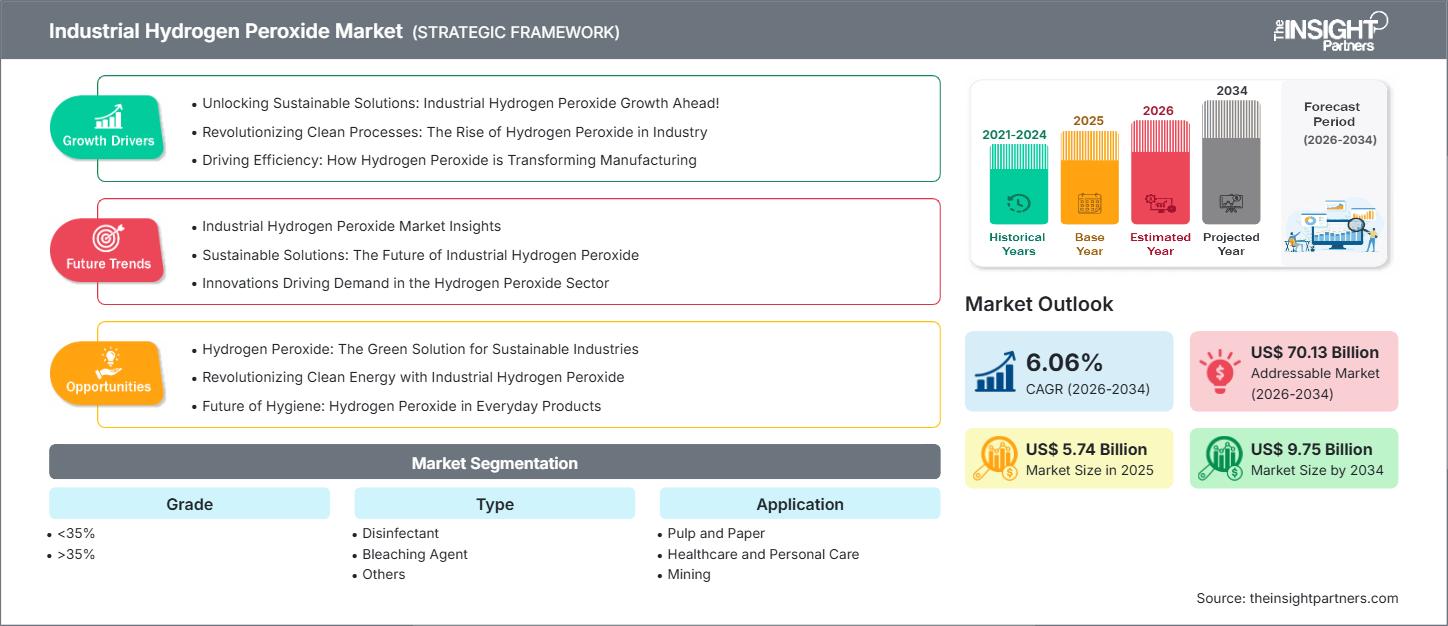
2025 Market Size
US$ 5.74 Bn
Base year value
2034 Forecast
US$ 9.75 Bn
Projected by 2034
CAGR 2026-2034
6.06 %
Growth rate
Addressable Market
US$ 70.13 Bn
(2026-2034)
The industrial hydrogen peroxide market was valued at US$ 5.74 Billion in 2025 and is projected to reach US$ 9.75 Billion by 2034, registering a CAGR of 6.06% during 2026–2034. The market is supported by demand for oxidation, bleaching, disinfection, and chemical processing applications, while investment in high-purity grades and localized supply systems is expanding its industrial relevance.
In North America, the industrial hydrogen peroxide market size is expected to expand at an estimated CAGR of 5.4–6.0% during 2026–2034. Structural demand is supported by established pulp processing, wastewater treatment, food sanitation, and specialty chemical manufacturing, while integrated on-site production can reduce transport constraints associated with concentrated peroxide solutions.
Industrial Hydrogen Peroxide Market Assessment and Insights
- North America: North America accounted for an estimated 27–31% share in 2025 and is expected to grow at a 5.4–6.0% CAGR between 2026–2034, supported by mature chemical infrastructure, wastewater treatment requirements, pulp processing, and rising adoption of localized supply arrangements.
- US: The US represented an estimated 78–84% of North American demand in 2025 and is projected to expand at a 5.5–6.1% CAGR during 2026–2034, supported by chemical processing, healthcare sanitation, food production, and environmental applications.
- Europe: Europe held an estimated 24–28% share in 2025 and is expected to grow at a 4.8–5.5% CAGR during 2026–2034. Germany, France, the UK, Italy, and Spain remain important consumption centers, although energy and competitiveness pressures influence production economics.
- Asia Pacific: Asia Pacific accounted for an estimated 34–38% share in 2025 and is projected to record a 6.8–7.6% CAGR during 2026–2034. China leads regional consumption, followed by Japan, South Korea, India, and Australia, supported by manufacturing and high-purity chemical demand.
- Largest Segment: Pulp and Paper represented an estimated 40–46% market share in 2025 and is projected to expand at a 5.2–6.0% CAGR during 2026–2034, supported by peroxide-based bleaching and brightness management across mechanical and chemical pulp operations.
- High Growth Segment: Mining accounted for an estimated 6–10% market share in 2025 and is anticipated to grow at a 7.5–8.5% CAGR during 2026–2034, driven by oxidation, remediation, and selected mineral-processing applications.
- Key companies analyzed in detail: Merck KGaA, Solvay SA, Dow Inc., BASF SE, Evonik Industries AG, Hawkins, Inc., Kemira Oyj, Aditya Birla Chemicals (India) Limited, Arkema SA, and Mitsubishi Gas Chemical Company, Inc.
Source: The Insight Partners' analysis based on proprietary research, government publications, company annual reports, investor presentations, industry databases, and expert interviews.
Production technology is increasingly shaped by integration with downstream chemical complexes and by demand for grades tailored to electronics, photovoltaic manufacturing, pulp bleaching, sanitation, and specialty oxidation. The industrial hydrogen peroxide market continues to rely primarily on anthraquinone-based production, but competitive differentiation increasingly depends on purification capability, concentration management, logistics infrastructure, and customer proximity. High-capacity facilities prefer integrated industrial clusters as hydrogen peroxide transportation costs grow with distance and concentration. The future will be impacted by the growth of the industrial sector in Asia, the development of semiconductor and solar industries, as well as investments in environmentally friendly oxidizers and bleaches. The growth of the new industrial hubs would facilitate capacity growth where there are reliable sources of hydrogen, utilities and offtake. Regulations aimed at reducing chlorine use, improving wastewater purity, food safety and chemicals management further stimulate the use of controlled oxidizers.
Industrial Hydrogen Peroxide Market Report Scope
| Report Attribute | Details |
|---|---|
| Market size in 2025 | US$ 5.74 Billion |
| Market Size by 2034 | US$ 9.75 Billion |
| Global CAGR (2026 - 2034) | 6.06% |
| Historical Data | 2021-2024 |
| Forecast period | 2026-2034 |
Industrial Hydrogen Peroxide Market Analysis
Demand expansion is linked to the chemical's ability to perform bleaching, oxidation, disinfection, and surface-treatment functions without generating persistent residues at the point of use. Pulp and paper remains a major demand center because peroxide supports brightness development in mechanical pulp and participates in chlorine-reduced bleaching sequences. The industrial hydrogen peroxide market growth outlook is also supported by wastewater treatment, food sanitation, chemical synthesis, and emerging high-purity applications.
Supply economics require the availability of feedstock, electricity, technology for the processes, systems for storing and distributing the output. Since the logistics, decompositions, and hazardous materials requirements restrict effective transport over long distances, producers gain from capacity proximity to big industrial consumers or building special supply systems. Such a situation provides advantages for integrated chemical complexes and long-term offtake agreements, and acts as a barrier to the entrance for those who lack logistics, purification, and safety management skills.
Competitiveness includes both diversified chemical groups and specialized active oxygen suppliers. Evonik Industries AG and Solvay SA have significant technology and applications, whereas Arkema SA joins through industrial peroxide technologies. BASF SE, Dow Inc., Merck KGaA, Kemira Oyj, Hawkins, Inc., Aditya Birla Chemicals (India) Limited, and Mitsubishi Gas Chemical Company, Inc. are included due to their diverse chemical portfolios, distribution skills, downstream expertise, or regional customer base.
Investment increasingly targets product purity, operational efficiency, customer proximity, and applications with higher technical requirements. Industrial hydrogen peroxide market analysis indicates that strategic positioning is shifting beyond commodity volume toward electronic-grade materials, photovoltaic processing, dedicated on-site supply, and lower-carbon production pathways. European chemical conditions remain challenging, with EU chemical capacity utilization at 74% in 2025, reinforcing the importance of selective capital allocation and differentiated applications.
● REPORT CUSTOMIZATION
Tailor This Report To Align With Your Specific Business Requirements
This report can be customized to align precisely with your business objectives, scope, and target markets. Customization options include tailored segmentation, geography, competitive analysis, and strategic insights to support informed decision-making.
Customize This Report →WHAT YOU CAN ADJUST
- ● Segmentations
- ● Geography
- ● Competitive Analysis
- ● Language Preferences
Industrial Hydrogen Peroxide Market: Strategic Insights
Regional Insights
North America Industrial Hydrogen Peroxide Market
North America accounted for an estimated 27–31% of the global Industrial Hydrogen Peroxide Market demand in 2025 and is projected to expand at a 5.4–6.0% CAGR during 2026–2034. The industrial hydrogen peroxide market share in the region is supported by established pulp, chemical, food-processing, healthcare, and environmental industries. Demand is particularly resilient where peroxide is integrated into continuous bleaching, oxidation, or sanitation operations, making supply reliability and storage infrastructure strategically important.
Growth in the region is becoming dependent on local manufacturing and logistics tailored to customers as opposed to the general expansion of commodities. The use of wastewater treatment and advanced oxidation is another potential avenue for growth in the industry, whereas the requirement of purity presents an opportunity in specialized manufacturing. The fact that North America has relatively more advanced infrastructure provides advantages for manufacturers in this region.
U.S. Industrial Hydrogen Peroxide Market
The US represented an estimated 78–84% of the North American Industrial Hydrogen Peroxide Market consumption in 2025 and is expected to register a 5.5–6.1% CAGR during 2026–2034. Demand is diversified across pulp and paper, chemical synthesis, food processing, healthcare sanitation, environmental treatment, and specialty manufacturing. The country also benefits from an extensive chemical production base and established suppliers, including Dow Inc., BASF SE, Hawkins, Inc., Evonik Industries AG, and Merck KGaA.
Application development increasingly centers on ensuring the supply security and efficiency of the process. Consumers with continual demand can be catered to using either the dedicated storage or on-site supply approach, which lowers the transportation intensity. The stability of the demand in industrial disinfection and food processing makes them an ideal market, with the advanced oxidation process supporting environmental cleanup. High-purity processing in electronic applications and specific chemical compounds is an important niche.
Europe Industrial Hydrogen Peroxide Market
Europe accounted for an estimated 24–28% of the Industrial Hydrogen Peroxide Market share in 2025 and is forecast to grow at a 4.8–5.5% CAGR during 2026–2034. Germany continues to be a top industrial market, with its chemical production, special processing, and technological infrastructure as the backbone of the economy. France and Italy also add their demands through chemicals, paper, food, and manufacturing applications. Meanwhile, Spain aids with its industrial processing and sanitization needs. However, the European market will be influenced by energy prices and the inconsistent usage of the industry.
The UK continues to have its demand through specialty chemicals, healthcare, food, environmental treatment, and advanced manufacturing. This means that the UK will keep on utilizing industrial oxidants. European chemical production totaled 224 million tonnes in 2024, although longer-term production remained below 2014 levels. These conditions encourage producers to prioritize efficient, high-value applications over undifferentiated capacity expansion.
APAC Industrial Hydrogen Peroxide Market
APAC accounted for an estimated 34–38% share in 2025 and is projected to grow at a 6.8–7.6% CAGR during 2026–2034. China leads regional demand through chemicals, electronics, photovoltaics, textiles, and pulp processing. Japan and South Korea provide strong high-purity opportunities, while India expands through chemicals, sanitation, and industrial manufacturing.
Industrial policy, semiconductor investment, solar manufacturing, and broader chemical capacity additions support regional consumption. Australia contributes through the mining and resource industries. The industrial hydrogen peroxide market benefits from the concentration of downstream manufacturing, although capacity additions can intensify competition and require suppliers to differentiate through purity, reliability, integrated logistics, and application-specific technical support.
Middle East & Africa Industrial Hydrogen Peroxide Market
The Middle East and Africa are expected to record a 6.2–7.0% CAGR during 2026–2034. The growth of chemical and industrial infrastructure will be an advantage for Saudi Arabia and the UAE, whereas in South Africa, the mining, water treatment, and industrial processes will help in generating demand. The energy availability and the industrial development could make new production investments more economical.
The creation of infrastructure, water management, mineral processing, and chemical diversification will provide long-term prospects in the region. Saudi Arabia is anticipated to dominate the market by virtue of its size and petrochemical integration. UAE's investment in the manufacturing and logistics industry will cater to specialized applications, whereas other MEA regions have selective opportunities associated with resource processing and environmental infrastructure.
Segmentation Analysis
Grade
The Grade segment is projected to expand at a 5.8–6.6% CAGR during 2026–2034. Concentration selection depends on application safety, transportation economics, process design, and customer storage capability. Lower-concentration solutions remain suitable for many sanitation and general industrial uses, whereas higher concentrations are strategically important where active oxygen efficiency, reduced water transport, and specialized processing justify stricter handling requirements.
- <35%: Lower-concentration grades maintain broad relevance in routine disinfection, sanitation, food processing, and smaller-scale industrial operations where easier handling, established storage practices, and flexible dosing support consistent demand.
- >35%: Higher-concentration products are important for industrial bleaching, chemical synthesis, advanced oxidation, and large-volume applications, where greater active content can improve process efficiency and reduce unnecessary water transportation.
Type
The Type segment is expected to grow at a 5.9–6.7% CAGR during 2026–2034. Product positioning reflects the functional role performed within customer processes. Disinfection applications benefit from hygiene requirements, while bleaching demand remains tied to pulp and other materials processing. Oxidation and specialty chemical uses broaden the addressable market and encourage suppliers to offer application-specific grades and technical support.
- Disinfectant: Disinfectant use is supported by food, healthcare, industrial hygiene, and sanitation requirements, with customers emphasizing controlled concentration, regulatory compliance, residue management, and compatibility with established cleaning systems.
- Bleaching Agent: Bleaching remains strategically important because peroxide supports brightness development and chlorine-reduction strategies across pulp processing and selected industrial applications requiring controlled optical or surface-quality outcomes.
Application
The Application segment is projected to expand at a 6.1–6.9% CAGR during 2026–2034, reflecting differences in process intensity, regulatory requirements, and regional industrial development. The industrial hydrogen peroxide market scope is broadest where peroxide can replace or complement more persistent oxidants, while customer demand increasingly favors reliable supply, controlled purity, and application-specific technical performance.
- Pulp and Paper: Pulp and paper remains the largest application, supported by mechanical pulp bleaching and chlorine-reduced processing, where hydrogen peroxide contributes to brightness, stability, and process flexibility.
- Healthcare and Personal Care: Healthcare and personal care demand is supported by controlled oxidation, hygiene, sanitation, and formulation requirements, with product quality and concentration consistency influencing supplier selection and regulatory acceptance.
- Mining: Mining is the high-growth application, with peroxide supporting oxidation, environmental remediation, and selected mineral-processing activities where water management and process control can increase adoption.
- Food Processing: Food processing demand is associated with sanitation, aseptic operations, packaging-related processes, and controlled hygiene systems that require reliable chemical quality and documented handling practices.
Opportunity Snapshot
| Application | Revenue Contribution | Trend Tag | Adoption Stage |
| Pulp and Paper | High | Chlorine Reduction | Mature |
| Healthcare and Personal Care | Medium | Hygiene Chemistry | Scaling |
| Mining | Low | Oxidative Recovery | Scaling |
| Food Processing | Medium | Aseptic Processing | Mature |
| Others | Medium | Advanced Oxidation | Emerging |
Industrial Hydrogen Peroxide Market Growth Drivers and Impact Analysis
Chlorine-Reduced Pulp Bleaching and Brightness Requirements
There exists a need for pulp manufacturers to have bleaching systems that offer consistent brightness performance against the rising standards in terms of environmental concerns. Hydrogen peroxide is highly significant for the manufacture of mechanical pulp as well as bleaching systems that minimize the use of elemental chlorine. Industrial hydrogen peroxide offers excellent optical performance without any risk of halogen compounds that may arise from other bleaching systems. This driver results in a regular need for the product because its use is built into the production process and not just a matter of purchase. The large-scale operation in pulp manufacturing needs dependable delivery and technical consistency in order to develop relationships between suppliers and consumers.
Expansion of Advanced Oxidation and Environmental Treatment
Industrial wastewaters are becoming increasingly laden with substances that are hard to remove using conventional methods alone, thereby offering possibilities for utilizing oxidative treatments. Hydrogen peroxide can be used as a reagent in advanced oxidation processes and remediation operations, especially in combination with other treatment techniques. In addition to benefiting municipalities, the market benefits from an expanding range of applications due to the fact that the operators of industries such as chemicals, medicines, food, mining, and manufacturing industries need to better handle their waste effluents. Companies capable of providing stable concentration, safe bulk transportation, and application know-how can benefit from this growing technical complexity in treatment systems.
High-Purity Manufacturing and Integrated Chemical Processing
The demand for peroxides is shifting away from conventional applications as peroxides are required for electronics, solar cell manufacturing, and the development of chemical complexes in which the use of pure substances becomes mandatory. The strategic value of high-purity grades results from the effect of impurities on such areas as cleaning semiconductors, manufacturing processes, and chemical synthesis. The development of integration allows for large-scale utilization such as propylene oxide production, which is facilitated by peroxides supplied by producers. Such trends alter the strategy of investing in purification technologies and integration as well as creating long-term relationships with customers. It is especially true of Asia Pacific, where clusters of manufacturing allow for fast expansion of production capacity and high-tech supply chains.
Industrial Hydrogen Peroxide Market Future Trends
Shift Toward Low-Carbon and Resource-Efficient Peroxide Supply
The industrial hydrogen peroxide market trends are expected to increasingly reflect customer efforts to reduce product-related emissions and improve resource efficiency. Producers are expected to focus on energy efficiency, the inclusion of renewable electricity where economically feasible, higher catalyst efficacy, and reduced emission raw materials sources. Lifecycle thinking will gain importance in the comparison between bleaching/oxidation processes by industrial clients. This may provide an advantage for companies able to prove their footprint and work together with their customers on reducing emissions. Competitive position will continue being important since the cost of energy impacts the economics of chemicals. Hence, a lower carbon profile can be expected to evolve first in applications where clients have sustainability objectives and traceable purchasing processes.
Dedicated Supply Models Will Expand Around Large Industrial Users
Capacity strategies in the future will tend to favor the placement of production and inventory sites near the most substantial users. Hydrogen peroxide logistics, stability, and strength features imply that there will be an economic benefit to reduce unnecessary logistical exposure. Plants, pipeline-linked plants, and customer-oriented inventory arrangements will help to ensure a steady supply while reducing the complications involved with repeated distant shipments. Such strategies will be especially applicable for combined chemical production, large pulp industries, and fast-growing manufacturing sites. Technology suppliers and existing manufacturers may find it increasingly profitable to combine their process know-how with infrastructure relationships. Therefore, success will not depend only on plant size but also on logistics designs for particular customers.
Industrial Hydrogen Peroxide Market Opportunities
Investing in High-Purity Grades for Electronics and Solar Manufacturing
Investment in high-purity peroxide capacity offers an opportunity to participate in applications where technical specifications create stronger differentiation than conventional bulk markets. Semiconductor and photovoltaic manufacturing require controlled cleaning and processing chemistries, making impurity management, analytical capability, and supply consistency central to customer qualification. The industrial hydrogen peroxide market Forecasts point to continued expansion of Asian high-technology manufacturing, supporting strategic investment near established industrial clusters. Companies entering this market segment should focus on purification systems, contamination control, testing applications, and qualification programs instead of merely going for volume. Collaboration with electronics materials distributors and manufacturers will help mitigate risks associated with commercializing the product. It is important for suppliers to have both high purity and dependable logistics locally.
Building Regional Supply Platforms for Mining and Water Treatment
Mining and water treatment offer an actionable route for suppliers seeking growth outside mature bleaching applications. Investment can focus on regional storage hubs, mobile dosing support, technical service teams, and partnerships with engineering companies that design oxidation and remediation systems. These applications often require solution development rather than standardized chemical supply, creating opportunities for higher-value customer engagement. The industrial hydrogen peroxide market Forecasts support targeted expansion in resource-producing and water-stressed economies where environmental infrastructure is developing. Successful strategies should evaluate local transport rules, customer concentration, storage requirements, and emergency-response capability before committing capacity. A hub-and-spoke model can improve service levels where constructing dedicated production facilities is not economically justified.
Recent Developments
- September 2025: Solvay SA expanded electronic-grade hydrogen peroxide production at its Zhenjiang, China, facility, with the reported capacity expansion targeting rising demand from semiconductor manufacturing. The development reflects the strategic shift toward higher-purity peroxide grades and localized supply in Asian electronics clusters, where contamination control and consistent chemical specifications are essential purchasing requirements.
- March 2025: Nouryon launched Eka HP Puroxide, a lower-carbon hydrogen peroxide offering for customers in the Nordic region. The product was positioned for pulp and paper, mining, and water treatment applications, with the initiative highlighting growing supplier attention to product-carbon intensity and differentiated industrial chemical sourcing.
Frequently Asked Questions

- Comprehensive Market Sizing and Forecast Analysis
- Detailed Segmentation Analysis
- In-Depth Market Dynamics Assessment
- Regional and Country-Level Insights
- Competitive Landscape and Company Benchmarking
- Strategic Business Intelligence
Recent Reports
Testimonials

The Insight Partners' SCADA System Market report is comprehensive, with valuable insights on current trends and future forecasts. The team was highly professional, responsive, and supportive throughout. We are very satisfied and highly recommend their services.
RAN KEDEM Partner, Reali Technologies LTDs
I requested a report on a very specific software market and the team produced the report in a few days. The information was very relevant and well presented. I then requested some changes and additions to the report. The team was again very responsive and I got the final report in less than a week.
JEAN-HERVE JENN Chairman, Future Analytica
We worked with The Insight Partners for an important market study and forecast. They gave us clear insights into opportunities and risks, which helped shape our plans. Their research was easy to use and based on solid data. It helped us make smart, confident decisions. We highly recommend them.
PIYUSH NAGPAL Sr. Vice President, High Beam Global
The Insight Partners delivered insightful, well-structured market research with strong domain expertise. Their team was professional and responsive throughout. The user-friendly website made accessing industry reports seamless. We highly recommend them for reliable, high-quality research services
YUKIHIKO ADACHI CEO, Deep Blue, LLC.
This is the first time I have purchased a market report from The Insight Partners.While I was unsure at first, I visited their web site and felt more comfortable to take the risk and purchase a market report.I am completely satisfied with the quality of the report and customer service. I had several questions and comments with the initial report, but after a couple of dialogs over email with their analyst I believe I have a report that I can use as input to our strategic planning process.Thank you so much for taking the extra time and making this a positive experience.I will definitely recommend your service to others and you will be my first call when we need further market data.
JOHN SUZUKI President and Chief Executive Officer, Board Director, BK Technologies
I wish to appreciate your support and the professionalism you displayed in the course of attending to my request for information regarding to infectious disease IVD market in Nigeria. I appreciate your patience, your guidance, and the fact that you were willing to offer a discount, which eventually made it possible for us to close a deal. I look forward to engaging The Insight Partners in the future, all thanks to the impression you have created in me as a result of this first encounter.
DR CHIJIOKE ONYIA MANAGING DIRECTOR, PineCrest Healthcare Ltd.Reason to Buy
- Informed Decision-Making
- Understanding Market Dynamics
- Competitive Analysis
- Identifying Emerging Markets
- Customer Insights
- Market Forecasts
- Risk Mitigation
- Boosting Operational Efficiency
- Strategic Planning
- Investment Justification
- Tracking Industry Innovations
- Aligning with Regulatory Trends





 Get Free Sample for