
Industrial Nitrogen Market Size, Share & Growth by 2034
Industrial Nitrogen Market Size and Forecasts (2021–2034), Global and Regional Share, Trends, and Growth Opportunity Analysis Report Coverage : by Form (Compressed Gas and Liquid Nitrogen); Application (Food and Beverages, Electronics, Metal Manufacturing and Fabrication, Oil and Gas, Pharmaceutical and Healthcare, Chemical); and Geography (North America, Europe, Asia Pacific, and South and Central America)
- Status : Data Released
- Report Code : TIPRE00039875
- Category : Chemicals and Materials
- No. of Pages : 150
- Available Report Formats :


- Last update date : August 28, 2026


2025 Market Size
US$ 16.17 Bn
Base year value
2034 Forecast
US$ 24.11 Bn
Projected by 2034
CAGR 2026-2034
5.12 %
Growth rate
Addressable Market
US$ 188.36 Bn
(2026-2034)
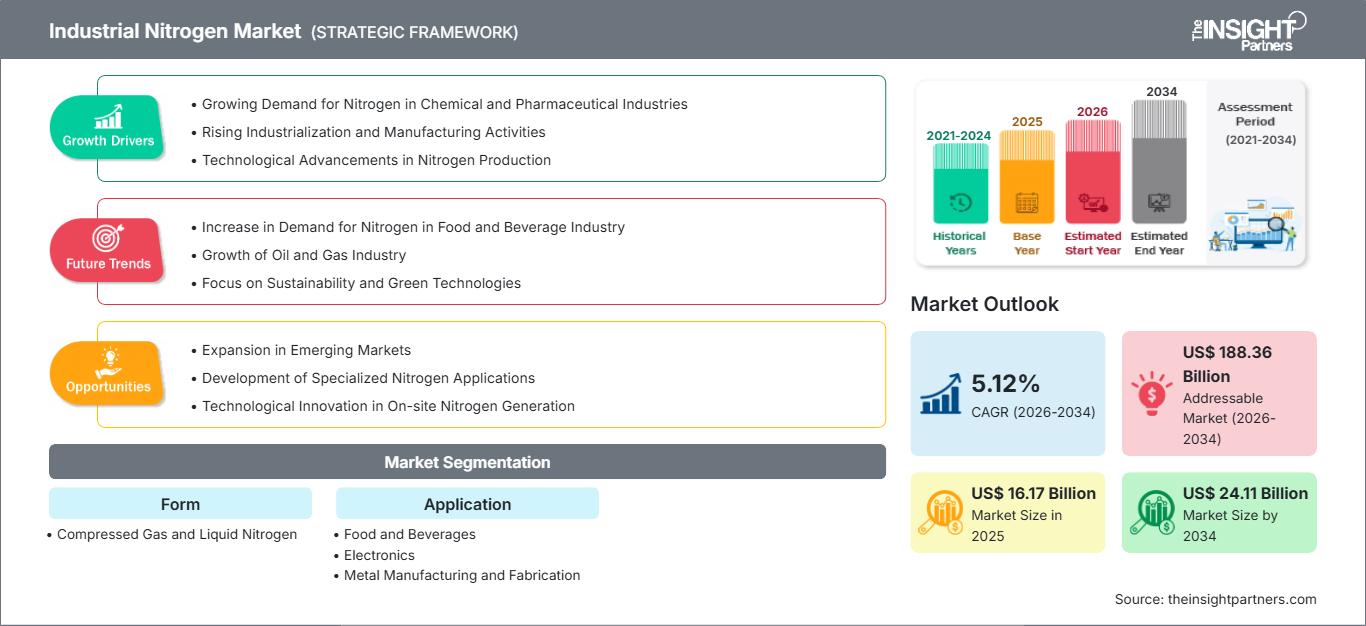
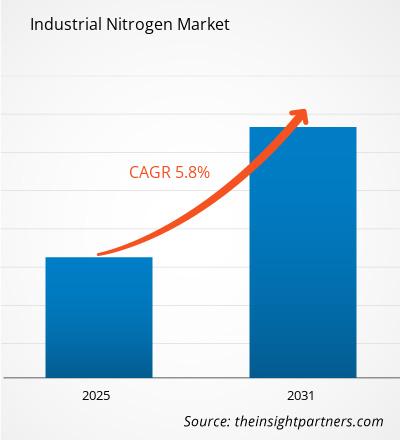
The industrial nitrogen market was valued at US$ 16.17 Billion in 2025 and is projected to reach US$ 24.11 Billion by 2034, registering a CAGR of 5.12% during 2026–2034. Market expansion is supported by nitrogen's essential role in inerting, freezing, blanketing, purging, pressure testing, electronics processing, pharmaceutical production, and metal fabrication across increasingly diversified industrial value chains.
In North America, the industrial nitrogen market size is supported by mature industrial infrastructure and expanding high-purity gas requirements, with regional growth expected in the 4.5–5.5% range during 2026–2034. Semiconductor capacity additions and increased investment in pharmaceutical manufacturing strengthen demand for reliable gaseous and liquid nitrogen supply, while distributed production systems improve availability for smaller industrial users.
Industrial Nitrogen Market Assessment and Insights
- North America: The region is expected to account for approximately 28–32% of the industrial nitrogen market in 2025 and expand at a CAGR of 4.5–5.5% during 2026–2034. Semiconductor manufacturing, healthcare capacity, industrial gases infrastructure, and on-site generation support sustained consumption.
- US: The US is estimated to represent 72–76% of North American demand in 2025, with growth projected at a CAGR of 4.5–5.5% during 2026–2034, supported by electronics fabrication, food processing, pharmaceuticals, and industrial modernization.
- Europe: Europe is expected to hold approximately 24–28% of the industrial nitrogen market in 2025 and grow at a CAGR of 3.5–4.5% during 2026–2034. Germany, the UK, France, Italy, and Spain remain major consumption centers.
- Asia Pacific: Asia Pacific is projected to account for approximately 34–38% of the market in 2025 and advance at a CAGR of 6.0–7.0% during 2026–2034. China, Japan, South Korea, and India anchor regional industrial gas consumption.
- Largest Segment: Compressed Gas is expected to command a market share of approximately 58–62% in 2025 and grow at a CAGR of 4.5–5.5% during 2026–2034, supported by broad industrial distribution requirements.
- High Growth Segment: Electronics is expected to account for approximately 12–16% market share in 2025 and expand at a CAGR of 7.0–8.0% during 2026–2034 as semiconductor and precision manufacturing investments increase.
- Key companies analyzed in detail: Linde plc, Air Products and Chemicals, Inc., Messer SE & Co. KGaA, Universal Industrial Gases, Inc., Southern Industrial Gas Sdn. Bhd., Yingde Gases Group Co., Ltd., Parker-Hannifin Corporation, Axcel Gases Limited, Ellenbarrie Industrial Gases Limited, Dubai Industrial Gases Co. LLC.
Source: The Insight Partners' analysis based on proprietary research, government publications, company annual reports, investor presentations, industry databases, and expert interviews.
In terms of market evolution, the market has moved from the centralization of the supply chain to a blend of merchant supply, pipeline network, packaged gases, liquid supply, and local generation. Cryogenic air separation is key to the production process in bulk, while pressure swing adsorption and membrane technology will provide for the decentralized need. In essence, the future of the market will depend on the ability to marry purity levels, pressure levels, delivery frequency, and cost-effectiveness with different applications.
Going into the future, the growth of manufacturing hubs in countries such as India, Southeast Asia, the Middle East, and some parts of Africa is likely to increase the consumer base. Investments in semiconductor industries, pharmaceutical industry, food cold chain, refinery, chemicals and clean energy industry are new areas of demand. There are efforts by companies to optimize electricity consumption and logistics in addition to production processes.
Industrial Nitrogen Market Report Scope
| Report Attribute | Details |
|---|---|
| Market size in 2025 | US$ 16.17 Billion |
| Market Size by 2034 | US$ 24.11 Billion |
| Global CAGR (2026 - 2034) | 5.12% |
| Historical Data | 2021-2024 |
| Forecast period | 2026-2034 |
Industrial Nitrogen Market Analysis
Industrial nitrogen market growth is driven by the expansion of process industries requiring oxygen displacement, controlled atmospheres, cryogenic cooling, and contamination prevention. Demand arises from a system of interconnected activities through the participation of air separation plants, bulk storage, transport, cylinders, generators, engineering companies, and industrial customers. Big volume consumers usually focus on continuity and purity, while small volume producers usually look into flexible contracts and lower dependency on logistics.
The supply side becomes more focused on geographical efficiency in its production. Big cryogenic plants operate in situations where there is piped or bulk demand, while smaller modular generators are used to lower the cost of transporting air separation products. Availability of electricity becomes an important consideration due to the nature of the product, since the process is energy-intensive.
Competitive positioning is shaped by production infrastructure, engineering capability, customer contracts, purity specifications, and distribution reach. Linde plc and Air Products and Chemicals, Inc. maintain broad industrial gas capabilities, while Messer SE & Co. KGaA combines regional production with application expertise. Universal Industrial Gases, Inc. and Southern Industrial Gas Sdn. Bhd. address specialized regional requirements through localized supply and service models.
Investment in industry is being made into captive power generation, purity systems, electronic monitoring systems, and the infrastructure for advanced manufacturing. The Parker-Hannifin Corporation does business in nitrogen generation systems, whereas the Yingde Gases Group Co., Ltd. caters to the industrial customers in China. Examples of regional manufacturers that operate close to the growing manufacturing and infrastructure hubs include Axcel Gases Limited, Ellenbarrie Industrial Gases Limited, and Dubai Industrial Gases Co. LLC.
● REPORT CUSTOMIZATION
Tailor This Report To Align With Your Specific Business Requirements
This report can be customized to align precisely with your business objectives, scope, and target markets. Customization options include tailored segmentation, geography, competitive analysis, and strategic insights to support informed decision-making.
Customize This Report →WHAT YOU CAN ADJUST
- ● Segmentations
- ● Geography
- ● Competitive Analysis
- ● Language Preferences
Industrial Nitrogen Market: Strategic Insights
Regional Insights
North America Industrial Nitrogen Market
North America is estimated to hold a 28–32% share in 2025 and expand at a CAGR of 4.5–5.5% during 2026–2034. Established air separation infrastructure, advanced manufacturing capacity, and substantial demand from food processing and healthcare support a diversified consumption base. Semiconductor investment adds another structural driver because high-purity gases are required throughout wafer fabrication and related process operations.
Strategies used in supplying these products now include both merchant liquid distribution and local generation by customers concerned about operational continuity. The area also enjoys the advantage of well-connected transport routes and industrial clusters. Both Canada and Mexico help in providing their contribution through the processing of food, car manufacturing, energy operations, and manufacturing processes. Therefore, the North American market is expected to continue being mature, but at the same time, technology-ready because customers will pay more attention to supply security and energy efficiency.
U.S. Industrial Nitrogen Market
The US represents approximately 72–76% of North American consumption in 2025 and is projected to grow at a CAGR of 4.5–5.5% during 2026–2034. Its large food manufacturing, electronics, pharmaceutical, chemical, metalworking, and energy industries support extensive nitrogen use. Major suppliers operate production and distribution infrastructure across industrial corridors, enabling bulk, liquid, packaged, and on-site supply configurations.
Application trends continue to favor the use of high-purity, constant availability of supplies for semiconductor manufacturing, biotechnology, pharmaceutical manufacturing, and precision manufacturing. Food freezing and packaging under a modified atmosphere also contribute to ongoing demands. Investment in domestic manufacturing capability is another market strength. On-site generation is becoming more relevant when transport costs or supply reliability confer economic benefit, while centralized air separation continues to play an important role among large-volume users who need liquid nitrogen.
Europe Industrial Nitrogen Market
Europe is estimated to account for 24–28% of the market in 2025 and grow at a CAGR of 3.5–4.5% during 2026–2034. Germany remains the leading regional country because of its extensive chemical, automotive, machinery, pharmaceutical, and metalworking industries. The UK maintains demand through healthcare, food processing, electronics, and advanced manufacturing, while established industrial gas infrastructure supports flexible distribution.
Germany and the UK collectively illustrate Europe's transition toward more energy-efficient industrial gas systems. France contributes through aerospace, food, pharmaceutical, and chemical manufacturing, whereas Italy and Spain provide demand from metal fabrication, food production, automotive supply chains, and industrial processing. Regional growth is moderated by mature manufacturing markets and energy costs, but modernization investments sustain replacement and application-specific demand.
The industrial nitrogen market share across Europe is also influenced by environmental compliance, industrial electrification, and the need to improve production efficiency. Suppliers increasingly optimize plant utilization and logistics to manage electricity-related costs. Growth opportunities are strongest where advanced manufacturing investment and high-purity requirements can offset slower expansion in mature conventional industries.
APAC Industrial Nitrogen Market
APAC is projected to represent 34–38% of the market in 2025 and grow at a CAGR of 6.0–7.0% during 2026–2034. China dominates the region’s consumption market, underpinned by chemicals, electronics, metals, and manufacturing activity. Japan and South Korea continue to be key markets for high-purity products, with India emerging as a growing market for pharmaceuticals, food processing, electronics, refining, and infrastructure development.
Government industrial policies, semiconductor investments, and manufacturing localization drive the growth in the region. Australia supports itself via mining, food, healthcare, and industrial processing. Distributed generation is becoming more relevant in cases where rapidly developing industrial regions lack extensive pipeline distribution networks.
Middle East & Africa Industrial Nitrogen Market
The Middle East & Africa region is expected to expand at a CAGR of 5.5–6.5% during 2026–2034. The demand driver in Saudi Arabia is refinery operations, petrochemicals, metals, and major industrial development. The UAE gains from logistics, food processing, healthcare, construction-related manufacturing, and diversified industrial investment, aided by existing port and free zone infrastructure.
South Africa continues to be one of the important consumers in Africa owing to mining operations, metals, chemicals, and food industries. In the remaining MEA, growth of infrastructure and industrial diversification opens up possibilities for local gas production. Availability of energy resources, distance of transport, and customer proximity would decide whether central or distributed air separation works better.
Segmentation Analysis
Form
The form segment is projected to expand at a CAGR of 4.5–5.5% during 2026–2034. Product selection depends on customer consumption volume, storage capability, delivery distance, required pressure, and operating continuity. Compressed systems are widely suited to distributed applications and direct process use, whereas liquid supply supports high-volume consumption and cryogenic requirements. The market scope across forms therefore, reflects application-specific economics rather than a single universal delivery preference.
- Compressed Gas: Compressed nitrogen supports welding, purging, blanketing, testing, food processing, and general manufacturing. Its accessibility through cylinders, bundles, pipelines, and on-site generators makes it strategically important across geographically dispersed industrial customers.
- Liquid Nitrogen: Liquid nitrogen is essential where high volumes, cryogenic temperatures, freezing, preservation, or compact storage are required. Its importance is particularly strong in food processing, healthcare, biotechnology, electronics, and specialized industrial operations.
Application
The application segment is projected to grow at a CAGR of 5.0–6.0% during 2026–2034 as nitrogen consumption broadens across process industries. Different applications require distinct purity levels, delivery systems, and storage configurations. The industrial nitrogen market increasingly benefits from applications where process reliability, contamination control, oxidation prevention, or temperature management directly influence product quality and operating efficiency.
- Food and Beverages: Nitrogen supports modified-atmosphere packaging, freezing, beverage processing, and preservation. Demand is reinforced by expanding packaged food consumption and investment in cold-chain infrastructure, where controlled atmospheres help protect quality.
- Electronics: High-purity nitrogen is used in semiconductor and electronics manufacturing to control oxidation and contamination. Strategic importance is increasing as new fabrication capacity and precision manufacturing require dependable gas quality.
- Metal Manufacturing and Fabrication: Nitrogen is used for laser cutting, heat treatment, blanketing, welding-related operations, and controlled atmospheres. Manufacturing modernization and precision processing support recurring demand across automotive, machinery, and engineered products.
- Oil and Gas: Nitrogen supports purging, inerting, pressure testing, enhanced operational safety, and maintenance activities. Its strategic value is linked to asset integrity and the need to manage combustible or oxygen-sensitive operating environments.
- Pharmaceutical and Healthcare: Pharmaceutical processing, laboratory operations, cryopreservation, medical applications, and controlled manufacturing environments create specialized requirements. Reliability and purity are particularly important where nitrogen quality directly affects process consistency or biological materials.
- Chemical: Chemical producers use nitrogen for blanketing, inerting, purging, pressure transfer, and process protection. Large continuous operations make supply reliability significant, supporting both dedicated production systems and long-term merchant gas arrangements.
Opportunity Snapshot
| Application | Revenue Contribution | Trend Tag | Adoption Stage |
| Food and Beverages | High | Cryogenic Freezing | Mature |
| Electronics | High | Semiconductor Purity | Scaling |
| Metal Manufacturing and Fabrication | High | Laser Cutting | Mature |
| Oil and Gas | Medium | Asset Inerting | Mature |
| Pharmaceutical and Healthcare | Medium | Bioprocess Control | Scaling |
| Chemical | High | Process Blanketing | Mature |
Industrial Nitrogen Market Growth Drivers and Impact Analysis
Semiconductor and Advanced Manufacturing Capacity Expansion
The increased fabrication of semiconductors and the development of new manufacturing capabilities will result in higher demand for high-purity industrial gases for fabrication, assembly, test and precise processing processes. Nitrogen gas is used for controlling the atmosphere, preventing oxidation, purging process tools and contamination-sensitive processes. This means that new plants will need reliable logistics, thus offering possibilities for pipelines, bulk storage and on-site production of nitrogen. The effect will not be limited to wafer fabrication only, since the chain of electronics production involves precision metal working and special component production. It means that nitrogen producers can count on long-term contracts and complicated projects.
Expansion of Food Preservation and Cold-Chain Processing
Food producers have started to utilize nitrogen gas in activities such as freezing, modified-atmosphere packaging, refrigeration, and preservation as a way of ensuring long shelf life and quality products. With the increase in packaged food production, organized retailing, convenience consumption, and temperature-sensitive logistical handling, there is growth in the number of locations that need a reliable gas supply. In cases where there is a need for rapid freezing and the processing time determines quality, liquid nitrogen becomes more critical. Another aspect of this driver is the need for decentralized distribution owing to the geographical dispersion of food processing locations and the need for customized storage solutions. Value can be captured through bulk delivery, microbulk system, application engineering, and monitoring services.
Greater Need for Process Safety and Oxygen Exclusion
Chemical plants, refineries, storage depots, pharmaceutical companies, and metal processing operations have found uses for nitrogen in the reduction of oxygen exposure and the management of flammable or oxidation-sensitive environments. As such, industrial plants become more advanced with their safety equipment and automation, the need for controlled inerting and purging may become greater. Nitrogen is also used for maintenance purposes, pressure testing, and equipment installation, thus increasing its application outside of the continuous manufacturing process. It is an important aspect commercially, as many consumers value the reliability of the supply rather than the commoditized price point when safety is at stake.
Industrial Nitrogen Market Future Trends
Distributed Generation and Hybrid Supply Models
Distributed generation is expected to become more prominent as customers seek greater control over supply reliability, transportation costs, and production scheduling. Hybrid models combining merchant liquid deliveries with on-site generation can provide operational flexibility for facilities with variable consumption. Advances in monitoring, automation, and predictive maintenance will improve system utilization and reduce unnecessary gas losses. The industrial nitrogen market trends increasingly favor solutions designed around total delivered economics rather than gas production alone. Suppliers will therefore differentiate through engineering capability, remote performance management, and integration with customer utilities. This shift may be especially relevant in emerging industrial clusters where demand is growing faster than centralized pipeline infrastructure and transport distances remain economically significant.
Higher Purity Requirements in Specialized Manufacturing
The specialty-manufacturing sector is forecast to create growing demand for nitrogen that is pure and contaminant-free in accordance with strict standards. Semiconductor manufacturing, battery manufacture, biotech, pharmaceuticals, new materials, and other fields are likely to need increasingly specialized systems for delivery of gases. Growing investments are going to be directed at improving the quality of the gas, system redundancy, filtering, analytical capabilities, and constant monitoring. Companies are going to develop closer cooperation with equipment providers and engineering firms as they are going to become involved in facility construction projects from the very beginning. With increasing sensitivity of manufacturing processes to air pollution, clients will look for suppliers that can guarantee the required level of reliability and support.
Industrial Nitrogen Market Opportunities
Localized Supply Infrastructure in Emerging Industrial Corridors
Investment opportunities are expanding in emerging industrial corridors where manufacturing capacity is increasing faster than established industrial gas infrastructure. India, Southeast Asia, the Middle East, and selected African markets offer potential for strategically located air separation units, liquid storage hubs, and distributed generation systems. Investors can prioritize clusters combining chemicals, food processing, pharmaceuticals, metals, and electronics because diversified customer bases improve asset utilization. The industrial nitrogen market Forecasts suggest that localized supply can reduce transport intensity and improve customer responsiveness where distances are significant. Partnerships with industrial parks, utilities, and engineering companies can accelerate deployment. Successful strategies will depend on electricity economics, customer concentration, logistics capability, and the ability to secure long-term anchor demand before commissioning production assets.
Application Engineering for High-Value Customer Segments
Application-oriented services create a chance to evolve from commoditized gas products to high-end customer partnerships. Gas suppliers could come up with solutions that would include cryogenic food processing, semiconductor atmosphere, pharmaceutical storage, laser cutting, chemical blanketing, and refinery safety operations. With technical staff investments, process diagnostics, and digital process monitoring, suppliers could assist their customers in reducing gas usage and increasing process stability. In other words, a differentiated commercial model is created on the basis of the overall efficiency of operations. New market entrants could integrate equipment leasing and gas supply, thereby reducing the capital expenditures of customers. The most promising prospects seem to be related to nitrogen usage, which is technically essential, costly to change, and involves engineering support.
Frequently Asked Questions

- Comprehensive Market Sizing and Forecast Analysis
- Detailed Segmentation Analysis
- In-Depth Market Dynamics Assessment
- Regional and Country-Level Insights
- Competitive Landscape and Company Benchmarking
- Strategic Business Intelligence
Recent Reports
Testimonials

The Insight Partners' SCADA System Market report is comprehensive, with valuable insights on current trends and future forecasts. The team was highly professional, responsive, and supportive throughout. We are very satisfied and highly recommend their services.
RAN KEDEM Partner, Reali Technologies LTDs
I requested a report on a very specific software market and the team produced the report in a few days. The information was very relevant and well presented. I then requested some changes and additions to the report. The team was again very responsive and I got the final report in less than a week.
JEAN-HERVE JENN Chairman, Future Analytica
We worked with The Insight Partners for an important market study and forecast. They gave us clear insights into opportunities and risks, which helped shape our plans. Their research was easy to use and based on solid data. It helped us make smart, confident decisions. We highly recommend them.
PIYUSH NAGPAL Sr. Vice President, High Beam Global
The Insight Partners delivered insightful, well-structured market research with strong domain expertise. Their team was professional and responsive throughout. The user-friendly website made accessing industry reports seamless. We highly recommend them for reliable, high-quality research services
YUKIHIKO ADACHI CEO, Deep Blue, LLC.
This is the first time I have purchased a market report from The Insight Partners.While I was unsure at first, I visited their web site and felt more comfortable to take the risk and purchase a market report.I am completely satisfied with the quality of the report and customer service. I had several questions and comments with the initial report, but after a couple of dialogs over email with their analyst I believe I have a report that I can use as input to our strategic planning process.Thank you so much for taking the extra time and making this a positive experience.I will definitely recommend your service to others and you will be my first call when we need further market data.
JOHN SUZUKI President and Chief Executive Officer, Board Director, BK Technologies
I wish to appreciate your support and the professionalism you displayed in the course of attending to my request for information regarding to infectious disease IVD market in Nigeria. I appreciate your patience, your guidance, and the fact that you were willing to offer a discount, which eventually made it possible for us to close a deal. I look forward to engaging The Insight Partners in the future, all thanks to the impression you have created in me as a result of this first encounter.
DR CHIJIOKE ONYIA MANAGING DIRECTOR, PineCrest Healthcare Ltd.Reason to Buy
- Informed Decision-Making
- Understanding Market Dynamics
- Competitive Analysis
- Identifying Emerging Markets
- Customer Insights
- Market Forecasts
- Risk Mitigation
- Boosting Operational Efficiency
- Strategic Planning
- Investment Justification
- Tracking Industry Innovations
- Aligning with Regulatory Trends





 Get Free Sample for