
Inverted Pouches Market Growth, Share & Trends by 2034
Coverage: By Pouch Type (Premade, Form Fill Seal); Capacity (Below 15 ML,15 - 5 ML, 5 ML - 1 Liter, Above 1 Liter); and Geography (North America, Europe, Asia Pacific, and South and Central America)
- Status : Data Released
- Report Code : TIPRE00021793
- Category : Chemicals and Materials
- No. of Pages : 150
- Available Report Formats :


- Last update date : August 17, 2026


2025 Market Size
US$ 15.30 Bn
Base year value
2034 Forecast
US$ 27.71 Bn
Projected by 2034
CAGR 2026-2034
6.82 %
Growth rate
Addressable Market
US$ 194.30 Bn
(2026-2034)
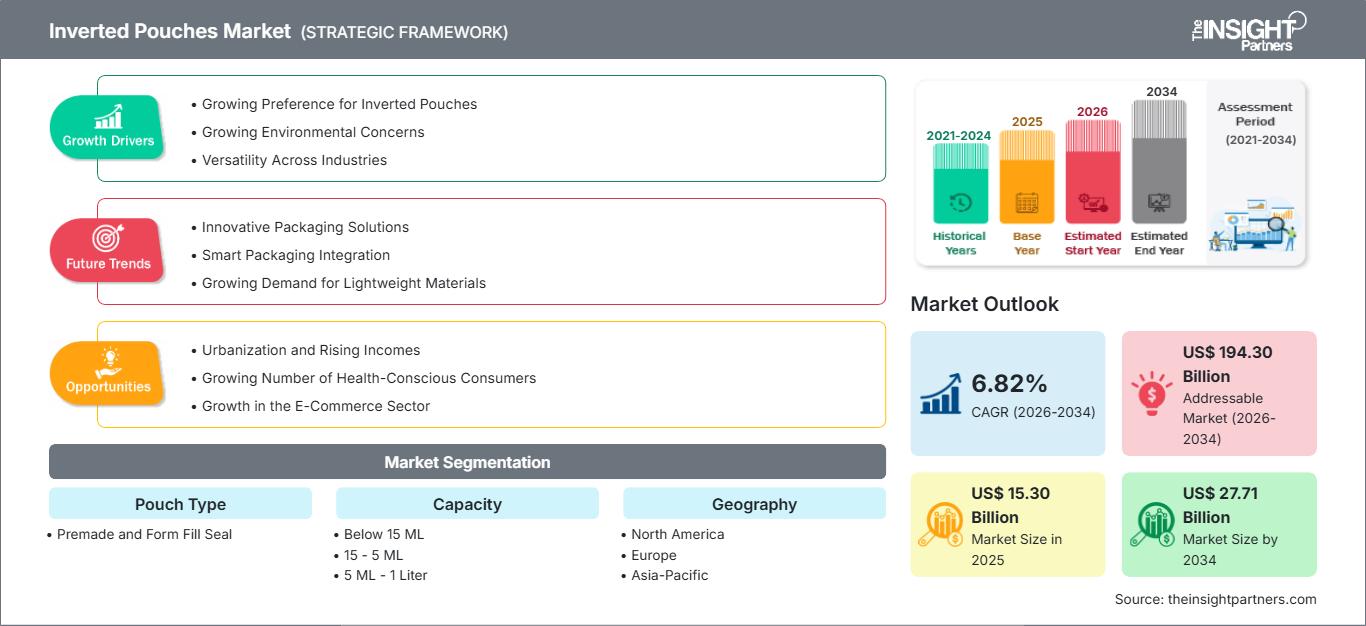
The inverted pouches market was valued at US$ 15.30 Billion in 2025 and is projected to reach US$ 27.71 Billion by 2034, growing at a CAGR of 6.82% during 2026–2034. The market is witnessing increased adoption across food, beverage, personal care, and household product applications due to convenient dispensing formats, lightweight packaging benefits, and improved product usability compared with conventional rigid containers.
North America represents a mature yet innovation-driven landscape supported by demand for flexible packaging formats, sustainable material development, and convenience-oriented consumer products. The region is estimated to expand at a CAGR of 6–7% between 2026 and 2034, supported by increased adoption among sauces, condiments, baby food, and personal care manufacturers seeking reduced packaging waste and efficient logistics. These factors continue to support the growth of the Inverted Pouches Market Size across the region.
Inverted Pouches Market Assessment and Insights
- North America The region demonstrates strong adoption of inverted dispensing formats, supported by foodservice and retail applications. North America accounted for a share range of 30–35% in 2025 and is expected to grow at a CAGR range of 6–7% during 2026–2034.
- US The US remains a major contributor due to demand from packaged food and personal care brands. The country represented 75–80% share of North America in 2025 and is projected to grow at a CAGR range of 6–7% during 2026–2034.
- Europe Europe continues to expand through sustainability initiatives and flexible packaging transitions across Germany, the UK, France, Italy, and Spain. The region held a share range of 25–30% in 2025 and is anticipated to register a CAGR range of 5–6% during 2026–2034.
- Asia Pacific Asia Pacific is supported by rising packaged food consumption and manufacturing expansion in China, India, Japan, South Korea, and Australia. The region captured a share range of 25–30% in 2025 and is expected to achieve a CAGR range of 8–9% during 2026–2034.
- Largest Segment Premade pouches represented the leading pouch type with a market share range of 55–60% in 2025, supported by established production capabilities and broad application acceptance. The segment is estimated to grow at a CAGR range of 6–7% during 2026–2034.
- High Growth Segment Form fill seal pouches are projected as the high growth segment, accounting for a share range of 40–45% in 2025 and expanding at a CAGR range of 7–8% during 2026–2034 due to automation advantages.
- Key companies analyzed in detail: AptarGroup, Inc., Cheer Pack North America, LLC, Glenroy, Inc., Polymer Packaging, Inc., THIMONNIER SAS, Viking Masek Global Packaging LLC, VOLPAK S.A.U., Amcor plc, Mondi plc, and ProAmpac Holdings Inc.
Source: The Insight Partners' analysis based on proprietary research, government publications, company annual reports, investor presentations, industry databases, and expert interviews.
The development of pouch packaging products has been made possible by the incorporation of improved barrier films and spouts, among others. Development in multilayer constructions, recycling material technologies, and accurate filling systems has enabled this innovation to be applicable in liquids, beverages, and consumer goods. The shift from rigid containers like bottles and jars to flexible ones has also affected the manufacturing process since manufacturers concentrate on material efficiency and cheaper modes of transportation, besides good shelf performance.
Future expansion is expected to be influenced by investments in sustainable packaging infrastructure, regional manufacturing capacity, and evolving regulatory requirements related to packaging waste reduction. Emerging economies in the Asia Pacific and Latin America are expected to provide additional opportunities as packaged food consumption increases. The adoption of mono-material films, improved recycling compatibility, and automation across filling operations will support long-term market development while encouraging packaging producers to optimize resource utilization, positively influencing the Inverted Pouches Market Share across key regional markets.
Inverted Pouches Market Report Scope
| Report Attribute | Details |
|---|---|
| Market size in 2025 | US$ 15.30 Billion |
| Market Size by 2034 | US$ 27.71 Billion |
| Global CAGR (2026 - 2034) | 6.82% |
| Historical Data | 2021-2024 |
| Forecast period | 2026-2034 |
Inverted Pouches Market Analysis
Demand for inverted dispensing formats is increasing as brands prioritize packaging solutions that improve convenience, product evacuation, and storage efficiency. Food products such as sauces, dressings, spreads, and liquid condiments remain significant application areas, while personal care and household products are creating additional demand. The inverted pouches market growth is supported by consumer preference for lightweight packaging, reduced material usage, and efficient supply chains. The ecosystem includes film producers, pouch converters, machinery suppliers, filling equipment manufacturers, and brand owners collaborating to develop application-specific solutions.
Suppliers of raw materials are a vital factor for product performance in terms of advanced polymer film, barrier coating, and recyclable constructions. Packaging converters are working hard to enhance the quality of pouches with better durability, dispensing precision, and suitability for automatic lines. Growth of flexible packaging conversion capabilities ensures greater availability of supplies in both developed and developing countries. Digital printing technology adoption is providing consumers with customized solutions along with reduced production cycles.
The market environment is driven by innovations, collaborations, and expanding manufacturing capacities for packaging solution providers. AptarGroup, Inc., Cheer Pack North America, LLC, Glenroy, Inc., and ProAmpac Holdings Inc. are among the companies that are concentrating on dispensing systems, sustainable materials, and customized pouches to meet various end-use demands. Machinery specialists, including THIMONNIER SAS, Viking Masek Global Packaging LLC, and VOLPAK S.A.U. support manufacturers through advanced pouch production and filling technologies, reflecting the competitive dynamics outlined in the Inverted Pouches Market Report.
Investment activities are increasingly directed toward recyclable packaging formats, automation, and regional production facilities. Global packaging companies such as Amcor plc and Mondi plc are strengthening their flexible packaging portfolios through material innovation and sustainability-focused solutions. Strategic positioning within this market depends on the ability to deliver cost-effective formats while meeting regulatory expectations regarding recyclability, waste reduction, and circular packaging systems. Competitive differentiation is also influenced by technical expertise in films, closures, and dispensing mechanisms.
● REPORT CUSTOMIZATION
Tailor This Report To Align With Your Specific Business Requirements
This report can be customized to align precisely with your business objectives, scope, and target markets. Customization options include tailored segmentation, geography, competitive analysis, and strategic insights to support informed decision-making.
Customize This Report →WHAT YOU CAN ADJUST
- ● Segmentations
- ● Geography
- ● Competitive Analysis
- ● Language Preferences
Inverted Pouches Market: Strategic Insights
Regional Insights
North America Inverted Pouches Market
North America accounted for a share range of 30–35% in 2025 and is expected to register a CAGR range of 6–7% during 2026–2034. The region benefits from established flexible packaging infrastructure, strong consumer demand for convenience products, and increasing adoption of lightweight packaging solutions across food, beverage, and household applications. The U.S. remains the primary contributor due to large-scale packaged food production and strong brand adoption, supporting the positive Inverted Pouches Market Forecast over the assessment period.
North American companies have been concentrating on recyclable film, better dispensing systems, and more efficient filling techniques. The continued demand for products in the sauces, condiments, baby food, and personal care product sectors has been helping to drive the growth of the market. There is also increasing pressure on companies in terms of regulations for packaging waste reduction and sustainability to use advanced pouches.
U.S. Inverted Pouches Market
The U.S. represented approximately 75–80% of North America’s share in 2025 and is anticipated to grow at a CAGR range of 6–7% during 2026–2034. Strong consumption of packaged food products, expanding private-label brands, and demand for convenient dispensing solutions are key factors supporting adoption. Food manufacturers are increasingly replacing traditional containers with flexible pouch formats for improved logistics and consumer handling, reinforcing key Inverted Pouches Market Trends across the region.
Sustainable packaging technology and improved pouch designs are being explored by firms based in the US in order to cater to environmental considerations. Uses in sauces, drinks, nutrition products, and personal care products are becoming more prevalent. The availability of packaging converters and dispensing technology suppliers makes the process of manufacturing in the domestic market more feasible. Recyclability and lighter packaging material will become increasingly important in the future.
Europe Inverted Pouches Market
Europe held a share range of 25–30% in 2025 and is projected to grow at a CAGR range of 5–6% during 2026–2034. The region is supported by sustainability-focused packaging policies, established food processing industries, and increasing demand for flexible alternatives. Germany represents a leading market due to advanced packaging manufacturing capabilities and strong adoption among food and household product producers, strengthening the regional position of the Inverted Pouches Market.
The UK market is driven by demands for convenient packaging and innovations that are sustainability-driven. The German market is enjoying the benefits of its packaging industrial experience. The French, Italian, and Spanish markets are growing based on food processing industry developments and the growing acceptance of flexible dispensers. There is emphasis on recyclable materials, monomaterial pouches, and cost-effective production technology by European manufacturers. Packaging circularity regulations will still drive market strategies in Europe.
APAC Inverted Pouches Market
Asia Pacific accounted for a share range of 25–30% in 2025 and is expected to expand at a CAGR range of 8–9% during 2026–2034. China leads regional demand due to large-scale food processing, flexible packaging manufacturing, and rising consumption of packaged products. Japan, South Korea, India, and Australia are also contributing through advanced packaging adoption and expanding consumer goods markets, reinforcing the growth potential of the Inverted Pouches Market across the region.
Industrial growth, urbanization, and the rise in penetration of packaged foods are fueling the regional expansion. Manufacturers are making investments in local manufacturing plants, automatic filling machines, and sustainable recycling packaging solutions. Government efforts aimed at cutting down waste and promoting sustainable packaging practices are motivating companies to create better pouch designs. The growth in online distribution channels is contributing even more to the need for such packaging solutions.
Middle East & Africa Inverted Pouches Market
The Middle East & Africa region is estimated to account for a smaller but growing share of the global Inverted Pouches Market, supported by food processing investments, retail expansion, and infrastructure development. Saudi Arabia and the UAE represent important markets due to increasing packaged food consumption and the diversification of consumer goods industries. The region is projected to grow at a CAGR range of 5–6% during 2026–2034, contributing steadily to the overall expansion of the market.
The involvement of South Africa lies in its existing food processing capability, whereas other countries within MEA are introducing flexible packaging solutions slowly. Availability of energy, industrial growth, and investment in manufacturing facilities locally will be some of the factors responsible for influencing packaging requirements in the region. There is increasing consideration of lightweight solutions by firms that can help them reduce packaging costs.
Segmentation Analysis
Pouch Type
The Pouch Type segment of the Inverted Pouches Market is categorized into Premade and Form Fill Seal formats. The segment is expected to grow at a CAGR range of 6–7% during 2026–2034. Packaging producers are adopting different pouch manufacturing approaches based on application requirements, production volumes, and customization needs. Premade solutions remain widely utilized due to established supply chains, while form-fill-seal technologies are gaining attention among manufacturers seeking higher automation and production efficiency.
- Premade: Premade pouches maintain strong adoption among brands requiring flexible packaging with quick filling operations and design flexibility. These formats are widely used in food, beverage, and personal care applications due to compatibility with existing filling systems.
- Form Fill Seal: Form fill seal pouches are increasingly preferred for high-volume manufacturing environments because they integrate pouch formation, filling, and sealing operations. Their operational efficiency supports adoption among large-scale consumer product manufacturers.
Capacity
Capacity segment includes Below 15 ML, 15 - 5 ML, 5 ML - 1 Liter, and Above 1 Liter. The segment is expected to register a CAGR range of 6–7% during 2026–2034. Capacity selection depends on product category, consumer usage patterns, storage requirements, and dispensing frequency. Medium-capacity formats remain widely used across household, food, and personal care applications, while larger formats support bulk-oriented products.
- Below 15 ML: Small-capacity pouches are primarily used for sample sizes, single-use applications, and specialized products requiring controlled dispensing. These formats support portability and convenience-oriented packaging strategies.
- 15-5 ML: This capacity range serves compact consumer products requiring easy handling and efficient storage. Demand is supported by personal care, food portions, and travel-oriented packaging applications.
- 5 ML-1 Liter: Medium-capacity pouches represent a significant application category due to suitability across sauces, beverages, household products, and personal care liquids. Their versatility supports broad market acceptance.
- Above 1 Liter: Larger-capacity formats are used for family-size and commercial applications requiring higher product volumes. These pouches support material efficiency and reduced packaging weight compared with rigid alternatives.
Opportunity Snapshot
| Application Segment | Revenue Contribution (High/Medium/Low) | Trend Tag | Adoption Stage |
| Food & Beverage | High | Portion Control | Mature |
| Personal Care | Medium | Premium Dispensing | Scaling |
| Household Products | Medium | Lightweight Packs | Scaling |
| Industrial Liquids | Low | Flexible Storage | Emerging |
Inverted Pouches Market Growth Drivers and Impact Analysis
Rising preference for lightweight and convenient packaging formats
The need for user-friendly packaging systems by consumers is shaping brands to incorporate flexible dispensing options in their products. Invertible pouches are known to offer ease of handling, better efficiency of product dispensing and minimal need for transportation when compared to rigid packages. With this option, it becomes possible for the manufacturers to use a minimal amount of materials without compromising on the effectiveness of the package. Manufacturers have started looking for packaging options based on the convenience shopping habits of consumers. This would result in an investment in converting technologies, films and dispensing components for pouches.
Expansion of sustainable flexible packaging initiatives
Environment-friendly practices are emerging as one of the key drivers behind the development of packaging strategies around the world. There are investments being made by brands and converters in materials like recyclable films, mono-materials, and new barrier systems to deal with the problem of packaging waste. Flexible pouches represent a chance to use less material and improve logistics due to the reduced weight of packages. The regulatory moves towards circular packaging systems are speeding up innovations on behalf of the producers and material suppliers. Manufacturers are creating products that are durable, shelf-life-protecting, and recyclable.
Increasing automation in pouch manufacturing and filling operations
Automation is revolutionizing pouch manufacturing in terms of increased efficiency, simplification of operations, and the ability to ensure quality control. Manufacturers are embracing machines that provide a seamless combination of filling and sealing processes to enable high output rates. Modern technology makes it easier for firms to cope with different packaging needs in an efficient way. The use of automation is most appropriate in the case of large consumer goods manufacturers who require scalable packaging operations. Technologists are designing machines that ensure accuracy, prevent wastage, and can handle multiple types of pouches.
Inverted Pouches Market Future Trends
Development of mono-material and recyclable pouch structures
The future of packaging technology would see the emergence of mono-material packages that would be created in order to enhance the recyclability of packages and still maintain the barrier characteristics. This is because manufacturers have been looking into innovative polymers, coatings, and sealing methods that would help create flexible pouches that can be incorporated into the changing recycling processes. Increasingly, brand owners are looking for packaging types that can help them achieve their sustainability goals without affecting the safety of their products. The developments in film production technology will pave the way for sustainable pouches in the future.
Integration of smart packaging and enhanced consumer interaction
Smart packaging solutions are anticipated to be on the radar in the coming years as companies look for ways to engage consumers and track the products in the supply chain. Pouch packaging design will include the integration of technology solutions that can help with product traceability, authenticity, and the availability of product information. Improvements in digital printing technology will make it possible for companies to customize more and produce pouches faster so that the needs of the market can be met in time. This development will ensure that the companies position their products in the premium segment.
Inverted Pouches Market Opportunities
Growth potential in emerging packaged food markets
Increased consumption of packaged food in developing nations will give rise to new avenues for companies dealing with pouches, raw material suppliers and packaging technology providers. Growth of urban population, lifestyle changes and increased presence of retail stores are driving the demand for food products that come in convenient packaging forms. Companies may benefit from their manufacturing operations in the region through the development of cost-effective pouch solutions that meet the demands of the market. Markets in the Asia Pacific and certain other developing countries represent potential markets because of the increased adoption of flexible packaging for different food items.
Investment opportunities through sustainable packaging innovation
Sustainability-focused investments represent an important opportunity for companies developing next-generation flexible packaging technologies. The inverted pouches market Forecasts indicate that manufacturers can benefit from innovations in recyclable films, improved dispensing systems, and efficient production processes. Companies investing in material science, recycling compatibility, and automation capabilities are positioned to address evolving customer requirements. Partnerships between converters, material producers, and packaging equipment suppliers can accelerate the commercialization of advanced solutions. Growing emphasis on environmental responsibility provides opportunities for businesses to differentiate through sustainable product portfolios while supporting regulatory compliance and customer-driven packaging transformation.
Recent Developments
- April 2026: Dai Nippon Printing Co., Ltd. (DNP) started providing samples of the newly developed “DNP’s Mono-material Medical Sterilization Pouch”. The pouch complies with the guidelines of the Circular Economy for Flexible Packaging (CEFLEX) consortium and features a mono-material design that improves sortability and recyclability in the recycling process.
- March 2026: Cheer Pack N.A. partnered with Amcor to launch breakthrough mono-material packaging solution addressing Extended Producer Responsibility requirements.
Frequently Asked Questions

- Comprehensive Market Sizing and Forecast Analysis
- Detailed Segmentation Analysis
- In-Depth Market Dynamics Assessment
- Regional and Country-Level Insights
- Competitive Landscape and Company Benchmarking
- Strategic Business Intelligence
Recent Reports
Testimonials

The Insight Partners' SCADA System Market report is comprehensive, with valuable insights on current trends and future forecasts. The team was highly professional, responsive, and supportive throughout. We are very satisfied and highly recommend their services.
RAN KEDEM Partner, Reali Technologies LTDs
I requested a report on a very specific software market and the team produced the report in a few days. The information was very relevant and well presented. I then requested some changes and additions to the report. The team was again very responsive and I got the final report in less than a week.
JEAN-HERVE JENN Chairman, Future Analytica
We worked with The Insight Partners for an important market study and forecast. They gave us clear insights into opportunities and risks, which helped shape our plans. Their research was easy to use and based on solid data. It helped us make smart, confident decisions. We highly recommend them.
PIYUSH NAGPAL Sr. Vice President, High Beam Global
The Insight Partners delivered insightful, well-structured market research with strong domain expertise. Their team was professional and responsive throughout. The user-friendly website made accessing industry reports seamless. We highly recommend them for reliable, high-quality research services
YUKIHIKO ADACHI CEO, Deep Blue, LLC.
This is the first time I have purchased a market report from The Insight Partners.While I was unsure at first, I visited their web site and felt more comfortable to take the risk and purchase a market report.I am completely satisfied with the quality of the report and customer service. I had several questions and comments with the initial report, but after a couple of dialogs over email with their analyst I believe I have a report that I can use as input to our strategic planning process.Thank you so much for taking the extra time and making this a positive experience.I will definitely recommend your service to others and you will be my first call when we need further market data.
JOHN SUZUKI President and Chief Executive Officer, Board Director, BK Technologies
I wish to appreciate your support and the professionalism you displayed in the course of attending to my request for information regarding to infectious disease IVD market in Nigeria. I appreciate your patience, your guidance, and the fact that you were willing to offer a discount, which eventually made it possible for us to close a deal. I look forward to engaging The Insight Partners in the future, all thanks to the impression you have created in me as a result of this first encounter.
DR CHIJIOKE ONYIA MANAGING DIRECTOR, PineCrest Healthcare Ltd.Reason to Buy
- Informed Decision-Making
- Understanding Market Dynamics
- Competitive Analysis
- Identifying Emerging Markets
- Customer Insights
- Market Forecasts
- Risk Mitigation
- Boosting Operational Efficiency
- Strategic Planning
- Investment Justification
- Tracking Industry Innovations
- Aligning with Regulatory Trends





 Get Free Sample for