
Laser Welding Machine Market Trends, Size & Forecast by 2034
Coverage: By Technology (Fiber, Solid-State, Co2); End-user (Automotive, Electronics, Medical, Aerospace, Jewelry, Packaging, Others), and Geography (North America, Europe, Asia Pacific, and South and Central America)
- Status : Data Released
- Report Code : TIPRE00015830
- Category : Manufacturing and Construction
- No. of Pages : 150
- Available Report Formats :


- Last update date : July 13, 2026


2025 Market Size
US$ 4.54 Bn
Base year value
2034 Forecast
US$ 8.4 Bn
Projected by 2034
CAGR 2026-2034
7.08 %
Growth rate
Addressable Market
US$ 58.42 Bn
(2026-2034)
The laser welding machine market size is projected to grow from US$ 4.54 Billion in 2025 to US$ 8.4 Billion by 2034, registering a CAGR of 7.08% during 2026–2034. Growth is attributed to increased adoption of laser welding technology among automobile, electronics, medical, aerospace, jewelry, and packaging industries, where such precision and low heat distortion is needed along with automated operations.
Growth in North America is projected at a CAGR of 6.5-7.0% between 2026-2034, due to the rise in manufacturing backshoring and increasing level of automation in manufacture of automobiles and medical devices. Robotic welding cells in North America, battery pack assembly, and defense-grade precision fabrication are the key drivers of growth in this region.
Laser Welding Machine Market Assessment and Insights
- North America: Share in 2025 is estimated at 25–30%, with CAGR between 2026–2034 of 6.5–7.0%, led by automotive automation, aerospace fabrication, and medical device joining demand.
- US: Share in 2025 is estimated at 78–82% of North America laser welding machine market, with CAGR between 2026–2034 of 6.6–7.1%, supported by EV, defense, and semiconductor equipment applications.
- Europe: Share in 2025 is estimated at 20–25%, with CAGR between 2026–2034 of 6.4–6.9%, led by Germany, the UK, France, Italy, and Spain through automotive and precision engineering programs.
- Asia Pacific: Share in 2025 is estimated at 35–40%, with CAGR between 2026–2034 of 7.6–8.2%, led by China, Japan, South Korea, and India in EV batteries and electronics assembly.
- Largest Segment: Fiber technology holds laser welding machine market share of 45–50% in 2025, with CAGR of 7.4–8.0% during 2026–2034, reflecting efficiency, beam quality, and automation compatibility.
- High Growth Segment: Electronics holds market share of 18–22% in 2025, with CAGR of 8.0–8.7% during 2026–2034, driven by miniaturization and high-throughput microjoining.
- Key companies analyzed in detail: Amada Weld Tech Co., Ltd., Emerson Electric Co., FANUC Corporation, GWEIKE TECH CO., LTD., IPG Photonics Corporation, Jenoptik AG, LaserStar Technologies Corporation, MECCO Partners, LLC, O.R. Lasertechnologie GmbH, TRUMPF SE + Co. KG, Coherent Corp., Han's Laser Technology Industry Group Co., Ltd.
Source: The Insight Partners' analysis based on proprietary research, government publications, company annual reports, investor presentations, industry databases, and expert interviews.
Laser welding has moved from specialized precision cells into mainstream production as manufacturers replace contact welding with cleaner, faster, digitally controlled joining.
Laser welding technology has gone out of specialized precision cells and entered into mainstream production as the companies are adopting digital control over contact welding by switching over to laser welding technology. The traditional CO2 technology is being phased out in favor of newer fiber lasers due to the higher wall plug efficiencies, smaller sizes, and better robotic compatibility of fibers.
In the future, the rise of manufacturing belts in countries like India, Southeast Asia, Mexico, and Eastern Europe will fuel the demand for laser welding platforms that are more flexible in nature. The growing need for traceability of quality in medical devices, aerospace components, and battery packs will help drive the use of laser welding technologies.
Laser Welding Machine Market Report Scope
| Report Attribute | Details |
|---|---|
| Market size in 2025 | US$ 4.54 Billion |
| Market Size by 2034 | US$ 8.4 Billion |
| Global CAGR (2026 - 2034) | 7.08% |
| Historical Data | 2021-2024 |
| Forecast period | 2026-2034 |
Laser Welding Machine Market Analysis
The need for laser welding machines is determined by the coming together of light-weighted materials, electrical mobility, small sizes of devices, and improved quality requirements. Auto producers apply laser technology for battery tabs, hairpins, body-in-white parts, and aluminum constructions. Electronics makers apply micro-welding for sensors, connections, and coverings. The Laser Welding Machine market report reflects the growing need to reduce rework and improve first-pass yield in automated factories.
The value chain includes laser sources, beam delivery optics, motion control, robotic integration, fixtures, software, shielding gases, and after-sales process support. Supply dynamics remain influenced by availability of high-power fiber modules, scanner optics, and precision sensors. Buyers increasingly evaluate suppliers on total cell performance rather than standalone equipment price, expanding the Laser Welding Machine market forecast beyond machine sales into process engineering and lifecycle services.
The competitive environment features a medium level of concentration, with TRUMPF SE + Co. KG, IPG Photonics Corporation, Coherent Corp., Han’s Laser Technology Industry Group Co., Ltd., and Jenoptik AG vying for supremacy based on beam quality, monitoring ability, geographical reach, and partnerships in automation. FANUC Corporation improves its robotic capabilities, whereas Amada Weld Tech Co., Ltd., LaserStar Technologies Corporation, MECCO Partners, LLC, and O.R. Lasertechnologie GmbH cater to special welding needs of the industry.
The current investment trends point toward a move towards an integrated system that includes real-time process verification, particularly in electric vehicle batteries and medical manufacturing. This requires positioning the company as a supplier with capabilities of integrating laser source, optics, software, and applications engineering. Laser Welding Machine market trend shows that customers are less focused on rated power alone and more focused on traceability, uptime, automation readiness, and reduced scrap economics.
● REPORT CUSTOMIZATION
Tailor This Report To Align With Your Specific Business Requirements
This report can be customized to align precisely with your business objectives, scope, and target markets. Customization options include tailored segmentation, geography, competitive analysis, and strategic insights to support informed decision-making.
Customize This Report →WHAT YOU CAN ADJUST
- ● Segmentations
- ● Geography
- ● Competitive Analysis
- ● Language Preferences
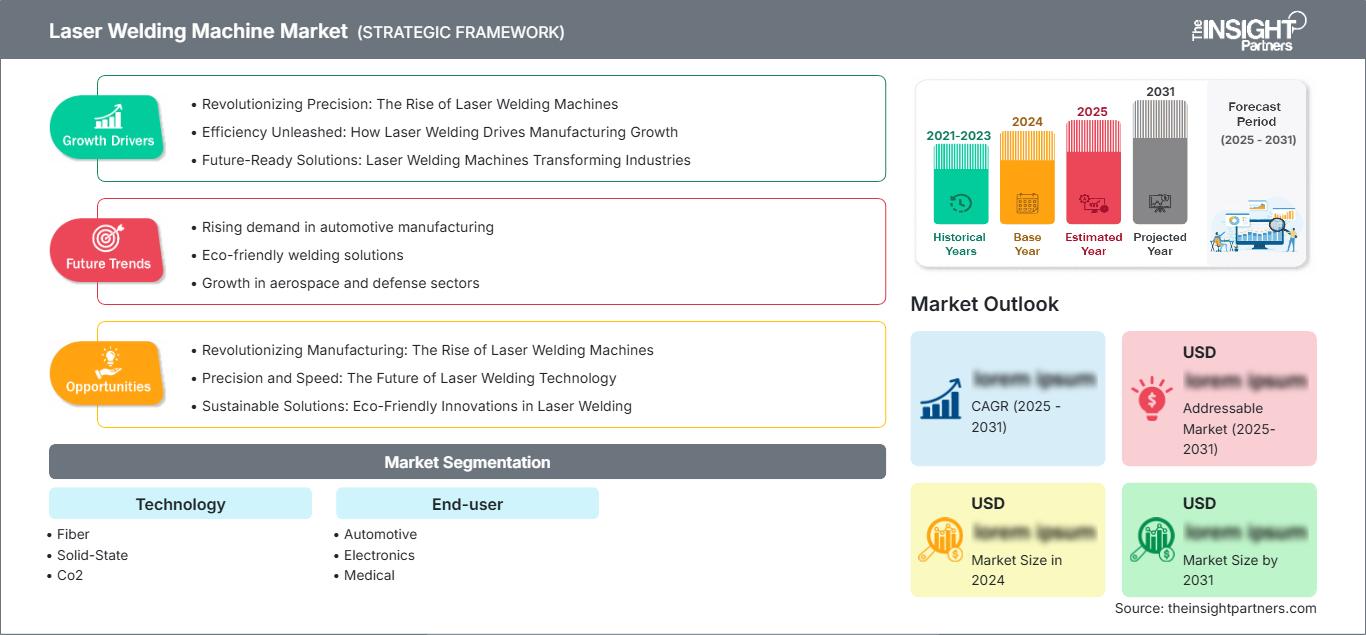
Laser Welding Machine Market: Strategic Insights
Regional Insights
North America Laser Welding Machine Market
North America accounts for 25–30% share in 2025 and is projected to expand at a CAGR of 6.5–7.0% during 2026–2034. Demand is anchored in automotive automation, aerospace structures, medical device manufacturing, and defense fabrication, where laser systems improve repeatability and reduce heat-affected zones.
The region benefits from high robot density, advanced welding qualifications, and strong adoption of process monitoring. EV battery plants, semiconductor equipment suppliers, and contract medical manufacturers are expanding the Laser Welding Machine market share by demanding equipment that supports validated, traceable, and low-defect joining. Canada and Mexico add incremental demand through automotive supply chains.
U.S. Laser Welding Machine Market
USA accounts for 78-82% of North America in 2025 and will have a CAGR of 6.6-7.1% in 2026-2034. Applications in demand include EV battery module welding, aerospace assemblies, medical implants, electronics enclosures, and high-end industrial fabrication where weld uniformity directly influences the warranty expense and quality requirements.
Company footprint is enhanced by IPG Photonics Corporation, Coherent Corp., Emerson Electric Co., FANUC America, LaserStar Technologies Corporation, and MECCO Partners, LLC. Together, they form an ecosystem that facilitates application lab, automation, and service support in addition to reshoring benefits and precision manufacturing investments in battery, defense, and medtech clusters.
Europe Laser Welding Machine Market
Europe holds 20–25% share in 2025 and is forecast to grow at a CAGR of 6.4–6.9% during 2026–2034. Germany remains the leading country because of its automotive equipment base, premium machinery clusters, and strong presence of TRUMPF SE + Co. KG, Jenoptik AG, and specialized integrators.
The market in the UK has been bolstered by aerospace industry, motorsports industry, medical devices, and centers of advanced manufacturing driven by research. Adoption is increasingly driven by use in welding of lightweight alloys, battery prototypes, and high-integrity assemblies, where laser joining minimizes post-processing steps. In the UK, customers have more inclination for flexible cells than high-volume dedicated systems.
French, Italian, and Spanish contributions come from the aerospace, packaging machines, jewelry, and automotive components industries. French focus on aerospace and defense-level traceability, while Italians focus on jewelry and machine tools. Regional Laser Welding Machine market trends favor compact automation, lower energy use, and closed-loop inspection.
APAC Laser Welding Machine Market
In Japan and South Korea, the emphasis lies in high-precision electronics, automotive electrification, and semiconductor equipment. In India, the growth is happening through manufacturing-incentive schemes, batteries, and medical devices.
Australia comes with its unique demand for mining equipment repair, defense manufacturing, and research purposes. Policy support for industrial automation, export manufacturing, and localized supply chains strengthens Laser Welding Machine market growth across the region.
Middle East & Africa Laser Welding Machine Market
Middle East & Africa is projected to grow at a CAGR of 5.8–6.4% during 2026–2034. Saudi Arabia is the leading country, supported by industrial diversification, energy infrastructure, and localized manufacturing programs.
Adoption in UAE is promoted by aerospace maintenance, precise manufacture, and industrial free zones. Adoption in South Africa takes place via mining machinery, automotive parts, and manufacturing based on repair.
Rest of MEA demand is still project-oriented and depends on energy, packaging, and infrastructure equipment. Buyers generally emphasize reliability, service, and training for operators.
Segmentation Analysis
Technology
Technology is expected to record a CAGR of 7.0–7.6% during 2026–2034 as manufacturers migrate toward higher beam quality, software-controlled process windows, and lower operating costs. Fiber systems dominate new investments, while solid-state and CO2 platforms remain relevant where material behavior, installed infrastructure, or process familiarity supports continued use.
- Fiber systems lead adoption because they combine high electrical efficiency, compact design, strong beam quality, and compatibility with robotic cells used in EV batteries, electronics, and precision metal fabrication.
- Solid-State systems remain strategically important for pulsed welding, microjoining, and applications involving dissimilar metals where controlled energy delivery supports reliable seams and reduced component damage.
- Co2 systems retain demand in legacy production lines and selected non-metal or thicker-material applications where users value proven process knowledge, installed tooling, and stable operating parameters.
End-user
End-user demand is forecast to grow at a CAGR of 7.1–7.8% during 2026–2034, led by industries where weld quality affects product reliability, safety, and regulatory compliance. Automotive and electronics generate high equipment volumes, while medical and aerospace require validated performance, documentation, and precise thermal control across specialized materials and miniature assemblies.
- Automotive remains the largest end-user because EV batteries, powertrain components, lightweight body structures, and sensor assemblies require repeatable joining with minimal distortion and high production throughput.
- Electronics demand is rising as miniaturized components, connectors, casings, and sensors require clean micro-welds, precise energy delivery, and automation-compatible joining for high-volume assembly lines.
- Medical adoption is linked to implants, instruments, catheters, and device housings where validated weld integrity, biocompatible materials, and low contamination risk are critical purchasing criteria.
- Aerospace users prioritize laser welding for lightweight alloys, high-integrity structures, turbine-related parts, and repair applications where traceability, repeatability, and reduced heat impact support certification needs.
- Jewelry manufacturers use laser welding for repair, customization, fine joining, and precious-metal conservation, with demand concentrated in compact systems that support skilled operators and small-batch production.
- Packaging applications focus on precision tooling, sealing components, molds, and machinery parts, where fast repair, clean seams, and lower post-processing improve equipment uptime and production continuity.
Opportunity Snapshot
| Segment Name | Revenue Contribution | Trend Tag | Adoption Stage |
| Automotive | High | EV Packs | Mature |
| Electronics | High | Microjoining | Scaling |
| Medical | Medium | Implant Welds | Scaling |
| Aerospace | Medium | Lightweight Alloys | Mature |
| Jewelry | Low | Fine Repair | Mature |
| Packaging | Low | Tooling Repair | Emerging |
Laser Welding Machine Market Growth Drivers and Impact Analysis
EV Battery and E-Mobility Manufacturing Scale-Up
Electric vehicle battery packs require hundreds of precise welds across tabs, busbars, housings, and cooling plates, making laser welding a core production technology rather than a discretionary equipment purchase. It offers the capacity for precise heat delivery, fast pace, and the ability to handle copper, aluminum, and multi-metal combinations. With battery manufacturers scaling up from pilot production to gigafactory scale operations, there is an increasing need for automation and real-time monitoring. This trend results in higher equipment efficiency, higher systems value, and service revenue for years to come.
Precision Requirements in Regulated Manufacturing
Medical equipment, aircraft parts, and other important automotive components are highly controlled by quality documents and cost of failures. The laser welding technology resolves all those issues because it generates reliable seams with minimal distortion, less heat-affected zones, and controllable process parameters. Modern buyers need to have equipment capable of collecting the information about the seam, detecting penetration and defects before assembly of the next step. This improves the market value of the combined sensors and software, and encourages suppliers to offer packages.
Automation Economics and Labor Productivity Pressure
Firms experiencing shortages in skilled welders, rising labor expenses, and accelerated deadlines are moving toward robotized laser welding in order to ensure consistent quality in production. Cells based on laser welding offer less variability in manual processes, increased capacity for production, and compatibility with digital plant systems used for scheduling, inspection, and maintenance purposes. While the initial expense is still high, there is room for improvement in return on investment when scrap reduction and quicker cycles are considered.
Laser Welding Machine Market Future Trends
AI-Guided Weld Monitoring Becomes Standard
Future equipment differentiation will increasingly depend on embedded intelligence that detects seam deviation, porosity risk, spatter, and penetration inconsistency in real time. AI-enabled monitoring will move from premium battery and aerospace cells into broader industrial applications as sensor costs decline and datasets improve. Suppliers with proprietary algorithms and application knowledge will gain pricing power because customers can justify investment through lower scrap and faster qualification. This trend will also shift purchasing decisions toward platform ecosystems rather than individual machines.
Green and Blue Lasers Expand Copper Welding Capability
Copper is increasingly important in EV batteries, power electronics, and renewable energy equipment, yet it is difficult to weld consistently with conventional infrared sources because of reflectivity and thermal conductivity. Green and blue wavelength lasers improve absorption, enabling more stable weld pools and fewer defects in copper-rich assemblies. As power ratings and reliability improve, these systems are expected to move from specialized applications into mainstream battery, connector, and electrical component production, creating a premium technology layer within the market.
Laser Welding Machine Market Opportunities
Application Labs for Emerging Manufacturing Hubs
Suppliers can capture growth in India, Southeast Asia, Mexico, and the Middle East by establishing application labs that help customers qualify materials, fixtures, and process windows before capital purchase. Many regional buyers understand the productivity benefits of laser welding but lack in-house metallurgical and automation expertise. Local demonstration centers shorten sales cycles, reduce adoption risk, and create recurring demand for training, maintenance, and upgrades. This opportunity is especially relevant for battery components, medical devices, electronics, and export-oriented automotive suppliers.
Retrofit Packages for Existing Welding Lines
A large installed base of resistance, arc, and older laser welding equipment creates an opportunity for retrofit packages that add fiber sources, scanner optics, monitoring sensors, and robotic control without full line replacement. This approach appeals to manufacturers seeking productivity gains while limiting downtime and capital exposure. Retrofit strategies can unlock demand among tier suppliers, packaging equipment makers, and precision fabricators that cannot justify greenfield automation cells. Vendors offering modular upgrades can expand addressable demand and strengthen aftermarket relationships.
Recent Developments
- September 2025: TRUMPF will be demonstrating a new solution for the North American market at FABTECH 2025 in Chicago that will improve the quality and robustness of laser welding. Currently, the only way to guide the laser beam during the welding process is via the welding robot – but TRUMPF’s new BrightLine Scan technology will also allow users to guide the laser beam using the laser scanner.
- June 2025: IPG Photonics Corporation (NASDAQ: IPGP), the global leader in fiber laser technology, will showcase new and innovative fiber laser solutions at Laser World of Photonics, June 24-27, 2025 in Munich, Germany. IPG will introduce the LDD-1000-DS, with the novel capability to sense real-time the quality of deep welds, demonstrate integrated On-the-Fly welding solutions, and new cleaning solutions using lasers.
- June 2025: TRUMPF has developed a new system solution that enables users to increase the quality and efficiency of their welding processes. The solution combines several sensors that monitor all process steps during laser welding. An integrated AI quality control system checks the weld seams, for example, and OCT (optical coherence tomography) monitors the welding depth of the laser.
Frequently Asked Questions

- Comprehensive Market Sizing and Forecast Analysis
- Detailed Segmentation Analysis
- In-Depth Market Dynamics Assessment
- Regional and Country-Level Insights
- Competitive Landscape and Company Benchmarking
- Strategic Business Intelligence
Recent Reports
Testimonials

The Insight Partners' SCADA System Market report is comprehensive, with valuable insights on current trends and future forecasts. The team was highly professional, responsive, and supportive throughout. We are very satisfied and highly recommend their services.
RAN KEDEM Partner, Reali Technologies LTDs
I requested a report on a very specific software market and the team produced the report in a few days. The information was very relevant and well presented. I then requested some changes and additions to the report. The team was again very responsive and I got the final report in less than a week.
JEAN-HERVE JENN Chairman, Future Analytica
We worked with The Insight Partners for an important market study and forecast. They gave us clear insights into opportunities and risks, which helped shape our plans. Their research was easy to use and based on solid data. It helped us make smart, confident decisions. We highly recommend them.
PIYUSH NAGPAL Sr. Vice President, High Beam Global
The Insight Partners delivered insightful, well-structured market research with strong domain expertise. Their team was professional and responsive throughout. The user-friendly website made accessing industry reports seamless. We highly recommend them for reliable, high-quality research services
YUKIHIKO ADACHI CEO, Deep Blue, LLC.
This is the first time I have purchased a market report from The Insight Partners.While I was unsure at first, I visited their web site and felt more comfortable to take the risk and purchase a market report.I am completely satisfied with the quality of the report and customer service. I had several questions and comments with the initial report, but after a couple of dialogs over email with their analyst I believe I have a report that I can use as input to our strategic planning process.Thank you so much for taking the extra time and making this a positive experience.I will definitely recommend your service to others and you will be my first call when we need further market data.
JOHN SUZUKI President and Chief Executive Officer, Board Director, BK Technologies
I wish to appreciate your support and the professionalism you displayed in the course of attending to my request for information regarding to infectious disease IVD market in Nigeria. I appreciate your patience, your guidance, and the fact that you were willing to offer a discount, which eventually made it possible for us to close a deal. I look forward to engaging The Insight Partners in the future, all thanks to the impression you have created in me as a result of this first encounter.
DR CHIJIOKE ONYIA MANAGING DIRECTOR, PineCrest Healthcare Ltd.Reason to Buy
- Informed Decision-Making
- Understanding Market Dynamics
- Competitive Analysis
- Identifying Emerging Markets
- Customer Insights
- Market Forecasts
- Risk Mitigation
- Boosting Operational Efficiency
- Strategic Planning
- Investment Justification
- Tracking Industry Innovations
- Aligning with Regulatory Trends





 Get Free Sample for