
Life Science Tools Market Size, Share & Growth by 2034
Coverage: By Type (Instruments, Consumables, Services); Technology (PCR and qPCR, Sanger Sequencing, Separation Technologies, Flow Cytometry, Nucleic Acid Microarray, Mass Spectrometry, Others); End-Use (Government and Academic, Biopharmaceutical Company, Health Care, Industry, Others), and Geography (North America, Europe, Asia Pacific, and South and Central America)
- Status : Data Released
- Report Code : TIPRE00019727
- Category : Life Sciences
- No. of Pages : 150
- Available Report Formats :


- Last update date : March 23, 2026


2025 Market Size
US$ 177.27 Bn
Base year value
2034 Forecast
US$ 359.52 Bn
Projected by 2034
CAGR 2026-2034
8.17 %
Growth rate
Addressable Market
US$ 2,411.59 Bn
(2026-2034)
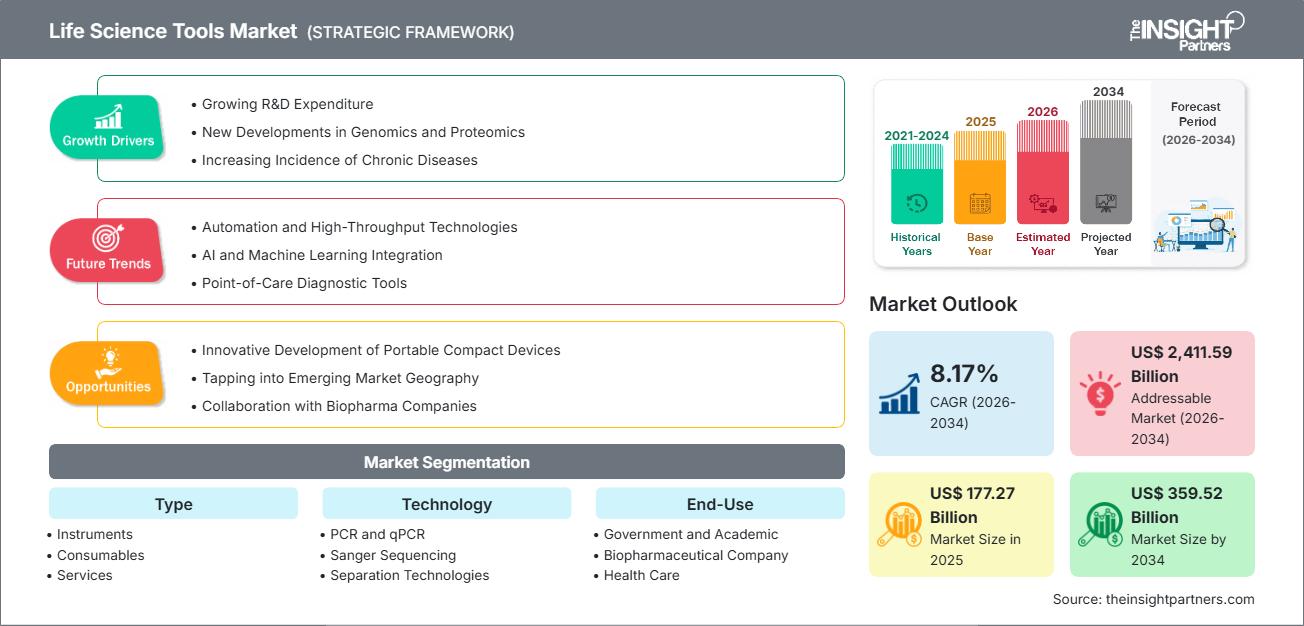
The global Life Science Tools Market size is projected to reach US$ 359.52 billion by 2034 from US$ 177.27 billion in 2025. The market is anticipated to register a CAGR of 8.17% during the forecast period 2026–2034
Key market dynamics include the rapid advancement of genomic and proteomic technologies, increasing R&D investments by biopharmaceutical companies, and a significant shift toward precision medicine and personalized healthcare. Additionally, the market is expected to benefit from the growing adoption of AI-driven analytical tools, the expansion of laboratory automation in emerging economies, and the rising demand for next-generation sequencing (NGS) and multi-omics integration in clinical diagnostics.
Life Science Tools Market Analysis
The life science tools market analysis shows integrated, high-throughput workflows as researchers prioritize speed and data accuracy. The market is shifting into traditional academic research equipment and high-growth industrial manufacturing platforms for advanced therapeutics. Strategic opportunities are emerging in the development of cell and gene therapies, where specialized manufacturing and quality control tools offer a clear competitive advantage. The analysis also notes that market expansion depends on the scalability of digital lab infrastructures and the ability of vendors to navigate complex regulatory environments for Lab-Developed Tests. Competitive differentiation now stands out depending on the ability to offer interoperable platforms, sustainable lab reagents, and robust technical support. This approach helps leading players maintain premium positioning in a landscape with increasingly complex technological requirements.
Life Science Tools Market Overview
Life science tools have advanced from niche laboratory equipment to mainstream industrial solutions essential for modern biology. Life science tools include high-resolution microscopy, mass spectrometry, flow cytometry, and automated liquid handling systems. Both global technology conglomerates and specialized biotech startups compete in this market, using advancements in fields such as microfluidics, nanotechnology, and artificial intelligence. Growing demand for convenient and rapid diagnostic options among healthcare providers in North America and Europe has increased the popularity of molecular biology tools as a portable wellness and clinical solution. North America leads in revenue due to its established pharmaceutical R&D infrastructure, while Asia-Pacific is advancing in manufacturing innovation and retail adoption of diagnostic services. The US market remains a global leader, fueled by extensive biomedical research funding and a sophisticated pharmaceutical infrastructure. Growth is propelled by the integration of AI-driven automation, rising demand for precision medicine, and expanded genomic research. Significant investments in cell and gene therapies further solidify its dominant position.
Market Research Highlights
- Global market for Life Science Tools was valued at US$ 177.27 Billion in 2025
- Annual market size is expected to reach US$ 359.52 Billion by 2034
- Total addressable market (TAM) during 2026-2034 is projected to reach approximately US$ 2,411.59 Billion
- Market is anticipated to register a CAGR of 8.17% during the forecast period
- The United States represents a key market, supported by Growing R&D Expenditure, New Developments in Genomics and Proteomics, Increasing Incidence of Chronic Diseases, as well as evolving industry dynamics
- Market analysis covers North America, Europe, Asia-Pacific, South and Central America, Middle East and Africa, with growth evaluated across the forecast period
- Market opportunities such as Innovative Development of Portable Compact Devices, Tapping into Emerging Market Geography, Collaboration with Biopharma Companies are expected to influence market dynamics and addressable market
- Report profiles industry participants, including Oxford Instruments plc, F. Hoffmann-La Roche Ltd., Shimadzu Corporation, Bio-Rad Laboratories, Inc., Hitachi, Ltd., Illumina, Inc., Agilent Technologies, Inc., EMD Millipore (Merck KGaA), Sigma-Aldrich Corporation, Life Technologies (Thermo Fisher Scientific Corporation), while analyzing competitive strategies and innovation developments
-
Source: The Insight Partners' analysis based on proprietary research, government publications, company annual reports, investor presentations, industry databases, and expert interviews.
● REPORT CUSTOMIZATION
Tailor This Report To Align With Your Specific Business Requirements
This report can be customized to align precisely with your business objectives, scope, and target markets. Customization options include tailored segmentation, geography, competitive analysis, and strategic insights to support informed decision-making.
Customize This Report →WHAT YOU CAN ADJUST
- ● Segmentations
- ● Geography
- ● Competitive Analysis
- ● Language Preferences
Life Science Tools Market: Strategic Insights
-
Get Top Key Market Trends of this report.This FREE sample will include data analysis, ranging from market trends to estimates and forecasts.
Life Science Tools Market Drivers and Opportunities
Market Drivers:
- Advancements in Precision Medicine and Genomics: The shift toward tailored therapies requires high-precision tools like NGS and qPCR for individual-level molecular profiling, which is a primary driver for market growth.
- Rising Biopharmaceutical R&D Expenditure: Increased funding for biologics, biosimilars, and rare disease research has sustained high demand for analytical instruments and high-purity consumables.
- Rapid Adoption of AI and Automation: Laboratories are increasingly adopting automated frameworks and AI-powered data analysis to improve reproducibility, efficiency, and pattern detection in complex datasets.
Market Opportunities:
- Expansion into Cell and Gene Therapy Manufacturing: Specialized closed-system manufacturing units and quality control tools offer significant growth potential as advanced therapies move toward commercialization.
- Growth in Emerging APAC Research Hubs: Forming strategic partnerships in regions like China and India may facilitate access to high-margin market segments where demand for premium research tools is increasing.
- Diversification into Sustainable Lab Solutions: There is a growing opportunity for producers to target eco-conscious institutions through certifications for green chemistry, energy-efficient instruments, and reduced-plastic consumables.
Life Science Tools Market Report Segmentation Analysis
The Life Science Tools Market share is analyzed across various segments to provide a clearer understanding of its structure, growth potential, and emerging trends. Below is the standard segmentation approach used in industry reports:
By Type:
- Consumables: The dominant volume driver, particularly within pharmaceutical and diagnostic sectors, due to the high frequency of repeat purchases for reagents and assay kits.
- Instruments: A high-value segment comprising sequencers, microscopes, and mass spectrometers, characterized by significant capital expenditure and technological innovation.
- Services: The fastest-rising category, enabling laboratories to outsource specialized analytics, maintenance, and cloud-based data management.
By Technology:
- PCR and qPCR: Essential tools widely adopted for molecular biology research, infectious disease testing, and oncology diagnostics.
- Sanger Sequencing: A foundational technology that remains critical for validated clinical sequencing and small-scale genomic research.
- Separation Technologies: Includes chromatography and electrophoresis, which are vital for protein purification and chemical analysis.
- Flow Cytometry: High-growth segment used extensively in immunology and cell therapy research for single-cell analysis.
- Nucleic Acid Microarray: Used for high-throughput gene expression profiling and genetic screening in research settings.
- Mass Spectrometry: Critical for proteomics and metabolomics, offering high sensitivity for identifying complex molecular structures.
- Others: Includes advanced technologies such as Next-Generation Sequencing (NGS), NMR, and electron microscopy.
By End-Use:
- Biopharmaceutical Company: The largest segment, utilizing tools across the drug discovery and manufacturing lifecycle to bring new therapies to market.
- Health Care: A growing segment as hospitals and diagnostic labs integrate advanced tools for patient monitoring and personalized treatment.
- Government and Academic: Focuses on basic research and discovery, supported by public grants and institutional funding for long-term scientific study.
- Industry: Includes applications in food and beverage testing, environmental monitoring, and forensic science.
- Others: Comprises Contract Research Organizations and regulatory agencies.
By Geography:
- North America
- Europe
- Asia Pacific
- South & Central America
- Middle East & Africa
Life Science Tools Market Report Scope
| Report Attribute | Details |
|---|---|
| Market size in 2025 | US$ 177.27 Billion |
| Market Size by 2034 | US$ 359.52 Billion |
| Global CAGR (2026 - 2034) | 8.17% |
| Historical Data | 2021-2024 |
| Forecast period | 2026-2034 |
| Segments Covered |
By Type
|
| Regions and Countries Covered |
North America
|
| Market leaders and key company profiles |
|
Life Science Tools Market Players Density: Understanding Its Impact on Business Dynamics
The Life Science Tools Market is growing rapidly, driven by increasing end-user demand due to factors such as evolving consumer preferences, technological advancements, and greater awareness of the product's benefits. As demand rises, businesses are expanding their offerings, innovating to meet consumer needs, and capitalizing on emerging trends, which further fuels market growth.
Life Science Tools Market Share Analysis by Geography
Asia-Pacific is expected to grow fastest in the coming years. Emerging markets in South & Central America, the Middle East, and Africa also have many untapped opportunities for diagnostic tool manufacturers and bioprocessing companies to expand.
The life science tools market is undergoing a significant transformation, moving from traditional academic tools to global high-value industrial platforms. Growth is driven by the rising prevalence of chronic diseases, a surge in personalized medicine demand, and the expansion of bioprocessing. Below is a summary of market trends by region:
1. North America
- Market Share: Holds the largest global share, driven by a robust pharmaceutical R&D infrastructure and high healthcare spending.
- Key Drivers:
- Presence of industry leaders like Thermo Fisher Scientific and Agilent Technologies
- Significant government funding for health research through organizations like the NIH
- Early adoption of advanced technologies like spatial-omics and AI-driven drug discovery
- Trends: Mainstreaming of multi-omics in clinical workflows and the successful adoption of automated laboratory systems to address labor shortages.
2. Europe
- Market Share: Second-largest market, anchored by strong biotech hubs in Germany, the United Kingdom, and Switzerland.
- Key Drivers:
- High demand for quality control tools in the well-established European pharmaceutical
- Strict regulatory frameworks for clinical diagnostics and medical devices
- Robust public-sector support for genomic research and biobanking
- Trends: A strategic shift toward sustainability and green lab initiatives, along with increasing focus on localized manufacturing to ensure supply chain resilience.
3. Asia-Pacific
- Market Share: The fastest-growing region, with China and India acting as primary for both manufacturing and clinical research.
- Key Drivers:
- Massive investments in biotechnology infrastructure and smart laboratory development
- Government-supported initiatives for precision medicine and population genomics
- Rising disposable incomes leading to a preference for advanced diagnostic services
- Trends: Heavy reliance on digital procurement platforms and the growth of local manufacturers competing with global brands in the mid-range instrument segment.
4. South and Central America
- Market Share: Emerging market with a growing clinical research in countries like Brazil and Chile.
- Key Drivers:
- Increasing awareness of the role of genomics in managing infectious and hereditary diseases
- Modernization of laboratory facilities to meet international quality standards
- Rising interest in clinical trials outsourcing due to diverse patient populations
- Trends: Growth of diagnostic service networks and the introduction of portable, cost-effective analytical tools to reach rural health centers.
5. Middle East and Africa
- Market Share: Developing market with strategic focus on building local life science capabilities to reduce import reliance.
- Key Drivers:
- Regional government investments in precision medicine and biotechnology parks
- High demand for diagnostic tools for disease surveillance in various climates
- Trends: Implementation of modern diagnostic and refrigeration technologies to formalize local healthcare systems, coupled with a focus on training a high-skilled biotech workforce.
High Market Density and Competition
Competition is intensifying due to the presence of established leaders such as Thermo Fisher Scientific, Agilent Technologies, and Danaher Corporation. Regional innovators and niche players like Illumina, QIAGEN, and Bio-Rad Laboratories, alongside diagnostic specialists like Roche, also contribute to a diverse and rapidly expanding market landscape.
This competitive environment pushes vendors to differentiate through:
- Digital Integration: Positioning platforms as part of a connected ecosystem that utilizes cloud computing and AI to manage and interpret vast biological datasets.
- Portfolio Expansion: Life science tools now include more than just hardware. Companies offer specialized software, comprehensive assay kits, and dedicated technical services to ensure customer loyalty.
- Supply Chain Transparency: Producers manage the entire lifecycle, from reagent production to instrument assembly. This approach ensures quality, meets ethical standards, and reduces lead times for critical research.
- New Analytical Technologies: Innovations like spectral flow cytometry and high-sensitivity mass spectrometry help create superior data quality for drug development and clinical research worldwide.
Opportunities and Strategic Moves
- Partner with High-End Research Centers: Tap into the surging demand for personalized medicine and cell therapy by providing specialized tools for high-growth research corridors.
- Incorporate Sustainable Practices: Develop energy-efficient instruments and recyclable consumables to appeal to environmentally conscious researchers and large institutions with green mandates.
Major Companies operating in the Life Science Tools Market are:
- Oxford Instruments plc
- F. Hoffmann-La Roche Ltd.
- Shimadzu Corporation
- Bio-Rad Laboratories, Inc.
- Hitachi, Ltd.
- Illumina, Inc.
- Agilent Technologies, Inc.
- EMD Millipore (Merck KGaA)
- Sigma-Aldrich Corporation
- Life Technologies (Thermo Fisher Scientific Corporation)
Disclaimer: The companies listed above are not ranked in any particular order.
Life Science Tools Market News and Recent Developments
- In February 2026, Waters Corporation launched 1 mm I.D. liquid chromatography (LC) columns with Waters' MaxPeak™ Premier Technology for its ACQUITY™, BioResolve™, and GTxResolve™ Column brands. Significantly improving sensitivity while minimizing solvent and sample waste, the new microflow columns deliver high-quality results across bioanalysis, pharmaceutical discovery and development, and metabolomics, proteomics, and lipidomics, all areas where both sample availability and time are limited.
- In January 2026, Thermo Fisher Scientific announced a strategic collaboration with NVIDIA Leveraging AI to advance scientific instrumentation and accelerate laboratory performance. The effort will leverage the NVIDIA Artificial Intelligence (AI) platform and Thermo Fisher Scientific solutions to progressively increase the automation, accuracy, and speed of laboratories. The companies are working together to evolve the digital foundation that powers scientific instruments, laboratory infrastructure, and data -- connecting them to powerful AI solutions, helping scientists reduce manual steps and accelerate scientific advancement.
Life Science Tools Market Report Coverage and Deliverables
The Life Science Tools Market Size and Forecast (2021–2034) report provides a detailed analysis of the market covering the areas below:
- Life Science Tools Market size and forecast at global, regional, and country levels for all the key market segments covered under the scope
- Life Science Tools Market trends, as well as market dynamics such as drivers, restraints, and key opportunities
- Detailed PEST and SWOT analysis
- Life Science Tools Market analysis covering key market trends, global and regional framework, major players, regulations, and recent market developments
- Industry landscape and competition analysis covering market concentration, heat map analysis, prominent players, and recent developments in the Life Science Tools Market
- Detailed company profiles
Frequently Asked Questions

- Comprehensive Market Sizing and Forecast Analysis
- Detailed Segmentation Analysis
- In-Depth Market Dynamics Assessment
- Regional and Country-Level Insights
- Competitive Landscape and Company Benchmarking
- Strategic Business Intelligence
Recent Reports
Testimonials

The Insight Partners provided valuable market intelligence that supported our global go-to-market strategy. Their team was professional, responsive, and attentive to our feedback, providing thoughtful analysis and helpful methodological clarifications throughout the project.
Junmo Kim Chief Financial Officer (CFO), Enertech Co., Ltd.
The Insight Partners' SCADA System Market report is comprehensive, with valuable insights on current trends and future forecasts. The team was highly professional, responsive, and supportive throughout. We are very satisfied and highly recommend their services.
RAN KEDEM Partner, Reali Technologies LTDs
I requested a report on a very specific software market and the team produced the report in a few days. The information was very relevant and well presented. I then requested some changes and additions to the report. The team was again very responsive and I got the final report in less than a week.
JEAN-HERVE JENN Chairman, Future Analytica
We worked with The Insight Partners for an important market study and forecast. They gave us clear insights into opportunities and risks, which helped shape our plans. Their research was easy to use and based on solid data. It helped us make smart, confident decisions. We highly recommend them.
PIYUSH NAGPAL Sr. Vice President, High Beam Global
The Insight Partners delivered insightful, well-structured market research with strong domain expertise. Their team was professional and responsive throughout. The user-friendly website made accessing industry reports seamless. We highly recommend them for reliable, high-quality research services
YUKIHIKO ADACHI CEO, Deep Blue, LLC.
This is the first time I have purchased a market report from The Insight Partners.While I was unsure at first, I visited their web site and felt more comfortable to take the risk and purchase a market report.I am completely satisfied with the quality of the report and customer service. I had several questions and comments with the initial report, but after a couple of dialogs over email with their analyst I believe I have a report that I can use as input to our strategic planning process.Thank you so much for taking the extra time and making this a positive experience.I will definitely recommend your service to others and you will be my first call when we need further market data.
JOHN SUZUKI President and Chief Executive Officer, Board Director, BK Technologies
I wish to appreciate your support and the professionalism you displayed in the course of attending to my request for information regarding to infectious disease IVD market in Nigeria. I appreciate your patience, your guidance, and the fact that you were willing to offer a discount, which eventually made it possible for us to close a deal. I look forward to engaging The Insight Partners in the future, all thanks to the impression you have created in me as a result of this first encounter.
DR CHIJIOKE ONYIA MANAGING DIRECTOR, PineCrest Healthcare Ltd.Reason to Buy
- Informed Decision-Making
- Understanding Market Dynamics
- Competitive Analysis
- Identifying Emerging Markets
- Customer Insights
- Market Forecasts
- Risk Mitigation
- Boosting Operational Efficiency
- Strategic Planning
- Investment Justification
- Tracking Industry Innovations
- Aligning with Regulatory Trends





 Get Free Sample for