
Lifestyle Drugs Market Growth, Share & Trends by 2034
Coverage: By Type (Obesity, Women's Health, Insomnia, Sexual Dysfunction, Dermatology, and Smoking); Form (Tablets, Gels, Oral Syrups, Parenteral, Creams, and Chewing Gums); End User (Hospital Pharmacies, Retail Pharmacies, Drug Stores, Clinics, e-Commerce/Online Pharmacies, and Others), and Geography (North America, Europe, Asia Pacific, and South and Central America)
- Status : Data Released
- Report Code : TIPRE00022706
- Category : Life Sciences
- No. of Pages : 150
- Available Report Formats :


- Last update date : June 22, 2026


2025 Market Size
US$ 33.51 Bn
Base year value
2034 Forecast
US$ 43.42 Bn
Projected by 2034
CAGR 2026-2034
2.92 %
Growth rate
Addressable Market
US$ 349.23 Bn
(2026-2034)
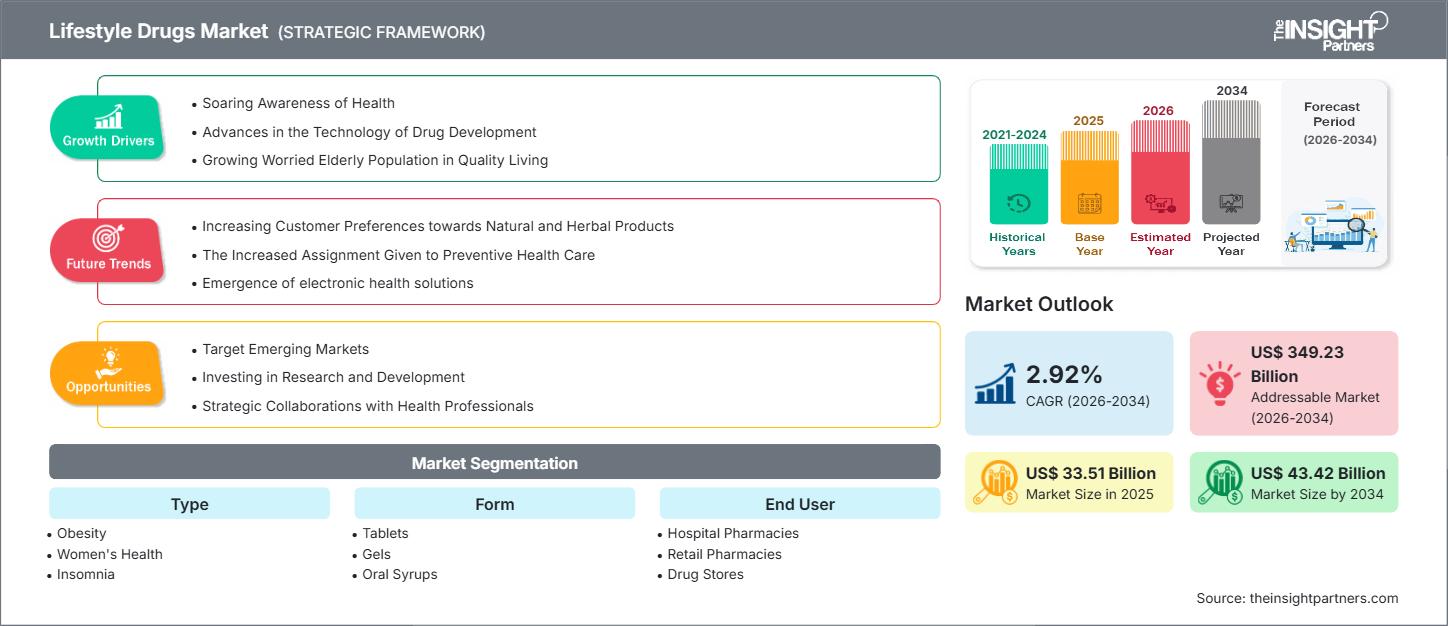
The global lifestyle drugs market size is projected to reach US$ 43.42 billion by 2034 from US$ 33.51 billion in 2025. The market is anticipated to register a CAGR of 2.92% during the forecast period 2026–2034.
Key market dynamics include a heightening global focus on personalized wellness, rising consumer awareness regarding quality-of-life enhancements, and a significant shift toward medical solutions for conditions related to modern living habits. Additionally, the market is expected to benefit from the growing popularity of metabolic health treatments, expansion in digital pharmacy infrastructure across emerging economies, and the increasing inclusion of aesthetic and functional medicines in standard healthcare regimens.
Lifestyle Drugs Market Analysis
The lifestyle drugs market analysis shows a shift toward high-value elective therapeutics as consumers prioritize self-image, performance, and long-term vitality. The market is diversifying into high-volume retail sectors for smoking cessation and hair loss, and high-growth clinical segments for obesity and hormone management. Strategic opportunities are emerging in specialized women's health and dermatology, where advanced formulations offer a clear competitive advantage over traditional generic options. The analysis also notes that market expansion depends on the integration of user-friendly delivery forms to ensure patient compliance and the efficiency of direct-to-consumer supply chains. Competitive differentiation now stands out depending on branding that highlights lifestyle integration, clinical safety, and the ability to provide discreet access to sensitive treatments. This approach helps established pharmaceutical providers maintain market leadership in an increasingly crowded global landscape.
Lifestyle Drugs Market Overview
Lifestyle drugs have evolved from niche supplements to essential components of modern healthcare. The market includes metabolic regulators, dermatological treatments, and sexual wellness aids. Both global pharmaceutical corporations and specialized biotech firms compete in this market, utilizing a wide range of delivery systems such as parenteral injectables, topical creams, and specialized chewing gums. Growing demand for convenient, self-administered options among health-conscious consumers in North America and Europe has increased the popularity of lifestyle drugs as a portable wellness solution. North America leads in revenue due to its established medical culture, while Asia-Pacific is advancing in manufacturing innovation and retail adoption. The US market remains a primary global hub, significantly influenced by a robust landscape of generic alternatives. The high availability of off-patent formulations for sexual wellness and hair loss allows for competitive pricing. This widespread accessibility, supported by streamlined regulatory pathways, ensures that cost-effective options are readily available to a broad consumer base.
Market Research Highlights
- Global market for Lifestyle Drugs was valued at US$ 33.51 Billion in 2025
- Annual market size is expected to reach US$ 43.42 Billion by 2034
- Total addressable market (TAM) during 2026-2034 is projected to reach approximately US$ 349.23 Billion
- Market is anticipated to register a CAGR of 2.92% during the forecast period
- The United States represents a key market, supported by Soaring Awareness of Health, Advances in the Technology of Drug Development, Growing Worried Elderly Population in Quality Living, as well as evolving industry dynamics
- Market analysis covers North America, Europe, Asia-Pacific, South and Central America, Middle East and Africa, with growth evaluated across the forecast period
- Market opportunities such as Target Emerging Markets, Investing in Research and Development, Strategic Collaborations with Health Professionals are expected to influence market dynamics and addressable market
- Report profiles industry participants, including Allergan, BMS, Eli Lilly, Galderma, Merck, Pfizer, Novartis, AstraZeneca, Sanofi, Valeant Pharmaceuticals, Johnson & Johnson, while analyzing competitive strategies and innovation developments
-
Source: The Insight Partners' analysis based on proprietary research, government publications, company annual reports, investor presentations, industry databases, and expert interviews.
● REPORT CUSTOMIZATION
Tailor This Report To Align With Your Specific Business Requirements
This report can be customized to align precisely with your business objectives, scope, and target markets. Customization options include tailored segmentation, geography, competitive analysis, and strategic insights to support informed decision-making.
Customize This Report →WHAT YOU CAN ADJUST
- ● Segmentations
- ● Geography
- ● Competitive Analysis
- ● Language Preferences
Lifestyle Drugs Market: Strategic Insights
-
Get Top Key Market Trends of this report.This FREE sample will include data analysis, ranging from market trends to estimates and forecasts.
Lifestyle Drugs Market Drivers and Opportunities
Market Drivers:
- Increasing Global Obesity and Metabolic Concerns: The rising prevalence of sedentary lifestyles and high-calorie diets is driving substantial demand for weight management medications and metabolic regulators.
- Growing Focus on Aesthetic and Physical Appearance: A cultural shift toward prolonged youthfulness and self-improvement is fueling the expansion of dermatology and hair regrowth segments.
- Destigmatization of Sensitive Health Issues: Greater public conversation and the rise of private consultation platforms have significantly boosted the market for sexual dysfunction and mental wellness treatments.
Market Opportunities:
- Expansion of Telehealth and Online Pharmacy Models: Digital platforms offer a massive opportunity to reach consumers in underserved regions, providing discreet access to lifestyle-enhancing prescriptions.
- Growth in Personalized Women's Health: Developing targeted pharmaceutical solutions for hormonal balance and age-related transitions presents a high-margin opportunity for innovators.
- Innovation in Non-Invasive Delivery Forms: There is a growing opportunity for producers to transition from traditional tablets to gels, creams, and parenteral forms that offer higher bioavailability and better user experiences.
Lifestyle Drugs Market Report Segmentation Analysis
The lifestyle drugs market share is analyzed across various segments to provide a clearer understanding of its structure, growth potential, and emerging trends. Below is the standard segmentation approach used in most industry reports:
By Type:
- Obesity: A fast-growing segment driven by the global need for metabolic intervention and high-efficacy weight management therapies.
- Women's Health: Includes treatments for hormonal regulation and reproductive wellness, catering to an increasingly health-aware female demographic.
- Insomnia: A rising category as consumers seek medical help for sleep disturbances caused by modern high-stress environments.
- Sexual Dysfunction: An established and major revenue contributor, benefiting from continuous brand innovation and reduced social stigma.
- Dermatology: Focuses on anti-aging, acne, and hair loss treatments, aligning with global aesthetic trends.
- Smoking: Centered on cessation aids that support public health initiatives and personal wellness goals.
By Form:
- Tablets: The dominant form due to ease of manufacturing, precise dosing, and widespread consumer familiarity.
- Gels and Creams: Preferred for topical applications in dermatology and certain sexual health treatments, offering targeted relief.
- Oral Syrups: Provide an alternative for patients who have difficulty swallowing solids, often used in pediatric or geriatric lifestyle care.
- Parenteral: A growing segment for high-potency obesity and hormone treatments requiring injection for maximum efficacy.
- Chewing Gums: Primarily utilized in the smoking cessation market to provide controlled nicotine delivery and behavioral support.
By End User:
- Retail Pharmacies: The primary touchpoint for most consumers, offering immediate access to a wide range of lifestyle medications.
- e-Commerce/Online Pharmacies: The fastest-growing channel, providing privacy, convenience, and home delivery for sensitive lifestyle products.
- Hospital Pharmacies and Clinics: Essential for specialist-led treatments such as clinical weight loss and dermatological procedures.
- Drug Stores and Others: Play a key role in the distribution of over-the-counter lifestyle aids and wellness supplements.
By Geography:
- North America
- Europe
- Asia Pacific
- South & Central America
- Middle East & Africa
Lifestyle Drugs Market Report Scope
| Report Attribute | Details |
|---|---|
| Market size in 2025 | US$ 33.51 Billion |
| Market Size by 2034 | US$ 43.42 Billion |
| Global CAGR (2026 - 2034) | 2.92% |
| Historical Data | 2021-2024 |
| Forecast period | 2026-2034 |
| Segments Covered |
By Type
|
| Regions and Countries Covered |
North America
|
| Market leaders and key company profiles |
|
Lifestyle Drugs Market Players Density: Understanding Its Impact on Business Dynamics
The Lifestyle Drugs Market is growing rapidly, driven by increasing end-user demand due to factors such as evolving consumer preferences, technological advancements, and greater awareness of the product's benefits. As demand rises, businesses are expanding their offerings, innovating to meet consumer needs, and capitalizing on emerging trends, which further fuels market growth.
Lifestyle Drugs Market Share Analysis by Geography
Asia-Pacific is expected to grow fastest in the coming years due to rising disposable incomes and urbanization. Emerging markets in South & Central America, the Middle East, and Africa also have many untapped opportunities for global pharmaceutical providers to expand their lifestyle portfolios.
The lifestyle drugs market is undergoing a significant transformation, moving from traditional apothecary-based sales to a digital-first, global wellness economy. Growth is driven by the rising prevalence of metabolic syndromes, a surge in performance-aging demand, and the expansion of the direct-to-consumer (D2C) pharmaceutical industry. Below is a summary of market share and trends by region:
1. North America
- Market Share: Holds the largest global revenue share, driven by high healthcare spending and a culture of medicalized self-improvement.
- Key Drivers:
- Widespread adoption of high-cost GLP-1 agonists for weight management.
- Mainstreaming of discreet healthcare via telehealth platforms like Hims & Hers and Ro.
- High consumer awareness regarding hair loss and dermatological pharmaceutical interventions.
- Trends: Integration of AI-driven subscription models for personalized dosing and the rapid expansion of parenteral (injectable) treatments in the home-care setting.
2. Europe
- Market Share: A mature and stable market, anchored by robust regulatory frameworks and a growing focus on preventive quality-of-life care.
- Key Drivers:
- Strict government initiatives supporting smoking cessation programs and related pharmaceutical aids.
- High demand for insomnia and stress-management medications in urban centers.
- Established insurance coverage for certain lifestyle-adjacent metabolic treatments.
- Trends: A strategic shift toward clean-label pharmaceuticals and sustainable packaging to meet the demands of eco-conscious European consumers.
3. Asia-Pacific
- Market Share: The fastest-growing region, with China and India acting as a massive market for both consumption and generic drug manufacturing.
- Key Drivers:
- Rapidly rising middle-class disposable incomes and a preference for Western luxury pharmaceutical brands.
- Government-supported health digitalization initiatives in Southeast Asia.
- Massive demand for dermatological treatments, particularly skin-lightening and acne-control medications.
- Trends: Heavy reliance on mobile-first e-commerce platforms and B2B contracts for high-volume supply of sexual dysfunction and hair-growth generics.
4. South and Central America
- Market Share: An emerging market with a booming aesthetic and dermatology sector in countries like Brazil and Chile.
- Key Drivers:
- Cultural emphasis on physical aesthetics and body image fuels the dermatology and obesity segments.
- Modernization of pharmacy retail chains to include specialized lifestyle drug sections.
- Rising interest in hormone replacement therapies among aging urban populations.
- Trends: Growth of boutique wellness clinics that offer pharmaceutical-grade aesthetic regimens and a rise in local generic competition.
5. Middle East and Africa
- Market Share: Developing market with high untapped potential, transitioning toward formalized commercial production of wellness drugs.
- Key Drivers:
- High regional prevalence of Type 2 diabetes and obesity driving demand for metabolic lifestyle drugs.
- Strategic investments in smart pharmacy infrastructure in the Gulf region.
- Increasing demand for fertility and sexual wellness products in growing urban hubs.
- Trends: Implementation of cold-chain logistics to support the distribution of temperature-sensitive injectables and a focus on high-potency oral formulations.
High Market Density and Competition
Competition is intensifying due to the presence of established leaders such as Pfizer Inc., Eli Lilly and Company, and Novo Nordisk A/S. Regional generic experts and niche players also contribute to a diverse and rapidly expanding market landscape.
This competitive environment pushes vendors to differentiate through:
- Formulation Innovation: Developing multi-functional treatments that address both aesthetic and metabolic health in a single regimen.
- Strategic Partnerships: Collaborating with digital health platforms to simplify the patient journey from consultation to home delivery.
- Supply Chain Excellence: Ensuring consistent availability of specialized forms like parenteral injectables and temperature-sensitive creams.
Opportunities and Strategic Moves
- Partner with Telehealth and D2C Platforms: To tap into the surging demand for private, convenient access to sensitive lifestyle treatments in Asia-Pacific and North American markets.
- Incorporate Personalized Medicine: Using genetic markers or lifestyle data to customize dosages, appealing to the high-end biohacking demographic and tech-savvy millennials
Major Companies operating in the Lifestyle Drugs Market are:
- Allergan
- BMS
- Eli Lilly
- Galderma
- Merck
- Pfizer
- Novartis
- AstraZeneca
- Sanofi
- Valeant Pharmaceuticals
- Johnson & Johnson
Lifestyle Drugs Market News and Recent Developments
- In January 2026, Syngene International announced the extension of its long-standing strategic collaboration with Bristol Myers Squibb through 2035. The expanded agreement broadens the scope of integrated services across the drug development lifecycle, spanning discovery (chemistry, biology, drug metabolism, and pharmacokinetics), translational sciences, pharmaceutical development and manufacturing, clinical trials, data, and information technology services to enable seamless progression from research to commercialization. The expansion of this collaboration marks the next phase of growth, reinforcing Syngene's position as a strategic partner delivering integrated, end-to-end scientific and manufacturing solutions.
- In December 2025, Fosun Pharma announced that its subsidiaries, Chongqing Yao Pharmaceutical Company, Limited, Shanghai Fosun Pharmaceutical Industrial Development Company Limited, and Pfizer Inc. have entered into an exclusive collaboration and license agreement. Under this agreement, Yao Pharma grants Pfizer an exclusive worldwide license for the development, use, manufacturing, and commercialization of oral small-molecule glucagon-like peptide-1 receptor (GLP-1R) agonists, including YP05002, and any products containing such oral small-molecule GLP-1R agonists as an active ingredient.
Lifestyle Drugs Market Report Coverage and Deliverables
The Lifestyle Drugs Market Size and Forecast (2021–2034) report provides a detailed analysis of the market covering below areas:
- Lifestyle Drugs Market size and forecast at global, regional, and country levels for all the key market segments covered under the scope
- Lifestyle Drugs Market trends, as well as market dynamics such as drivers, restraints, and key opportunities
- Detailed PEST and SWOT analysis
- Lifestyle Drugs Market analysis covering key market trends, global and regional framework, major players, regulations, and recent market developments
- Industry landscape and competition analysis covering market concentration, heat map analysis, prominent players, and recent developments in the Lifestyle Drugs Market.
- Detailed company profiles
Frequently Asked Questions

- Comprehensive Market Sizing and Forecast Analysis
- Detailed Segmentation Analysis
- In-Depth Market Dynamics Assessment
- Regional and Country-Level Insights
- Competitive Landscape and Company Benchmarking
- Strategic Business Intelligence
Recent Reports
Testimonials

The Insight Partners' SCADA System Market report is comprehensive, with valuable insights on current trends and future forecasts. The team was highly professional, responsive, and supportive throughout. We are very satisfied and highly recommend their services.
RAN KEDEM Partner, Reali Technologies LTDs
I requested a report on a very specific software market and the team produced the report in a few days. The information was very relevant and well presented. I then requested some changes and additions to the report. The team was again very responsive and I got the final report in less than a week.
JEAN-HERVE JENN Chairman, Future Analytica
We worked with The Insight Partners for an important market study and forecast. They gave us clear insights into opportunities and risks, which helped shape our plans. Their research was easy to use and based on solid data. It helped us make smart, confident decisions. We highly recommend them.
PIYUSH NAGPAL Sr. Vice President, High Beam Global
The Insight Partners delivered insightful, well-structured market research with strong domain expertise. Their team was professional and responsive throughout. The user-friendly website made accessing industry reports seamless. We highly recommend them for reliable, high-quality research services
YUKIHIKO ADACHI CEO, Deep Blue, LLC.
This is the first time I have purchased a market report from The Insight Partners.While I was unsure at first, I visited their web site and felt more comfortable to take the risk and purchase a market report.I am completely satisfied with the quality of the report and customer service. I had several questions and comments with the initial report, but after a couple of dialogs over email with their analyst I believe I have a report that I can use as input to our strategic planning process.Thank you so much for taking the extra time and making this a positive experience.I will definitely recommend your service to others and you will be my first call when we need further market data.
JOHN SUZUKI President and Chief Executive Officer, Board Director, BK Technologies
I wish to appreciate your support and the professionalism you displayed in the course of attending to my request for information regarding to infectious disease IVD market in Nigeria. I appreciate your patience, your guidance, and the fact that you were willing to offer a discount, which eventually made it possible for us to close a deal. I look forward to engaging The Insight Partners in the future, all thanks to the impression you have created in me as a result of this first encounter.
DR CHIJIOKE ONYIA MANAGING DIRECTOR, PineCrest Healthcare Ltd.Reason to Buy
- Informed Decision-Making
- Understanding Market Dynamics
- Competitive Analysis
- Identifying Emerging Markets
- Customer Insights
- Market Forecasts
- Risk Mitigation
- Boosting Operational Efficiency
- Strategic Planning
- Investment Justification
- Tracking Industry Innovations
- Aligning with Regulatory Trends





 Get Free Sample for