
Linseed Oil Market Growth, Size & Forecast by 2034
Coverage: By Nature (Organic, Conventional); Product Type (Raw Linseed Oil, Boiled Linseed Oil, Double-Boiled Linseed Oil, Others); Application (Paints and Varnishes, Flooring, Processed Food, Cosmetics, Pharmaceuticals, Others), and Geography (North America, Europe, Asia Pacific, and South and Central America)
- Status : Data Released
- Report Code : TIPRE00016425
- Category : Chemicals and Materials
- No. of Pages : 150
- Available Report Formats :


- Last update date : March 24, 2026


2025 Market Size
US$ 3.66 Bn
Base year value
2034 Forecast
US$ 6.16 Bn
Projected by 2034
CAGR 2026-2034
5.95 %
Growth rate
Addressable Market
US$ 44.47 Bn
(2026-2034)
The Linseed Oil Market size is expected to reach US$ 6.16 Billion by 2034 from US$ 3.66 Billion in 2025. The market is estimated to record a CAGR of 5.95% from 2026 to 2034.
Key market dynamics include an escalating industrial pivot toward bio-based and sustainable drying oils, rising consumer integration of plant-based Omega-3 fatty acids into daily diets, and the rapid expansion of the eco-friendly construction industry. Additionally, the market is expected to benefit from the growing preference for natural wood finishes in premium interior design, advancements in cold-pressing extraction technologies that preserve nutrient integrity, and the increasing utilization of linseed derivatives in high-end cosmetic and dermatological formulations.
Linseed Oil Market Analysis
The linseed oil market analysis indicates a strategic shift toward high-purity, multi-functional oils as industries seek renewable alternatives to petroleum-based resins. Procurement trends suggest a clear division between the high-volume industry, focused on VOC-compliant paints and varnishes, and the high-margin nutraceutical market, which prioritizes organic and cold-pressed certifications. Strategic opportunities are emerging in the green building movement, where linseed oil’s natural polymerizing properties offer a competitive edge for architects and developers aiming for LEED or equivalent sustainability certifications. The analysis also underscores that market resilience is increasingly tied to supply chain transparency and the ability to mitigate price volatility in flaxseed harvests through long-term agricultural partnerships and regenerative farming practices.
Linseed Oil Market Overview
Linseed oil is transitioning from a traditional industrial commodity to a versatile, high-value ingredient across the food, health, and manufacturing markets. Historically valued for its role as a binder in oil paints and wood treatments, linseed oil (or flaxseed oil) is now experiencing a resurgence driven by its rich concentration of alpha-linolenic acid (ALA). Global production remains concentrated in temperate climates suitable for flax cultivation, but distribution networks are expanding rapidly to meet the burgeoning demand in emerging economies. The market ecosystem comprises large-scale global processors who dominate the industrial supply and smaller specialty firms catering to the clean-label food and beauty markets. As sustainability becomes a core corporate mandate, linseed oil is increasingly positioned as a key feedstock for biodegradable polymers and eco-friendly coatings. For instance, the market in the US represents a significant and mature hub for the linseed oil market, driven by a robust demand for sustainable home improvement products and premium health supplements. Growing awareness of plant-based nutrition has integrated the oil into mainstream diets, while stringent environmental regulations continue to favor its use in industrial applications.
Market Research Highlights
- Global market for Linseed Oil was valued at US$ 3.66 Billion in 2025
- Annual market size is expected to reach US$ 6.16 Billion by 2034
- Total addressable market (TAM) during 2026-2034 is projected to reach approximately US$ 44.47 Billion
- Market is anticipated to register a CAGR of 5.95% during the forecast period
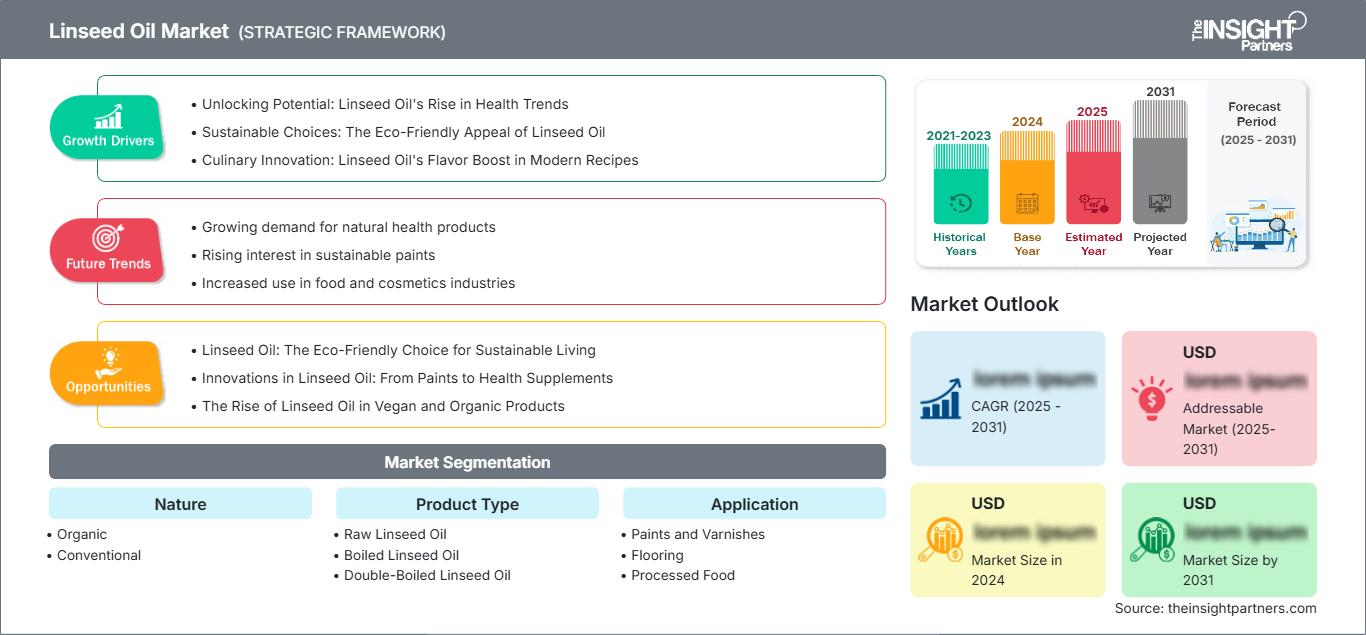
- The United States represents a key market, supported by Unlocking Potential: Linseed Oil's Rise in Health Trends, Sustainable Choices: The Eco-Friendly Appeal of Linseed Oil, Culinary Innovation: Linseed Oil's Flavor Boost in Modern Recipes, as well as evolving industry dynamics
- Market analysis covers North America, Europe, Asia-Pacific, South and Central America, Middle East and Africa, with growth evaluated across the forecast period
- Market opportunities such as Linseed Oil: The Eco-Friendly Choice for Sustainable Living, Innovations in Linseed Oil: From Paints to Health Supplements, The Rise of Linseed Oil in Vegan and Organic Products are expected to influence market dynamics and addressable market
- Report profiles industry participants, including Archer Daniels Midland (ADM) Company, Cargill, Inc., Carrington Farms, G.C. Rutteman and Co. B.V., Gustav Heess GmbH, Henry Lamotte Oils GmbH, Krishi Oils Limited (KOL), Linolie Danmark Aps, Natrol LLC, Natural Factors, Inc., while analyzing competitive strategies and innovation developments
-
Source: The Insight Partners' analysis based on proprietary research, government publications, company annual reports, investor presentations, industry databases, and expert interviews.
● REPORT CUSTOMIZATION
Tailor This Report To Align With Your Specific Business Requirements
This report can be customized to align precisely with your business objectives, scope, and target markets. Customization options include tailored segmentation, geography, competitive analysis, and strategic insights to support informed decision-making.
Customize This Report →WHAT YOU CAN ADJUST
- ● Segmentations
- ● Geography
- ● Competitive Analysis
- ● Language Preferences
Linseed Oil Market: Strategic Insights
-
Get Top Key Market Trends of this report.This FREE sample will include data analysis, ranging from market trends to estimates and forecasts.
Market Drivers:
- Surge in Sustainable and Bio-Based Coatings: As global environmental regulations tighten regarding Volatile Organic Compounds (VOCs), the paint and coating industry is rapidly adopting linseed oil as a natural, biodegradable binder. Its ability to polymerize into a durable, protective film makes it an essential component for eco-friendly industrial and decorative finishes.
- Rising Health Awareness and Omega-3 Demand: Linseed oil is one of the richest plant sources of Omega-3 fatty acids. Increasing consumer focus on heart health, cognitive function, and anti-inflammatory diets has propelled its use as a primary ingredient in dietary supplements, functional foods, and pharmaceutical preparations.
- Expansion of the Premium Wood Finishing Market: The global trend toward natural and artisanal aesthetics in furniture and flooring has reinvigorated the demand for linseed oil. Unlike synthetic lacquers, linseed oil penetrates wood fibers to provide a breathable, protective finish that highlights natural textures, appealing to high-end residential and commercial designers.
Market Opportunities:
- Innovation in Nutraceutical and Cosmetic Formulations: There is a significant opportunity to develop specialized linseed oil derivatives for the Clean Beauty sector. Its moisturizing and regenerative properties make it an ideal candidate for anti-aging serums, hair care products, and skin barrier repair treatments targeted at eco-conscious consumers.
- Adoption in Regenerative and Smart Agriculture: Producers can capitalize on the growing demand for ethically sourced raw materials by implementing regenerative farming certifications. This not only secures the supply chain against climate volatility but also allows brands to command a premium price through enhanced sustainability storytelling.
- Development of Industrial Biolubricants and Resins: Beyond traditional paints, there is vast potential for linseed oil in the production of bio-based lubricants, linoleum flooring, and specialized polymers. Strategic R&D into the chemical modification of the oil can open new B2B channels in automotive and aerospace, seeking renewable materials.
Linseed Oil Market Report Segmentation
Analysis
The Linseed Oil Market share is analyzed across various segments to provide a clearer understanding of its structure, growth potential, and emerging trends. Below is the standard segmentation approach used in most industry reports:
By Nature:
- Organic: This segment is experiencing rapid growth, fueled by health-conscious consumers and the clean-label movement. It is predominantly used in the food, supplement, and premium cosmetic market, where pesticide-free certification is a key purchasing driver.
- Conventional: The dominant volume driver for the market, widely utilized in large-scale industrial applications such as mass-market paints, varnishes, and commercial flooring due to its cost-effectiveness and established supply chains.
By Product Type:
- Raw Linseed Oil: Primarily used for delicate wood finishes and interior applications, as well as being the base for further processing. It is valued for its slow drying time and deep penetration capabilities.
- Boiled Linseed Oil: A major industrial segment where the oil is pre-heated and treated with metallic dryers to significantly reduce drying time, making it ideal for exterior wood protection and industrial coatings.
- Double-Boiled Linseed Oil: A refined variant that offers even faster drying and a thicker consistency, often used in specialized marine applications and high-performance traditional paints.
- Others: Includes stand oil, pale boiled oil, and refined pharmaceutical-grade oils tailored for specific chemical or nutritional requirements.
By Application:
- Paints and Varnishes: The largest application segment, where the oil acts as a drying agent and binder for high-quality, eco-friendly coatings.
- Flooring: Used extensively in the manufacture of linoleum and as a natural sealer for wooden floors in sustainable building projects.
- Processed Food: An expanding segment where the oil is used as a nutritional fortifier in baked goods, juices, and functional spreads.
- Cosmetics: Utilized in skin and hair care for its moisturizing, anti-inflammatory, and high Vitamin E content.
- Pharmaceuticals: Employed as a carrier or active ingredient in supplements and topical treatments focused on cardiovascular and skin health.
- Others: Includes applications in animal feed, inks, and as a feedstock for bio-based chemicals.
By Geography:
- North America
- Europe
- Asia Pacific
- South & Central America
- Middle East & Africa
Linseed Oil Market Report Scope
| Report Attribute | Details |
|---|---|
| Market size in 2025 | US$ 3.66 Billion |
| Market Size by 2034 | US$ 6.16 Billion |
| Global CAGR (2026 - 2034) | 5.95% |
| Historical Data | 2021-2024 |
| Forecast period | 2026-2034 |
| Segments Covered |
By Nature
|
| Regions and Countries Covered |
North America
|
| Market leaders and key company profiles |
|
Linseed Oil Market Players Density: Understanding Its Impact on Business Dynamics
The Linseed Oil Market is growing rapidly, driven by increasing end-user demand due to factors such as evolving consumer preferences, technological advancements, and greater awareness of the product's benefits. As demand rises, businesses are expanding their offerings, innovating to meet consumer needs, and capitalizing on emerging trends, which further fuels market growth.
Linseed Oil Market Share Analysis by Geography
Asia-Pacific is expected to grow fastest in the coming years due to massive construction activity and a rising middle class. North America and Europe currently maintain substantial shares, supported by mature industrial bases and high health-consciousness.
The linseed oil market is undergoing a significant transformation, moving from a traditional industrial binder to a global high-value functional oil. Growth is driven by the global transition toward bio-based materials and the mainstreaming of plant-based nutrition. Below is a summary of market share and trends by region:
North America
- Market Share: A leading regional segment driven by a robust demand for premium wood finishes and dietary supplements.
- Key Drivers:
- Strict environmental regulations favoring low-VOC and bio-based industrial coatings.
- High consumer adoption of Omega-3-rich plant oils in the US and Canada.
- Significant presence of major global players like ADM and Cargill.
- Trends: Increasing investment in traceable and regenerative flaxseed supply chains and a surge in the DIY home restoration market using natural oils.
Europe
- Market Share: Holds a substantial share, anchored by a strong tradition of wood craftsmanship and the most stringent organic certification standards globally.
- Key Drivers:
- Strong government backing for sustainable building materials and Green Deal initiatives.
- High demand for traditionally manufactured, solvent-free linseed oil paints for historic preservation.
- Established infrastructure for organic and cold-pressed oil production.
- Trends: A strategic shift toward using linseed oil as a feedstock for bio-polymers and the growth of the organic nutraceutical market in Germany and France.
Asia-Pacific
- Market Share: The fastest-growing region, with countries like China, India, and Australia serving as both major producers and massive consumption hubs.
- Key Drivers:
- Unprecedented infrastructure and residential construction growth require vast quantities of paint and flooring.
- Rising disposable income is leading to a preference for premium, health-focused food ingredients.
- Large-scale flaxseed cultivation provides a stable regional raw material base.
- Trends: Rapid expansion of e-commerce channels for health supplements and the formalization of industrial coatings in Southeast Asia.
South and Central America
- Market Share: An emerging market with a growing artisanal and industrial sector in countries like Brazil and Argentina.
- Key Drivers:
- Increasing awareness of the nutritional benefits of flaxseed oil for heart health.
- Expansion of the regional furniture manufacturing industry, catering to international markets.
- Favorable climates for oilseed production and processing.
- Trends: Growth in local farm-to-table organic brands and the adoption of linseed-based treatments in the commercial timber industry.
Middle East and Africa
- Market Share: Developing market with deep cultural roots in oilseed usage, transitioning toward formalized commercial production.
- Key Drivers:
- Growing demand for shelf-stable and natural food ingredients in expanding urban centers.
- Strategic investments in sustainable construction to support regional Vision development plans.
- Traditional presence of flaxseed in regional diets and medicinal practices.
- Trends: Implementation of modern extraction technologies and an increasing reliance on high-quality imported linseed oils for cosmetics and pharmaceuticals.
High Market Density and Competition
Competition is intensifying due to the presence of established leaders such as Cargill, Inc., Archer Daniels Midland (ADM) Company, and Gustav Heess GmbH. The landscape is further diversified by regional artisanal experts and niche players like Bioriginal Food & Science Corp. and Henry Lamotte Oils GmbH, alongside North American innovators focused on organic and cold-pressed varieties.
This competitive environment pushes vendors to differentiate through:
- Sustainability and Traceability: Emphasizing seed-to-shelf transparency and regenerative farming practices to appeal to ethically-minded consumers and industrial partners.
- Functional Diversification: Expanding product portfolios beyond liquid oil to include micro-encapsulated powders, high-performance bio-resins, and specialized organic gummies.
- Technological Integration: Utilizing advanced extraction and polymerization techniques to ensure high-purity, low-odor, and fast-drying profiles for both industrial and food-grade applications.
- Strategic Partnerships: Forming alliances with retail chains and industrial manufacturers to secure long-term distribution channels in high-growth regions like Asia-Pacific.
Opportunities and Strategic Moves
- Partner with high-end retail channels and e-commerce platforms to tap into the surging demand for plant-based Omega-3 supplements and natural DIY wood finishing kits in North American and Asian markets.
- Incorporate sustainable farming practices and regenerative agriculture certifications to appeal to environmentally conscious millennials and Gen Z consumers seeking ethical and low-carbon alternatives.
- Invest in R&D for bio-based industrial resins to capitalize on the global shift away from petroleum-derived materials in the automotive and construction markets.
Major Companies operating in the Linseed Oil Market are:
- Archer Daniels Midland (ADM) Company
- Cargill, Inc.
- Carrington Farms
- G.C. Rutteman and Co. B.V.
- Gustav Heess GmbH
- Henry Lamotte Oils GmbH
- Krishi Oils Limited (KOL)
- Linolie Danmark Aps
- Natrol LLC
- Natural Factors, Inc.
Disclaimer: The companies listed above are not ranked in any particular order.
Linseed Oil Market News and Recent Developments
- In November 2025, Bioriginal Food & Science Corp. announced the official launch of the Bioriginal Group of Companies. This move marked a major milestone in the company’s evolution into a fully integrated global organization. The new group united innovation, expertise, and supply chain capabilities across continents, enabling Bioriginal to deliver greater value and efficiency to partners at every stage of product development, particularly in the production and distribution of high-quality Linseed Oil.
- In October 2024, Brouns & Co. formally entered the US market. The company established local stockholding and distribution centers in New Hampshire, launched a dedicated US website, and implemented localized billing and payment systems. Michiel Brouns, the founder, cited the US market’s rapid growth as a primary driver, noting that American architectural styles increasingly required natural components and a reduced carbon footprint, which spurred the demand for high-quality Linseed Oil as a primary ingredient in their sustainable coatings.
Linseed Oil Market Report Coverage and Deliverables
The Linseed Oil Market Size and Forecast (2021–2034) report provides a detailed analysis of the market covering below areas:
- Linseed Oil Market size and forecast at global, regional, and country levels for all the key market segments covered under the scope
- Linseed Oil Market trends, as well as market dynamics such as drivers, restraints, and key opportunities
- Detailed PEST and SWOT analysis
- Linseed Oil Market analysis covering key market trends, global and regional framework, major players, regulations, and recent market developments
- Industry landscape and competition analysis covering market concentration, heat map analysis, prominent players, and recent developments in the Linseed Oil Market.
- Detailed company profiles
Frequently Asked Questions

- Comprehensive Market Sizing and Forecast Analysis
- Detailed Segmentation Analysis
- In-Depth Market Dynamics Assessment
- Regional and Country-Level Insights
- Competitive Landscape and Company Benchmarking
- Strategic Business Intelligence
Recent Reports
Testimonials

The Insight Partners provided valuable market intelligence that supported our global go-to-market strategy. Their team was professional, responsive, and attentive to our feedback, providing thoughtful analysis and helpful methodological clarifications throughout the project.
Junmo Kim Chief Financial Officer (CFO), Enertech Co., Ltd.
The Insight Partners' SCADA System Market report is comprehensive, with valuable insights on current trends and future forecasts. The team was highly professional, responsive, and supportive throughout. We are very satisfied and highly recommend their services.
RAN KEDEM Partner, Reali Technologies LTDs
I requested a report on a very specific software market and the team produced the report in a few days. The information was very relevant and well presented. I then requested some changes and additions to the report. The team was again very responsive and I got the final report in less than a week.
JEAN-HERVE JENN Chairman, Future Analytica
We worked with The Insight Partners for an important market study and forecast. They gave us clear insights into opportunities and risks, which helped shape our plans. Their research was easy to use and based on solid data. It helped us make smart, confident decisions. We highly recommend them.
PIYUSH NAGPAL Sr. Vice President, High Beam Global
The Insight Partners delivered insightful, well-structured market research with strong domain expertise. Their team was professional and responsive throughout. The user-friendly website made accessing industry reports seamless. We highly recommend them for reliable, high-quality research services
YUKIHIKO ADACHI CEO, Deep Blue, LLC.
This is the first time I have purchased a market report from The Insight Partners.While I was unsure at first, I visited their web site and felt more comfortable to take the risk and purchase a market report.I am completely satisfied with the quality of the report and customer service. I had several questions and comments with the initial report, but after a couple of dialogs over email with their analyst I believe I have a report that I can use as input to our strategic planning process.Thank you so much for taking the extra time and making this a positive experience.I will definitely recommend your service to others and you will be my first call when we need further market data.
JOHN SUZUKI President and Chief Executive Officer, Board Director, BK Technologies
I wish to appreciate your support and the professionalism you displayed in the course of attending to my request for information regarding to infectious disease IVD market in Nigeria. I appreciate your patience, your guidance, and the fact that you were willing to offer a discount, which eventually made it possible for us to close a deal. I look forward to engaging The Insight Partners in the future, all thanks to the impression you have created in me as a result of this first encounter.
DR CHIJIOKE ONYIA MANAGING DIRECTOR, PineCrest Healthcare Ltd.Reason to Buy
- Informed Decision-Making
- Understanding Market Dynamics
- Competitive Analysis
- Identifying Emerging Markets
- Customer Insights
- Market Forecasts
- Risk Mitigation
- Boosting Operational Efficiency
- Strategic Planning
- Investment Justification
- Tracking Industry Innovations
- Aligning with Regulatory Trends





 Get Free Sample for