
Lithium Market Demand, Trends & Forecast by 2034
Coverage: By Type (Metal, Compound, Alloy); Application (Battery, Air Treatment, Glass and Ceramics, Metallurgy, Others); End-Use Industry (Industrial, Consumer Electronics, Electric Vehicle, Medical, Others) , and Geography (North America, Europe, Asia Pacific, and South and Central America)
- Status : Data Released
- Report Code : TIPRE00003923
- Category : Chemicals and Materials
- No. of Pages : 150
- Available Report Formats :


- Last update date : July 09, 2026


2025 Market Size
US$ 31.73 Bn
Base year value
2034 Forecast
US$ 112.65 Bn
Projected by 2034
CAGR 2026-2034
15.12 %
Growth rate
Addressable Market
US$ 616.29 Bn
(2026-2034)
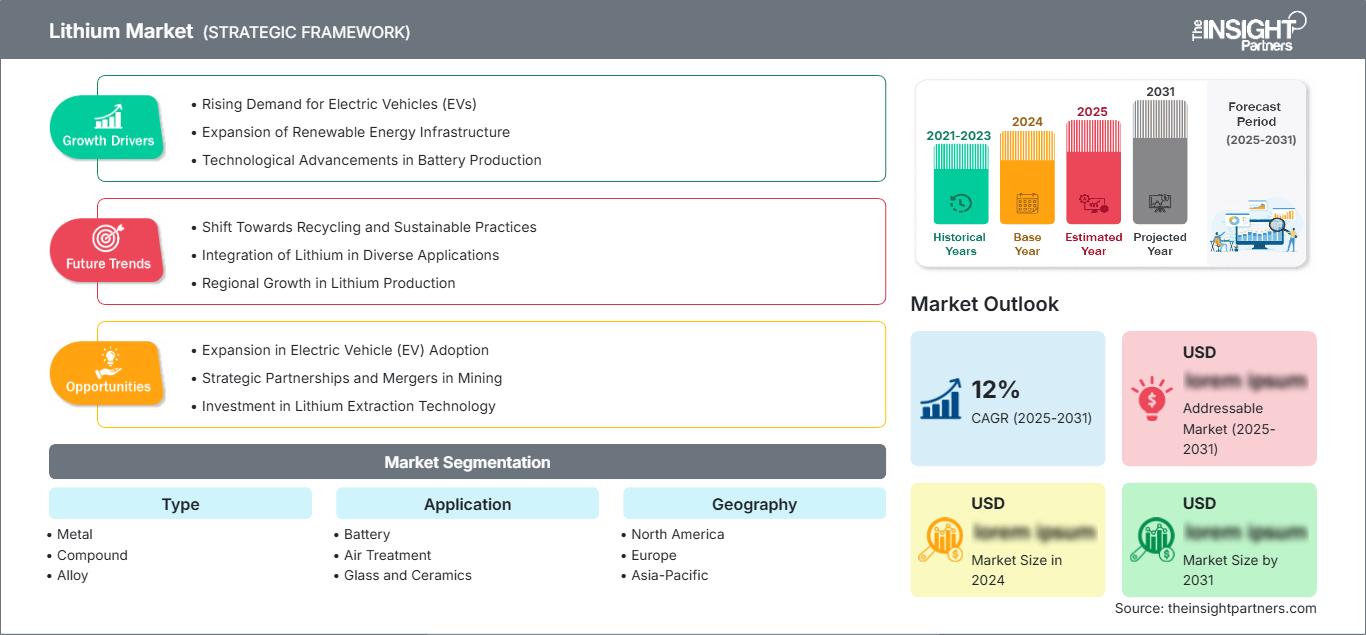
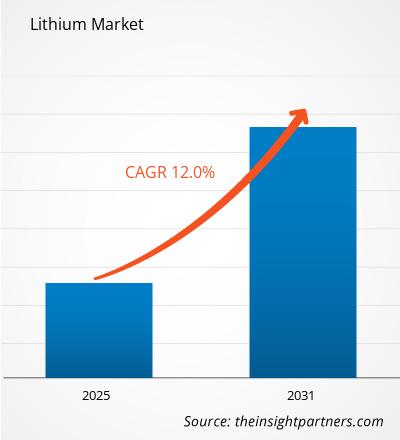
The Lithium Market had a valuation of US$ 31.73 billion in 2025 and is expected to reach US$ 112.65 billion by 2034, registering a CAGR of 15.12% from 2026 to 2034. Growth in the market can be attributed to accelerated electrification of vehicles, the rising deployment of energy storage solutions, and higher usage of lithium-based products for industrial applications. Continued investment in resource exploration and refining is fueling industry growth prospects.
North America is set to see a compound annual growth rate (CAGR) of 13.2 to 14.0% from 2026 to 2034. This growth is supported by investments in domestic lithium extraction, refining infrastructure, and battery manufacturing. Government incentives that encourage local supply chains for critical minerals, along with rising electric vehicle production and large-scale energy storage projects, are improving regional self-sufficiency. This also reduces reliance on imported lithium chemicals and processed materials.
Lithium Market Assessment and Insights
- North America: North America accounted for 22–26% market share in 2025 and is projected to expand at a CAGR of 13.2%–14.0% during 2026–2034. Growth is driven by increasing domestic battery investments, supportive critical mineral policies, and efforts to strengthen regional lithium supply chain resilience.
- U.S.: The U.S. represented 82–86% of the North American market in 2025 and is anticipated to register a CAGR of 13.5%–14.3% during 2026–2034, supported by expanding battery manufacturing capacity, rising electric vehicle adoption, and government initiatives to secure domestic critical mineral supplies.
- Europe: Europe held 18–22% market share in 2025 and is expected to grow at a CAGR of 14.0%–14.8% during 2026–2034. Germany, France, and the United Kingdom remain the leading regional markets, supported by automotive electrification trends, battery manufacturing expansion, and favorable sustainability policies.
- Asia Pacific: Asia Pacific accounted for 48–52% market share in 2025 and is forecast to expand at a CAGR of 16.0%–16.8% during 2026–2034. China, Japan, and South Korea drive regional growth through large-scale battery production, extensive lithium processing capabilities, and strong electric vehicle supply chains.
- Largest Segment – Battery: The Battery segment represented the largest market segment, accounting for 66–70% market share in 2025, and is expected to grow at a CAGR of 16.0%–17.0% during 2026–2034, driven by increasing demand from electric vehicles, stationary energy storage systems, and portable electronic devices.
- High Growth Segment – Battery: The Battery segment is also projected to register the fastest growth, advancing at a CAGR of 16.0%–17.0% during 2026–2034, supported by accelerating global battery manufacturing capacity additions and growing demand for energy storage applications.
- Key companies analyzed in detail: Albemarle Corporation; Arcadium Lithium plc; Ganfeng Lithium Group Co., Ltd.; Tianqi Lithium Corporation; Sociedad Química y Minera de Chile S.A.; Pilbara Minerals Limited; Mineral Resources Limited; Lithium Americas Corp.; Piedmont Lithium Inc.; Patriot Battery Metals Inc.; Sigma Lithium Corporation; Zhejiang Huayou Cobalt Co., Ltd.; Chengxin Lithium Group Co., Ltd.; Xinjiang Zhicun Lithium Co., Ltd.; and Sunresin New Materials Co., Ltd.
Source: The Insight Partners' analysis based on proprietary research, government publications, company annual reports, investor presentations, industry databases, and expert interviews.
Lithium has shifted from specialized industrial uses to a key raw material for global electrification. The growth of battery manufacturing has changed priorities in mining, while refiners are placing more emphasis on producing battery-grade lithium compounds that meet higher purity standards. Lithium market trends show producers diversifying resource development between hard-rock and brine deposits, backed by technological advances that improve recovery rates, processing efficiency, and sustainable operations throughout the value chain. Looking forward, investment activity is likely to extend beyond established producing countries into emerging resource-rich areas supported by favorable mining policies and strategic partnerships. Governments are increasingly acknowledging lithium as an essential mineral. They are promoting domestic processing capacity, developing recycling infrastructure, and creating integrated supply chains. These changes are expected to enhance supply security, reduce reliance on imports, and boost long-term competitiveness within global battery manufacturing.
Lithium Market Report Scope
| Report Attribute | Details |
|---|---|
| Market size in 2025 | US$ 31.73 Billion |
| Market Size by 2034 | US$ 112.65 Billion |
| Global CAGR (2026 - 2034) | 15.12% |
| Historical Data | 2021-2024 |
| Forecast period | 2026-2034 |
Lithium Market Analysis
The Lithium market analysis shows that growing electrification in transportation, renewable energy storage, and electronics is reshaping lithium demand globally. Battery manufacturers increasingly need reliable supplies of battery-grade lithium compounds with consistent quality. This need is leading to long-term agreements between miners, refiners, and manufacturers. Industrial applications such as glass, ceramics, metallurgy, and air treatment continue to support diverse demand, even as batteries remain the largest consumption segment. The lithium value chain has become more integrated. Mining companies are moving downstream into chemical processing while battery manufacturers are investing upstream to ensure raw material availability. Supply is diversifying through hard-rock mining, brine extraction, and new direct lithium extraction technologies. These advancements improve resource use and help balance regional production capacities with rapidly growing consumption.
Competition to strengthen Lithium market share increasingly focuses on resource quality, processing know-how, production scalability, and geographic diversity. Established producers like Albemarle Corporation, Arcadium Lithium plc, Ganfeng Lithium Group Co., Ltd., Tianqi Lithium Corporation, and Sociedad Química y Minera de Chile S.A. are expanding production capacity and strengthening vertical integration across mining, refining, and specialty lithium chemicals. Strategic investments are targeting processing facilities closer to battery manufacturing hubs. This move improves logistics and strengthens supply chain resilience. Emerging companies such as Lithium Americas Corp., Piedmont Lithium Inc., Patriot Battery Metals Inc., and Sigma Lithium Corporation are advancing resource development projects. Meanwhile, companies like Zhejiang Huayou Cobalt Co., Ltd., Chengxin Lithium Group Co., Ltd., and Sunresin New Materials Co., Ltd. are enhancing processing technologies and chemical production capabilities to meet changing customer needs.
● REPORT CUSTOMIZATION
Tailor This Report To Align With Your Specific Business Requirements
This report can be customized to align precisely with your business objectives, scope, and target markets. Customization options include tailored segmentation, geography, competitive analysis, and strategic insights to support informed decision-making.
Customize This Report →WHAT YOU CAN ADJUST
- ● Segmentations
- ● Geography
- ● Competitive Analysis
- ● Language Preferences
Lithium Market: Strategic Insights
Regional Insights
North America Lithium Market
North America accounted for 22–26% of the global market in 2025 and is projected to expand at a CAGR of 13.2–14.0% during 2026–2034. Strong policy support for developing critical minerals in the country continues to encourage investments in mining, refining, and battery manufacturing. Lithium market size in North America continues to benefit from nearby battery supply chains, growth in electric vehicle manufacturing, and investments in large-scale energy storage. Public funding, private capital, and strategic partnerships together improve long-term competitiveness and lower the risk of overseas supply disruptions.
U.S. Lithium Market
The United States represented 82–86% of North American lithium demand in 2025 and is forecast to register a CAGR of 13.5–14.3% through 2034. Federal incentives are speeding up domestic investments in mining, refining, and battery manufacturing facilities. Companies like Albemarle Corporation, Lithium Americas Corp., and Piedmont Lithium Inc. are growing their operations in the U.S. to support local supply chains. The rising use of electric vehicles and stationary battery systems keeps boosting lithium demand in automotive, renewable energy, and industrial sectors.
Europe Lithium Market
Europe represented 18–22% of the global lithium market during 2025 and is anticipated to grow at a CAGR of 14.0–14.8% through 2034. Germany remains the leading regional market due to its strong automotive manufacturing and growing battery production capacity. The United Kingdom is increasing investments in battery innovation, recycling technologies, and developing critical mineral supply chains. Research collaborations between industry and academic institutions help bring next-generation lithium processing technologies to market and improve long-term resource security. Germany holds its leadership through extensive electric vehicle manufacturing, battery cell production, and industrial automation. Government-backed industrial plans are attracting investments in refining facilities and battery materials, which boosts domestic value addition across the lithium supply chain. France, Italy, and Spain together enhance regional demand through automotive electrification, renewable energy storage, and industrial manufacturing. Ongoing investments in battery gigafactories and related infrastructure strengthen regional competitiveness and increase the use of lithium compounds.
APAC Lithium Market
Asia Pacific accounted for 48–52% of the global lithium market in 2025 and is projected to register the fastest regional expansion with a CAGR of 16.0–16.8% through 2034. China remains the dominant regional market due to its integrated battery manufacturing and lithium processing ecosystem. Japan and South Korea are increasing demand through improved battery technologies, premium electric vehicle production, and energy storage manufacturing. Their established chemical processing skills also make the region more competitive in high-value lithium applications. Australia is a top upstream supplier due to extensive hard-rock lithium mining. Meanwhile, India is becoming an important downstream consumer, driven by growing electric mobility initiatives and investments in domestic battery manufacturing. Regional industrial policies continue to strengthen long-term market fundamentals.
Middle East & Africa Lithium Market
The lithium market in the Middle East and Africa is expected to grow at a rate of 12.0 to 12.8% from 2026 to 2034. Even though regional consumption is still relatively small, investments in renewable energy, industrial diversification, and battery storage projects are creating new demand opportunities. Saudi Arabia is becoming the leading market in the region by investing in critical minerals and battery materials. The United Arab Emirates is boosting market growth with clean energy initiatives and development in manufacturing. South Africa is contributing with its established mining skills and a growing interest in battery mineral supply chains. Meanwhile, the rest of the Middle East and Africa is increasingly looking into lithium processing, renewable energy integration, and investments in industrial infrastructure to support future market growth.
Segmentation Analysis
Type
The Compound segment is expected to register the fastest growth during the forecast period, expanding at a CAGR of 14.5–15.5% from 2026 to 2034. Rising production of battery-grade lithium hydroxide and lithium carbonate for electric vehicle batteries, energy storage systems, and high-performance industrial applications is driving demand. Investments in refining technologies and chemical processing capacity are supporting the long-term growth of lithium compounds.
- Metal: Lithium metal is widely utilized in specialty alloys, primary batteries, aerospace components, and advanced chemical synthesis. Although volumes remain comparatively limited, demand is supported by high-value applications requiring exceptional energy density, lightweight characteristics, and superior electrochemical performance.
- Compound: Lithium compounds, particularly lithium carbonate and lithium hydroxide, account for the largest share of market consumption due to their essential role in rechargeable batteries. Increasing investments in refining capacity and battery-grade chemical production continue strengthening this sub-segment's strategic importance.
- Alloy: Lithium alloys are increasingly adopted in aerospace, defense, and metallurgical applications where lightweight construction and enhanced mechanical strength are required. Ongoing material innovation and growing emphasis on fuel efficiency continue supporting steady demand across specialized industrial sectors.
Application
Battery manufacturing is the biggest area of use. This growth is driven by the rising production of electric vehicles, the integration of renewable energy, and the quick setup of stationary energy storage systems. Industrial uses like glass and ceramics, metallurgy, and air treatment keep creating steady demand. They also diversify how different industries consume products.
- Battery: Battery manufacturers remain the largest consumers of lithium owing to expanding production of electric vehicles, consumer electronics, and stationary energy storage systems. Continuous improvements in battery chemistry, charging performance, and manufacturing capacity further reinforce long-term demand.
- Air Treatment: Lithium compounds are used in industrial air purification, carbon dioxide absorption, and humidity control applications. Increasing deployment across aerospace, defense, submarines, healthcare, and specialized industrial facilities supports stable demand for this application segment.
- Glass and Ceramics: Lithium enhances thermal resistance, durability, and mechanical strength in specialty glass and ceramic products. Growing demand from construction, consumer appliances, laboratory equipment, and advanced industrial manufacturing continues supporting consistent market growth.
- Metallurgy: Metallurgical applications utilize lithium to improve casting quality, reduce operating temperatures, and enhance alloy properties. Increasing production of lightweight metals for transportation, aerospace, and industrial manufacturing contributes to sustained demand across this application area.
Opportunity Snapshot
| Segment Name | Revenue Contribution | Trend Tag | Adoption Stage |
| Battery | High | Fast Charging | Mature |
| Air Treatment | Low | Carbon Capture | Scaling |
| Glass and Ceramics | Medium | Specialty Glass | Mature |
| Metallurgy | Medium | Lightweight Alloys | Scaling |
Lithium Market Growth Drivers and Impact Analysis
Expansion of Electric Vehicle Manufacturing Worldwide
Rapid electrification of passenger vehicles, commercial fleets, buses, and two-wheelers is driving substantial growth in the lithium market. Battery manufacturers are boosting production to meet rising demand from the automotive sector, which leads to consistent consumption of lithium hydroxide and lithium carbonate. Governments are backing electric mobility with emission rules, financial incentives, and investments in charging infrastructure. This support prompts automotive manufacturers to speed up the production of battery-powered vehicles. These changes strengthen long-term agreements between mining companies, chemical refiners, and battery manufacturers. They also encourage investments throughout the lithium value chain. The increase in battery manufacturing capacity is continuously changing the global dynamics of lithium supply.
Rising Deployment of Grid-Scale Energy Storage Systems
The increasing use of renewable electricity generation is raising the need for efficient energy storage solutions that can balance variable solar and wind power. Lithium-ion batteries are still the top choice for utility-scale energy storage due to their high efficiency, flexibility, and dropping lifecycle costs. Governments and utilities are investing in large-scale storage facilities to enhance grid reliability and boost energy resilience. This investment is driving demand beyond the automotive sector, increasing lithium use in utility infrastructure, commercial energy management, and distributed storage applications. It also encourages more investment in refining and processing capacity.
Government Support for Critical Mineral Supply Chains
Many countries have introduced industrial policies to reduce dependence on imported critical minerals. They encourage domestic mining, refining, recycling, and battery manufacturing. Supporting the Lithium market forecast, financial incentives, permitting changes, strategic funding programs, and partnerships between public and private sectors are speeding up the development of integrated lithium supply chains. These initiatives improve resource security and stimulate investment in extraction, chemical processing, and manufacturing. As governments focus more on supply chain resilience, lithium producers are expanding production capacity and setting up regional processing facilities near battery manufacturing hubs. This move boosts operational efficiency and market stability in the long run.
Lithium Market Future Trends
Acceleration of Direct Lithium Extraction Technologies
Direct lithium extraction (DLE) technologies are likely to be adopted more widely as producers look for higher recovery rates, less freshwater usage, and faster project development. Unlike traditional evaporation ponds, DLE can improve operational efficiency and reduce environmental effects in appropriate brine resources. Ongoing improvements in adsorption materials, ion-exchange technologies, and solvent extraction processes should make these technologies more commercially viable. Successfully implementing these technologies could diversify the global lithium supply, boost production economics, and lessen reliance on conventional extraction methods in the next decade.
Expansion of Circular Battery Material Ecosystems
Current Lithium market trends indicate that battery recycling is becoming more important in the lithium value chain as old electric vehicle batteries enter commercial recycling processes. Manufacturers are investing in technologies that can recover lithium and other valuable materials from batteries while reducing reliance on primary mining. Regulatory efforts promoting resource efficiency and circular economy practices are likely to encourage wider use of recycled battery materials. As recycling technologies develop, the supply of secondary lithium will increasingly support primary production, enhancing long-term supply security and helping sustainability goals across the battery industry.
Lithium Market Opportunities
Investment in Integrated Refining and Chemical Processing Facilities
Significant opportunities exist for companies that can expand battery-grade lithium refining capacity near major battery manufacturing hubs. While mining projects are increasing the supply of raw materials, refining is still a major bottleneck in many areas. Investments in chemical processing facilities can improve supply security, lower transportation costs, and boost regional competitiveness. Supporting the Lithium market forecast, partnerships between mining companies, chemical producers, battery manufacturers, and governments are expected to speed up integrated project development. Companies that can consistently provide high-purity lithium chemicals are likely to gain from long-term procurement contracts and premium product positioning.
Development of Emerging Lithium Resource Regions
Exploration activities are growing in new mining regions with good geological resources and supportive regulations. Countries that want to diversify their critical mineral production are promoting investment through better licensing, infrastructure development, and financial incentives. These projects open doors for mining companies, engineering firms, equipment suppliers, and technology providers involved in the lithium value chain. Investing early in high-quality resource assets, along with sustainable mining practices and efficient processing technologies, helps producers strengthen their Lithium market share before future supply shortages increase in global battery manufacturing markets.
Recent Developments
- July 2026: Rock Tech Lithium entered into an option agreement to acquire a 100% interest in the Victory Project, a 9,875-hectare lithium exploration property in Northwestern Ontario from Bounty Gold Corp. and Last Resort Resources Ltd.
- May 2026: AMG Lithium B.V. announced a recommended cash-and-share acquisition of Zinnwald Lithium plc, seeking to acquire the remaining shares not already owned. At the time of the announcement, AMG Lithium held approximately 29.32% of Zinnwald Lithium's issued ordinary share capital, strengthening its strategic position in European lithium development. -
- March 2026: Lithium Royalty Corp. announced portfolio updates highlighting continued progress across multiple royalty assets. Ganfeng Lithium advanced the Goulamina and Mariana lithium projects with expected royalty payments and the first lithium chloride shipment from Mariana, while Sigma Lithium resumed production at Grota do Cirilo and Core Lithium executed spodumene concentrate sales as it progressed toward restarting the Finniss project.
Frequently Asked Questions

- Comprehensive Market Sizing and Forecast Analysis
- Detailed Segmentation Analysis
- In-Depth Market Dynamics Assessment
- Regional and Country-Level Insights
- Competitive Landscape and Company Benchmarking
- Strategic Business Intelligence
Recent Reports
Testimonials

The Insight Partners' SCADA System Market report is comprehensive, with valuable insights on current trends and future forecasts. The team was highly professional, responsive, and supportive throughout. We are very satisfied and highly recommend their services.
RAN KEDEM Partner, Reali Technologies LTDs
I requested a report on a very specific software market and the team produced the report in a few days. The information was very relevant and well presented. I then requested some changes and additions to the report. The team was again very responsive and I got the final report in less than a week.
JEAN-HERVE JENN Chairman, Future Analytica
We worked with The Insight Partners for an important market study and forecast. They gave us clear insights into opportunities and risks, which helped shape our plans. Their research was easy to use and based on solid data. It helped us make smart, confident decisions. We highly recommend them.
PIYUSH NAGPAL Sr. Vice President, High Beam Global
The Insight Partners delivered insightful, well-structured market research with strong domain expertise. Their team was professional and responsive throughout. The user-friendly website made accessing industry reports seamless. We highly recommend them for reliable, high-quality research services
YUKIHIKO ADACHI CEO, Deep Blue, LLC.
This is the first time I have purchased a market report from The Insight Partners.While I was unsure at first, I visited their web site and felt more comfortable to take the risk and purchase a market report.I am completely satisfied with the quality of the report and customer service. I had several questions and comments with the initial report, but after a couple of dialogs over email with their analyst I believe I have a report that I can use as input to our strategic planning process.Thank you so much for taking the extra time and making this a positive experience.I will definitely recommend your service to others and you will be my first call when we need further market data.
JOHN SUZUKI President and Chief Executive Officer, Board Director, BK Technologies
I wish to appreciate your support and the professionalism you displayed in the course of attending to my request for information regarding to infectious disease IVD market in Nigeria. I appreciate your patience, your guidance, and the fact that you were willing to offer a discount, which eventually made it possible for us to close a deal. I look forward to engaging The Insight Partners in the future, all thanks to the impression you have created in me as a result of this first encounter.
DR CHIJIOKE ONYIA MANAGING DIRECTOR, PineCrest Healthcare Ltd.Reason to Buy
- Informed Decision-Making
- Understanding Market Dynamics
- Competitive Analysis
- Identifying Emerging Markets
- Customer Insights
- Market Forecasts
- Risk Mitigation
- Boosting Operational Efficiency
- Strategic Planning
- Investment Justification
- Tracking Industry Innovations
- Aligning with Regulatory Trends





 Get Free Sample for