
Lubricants Market Size, Trends & Demand by 2034
Coverage: By Base Oil (Mineral Oil, Synthetic Oil, and Bio-based Oil), By Type (Hydraulic Fluids, Engine Oils, Driveline Lubricants, Metalworking Fluids, Grease, Process Oils, Coolants, Transformer Oils, and Others) and By End-Use Industry (Automotive (Passenger Cars, Light Commercial Vehicles, Heavy Commercial Vehicles, and Others), Building and Construction, Power Generation, Mining and Metallurgy, Food Processing, Oil and Gas, Marine, Aviation, and Others)
- Status : Published
- Report Code : TIPRE00003547
- Category : Chemicals and Materials
- No. of Pages : 536
- Available Report Formats :


- Last update date : September 10, 2026


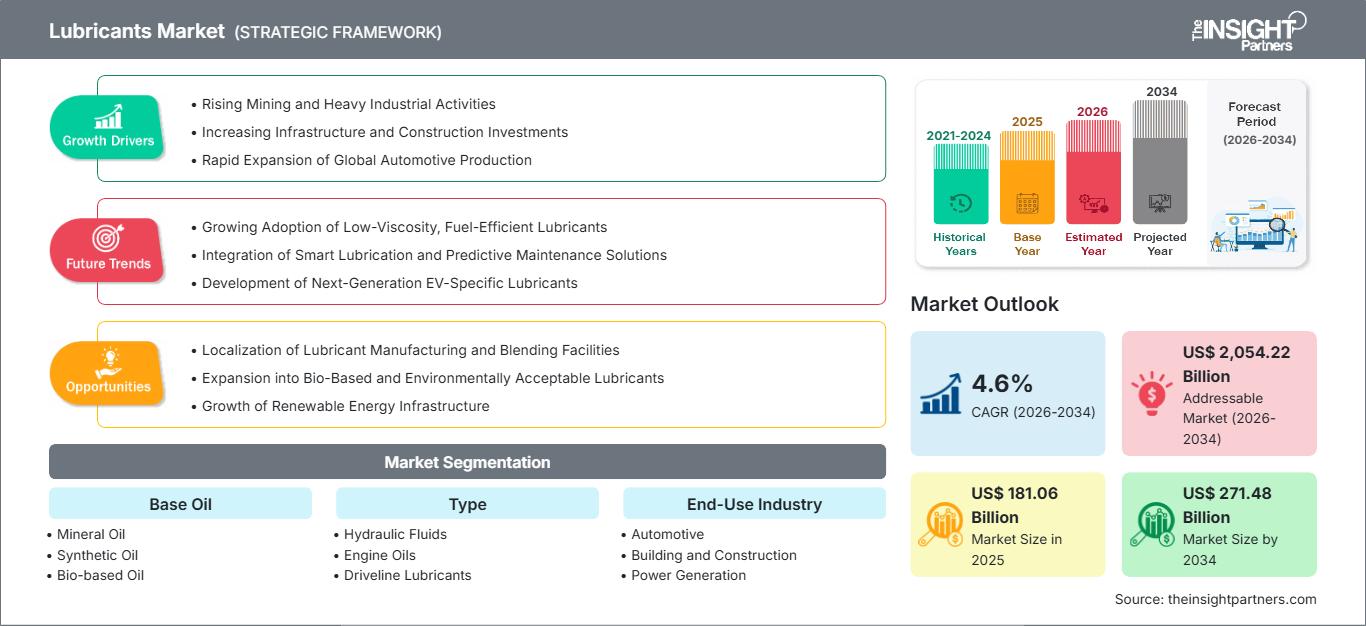
2025 Market Size
US$ 181.06 Bn
Base year value
2034 Forecast
US$ 271.48 Bn
Projected by 2034
CAGR 2026-2034
4.6 %
Growth rate
Addressable Market
US$ 2,054.22 Bn
(2026-2034)
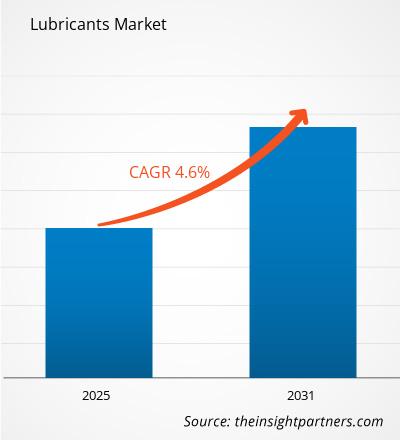
The Lubricants market was valued at US$ 181.06 Billion in 2025 and is projected to reach US$ 271.48 Billion by 2034, expanding at a CAGR of 4.6% from 2026 to 2034. Demand is supported by vehicle fleet expansion, industrial production, infrastructure development, equipment reliability requirements, and increasing adoption of performance-oriented formulations. Product development is also shifting toward synthetic, bio-based, energy-efficient, and application-specific formulations across automotive and industrial operating environments.
North America remains an important market focus because mature automotive fleets, industrial automation, power generation, aerospace activity, and replacement demand sustain lubricant consumption. The region is estimated to expand at a 3.5–5.4% CAGR between 2026 and 2034, supported by premium synthetic formulations, longer-drain products, equipment-efficiency programs, and regulatory emphasis on environmental performance.
Lubricants Market Assessment and Insights
- North America: North America accounted for an estimated 20.20% share in 2025 and is projected to grow at a 4.3% CAGR between 2026 and 2034, supported by industrial maintenance, automotive aftermarket consumption, and premium formulations.
- U.S.: The U.S. accounted for approximately 82.07% of North America's 2025 demand and is expected to grow at a 4.4% CAGR between 2026 and 2034, driven by transportation, manufacturing, and energy applications.
- Europe: Europe held an estimated 23.50% share in 2025 and is projected to grow at a 3.0–4.6% CAGR between 2026 and 2034, with Germany, the UK, France, Italy, and Spain supporting demand through automotive production and industrial modernization.
- Asia Pacific: Asia Pacific accounted for approximately 27.85% of the market in 2025 and is expected to register a 5.4% CAGR between 2026 and 2034, led by China, India, Japan, South Korea, and Southeast Asian manufacturing economies.
- Largest Segment: Automotive accounted for approximately 51.41% of the market share in 2025 and is estimated to grow at a 4.6% CAGR between 2026 and 2034, retaining the largest demand base.
- High Growth Segment: Bio-based Oil held approximately 5.16% market share in 2025 and is expected to register a 5.9% CAGR between 2026 and 2034, supported by environmental applications.
- Key companies analyzed in detail: Shell Plc, Exxon Mobil Corporation, TotalEnergies SE, Chevron Corp, BP Plc, Fuchs SE, Valvoline Inc, China National Petroleum Corporation (CNPC), Puma Energy Holdings Pte Ltd, ENEOS Holdings Inc, Repsol SA, Gulf Oil International Ltd, Idemitsu Kosan Co Ltd, Hindustan Petroleum Corporation Ltd, and Petron.
Source: The Insight Partners' analysis based on proprietary research, government publications, company annual reports, investor presentations, industry databases, and expert interviews.
The Lubricants Market size landscape has evolved from predominantly mineral-oil-based products toward differentiated formulations engineered around viscosity control, oxidation resistance, thermal stability, fuel efficiency, and equipment protection. Advances in additive chemistry, base-oil processing, synthetic formulation, and condition monitoring are enabling longer service intervals and application-specific performance. Automotive electrification is also changing requirements for thermal fluids, e-drive systems, bearings, and specialized greases.
Forward demand is expected to broaden across emerging manufacturing centers, particularly India, Southeast Asia, the Middle East, and selected African economies. Investments in power infrastructure, logistics fleets, mining, renewable generation, data centers, and advanced manufacturing create opportunities for specialized products. Regulatory initiatives affecting emissions, waste oil, marine discharge, and industrial environmental performance should encourage formulation upgrades. Procurement decisions are consequently becoming more technical, with OEM approvals, life-cycle performance, supply continuity, and sustainability credentials gaining importance.
Lubricants Market Report Scope
| Report Attribute | Details |
|---|---|
| Market size in 2025 | US$ 181.06 Billion |
| Market Size by 2034 | US$ 271.48 Billion |
| Global CAGR (2026 - 2034) | 4.6% |
| Historical Data | 2021-2024 |
| Forecast period | 2026-2034 |
Lubricants Market Analysis
A wide value chain, which starts with crude-derived and synthetic base oils, continues through additive production, additive blending, additive formulation, packaging, distribution, and technical services, drives the Lubricants Market growth. The main consumption center is the automotive sector, and industrial users demand hydraulic fluids, gear oils, metalworking fluids, greases, transformer oils, process fluids, and coolants. The more machinery that is used, the more needs to be replenished and maintained.
Supply dynamics are a function of base oil availability, additive supply, refinery utilization, transportation costs, and regional blending capacity. Integrated producers can control feedstock volatility by maintaining vertically integrated refining and trading operations, and specialty suppliers can distinguish themselves by leveraging formulation expertise. Fluctuations in crude, base-oil, additive, energy, and freight costs affect product prices and inventory management, leading to diversification of sources and regionalization of production.
Product technology, application engineering, reach into distribution, OEM relationships, and portfolio breadth are increasingly important factors in competitive positioning. The integrated operations and already-established global brands are Shell plc, Exxon Mobil Corporation, TotalEnergies SE, Chevron Corporation, and BP p.l.c., while FUCHS SE, PETROFER CHEMIE H. R. Fischer GmbH + Co. KG, and Valvoline Inc. focus on specialized formulations and technical services.
The investment movement is toward more regional manufacturing and higher-value-added products. They are involved through specific regional supply chains and product portfolios, namely China National Petroleum Corporation, ENEOS Holdings, Inc., PJSC LUKOIL, Repsol, S.A., Puma Energy Holdings Pte Ltd, Gulf Oil International Ltd, and Petro-Canada Lubricants Inc. These are synthetic products, bio-based formulations, EV fluids, predictive maintenance services, and circularity initiatives - all of which are becoming part of the strategic differentiation. Therefore, the Lubricants Market analysis is increasingly applied to formulation capabilities, as well as to distribution and manufacturing scale.
● REPORT CUSTOMIZATION
Tailor This Report To Align With Your Specific Business Requirements
This report can be customized to align precisely with your business objectives, scope, and target markets. Customization options include tailored segmentation, geography, competitive analysis, and strategic insights to support informed decision-making.
Customize This Report →WHAT YOU CAN ADJUST
- ● Segmentations
- ● Geography
- ● Competitive Analysis
- ● Language Preferences
Lubricants Market: Strategic Insights
Regional Insights
North America Lubricants Market
North America is estimated to account for 20.20% of global demand in 2025, with regional growth projected at a 4.3% CAGR through 2034. Mature vehicle fleets, industrial machinery, aerospace activity, mining, and power generation create a substantial replacement and maintenance base. Demand is shifting toward longer-drain engine oils, synthetic products, high-performance greases, and specialty industrial fluids that improve equipment efficiency. The U.S. represents the dominant regional consumption center.
Canada and Mexico complement regional demand through mining, energy, manufacturing, transportation, and automotive production. Industrial customers increasingly use oil analysis and condition monitoring to optimize lubricant intervals and prevent equipment failures. Environmental requirements are encouraging the use of lower-toxicity, biodegradable formulations in selected marine, forestry, and industrial applications. Regional suppliers benefit from established distribution infrastructure, OEM relationships, local blending facilities, and technical support capabilities that help customers address application-specific performance requirements.
U.S. Lubricants Market
The U.S. represents approximately 82.07% of North American demand in 2025 and is expected to grow at a 4.4% CAGR through 2034. Its large passenger and commercial vehicle fleet drives demand for engine oil, transmission fluid, grease, and hydraulic fluid, while manufacturing and energy applications support industrial consumption. Major suppliers maintain extensive blending, distribution, technical support, and OEM relationships across the country.
Automotive aftermarket requirements remain important alongside aerospace, construction, mining, data-center infrastructure, and power-generation applications. Shell plc, Exxon Mobil Corporation, Chevron Corporation, BP p.l.c., and Valvoline Inc. maintain significant market presence through branded and specialized portfolios. Tighter engine specifications, longer drain intervals, equipment-efficiency requirements, and synthetic formulations support premiumization. Industrial users increasingly prioritize lubricant monitoring and life-cycle cost reduction when selecting products, strengthening demand for technical service.
Europe Lubricants Market
Europe is estimated to represent 23.50% share in 2025, with growth of 5.4% through 2034. Germany remains the leading country because of its automotive manufacturing base, machinery production, chemicals industry, and engineering ecosystem. The UK maintains demand through transportation, manufacturing, marine, aviation, and energy applications, while regulatory pressure encourages efficient and environmentally responsible formulations.
France and Italy account for significant consumption in the automotive, industrial machinery, food processing, and transportation sectors. Spain adds demand from automotive manufacturing, logistics, construction, energy, and industrial operations. Across Europe, stricter environmental expectations and OEM specifications support the use of synthetic, low-viscosity, biodegradable, and application-specific products. Re-refining, waste-oil recovery, life-cycle assessment, and formulation efficiency are becoming increasingly relevant to procurement decisions. At the same time, industrial users continue adopting condition-based maintenance and high-performance lubrication programs.
APAC Lubricants Market
APAC holds approximately 27.85% of the Lubricants Market share in 2025 and is projected to grow at a 5.4% CAGR through 2034, making it the leading regional market. China represents the largest demand base, followed by Japan, India, South Korea, and Australia. Vehicle production, industrialization, infrastructure development, and the expansion of manufacturing capacity underpin consumption.
China and India are major growth engines, while Japan and South Korea support advanced applications in automotive, electronics, shipbuilding, and machinery. Australia contributes through mining, construction, transportation, and energy. Industrial policy, domestic manufacturing initiatives, infrastructure investment, and energy transition projects support the production of hydraulic fluids, greases, transformer oils, and specialty products. Local blending, OEM approvals, technical service, and application-specific formulations remain important competitive factors.
Middle East & Africa Lubricants Market
Demand in the Middle East & Africa is expected to expand at a 4.9% CAGR through 2034, supported by investment in energy, construction, mining, logistics, and infrastructure. Saudi Arabia leads regional demand, while the UAE remains an important distribution and re-export hub. South Africa provides a diversified industrial base spanning mining, transportation, manufacturing, and power generation.
Large energy projects sustain demand for industrial and process lubricants, while infrastructure development increases consumption of hydraulic fluids, engine oils, greases, and construction-equipment products. The rest of MEA offers opportunities through the expansion of transportation fleets, agricultural mechanization, mining projects, and industrialization. Suppliers increasingly require resilient distribution networks because of climate conditions, long transport distances, equipment intensity, and supply-chain variability influence lubricant selection, inventory requirements, and service intervals.
Segmentation Analysis
Base Oil
The Lubricants Market scope covers Mineral Oil, Synthetic Oil, and Bio-based Oil, with each category addressing different performance, cost, environmental, and operating requirements. Mineral Oil remains the volume foundation, while Synthetic Oil gains preference where thermal stability, fuel efficiency, low-temperature performance, and longer service intervals justify premium pricing. Bio-based Oil remains smaller but benefits from environmentally sensitive applications and sustainability-oriented procurement.
- Mineral Oil: Mineral Oil remains strategically important due to its broad availability, established formulation technology, cost competitiveness, and compatibility with conventional automotive and industrial applications. It continues supporting high-volume applications where premium performance is not essential.
- Synthetic Oil: Synthetic Oil is increasingly chosen for demanding engines, industrial machinery, aviation equipment, and specialty applications that require enhanced oxidation resistance, temperature stability, longer service intervals, and improved efficiency under severe operating conditions.
- Bio-based Oil: Bio-based Oil is gaining attention in environmentally sensitive applications such as forestry, agriculture, marine operations, and selected industrial equipment where biodegradability, reduced environmental impact, and sustainability credentials influence procurement decisions.
Type
Engine Oils remain central, while hydraulic fluids, process oils, transformer oils, greases, metalworking fluids, and coolants benefit from expansion in industrial equipment and specialized performance requirements.
- Hydraulic Fluids: Hydraulic Fluids support construction, manufacturing, mining, agriculture, and material-handling equipment, with demand increasingly favoring formulations that provide wear protection, thermal stability, cleanliness, and reliable operation under high-pressure conditions.
- Engine Oils: Engine Oils represent the largest lubricant product requirement across passenger vehicles, commercial fleets, motorcycles, and heavy equipment, with premium synthetic formulations gaining relevance as engines become smaller, more efficient, and more technically demanding.
- Driveline Lubricants: Driveline Lubricants serve transmissions, differentials, axles, and related systems, with formulation requirements becoming increasingly application specifically as automatic transmissions, hybrid drivetrains, and advanced vehicle architectures expand.
- Metalworking Fluids: Metalworking Fluids are essential for cutting, forming, grinding, stamping, and machining, where manufacturers increasingly emphasize tool life, surface quality, worker safety, fluid stability, and waste reduction.
- Grease: Grease remains important for bearings, joints, gears, and components exposed to contamination or difficult relubrication conditions, with specialized grades gaining preference in high-temperature, heavy-load, marine, and electric-motor applications.
- Process Oils: Process Oils are used as functional inputs and processing aids across rubber, polymers, chemicals, textiles, and manufacturing, making demand closely linked to industrial production levels and material-processing requirements.
- Coolants: Coolants support engines, industrial equipment, and thermal-management systems by controlling heat and corrosion, with advanced formulations increasingly required for high-performance machinery and electrified powertrain components.
- Transformer Oils: Transformer Oils remain essential for electrical insulation and heat dissipation in transformers, with grid expansion, renewable integration, and replacement of aging electrical infrastructure supporting long-term demand.
End-Use Industry
Automotive remains the largest demand center, while power generation, construction, mining, food processing, oil and gas, marine, and aviation create diversified requirements for specialized lubricant performance.
- Automotive: Automotive consumption spans passenger cars, light commercial vehicles, heavy commercial vehicles, and other vehicle categories, with demand driven by fleet growth, replacement cycles, OEM specifications, engine technology, and rising efficiency requirements.
- Building and Construction: Building and Construction generates demand for excavators, cranes, loaders, compressors, concrete equipment, and other machinery that require hydraulic fluids, engine oils, greases, and gear lubricants to operate under demanding conditions.
- Power Generation: Power Generation uses turbine oils, hydraulic fluids, greases, transformer oils, and specialty products across conventional and renewable assets, with equipment reliability and maintenance optimization strongly influencing procurement.
- Mining and Metallurgy: Mining and Metallurgy require heavy-duty lubricants for crushers, conveyors, mills, haul trucks, hydraulic systems, and processing equipment, creating demand for high-load, contamination-resistant, and extended-life formulations.
- Food Processing: Food Processing requires specialized lubricants designed for applications where incidental food contact can occur, making regulatory compliance, cleanliness, low toxicity, and reliable equipment performance important purchasing considerations.
- Oil and Gas: Oil and Gas operations consume lubricants across drilling, compression, pumping, transportation, refining, and processing equipment, and severe operating conditions increase the need for high-performance, thermally stable formulations.
- Marine: Marine applications require engine oils, gear lubricants, hydraulic fluids, and environmentally acceptable products for propulsion and auxiliary equipment, with regulatory compliance and equipment reliability shaping supplier selection.
- Aviation: Aviation demands highly specialized lubricants for aircraft engines, turbines, bearings, actuators, and auxiliary systems, where stringent specifications, safety requirements, qualification processes, and thermal performance create high technical barriers.
- Others: Other industries include agriculture, railways, chemicals, pharmaceuticals, electronics, and general manufacturing, providing diversified demand for specialized products aligned with equipment design and operating conditions.
Opportunity Snapshot
| End-Use Industry | Revenue Contribution (High/Medium/Low) | Trend Tag (MAX 2 words) | Adoption Stage (Emerging/Scaling/Mature) |
| Automotive | High | Fleet Efficiency | Mature |
| Building and Construction | Medium | Equipment Uptime | Scaling |
| Power Generation | Medium | Grid Expansion | Scaling |
| Mining and Metallurgy | Medium | Heavy-Duty | Mature |
| Food Processing | Medium | Hygienic Lubrication | Scaling |
| Oil and Gas | Medium | Asset Reliability | Mature |
| Marine | Medium | EAL Adoption | Scaling |
| Aviation | Low | Thermal Performance | Mature |
| Others | Low | Specialty Systems | Scaling |
Lubricants Market Growth Drivers and Impact Analysis
Increased Vehicle Fleet and Commercial Transportation
The growth of car ownership in emerging economies directly drives repeat demand for engine oil, driveline lubricants and greases, coolants, and transmission fluids. Commercial fleets are key to aftermarket consumption, as their high utilization rates generate many maintenance cycles. Logistics, e-commerce distribution, public transportation, construction, and regional freight transport all contribute to the further rise in lubricant intensity per vehicle. Meanwhile, increased OEM specifications are pushing up the technical demands for viscosity control, oxidation resistance, deposit protection, and fuel efficiency. Suppliers can thus begin to shift customers toward higher-priced products rather than simply bidding on volume. While electrification moderates some traditional engine-oil demand in the long term, other hybrid-vehicle components—such as commercial-fleet oils, thermal-management oils, and non-powertrain oils—still require specialized oils.
Industrial Automation and Equipment Reliability Requirements
The value of machinery uptime, energy efficiency, and predictive maintenance is growing as industrial modernization gains momentum. Automated plant equipment is increasingly operating continuously and under higher loads in manufacturing plants, mines, power plants, warehouses, and processing facilities. Lubricant failure can lead to expensive downtime and raise concerns for purchasing agents if the lubricant becomes unstable in viscosity, contaminated, or oxidized, or has a long changeover period between oil changes. Instead of just following a fixed schedule, digital oil analysis (DOA) and sensor-based condition monitoring (SCM) enable operators to determine when to change lubricants. This helps support premium products that have measurable benefits throughout their life cycle. The lubricant selection can be part of the maintenance planning, making the selection process part of the work done for the customer, which is a great way to reinforce customer retention for a manufacturer that combines formulation technology with technical services. This is especially critical for hydraulic systems, bearings, gearboxes, compressors, turbines, and other machinery, where an unexpected failure could halt production.
Infrastructure Investment and Energy-system Expansion
The generation of electricity, transportation, industrial applications, and urban construction increases the demand for lubricants. Wind turbine equipment and bearing lubrication, solar construction and maintenance, and electrical maintenance and transformer oils are all areas where demand will rise to improve the grid. Hydraulic fluids, engine oils, greases, and driveline lubricants are also used in heavy equipment fleets during construction and infrastructure projects. Emerging economies are important because they witness two simultaneous trends: infrastructure development and growth in manufacturing and logistics. Energy and infrastructure companies are increasingly considering the reliability, technical support, supply continuity, and equipment-life benefits of the lubricant supplier. This is to the advantage of manufacturers who can blend their products locally, have application engineering skills, and have a wide-based distribution system with several operating sites to support large projects.
Lubricants Market Future Trends
Transition Toward Low-Carbon and Circular Lubrication Solutions
The Lubricants Market trends landscape is anticipated to gradually shift towards lower-carbon-based feedstocks, biodegradable esters, re-refined base oil, recycled packaging, and products with longer service life. The change does not mean that mineral formulations will be phased out, but it will increase the extent to which environmental performance is made a formal procurement criterion. LCO is now considering life cycle impacts as well as technical aspects and is being used by fleet operators, industrial manufacturers, marine companies, and infrastructure owners alike. Re-refining can enable circular feedstock pathways by turning used oils into reusable base-olefin components. Suppliers will be at an advantage if they can document product composition, environmental performance, collection pathways, and end-of-life handling as sustainability becomes part of corporate purchasing policies. In the future, product development will likely focus on balancing biodegradability, oxidative stability, equipment compatibility, and cost, rather than making sustainability a key feature in its own right.
Digital Lubrication Management and Application-Specific Formulation
Digital technologies are expected to be used more widely in lubricant selection, monitoring, and maintenance. Viscosity changes, contamination, oxidation, wear particles, and abnormal operating conditions can be detected through sensors, lab analysis, connected equipment, and predictive analytics before equipment failure. This is a change from selling lubricant volume to providing equipment performance solutions. In addition to traditional product offerings, manufacturers can expect to offer digital monitoring services, automated recommendations, and application-specific maintenance programs. On the formulation side, information from connected machines can be used to more accurately specify product requirements based on temperature, load, speed, contamination, and operating cycle. These are especially important for mining, manufacturing, power generation, marine, and large commercial fleets – where maintenance downtime can have a financial impact. Digital services are to be integrated to reinforce premium positioning and improve relationships among suppliers, OEMs, and industrial users.
Lubricants Market Opportunities
Development of High-Performance Fluids for Electrified Equipment
As electrification expands to provide a host of specialized opportunities, Lubricants Market Forecasts are increasingly covering these in addition to the conventional engine. Suppliers can create fluids with enhanced electrical conductivity, thermal stability, material compatibility, low volatility, and suitable friction properties. The opportunity isn't limited to the passenger car sector; it also applies to electric commercial vehicles, buses, mining equipment, warehouse equipment, and industrial drives. Manufacturers with existing OEM ties have access to qualification capabilities to gain entry to new platforms as early as possible; specialty suppliers can focus on high-value applications, where technical performance is more important than volume. Formulation labs, testing facilities, additive compatibility, and co-development of equipment should be prioritized in investments. The production capacity of the region will come into play as the e-mobility supply chain becomes more regionalized in China, Europe, North America, and India.
Localized Blending and Circular Base-Oil Networks Expansion
Regionalized manufacturing offers an opportunity to reduce supply chain risk and enhance responsiveness to customer needs. Country-specific specifications, reduced transportation costs, and country-specific lead times can be achieved by local blending plants, as well as greater flexibility across the automotive and industrial portfolio. Collection and re-refining of used oil can create circular feedstock chains that reduce the need for virgin base oil and support environmental goals. Such an opportunity is especially true in high-growth markets, where vehicle numbers, manufacturing, and infrastructure investment are also ramping up. Partnering with distributors, waste-oil collectors, recyclers, OEMs, and industrial customers can help companies improve their market access. Quality-controlled collection systems, re-refining, additive compatibility, digital traceability, and regional logistics should be investment priorities. The integrated models offer the prospect of increased resiliency and provide added value beyond traditional lubricant distribution.
Recent Developments
- August 2026: FUCHS SE opened its new 55,000-square-foot Americas Technology Center in Taunton, Massachusetts. The facility focuses on research, development, technical support, formulation, validation, and performance testing for automotive, industrial manufacturing, metalworking, medical, and other applications. Investment strengthens application-driven innovation and customer collaboration across the Americas.
- August 2026: SK Enmove expanded its premium base-oil distribution network in North America, strengthening its position in the regional lubricant supply chain. The development is relevant to the market because premium base oils are increasingly important in high-performance lubricant formulations, particularly for manufacturers seeking improved efficiency, durability, and formulation performance.
- July 2026: Hyrax Oil Sdn Bhd signed agreements to expand its Hyrax Estramol ester transformer fluids into Thailand, Cambodia, Laos, Myanmar, and Vietnam. Metson Power was appointed as the preferred distributor for mineral and ester-based transformer oils and industrial lubricants, while Eternity Technology Engineering became the exclusive technical services partner in Thailand. The development supports the expansion of biodegradable insulating fluids and strengthens regional technical capabilities.
Frequently Asked Questions

- Comprehensive Market Sizing and Forecast Analysis
- Detailed Segmentation Analysis
- In-Depth Market Dynamics Assessment
- Regional and Country-Level Insights
- Competitive Landscape and Company Benchmarking
- Strategic Business Intelligence
Recent Reports
Testimonials

The Insight Partners provided valuable market intelligence that supported our global go-to-market strategy. Their team was professional, responsive, and attentive to our feedback, providing thoughtful analysis and helpful methodological clarifications throughout the project.
Junmo Kim Chief Financial Officer (CFO), Enertech Co., Ltd.
The Insight Partners' SCADA System Market report is comprehensive, with valuable insights on current trends and future forecasts. The team was highly professional, responsive, and supportive throughout. We are very satisfied and highly recommend their services.
RAN KEDEM Partner, Reali Technologies LTDs
I requested a report on a very specific software market and the team produced the report in a few days. The information was very relevant and well presented. I then requested some changes and additions to the report. The team was again very responsive and I got the final report in less than a week.
JEAN-HERVE JENN Chairman, Future Analytica
We worked with The Insight Partners for an important market study and forecast. They gave us clear insights into opportunities and risks, which helped shape our plans. Their research was easy to use and based on solid data. It helped us make smart, confident decisions. We highly recommend them.
PIYUSH NAGPAL Sr. Vice President, High Beam Global
The Insight Partners delivered insightful, well-structured market research with strong domain expertise. Their team was professional and responsive throughout. The user-friendly website made accessing industry reports seamless. We highly recommend them for reliable, high-quality research services
YUKIHIKO ADACHI CEO, Deep Blue, LLC.
This is the first time I have purchased a market report from The Insight Partners.While I was unsure at first, I visited their web site and felt more comfortable to take the risk and purchase a market report.I am completely satisfied with the quality of the report and customer service. I had several questions and comments with the initial report, but after a couple of dialogs over email with their analyst I believe I have a report that I can use as input to our strategic planning process.Thank you so much for taking the extra time and making this a positive experience.I will definitely recommend your service to others and you will be my first call when we need further market data.
JOHN SUZUKI President and Chief Executive Officer, Board Director, BK Technologies
I wish to appreciate your support and the professionalism you displayed in the course of attending to my request for information regarding to infectious disease IVD market in Nigeria. I appreciate your patience, your guidance, and the fact that you were willing to offer a discount, which eventually made it possible for us to close a deal. I look forward to engaging The Insight Partners in the future, all thanks to the impression you have created in me as a result of this first encounter.
DR CHIJIOKE ONYIA MANAGING DIRECTOR, PineCrest Healthcare Ltd.Reason to Buy
- Informed Decision-Making
- Understanding Market Dynamics
- Competitive Analysis
- Identifying Emerging Markets
- Customer Insights
- Market Forecasts
- Risk Mitigation
- Boosting Operational Efficiency
- Strategic Planning
- Investment Justification
- Tracking Industry Innovations
- Aligning with Regulatory Trends






 Get Free Sample for