
Machine Safeguarding Solutions Market Growth, Trends & Forecast by 2034
Coverage: by Component (Controllers, Switches, Relays, Safety Products, Others); Industry (Manufacturing, Food and Beverages, Automotive, Mining, Healthcare, Electronics and Electrical, Others) , and Geography (North America, Europe, Asia Pacific, and South and Central America)
- Status : Data Released
- Report Code : TIPRE00006990
- Category : Manufacturing and Construction
- No. of Pages : 150
- Available Report Formats :


- Last update date : July 16, 2026


2025 Market Size
US$ 3.64 Bn
Base year value
2034 Forecast
US$ 6.27 Bn
Projected by 2034
CAGR 2026-2034
6.23 %
Growth rate
Addressable Market
US$ 44.86 Bn
(2026-2034)
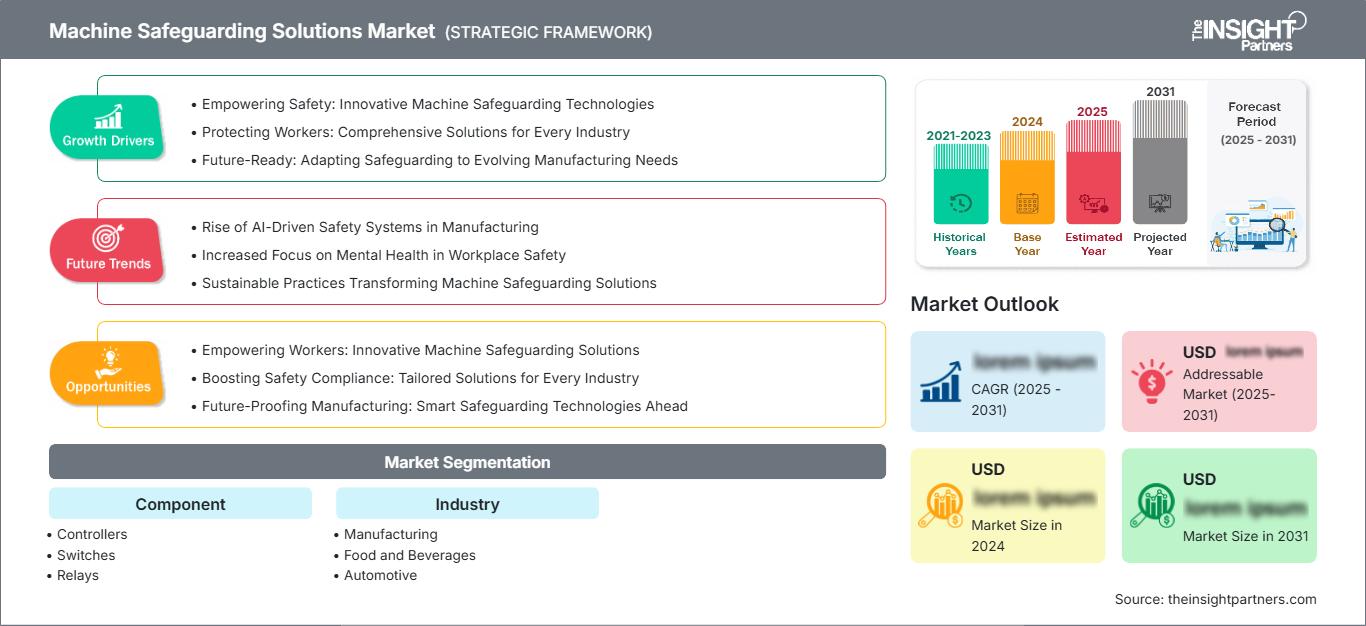
The Machine Safeguarding Solutions Market size is expected to grow from US$ 3.64 Billion in 2025 to US$ 6.27 Billion by 2034, at a CAGR of 6.23% from 2026 to 2034. Factors driving demand include increased machinery safety requirements, automation, and need for decreased operator interaction around presses, robots, conveyors, packaging machinery, and automated material handling systems.
North America is forecasted to witness a CAGR of 5.8% to 6.4% through 2034 due to OSHA enforcement of machine guarding, reshoring-driven modernization of factories, and increased safety rated programmable control systems. The North America installed base of automated packaging, automotive, and electronic machinery presents an opportunity for repeated retrofits, whereas ISO 13849-1:2023 and IEC 62061 guidelines keep influencing machine makers’ designs.
Machine Safeguarding Solutions Market Assessment and Insights
- North America accounted for 31–34% share in 2025 and is growing at a CAGR of 5.8–6.4% during 2026–2034, led by compliance retrofits, robotics cells, and connected safety devices.
- The US represented 76–80% of North America in 2025 and is growing at a CAGR of 5.9–6.5% during 2026–2034, driven by manufacturing modernization.
- Europe held 27–30% share in 2025 and is growing at a CAGR of 5.5–6.1% during 2026–2034, with Germany, the UK, France, Italy, and Spain leading adoption.
- Asia Pacific captured 25–28% share in 2025 and is growing at a CAGR of 6.8–7.5% during 2026–2034, led by China, Japan, South Korea, India, and Australia.
- Largest Segment: Safety Products held 38–42% market share in 2025 and is growing at a CAGR of 6.0–6.6% during 2026–2034 as light curtains, guards, mats, and interlocks remain essential.
- High Growth Segment: Healthcare held 7–10% market share in 2025 and is growing at a CAGR of 7.2–8.0% during 2026–2034 as automation expands in sterile production and diagnostics.
- Key companies analyzed in detail: ABB Ltd., Banner Engineering Corp., Honeywell International Inc., MPSA, OMRON Corporation, Procter Bros Ltd, Rockford Systems, LLC, Rockwell Automation, Inc., Siemens AG, and Uniguard Machine Guards.
Source: The Insight Partners' analysis based on proprietary research, government publications, company annual reports, investor presentations, industry databases, and expert interviews.
The Machine Safeguarding Solutions Market is moving beyond mechanical guards into a combination of sensor, controller, relay, drive, and diagnostic systems as an architecture of safety. Machines now incorporate safeguarding early on in the design phase due to flexible lines, collaborative working spaces, and high-speed packaging areas that need safe distances to stop. Manufacturers prefer modular products that can aid in performance-level calculations of ISO 13849 and minimize machine downtime during servicing activities.
The Machine Safeguarding Solutions Market forecasts indicate that investments are likely to increase in software configurable safety, safety over Ethernet networking, and compliance documents as per the region. Manufacturing regions like India, Southeast Asia, and Gulf may contribute to the demand for standardized safety guarding packages with the growth of newer plants that need automation. The Machine Safeguarding Solutions Market will benefit from the regulatory push provided by the EU Machinery Regulation, OSHA guidelines, and global functional safety norms.
Machine Safeguarding Solutions Market Report Scope
| Report Attribute | Details |
|---|---|
| Market size in 2025 | US$ 3.64 Billion |
| Market Size by 2034 | US$ 6.27 Billion |
| Global CAGR (2026 - 2034) | 6.23% |
| Historical Data | 2021-2024 |
| Forecast period | 2026-2034 |
Machine Safeguarding Solutions Market Analysis
The demand is founded on a solid business rationale: injury prevention along with maintaining productivity. According to OSHA, machine safeguarding has been listed repeatedly among their requirements, and according to ISO 13849-1:2023, safety-related control systems are developed in accordance with specific performance levels. Hence, safety controllers, interlocks, light curtains, emergency stops, and relays have become key elements in buying modern machinery.
The supply chain consists of component suppliers, machine builders, system integrators, distributors, certifiers, and end users. Factors driving the supply include availability of semiconductors, demand for industrial sensors, and migration toward safety-rated networking. Growth of the Machine Safeguarding Solutions Market is linked to lifecycle service offerings including risk assessment, validation, training, and regular audits.
Competition is concentrated in the control and sensor layers but fragmented in physical guarding. Some of the key competitors in the integrated automation portfolio category include ABB Ltd, OMRON Corporation, Rockwell Automation, Inc., Siemens AG, and Honeywell International Inc., whereas some of the major players competing in the application-specific category include Banner Engineering Corp., Procter Bros Ltd, Rockford Systems, LLC, MPSA, and Uniguard Machine Guards.
According to the Machine Safeguarding Solutions Market report, the focus of investment is towards making safety data visible, machine analytics, and designs with low engineering efforts. The positioning of companies will depend on how easy it is for the suppliers to provide certified components, safety calculations, documentation, and integration with PLC, robot, drive, and HMI systems.
● REPORT CUSTOMIZATION
Tailor This Report To Align With Your Specific Business Requirements
This report can be customized to align precisely with your business objectives, scope, and target markets. Customization options include tailored segmentation, geography, competitive analysis, and strategic insights to support informed decision-making.
Customize This Report →WHAT YOU CAN ADJUST
- ● Segmentations
- ● Geography
- ● Competitive Analysis
- ● Language Preferences
Machine Safeguarding Solutions Market: Strategic Insights
Regional Insights
North America Machine Safeguarding Solutions Market
North America accounted for 31-34% market share in 2025 and is estimated to register a CAGR of 5.8-6.4% during 2026-2034. High adoption of machine guarding solutions complying with OSHA standards, presence of industrial robots, and a strong replacement demand in automobile, packaging, aerospace, electronics, and food processing industries will fuel the demand. Reshoring, automation in warehouses, and deployment of connected safety systems that minimize downtime are some of the structural factors driving growth. North America Machine Safeguarding Solutions Market shares will be influenced by distributors, safety consultants, and integration partners that provide risk assessment, validation documents, and retrofit kits for aged machines.
U.S. Machine Safeguarding Solutions Market
US represented 76-80% of North America in 2025 and has an estimated growth rate of CAGR 5.9-6.5% for 2026-2034. The demand is driven by automated assembly, robotic welding, logistics, food packaging, and semiconductor manufacturing where downtime, operator accessibility, and safety validation have high costs associated. Some companies having a visible presence in the US market are Rockwell Automation Inc., Honeywell International Inc., Banner Engineering Corp., Rockford Systems, LLC, and Uniguard Machine Guards. The application trends include safety-rated motion control, interlocked perimeter fencing, lockout capabilities, and retrofit evaluations for existing presses and conveyor systems.
Europe Machine Safeguarding Solutions Market
The Europe region held 27-30% market share in 2025 and is estimated to grow at a CAGR of 5.5-6.1% from 2026 to 2034. In the UK region, retrofits will remain a major area of focus for applications such as food processing, pharmaceutical, and logistics due to safety regulations at the workplace. Germany leads the market due to machinery exports, automotive automation, robotics, and high adoption of functional safety engineering. Siemens AG, ABB Ltd., and OMRON Corporation will derive benefits due to their well-balanced portfolio of controllers, drives, sensors, and engineering software according to European standards for machinery safety. France, Italy, and Spain contribute to the market due to packaging machinery, metal industries, automotive parts, and food machinery. The shift from Machinery Directive to (EU) 2023/1230 regulation promotes the process of documentations, risk assessment, and safety validation, boosting demand for certification and comprehensive guarding systems.
APAC Machine Safeguarding Solutions Market
APAC held 25–28% share in 2025 and is forecast to grow at a CAGR of 6.8–7.5% during 2026–2034. China leads volume demand due to electronics, automotive, batteries, and machinery manufacturing. Advanced robotic technology, small safety control systems and top-of-the-line sensors characterize Japan and South Korea. In India, factory automation is being made possible by investments in electronics, automobiles, and pharmaceuticals. In Australia, contributions come from mining, food processing, and warehousing automation. Domestic manufacturing, export-focused manufacturing, and safe automation are policies supporting growth of the Machine Safeguarding Solutions Market in APAC region.
Middle East & Africa Machine Safeguarding Solutions Market
Middle East & Africa is expected to grow at a CAGR of 5.6–6.2% during 2026–2034. Saudi Arabia is the leading country as industrial diversification, logistics, mining, and energy projects expand automated assets. In terms of supporting demand, UAE is known to invest in logistics, packaging, and food processing. South Africa's contribution includes mining, metals, and manufacturing development, which will require security perimeters. The rest of MEA demand is still project driven, especially where global OEMs require global safety standards. This opens up an opportunity for energy projects, water treatment, and industrial parks.
Segmentation Analysis
Component
The Component segment is expected to grow at a CAGR of 6.0–6.7% during 2026–2034. Adoption is shaped by the need to integrate sensing, logic, and actuation into validated safety functions. Buyers increasingly prefer components with diagnostic coverage, certified libraries, and compatibility with safety-rated control networks to simplify commissioning and long-term maintenance.
- Controllers are central to programmable safety architectures, especially in robotic cells and complex lines where multiple devices, zones, and operating modes must be validated together.
- Switches remain widely deployed for access doors, gates, emergency stops, and interlocks, supporting practical protection in both new machinery and retrofit environments.
- Relays continue to serve cost-sensitive and discrete applications where hardwired safety functions, simple diagnostics, and fast installation remain sufficient for risk reduction.
- Safety Products, including guards, light curtains, mats, bumpers, and sensors, represent the largest component group because physical separation and presence detection remain mandatory safeguards.
Industry
The Industry segment is expected to grow at a CAGR of 6.2–6.9% during 2026–2034. Demand differs by process risk, automation density, cleaning requirements, and downtime cost. Manufacturing and automotive account for established demand, while healthcare and electronics require compact, contamination-aware, and high-reliability safeguarding for increasingly automated production environments.
- Manufacturing remains the broadest end-use base, covering presses, conveyors, CNC machines, packaging lines, and assembly cells that require layered safeguarding across operating modes.
- Food and Beverages demand washdown-ready interlocks, stainless guards, light curtains, and emergency stops that protect workers while supporting hygienic, high-throughput processing.
- Automotive uses safety-rated controls, fencing, scanners, and interlocks around robotic welding, stamping, painting, and assembly lines where human-machine interaction is frequent.
- Mining requires rugged guarding, pull-cord switches, emergency stops, and conveyor protection designed for dust, vibration, long distances, and harsh operating environments.
- Healthcare adoption is rising in pharmaceutical filling, diagnostics, medical device assembly, and sterile packaging where precision automation must maintain controlled access.
- Electronics and Electrical facilities use compact sensors, curtains, and safety controllers for high-speed assembly, semiconductor equipment, battery lines, and delicate automated handling.
Opportunity Snapshot
| Industry | Revenue Contribution | Trend Tag | Adoption Stage |
| Manufacturing | High | Smart Cells | Mature |
| Food and Beverages | Medium | Washdown Safety | Scaling |
| Automotive | High | Robot Zones | Mature |
| Mining | Medium | Conveyor Guarding | Scaling |
| Healthcare | Medium | Sterile Automation | Scaling |
| Electronics and Electrical | High | Precision Cells | Scaling |
Machine Safeguarding Solutions Market Growth Drivers and Impact Analysis
Rising Automation Density in Industrial Workcells
Higher automation density is increasing the number of hazardous interfaces per production line. Robotic welding, automated packaging, palletizing, CNC tending, and conveyorized assembly create zones where operators, maintenance teams, and machines interact frequently. As a result, safety products must now manage access, presence detection, safe speed, and emergency stopping without materially reducing throughput. This driver strengthens demand for integrated controllers, switches, relays, light curtains, scanners, and modular guards. It also raises the value of suppliers that can support documented risk assessment and validation across multiple machines.
Regulatory Alignment Around Functional Safety Standards
Functional safety standards are becoming more central to procurement because global manufacturers need equipment that can be deployed across regions with consistent documentation. ISO 13849-1:2023 and IEC 62061 guide the design and validation of safety-related control systems, while OSHA requirements continue to influence US workplace compliance. The impact is strongest for OEMs and multinationals that must prove risk reduction through performance levels, diagnostic coverage, and validation records. This accelerates purchasing of certified devices and engineering tools that reduce audit risk.
Brownfield Retrofit Demand Across Legacy Equipment
Many factories operate presses, conveyors, mixers, packaging machines, and material-handling systems installed before current expectations for risk assessment, safe access, and diagnostic monitoring became standard. Brownfield retrofits are attractive because they can improve worker protection without full equipment replacement. Retrofit projects typically combine physical guards, interlock switches, emergency-stop circuits, safety relays, and programmable safety controllers. This creates recurring revenue for component suppliers, integrators, and machine-safety consultants, especially where production uptime requires phased implementation during planned maintenance windows.
Machine Safeguarding Solutions Market Future Trends
Software-Configurable Safety Architectures
Future systems will move further toward software-configurable safety, where zones, muting logic, safe-speed functions, and diagnostics can be engineered with reusable templates. This trend is important for modular machinery, mobile robots, and high-mix production because safety logic must adapt without extensive rewiring. Suppliers with certified function blocks, digital validation records, and compatibility across controllers, drives, sensors, and HMIs will gain preference. The trend also supports remote troubleshooting and lifecycle updates, provided cybersecurity and change-control processes are managed carefully.
Safety Data as an Operational Performance Input
Safety devices are increasingly becoming data sources for maintenance and operations teams. Frequency of guard-door openings, light-curtain interruptions, emergency-stop events, and safe-speed activations can reveal workflow bottlenecks, poor ergonomics, or recurring jams. Over time, this data will be used to redesign workcells, optimize access points, and improve training. The Machine Safeguarding Solutions Market trends therefore extend beyond compliance toward measurable uptime and productivity benefits, especially in connected factories using industrial Ethernet and centralized monitoring.
Machine Safeguarding Solutions Market Opportunities
Packaged Retrofit Services for Small and Mid-Sized Manufacturers
Small and mid-sized manufacturers often lack internal functional safety engineering resources, yet they operate machines with significant point-of-operation, pinch, and entanglement risks. Suppliers can capture opportunity by offering packaged services that include risk assessment, bill of materials, installation, validation, training, and documentation. Bundled retrofit programs reduce decision complexity and help customers allocate capital across the most critical hazards first. This approach is particularly relevant for presses, packaging lines, conveyors, and food equipment where downtime windows are limited and compliance urgency is high.
Localized Solutions for Emerging Manufacturing Hubs
Emerging manufacturing hubs require safeguarding solutions that balance global compliance expectations with local installation realities. India, Southeast Asia, Mexico, and Gulf industrial zones are adding automated lines in electronics, food, automotive components, and logistics. Vendors can differentiate through localized engineering support, multilingual documentation, stocked components, and partnerships with machine builders. The opportunity is strongest where multinational buyers require consistent safety architecture across plants, while local suppliers need training and practical tools to implement performance-level calculations correctly.
Recent Developments
- April 2026: Ferndale Safety announce its participation in the Safety 2026 Conference & Expo. The company demonstrated off-the-shelf machine guards, including chuck guards, chip shields, and lathe safety solutions at Booth #4473. Its machine safeguarding solutions is designed to improve workplace safety and reduce risk.
- March 2026, Topcon Positioning Systems has announced new 3D machine control technologies, functionalities, and safety features for earthmoving and paving applications, as well as geomatic technologies for surveying and building construction applications. By connecting equipment, people, and processes, the new technologies are designed to increase productivity across applications and project phases through a centralized platform approach.
- June 2025: Siemens AG announced its plans to integrate its Operations Copilot into driverless transport systems and mobile robots. The Operations Copilot is an industrial copilot used for machine operation and maintenance. Similarly, the company also introduce new software-based safety solution Safe Velocity, enables the fail-safe monitoring of vehicle speed, which permits the protective fields of safety laser scanners to be dynamically adjusted in real time.
Frequently Asked Questions

- Comprehensive Market Sizing and Forecast Analysis
- Detailed Segmentation Analysis
- In-Depth Market Dynamics Assessment
- Regional and Country-Level Insights
- Competitive Landscape and Company Benchmarking
- Strategic Business Intelligence
Recent Reports
Testimonials

The Insight Partners' SCADA System Market report is comprehensive, with valuable insights on current trends and future forecasts. The team was highly professional, responsive, and supportive throughout. We are very satisfied and highly recommend their services.
RAN KEDEM Partner, Reali Technologies LTDs
I requested a report on a very specific software market and the team produced the report in a few days. The information was very relevant and well presented. I then requested some changes and additions to the report. The team was again very responsive and I got the final report in less than a week.
JEAN-HERVE JENN Chairman, Future Analytica
We worked with The Insight Partners for an important market study and forecast. They gave us clear insights into opportunities and risks, which helped shape our plans. Their research was easy to use and based on solid data. It helped us make smart, confident decisions. We highly recommend them.
PIYUSH NAGPAL Sr. Vice President, High Beam Global
The Insight Partners delivered insightful, well-structured market research with strong domain expertise. Their team was professional and responsive throughout. The user-friendly website made accessing industry reports seamless. We highly recommend them for reliable, high-quality research services
YUKIHIKO ADACHI CEO, Deep Blue, LLC.
This is the first time I have purchased a market report from The Insight Partners.While I was unsure at first, I visited their web site and felt more comfortable to take the risk and purchase a market report.I am completely satisfied with the quality of the report and customer service. I had several questions and comments with the initial report, but after a couple of dialogs over email with their analyst I believe I have a report that I can use as input to our strategic planning process.Thank you so much for taking the extra time and making this a positive experience.I will definitely recommend your service to others and you will be my first call when we need further market data.
JOHN SUZUKI President and Chief Executive Officer, Board Director, BK Technologies
I wish to appreciate your support and the professionalism you displayed in the course of attending to my request for information regarding to infectious disease IVD market in Nigeria. I appreciate your patience, your guidance, and the fact that you were willing to offer a discount, which eventually made it possible for us to close a deal. I look forward to engaging The Insight Partners in the future, all thanks to the impression you have created in me as a result of this first encounter.
DR CHIJIOKE ONYIA MANAGING DIRECTOR, PineCrest Healthcare Ltd.Reason to Buy
- Informed Decision-Making
- Understanding Market Dynamics
- Competitive Analysis
- Identifying Emerging Markets
- Customer Insights
- Market Forecasts
- Risk Mitigation
- Boosting Operational Efficiency
- Strategic Planning
- Investment Justification
- Tracking Industry Innovations
- Aligning with Regulatory Trends





 Get Free Sample for