
Material Handling Equipment Market Size, Share & Forecast by 2034
Coverage: By Product (Storage and Handling Equipment, Industrial Trucks, Bulk Material Handling Equipment, Automated Storage and Retrieval System (ASRS), Others); End-user (Manufacturing, Automotive, Aerospace, Food and Beverage, Retail and E-commerce, Pharmaceutical, Chemical, Others), and Geography (North America, Europe, Asia Pacific, and South and Central America)
- Status : Data Released
- Report Code : TIPRE00014292
- Category : Manufacturing and Construction
- No. of Pages : 150
- Available Report Formats :


- Last update date : July 20, 2026


2025 Market Size
US$ 191.88 Bn
Base year value
2034 Forecast
US$ 356.93 Bn
Projected by 2034
CAGR 2026-2034
7.14 %
Growth rate
Addressable Market
US$ 2,476.82 Bn
(2026-2034)
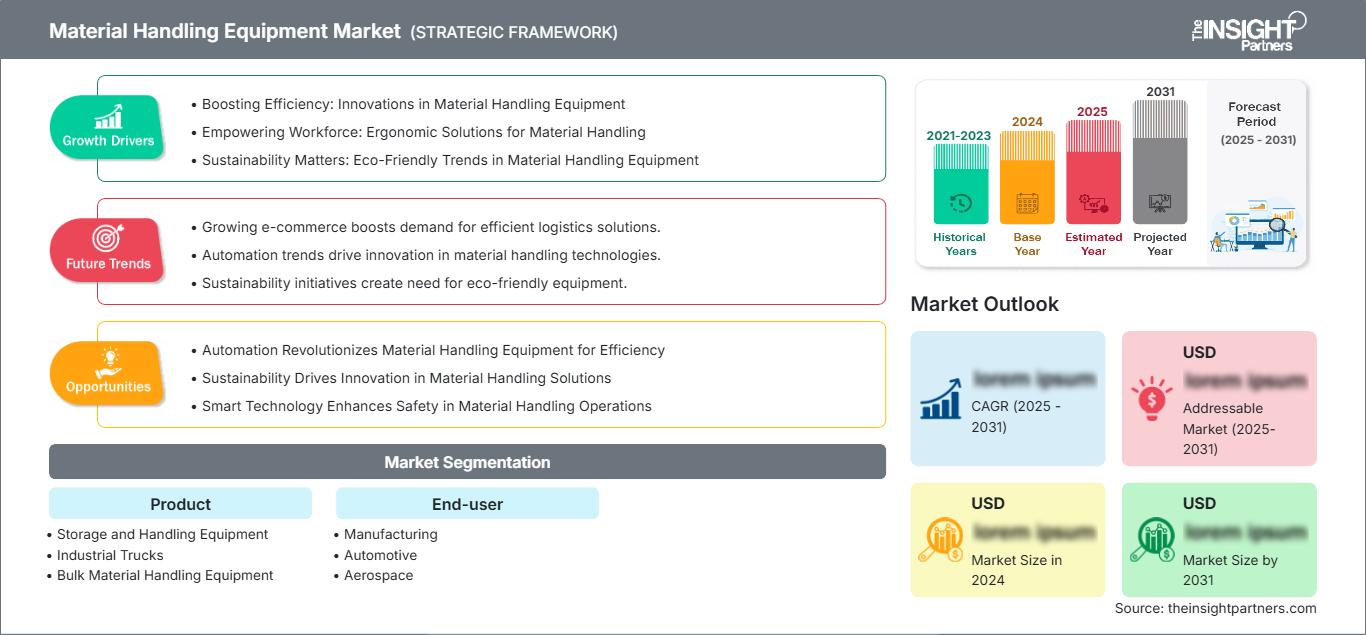
The Material Handling Equipment Market is projected to grow from US$ 191.88 Billion in 2025 to US$ 356.93 Billion by 2034, registering a CAGR of 7.14% during 2026–2034. The expansion is driven by the use of automation in warehousing, the recovery of industrial production, and the requirement for safe logistics in high throughput across factories, distribution centers, airports, and cold chain facilities.
North America remains a structurally advanced market, with the Material Handling Equipment Market size supported by warehouse modernization, e-commerce fulfillment density, and reshoring-linked production investments. The region is expected to expand at a 6.6–7.0% CAGR through 2034 as operators prioritize automated storage, electric industrial trucks, and integrated controls to offset labor constraints and improve inventory accuracy.
Material Handling Equipment Market Assessment and Insights
- North America accounted for 31–33% share in 2025 and is expected to grow at a CAGR of 6.6–7.0% between 2026–2034, supported by automated fulfillment and manufacturing reinvestment.
- US represented 80–84% of North America in 2025 and is projected to grow at a CAGR of 6.5–6.9% between 2026–2034 amid warehouse consolidation.
- Europe held 24–26% share in 2025 and is forecast to grow at a CAGR of 6.4–6.8% between 2026–2034, led by Germany, the UK, France, Italy, and Spain.
- Asia Pacific captured 30–32% share in 2025 and is expected to grow at a CAGR of 8.0–8.4% between 2026–2034, led by China, Japan, South Korea, India, and Australia.
- Largest Segment Industrial Trucks held 37–39% market share in 2025 and is estimated to grow at a CAGR of 6.5–6.9% between 2026–2034.
- High Growth Segment Automated Storage and Retrieval System held 14–16% market share in 2025 and is forecast to grow at a CAGR of 9.2–9.7% between 2026–2034.
- Key companies analyzed in detail: BEUMER Group GmbH & Co. KG, Daifuku Co., Ltd., Hyster-Yale Materials Handling, Inc., JBT Marel Corporation, Jungheinrich AG, KION GROUP AG, KUKA AG, Murata Machinery, Ltd., SSI Schaefer AG, and Toyota Industries Corporation.
Source: The Insight Partners' analysis based on proprietary research, government publications, company annual reports, investor presentations, industry databases, and expert interviews.
The market is moving away from manual conveyors and lifters to connected, software-led systems that involve integration between sensors, fleet management, robotics, and warehouse management platforms. Producers are reconfiguring production lines to accommodate shrinking cycles, complex SKUs, and enhanced safety standards. This change has created an increased need for modular conveyors, electric forklifts, pallet shuttles, and AS/RS technologies that can increase efficiency without increasing the size of the facility.
New industrial corridors in India, Southeast Asia, Mexico, and the Gulf region should drive new installations during the forecast period, alongside upgrades by mature countries. The focus of regulation on safety in the work environment, emission control, and pharmaceutical traceability should further broaden adoption. Future investment will probably go towards interoperable platforms that integrate equipment, workforce management, and inventories in productivity programs.
Material Handling Equipment Market Report Scope
| Report Attribute | Details |
|---|---|
| Market size in 2025 | US$ 191.88 Billion |
| Market Size by 2034 | US$ 356.93 Billion |
| Global CAGR (2026 - 2034) | 7.14% |
| Historical Data | 2021-2024 |
| Forecast period | 2026-2034 |
Material Handling Equipment Market Analysis
Growth in the Material Handling Equipment market will be driven by increased order fragmentation, more frequent replenishment intervals, and labor shortage in warehouses and factories. The IATA 2025 vision for cargo facilities stresses automation, visibility, and the use of AI to optimize freight movement and management, thereby driving the need for intelligent conveyor and sorting solutions and intelligent material handling systems.
The supply side continues to depend on steel, batteries, sensors, motors, and control software. Suppliers of material handling equipment have been diversifying their offerings to include services because uptime, predictive maintenance, and operator training have become major determinants of total cost of ownership. Growth forecasts for global GDP from the IMF suggest prudent investment.
Material Handling Equipment Market analysis indicates a competitive field where global integrators, forklift manufacturers, and automation specialists are converging. Daifuku Co., Ltd., KION GROUP AG, Toyota Industries Corporation, SSI Schaefer AG, and Jungheinrich AG will be aligning themselves with integrated warehouse automation. On the other hand, BEUMER Group GmbH & Co. KG and Murata Machinery, Ltd. will continue to maintain their strengths in complex conveying and automated storage.
Investments are being made towards digital twin technologies, AI-driven fleets, lithium-ion trucks, and scalable shuttles. KUKA AG and JBT Marel Corporation bring to the table robotics and automated guided vehicles technology, whereas Hyster-Yale Materials Handling, Inc. brings electric trucks and service offerings to the market. Strategic alignment is becoming more and more software-based and revolves around delivering tangible efficiency improvements for multi-site customers.
● REPORT CUSTOMIZATION
Tailor This Report To Align With Your Specific Business Requirements
This report can be customized to align precisely with your business objectives, scope, and target markets. Customization options include tailored segmentation, geography, competitive analysis, and strategic insights to support informed decision-making.
Customize This Report →WHAT YOU CAN ADJUST
- ● Segmentations
- ● Geography
- ● Competitive Analysis
- ● Language Preferences
Material Handling Equipment Market: Strategic Insights
Regional Insights
North America Material Handling Equipment Market
North America accounted for 31–33% of global revenue in 2025 and is projected to expand at a 6.6–7.0% CAGR through 2034. The Material Handling Equipment Market share reflects mature warehouse automation, high forklift penetration, and strong replacement demand in retail, food distribution, automotive, and third-party logistics networks.
Structural drivers include e-commerce fulfillment density, cold-chain expansion, and labor productivity pressure. Regional buyers increasingly combine electric trucks, AS/RS, conveyors, and warehouse software to raise space utilization. Safety compliance and emissions goals also support conversion from internal-combustion forklifts to battery-powered fleets across large distribution and manufacturing sites.
U.S. Material Handling Equipment Market Market
The U.S. represented 80–84% of North America in 2025 and is expected to grow at a 6.5–6.9% CAGR during 2026–2034. Requirements include omni-channel retailing, parcel distribution, automotive parts, food and beverage, and pharmaceutical logistics, where throughput, visibility, and availability play an important role in purchasing decisions.
The geographical spread of companies is large, with some of the major companies including Toyota Industries Corporation, Hyster-Yale Materials Handling, Inc., Daifuku Co., Ltd., and KION GROUP AG. Trends for applications include automatic pallet handling, automatic case handling, and high-density storage, particularly in brownfield applications because of economic real estate costs.
Europe Material Handling Equipment Market Market
Europe held 24–26% share in 2025 and is forecast to grow at a 6.4–6.8% CAGR through 2034, with Germany leading regional demand. Automated Retail, Parcel Sortation, and Grocery Logistics are the main focus for the UK, as the availability of workforce and delivery charges in urban areas promote warehouse automation.
Germany continues to be the anchor for technology through automobile manufacturing, machinery exports, and intralogistics engineering skills. In addition, France, Italy, and Spain create demand through food manufacturing, pharmaceuticals, chemicals, and airport logistics. Energy efficiency, safety certifications, and lifecycle service agreements make lifecycle economics as critical as the cost of equipment.
APAC Material Handling Equipment Market Market
APAC accounted for 30–32% share in 2025 and is projected to expand at an 8.0–8.4% CAGR, the fastest regional pace. China excels in terms of volume manufacturing and logistics automation, whereas Japan and South Korea move ahead in robotics, precise handling systems, and semiconductor storage solutions.
India and Australia are contributing through warehousing, logistics for the mining industry, food logistics, and industrialization via infrastructural development. Support from policy-makers to localize manufacturing, upgrade ports, and build logistics parks is improving the economics of adoption. The region offers greenfield projects coupled with the expansion of the e-commerce logistics network.
Middle East & Africa Material Handling Equipment Market Market
The Middle East & Africa region is predicted to grow at a CAGR of 6.8% to 7.2% until 2034. The key driver for the Middle East is diversification, airport logistics, and mega-project logistics in Saudi Arabia, and focus on port logistics and services, free trade zones, and distribution logistics centers in the UAE.
South Africa and the rest of the MEA region offer additional growth opportunities in mining logistics, chemical logistics, food logistics, and infrastructure warehousing. Logistics in the energy sector require robust bulk-handling equipment and industrial trucks, and modernized retail logistics offer potential for selective automation.
Segmentation Analysis
Product
The growth of the product is anticipated to grow at a CAGR of 7.0–7.4% from 2026 to 2034 due to the integration of legacy handling equipment with automation-ready systems. The Material Handling Equipment Market covers storage systems, forklifts, conveyors, bulk handling systems, and AS/RS. This way, customers can stagger investments based on facility readiness.
- Storage and Handling Equipment provides solutions for racking, shelving, bins, and pallet flow systems, where space utilization, visibility, and proper movement make the difference between a well-run and poorly run warehouse operation.
- Industrial Trucks have traditionally been the biggest market segment; here, needs are driven by the need for fleet replacement, electrification, operator safety, and flexible mobility.
- Bulk Material Handling Equipment is used in mining, chemicals, food processing, and heavy industries, where continuous material handling, dust control, and reliability are critical to operations.
- Automated Storage and Retrieval Systems are becoming more important to high-volume operations requiring dense storage, cost reduction, increased accuracy, and controlled movement of pallets, totes, and cases.
End-user
The end-user demand is expected to grow at a CAGR of 7.1-7.5% during 2026-2034. The use of automation will impact manufacturing, distribution, and regulatory settings. The sectors such as manufacturing and automotive represent the demand baseline, whereas others, such as retail, ecommerce, pharma, and food processing, need more sophisticated solutions.
- In manufacturing, handling systems are needed to link production cells, control work in progress, limit manual handling, and even out throughput in facilities with shorter product life cycles.
- In automotive, there is a need for coordinated movement of components, batteries, body shells, and spare parts that will ensure tough trucks, conveyors, and automated storage.
- In aerospace, it is essential to handle parts, tooling, and assemblies safely because this industry works with highly valuable materials that require precision handling, traceability, and proper storage.
- Food and Beverage is heavily reliant on hygienic handling, cold chain capability, pallet handling, and efficient order preparation.
- Retail and E-commerce lead to increased use of sorters, shuttles, AMRs, and AS/RS to cope with SKU explosion, quick dispatch cycles, and reverse logistics.
- Pharmaceutical companies need compliant storage, batch tracking, validated transfer, and a controlled environment, so automation is key to precision and compliance.
- Chemical companies demand tough handling of bulk material, safety, containment, and resistance to corrosion to move powdered and liquid materials, drums, and packed materials.
Opportunity Snapshot
| End-user | Revenue Contribution | Trend Tag | Adoption Stage |
| Manufacturing | High | Smart Cells | Mature |
| Automotive | High | Battery Flow | Scaling |
| Aerospace | Medium | Precision Lift | Scaling |
| Food and Beverage | High | Cold Chain | Mature |
| Retail and E-commerce | High | Fast Fulfillment | Scaling |
| Pharmaceutical | Medium | Validated Storage | Scaling |
| Chemical | Medium | Safe Transfer | Mature |
Material Handling Equipment Market Growth Drivers and Impact Analysis
Warehouse Automation Becomes a Productivity Requirement
Material handling systems are shifting away from manpower-based pick-and-place operations towards automated storage, transport, sorting, and robotic motion due to small and frequent orders being difficult to handle. IATA’s future cargo facilities model emphasizes connection and autonomy as key technologies in optimizing resource management and monitoring shipments. The implication is that it will positively impact the Material Handling Equipment Market through increased demand for comprehensive equipment solutions as opposed to separate acquisitions. It is most notable in the areas of e-commerce, parcel, grocery, and pharmaceutical logistics since it comes with a cost when service windows are not met. Customers are now evaluating solutions on parameters such as output per square meter, efficiency gains, energy consumption, and life-cycle serviceability.
Electrification and Safety Standards Reshape Fleet Decisions
Truck fleets have become a thing of the past for industrial trucks due to reduced indoor emissions, increased safety of operators, and uniform maintenance procedures. Changes in battery technology, power requirements, and analysis of fleet operations are moving procurement from replacing units to productivity management programs. It can be seen in manufacturing, retail logistics, food handling, and chemical industries, which have the challenge of using equipment in both indoor and outdoor environments in a manner that guarantees safety and reliability. Regulatory requirements favor proximity warnings, load weighing and monitoring systems, and assist operator technologies. Equipment suppliers that provide training, financing, and servicing will benefit since customers seek guaranteed performance through transition.
Manufacturing Reconfiguration Supports Integrated Handling
Plants are being redesigned to incorporate flexibility, regional logistics, and quicker changeovers, thus creating greater demand for modular material handling solutions. IMF forecasts about global growth and uncertainty favor projects focused on efficiency rather than capacity alone. Materials handling equipment linking workstations, buffering stock levels, and minimizing ergonomic strain can boost resilience without plant expansion. Battery manufacturing, electronics assembly, aerospace parts manufacturing, and packaged food processing are examples of industries where adoption is taking place since they depend on the coordination of the motion of parts. The business implications are the trend towards consultative project design, where materials handling equipment providers have to prove how conveyor and truck systems, storage, and software help increase agility.
Material Handling Equipment Market Future Trends
Physical AI and Digital Twins Enter Daily Operations
Material Handling Equipment Market trends are moving toward physical AI, digital twins, and simulation-led design that allow operators to test layouts, traffic flows, and robot interactions before deployment. Demonstrations of AI-driven warehouse orchestration by KION GROUP AG for 2025 highlight how real-time information can help in orchestrating autonomous vehicles, cameras, and other warehouse equipment. In the coming decade, this will decrease the risk associated with the commissioning process and improve asset efficiency in sophisticated facilities. Digital twins will enable continuous improvement post-installation by helping managers modify their storage, staffing, and maintenance schedules based on fluctuating demand trends.
High-Density Automation Expands Beyond Mega Warehouses
AS/RS, shuttles, and robotic storage systems will more likely shift toward medium-scale installations as modular solutions drive down costs. In the past, full-scale automation took place mainly in large fulfillment centers and airport logistics, but now space restrictions and higher service standards influence regional warehouses, manufacturers, and distributors. Automation will be applied on a smaller scale to particular processes such as buffer storage, goods-to-person picking, and temperature-controlled storage. Such an approach opens up the chance to develop modular systems, which may start with fewer aisles or modules and then grow over time. Those suppliers who offer integration with forklifts, conveyors, and enterprise systems have a larger market potential.
Material Handling Equipment Market Opportunities
Brownfield Automation Retrofit Programs
A large share of warehouses and factories cannot justify complete rebuilds, creating a strong opportunity for phased retrofits that add conveyors, pallet shuttles, automated storage, and fleet management around existing assets. Material Handling Equipment Market Forecasts indicate that customers will prioritize projects with short payback, limited disruption, and clear productivity metrics. Such an approach can be taken advantage of by vendors through providing site audits, modular engineering, finance, and lifecycle services packages. Food distribution, automotive after-market parts, retail replenishment, and pharmaceutical warehousing are some of the best targets for such projects because of the associated cost implications when downtime occurs.
Emerging Logistics Parks and Industrial Corridors
Logistics parks under development in India, Southeast Asia, the Gulf, and Mexico provide suppliers with an opportunity to influence equipment specifications even prior to the completion of the facilities. In greenfield projects, there is the perfect opportunity to position the docks, aisles, conveyor, charging area, and automation area optimally, thereby avoiding high retrofitting expenses. Public investments in infrastructure, localized production, and upgraded ports make the economic case compelling for integrated handling systems. It is important for equipment suppliers to forge alliances with logistics park developers, third-party logistics firms, and system integrators to become involved in early equipment specifications.
Recent Developments
- March 2026: Daifuku Co., Ltd. newly opened Tokyo Lab in Minato, Tokyo, on March 11, 2026, as a new base for research and development of cutting-edge technologies. Daifuku positions AI as a new driver in the evolution of material handling and is advancing its implementation into the company’s systems. By utilizing next-generation robotics and other cutting-edge technologies, such as IoT and digital twins, Daifuku aims to build more advanced and autonomous material handling systems and solutions.
- November 2025: Toyota Industries Corporation has the intention to reorganize its warehouse automation business, which provides automated systems for warehousing, storage, retrieval (picking), and other logistics processes at warehouses, fulfillment centers, and factories. Toyota Industries is exploring establishing regional operating companies in the United States and Europe, unifying all warehouse automation-related organizations in these regions, including subsidiaries, under the "Toyota Automated Logistics" with the regional name. Through this contemplated reorganization, Toyota Industries aims to strengthen group-wide collaboration and enhance its global warehouse automation business.
- October 2025: KION showcases physical AI turning real-time data into real-world warehouse performance at CeMAT Shanghai from October 28-31. The showcase has been enhanced through deeper systems integration and best-in-class autonomy features deriving from KION’s ongoing collaboration with NVIDIA and Accenture, being a milestone of KION’s path to an adaptive, autonomous material handling standard for customers worldwide.
Frequently Asked Questions

- Comprehensive Market Sizing and Forecast Analysis
- Detailed Segmentation Analysis
- In-Depth Market Dynamics Assessment
- Regional and Country-Level Insights
- Competitive Landscape and Company Benchmarking
- Strategic Business Intelligence
Recent Reports
Testimonials

The Insight Partners' SCADA System Market report is comprehensive, with valuable insights on current trends and future forecasts. The team was highly professional, responsive, and supportive throughout. We are very satisfied and highly recommend their services.
RAN KEDEM Partner, Reali Technologies LTDs
I requested a report on a very specific software market and the team produced the report in a few days. The information was very relevant and well presented. I then requested some changes and additions to the report. The team was again very responsive and I got the final report in less than a week.
JEAN-HERVE JENN Chairman, Future Analytica
We worked with The Insight Partners for an important market study and forecast. They gave us clear insights into opportunities and risks, which helped shape our plans. Their research was easy to use and based on solid data. It helped us make smart, confident decisions. We highly recommend them.
PIYUSH NAGPAL Sr. Vice President, High Beam Global
The Insight Partners delivered insightful, well-structured market research with strong domain expertise. Their team was professional and responsive throughout. The user-friendly website made accessing industry reports seamless. We highly recommend them for reliable, high-quality research services
YUKIHIKO ADACHI CEO, Deep Blue, LLC.
This is the first time I have purchased a market report from The Insight Partners.While I was unsure at first, I visited their web site and felt more comfortable to take the risk and purchase a market report.I am completely satisfied with the quality of the report and customer service. I had several questions and comments with the initial report, but after a couple of dialogs over email with their analyst I believe I have a report that I can use as input to our strategic planning process.Thank you so much for taking the extra time and making this a positive experience.I will definitely recommend your service to others and you will be my first call when we need further market data.
JOHN SUZUKI President and Chief Executive Officer, Board Director, BK Technologies
I wish to appreciate your support and the professionalism you displayed in the course of attending to my request for information regarding to infectious disease IVD market in Nigeria. I appreciate your patience, your guidance, and the fact that you were willing to offer a discount, which eventually made it possible for us to close a deal. I look forward to engaging The Insight Partners in the future, all thanks to the impression you have created in me as a result of this first encounter.
DR CHIJIOKE ONYIA MANAGING DIRECTOR, PineCrest Healthcare Ltd.Reason to Buy
- Informed Decision-Making
- Understanding Market Dynamics
- Competitive Analysis
- Identifying Emerging Markets
- Customer Insights
- Market Forecasts
- Risk Mitigation
- Boosting Operational Efficiency
- Strategic Planning
- Investment Justification
- Tracking Industry Innovations
- Aligning with Regulatory Trends





 Get Free Sample for