
Medical Robots Market Demand, Share & Growth by 2034
Coverage: By Product (Surgical Robots, Hospital & Pharmacy Robots, Rehabilitation Robots, Non-Invasive Radiosurgery Robots, and Others), Application (Laparoscopy, Neurology, Orthopedics, Gynecology, Urology, Cardiology, and Others), and End User (Hospitals, Ambulatory Surgical Centers, and Others), and Geography (North America, Europe, Asia Pacific, and South and Central America)
- Status : Data Released
- Report Code : TIPHE100000816
- Category : Life Sciences
- No. of Pages : 150
- Available Report Formats :


- Last update date : June 23, 2026


2025 Market Size
US$ 15.98 Bn
Base year value
2034 Forecast
US$ 61.27 Bn
Projected by 2034
CAGR 2026-2034
16.11 %
Growth rate
Addressable Market
US$ 326.58 Bn
(2026-2034)
The global medical robots market size is projected to reach US$ 61.27 billion by 2034 from US$ 15.98 billion in 2025. The market is anticipated to register a CAGR of 16.11% during the forecast period 2026–2034.
Key market dynamics include an accelerating global shift toward minimally invasive surgeries, rapid advancements in AI-driven precision healthcare, and the increasing need for automation to address global healthcare labor shortages. Additionally, the market is expected to benefit from the rising geriatric population prone to chronic conditions, the expansion of robotic-assisted platforms in emerging economies, and a growing emphasis on reducing hospital stays and recovery times through high-accuracy robotic interventions.
Medical Robots Market Analysis
The medical robots market analysis shows a decisive shift toward high-precision, multi-specialty platforms that are moving beyond traditional urological and gynecological dominance. The market is diversifying into specialized areas, including orthopedic joint replacement, neurosurgery, and the rapidly growing field of rehabilitation robotics. Strategic opportunities are emerging in the integration of Artificial Intelligence and Machine Learning for intraoperative decision support, where real-time data analytics offer a clear competitive advantage in surgical outcomes. The market growth depends on the democratization of technology through lower-cost, modular robotic systems designed for smaller hospitals and ambulatory settings. Competitive differentiation now hinges on performance-guided surgery, where platforms offer haptic feedback, 3D visualization, and integrated digital workflows to ensure safety and transparency.
Medical Robots Market Overview
Medical robots have advanced from niche experimental tools to essential components of modern clinical infrastructure. The market encompasses a wide range of systems, including surgical assistants, autonomous hospital logistics robots, pharmacy automation platforms, and advanced exoskeletons for rehabilitation. Both established medtech giants and agile startups compete in this market, leveraging technologies like 5G-enabled telesurgery and soft robotics. Growing demand for outpatient procedures and value-based care in North America and Europe has increased the popularity of compact robotic systems as a portable solution for specialty clinics. North America leads in revenue due to its advanced healthcare infrastructure and favorable reimbursement policies, while Asia-Pacific is advancing rapidly in indigenous technology innovation and large-scale hospital adoption. The US market remains a global leader, driven by a sophisticated healthcare ecosystem and widespread clinical adoption. Growth stems from high demand for minimally invasive procedures and advanced rehabilitation. Favorable reimbursement policies and significant investment in surgical automation further solidify its position as a primary hub for technological innovation.
Market Research Highlights
- Global market for Medical Robots was valued at US$ 15.98 Billion in 2025
- Annual market size is expected to reach US$ 61.27 Billion by 2034
- Total addressable market (TAM) during 2026-2034 is projected to reach approximately US$ 326.58 Billion
- Market is anticipated to register a CAGR of 16.11% during the forecast period
- The United States represents a key market, supported by Growing demand for minimally invasive surgeries, Advancements in robotics and automation in healthcare, as well as evolving industry dynamics
- Market analysis covers North America, Europe, Asia-Pacific, South and Central America, Middle East and Africa, with growth evaluated across the forecast period
- Market opportunities such as Advancements in robotic technologies creating opportunities for automation in medical procedures, Growing demand for minimally invasive surgery providing new growth avenues are expected to influence market dynamics and addressable market
- Report profiles industry participants, including Abbott, F. Hoffmann-La Roche Ltd., Immunexpress Inc., BD, Danaher, Luminex Corporation, Thermo Fisher Scientific Inc., bioMerieux SA., T2 Biosystems, Inc., Axis-Shield Diagnostics Ltd., while analyzing competitive strategies and innovation developments
-
Source: The Insight Partners' analysis based on proprietary research, government publications, company annual reports, investor presentations, industry databases, and expert interviews.
● REPORT CUSTOMIZATION
Tailor This Report To Align With Your Specific Business Requirements
This report can be customized to align precisely with your business objectives, scope, and target markets. Customization options include tailored segmentation, geography, competitive analysis, and strategic insights to support informed decision-making.
Customize This Report →WHAT YOU CAN ADJUST
- ● Segmentations
- ● Geography
- ● Competitive Analysis
- ● Language Preferences
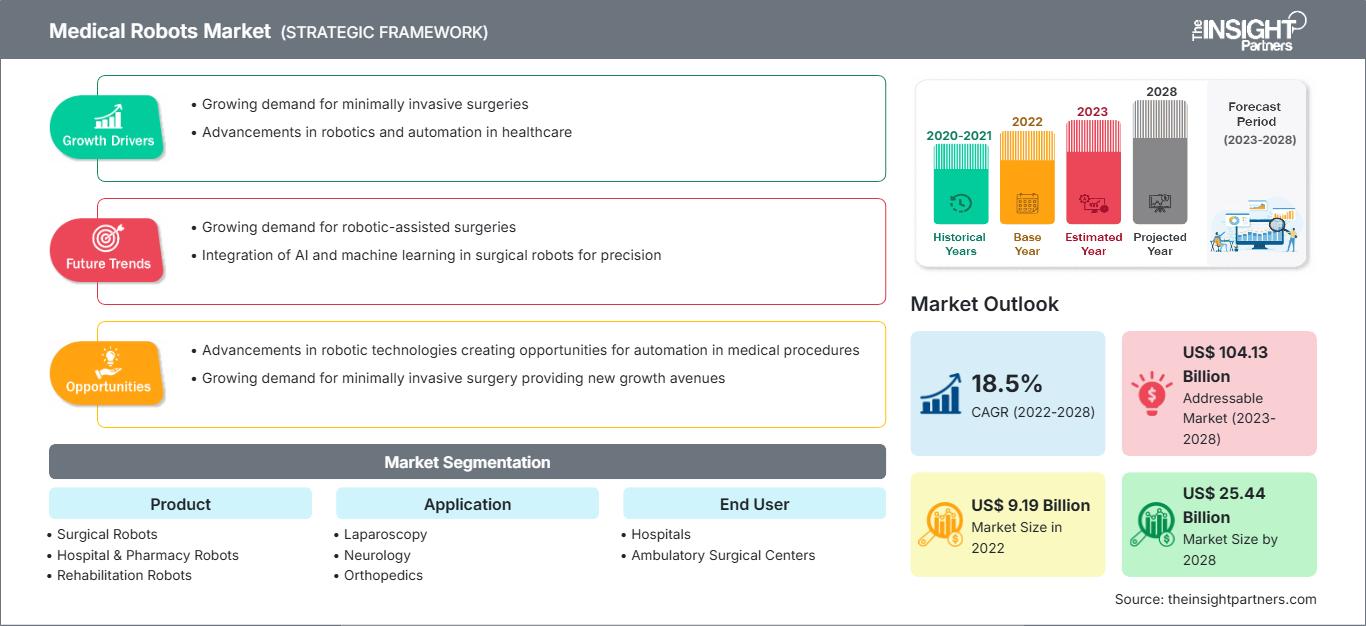
Medical Robots Market: Strategic Insights
-
Get Top Key Market Trends of this report.This FREE sample will include data analysis, ranging from market trends to estimates and forecasts.
Medical Robots Market Drivers and Opportunities
Market Drivers:
- Demand for Minimally Invasive Procedures: Patients and providers increasingly prefer procedures with smaller incisions, which lead to reduced pain and faster recovery times.
- Advancements in AI and Sensor Technology: Integration of sophisticated sensors and artificial intelligence allows for greater precision, real-time feedback, and enhanced surgical safety.
- Healthcare Labor Shortages: Automation in pharmacies and hospital logistics helps mitigate the impact of staff shortages by handling repetitive tasks like medication dispensing and material transport.
Market Opportunities:
- Expansion into Ambulatory Surgical Centers: Developing cost-effective, smaller footprint robotic systems specifically for outpatient centers offers a significant growth pathway.
- Growth in Telestroke and Remote Surgery: Improving telecommunication infrastructure provides opportunities for specialists to provide robotic assistance to patients in remote or rural locations.
- Integration with Digital Twin Technology: Using digital twins for pre-operative planning and simulation can improve procedural success rates and surgeon training efficiency.
Medical Robots Market Report Segmentation Analysis
The Medical Robots Market share is analyzed across various segments to provide a clearer understanding of its structure, growth potential, and emerging trends. Below is the standard segmentation approach used in most industry reports:
By Product:
- Surgical Robots: The largest segment, featuring systems designed for complex surgical maneuvers with enhanced dexterity and visualization.
- Hospital & Pharmacy Robots: Includes autonomous mobile robots for delivery, telepresence units, and automated medication dispensing systems.
- Rehabilitation Robots: Focuses on assistive devices, exoskeletons, and therapeutic robots that aid in patient mobility and physical recovery.
- Non-Invasive Radiosurgery Robots: High-precision systems used primarily in oncology to deliver targeted radiation without surgical incisions.
- Others: Includes specialized platforms such as micro-robots and emergency response robotic units.
By Application:
- Laparoscopy: A dominant application area where robots assist in abdominal and thoracic procedures through small incisions.
- Orthopedics: Features robotic-arm assisted technology for joint replacements, spine surgeries, and bone contouring.
- Neurology: Systems designed for high-precision brain surgery, biopsies, and electrode placement.
- Gynecology: Robotic platforms used for hysterectomies and other complex pelvic procedures.
- Urology: One of the most established applications, primarily used for prostatectomies and kidney surgeries.
- Cardiology: Emerging use of robots for catheter-based interventions and heart valve repairs.
- Others: Includes applications in ophthalmology, dentistry, and vascular surgery.
By End User:
- Hospitals: The primary adopters due to high patient volumes and the financial capacity to invest in large-scale robotic infrastructure.
- Ambulatory Surgical Centers: A rapidly growing segment as more surgeries shift from inpatient to outpatient settings.
- Others: Comprises specialty clinics, rehabilitation centers, and academic research institutions.
By Geography:
- North America
- Europe
- Asia Pacific
- South & Central America
- Middle East & Africa
Medical Robots Market Report Scope
| Report Attribute | Details |
|---|---|
| Market size in 2025 | US$ 15.98 Billion |
| Market Size by 2034 | US$ 61.27 Billion |
| Global CAGR (2026 - 2034) | 16.11% |
| Historical Data | 2021-2024 |
| Forecast period | 2026-2034 |
| Segments Covered |
By Product
|
| Regions and Countries Covered |
North America
|
| Market leaders and key company profiles |
|
Medical Robots Market Players Density: Understanding Its Impact on Business Dynamics
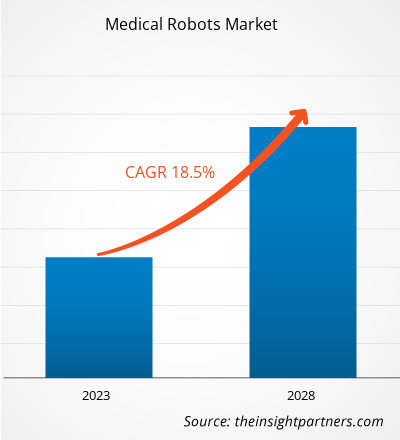
The Medical Robots Market is growing rapidly, driven by increasing end-user demand due to factors such as evolving consumer preferences, technological advancements, and greater awareness of the product's benefits. As demand rises, businesses are expanding their offerings, innovating to meet consumer needs, and capitalizing on emerging trends, which further fuels market growth.
Medical Robots Market Share Analysis by Geography
Asia-Pacific is expected to grow fastest in the coming years. Emerging markets in South & Central America, the Middle East, and Africa also have many untapped opportunities for premium medical technology providers and healthcare infrastructure developers to expand.
The medical robots market is undergoing a massive digital transformation, transitioning from specialized surgical tools to integrated platforms for autonomous healthcare delivery. Growth is driven by the global expansion of minimally invasive surgery (MIS), the rise of outpatient surgery centers, and the integration of AI-driven diagnostics. Below is a summary of market share and trends by region:
1. North America
- Market Share: Holds the largest share globally, fueled by high healthcare expenditure and a robust network of specialized surgery centers.
- Key Drivers:
- Widespread adoption of robotic-assisted systems in urology and orthopedic joint replacement.
- Early integration of 5G and AI technologies in surgical platforms.
- Favorable reimbursement policies for robotic procedures in the US and Canada.
- Trends: A significant shift toward Ambulatory Surgical Centers (ASCs) and the mainstreaming of robotic-assisted spine and cardiovascular interventions.
2. Europe
- Market Share: Represents a substantial portion of the global market, anchored by advanced clinical research and a strong focus on rehabilitation robotics.
- Key Drivers:
- High domestic demand for advanced neurological and geriatric care systems.
- Strong government support for public-private partnerships in healthcare automation.
- Mature regulatory frameworks ensuring high standards for medical device safety.
- Trends: Strategic focus on modular robotic arms that can be shared across multiple hospital departments to maximize return on investment and cost efficiency.
3. Asia-Pacific
- Market Share: The fastest-growing region, with China, Japan, and India serving as major markets for large-scale hospital modernization.
- Key Drivers:
- Massive investments in smart healthcare infrastructure to support rising urban populations.
- Government initiatives focused on high-value domestic medical device manufacturing.
- Increasing disposable incomes leading to a preference for precise, minimally invasive treatments.
- Trends: High reliance on indigenous technological innovation and B2B contracts for hospital and pharmacy automation to manage high patient volumes.
4. South and Central America
- Market Share: Emerging market with a growing private healthcare sector in countries like Brazil and Chile.
- Key Drivers:
- Increasing awareness of the clinical benefits of robotic-assisted surgery for faster recovery.
- Modernization of private surgical clinics into high-tech centers to attract medical tourism.
- Rising interest in laparoscopy and robotic gynecology applications.
- Trends: Growth of boutique surgical centers and the introduction of refurbished robotic systems to increase accessibility in middle-income segments.
5. Middle East and Africa
- Market Share: Developing market with deep strategic investments in digital health hubs across the Gulf region.
- Key Drivers:
- Strategic focus on reducing reliance on foreign medical expertise through local high-tech surgical centers.
- High demand for telepresence and autonomous delivery robots in advanced hospital complexes.
- Investments in infrastructure to fund state-of-the-art medical facilities.
- Trends: Implementation of remote surgical platforms to provide specialized care in underserved areas, coupled with a focus on robotic pharmacy systems for operational efficiency.
High Market Density and Competition
Competition is intensifying due to the presence of established leaders such as Intuitive Surgical, Stryker, and Medtronic. Regional innovators and niche players like CMR Surgical and Asensus Surgical, alongside orthopedic experts like Zimmer Biomet and Smith & Nephew, also contribute to a diverse and rapidly expanding market landscape.
This competitive environment pushes vendors to differentiate through:
- Value-Based Pricing Models: Companies are offering leasing and pay-per-procedure models to make robotic technology more accessible to smaller hospitals.
- Advanced Imaging Integration: Real-time 3D mapping and fluorescence imaging are becoming standard features to improve surgical accuracy.
- Enhanced Surgeon Training: Providing comprehensive virtual reality simulation platforms to shorten the learning curve for clinical staff.
Opportunities and Strategic Moves
- Partner with Ambulatory Surgical Centers (ASCs): Tap into the surging demand for outpatient procedures by developing compact, cost-effective robotic systems tailored for smaller operating rooms.
- Incorporate AI and Machine Learning: Integrate predictive analytics and real-time intraoperative guidance to appeal to high-end hospitals seeking to improve surgical success rates and reduce human error.
Major Companies operating in the Medical Robots Market are:
- Abbott
- F. Hoffmann-La Roche Ltd.
- Immunexpress Inc.
- BD
- Danaher
- Luminex Corporation
- Thermo Fisher Scientific Inc.
- bioMerieux SA.
- T2 Biosystems, Inc.
- Axis-Shield Diagnostics Ltd.
Disclaimer: The companies listed above are not ranked in any particular order.
Medical Robots Market News and Recent Developments
- In May 2026, Johnson & Johnson announced results from the first clinical study of the investigational OTTAVA™ Robotic Surgical System, a prospective, multicenter clinical study evaluating the safety and performance of the system in Roux-en-Y gastric bypass procedures.
- In May 2026, Olympus Corporation (Olympus), a global MedTech company committed to advancing endoscopy-enabled care, today announced it has signed an exclusive global distribution agreement with EndoRobotics Co., Ltd. Under this agreement, robot-assisted technologies manufactured by EndoRobotics will be distributed globally by Olympus exclusively as part of its EndoTherapy portfolio. This collaboration will help drive broader adoption of advanced endoscopic procedures, such as endoscopic submucosal dissection (ESD), helping clinicians deliver organ-sparing, minimally invasive care with precision and confidence.
Medical Robots Market Report Coverage and Deliverables
The Medical Robots Market Size and Forecast (2021–2034) report provides a detailed analysis of the market covering below areas:
- Medical Robots Market size and forecast at global, regional, and country levels for all the key market segments covered under the scope
- Medical Robots Market trends, as well as market dynamics such as drivers, restraints, and key opportunities
- Detailed PEST and SWOT analysis
- Medical Robots Market analysis covering key market trends, global and regional framework, major players, regulations, and recent market developments
- Industry landscape and competition analysis covering market concentration, heat map analysis, prominent players, and recent developments in the Medical Robots Market.
- Detailed company profiles
Frequently Asked Questions

- Comprehensive Market Sizing and Forecast Analysis
- Detailed Segmentation Analysis
- In-Depth Market Dynamics Assessment
- Regional and Country-Level Insights
- Competitive Landscape and Company Benchmarking
- Strategic Business Intelligence
Recent Reports
Testimonials

The Insight Partners provided valuable market intelligence that supported our global go-to-market strategy. Their team was professional, responsive, and attentive to our feedback, providing thoughtful analysis and helpful methodological clarifications throughout the project.
Junmo Kim Chief Financial Officer (CFO), Enertech Co., Ltd.
The Insight Partners' SCADA System Market report is comprehensive, with valuable insights on current trends and future forecasts. The team was highly professional, responsive, and supportive throughout. We are very satisfied and highly recommend their services.
RAN KEDEM Partner, Reali Technologies LTDs
I requested a report on a very specific software market and the team produced the report in a few days. The information was very relevant and well presented. I then requested some changes and additions to the report. The team was again very responsive and I got the final report in less than a week.
JEAN-HERVE JENN Chairman, Future Analytica
We worked with The Insight Partners for an important market study and forecast. They gave us clear insights into opportunities and risks, which helped shape our plans. Their research was easy to use and based on solid data. It helped us make smart, confident decisions. We highly recommend them.
PIYUSH NAGPAL Sr. Vice President, High Beam Global
The Insight Partners delivered insightful, well-structured market research with strong domain expertise. Their team was professional and responsive throughout. The user-friendly website made accessing industry reports seamless. We highly recommend them for reliable, high-quality research services
YUKIHIKO ADACHI CEO, Deep Blue, LLC.
This is the first time I have purchased a market report from The Insight Partners.While I was unsure at first, I visited their web site and felt more comfortable to take the risk and purchase a market report.I am completely satisfied with the quality of the report and customer service. I had several questions and comments with the initial report, but after a couple of dialogs over email with their analyst I believe I have a report that I can use as input to our strategic planning process.Thank you so much for taking the extra time and making this a positive experience.I will definitely recommend your service to others and you will be my first call when we need further market data.
JOHN SUZUKI President and Chief Executive Officer, Board Director, BK Technologies
I wish to appreciate your support and the professionalism you displayed in the course of attending to my request for information regarding to infectious disease IVD market in Nigeria. I appreciate your patience, your guidance, and the fact that you were willing to offer a discount, which eventually made it possible for us to close a deal. I look forward to engaging The Insight Partners in the future, all thanks to the impression you have created in me as a result of this first encounter.
DR CHIJIOKE ONYIA MANAGING DIRECTOR, PineCrest Healthcare Ltd.Reason to Buy
- Informed Decision-Making
- Understanding Market Dynamics
- Competitive Analysis
- Identifying Emerging Markets
- Customer Insights
- Market Forecasts
- Risk Mitigation
- Boosting Operational Efficiency
- Strategic Planning
- Investment Justification
- Tracking Industry Innovations
- Aligning with Regulatory Trends






 Get Free Sample for